

- Gold and silver are India’s two precious metals, and both are non-ferrous. The country mines very little of either and imports most of what it uses.
- Gold comes from a handful of mines, almost all in Raichur district of Karnataka. Silver is not mined for itself at all: it is a by-product of lead-zinc smelting in Rajasthan and of gold refining.
- Both belong to the old Dharwar and Aravalli rocks of the Peninsula, with small amounts of gold washed into river sands.
Gold
Character and Uses
- Gold is a valuable metal: bright, slightly reddish yellow, dense, soft, malleable and ductile. It is one of the least reactive elements, so it is often found native, as grains or nuggets.
- It occurs in two forms of deposit:
- Auriferous rocks: “auriferous” means containing gold. In India these are mainly gold-bearing quartz lodes and reefs, the primary source.
- Alluvial or placer gold: found in the sands of several rivers.
- Weathering frees the particles from the rock, and the river concentrates them at certain spots. The gold is recovered by panning.
- The quantity is very small, but such rivers are numerous.
- Uses:
- Ornaments, the largest use in India.
- International currency, because of its universal acceptance. It is also held as an investment and in bank reserves.
- Smaller demand comes from electronics, dentistry and medicine.
Imports and World Position
- Production in India is far short of demand, and the gap is met by imports.
- Older accounts name Australia, Canada and Myanmar as the suppliers.
- In 2023-24 India imported about 7.95 lakh kg of gold, mainly from Switzerland, the UAE, South Africa, Peru, Australia and Ghana (Indian Bureau of Mines).
- Another 36.2 lakh kg of gold ores and concentrates came in that year, led by Australia, for treatment at Indian plants.
- Countries with significant deposits: South Africa, Australia, Indonesia, Canada, Ghana, Chile, China, USA, Russia and others.
- World reserves are about 59,000 tonnes of metal (US Geological Survey, 2024), led by Australia (12,000 tonnes) and Russia (11,100 tonnes), then South Africa (5,000 tonnes).
- World mine output was about 3,300 tonnes in 2023. China had about 11%, Russia and Australia about 9% each, Canada 6% and the USA 5%.
| Measure | Older figure | Latest figure |
|---|---|---|
| India’s gold ore resources | 493.69 million tonnes (2010) | 518.23 million tonnes (1 April 2020) |
| Of which reserves | 24.12 million tonnes | 23.72 million tonnes |
| Primary gold metal | 659.84 tonnes | 607.26 tonnes, of which reserves 92.76 tonnes |
| Placer ore, Keralam (Kerala) | 26.12 million tonnes | 26.12 million tonnes, with 5.86 tonnes of metal |
| Primary gold produced | 2,412 kg (1980-81); 2,817 kg (2011-12) | 1,407 kg (2021-22); 1,437 kg (2022-23); 1,603 kg (2023-24) |
- Total gold bullion reached 16,639 kg in 2023-24. This counts by-product and secondary gold, including about 15 tonnes a year of capacity at the Birla Copper complex at Dahej, Gujarat, which treats imported copper concentrates.
Gold Reserves in India
- By ore (primary), the largest resources do not lie where the mines are:
| State | Share of ore, older figure | Share of ore, 1 April 2020 | Metal, 1 April 2020 (tonnes) |
|---|---|---|---|
| Bihar | 45% | 43% | 37.60 |
| Rajasthan | 23% | about 25% | 234.56 |
| Karnataka | 22% | 20% | 251.17 |
| West Bengal | 3% | about 2.5% | 0.65 |
| Andhra Pradesh | 2% | 3% | 47.17 |
| Madhya Pradesh | 2% | about 1.5% | 8.25 |
| Jharkhand | under the remaining share | 2% | 15.43 |
- By metal content, the order is Karnataka, Rajasthan, Andhra Pradesh, Bihar, Jharkhand.
- Older lists put Bihar ahead of Andhra Pradesh.
- Bihar’s lead is one of tonnage, not of metal.
- Its 222.88 million tonnes of ore in Jamui district (Karmatia, Jhajha and Sono) hold only about 37.6 tonnes of gold.
- All of it stands in the inferred and reconnaissance categories, so it is a preliminary estimate. The figure dates from earlier inventories and is not a new discovery.
- Rajasthan’s resources include the Banswara area, around Bhukia.
- Kolar Gold Field, Hutti Gold Field and Ramagiri Gold Field are the three classical gold fields.
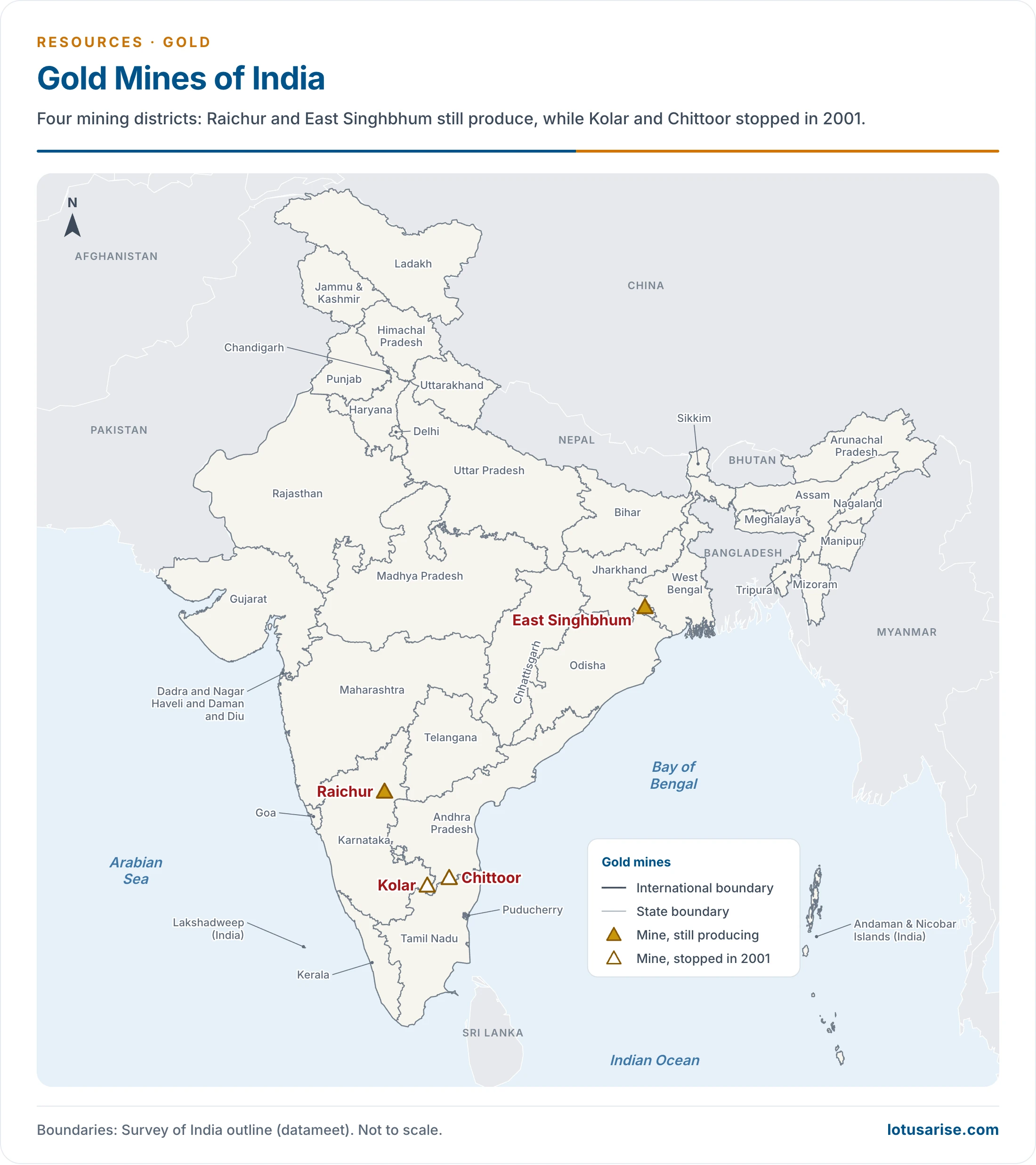
- Of these sites, only Raichur and East Singhbhum are still producing. The Kolar and Chittoor mines stopped in 2001.
Gold in Karnataka
- Karnataka leads gold output by a wide margin.
- Older figures gave it about 80–89% of output. In 2023-24 it produced 1,553 of 1,603 kg, about 97%.
- Almost every part of the State has some gold.
- Main areas: Kolar, Dharwad, Hassan and Raichur districts.
- Scattered finds: Kalaburagi (Gulbarga), Belagavi, Ballari, Mysuru, Mandya, Chikkamagaluru and Shivamogga.
- Newer fields: Ballara (Tumakuru), Kempinkole (Hassan), Honnoli (Shivamogga), Siddarhalli (Chikkamagaluru), Munghur (Kalaburagi), and Gadag in the Dharwad belt.
- Kolar Gold Field long held the most important reserves and was the largest supplier of gold in India. It no longer produces.
- Mining began in 1871. The belt is about 80 km long from north to south and 3–4 km wide, with the gold-bearing quartz veins confined to a stretch of 6–7 km near Marikuppam.
- Its share was once about 58% of the State’s output.
- The workings passed 3,000 metres, among the deepest in the world. Costs rose as the grade of the remaining ore fell.
- The operator, Bharat Gold Mines Ltd, was closed with effect from 1 March 2001.
- Surveys had earlier proved about 35.39 lakh tonnes of ore with 17,738 kg of gold.
- Hutti Mine, Raichur district, stood next to Kolar, far below it in output. It now carries almost the whole of Indian production.
- The belt measures 3.7 km by 1,220 m and holds six auriferous quartz reefs.
- It gave 593.3 kg in 1915, then closed in 1920, and restarted in the late 1940s.
- The ore is of low grade, about 2.5 grams per tonne in 2023-24, against the 8–10 grams often taken as top quality.
- The Hutti Gold Mines Co. Ltd, a Karnataka State company, is now the only public sector producer. It works Hutti and Hira-Buddini in Raichur, and treats ore from Uti at Hutti.
- Older estimates put in situ reserves in Raichur at about 45 lakh tonnes of ore with 45,000 kg of gold.
Gold in Andhra Pradesh
- Older accounts rank Andhra Pradesh as the second-largest producer, far behind Karnataka. In 2023-24 it stood third, with 22 kg, behind Jharkhand’s 28 kg.
- The main classical deposits are at Ramagiri in Anantapur district. This field is nearly exhausted, and its Yeppamana mine closed with Bharat Gold Mines in 2001.
- Earlier surveys assessed about 70.6 lakh tonnes of ore with 37,025 kg of metal in the State. The latest inventory gives 47.17 tonnes of metal.
- Other deposits: Bisanattam and Palachchur in Chittoor district, and Jonnagiri in Kurnool district.
- Jonnagiri is the newest working field.
- Geomysore Services (India) holds a lease of about 598 hectares there.
- Commercial production began in June 2026. It is described as India’s first large private gold mine with its own processing plant.
- Apart from these mines, gold is also obtained as placer deposits from river sands.
Gold in Jharkhand
- Older accounts rank Jharkhand third, with about 10% of production. In 2023-24 it stood second, but with only 28 kg, under 2% of the total.
- It has both forms of gold:
- Placer deposits in the sands of the Subarnarekha (the “gold streak”), the Sona Nadi and the streams of the Sonapat valley.
- Native gold near Lawa in Singhbhum district and in some parts of the Chotanagpur plateau.
- Manmohan Mineral Industries mines gold underground at Kunderkocha, the State’s one reporting mine.
Gold in Keralam
- Terraces of the Punna Puzha and the Chaliyar Puzha hold some alluvial gold.
- The Punna Puzha is one of the streams that form the Chaliyar near Nilambur, where hand panning still goes on.
- The Ambankadava Puzha and rivers near Mannarkkad carry it too.
- All of India’s estimated placer ore (26.12 million tonnes) is in Keralam.
Other Occurrences
- Small amounts of river gold come from:
- Himachal Pradesh: Shimla and Bilaspur.
- Ladakh: terraces of the Indus in the Kargil area and alluvial and morainic deposits of the Dras river.
- Madhya Pradesh: Balaghat and Seoni.
- Chhattisgarh: Bastar, Raipur and Raigarh.
- West Bengal: Purulia.
- Sonbhadra, Uttar Pradesh:
- A 2020 State claim of about 3,000 tonnes at Son Pahadi was rejected by the Geological Survey of India, which puts the resource at about 160 kg of gold in some 52,806 tonnes of ore.
- The latest inventory gives Uttar Pradesh 2.08 tonnes of metal.
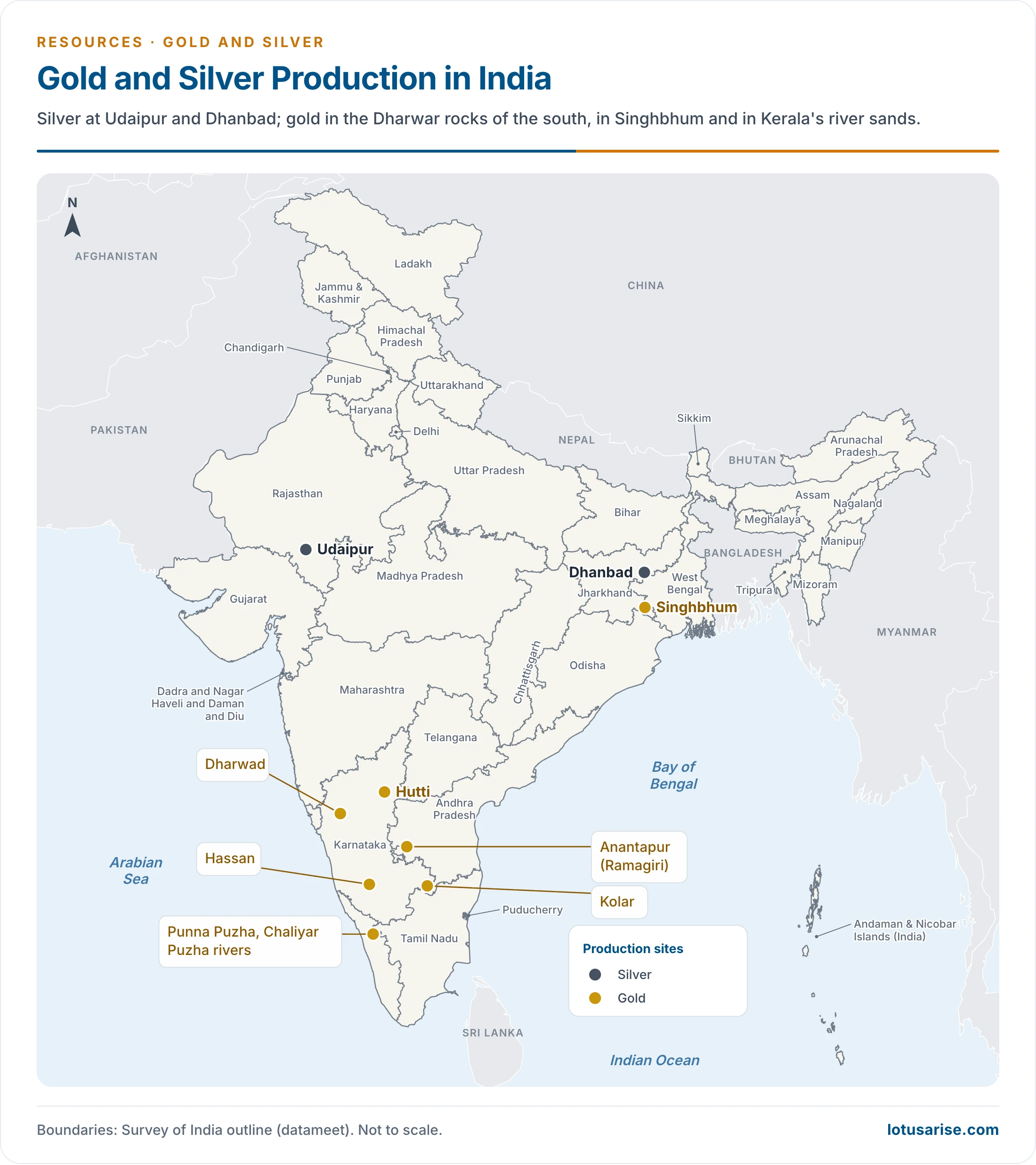
List of Gold Mines in India
| Gold Mines | State | Position |
|---|---|---|
| Hatti (Hutti) Gold Mines | Karnataka | Working; the country’s main producer |
| Kolar Gold Fields | Karnataka | Closed in 2001 |
| Lava (Lawa) Gold Mines | Jharkhand | Not among 2023-24 reporting mines |
| Sonbhadra Mine | Uttar Pradesh | A prospect, about 160 kg; no working mine |
| Parasi | Jharkhand | Not among 2023-24 reporting mines |
| Pahadia | Jharkhand | Not among 2023-24 reporting mines |
| Kunderkocha | Jharkhand | Working |
| Bhitar Dari | Jharkhand | Not among 2023-24 reporting mines |
Silver
Character and Uses
- Silver is also a precious metal, valued next to gold for making ornaments because it is soft and brilliantly white. In India it is used for religious ceremonies, festivals, weddings and many other cultural events, and it was long a currency metal.
- It has the highest electrical and thermal conductivity of all metals.
- Industry takes it for chemicals, electroplating, photography and glass colouring.
- Solar cells and electronics are now among the largest and fastest-growing uses.
- Chief ore minerals: argentite, stephanite, pyrargyrite and proustite.
Occurrence
- It occurs mixed with other metals: copper, lead, gold and zinc.
- It occurs generally with lead, zinc, copper and gold ores, especially sulphides, and is extracted as a by-product by electrolysis or chemical methods.
- India has no native silver deposit of size, apart from the small and unique Bharak deposit in Rajasthan.
- No mining lease is worked for silver alone.
Resources
- Total resources (1 April 2020): 568.64 million tonnes of ore with 30,267.91 tonnes of metal.
- Rajasthan dominates, with about 86% of the ore and 98% of the metal.
- By ore, Karnataka, Jharkhand and Andhra Pradesh follow, each under 5%.
- By metal, Madhya Pradesh, Uttarakhand and Andhra Pradesh follow, each around 0.5%.
- World reserves are about 6,10,000 tonnes, led by Peru (18%), Australia and Russia (15% each). India holds about 1% (8,000 tonnes).
Production and Trade
- India mines little silver by world standards, and imports cover most of its use.
- Imports were 7,337 tonnes in 2023-24, mainly from the UK (37%), UAE (31%) and Hong Kong (21%). Apparent consumption was 7,951 tonnes, and exports only 132 tonnes.
- World mine output was 26,691 tonnes in 2023, led by Mexico (27%), China (13%) and Peru (11%).
| Year | Silver produced (kg) |
|---|---|
| 2021-22 | 6,47,156 |
| 2022-23 | 7,13,768 |
| 2023-24 | 7,45,980 |
- Rajasthan is the largest producer, with 7,45,830 kg of the 2023-24 total.
- Karnataka gave only 150 kg.
- Gujarat follows by another route: Hindalco at Dahej recovered 73,745 kg from imported copper concentrates, which is counted apart from the national figure.
- Older lists put Gujarat and Jharkhand next to Rajasthan. Jharkhand reported no silver in 2023-24.
- Rajasthan’s silver comes from galena and zinc ore.
- The major production has come from the Zawar mines in Udaipur, as a by-product of galena (lead) ore in the Hindustan Zinc smelter.
- Silver content in older records ranged from about 171 grams a tonne of zinc concentrate to 775 grams a tonne of lead concentrate.
- Recovery is now at Hindustan Zinc’s Chanderia lead-zinc smelter in Chittorgarh, with a refining capacity of 800 tonnes a year. The company reported about 687 tonnes of saleable silver in 2024-25.
- Kolar Gold Fields and Hutti Gold Fields gave silver during the refining of gold. Only Hutti still does, since Kolar closed.
- Older by-product sources, none of which reported silver in 2023-24:
- At Tundoo in Dhanbad district (Jharkhand), a lead smelter.
- At Visakhapatnam in Andhra Pradesh, the Vizag Zinc smelter, on lead concentrates.
- Hindustan Copper’s Maubhandar smelter in Singhbhum, from copper slimes.
- Traces occur in:
- Jharkhand: Hazaribag, Palamu, Ranchi and Singhbhum.
- Andhra Pradesh: Kadapa, Guntur and Kurnool.
- Gujarat: Vadodara. Karnataka: Ballari.
- Jammu and Kashmir: Baramula. Uttarakhand: Almora.
List of Silver Mines in India
- All four Rajasthan mines belong to Hindustan Zinc, a Vedanta Resources company. They are lead-zinc mines that yield silver as a by-product.
- The closure years below are older projections. Hindustan Zinc was still working all four in 2023-24, past the year given for Zawar.
| Silver Mines | State (district) | Silver, 2020 estimate (thousand ounces) | Older projected closure |
|---|---|---|---|
| Sindesar Khurd Mine | Rajasthan (Rajsamand) | 11,804 | 2025 |
| Rampura Agucha Mine | Rajasthan (Bhilwara) | 5,154 | 2027 |
| Zawar Mine | Rajasthan (Udaipur) | 1,331 | 2022 |
| Rajpura Dariba Mine | Rajasthan (Rajsamand) | 1,007 | 2024 |
| Hutti Mine | Karnataka (Raichur) | 6.851 | not given |
- Sindesar Khurd, Rampura Agucha, Rajpura Dariba and Hutti are underground mines. Hutti belongs to the Hutti Gold Mines Company.
Previous Year Questions
2023Map item: Hutti




Kindly mention the places of goldmines ,statewise
I have updated the article. Happy learning.
thank you sir
Thank u brother…
Most Welcome 😊
very nice and informative
Excellent notes. Thank you sir.