

- The Indian monsoon is a seasonal reversal of winds that brings most of the country’s rain in four months. No single cause explains it.
- Its mechanism draws on five ideas from climatology and oceanography: the ITCZ, the jet stream, ocean currents, the Southern Oscillation and the Indian Ocean Dipole.
- These six videos help to visualise the basic concepts before the detail.
Indian Monsoon
Meaning and Definition
- The word monsoon is believed to come from the Arabic mawsim, meaning season.
- Monsoons are periodic winds that change direction with the season. They blow from sea to land in summer and from land to sea in winter, so they form a double system of seasonal winds.
- Scholars stress different tests:
- Reversal: E. H. G. Dobby and P. A. Menon make the swing of the wind system between summer and winter the main criterion. Conrad asks for a turn of about 180° in a true thermal monsoon.
- Persistence: A. A. Rama Sastry adds that the winds hold one direction steadily over very wide areas until the season changes.
- Scale: some scholars, among them Wladimir Köppen and Julius Hann, read the monsoon as a giant land and sea breeze, with the year replacing the day.
- Colin S. Ramage (1971) gave the most used objective test:
- From January to July the main wind direction swings 120° or more.
- That main direction holds on over 40% of occasions, on average, in those months.
- The mean resultant wind exceeds 3 m/s in at least one of them.
- Cyclones and anticyclones alternate less than once in two years within any 5° box.
- On these tests his monsoon region runs from 35° N to 25° S and 30° W to about 170° E.
- Older accounts confine the monsoon to the tropics, roughly 20° N to 20° S. Ramage’s limits are wider, and in Asia the system reaches well beyond the Tropic of Cancer.
The Two Monsoons of India
- Monsoons have long mattered to traders and seafarers, who used them to sail from place to place.
- They occur in the Indian subcontinent, central-western Africa, Southeast Asia and a few other places, but are most pronounced in the Indian subcontinent.
- India receives the southwest monsoon in summer and the northeast monsoon in winter.
- The southwest monsoon is drawn by an intense low-pressure system in summer. Older accounts place this low over the Tibetan Plateau. The surface heat low in fact lies over north-west India and Pakistan, while the plateau acts aloft.
- The northeast monsoon flows out of high-pressure cells over Siberia and the Tibetan plateau.
- The southwest monsoon brings intense rain to most of India. The northeast monsoon mainly wets the south-eastern coast: Tamil Nadu and south coastal Andhra Pradesh (older accounts call it the southern coast of Seemandhra).
- India, Indonesia, Bangladesh and Myanmar receive most of their annual rain in the southwest monsoon season. South-east China and Japan do so in the northeast monsoon season.


Mechanism of Indian Monsoon
- Monsoon is a complex meteorological phenomenon, and its origin is not fully understood. Several theories attempt it, and they fall into two broad groups: classical and modern.
- Early records:
- The Rig Veda and Greek and Buddhist writers mention these winds.
- Al-Masudi, a tenth-century Arab explorer from Baghdad, described the reversal of winds and currents in the north Indian Ocean.
- Sidi Ali (1554) noted the dates on which the monsoon began at several places.
Thermal Concept (Classical Theory)
- Edmond Halley, the astronomer, proposed in 1686 that the primary cause of the monsoon circulation is the differential heating of land and sea. On this view, monsoons are land and sea breezes writ large.
- Winter:
- Asia’s huge landmass cools faster than the surrounding oceans, and a strong high-pressure centre forms over the continent. Pressure over the adjacent oceans stays relatively lower.
- The gradient therefore points from land to sea, and cold, dry air flows out towards low latitudes.
- The sun stands over the Tropic of Capricorn in this season.
- Summer:
- The conditions reverse. The landmass heats quickly and builds a strong low-pressure centre, reinforced by the poleward shift of the Intertropical Convergence Zone (ITCZ) over southern Asia.
- With higher pressure over the oceans, a sea-to-land gradient sets up, and warm, moist air streams towards the heated land.
- The sun stands over the Tropic of Cancer in this season.
- Criticism:
- It cannot explain the monsoon’s intricacies: the sudden burst, the breaks, and the spread of rain in space and time.
- The low-pressure areas are not stationary. They shift suddenly, so they cannot be purely thermal.
- The rain is not simply convectional. It is a mix of orographic, cyclonic and convectional rainfall.
- North-west India grows very hot from mid-April, yet no rain falls there until the monsoon arrives.
- Halley ignored the Coriolis effect, latent heat, the shape of the continents and the upper-air circulation. A purely thermal monsoon would also need a clear return flow aloft, which the older observations did not find.
- Status: it held the field for about three centuries and has not been rejected outright. Land–sea contrast remains a basic ingredient, but it is no longer treated as the whole story.
Air Mass and Dynamic Concept (ITCZ)
- The southeast and northeast trade winds converge near the equator in the ITCZ, a belt of ascending air, thick cloud and heavy rain. It moves north and south with the seasons.
- Hermann Flohn (1951) rejected the thermal explanation and treated the monsoon as a modification of the planetary winds, caused by the seasonal shift of pressure and wind belts.
- The thermal low of northern India is simply the Northern ITCZ (NITCZ) pushed unusually far north, to about 30° N in July.
- The southeast trades cross the equator, turn right under the Coriolis force, and arrive as the southwest monsoon. These are the expanded equatorial westerlies.
- In January the Southern ITCZ (SITCZ) takes over, and the northeast trades return as the winter monsoon.
- The line where the southwest monsoon meets the northeast trades is the Monsoon Front. In July the ITCZ lies at 20°–25° N over the Indo-Gangetic plain and is called the Monsoon Trough.
- Limits: the concept leaves out the jet streams and the Southern Oscillation, and it does not explain the early arrival of rain in north-east India.
- Current view: many meteorologists now describe the monsoon as a seasonal migration of a continental tropical convergence zone, which keeps the core of this idea.
Recent Concept about the Origin of Indian Monsoon
- Upper-air circulation has been studied closely since the Second World War. Differential heating alone is now thought unable to produce the monsoon circulation.
- Recent thinking rests on:
- The Himalayas and Tibetan Plateau as a physical barrier and a high-level heat source.
- The upper-air jet streams of the troposphere.
- The upper-air circumpolar whirl over the north and south poles, whose seasonal shift moves the jets.
- ENSO (El Niño and Southern Oscillation) in the South Pacific Ocean.
- The Walker cell in the Indian Ocean.
- The Indian Ocean Dipole.
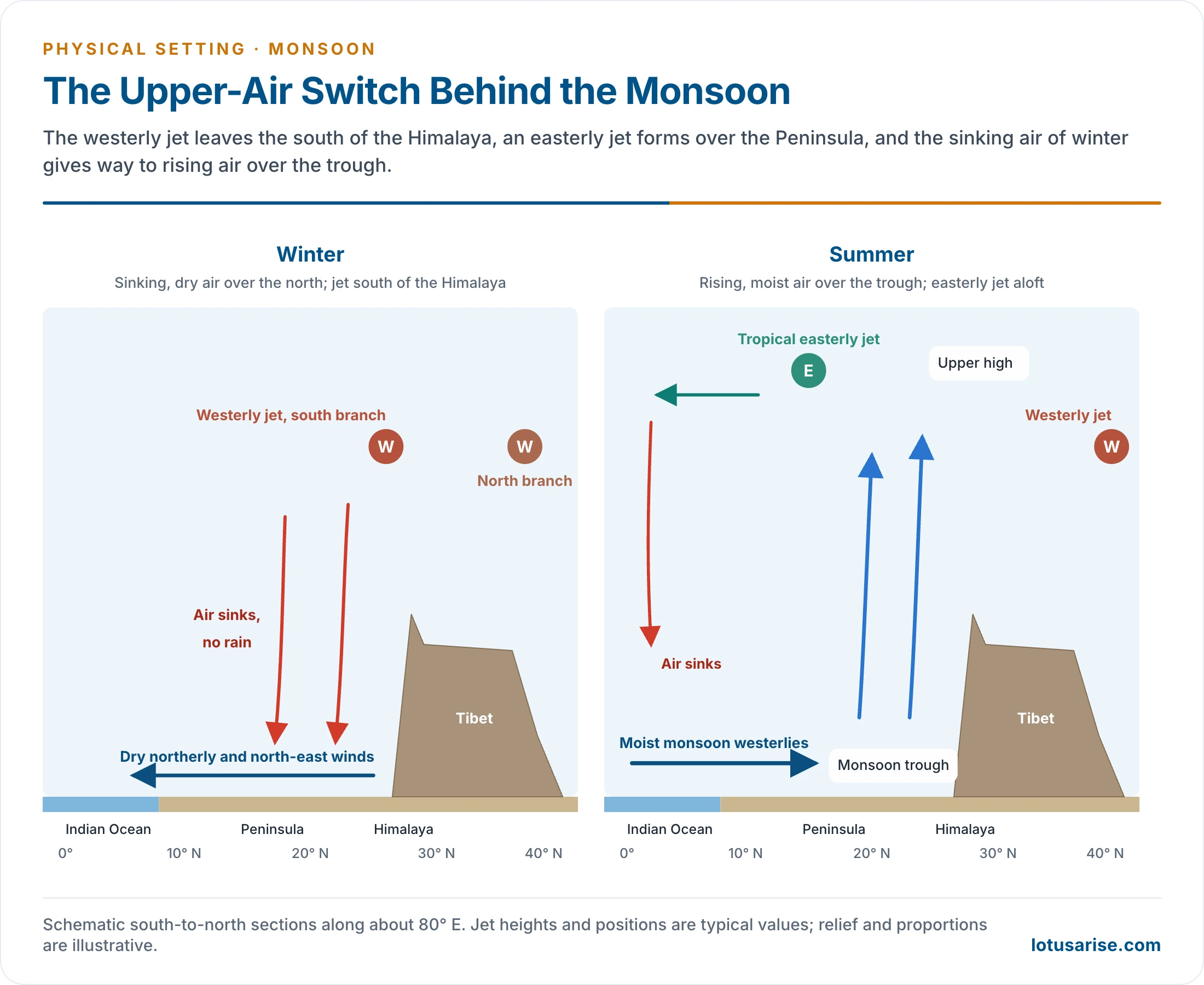
- Their combined effect appears at every level of the atmosphere, as the figure shows.
Role of the Himalayas and Tibetan Plateau
- The plateau: an ellipsoid block covering about 4.5 million sq km at a mean height near 4,000 m, ringed by ranges of 6,000–8,000 m.
- Its heating: summer air above it runs 2–3°C warmer than over the lands around. Older accounts call this extra insolation, but the figure is an air-temperature difference.
- When the idea arose: the heat-source idea goes back to the 1950s, to P. Koteswaram and Hermann Flohn. The Indo-Soviet observations of the 1970s gave it strong support, and the discovery is often dated to that decade.
- The heat engine (Koteswaram):
- Heated air rises over the plateau and spreads outward near 300–200 mb (9–12 km).
- The rotation of the earth deflects it to the right, so an anticyclone with clockwise flow forms in the upper troposphere. Some accounts place it in the middle troposphere.
- Two streams leave this high. One blows southward and develops into the tropical easterly jet (TEJ). The other turns towards the north and joins the westerly jet over Central Asia.
- The air sinks over the equatorial Indian Ocean and returns to India’s west coast from the south-west, gathering moisture on the way.

- On this slide, the low-pressure mark over Tibet is a surface feature. Above it stands the high that feeds the easterly jet.
- Snow link: heavy, late-lying snow on the plateau delays heating and is followed by a weak monsoon. Henry Francis Blanford used Himalayan snow in the first monsoon forecasts of the 1880s.
- Current view:
- William R. Boos and Zhiming Kuang (2010) removed the plateau in a climate model and kept the narrow Himalaya. The large-scale monsoon hardly changed.
- They argue that the mountains act mainly as an insulating wall, shutting off cold, dry air from the north and letting warm, moist air build over India.
- The upper-level high also centres just south of the plateau. The plateau’s heating still strengthens rain along its southern edge, and the debate continues.
Role of Jet Stream
- A jet stream is a narrow band of very fast upper air. Westerly jets commonly run at 150–300 km/h near 12 km.
- M. T. Yin (1949) tied the burst to the upper-air circulation, and Pierre Pédelaborde (1963) developed the idea. B. W. Thompson, Flohn and others reached similar views.
- Winter:
- The sub-tropical westerly jet is split by the highland of Tibet. In winter it lies within about 20°–35° N.
- The southern branch runs along the Himalayan slopes near 25° N at about 240 km/h. The northern branch, north of the plateau, is much weaker at 70–90 km/h. They rejoin off the coast of China.
- Air sinking beneath the southern branch gives dry, outblowing winds over north-west India and Pakistan. The jet also steers western disturbances from the Mediterranean.

- This map shows the winter pattern. The arrows south of the equator labelled “southwest surface winds” blow from the south-east: they are the southeast trades.
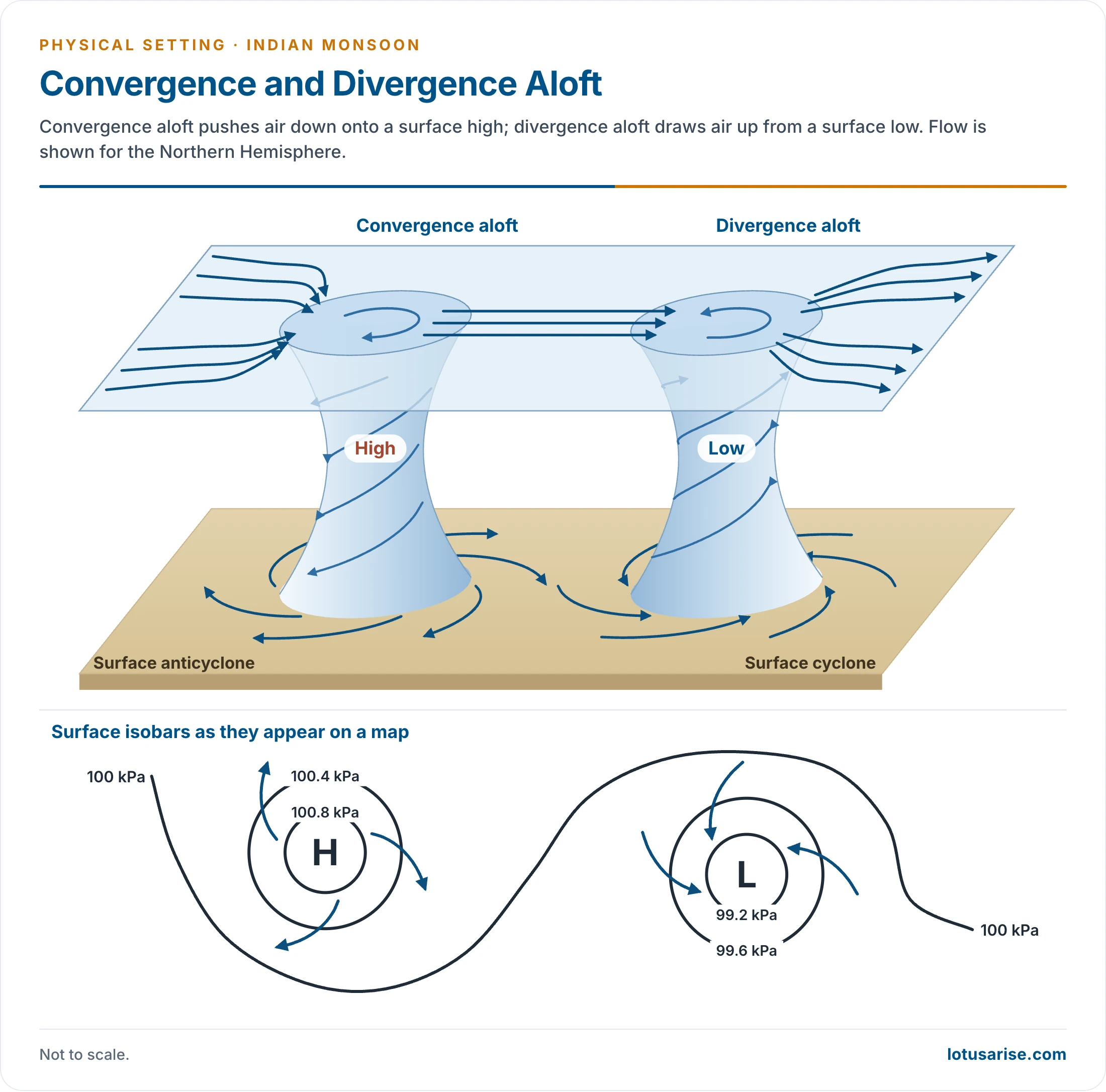
- This general figure shows why the jets matter: divergence aloft draws air up from a surface low, and convergence aloft pushes air down onto a surface high.
- Summer:
- The westerlies begin to move north in March, but the southern branch stays south of Tibet and keeps the weather dry and squally.
- By late May or early June it breaks and shifts north of the plateau. This northward jump is the first sign of the monsoon’s onset.
- The Tropical Easterly Jet forms over the peninsula. P. R. Krishna Rao (1952) first inferred it, and P. Koteswaram (1958) established it. Its core lies near 13 km (150 mb), with winds over 100 knots, and its axis lies around 15° N, reaching at times from the Peninsula’s tip to near 20° N.
- T. N. Krishnamurti found strong upper-level divergence over northern India and Tibet in summer, which ties the jet to the rising limb of the circulation.
- R. Ananthakrishnan stressed the heat belt of 20°–40° N, and Raman and Ramanathan the part played by latent heat released in the monsoon clouds.
- Link to the surface:
- The TEJ descends over the Indian Ocean and is thought to intensify the high-pressure cell called the Mascarene High, offshore of Madagascar.
- From this cell, onshore winds blow towards the low over the subcontinent. After crossing the equator they become south-westerly as the southwest summer monsoon.
- The stronger the easterly jet, the steeper this pressure gradient and the more vigorous the monsoon.
- Low-level jet: J. Findlater (1969) traced a fast cross-equatorial current past Kenya and Somalia towards western India. This is the Somali or Findlater Jet, also described as an equatorial jet stream along the eastern coast of Africa.
Role of ENSO
- The monsoon is also influenced by El Niño, the Southern Oscillation and the Somali Current. Links of this kind across long distances are called teleconnections.
- El Niño:
- A narrow warm current that appears off Peru around December. The Spanish name means the Christ Child. It temporarily replaces the cold Peru Current, and warms surface waters sharply in strong events.
- More broadly, it is a reversal of normal sea surface temperature conditions in the Pacific.
- La Niña: the opposite phase. Strong trades pile warm water in the west and bring cold water to the surface in the central and eastern Pacific. It usually favours good monsoon rain.
| Feature | El Niño | La Niña |
|---|---|---|
| Trade winds | Weaken | Strengthen |
| Warm water | Moves east | Held in the west |
| Upwelling off Peru | Reduced | Strong |
| Indian monsoon | Tends to weaken | Tends to strengthen |
| Frequency | Every 3–5 years in older accounts | About half as often |
- There is no direct one-to-one link, although bad monsoons and El Niño are generally associated. India has had severe droughts outside El Niño years, and good rain during them.
- 1870–1970: 19 of 43 deficient monsoon years went with an El Niño, and 6 El Niño years had good rain.
- 1972–73 to 2013–14: 9 of 14 drought years were El Niño years and 5 were not.
- How the link is changing:
- K. Krishna Kumar and colleagues (1999) showed the inverse relationship had weakened after about 1980. Two causes were proposed: a south-eastward shift of the Walker circulation anomalies, and a warmer Eurasia that strengthens the land–sea contrast.
- Their 2006 study found that the location of warming matters. El Niños warmest in the central Pacific focus sinking air over India and bring drought. Those warmest in the east often do not. The giant El Niño of 1997 came with a normal monsoon, while the moderate one of 2002 brought one of the worst droughts.
- 2026: an El Niño set in by June and kept strengthening, the Dipole stayed neutral, and rainfall came to 87% of the long-period average, the lowest since 2015.
- Southern Oscillation:
- A see-saw of atmospheric pressure between the Pacific and the Indian Ocean, named by Sir Gilbert Walker in 1924 while heading India’s meteorological service.
- Its period is irregular, between 2 and 7 years.
- It is measured by the Southern Oscillation Index (SOI): the pressure at Tahiti minus that at Darwin.
- Together, El Niño and the Oscillation are called an ENSO event.
| Feature | Positive SOI | Negative SOI |
|---|---|---|
| Pressure | Tahiti above Darwin | Darwin above Tahiti |
| Winter high | East Pacific | North Indian Ocean |
| Eastern Pacific rain | Low | Above usual |
| Indian monsoon | Good prospects | Poor monsoon |
- Somali Current:
- It reverses every six months. In the northeast monsoon it flows to the south-west. In the southwest monsoon it is a major western boundary current, comparable with the Gulf Stream, with cold upwelling beside it.
- Older accounts add a pressure effect. A low normally lies off the coast of Somalia, and in exceptional years, every six or seven years, the western Arabian Sea turns to high pressure and the monsoon weakens.
- That fixed period has no firm support in current work. A related case is 1979, when an Arabian Sea anticyclone delayed onset over Kerala by 12 days.
Walker Cell
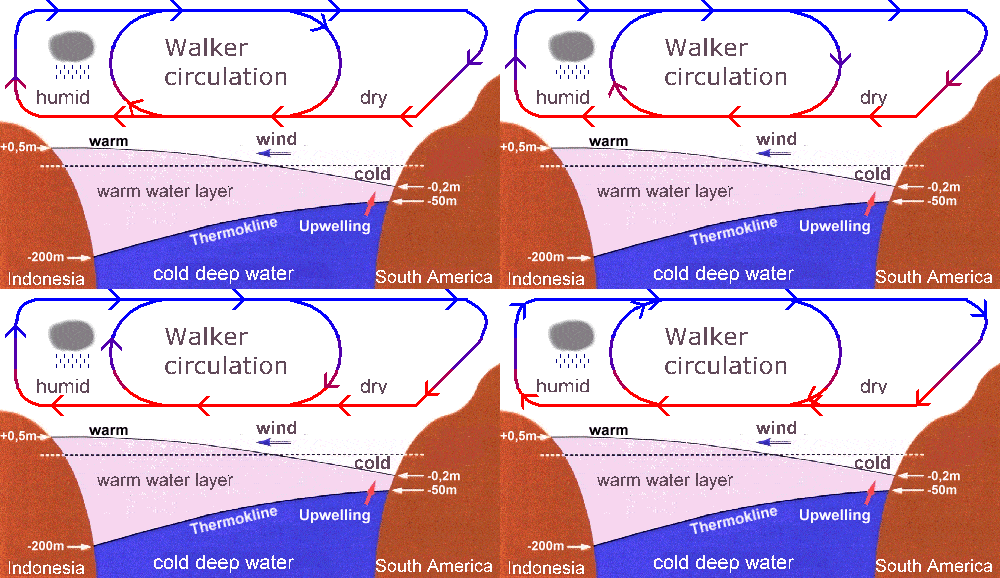
- An east–west atmospheric circulation runs over the tropical oceans. Jacob Bjerknes (1969) named the Pacific cell after Walker, and many scientists use the term for such cells in every ocean.
- It rises over low pressure and sinks over high pressure, and its strength varies with the SOI.
- High positive SOI:
- Low pressure lies over Australia and the Indonesian archipelago. Rising air there diverges aloft towards Africa and South America.
- In the Indian Ocean the air descends into a high-pressure zone, from which surface winds blow towards India as the southwest monsoon.
- During La Niña this Indian Ocean branch strengthens, surface winds intensify, and the monsoon is generally good.
- El Niño or negative SOI:
- The rising branch shifts from the western Pacific to its central regions, and the Indian Ocean cell shifts east.
- Southwest monsoon winds become weaker than normal.

Indian Ocean Dipole
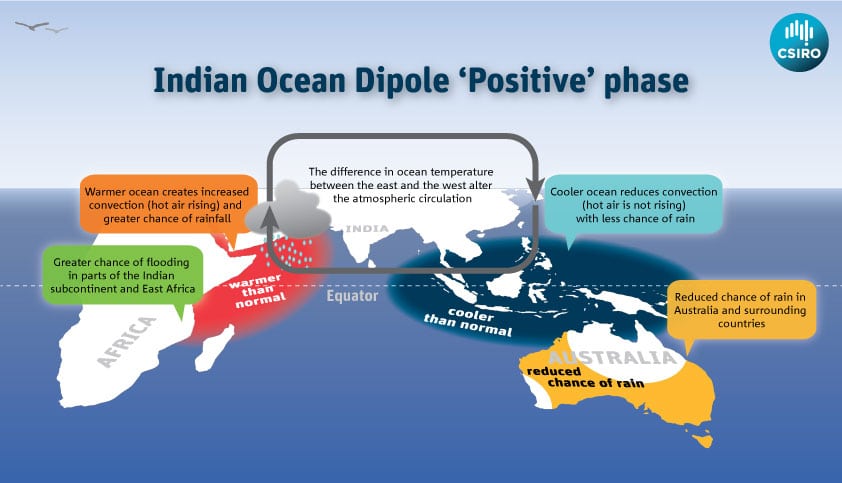
- The Indian Ocean Dipole (IOD), also called the Indian Niño, is a coupled ocean–atmosphere phenomenon. N. H. Saji and colleagues (1999) identified it.
- It is defined by the sea surface temperature difference between two poles:
- Western pole: the western tropical Indian Ocean (50°–70° E, 10° S–10° N). It is often loosely called the Arabian Sea pole, though most of that sea lies outside this box.
- Eastern pole: the eastern Indian Ocean south of Indonesia, off Sumatra (90°–110° E, 10° S–equator).
- It oscillates between positive, neutral and negative phases, peaking around October.
| Phase | Western Indian Ocean | Eastern Indian Ocean | Effect |
|---|---|---|---|
| Positive | Warmer, more rain | Cooler, drier | Droughts in Indonesia and Australia; favours the Indian monsoon |
| Negative | Cooler, drier | Warmer, more rain | Opposite pattern |
- Relation with ENSO: the IOD is one part of the general cycle of global climate and interacts with ENSO, but the two do not move in step.
- Positive and negative IOD have both been seen with La Niña.
- Saji’s events of 1961, 1967 and 1994 came with no ENSO, a La Niña and a weak El Niño. Those of 1972 and 1997 came with strong El Niños.
- Effect on the monsoon:
- Karumuri Ashok and colleagues (2001) showed the two work in a complementary way: when the ENSO–monsoon correlation is low, the IOD–monsoon correlation is high.
- A positive IOD helped offset the 1997 El Niño. The extreme positive event of 2019 went with rainfall of 110% of the long-period average.
Monsoon Experiments and Forecasting
| Programme | Years | Contribution |
|---|---|---|
| International Indian Ocean Expedition | 1960s | First large joint study of the ocean and air |
| ISMEX and Monsoon-77 | 1973, 1977 | Indo-Soviet work; found the crossing zone off Kenya and tied it to Maharashtra’s rain |
| MONEX-1979 | 1978–79 | Largest effort, with 45 countries and 52 ships; winter, summer and West African parts |
| TOGA, then CLIVAR | 1985, 1995 | Teleconnections, then climate variability forecasting |
| Monsoon Mission | from 2012 | Coupled dynamical model built at Pune |
- MONEX met an abnormal year: an Arabian Sea anticyclone, weak spells in July and only one depression. Its value lies in showing how the monsoon fails. The Department of Space’s Indian Middle Atmosphere Programme added upper-air data.
- Forecasting steps by the India Meteorological Department (IMD):
- 1886: first operational forecast, after Blanford’s trials.
- 1909: Walker’s regression forecast. Some of his predictors stayed in use for decades.
- 1988–2002: the 16-parameter power regression model, grown from 15 signals of temperature, wind, pressure and snow cover. More than half the signals favourable meant a normal monsoon, and 70% or more meant above normal.
- 2003–06: two-stage forecasts on 8 and 10 parameters. 2007: a statistical ensemble.
- 2017: the Monsoon Mission model became operational. 2021: a Multi-Model Ensemble of global climate models was adopted.
- 2024–25: Mission Mausam was approved and launched, and the Bharat Forecast System began running at 6 km.
- A foolproof model for specific areas is still lacking. In 2026, IMD’s Kerala onset forecast ran about eight days ahead of the actual date (4 June), though its seasonal forecast held.
Nature of Indian Monsoon
- Systematic study of the region’s rain helps to explain the monsoon’s salient features:
- Onset and advance of the monsoon.
- Rain-bearing systems, and how their frequency relates to the distribution of monsoon rainfall.
- Breaks in the monsoon.
- Retreat of the monsoon.
Onset and Advance of Monsoon
- Many meteorologists still regard the differential heating of land and sea as the primary cause.
- In May the low at the ITCZ over north India grows so intense that it pulls the southern trade winds north. These southeast trades cross the equator into both seas and are drawn into the circulation over India.
- Passing over warm equatorial currents, they gather abundant moisture. With the ITCZ’s northward shift, an easterly jet develops near 15° N.
- Monsoon burst: rain begins abruptly, with violent thunder and lightning, and temperatures fall substantially. This sudden arrival of moist winds is called the “break” or “burst” of the monsoon.
- Upper-air change is the trigger: the surface flow cannot establish itself until the jet has left the south side of the Himalaya.
- Normal dates:
| Place | Older date | Current normal (IMD, 2020) |
|---|---|---|
| Andaman and Nicobar Islands | 15–20 May | 22 May |
| Keralam (Kerala) | 1 June | 1 June |
| Kolkata | 7–13 June | 11 June |
| Mumbai | 10–13 June | 11 June |
| Delhi | 23 June | 27 June |
| Whole of India | 15 July | 8 July |
| Withdrawal begins, west Rajasthan | 1 September | 17 September |
| Withdrawal complete | 15 October | 15 October |
- Keralam onset is declared by rule. After 10 May, at least 60% of 14 listed stations must report 2.5 mm or more on two straight days. Westerlies must reach 600 hPa, and outgoing longwave radiation must fall below 200 W/m².
- Variation: the earliest onset over Kerala was 11 May 1918 and the latest 18 June 1972. In 2026 onset came on 4 June, and the whole country was covered by 9 July.
- The Bay current advances faster than the Arabian Sea current. It may reach 20° N in the Bay by the third week of May while it is still near 7° N in the Arabian Sea.
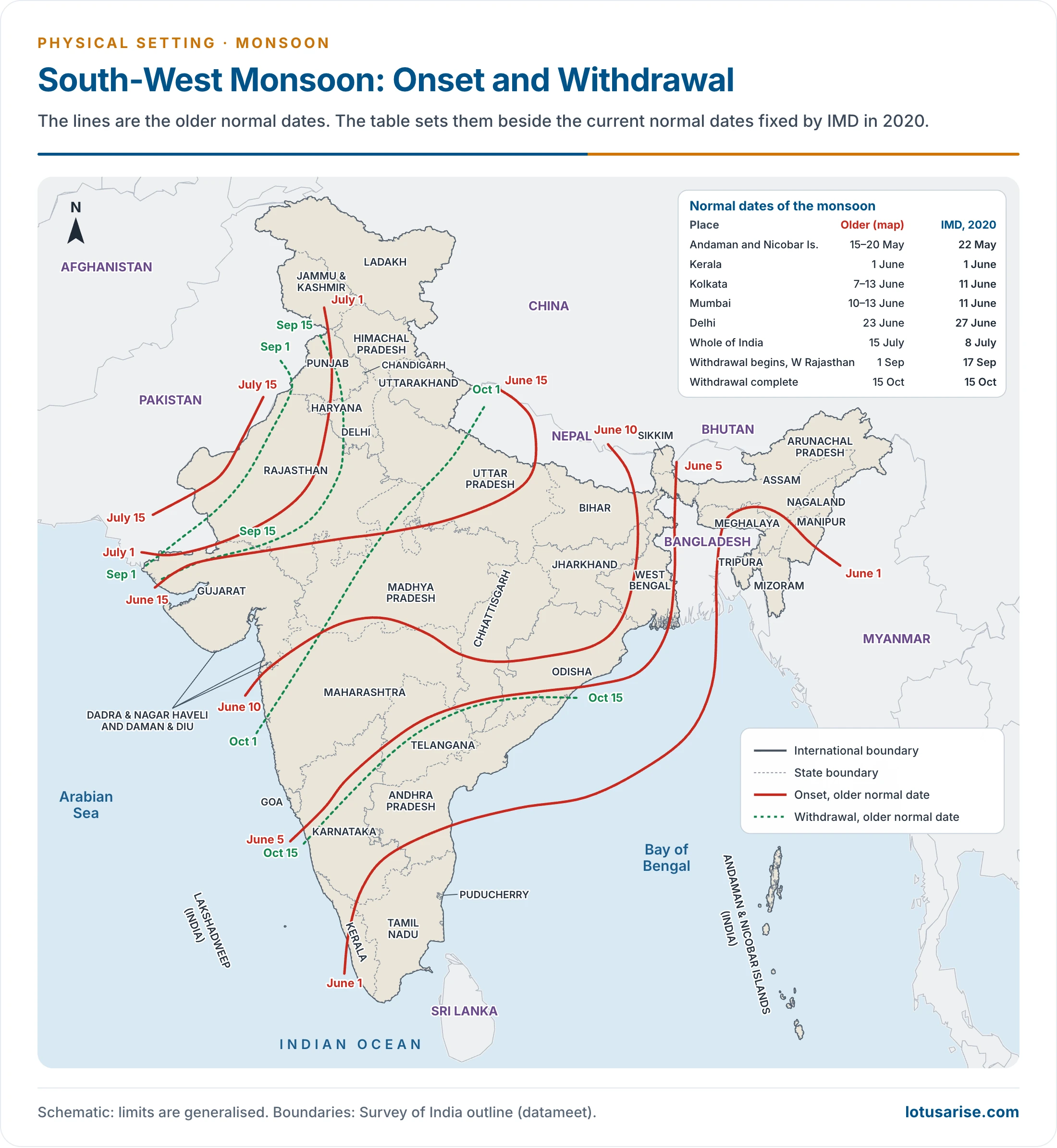
- The lines on this map are the older normal dates, such as 15 July for full cover and 1 September for the first withdrawal. The table above gives the current dates. Telangana became a State in 2014 and Ladakh a Union Territory in 2019.
Rain Bearing Systems and Distribution of Rainfall
- The southwest monsoon splits near the southern tip of the Peninsula into the Arabian Sea branch and the Bay of Bengal branch.
- The Bay branch brings rain to the plains of north India. The Arabian Sea branch brings it to the west coast.
- The Arabian Sea branch extends towards the low over the Thar Desert and is roughly three times stronger. The Arabian Sea is the larger, and all of its current heads for India, while part of the Bay current goes on to Myanmar, Thailand and Malaysia.
- They meet along a line through Agra and Ferozepur, and either may give Delhi its first showers.
Arabian Sea Branch
- This branch divides into three streams:
- A. Western Ghats stream:
- It meets the Ghats almost at right angles, especially between 10° and 20° N. Orographic uplift gives the windward side 250–400 cm, with 400–500 cm near the crest.
- The air descends, warms and loses humidity, so little rain falls to the east. This is the rain-shadow area.
- Mumbai gets about 190 cm in the season, Khandala 60 cm and Pune only 50 cm. Further east the air rises again and rain recovers.
- B. Narmada–Tapi stream:
- It strikes the coast north of Mumbai and moves up the two valleys to central India. With no major barrier near the coast, it gives little there. Nagpur receives about 60 cm.
- The Chotanagpur plateau gets 15 cm from it. It then enters the Ganga plains and mingles with the Bay branch.
- C. Saurashtra–Rajasthan stream:
- It strikes Saurashtra and Kachchh, then passes over west Rajasthan and along the Aravallis, giving only scanty rain.
- The range runs parallel to the wind, so it offers little obstacle and moisture is not released. Mount Abu, on its south-eastern edge, still gets about 170 cm against 60–80 cm on the plains around it.
- In Punjab and Haryana this stream joins the Bay branch, and together they bring rain to the western Himalayas.
- A. Western Ghats stream:
- The intensity of rain on the west coast depends on two factors:
- The offshore meteorological conditions.
- The position of the low-level jet along the east coast of Africa.
Bay of Bengal Branch
- It strikes the coast of Myanmar and part of south-east Bangladesh. The Arakan Hills turn a big portion of it towards the subcontinent, so it enters West Bengal and Bangladesh from the south and south-east.
- There it splits under the influence of the Himalaya and the thermal low of north-west India:
- Westward branch: it runs along the Ganga plains as far as Punjab, with rain falling steadily on the way. Kolkata gets 119 cm, Patna 105 cm, Allahabad (Prayagraj) 76–91 cm, Delhi 51–56 cm and Bikaner 24 cm.
- Northern branch: it moves up the Brahmaputra valley with widespread rain. A sub-branch strikes the Garo and Khasi Hills of Meghalaya.
- Meghalaya’s record rainfall:
- Mawsynram, on the crest of the Khasi Hills, is taken to receive the highest average annual rainfall in the world, about 1,187 cm on a short 1941–79 record. Older accounts give 1,221 cm.
- Cherrapunji, 16 km to the east, averages about 1,100 cm. It holds the world 12-month record of 2,646 cm (August 1860 to July 1861).
- The funnel-shaped valleys trap the wind and force it up steep slopes. Rain falls sharply beyond: just 90 km away, Guwahati gets 161 cm.
- The Tamil Nadu coast stays dry in this season. It lies in the rain shadow of the Arabian Sea branch and runs parallel to the Bay branch.
- Monsoon depressions:
- Tropical depressions from the Bay of Bengal vary in frequency from year to year, and their paths follow the position of the ITCZ, or monsoon trough.
- The trough’s axis oscillates with the sun’s apparent movement between the Tropics of Cancer and Capricorn. So the track of depressions and the amount of rain vary each year.
- North Indian rain varies with their frequency. On average, one to three form each month (some counts say 3–4), and each lasts about one week. A single one can bring 60 cm in a day. The 2026 season had 14 low-pressure systems, six of them depressions.
- Rain rates in the wettest quadrant of depressions have risen over the past 40 years. A decline in their number, often reported, may partly reflect changes in observation.
- Pattern of decline: the rain comes in spells and declines from west to east over the west coast, and from the south-east towards the north-west over the North Indian Plain and the northern Peninsula.
Break in the Monsoon
- Definition: if rain fails for one or more weeks after a few wet days in the southwest monsoon, it is a break. Such dry spells are quite common, especially in July and August.
- Regional reasons:
- In northern India, rain fails when rain-bearing storms are infrequent along the monsoon trough or ITCZ.
- Over the west coast, dry spells come on days when winds blow parallel to the coast.
- The large-scale pattern:
- The monsoon trough shifts north to the Himalayan foothills. This has been tied to the collapse of the Tibetan high.
- Central and north-west India turn dry, while the foothills, north-east India and the south-eastern Peninsula get heavy rain. Himalayan rivers flood even as the plains go dry.
- Current definition (Madhavan Rajeevan, Sulochana Gadgil and Jyoti Bhate, 2010):
- A break is a spell of three or more days in July–August when rain over the core monsoon zone falls more than one standard deviation below normal.
- Breaks last longer than active spells, and 32% run for a week or more.
- There were no breaks in 26% of years, and there is no significant trend. Older counts had found a break in 85 years out of 100, on looser criteria.
Retreating/Post Monsoons (The Transition Season)
- In October–November, as the sun moves south, the monsoon trough weakens and a high-pressure system replaces it. The southwest winds weaken and withdraw gradually, unlike their sudden arrival.
- North-west India gets the monsoon last and loses it first. Punjab has only about two and a half months of it.
- By the beginning of October the monsoon has left the Northern Plains. October and November form the transition from the hot rainy season to dry winter.
- October heat: clear skies and rising temperature mark the retreat. Days are hot and nights pleasant. With moist ground and high humidity, the daytime turns oppressive. Temperatures fall fast in northern India from the second half of October.
- Cyclones:
- The low over north-western India moves to the Bay of Bengal by early November, along with cyclonic depressions that originate over the Andaman Sea.
- They cross the east coast with heavy, widespread rain and are often very destructive. The crowded deltas of the Godavari, Krishna and Kaveri are frequently hit, and at times the coasts of Odisha, West Bengal and Bangladesh.
- These are the post-monsoon tropical cyclones of the Bay.
- Northeast monsoon rain:
- The bulk of the Coromandel Coast’s rainfall comes from these depressions and cyclones, along with moisture picked up by the retreating winds over the Bay.
- Tamil Nadu receives about 48% of its annual rain from October to December. Keralam has a two-peak pattern, with a smaller maximum in this season.
- The cycle of Indian seasons follows from this rhythm of advance and retreat.
Features of Monsoon Rainfall
- Seasonal: rain falls mainly between June and September. Of the annual normal of 116 cm (older figure 118 cm), the season brings 74.9%, the pre-monsoon about 11%, the post-monsoon about 10%, and winter the remainder.
- The June–September long-period average is 86.86 cm for 1971–2020, against 88.06 cm for 1961–2010.
- Governed by relief: the windward Western Ghats register over 250 cm, and the hill ranges and Eastern Himalayas give the north-eastern States heavy rain. Totals run from 20 cm in western Rajasthan to more than 400 cm in parts of the Western Ghats and North-East India. Without the Himalaya and the Ghats, much of India would be desert.
- Falls with distance from the sea: rain declines from east to west across the plains, as one branch enters from the east. Kolkata receives 119 cm, Allahabad 76 cm and Delhi 56 cm.
- Comes in spells: rainless breaks separate wet spells, and these relate to cyclonic depressions forming at the head of the Bay of Bengal and crossing the mainland. Their frequency, intensity and path govern where the rain falls.
- Torrential: rainy days number only about 40–45 in the season. Heavy downpours mean large run-off and soil erosion.
- Early end: rains sometimes stop well before time, damaging standing crops and making it hard to sow winter crops.
- Late start: the monsoon may also be delayed across all or part of the country.
Annual Rainfall and Variability
| Rainfall class | Annual total | Main areas |
|---|---|---|
| Very high | Over 200 cm | West coast; Assam, Meghalaya, Nagaland, Mizoram, Arunachal Pradesh, Sikkim |
| High | 100–200 cm | Eastern slopes of the Ghats, most of the northern plain, Odisha |
| Low | 50–100 cm | Interior Peninsula, eastern Rajasthan, Punjab, Haryana |
| Very low | Under 50 cm | Western Rajasthan, Kachchh, Ladakh |
- Coefficient of variability = standard deviation × 100 ÷ mean.
- It generally runs at 15–35% for the country, and is lowest on the west coast and in the north-east (15–20%).
- It is well over 40% in Rajasthan and Gujarat, reaching 80% in the far west. Leh and Rayalaseema are also high.
- Variability is inverse to the total. The driest areas are the least reliable, and so suffer chronic water shortage, drought and crop failure, while heavy-rain belts are prone to floods.
- Why the monsoon is erratic: the causes combine. ENSO, the IOD, snow cover, depression tracks, jet behaviour and the internal chaos of the atmosphere all play a part.
- Recent trends:
- M. K. Roxy and colleagues (2017) found mean monsoon rain over central India falling by about 10% during 1950–2015, while widespread extreme rain events rose threefold.
- IMD reads the lower recent normal as part of a multi-decadal dry epoch that began in the 1970s.
- 2026 showed how uneven a season can be: East and Northeast India got 74% of its average, the lowest since 1901, the South Peninsula 76%, while Central India had a normal 97% and Odisha an excess.
Monsoons and the Economic Life in India
- Monsoon is the axis of India’s entire agricultural cycle. Older accounts put the share of people depending on farming at about 64%. Agriculture now employs 46.1% of the workforce (Periodic Labour Force Survey, 2023–24) and much of it still relies on southwest monsoon rain.
- Except in the Himalaya, temperatures everywhere stay above the threshold for growing crops or plants through the year.
- Regional variations in monsoon climate allow a wide variety of crops.
- Agricultural prosperity depends on timely, well-spread rain. When it fails, farming suffers most where irrigation is undeveloped.
- A sudden burst erodes soil over large areas of India.
Monsoon as Unifying Factor
- The Himalayas shield the subcontinent from the very cold winds of Central Asia, so northern India stays warmer than other places on the same latitudes.
- The Peninsular plateau, with the sea on three sides, has moderate temperatures.
- Despite these moderating influences, temperature still varies greatly. Even so, the unifying influence of the monsoon is plain:
- The seasonal change of winds and weather gives a rhythmic cycle of seasons.
- Even its uncertainties and uneven spread are typical of monsoon lands.
- The landscape, plant and animal life, farm calendar and the life of the people, festivals included, turn around it.
- Year after year, people from north to south and east to west wait eagerly for its arrival.
- The winds bind the whole country by providing the water for farming, and the river valleys carrying that water also unite as one river-valley unit.
Previous Year Questions
2026The relationship between El Niño and the Indian monsoon is becoming complex under the conditions of global warming. Critically examine.2024How are geographic factors influencing the distribution of high annual rainfall in certain parts of India?2022Critically examine the factors affecting the unpredictability of the South-West Monsoon system in India.2020Explain how various factors influence the origin and development of the Indian monsoon system.2019Why is the Indian monsoon erratic in nature? Explain.2019Discuss the rainfall pattern and correlate it with the spatial distribution of natural vegetation in India.2018Explain the origin, progress and retreat of the Indian monsoon and discuss its impact on the Indian economy.2017Give a reasoned account of the unusual pattern of distribution of monsoonal rainfall in India in 2017.2015Explain the pattern of winter rainfall in India.2014Discuss the nature and origin of the Indian monsoon and recent techniques of its prediction.2013Discuss the mechanism of the Indian monsoon.2009Give reasons as to why rainfall variability is a characteristic feature of India’s monsoons.2008Discuss the mechanism and origin of Monsoon winds & explain the role of El Nino on Monsoon circulation.2006Give a critical account of the recent theories of origin of Indian monsoon with special reference to Jet Stream Theory.2002Explain the origin, mechanism and characteristics of Summer Monsoon in India.1999Elucidate the mechanism of the Indian Monsoon.1995Explain the factors responsible for uneven distribution of rainfall in India.1994Discuss the recent theories put forward to explain the origin and mechanism of the Indian Monsoon.1992Discuss the major characteristics of the Indian monsoon with special emphasis on the causative factors.1990Explain some of the important theories of the origin of the South-West monsoon in India. Evaluate the impact of its characteristics with occurrence of floods and droughts in different parts of our country.1987Analyse the mechanism of Indian Monsoon. How are the spatial temporal variations and vicissitudes in precipitation related to this mechanism?





Incredible!
♥️
👍👍👍👍👍👍👍👍 good work sor
bestest content
This is best platform to study geography for upsc
such a detailed analysis ,I like the sequential arrangement of the topic, thanx a lot
Bestest explanation and vdo content