- An urban settlement has a large population size and a high population density where secondary activities like manufacturing and tertiary activities such as trade are dominant.
Types of Urban Settlement

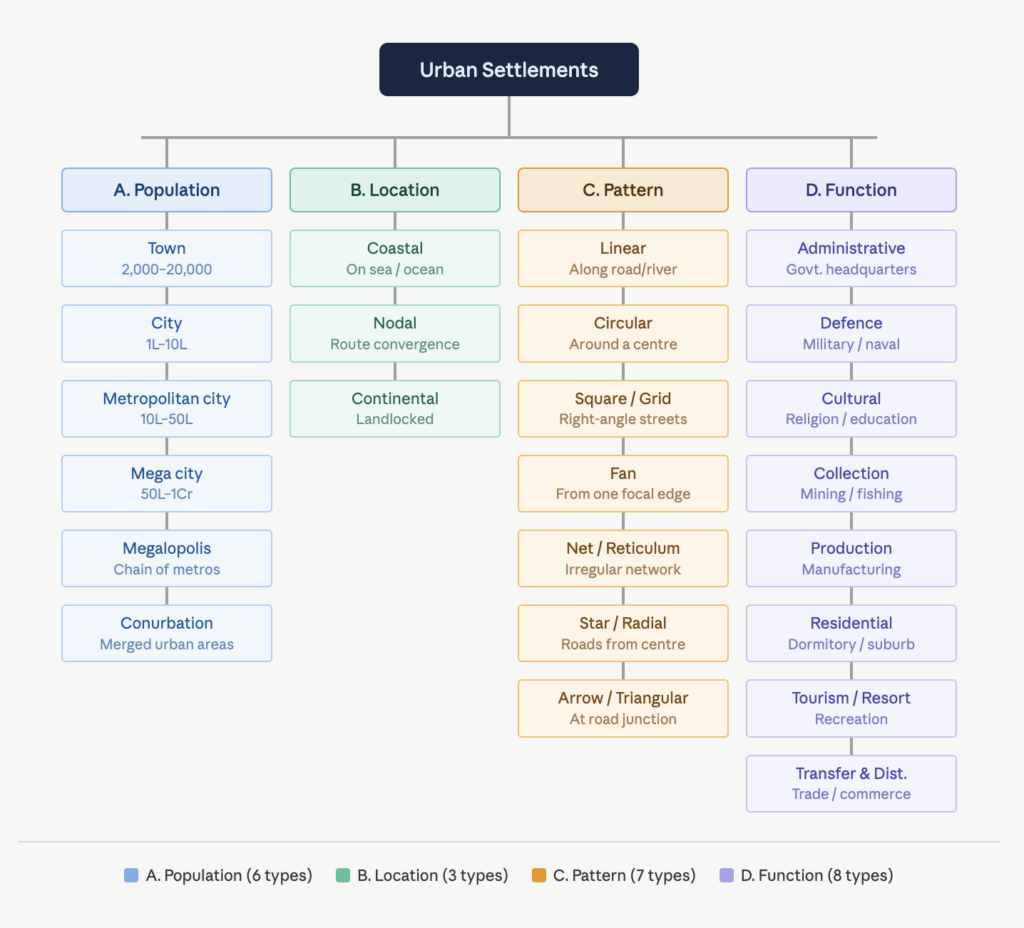
- Urban settlements may be classified on various bases:
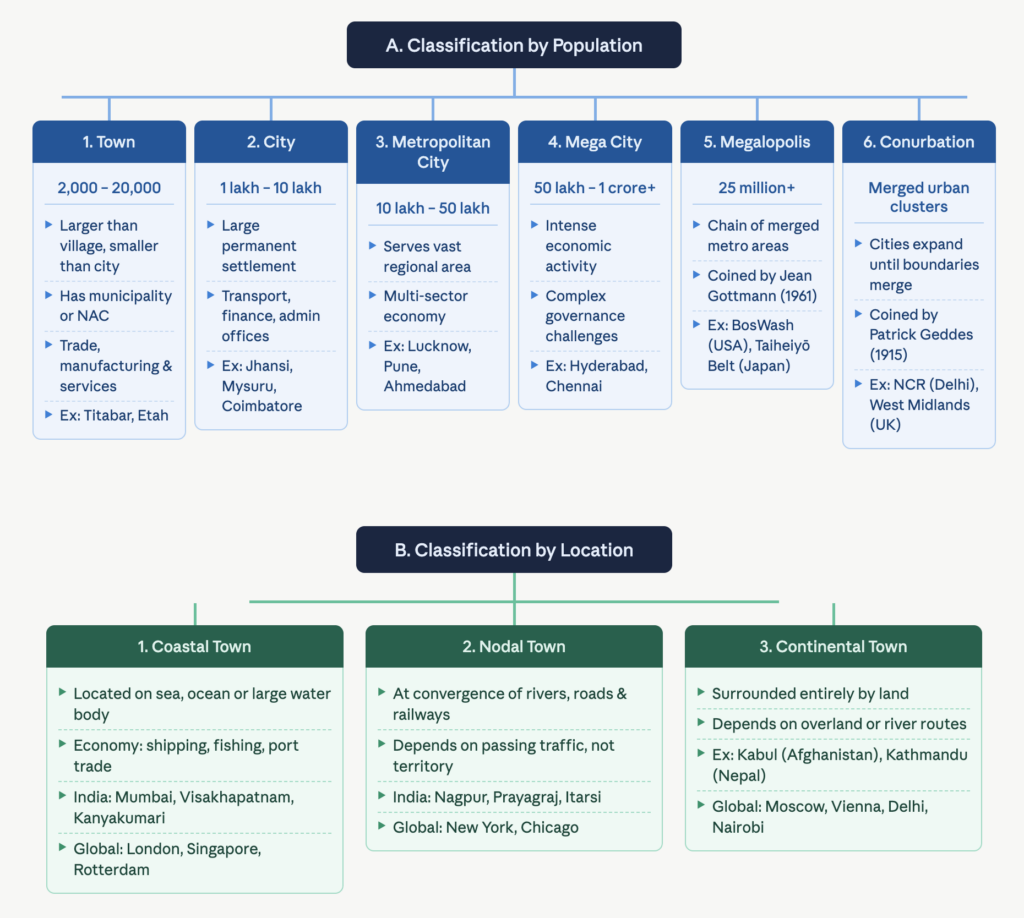
- On the basis of Population
- On the basis of Location
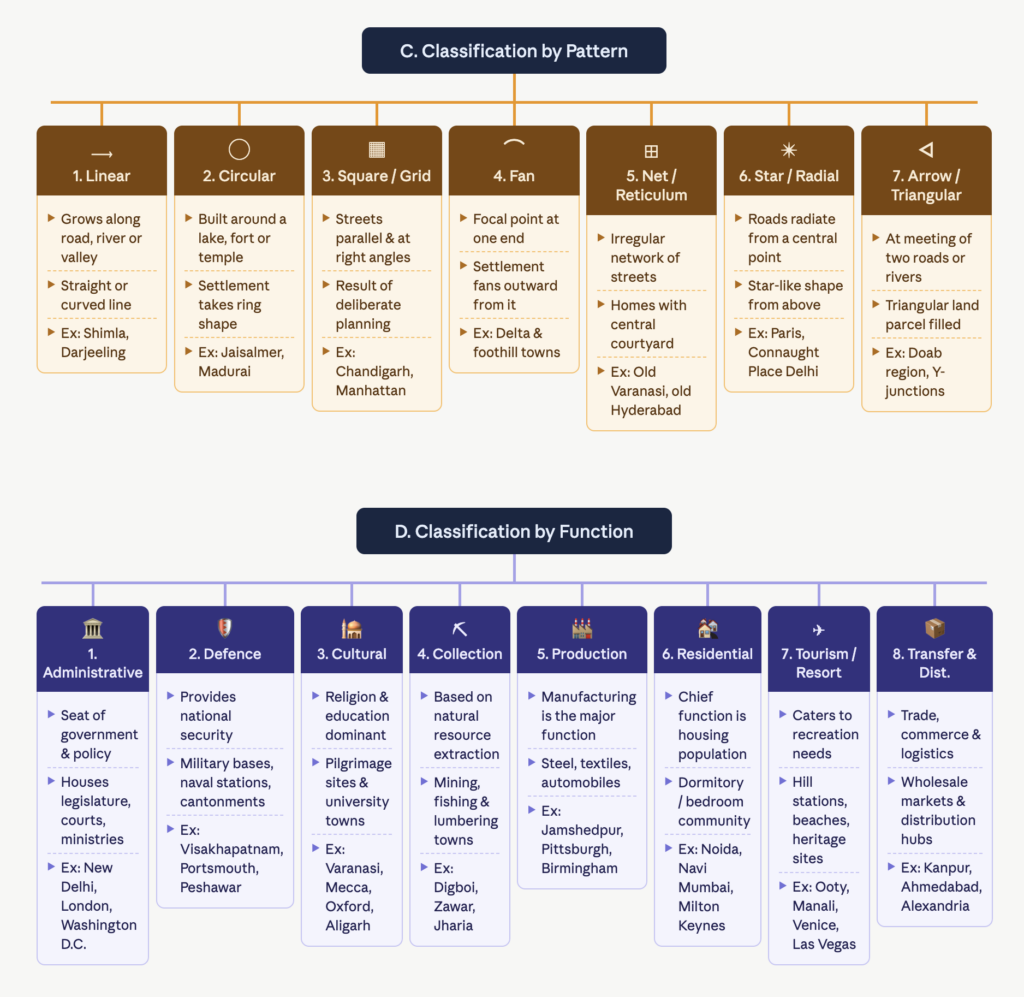
- On the basis of Pattern
- On the basis of Function
A. Types of Urban Settlement on the Basis of Population
- Six main categories: Town, City, Metropolitan City, Mega City, Megalopolis, Conurbation
1. Town
- A human settlement that is larger than a village but smaller than a city.
- Has a municipality, notified area committee (NAC), or town area committee (TAC) for local administration.
- Population ranges between 2,000 to 20,000 persons (though this varies by country).
- Population size is not the only criterion — specific functions also matter.
- Key functions present in towns:
- Manufacturing and small-scale industry
- Retail and wholesale trade
- Professional services (doctors, lawyers, accountants)
- Indian examples: Titabar (Assam), Etah (UP), Solan (HP).
- As per the Census of India, a settlement is classified as a town if:
- (a) it has a minimum population of 5,000;
- (b) at least 75% of the male working population is engaged in non-agricultural pursuits; and
- (c) a population density of at least 400 persons per km².
- These multi-factor criteria prevent over-counting of “urban” population.
2. City
- A large and permanent human settlement — regarded as a “leading town.”
- Lewis Mumford defined it as: “the physical form of the highest and most complex type of associative life.”
- Population: one lakh (1,00,000) to one million (10,00,000).
- Much larger than towns with a greater number of economic functions.
- Key features of a city:
- Major transport terminals (railway stations, bus depots, airports)
- Regional and national financial institutions (banks, stock exchanges)
- Regional administrative offices and courts
- Specialized educational and healthcare facilities
- Indian examples: Jhansi, Mysuru, Coimbatore, Nagpur, Amritsar.
- Cities globally are defined very differently. Japan requires 50,000 inhabitants; China sets the bar at 100,000. The UN’s Degree of Urbanisation (2020) classifies a city as any contiguous high-density cluster of ≥1,500 persons/km² with a total population of at least 50,000 — to allow cross-country statistical comparisons.
3. Metropolitan City
- Cities with population between one million (10 lakh) to five million (50 lakh).
- Serve as regional economic engines, drawing people and businesses from large surrounding areas.
- Have extensive suburban spread, satellite towns, and complex commuter zones.
- Key characteristics:
- Multi-sector economy (industry, services, IT, trade)
- Major regional airports and inter-city rail connections
- Universities, research institutions, and teaching hospitals
- Significant in-migration from rural and smaller urban areas
- Indian examples: Lucknow, Pune, Ahmedabad, Surat, Kochi.
4. Mega City
- Cities having more than 5 million population.
- Characterized by intense economic activity, severe infrastructure pressure, and complex governance.
- Generate a disproportionately large share of national GDP.
- Challenges associated with mega cities:
- Housing shortages and growth of informal settlements/slums
- Traffic congestion and air pollution
- Pressure on water supply, sanitation, and waste management
- Rising inequality between rich and poor neighborhoods
- Indian examples: Hyderabad, Chennai, Bengaluru.
- The UN now defines megacities as urban areas with 10 million+ inhabitants. As of 2025, there are 33 megacities worldwide — up from just 8 in 1975. Jakarta (Indonesia) has overtaken Tokyo as the world’s largest city with nearly 42 million residents, followed by Dhaka (~40 million) and Tokyo (~33 million). Nineteen of the 33 megacities are in Asia.
Global Fact — Megacities 2025 (UN World Urbanization Prospects)
- The number of megacities has quadrupled from 8 in 1975 to 33 in 2025. By 2050, the count is expected to rise to 37, with new entrants from Africa including Addis Ababa (Ethiopia) and Dar es Salaam (Tanzania). Despite their prominence, small and medium-sized cities house more people than megacities and are growing faster, particularly in Africa and Asia.
5. Megalopolis
- A very large, heavily populated city or urban complex with more than 5–10 million population.
- Formed from the coalescence of a chain of metropolitan areas into one continuous urban corridor.
- Each metropolitan area within it has grown around a substantial urban nucleus.
- The term was coined by geographer Jean Gottmann (1961) to describe the northeastern US corridor.
- Characteristics of a megalopolis:
- Continuous built-up area stretching hundreds of kilometres
- Multiple city centres with distinct identities but shared infrastructure
- Complex inter-city commuting patterns
- Extremely high land values and property costs
- Key global examples:
- BosWash (USA) — Boston–New York–Philadelphia–Washington D.C. corridor, ~700 km long, ~55 million people
- Taiheiyō Belt (Japan) — Tokyo–Nagoya–Osaka–Kobe corridor, world’s most productive megalopolis
- Pearl River Delta (China) — Guangzhou–Shenzhen–Hong Kong region, the world’s largest urban agglomeration by area
- India’s emerging Delhi–Meerut–Agra corridor and the Mumbai–Pune industrial belt are developing megalopolitan characteristics, driven by expressway connectivity, economic zones, and rapid population growth along these corridors.
6. Conurbation
- An extended urban area comprising a number of cities, large towns, and other urban areas that have merged to form one continuous urban and industrially developed area.
- Formed through population growth and physical expansion — neighbouring cities grow until their boundaries touch and eventually merge.
- Unlike a megalopolis, a conurbation is typically more compact and regionally limited.
- The term was coined by Patrick Geddes (1915) in his book Cities in Evolution.
- Key global examples:
- West Midlands, England — Birmingham, Wolverhampton, Coventry
- Rhine-Ruhr, Germany — Cologne, Dortmund, Essen, Düsseldorf
- Randstad, Netherlands — Amsterdam, Rotterdam, The Hague, Utrecht
- Greater London — London with surrounding boroughs and commuter towns
- Indian context: The National Capital Region (NCR) — Delhi, Gurgaon, Noida, Faridabad, Ghaziabad — is India’s most prominent conurbation.
B. Types of Urban Settlement on the Basis of Location
- Three main types: Coastal, Nodal, Continental
1. Coastal Town
- Towns located on the coast of a sea, ocean, or large water body.
- Historically emerged as port and trading centres due to access to maritime trade routes.
- Economy dominated by shipping, fishing, international trade, and port-based industries.
- Indian examples: Mumbai (Maharashtra), Visakhapatnam (Andhra Pradesh), Kanyakumari (Tamil Nadu), Chennai, Kochi, Surat.
- Global examples: London, New York, Singapore, Rotterdam, Sydney, Shanghai.
- Modern coastal towns face growing threats from climate change — rising sea levels, storm surges, and coastal erosion now threaten hundreds of millions of urban residents globally. Cities like Miami, Jakarta, and Kolkata are developing coastal protection master plans as a result. Jakarta’s ongoing sinking (land subsidence) and flooding has even led Indonesia to shift its capital inland to Nusantara (Kalimantan).
2. Nodal Town
- Nodal towns develop at the convergence points of rivers, roads, and railways.
- Derive importance from the flow of traffic (people and goods) passing through them, not from the surrounding territory.
- Passengers and traders who pass through these routes provide the economic base.
- Types of nodal points:
- River confluences (where two or more rivers meet)
- Road/railway junctions (where multiple routes intersect)
- Port and harbour entrances (where sea and land routes meet)
- Mountain passes (gateway to or from a region)
- Global examples: New York City (harbour at the Hudson River mouth), Chicago (Great Lakes + rail hub).
- Indian examples: Nagpur (heart of India, all national highways converge), Allahabad/Prayagraj (Ganga–Yamuna confluence), Itarsi (major railway junction, MP).
- In the modern era, airports function as new nodal points. Cities like Dubai, Singapore, and Amsterdam have built powerful economies around being global aviation hubs — modern equivalents of the 19th-century railway junction towns.
3. Continental (Inland) Town
- Towns that are surrounded entirely by land with no direct coastal or maritime access.
- Depend entirely on overland or river routes for trade and connectivity.
- Often develop in fertile agricultural plains, strategic mountain valleys, or at historical land-route crossings.
- Classic examples: Kabul (Afghanistan), Kathmandu (Nepal).
- Major continental cities globally: Moscow (Russia), Vienna (Austria), Delhi (India), Nairobi (Kenya), São Paulo (Brazil).
- Continental cities were historically at a disadvantage compared to ports, but the rise of air freight, expressways, and high-speed rail has dramatically reduced this handicap. Cities like Chengdu (China) and Addis Ababa (Ethiopia) — both inland — have become major international economic hubs in the 21st century through aggressive investment in connectivity infrastructure.
C. Types of Urban Settlement on the Basis of Pattern
- Seven main patterns: Linear, Circular, Square, Net/Reticulum, Fan, Star/Radial, Arrow
- Patterns are not random — they reflect landscape, transportation routes, historical order of development, and planning decisions.
1. Linear Pattern
- Settlement that has grown in a line — can be straight or curved.
- Follows a natural or man-made feature:
- A road or highway
- A river or canal bank
- A coastline or valley floor
- A railway line
- Buildings are arranged along pre-defined lines varying from straight to curved.
- Common in hilly or mountainous terrain where flat land is scarce.
- Indian examples: Shimla (HP), Darjeeling (WB), settlements along NH corridors.
- Linear patterns are increasingly common in ribbon development around Indian cities — where urban growth sprints outward along highways before filling in, creating traffic congestion and unplanned sprawl. Many urban planners advocate “transit-oriented development” (TOD) policies to manage this pattern responsibly.
2. Circular Pattern
- Urban settlements that occur on all sides of some central feature.
- Central features that trigger circular growth:
- Lakes, ponds, or tanks
- A fort or walled enclosure
- A temple, mosque, or church
- A meander bend or loop of a river
- Wells or oases (in arid regions)
- Houses constructed around these sites make the settlement take the shape of a circle.
- Indian examples: Jaisalmer (Rajasthan — built around the fort), many temple towns of Tamil Nadu with concentric rings of streets (e.g., Kumbakonam, Madurai).
- The circular pattern is also deliberately used in planned city design. Chandigarh’s sectors and the concentric rings of New Delhi’s Lutyens zone are modern adaptations of circular logic, ensuring equidistant access to the city centre from all directions.
3. Square / Rectangular (Grid) Pattern
- Square or rectangular cluster with streets running parallel or at right angles to one another.
- Also known as the grid-iron or checker-board pattern.
- Product of deliberate planning rather than organic growth.
- Advantages of grid pattern:
- Easy navigation and address-finding
- Efficient land subdivision and plot allocation
- Simple infrastructure (water, electricity, sewage) routing
- Indian examples: Chandigarh (Le Corbusier’s design), Jaipur’s old walled city (Jai Singh II’s 18th-century grid), Gandhinagar (Gujarat).
- Global examples: Manhattan (New York City), Melbourne (Australia), Barcelona (Eixample district by Ildefons Cerdà).
4. Fan Pattern
- Seen where a focal point or line is situated at one end of the town.
- Settlement spreads outward like a fan from this one-sided focus.
- Focal features that generate fan patterns:
- A tank or reservoir
- A riverside or embankment
- An orchard, forest edge, or mountain base
- A main road or entry gate
- A place of worship
- Particularly common in delta areas or at the base of mountains — the settlement fans outward from the high ground or water body edge.
- Indian examples: Many settlements in the Ganga–Brahmaputra delta region; towns at the foothills of the Himalayas (e.g., Haridwar, which fans out from the Ganga ghats).
5. Net / Reticulum Pattern
- Isolated homes with a central courtyard found in different parts of India.
- Net type settlements are irregularly distributed in villages and older urban quarters.
- Streets and pathways form an irregular network (or “net”) rather than a defined geometric shape.
- Common in unplanned growth areas, old city cores, and historically organic settlements.
- Indian examples: Old quarters of Varanasi, Hyderabad’s old city (Charminar area), many older mohallas of North Indian cities.
- The net/reticulum pattern is increasingly studied in the context of slum upgrading — because organic irregular settlements are often more socially cohesive and resilient than assumed. Urban planners now prefer upgrading existing organic neighbourhoods rather than demolishing and rebuilding on a grid.
6. Star / Radial Pattern
- Dwellings spread out in several directions from a central point.
- Streets or roads radiate outward from a common centre, giving a star-like appearance when viewed from above.
- Central point may be:
- A large water body (lake, reservoir)
- A major market or commercial square
- A transport junction (railway station, roundabout)
- A fort, palace, or administrative building
- Global examples: Paris (with boulevards radiating from the Arc de Triomphe — Étoile), Washington D.C. (L’Enfant’s radial plan), Moscow (ring-road + radial avenue system).
- Indian examples: Connaught Place, New Delhi (radial roads from the central circus), Laxmi Bai Nagar area.
7. Arrow / Triangular Pattern
- Arrowhead pattern of settlements occurs at the meeting of two roads or two rivers.
- Triangular pattern is a special feature of this settlement type.
- Found on any triangular patch of land between converging routes or water bodies.
- The settlement fills the triangular land parcel created by the junction, with the “point” of the arrow facing the confluence.
- Indian examples: Many settlements at doabs (land between two rivers), such as the Doab region between the Ganga and Yamuna; towns at Y-shaped road junctions across rural India.
D. Types of Urban Settlement on the Basis of Function
- Eight main functional types: Administrative, Defence, Cultural, Collection, Production, Residential, Tourism/Resort, Transfer & Distribution
- Most large cities are multifunctional — the classification refers to the dominant function.
| Functional Type | Dominant Activity | Indian Examples | Global Examples |
|---|---|---|---|
| Administrative | Government, policy, administration | New Delhi, Bhopal, Patna | Washington D.C., London, Cairo, Tokyo |
| Defence | Military bases, cantonments, naval stations | Visakhapatnam, Pune Cantonment | Portsmouth (UK), Peshawar, Nova Scotia |
| Cultural | Religion, pilgrimage, education | Varanasi, Tirupati, Aligarh, Bodh Gaya | Mecca, Jerusalem, Oxford, Cambridge |
| Collection | Mining, fishing, logging, extraction | Digboi (oil), Zawar (zinc), Jharia (coal) | Johannesburg, Broken Hill (Australia) |
| Production | Heavy industry, manufacturing | Jamshedpur, Bhilai, Rourkela, Surat | Pittsburgh (USA), Birmingham (UK), Magnitogorsk (Russia) |
| Residential | Housing suburban/dormitory population | Gurgaon, Noida, Navi Mumbai | Levittown (USA), Milton Keynes (UK) |
| Tourism / Resort | Recreation, heritage, hill stations | Ooty, Manali, Agra, Jaipur, Goa | Venice, Barcelona, Las Vegas, Pattaya, Bali |
| Transfer & Distribution | Trade, commerce, logistics, wholesale | Kanpur, Ahmedabad, Ludhiana, Hapur | Alexandria (Egypt), Norwich (UK), Kumasi (Ghana) |
1. Administrative Town
- Towns supporting administrative headquarters of higher order.
- House government institutions such as legislatures, ministries, high courts, and secretariats.
- Economic base heavily dependent on government employment and services.
- Can be historical capitals (naturally grown) or purpose-built capitals (planned).
- Major examples:
- New Delhi (India) — capital of India, seat of Parliament, Supreme Court, and executive ministries
- London (UK) — Parliament, the Crown, Whitehall bureaucracy
- Washington D.C. (USA) — Congress, White House, federal judiciary
- Cairo (Egypt) — seat of government for Africa’s most populous country
- Tokyo (Japan) — national government plus world’s largest urban economy
- Several countries have recently built or are building new purpose-designed capitals to distribute development and reduce mega-city pressure:
- Indonesia is relocating from Jakarta to Nusantara (Kalimantan), partly due to Jakarta’s sinking and flooding
- Egypt is building a New Administrative Capital east of Cairo
- Myanmar shifted to Naypyidaw (2006) — a contemporary example of deliberate capital creation
2. Defence Town
- Main purpose: to provide necessary security and protect the integrity and sovereignty of the country.
- Defence has been an important function of towns in both the past and the present.
- Features of defence towns:
- Military cantonments with restricted residential zones
- Naval dockyards, air force stations, or army headquarters
- Ordnance factories and defence research establishments
- Strategic location — coast, border, mountain pass, or high ground
- Indian examples: Visakhapatnam (Eastern Naval Command HQ), Pune (Southern Command cantonment, DRDO), Jodhpur (Western Air Command).
- Global examples: Nova Scotia (Canada), Portsmouth (UK), Peshawar (Pakistan), San Diego (USA).
- Modern defence towns have diversified significantly. Bengaluru hosts HAL (Hindustan Aeronautics Limited) and numerous DRDO labs, making it simultaneously a defence town and a production/technology city. The U.S. city of Huntsville, Alabama — built around NASA’s Marshall Space Flight Center — similarly bridges defence and cutting-edge technology.
3. Cultural Town
- Towns famous for religious and educational functions.
- Two sub-types:
- Religious towns: Places of pilgrimage where people travel for spiritual purposes
- Educational towns: Centres of learning where universities or major institutions dominate the economy
- Religious town examples:
- Varanasi (India) — one of the world’s oldest continuously inhabited cities; centre of Hindu learning and pilgrimage on the Ganga
- Badrinath, Kedarnath (India) — Char Dham pilgrimage sites
- Mecca (Saudi Arabia) — draws over 2 million pilgrims during Hajj; holiest city in Islam
- Jerusalem (Israel/Palestine) — sacred to Judaism, Christianity, and Islam
- Vatican City — the world’s smallest state, entirely a religious/administrative city
- Educational town examples:
- Oxford and Cambridge (UK) — entire city economies revolve around their ancient universities
- Aligarh (India) — home to Aligarh Muslim University (AMU), a premier institution of Muslim education
- Pilani (Rajasthan, India) — home of BITS Pilani; a small town defined by its institution
- Tirupati (Andhra Pradesh) receives more pilgrims annually than any other religious site in the world — over 50,000 visitors per day on average — generating a massive service economy around hotels, prasadam production, transport, and retail. India’s new education policy and “education cities” like Manipal (Karnataka) and Amritsar (with Guru Nanak Dev University) are creating 21st-century equivalents of traditional educational towns.
4. Collection Town
- Mining towns, fishing ports, and lumbering centres fall under the category of collection centres.
- Economy based on extraction of natural resources from the surrounding area.
- Three main sub-types:
- Mining towns — coal, iron ore, copper, zinc, gold, diamond, oil
- Fishing ports — fresh fish processing, cold storage, canneries, boat-building
- Lumbering centres — timber harvesting, sawmills, pulp and paper industry
- Indian examples:
- Digboi (Assam) — Asia’s oldest oil refinery (est. 1901), built around petroleum extraction
- Zawar (near Udaipur, Rajasthan) — zinc and lead mining
- Bijolia (Madhya Pradesh) — sandstone quarrying
- Jharia (Jharkhand) — one of India’s largest and oldest coalfields
- Global examples: Johannesburg (South Africa) — gold rush origin; Aberdeen (UK) — transformed by North Sea oil.
- Collection towns face severe boom-and-bust cycles. Once resources are exhausted, they can face rapid population decline and economic collapse — a challenge confronting the US Rust Belt, post-coal towns in Wales and Germany, and many Indian mining towns today. Responsible resource planning, economic diversification, and “just transition” policies are now central to managing the decline of collection towns.
5. Production Town
- Urban places where some kind of manufacturing industry is the major function.
- Emerged strongly during industrialization, clustering near raw materials, energy sources, and transport.
- Key industrial sectors represented:
- Iron and steel production
- Textiles and garments
- Automobiles and engineering goods
- Chemicals, plastics, and petrochemicals
- Electronics and technology hardware
- Indian examples:
- Jamshedpur (Jharkhand) — Tata Steel; India’s first planned industrial city
- Rourkela (Odisha) — Steel Authority of India Limited (SAIL) plant
- Bhilai (Chhattisgarh) — SAIL integrated steel plant (Soviet collaboration)
- Durgapur (West Bengal) — steel, chemicals, and coal-based industries
- Dhanbad (Jharkhand) — coal capital of India
- Bhadravati (Karnataka) — iron, steel, and paper industries
- Global examples: Pittsburgh (USA) — steel; Magnitogorsk (Russia) — steel; Birmingham (UK) — engineering, steel, and automotive.
- The 21st century is seeing major deindustrialization and reinvention of production towns. Pittsburgh (once the “Steel City”) has transformed into a healthcare, robotics, and AI research hub — home to Carnegie Mellon University’s world-leading robotics program. In India, cities like Jamshedpur and Bhilai are diversifying into IT services and logistics to reduce dependence on steel alone. Automation and green manufacturing are the next frontier for production cities globally.
6. Residential Town
- Towns where the chief function is simply to house a concentration of population.
- Also called dormitory towns or bedroom communities — residents work in a nearby larger city.
- Offer lower land costs, less congestion, and better housing compared to the core city.
- Characteristics:
- Large share of population commuting daily to a nearby metro city
- High residential density with limited local employment
- Good road and rail connectivity to the parent city
- Shopping centres, schools, and residential amenities, but limited offices or factories
- Examples — all suburbs of major cities of the world:
- Gurgaon (Haryana) — satellite city of Delhi (though now also a major corporate hub)
- Noida and Ghaziabad (UP) — residential extensions of the NCR
- Navi Mumbai (Maharashtra) — planned to decongest old Mumbai
- Levittown (USA) — post-WWII mass housing suburb of New York
- Milton Keynes (UK) — purpose-built new town to house London’s overflow population
- The COVID-19 pandemic (2020–22) fundamentally disrupted the residential town model. With remote work normalized, many suburban dormitory towns have evolved into more self-sufficient communities with local offices, co-working spaces, and retail. This “15-minute city” concept — where all daily needs are accessible within a 15-minute walk or cycle — is now shaping new urban residential planning in India (Smart Cities Mission) and globally.
7. Tourism / Recreational / Resort Town
- Urban places that cater to the recreation needs of people.
- Economy built around tourism, hospitality, entertainment, and visitor services.
- Types of tourist attractions that drive such towns:
- Health-giving water (hot springs, mineral springs)
- Seaside recreation and beaches
- Mountain climbing and trekking
- Cultural attractions and performing arts
- Historical monuments and archaeological sites
- Sports facilities and adventure tourism
- National parks and wildlife sanctuaries
- Religious tourism and pilgrimage circuits
- Indian examples: Ooty (Tamil Nadu), Manali (Himachal Pradesh), Agra (UP), Jaipur (Rajasthan), Goa.
- Global examples: Bern, Athens, Florence, Venice, Jaipur, Pattaya (Thailand), Ho Chi Minh City, Vienna, Denpasar (Bali), Barcelona, Las Vegas.
- Over-tourism has become a major crisis for many iconic resort towns. Venice (Italy) receives 30 million tourists per year — against a resident population of only ~50,000 — leading to resident displacement, pollution, and infrastructure strain. Cities like Amsterdam, Dubrovnik, and Shimla have introduced visitor caps, heritage preservation laws, and tourist taxes. India’s tourism towns like Shimla, Mussoorie, and Manali also face rapid commercialization, water scarcity, and waste management challenges driven by uncontrolled tourist inflows.
8. Transfer and Distribution Town
- Main functions: trade, commerce, and services — moving goods and commodities between producers and consumers.
- Act as the arteries of regional and national economies.
- Key functions of transfer and distribution towns:
- Wholesale markets (mandis) for agricultural produce, grains, and commodities
- Break-of-bulk points — where large shipments are broken into smaller loads for local distribution
- Warehousing and cold storage facilities
- Financial services (commodity exchanges, banking, insurance)
- Transport and logistics hubs (trucking, railway freight yards, inland container depots)
- Indian examples:
- Kanpur (UP) — once the “Manchester of the East”; leather, textiles, and trade hub of North India
- Ahmedabad (Gujarat) — major textile and commercial distribution hub
- Vadodara and Indore — regional commercial centres
- Bhopal and Patna — administrative-cum-distribution centres
- Ludhiana (Punjab) — cycles, hosiery, and light manufacturing distribution
- Hapur (UP) — major wholesale grain and pulse market for North India
- Global examples: Norwich (England), Alexandria (Egypt), Kumasi (Ghana).
- The rise of e-commerce and digital supply chains is completely transforming transfer and distribution towns. New logistics hubs are emerging near airports and expressway corridors:
- Bhiwandi (near Mumbai) — India’s largest warehousing and logistics cluster, driven by Amazon, Flipkart, and Meesho
- Kundli (near Delhi) and Luhari (Haryana) — fast-emerging distribution corridors along the Delhi–Mumbai Expressway
- Traditional wholesale mandis are being complemented by automated fulfillment centres, cold-chain logistics parks, and multi-modal logistics hubs under the PM Gati Shakti National Master Plan
Summary
- Urban settlements are among the most complex products of human civilization. No single classification fully captures a city’s character — most large cities are multifunctional, combining elements of several types. The four classification systems — by population, location, pattern, and function — are complementary lenses, each revealing a different dimension of how human societies organize collective life in space. As urbanization accelerates globally, understanding these categories becomes essential for planners, policymakers, and geographers shaping the cities of the 21st century.