- Economic geography has no single theory. It is a plural, evolving sub-discipline built from several theoretical perspectives. Each starts from different assumptions about people, firms and space.
- Even its key concepts are debated.
- Some geographers treat space as absolute (a container measured in kilometres), others as relative (measured by time and cost) or relational (produced by flows and power).
- The meaning of a concept therefore depends on the perspective in use.
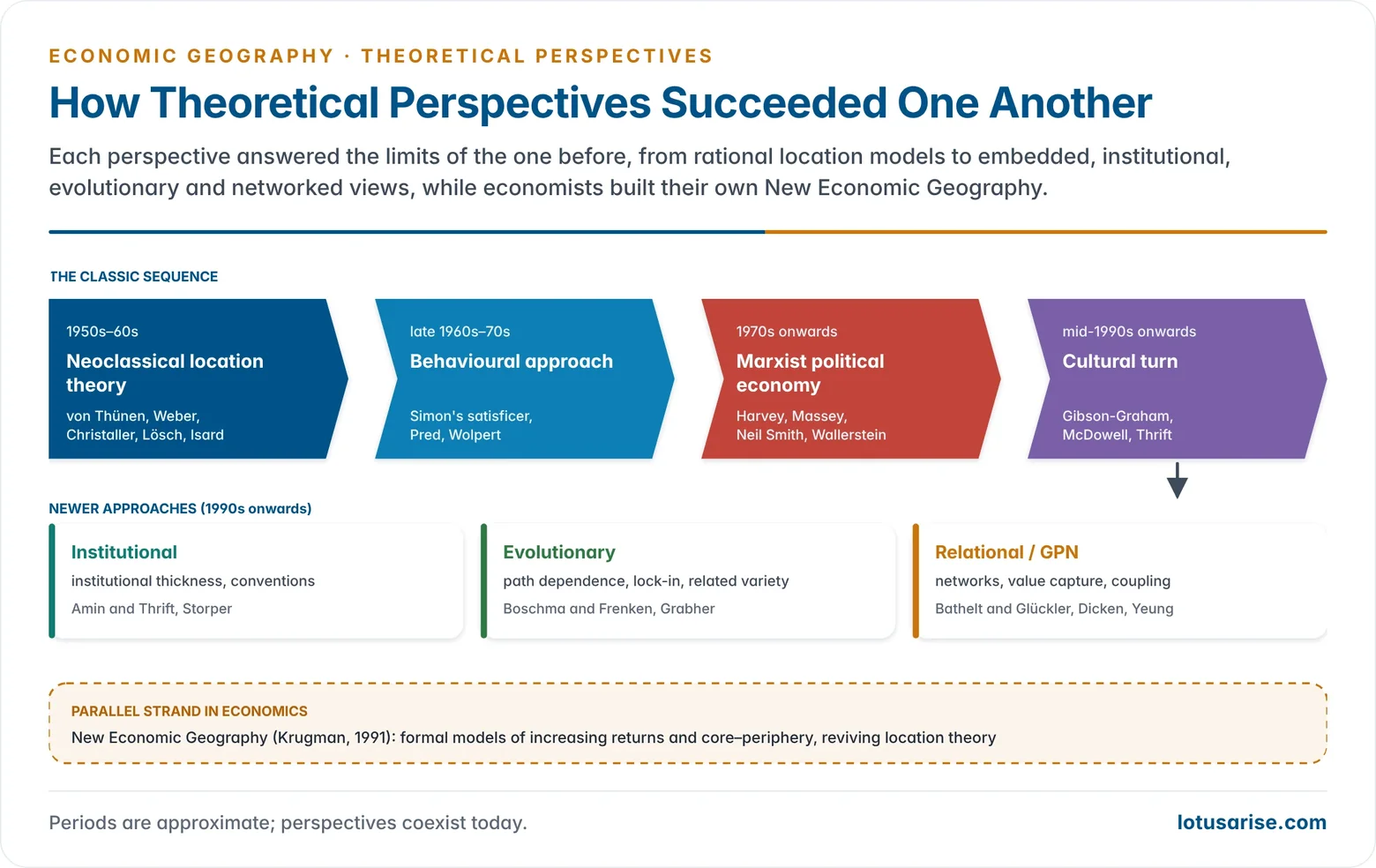
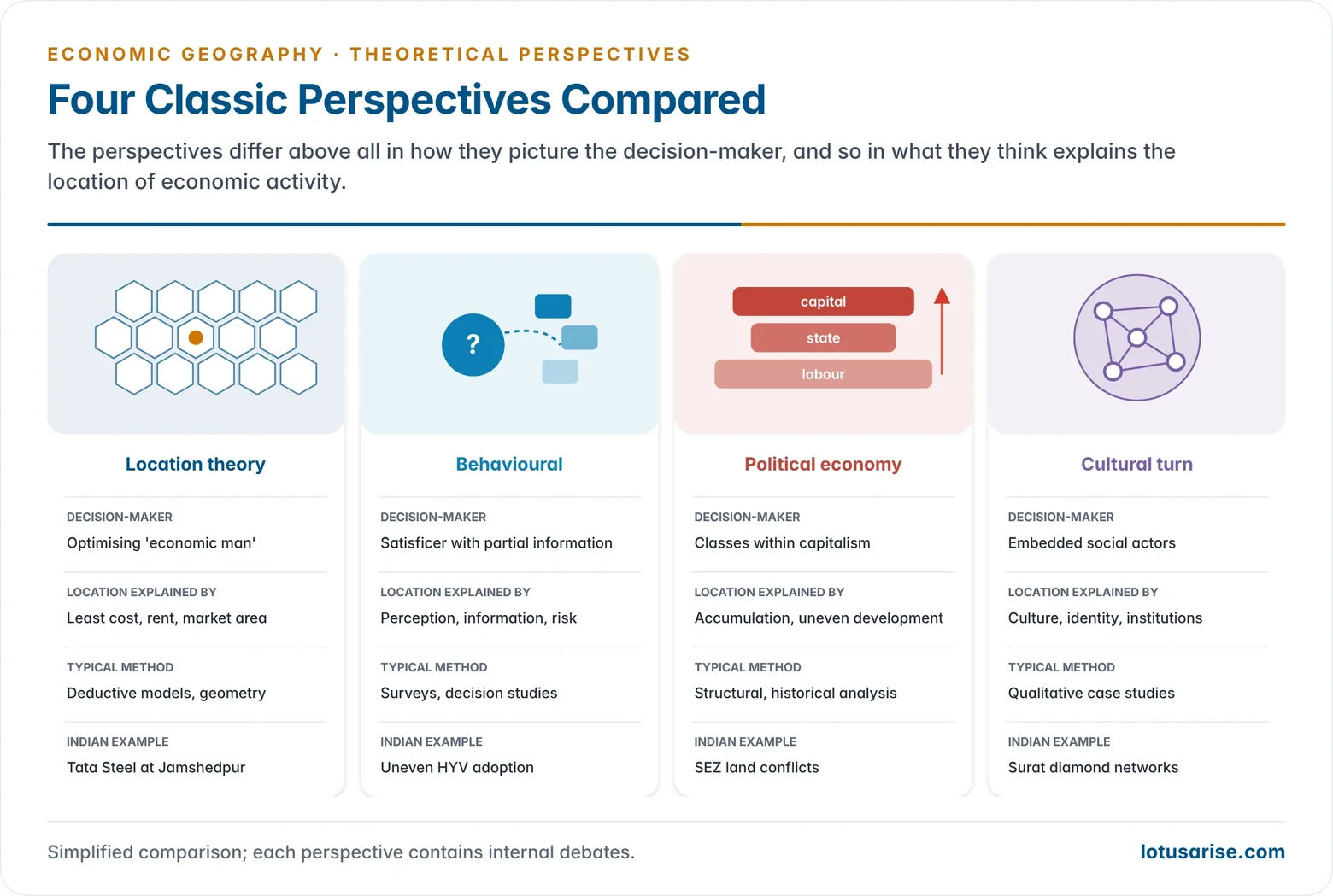
- Four perspectives form the classic sequence: neoclassical location theory, the behavioural approach, Marxist political economy and the post-structuralist/cultural turn.
- Since the 1990s, institutional, evolutionary and relational approaches have been added.
- The economists’ New Economic Geography forms a parallel tradition.
The Classic Sequence

Neoclassical Location Theory
- Period: dominant in the 1950s and 1960s, during the quantitative revolution, though its roots are much older.
- Aim: to identify and explain regularities in the location of economic activities, using models drawn from neoclassical economics.
- Assumptions:
- Rational economic man (homo economicus): perfectly informed and profit-maximising.
- Isotropic plain: a uniform surface with equal transport in all directions.
- Perfect competition and constant or diminishing returns.
- Foundational models:
- Johann Heinrich von Thünen (1826): agricultural land-use rings set by distance to market and economic rent.
- Alfred Weber (1909): least-cost industrial location, using the material index, isodapanes and labour and agglomeration deviations.
- Walter Christaller (1933) and August Lösch (1940): central places, hexagonal market areas and the hierarchy of settlements.
- Harold Hotelling (1929): spatial competition between two sellers.
- Walter Isard (Location and Space-Economy, 1956) founded regional science.
- Legacy: this phase laid the groundwork for regional science, spatial economics and geographical economics.
- Interest revived in the 1990s through Paul Krugman’s New Economic Geography.
- Criticism:
- Its assumptions are unrealistic: real space is uneven and real decision-makers are not all-knowing.
- It is static, describing equilibrium rather than change.
- It ignores power, institutions, history and culture. Many geographers grew dissatisfied with its abstract, model-driven character.
- India: the siting of Tata Steel at Jamshedpur (1907) near the iron ore, coal and water of the Chotanagpur region fits Weberian least-cost logic.
Behavioural Approach
- Period: emerged in the late 1960s as a reaction to the limits of the quantitative revolution.
- Core idea: replace the rational, profit-maximising homo economicus with real decision-makers, who have:
- imperfect information,
- limited ability to use it, and
- varied goals, not profit alone.
- Key ideas:
- Herbert Simon’s “satisficer” (bounded rationality): people accept a satisfactory outcome, not the optimum.
- Allan Pred’s behavioural matrix (1967): location decisions depend on the quantity of information and the ability to use it. Optimal locations are reached largely by chance.
- Julian Wolpert (1964): farmers in central Sweden achieved only about two-thirds of their potential productivity. Their choices were constrained by information and attitudes to risk.
- Mental maps and perception of places (Peter Gould).
- Contribution: it explains why firms and farmers often choose “good enough” locations and crops, and why inertia and imitation are common.
- Criticism:
- It focuses on individuals and does not adequately examine the relationship between individual decision-makers and wider society: class, institutions, the state.
- It is often descriptive and hard to generalise.
- India: the uneven adoption of high-yielding varieties in the 1960s–70s reflected differences in information, credit and attitudes to risk among farmers, as well as differences in irrigation.
Structuralist and Marxist Political Economy
- Period: influential from the 1970s onwards, and still a strong current.
- Core idea:
- Social relations, especially class, are the centre of analysis.
- Spatial patterns are outcomes of the structures of capitalism, not of free individual choice.
- Attention shifts from spatial patterns and location factors to the social relations and economic structures that produce them.
- Key thinkers and concepts:
- David Harvey (Social Justice and the City, 1973; The Limits to Capital, 1982):
- capital accumulation and over-accumulation;
- the “spatial fix”, in which crises are resolved by expanding geographically;
- the built environment as a sink for surplus capital.
- Doreen Massey (Spatial Divisions of Labour, 1984): firms locate different stages (headquarters, research, routine assembly) in different regions. Each new round of investment lays a new layer over earlier geographies.
- Neil Smith (Uneven Development, 1984): the see-saw movement of capital between developed and underdeveloped places.
- Dependency and world-systems theory (Andre Gunder Frank, Immanuel Wallerstein): core–periphery relations in the world economy.
- David Harvey (Social Justice and the City, 1973; The Limits to Capital, 1982):
- Contribution: it explains uneven development, deindustrialisation, regional decline and the exploitation of labour and periphery.
- It made economic geography critical and socially aware.
- Criticism:
- Structural determinism: people appear as bearers of structures.
- Economism: culture, gender and race are reduced to class.
- Weak attention to place-specific detail.
- India:
- Political-economy readings of SEZ land acquisition (Singur, 2006–08), of the mineral-rich but poor tribal belt of central India, and of migrant labour in coastal industrial hubs.
Post-structuralist Approaches and the Cultural Turn
- Period: from the mid-1990s, under the influence of post-structuralist philosophy.
- Core idea:
- Economic processes cannot be separated from their social, cultural and political contexts.
- Culture, identity and institutions are central to how economies work, not add-ons.
- Shifts it brought:
- From general structures to particular, place-specific features of societies and economies.
- From class alone to multiple identities: gender, race, age, religion and culture.
- From one capitalist economy to “diverse economies”. J. K. Gibson-Graham (1996) drew attention to unpaid work, co-operatives, gifting and the informal sector.
- Key contributions:
- Linda McDowell’s studies of gendered work in the City of London finance industry.
- Work on consumption, identity and the cultural meaning of goods.
- Postcolonial critiques of Western-centred theory.
- Criticism: it can become descriptive and lose sight of power and structure. Case studies are hard to generalise.
- India:
- The caste and community networks of Surat’s diamond trade and Marwari business houses.
- Women’s self-help groups and dairy co-operatives such as Amul.
Newer Perspectives
Institutional Approach
- Core idea: economies are shaped by institutions, both formal (laws, regulations, state agencies) and informal (norms, trust, conventions).
- Key ideas:
- “Institutional thickness” (Ash Amin and Nigel Thrift, 1994): many institutions, high interaction and a shared sense of purpose help regions prosper.
- Untraded interdependencies (Michael Storper): conventions, trust and tacit knowledge that make clusters work.
- Learning regions and varieties of capitalism (Peter Hall and David Soskice, 2001), which compare liberal and coordinated market economies.
- India: state-level differences in industrial policy, labour laws and ease of doing business help explain why Tamil Nadu and Gujarat attract more manufacturing than many other states.
Evolutionary Economic Geography
- Core idea: regional economies evolve over time. History matters.
- Key ideas:
- Path dependence: small early events lock places into trajectories (Paul David, W. Brian Arthur).
- Lock-in: old strengths become rigidities. Gernot Grabher (1993) used the Ruhr’s coal and steel complex as the example.
- Related variety and regional branching: new industries grow from related existing ones.
- The field was framed by Ron Boschma and Koen Frenken (2006).
- India:
- Bengaluru’s IT grew from earlier public-sector research and aerospace institutions (IISc, HAL, ISRO) and a skilled workforce.
- Kolkata’s jute industry shows how lock-in can turn into long decline.
Relational Approach and Global Production Networks
- Core idea: economic action is understood through relations and networks between firms, workers, states and places, not through isolated units.
- Key ideas:
- Relational economic geography (Harald Bathelt and Johannes Glückler, 2003).
- Global production networks (the Manchester school: Jeffrey Henderson, Peter Dicken, Martin Hess, Neil Coe, Henry Wai-chung Yeung, 2002). Value is created, enhanced and captured across networked places.
- Strategic coupling: regional assets are matched with the needs of lead firms.
- India:
- Indian IT and pharmaceutical firms are embedded in global networks.
- Apple’s supplier network in Tamil Nadu and Karnataka shows strategic coupling.
Two “New Economic Geographies”
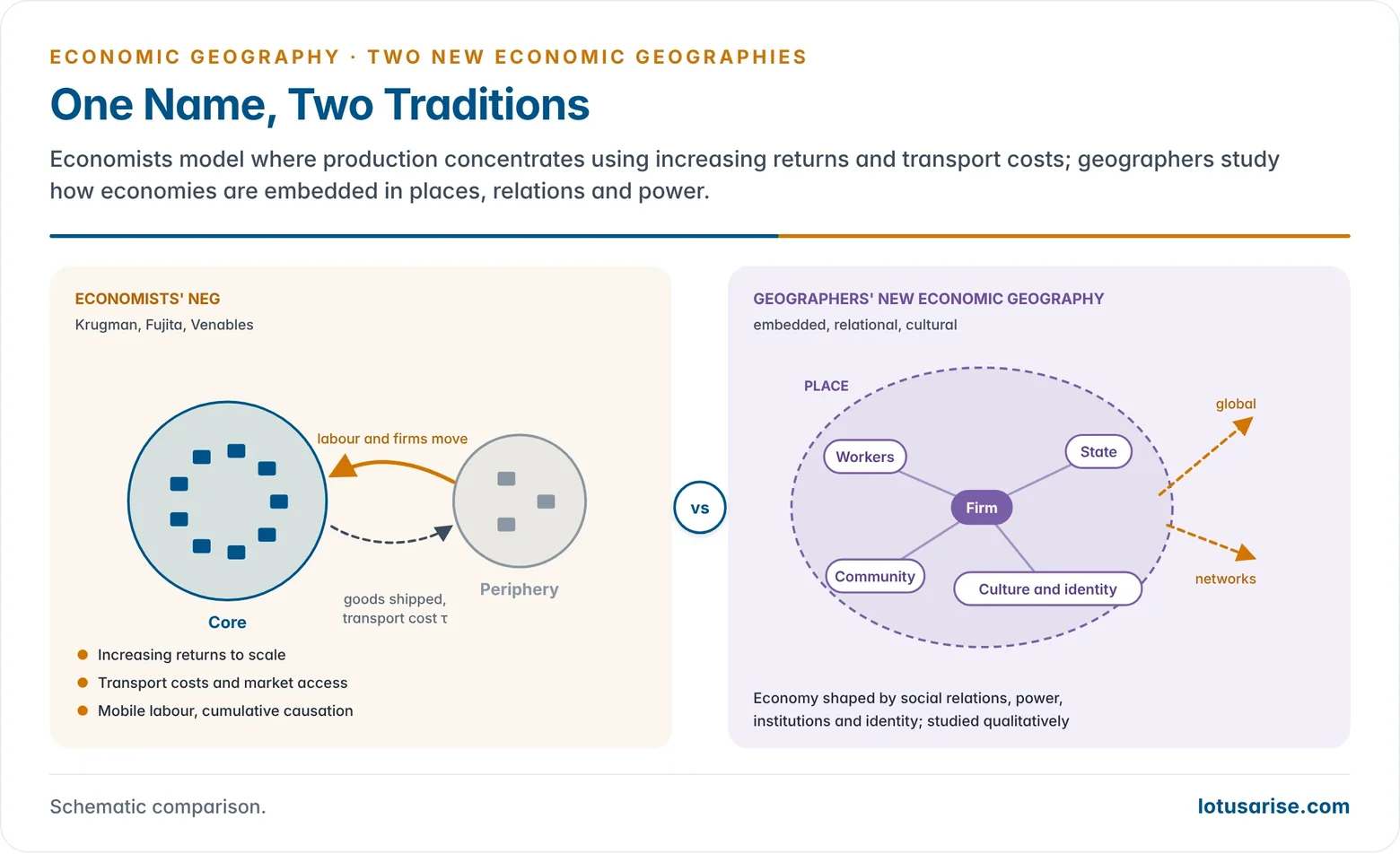
- The phrase “new economic geography” has two meanings, and the difference shows how geographers and economists see the purpose of the field.
The Economists’ NEG
- Its chief architect is Paul Krugman (Geography and Trade, 1991; Nobel Prize, 2008).
- For him, economic geography is the study of “the location of production in space”: a branch of economics asking where activities happen and how their locations relate.
- Method:
- Formal general-equilibrium models with increasing returns, imperfect competition and transport costs.
- Geography is usually reduced to transport cost.
- It shares much with neoclassical location theory, though with increasing returns at its core.
- Many geographers prefer to call it “geographical economics”.
The Geographers’ “New Economic Geography”
- It emerged with the cultural turn of the mid-1990s. It is not one unified theory but a diverse set of approaches.
- It offers a sharply different view of how economies work and how economic geographies should be studied:
- Economic processes are embedded in social, cultural, institutional and political contexts, not driven by market forces or transport costs alone.
- It studies how social relations, culture, identity (class, gender, race) and local history shape economic activity in space.
- Its methods are often qualitative: interviews, case studies and ethnography.
- Bridging efforts: the Oxford Handbook of Economic Geography (2000) and the Journal of Economic Geography (from 2001) brought both groups together. The differences remain substantial.
| Feature | Economists’ NEG | Geographers’ new economic geography |
|---|---|---|
| Core question | Why does production concentrate? | How are economies shaped by society, culture and power? |
| Theory | One formal model family (Krugman, Fujita, Venables) | Many approaches, no single theory |
| Method | Mathematical general equilibrium | Qualitative, case-based, relational |
| Space | Transport cost; often abstract | Place-specific, embedded, relational |
| Actors | Representative firms and workers | Firms, workers, states, communities, identities |
Comparing the Perspectives
| Perspective | Period | View of actors | Key concepts | Main criticism |
|---|---|---|---|---|
| Neoclassical location theory | 1950s–60s (roots 1826) | Rational, fully informed | Least cost, economic rent, market areas | Unrealistic, static |
| Behavioural | Late 1960s–70s | Bounded rationality, satisficers | Behavioural matrix, perception | Ignores structures |
| Marxist political economy | 1970s onwards | Classes within capitalism | Accumulation, uneven development, spatial fix | Structural determinism |
| Cultural / post-structural | Mid-1990s onwards | Embedded, plural identities | Embeddedness, diverse economies | Loses power and generality |
| Institutional | 1990s onwards | Shaped by rules and norms | Institutional thickness, conventions | Hard to measure |
| Evolutionary | 2000s onwards | Routines of firms | Path dependence, lock-in, related variety | Can neglect power |
| Relational / GPN | 2000s onwards | Actors in networks | Value capture, strategic coupling | Network boundaries unclear |
| NEG (economists) | 1991 onwards | Representative agents | Increasing returns, core–periphery | Thin view of place |
- Present position:
- Economic geography today is pluralist. Scholars combine insights, for example evolutionary and institutional views of clusters, or political-economy and relational views of value chains.
- This variety is a strength, because the field draws on many disciplines and not only on economics.
Previous Year Questions
- No direct PYQ has been asked on this sub-topic yet.