

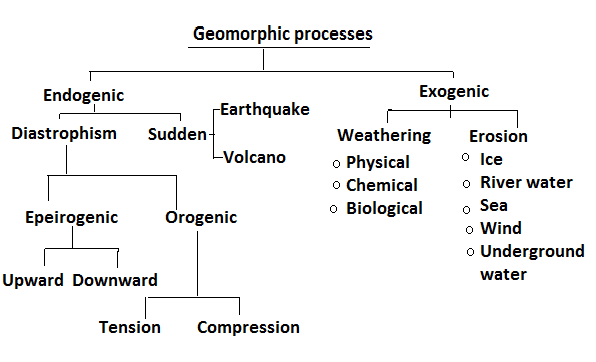
- Exogenic (exogenetic) forces are the external forces that draw their energy from the atmosphere and the Sun and act on the land through weathering, mass wasting, erosion, transportation and deposition.
- They are also called epigene, denudational, destructional or gradational forces, because they wear down the relief that internal forces build.
- They work against the endogenic forces, which create vertical irregularities such as mountains, plateaus and rift valleys.
- Every landscape is the outcome of this continual contest: internal forces raise relief, external forces plane it down.
- Their net work is planation: each exogenic process tends to reduce the land towards a low, gently sloping surface.
Exogenic Forces: Meaning, Energy and Classification
Nature of Exogenic Forces
- Exogenic processes result from stress induced in earth materials by forces arising from the Sun’s heat and gravity.
- Stress is force per unit area, produced in a solid by pushing or pulling; when it exceeds a rock’s strength, the rock breaks or moves.
- Temperature and precipitation are the two climatic elements that control most exogenic processes, through thermal, moisture and chemical stresses.
- Most exogenic effects are small and slow, but repeated over long spans they fatigue and break even the hardest rocks.
Sources of Energy
- Solar radiation drives the atmosphere and the hydrological cycle, and so powers running water, wind, waves and glaciers; its heating and cooling also drive frost action and chemical reactions.
- Gravity is the directional force behind all exogenic work: it pulls material downslope and sets the gradients along which every agent moves.
- Tidal forces add a smaller share on coasts, and organisms add biological energy.
- Endogenic forces, by contrast, draw on the Earth’s internal heat.
Geomorphic Processes and Geomorphic Agents
- A geomorphic process is any physical or chemical change that affects the surface and shapes landforms.
- John B. Thornes (1979) defined it as dynamic action in a geomorphic system involving the application of forces over gradients.
- A geomorphic agent is the mobile medium that detaches, carries and deposits material: running water, groundwater, glaciers, wind, waves and currents.
- William D. Thornbury kept the two terms apart; in practice they are often used as synonyms (“fluvial process” for the work of rivers).
- Gravity is not an agent, since it carries nothing itself, but no agent moves without it.
| Basis | Endogenic forces | Exogenic forces |
|---|---|---|
| Origin | Earth’s interior | Atmosphere and surface |
| Energy | Internal heat, mantle convection | Solar energy, gravity |
| Nature | Constructive (build relief) | Destructive / gradational (level relief) |
| Speed | Sudden (earthquakes, eruptions) or slow (diastrophism) | Mostly slow and continuous; sudden in landslides, floods |
| Examples | Folding, faulting, warping, volcanism | Weathering, mass wasting, erosion, deposition |
| Relief order | First- and second-order relief | Third-order (detailed) relief |
Classification of Geomorphic Processes
- By source, geomorphic processes fall into four groups.
- Epigene (exogenous) processes, which are gradational:
- Degradation: weathering, mass movement, and erosion by running water, groundwater, waves, wind, glaciers and periglacial processes.
- Aggradation: deposition by rivers, groundwater, waves, wind and glaciers.
- Hypogene (endogenous) processes, which are constructional: epeirogenic (emergence, submergence) and orogenic (folding, faulting, warping) movements, plus earthquakes and volcanism.
- Extraterrestrial processes, such as meteorite impacts.
- Anthropogenic processes, the geomorphic work of human beings.
- Epigene (exogenous) processes, which are gradational:
- Exogenic processes can also be grouped by climate, each zone having its own dominant set, the basis of morphogenetic regions.
Gradation: Degradation and Aggradation
- Gradation is the sum of processes that bring the surface to a common level, working in two opposite ways.
- Degradation (“levelling down”) lowers upstanding land by weathering, mass wasting and erosion.
- Example: Himalayan rivers cutting deep gorges.
- Aggradation (“levelling up”) raises low ground by deposition.
- Example: the building of the Indo-Gangetic plain from Himalayan sediment.
- What is degraded in one place is aggraded in another, so a sediment cascade runs from mountain to plain to sea floor.
Factors Controlling Exogenic Processes
- Climate decides which process dominates: frost action in cold regions, chemical weathering in the humid tropics, wind in deserts.
- Rock type and structure: folds, faults, joints, bedding planes, dip, mineral hardness, chemical susceptibility and permeability.
- Permeable rocks (sandstone, many limestones) often stand up as plateaus and escarpments; impermeable, weak rocks (clay, shale) wash away into vales and lowlands.
- Resistance is relative to climate: limestone dissolves readily in humid regions but is resistant in hot deserts.
- Slope, vegetation, time and human activity complete the list.
Denudation
Meaning and Components
- Denudation (from “denude”, to strip off or uncover) is the collective term for processes that wear away and lay bare the land.
- It includes weathering, mass wasting, erosion and transportation; deposition is aggradation, the end stage of the same cycle.
- Weathering is static: it breaks rocks in situ. Erosion is dynamic: it removes and carries material and needs a moving agent.
- Weathering prepares material and speeds erosion, yet it is not a precondition for it: rivers and glaciers can erode fresh rock.
Weathering
- Weathering is the disintegration and decomposition of rocks in situ by physical, chemical and biological agents; it is mechanical, chemical or biological.
- Geomorphic significance: weathering forms the regolith and soil on which the biosphere depends, concentrates ores such as bauxite and laterite (as on the Chotanagpur and Deccan uplands), and prepares loose material for mass wasting and erosion.
- Uneven weathering of jointed rock leaves tors, domes and inselbergs, and deep tropical weathering followed by stripping produces etchplains.
Mechanical Weathering
- Mechanical weathering breaks rock into pieces without changing its chemistry.
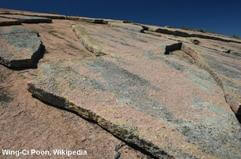
- Exfoliation by unloading (sheeting): as erosion removes the overburden from deep-seated intrusive rocks, pressure release makes outer layers expand and split in sheets parallel to the surface.
- Exfoliation by thermal stress: daily and seasonal heating makes the surface layers expand more than the rock beneath, so they peel off; it is strongest in dry climates and high altitudes, and moisture enhances it.
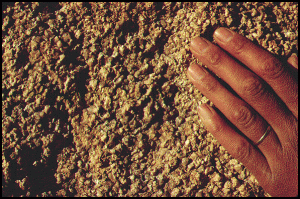
- Granular disintegration: in coarse-grained rocks of mixed minerals, dark grains absorb more heat than light ones, and unequal expansion loosens the rock grain by grain.
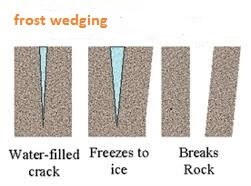
- Frost weathering covers processes driven by ice growth in pores and cracks; water expands by about 9% on freezing.
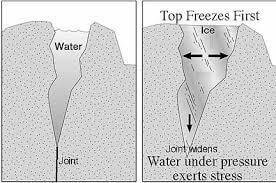
- Frost wedging: repeated freeze–thaw cycles force water-filled cracks wider.
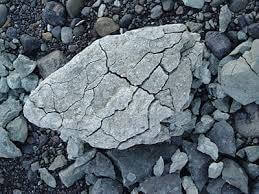
- Frost shattering: severe frost splits rock into sharp, angular fragments that pile up as scree (talus).
- Block separation: freeze–thaw along joints splits rock into angular blocks.
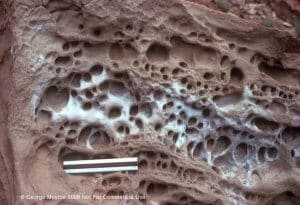
- Salt weathering: salt crystals growing from evaporating saline water expand and prise grains apart; it is typical of arid and coastal settings.
- Mechanical weathering makes rock transportable and enlarges the surface open to chemical attack.
Chemical Weathering
- Chemical weathering decomposes rocks by changing their minerals; it is fastest where it is warm and wet, with water as the main operator.
- Solution and carbonation: water holding CO₂ forms weak carbonic acid that dissolves carbonate rocks (CaCO₃ + H₂O + CO₂ → Ca²⁺ + 2HCO₃⁻), the basis of karst landforms.
- Hydrolysis: H⁺ and OH⁻ ions of water break down silicate minerals such as feldspar into clays; it is the key process on granite and basalt.
- Hydration swells minerals (anhydrite to gypsum); oxidation of iron gives the red and yellow oxides of laterite.
- Acid rain: sulphur and nitrogen oxides from fossil fuels form sulphuric and nitric acids, which attack limestone and marble monuments.

Biological Weathering
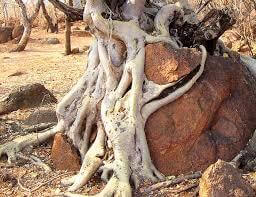
- Biological weathering is rock breakdown by plants, animals and microbes: physically (roots widening cracks, burrowing, hooves) and chemically (organic acids from lichens, roots and decay).
Mass Wasting
- Mass wasting (mass movement) is the downslope movement of soil, regolith and rock as a mass under gravity, usually helped by water; it needs no transporting medium.
- A landslide is the rapid movement of rock, debris or earth when slope materials fail.
| Type | Movement | Speed / note |
|---|---|---|
| Fall | Free fall, bounce or roll from steep cliffs | Extremely rapid |
| Topple | Forward rotation about a pivot at the base | Rapid |
| Rotational slide (slump) | Along a curved plane, mass tilts backward | Slow to rapid |
| Translational slide | Along a planar surface, parallel to slope | Rapid |
| Lateral spread | Sideways extension over a weak, often liquefied layer | Often earthquake-triggered |
| Flow (creep, mudflow, debris flow) | Deforming viscous mass, no discrete failure plane | Imperceptible to very rapid |
- Causes: natural (high pore-water pressure after heavy rain, earthquakes, undercutting by rivers and waves, vegetation loss) and human (slope cutting for roads, blasting, vibration, deforestation, altered drainage).
- Mitigation: avoid hazard zones; improve drainage; unload the head and buttress the toe; build piles and retaining walls; keep vegetation; catch rockfalls with ditches and fences; and give early warning.
- Indian examples:
- The Landslide Atlas of India (2023) of ISRO’s National Remote Sensing Centre mapped about 80,000 landslides (1998–2022) and puts about 12.6% of India’s land in the landslide-prone category, the Himalaya and Western Ghats being most exposed.
- Rudraprayag and Tehri Garhwal (Uttarakhand) have the highest landslide density and exposure in the country.
- The Wayanad debris flows of 30 July 2024, triggered by extreme rain on saturated slopes, destroyed Mundakkai and Chooralmala villages.
- Joshimath (Uttarakhand), built on old landslide debris, suffered serious land subsidence in early 2023, worsened by poor drainage and heavy construction.
- Significance: mass wasting is the link between weathering and river erosion, feeding debris to valley floors; it drives slope retreat and builds talus cones and debris fans.
Erosion
- Erosion is the removal of rock and soil by a moving agent and its carriage elsewhere: an ex-situ process powered by the agent’s kinetic energy.
- It is the most active process shaping the Earth’s detailed (third-order) relief.
Mechanisms of Erosion
| Mechanism | What happens | Main agents |
|---|---|---|
| Corrosion (solution) | Soluble minerals dissolved by water with CO₂ | Groundwater, rivers, waves |
| Abrasion (corrasion) | Rock scraped by transported “tools” (boulders, pebbles, sand) | Rivers, waves, glaciers, wind |
| Hydraulic action | Force of water alone loosens and removes rock | Rivers, storm waves |
| Attrition | Transported fragments collide and wear each other down | Rivers, waves, wind |
| Deflation | Loose, dry dust and sand lifted and blown away | Wind |
| Plucking (quarrying) | Blocks frozen to ice or loosened by waves torn out | Glaciers, waves |
| Cryoturbation, nivation | Frost churning, snow-patch erosion | Periglacial processes |
- Corrosion depends on rock composition, joints, temperature, dissolved CO₂ and contact time; groundwater is the most effective corrosive agent, and waves corrode coastal limestone into caves and coves.
- Abrasion depends on the size, amount and calibre (angularity) of the tools and on velocity.
- In rivers it works vertically (downcutting, drilling potholes), strongest in the youthful stage, and laterally (valley widening).
- Wind abrasion (sandblasting) is concentrated close to the ground, where most sand travels, undercutting rocks into mushroom forms.
- Hydraulic action peaks where storm waves compress air in joints and dislodge blocks weighing tonnes.
- Attrition makes material smaller and rounder downstream; deflation hollows out blowouts and exposes bedrock to abrasion.
Agents of Erosion
| Agent | Where dominant | Landform family |
|---|---|---|
| Running water | Humid regions, most of the land | Fluvial landforms |
| Groundwater | Limestone and dolomite | Karst landforms |
| Glaciers | High mountains, polar regions | Glacial landforms |
| Wind | Arid and semi-arid regions | Desert (aeolian) landforms |
| Waves and currents | Coasts | Marine landforms |
| Frost and snow | Ice-sheet margins, high mountains | Periglacial landforms |
- Running water, glaciers and wind are climatically controlled, so the dominant agent shifts with climate: fluvial in the Ganga plain, aeolian in the Thar, glacial in the Greater Himalaya, karst in Meghalaya, marine along the Konkan coast.
Transportation
- Transportation is the carriage of eroded material by traction (rolling, sliding), saltation (bouncing), suspension, solution and flotation.
- Rivers move bed load by traction and saltation, suspended load held up by turbulence, and dissolved load; transport is one-way (downstream).
- By the sixth power law, the weight of the largest particle a stream can move varies with the sixth power of velocity: doubling velocity raises it about 64 times.
- It was derived in the 18th–19th centuries, notably by William Hopkins in the 1840s; Grove Karl Gilbert (1914) later tested stream transport in flume experiments.
- Rivers deliver roughly 15–20 billion tonnes of sediment to the oceans each year; the Ganga–Brahmaputra carries one of the largest loads on Earth.
- By the sixth power law, the weight of the largest particle a stream can move varies with the sixth power of velocity: doubling velocity raises it about 64 times.
- Groundwater carries material almost wholly in solution, because it moves very slowly.
- Waves move sediment both ways (backwash seaward, swash landward), while longshore currents move it parallel to the coast.
- Wind transport is multi-directional: dust travels in suspension, often over thousands of kilometres; sand saltates; coarser grains creep.
- Glaciers carry debris supraglacially, englacially and subglacially; only the bed load is dragged along the floor.
- Periglacial material moves by solifluction (gelifluction) over permafrost; Kirk Bryan (1946) coined cryoturbation for frost churning of the regolith.
Deposition
Causes of Deposition
- Deposition is the laying down of material when an agent loses velocity and energy; it is the consequence of erosion, not the work of a separate agent.
- Rivers deposit when gradient falls, water spreads out, flow is obstructed, discharge drops, or load exceeds capacity: in channels, on floodplains and at mouths (deltas).
- Groundwater deposits when it becomes supersaturated through evaporation, loss of CO₂ or slower flow; wind, where its speed falls or obstacles intervene; glaciers, where ice ablates.
Depositional Work of the Agents
| Agent | Nature of deposits | Main depositional forms |
|---|---|---|
| Rivers | Sorted, stratified alluvium | Alluvial fans and cones, floodplains, natural levees, deltas |
| Groundwater | Calcite precipitated from solution | Speleothems: stalactites, stalagmites, dripstones, travertine, tufa |
| Sea waves | Reworked, temporary | Beaches, beach cusps, bars, spits |
| Wind | Well-sorted sand and silt | Sand shadows, sand drifts, dunes, loess |
| Glaciers | Unsorted till; sorted outwash | Moraines, drumlins, eskers, outwash plains |
- Groundwater: banded deposits are travertine, softer ones at cave mouths and springs tufa, and those from dripping water dripstones.
- Marine deposits are the least permanent, built, removed and rebuilt repeatedly.
- When swash supply balances backwash removal, the shore reaches a profile of equilibrium; destructive waves flatten a steep platform, constructive waves build beaches on a gentle one.
- Wind: sand heaped beside an obstacle forms sand shadows, sand between obstacles forms sand drifts, and fine silt settles far downwind as loess.
- Glaciers: till (boulder clay) is unsorted: lodgement till is dense and clay-rich, laid under the ice; ablation till is loose, let down from melting ice. Ice-contact stratified drift is reworked by meltwater, and ridges of debris are moraines.
- Indian example: the Ganga–Brahmaputra delta, the Kosi fan, the Thar dunes and the moraines below the Gangotri glacier record four different agents.
Process and Landform
Process–Response
- Each geomorphic process leaves its own imprint and develops its own assemblage of landforms, a concept stated by Thornbury among his fundamental concepts of geomorphology.
- The older poly-process approach read a landscape as the product of all processes together; process geomorphology studies each process and its landforms separately (mono-process approach).
- Canyons and deltas point to rivers, dolines and speleothems to groundwater, cirques and eskers to glaciers, dunes to wind, pingos and patterned ground to periglacial action.
- Genetic classification, pioneered by William Morris Davis, names a landform by the process that made it, revealing its origin and history.
| Descriptive name | Genetic forms (process) |
|---|---|
| Plain | Floodplain, peneplain, panplain (fluvial); karst plain (groundwater); pediplain (scarp retreat, semi-arid); etchplain (deep weathering, savanna); outwash plain (fluvio-glacial); cryoplain (periglacial) |
| Ridge | Anticlinal ridge (tectonic); hogback (tectonic–erosional); beach ridge (waves); morainic ridge (glacier); nivation ridge (periglacial) |
| Scarp | Fault scarp (tectonic); fault-line and resurrected scarps (fluvial erosion) |
| Valley | V-shaped (fluvial); rift valley (tectonic); blind valley (groundwater); U-shaped trough (glacial); dry valley (periglacial) |
| Terrace | River terraces (fluvial); marine terrace (waves); solifluction and altiplanation terraces (periglacial) |
| Hole / hollow | Pothole (fluvial); sinkhole (groundwater); thaw sink (periglacial); blowout (wind) |
- Evaluation: few landforms are truly mono-process; most are polygenetic, often shaped under past climates, and different processes can yield similar forms (equifinality).
Humans as an Exogenic Agent
- Humans now rival natural processes as a geomorphic agent through mining, construction, dredging and river regulation.
- Anthony H. Cooper and colleagues (2018) estimated that people move over 300 billion tonnes of rock and sediment a year, many times the load of all rivers.
- Dams trap sediment and starve deltas; deforestation and farming speed up soil erosion.
- India: Himalayan road-cutting and hydropower works add to landslide risk, and sand mining starves deltas and beaches.
Previous Year Questions
2015Attempt a classification of geomorphic process from the zonal point of view.2014Explain weathering and mass wasting, and describe their geomorphic significance.2011Name the climatically controlled agents of erosion. Explain how they differ in terms of properties of matter. Compare the landforms produced by each one of them.1998Write short note: Geomorphic processes.





Thank you, its a nice and brief analysis.
Deposition notes missing
Good content with better explanation
Earthquakes come under diastrophic processes.
Thank you but need some value added example with figure