

Explain weathering and mass wasting, and describe their geomorphic significance. (2014)
- Weathering breaks rock down in situ; mass wasting moves the loosened material downslope under gravity, without the help of a transporting medium such as a river, glacier or wind.
- Together they form the first stage of denudation: they prepare and deliver the material that rivers, ice, wind and waves then erode and carry away.
Weathering
- Weathering is the disintegration and decomposition of rocks and minerals at or near the Earth’s surface by exposure to the atmosphere, water and organisms, with little or no movement of the products.
Physical (mechanical) weathering — disintegration without chemical change
- Frost wedging: water expands by about 9 per cent on freezing and widens joints — dominant in periglacial and high-mountain zones such as the Himalaya.
- Thermal stress (insolation weathering): repeated heating and cooling in deserts loosens grains and outer shells; laboratory tests long suggested heat alone was weak and that moisture is needed, so it is now seen as acting with moisture and salts.
- Salt crystallisation (haloclasty): growing salt crystals pry grains apart in arid and coastal areas.
- Pressure release (sheeting): removal of overlying rock lets granite expand and split into curved sheets, forming exfoliation domes.
Chemical weathering — decomposition by chemical change
- Hydrolysis: feldspar alters to clay minerals such as kaolinite — dominant in the humid tropics.
- Oxidation: iron-bearing minerals oxidise to red-brown oxides. Under intense tropical leaching, silica is removed and iron and aluminium oxides remain, forming laterite (Western Ghats, Malabar coast, Chota Nagpur).
- Carbonation and solution: carbonic acid dissolves limestone, producing karst (the cave terrain of Meghalaya).
- Hydration: minerals take up water and swell — anhydrite becomes gypsum.
Biological weathering
- Roots widen joints, burrowing animals turn over regolith, and lichens and microbes release organic acids — combining physical and chemical action.
- Climate controls the mix: Louis C. Peltier (1950) related weathering type to mean annual temperature and rainfall — chemical weathering dominates where it is hot and wet, frost action where it is cold and moist, and weathering is weak where it is very dry.
Mass Wasting
- Mass wasting (mass movement) is the downslope movement of rock, regolith and soil under the direct pull of gravity. Water is rarely absent — it adds weight, raises pore-water pressure and reduces friction — but it does not carry the material.
- Controls: slope angle relative to the angle of repose, saturation, vegetation cover, earthquakes, and undercutting of the slope toe by rivers, waves or road cutting.
- Charles F. S. Sharpe (1938) classified mass movements by type of movement, material, water content and speed:
| Type | Typical speed | Examples |
|---|---|---|
| Slow flowage | extremely to very slow | soil creep, rock creep, solifluction |
| Rapid flowage | moderate to extremely rapid | earthflow, mudflow, debris avalanche |
| Landslides | slow to extremely rapid | slump (rotational), debris slide, rockslide, rockfall |
| Subsidence | variable | sinking over solution cavities or mined ground |
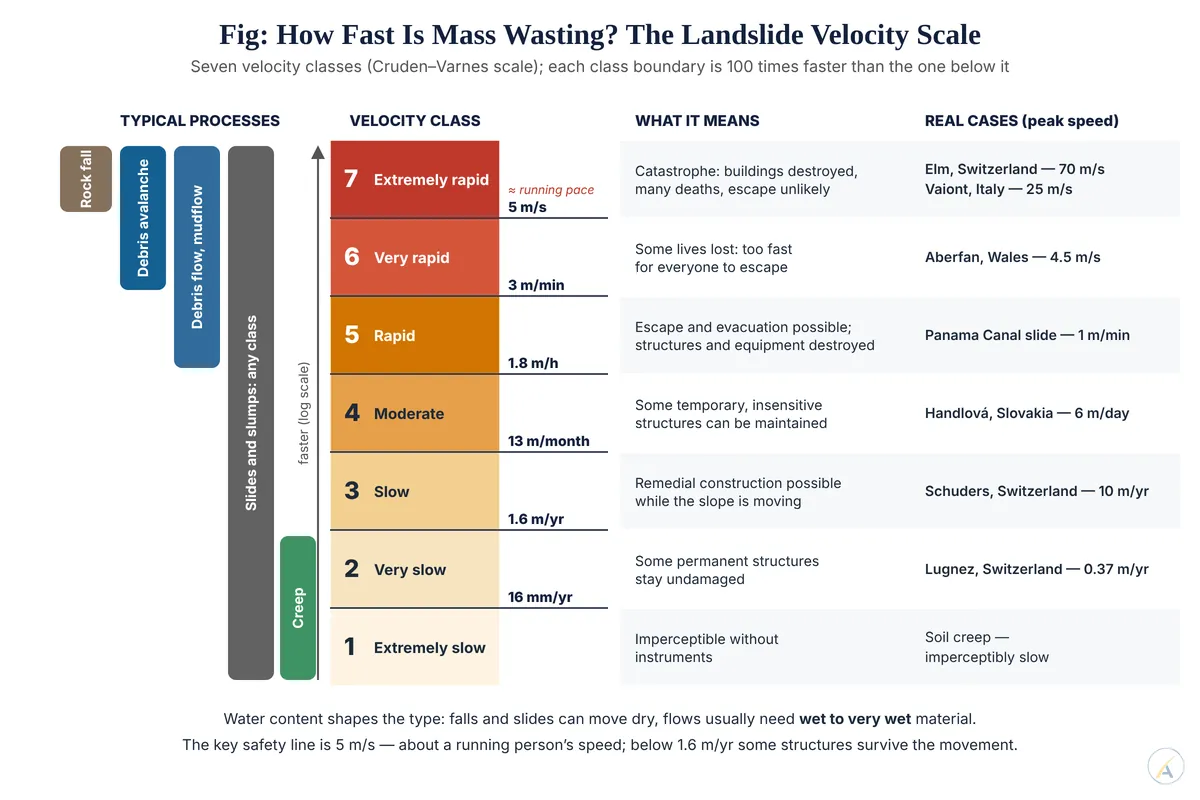
- The velocity scale of David M. Cruden and David J. Varnes (1996) grades movements into seven classes, from extremely slow (below 16 mm a year) to extremely rapid (above 5 m a second).
Geomorphic Significance
- Precursor to erosion: weathering produces the regolith that agents of erosion can move; bare unweathered rock erodes very slowly. Hillslopes are weathering-limited where supply is the bottleneck and transport-limited where removal is — a distinction going back to Grove Karl Gilbert (1877) and formalised by Michael A. Carson and Michael J. Kirkby (1972).
- Slope evolution: the balance between weathering supply and mass-wasting removal shapes slope form — the slope decline of William Morris Davis, the slope replacement of Walther Penck and the parallel retreat of Lester C. King all rest on how debris is produced and removed.
- Soil formation: weathered rock is the parent material of soil — one of the factors in Hans Jenny’s (1941) equation of soil formation alongside climate, organisms, relief and time.
- Distinctive landforms:
- from weathering — tors and inselbergs (differential weathering), karst, laterite caps, exfoliation domes;
- from mass wasting — talus (scree) cones, landslide scars and hummocky debris, terracettes from creep.
- Sediment supply to rivers: in young mountains, landslides and debris flows deliver much of the river load. The Chamoli disaster of 7 February 2021 began as about 27 million cubic metres of rock and glacier ice collapsing from Ronti Peak and turned into a highly mobile debris flow, according to Dan H. Shugar and colleagues (2021).
- Hazard: the Landslide Atlas of India (2023) mapped about 80,000 landslides between 1998 and 2022, and about 12.6 per cent of India’s land area outside snow cover is landslide-prone.
- Joshimath (2023) subsided on old landslide debris; the Wayanad debris flows of 30 July 2024 followed about 577 mm of rain in 48 hours on deeply weathered Western Ghats slopes.
- Climate link — a live debate: Maureen E. Raymo and William F. Ruddiman (1992) argued that Himalayan uplift increased chemical weathering, drawing down atmospheric carbon dioxide and cooling the Earth; Jeremy K. Caves Rugenstein, Daniel E. Ibarra and Friedhelm von Blanckenburg (2019) argued instead that the land surface became more reactive while total weathering flux stayed steady.
- Judgement: weathering and mass wasting are not preliminaries to “real” geomorphology but its engine — they set the pace of erosion, the form of slopes and the sediment budgets of rivers, and today they decide where mountain settlements are safe, which makes their study as much applied as theoretical.