

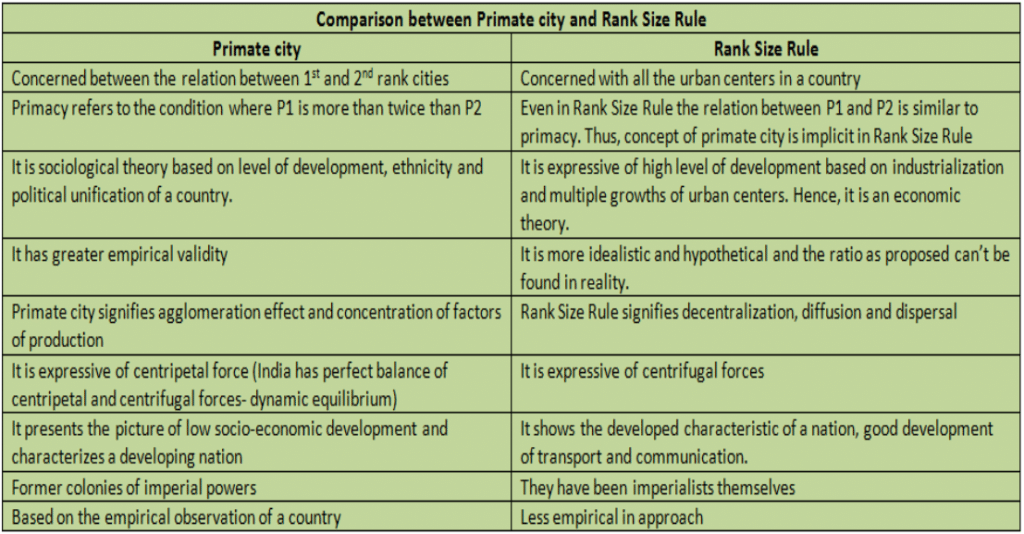
Primate City

- The Primate City Model is a major concept in settlement geography that explains the dominance of a single city within an urban system, in contrast to the balanced hierarchy suggested by the rank–size rule.
- It reflects a situation where one city becomes disproportionately large and functionally dominant, overshadowing all other settlements in the region.
- The concept of Primate City is an empirical inductive model (based on experience and observation) based on studies of 51 countries.
- It was proposed by Mark Jefferson as a yardstick to analyze the socio-economic conditions and stage of development of a country. The level of development is reflected by the nature of urbanization.
- A Primate City refers to the largest and most magnified urban settlement which has grown disproportionately with respect to other settlements due to centripetally based on economic opportunities, centralization of political power, industrial growth, the concentration of factors of production, and moreover the agglomeration effect.
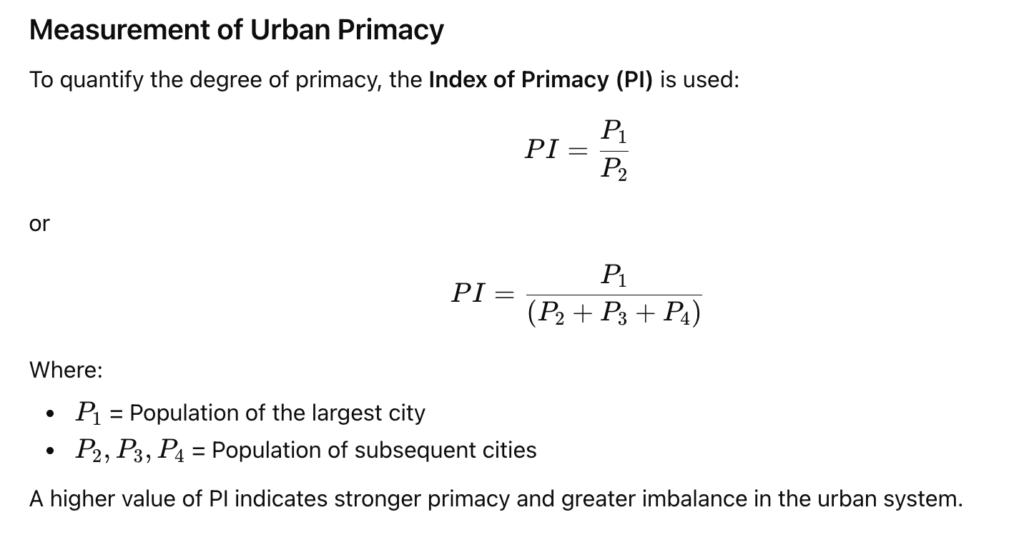
- He observed that the largest city is more than twice the size of the second city, and often five times larger than the third city, which indicates extreme concentration of population and functions.
- It is the largest economic magnet that attracts huge migrations and pulls of resources from the surroundings. E.g. London, New York.
- It is the manifestation of people’s socio-economic aspirations and experience of national sentiments.
- It signifies centripetal forces and the uniform ethnolinguistic character of a nation.
- It is the outburst of the strong national sentiment and the developing character of an economy.
- Jefferson studied 51 countries of Europe and found that 41 of them have primate cities such as London in Britain, Paris in France, Berlin in Germany (London is at least 5 times bigger than the next largest city in Britain i.e. Birmingham).
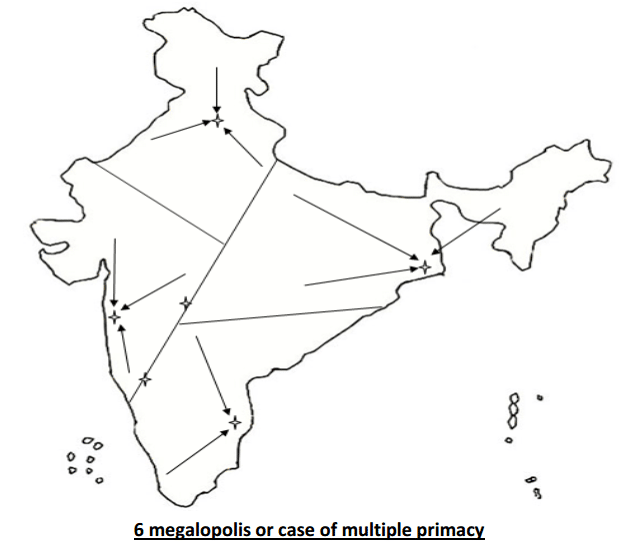
- This is however not a norm for all the countries where in many countries there are more than two comparable cities. E.g. 4 mega cities in case of India, Sydney, and Melbourne in Australia, Toronto, and Montreal in Canada.
- Unlike the gradual hierarchy of settlements seen in the rank–size rule, the primate city model reflects a steep and uneven urban hierarchy, where:
- The first city dwarfs all others,
- Lower-ranked cities are significantly smaller and less developed,
- Functional complexity is concentrated in a single dominant centre.
Characteristics of a Primate City
- A primate city is not merely large in population but is distinguished by multi-dimensional dominance, which includes:
- Economic dominance, where major industries, trade, finance and services are concentrated, making it the principal economic hub of the country or region.
- Political centrality, as it often functions as the administrative capital or seat of power, thereby attracting government institutions and decision-making bodies.
- Cultural supremacy, where it becomes the centre of education, media, arts and intellectual activity, shaping national identity.
- Transport and communication advantage, with the best connectivity networks, ports, airports and infrastructure.
- Demographic magnetism, attracting large-scale migration from rural areas and smaller towns, leading to rapid population growth.
- As a result, such a city becomes functionally complex and self-reinforcing, continuously attracting more resources, people and investments.
Evaluation of theory
- Jefferson himself did not determine the process of primate city development. It was Linskey who suggested the following characteristics of countries that have primate cities:
- Large population base
- Small territorial extent
- High population pressure (density) and growth rate.
- Agro based economy
- Low per capita income
- Former colonial status.
- Linskey was perhaps referring to the primate cities being an aspect of developing countries. However, not all countries that have primate cities are developing countries, and there are many developing countries that have primate cities (e.g. India)
- In the case of India, due to its large territorial extent and cultural and economic diversity, it is not possible for a city to reflect and express itself in terms of the entire country.
- Britain, Germany and France despite of being developed countries have primate cities.
Emergence of a Primate City
- The development of a primate city is not accidental but follows a cumulative and self-reinforcing process:
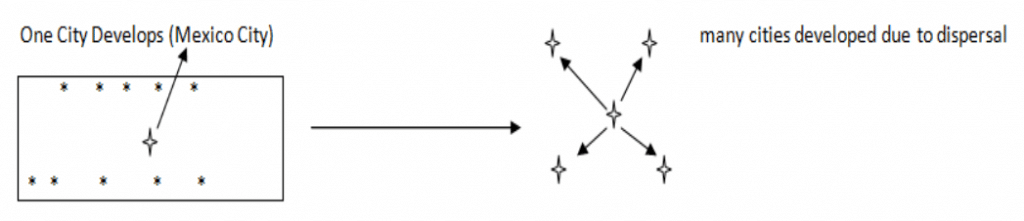
- Initially, a region may have several settlements of relatively equal status, each surrounded by its rural hinterland. As urbanization progresses, some cities begin to grow due to their locational or historical advantages. If one city gains a strategic advantage, such as better connectivity, political importance or access to global trade, it begins to attract more economic activities.
- This leads to:
- Increased in-migration,
- Expansion of economic opportunities,
- Growth in infrastructure and services,
- which further enhances its attractiveness. Over time, this process creates a positive feedback loop, where the city grows at the cost of others, eventually emerging as a primate city.
- Once established, primacy tends to sustain itself, because:
- Investments continue to concentrate there,
- Skilled labour prefers the dominant city,
- Institutional and infrastructural advantages reinforce its growth.
Process of development
- Although not mentioned explicitly the process of development of primate city is better explained by Gunnar-Myrdal in his theory of cumulative causation.
- According to Myrdal the economic development of a country is general process through 3 stages:
- 1st stage:
- In this stage there is uniformity in development but the level of development is poor.
- 2nd stage:
- In this stage the geographical space which is central attracts the factors of population like capital, labour, enterprises and begin to grow disproportionately by incapacitating (decreasing other’s capacity) the surrounding and draining out their resources.
- The process of backwash where one city act like a vacuum pump sucking out all investments and technology at expense of other cities.
- 3rd stage:
- In third (last) phase there is development dispersion and diffusion from primate city leading to the development of the whole landscape.
- Thus, primate city is merely a stage in development.
- 1st stage:
- Primate City offers better employment, high wage, improved infrastructure, hope and perception of better life. It is possible by stream of migration, emerging commercial sector, gravity centre for capital and human resources.
- Mark Jefferson studied 51 countries where he found that
- In 27 countries the population of largest city is more than twice than the 2nd rating city.
- In 18 countries the population was more than three times.
- Thus, from above, Mark Jefferson concluded that a primate city is one that has more than twice the population of the second-ranking city.
- Thus, the primate city is based on the relationship between R1 and R2 and the ratio of their population.

- Thus, primate city can be defined as the most populous city of a country which is twice or more larger than second ranking city of a country.
Applicability of theory
- Primate City is an inductive theory; it does not have universal application as socioeconomic forces are dynamic.
- Any law in human geography that deals with human behavior can’t be objective and therefore, it will lack universal validity. This is true for the primate city concept also. Its applicability has mixed relevance.
- E.g. Mexico City is 5 times larger than the second-ranking city Guadalajara. In Uruguay the ratio of population between Montevideo/Paysandú > 7 on the other hand, in Canada the ratio of population between Montreal/Toronto > 1.
- Linskey tried to enumerate the conditions that make the primate city concept operable but there are exceptions.
Case of India
- India does not have primate cities. In India instead of primacy, multiple primacy is found due to:
- Large geographical extent
- Multi-ethnic, multi-lingual country with regional consciousness.
- Growth of four different megalopoleis at four different quadrants.
- Distance decay factor.
- Four different cities have a history of development through colonization.
- Mumbai/Kolkata=1.1 (No Primacy)
- Constitutional right to settle anywhere
- Federal state.
- In India there is no primacy at the national level, it exists at the state level as a norm.
- State capitals invariably operate as primate cities, but again there are exceptions. E.g.
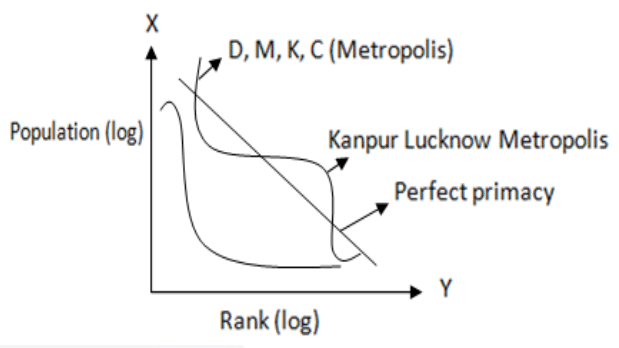
- In Uttar Pradesh despite its low development status, it has Varanasi, Allahabad, Lucknow, and Kanpur which are large and comparable (this may be due to the size of Uttar Pradesh)
- Tamil Nadu has Madurai, Coimbatore, Chennai, where Chennai is the largest but not disproportionately very large (because Tamil Nadu has the better record in the dispersal of development)
- Kerala– despite of being a relatively more developed state and also with a small territorial size, it does not have a primate city (Thiruvananthpuram, Kochi, Calicut are all comparable). This may be due to the fact that the entire area is the hilly region with narrow coastal plain with no region having extra advantage or disadvantage over other.
- Most of the other states have state capitals as their primate city. E.g. Jaipur in Rajasthan, Bangalore in Karnataka, Gandhinagar/ Ahmadabad in Gujarat.
State level primacy in India
- The study was done by Professor Qazi Ahmed in 1971.
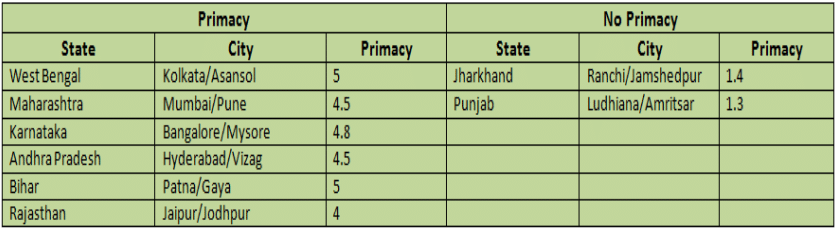
- The socio-economic analysis of states hardly reveals any trend. States with greater industrialization, growth of secondary sector have the tendency of greater primacy.
- Such theories are tested by two principles:
- Desirability
- Applicability
- Applicability: Humanistic model represents half truth, thus they are partially applicable, even then desirable because they are yardsticks to measure reality and deviation from it and causes from such deviation.
- Desirability:
- Presence of primacy is an example of disparity. Hence, in general planners might be inclined to discourage primacy.
- However, in certain circumstances primacy may be desirable such as while planning for small territorial region with limited resources and investment.
- It might result in duplication or wasteful, inefficient investment if development is spread and is evenly distributed.
- In poor and developing countries initial primacy may be desirable (example of deliberate imbalance based planning).
- So, in initial stage of development primacy may be used for efficient use of resources and investment, but in long term, development should be spread to discourage disparity.
Rank Size Rule
- One of the fundamental observations in settlement geography is that smaller settlements are always higher in number, while larger settlements are comparatively fewer. In any region, there exists a general gradation — from the smallest hamlets and villages to medium-sized towns and ultimately to large metropolitan cities. This gradation is not random; it follows a discernible pattern that geographers have attempted to quantify and theorise.
- The Rank-Size Rule is one such attempt. It describes the relationship between the size (population) of a settlement and its rank within a regional urban hierarchy.
- The study of urban hierarchy and urban continuum was first conducted in 1914 by Auerbach, but as a theoretical law, it was presented in 1949 by G.K. Zipf.
- Rank Size Rule is an idealistic inductive model based on a statistical analysis of several countries of their urban center and their size hierarchy.
- It seeks to understand the population relationship between cities of various ranks and also the urban continuum of a country.
- It analyses why cities in lower ranks are higher in number than the cities of higher ranks.
- The number of higher cities is much lower than the cities in the lower order.
- The largest cities have multiple functions and more diverse economic activities and they have much larger areas, thus their number is less.
Definition of the Rank-Size Rule
- The Rank-Size Rule states: “If all settlements are ranked according to size with the largest city having the first rank, then the population of a town multiplied by its rank will equal the population of the largest city.”
- Rank Size Rule states that the population of the ‘nth’ city is ‘1/nth’ of the 1st rating city of a country.
- It may be numerically expressed as
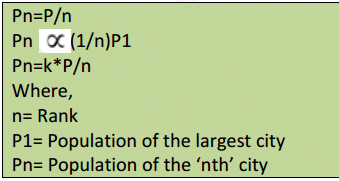
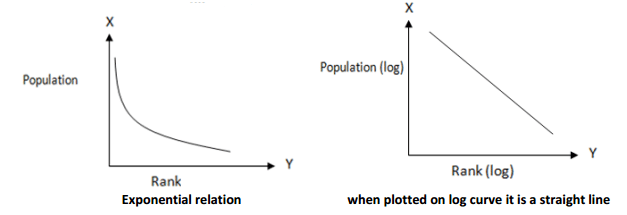
- The above relation is an exponential one. Thus, the population may be sequentially represented as:

Worked Example:
Question: The population of the largest city in Region X is 3,00,000. What would be the population of the 5th-ranking city?
Answer: P₅ = 3,00,000 / 5 = 60,000
This simple formula allows one to predict the expected population of any city in a region, provided the rule holds valid for that region.
Graphical Representation
- The rank-size relationship can be represented graphically in two ways:
- Arithmetic Graph
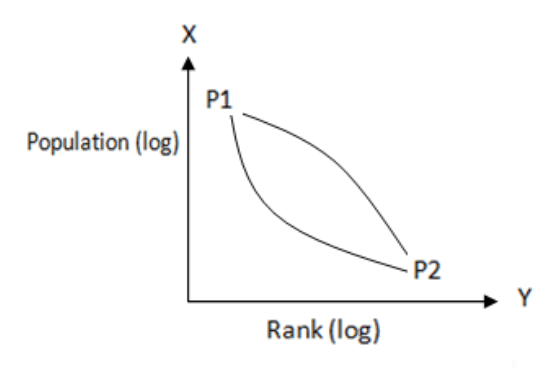
- When population is plotted against rank on normal (arithmetic) graph paper, the result is an inverted J-shaped curve (also called a reverse-J frequency distribution). Population drops sharply from rank 1 and then gradually flattens out toward higher ranks.
- Logarithmic Graph
- When both axes are plotted on a logarithmic scale (log P_R vs. log R), the rank-size relationship is transformed into a straight line. This is because:
- log P_R = log P₁ − log R
- This logarithmic linearity is the mathematical signature of the rank-size rule. The straight-line graph on log-log scale is called the theoretical rank-size pattern.
- Arithmetic Graph
- Note: The straight line on the log-log graph is the ideal/hypothetical condition. In reality, actual city distributions deviate from this straight line, forming either binary or primate patterns.
Implication of rank size rule and what does it depicts?
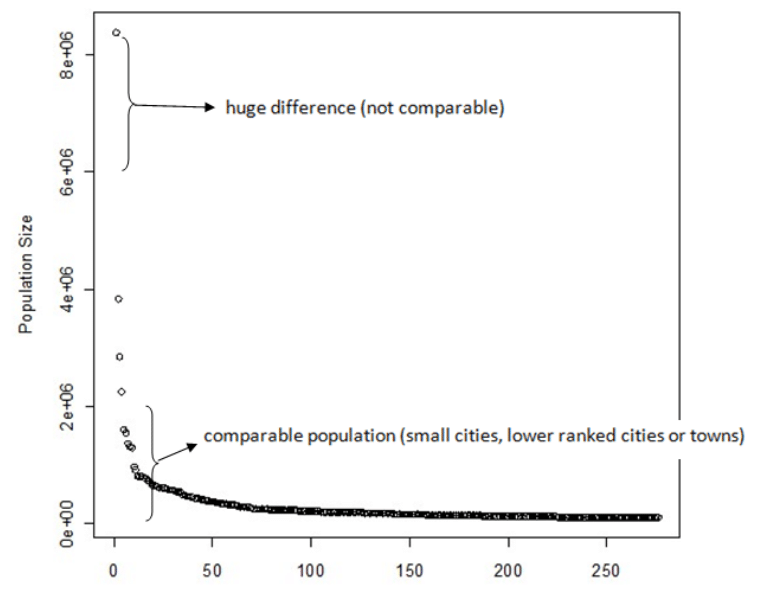
- In settlement system large cities are disproportionately large.
- Large cities are few in number (large cities are not comparable in size), whereas small towns and villages are numerous and they are of comparable size.
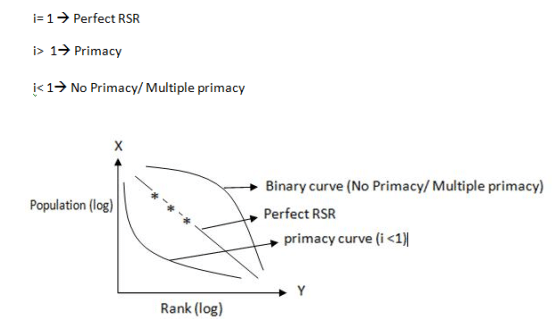
- In log curve Zipf was suggesting a normative ideal possibility in the straight line relationship. In reality there may be deviation as shown in graph.
- The straight line of the log function is actually an ideal state.
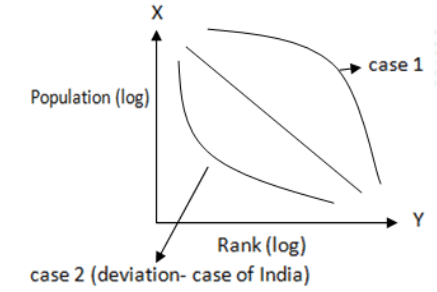
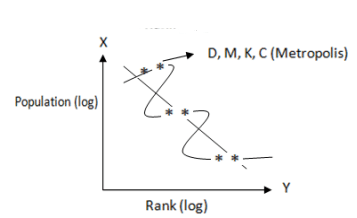
- There are 2 possible deviations.
- Case 1– In case-1 the deviation in the curve signifies that there is more than one city that is of comparable size (i.e. the possibility of more than one city comparable in size in the levels of upper hierarchy).
- Case 2– In case-2 deviation in the curve is an example of high primacy i.e. the largest city is much bigger and is a disproportionately large curve, so the Jefferson primate city concept is the special case in rank-size rule.
- Big cities are very few and have considerable variation in their disproportionate sizes whereas smaller settlements, towns, and villages are numerous and maybe all of the comparable sizes.
- In Ireland the primacy is shown by the city Belfast, which is proportionally very large than other cities of Ireland, but other cities and towns of Ireland follow rank size rule appreciably.
- Rank size rule envisages existence of high number of urban centres where landscape is fully developed and city functions are well distributed.
Rank Size Rule in India
National Level
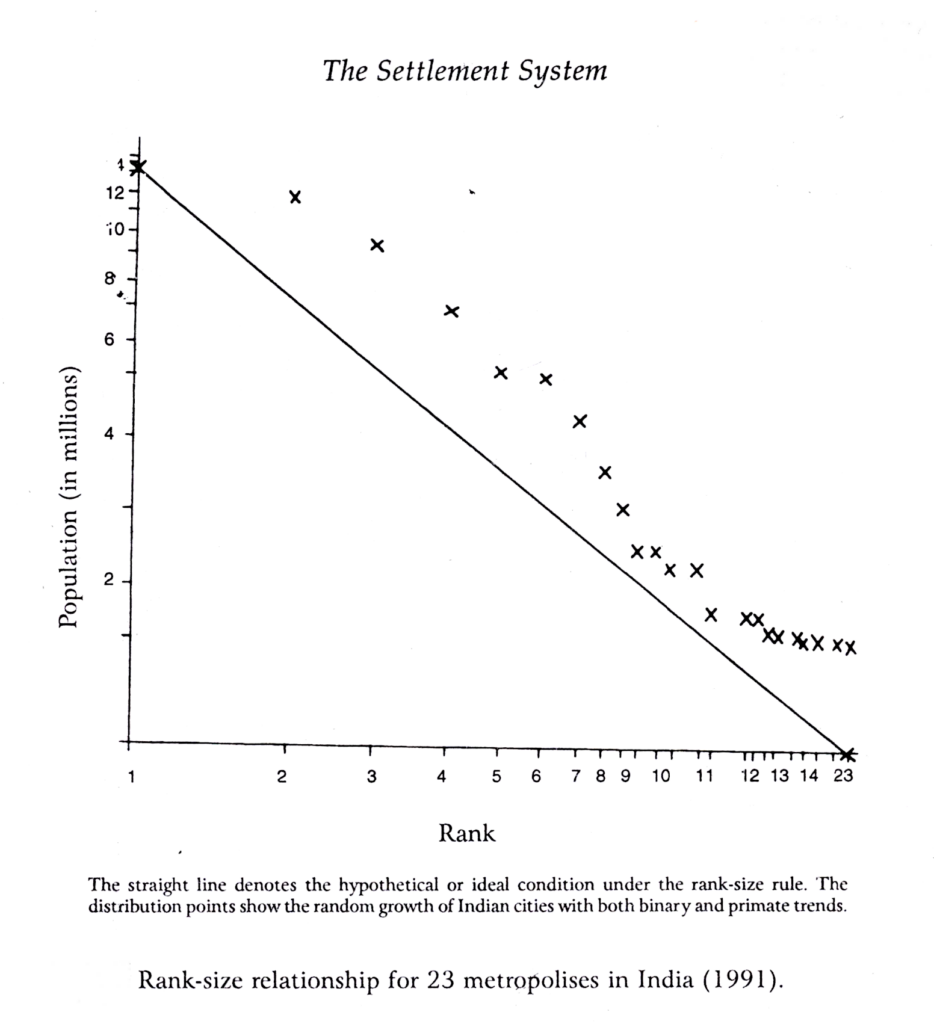
- The rank-size rule fails almost totally in the Indian context. The two largest cities — Mumbai and Calcutta (Kolkata) — have nearly the same population, which contradicts the rule’s expectation that the 2nd city should have exactly half the population of the 1st. Furthermore, all Class I cities have much higher populations than would be predicted under the rank-size rule.
- The figure below shows the rank-size relationship for 23 metropolitan cities in India (1991). The straight diagonal line represents the ideal/hypothetical rank-size relationship. The actual data points deviate significantly from this line, showing both binary and primate trends simultaneously.
State Level — Ramachandran’s Study (1989)
- Professor R. Ramachandran (1989), one of India’s most prominent settlement geographers, empirically tested the rank-size rule using Census 1981 datasets at the state level.
- His findings showed that the rank-size rule is valid for only three states of India:
- Rajasthan
- Uttar Pradesh
- Haryana
- For all other states, the rule does not hold — confirming that India’s urban system is highly heterogeneous and does not conform to the idealised rank-size hierarchy.
- Qazi Ahmed has applied Rank Size Rule in India and classified the states in two groups:
- States where the rule is followed: states with no primacy have Rank Size Rule e.g. Punjab, UP, Haryana, Kerala
- Where the rule is not followed: At national level India has multiple primacy and hence there is no application of Rank Size Rule.
Deviations from the Rank-Size Rule: Hagget’s Three Patterns
- Under heterogeneous conditions, several distortions occur in the rank-size relationship. Hagget identified three possible distribution patterns on a log-log scale:
- Pattern 1: Theoretical Rank-Size Pattern
- The ideal, perfectly regular distribution forming a straight diagonal line on the log-log graph. This represents an integrated, balanced urban system where population decreases proportionally with rank. It is only possible under certain conditions of homogeneity.
- Pattern 2: Binary Pattern
- This occurs when a few large cities have approximately the same population size, creating a “flat” upper portion of the distribution before it drops off sharply. The curve on the log-log graph falls to the right of the theoretical line (shallower slope).
- Indian example: The growth of industrial townships like Rourkela and Jamshedpur, where planned industrial development has created cities of roughly equal size at the top of a regional hierarchy.
- Pattern 3: Primate Pattern
- This occurs when one or two cities have a very large population, followed by a sharp decline to many smaller settlements of roughly similar (and much smaller) size. The curve on the log-log graph falls steeply to the left of the theoretical line.
- Indian example: Kolkata (Calcutta), with its extreme concentration of industrial, commercial, and service functions, dominates the settlement hierarchy of eastern India in a strongly primate pattern.
- Pattern 1: Theoretical Rank-Size Pattern
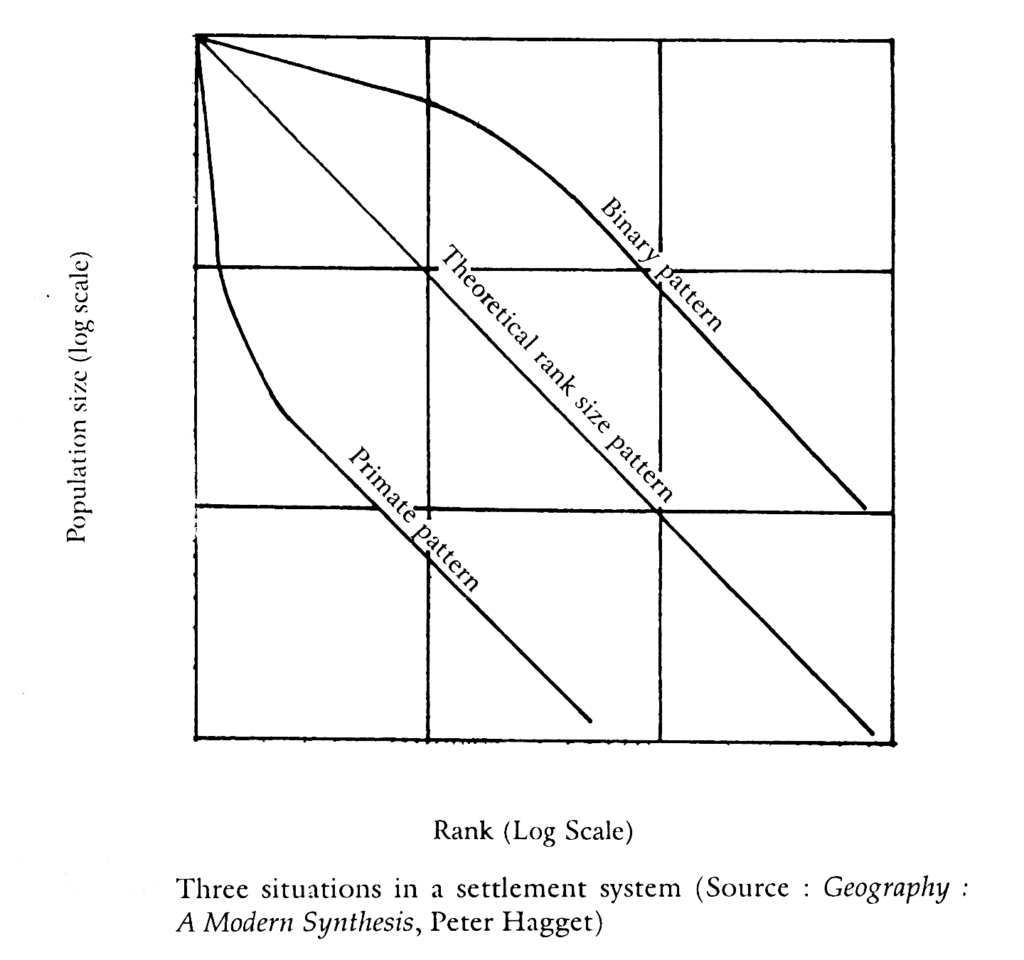
Key Insight: The binary pattern results from forces of industrial decentralisation creating multiple large cities; the primate pattern results from the concentration of economic and political power in one dominant city.
Theoretical Explanation of the Rank-Size Rule
Zipf’s Theory: Forces of Diversification and Unification
- Zipf explained the rank-size rule as a balance between two opposing economic forces:
- Forces of Diversification:
- Small villages are dispersed widely across a region
- This allows them to make maximum use of the resource base with minimum travel cost
- Agricultural communities, fishing villages, and forest-dependent communities must stay near the raw material source
- This leads to the splitting of population into many small, dispersed settlements — the force of diversification
- Forces of Unification:
- Manufacturing and service centres need to concentrate a large number of people to minimise the movement of services and finished goods to consumers
- Secondary activities (processing, marketing) require people to concentrate in production centres
- This leads to the formation of larger settlements — the force of unification
- The size of these larger cities varies with the intensity of the force of unification. The total settlement system is a balance between these two forces. In the ideal equilibrium state, this balance produces a rank-size relationship between settlements.
Simon and Berry-Garrison: Statistical / Stochastic Explanation
- Herbert A. Simon, elaborated upon by Berry and Garrison, offered a complementary explanation using statistical arguments.
- According to them, the rank-size relationship results from a large number of random decisions by inhabitants regarding the places they choose to live in. Simon postulated the straight-line graph on a logarithmic scale as the equilibrium slope of a general growth process of the urban system.
- This means that even without any deliberate planning or economic logic, if a large population makes random, independent decisions about where to settle, the aggregate result tends toward a rank-size distribution. Such a situation is best considered as an “average condition” in the history of urbanisation, and deviations from this average open up new areas for explanations in settlement geography.
Significance and Limitations of the Rank-Size Rule
Significance
- Diagnostic tool: It helps identify whether a country’s urban hierarchy is balanced or distorted
- Planning application: Deviations from the ideal pattern indicate areas needing policy intervention — e.g., reducing urban primacy or promoting intermediate cities
- Integration indicator: A country following the rank-size rule is considered to have a well-integrated urban system with smooth functional linkages (Zipf)
- Comparative tool: Allows comparison of settlement systems across countries and regions
- Simplicity: The formula P_R = P₁/R is elegant and easy to apply to any dataset
Limitations
- Not universally valid: Only 13 of 37 countries studied by Berry and Horton followed the rule
- Inductive, not deductive: The rule is based on observed facts, not derived from first principles. As Sumita Ghosh notes, “the study of rank-size relationship becomes a mere statistical exercise, unless a theoretical base is also established together with its empirical validity”
- Ignores historical and cultural factors: The rule cannot account for colonial legacies, political centralization, or cultural factors shaping city growth (highly relevant to India)
- Static: The rule describes a snapshot in time and cannot capture the dynamic evolution of settlement systems
- Fails for heterogeneous systems: In large, diverse countries like India with regional disparities, multiple language zones, and varied economic geographies, the rule breaks down
- Does not explain outliers: Cities that exceed or fall below the predicted size are left unexplained by the rule alone
- Rigid form is difficult to accept: In its strict mathematical form, the rule rarely holds perfectly for any real-world country
Conclusion
- Rank Size Rule has no universal application, but it acts as a yardstick to measure the relationship of urban centre and their functional integration and level of development of a country with the development of transport, communication and industries.
- It is a useful method to understand the socio-economic aspirations of a nation.





Sir Are you an upsc aspirant or geography phd? your notes seem to be good enough. looks u have cleared mains
UPSC Aspirant 🙂
Well done. You will clear this time.
Thanks 🙂
The last diagram case 1 and case 2 given wrong, they have been mistakenly altered.
Thank You Ravinder for pointing out the mistake, I have corrected the same. Keep reading.
Case 1 and case 2 are right , just the example of India, will be case 1 . DMKC are primate cities at upper hierarchy
T
thank u so much
That is great
SIR ARE THERE ANY VIDEO LECTURES OF YOURS
No
Then how can we connect with you