

- Economic geography is organised around a few recurring themes that link where economic activity happens with why it happens there.
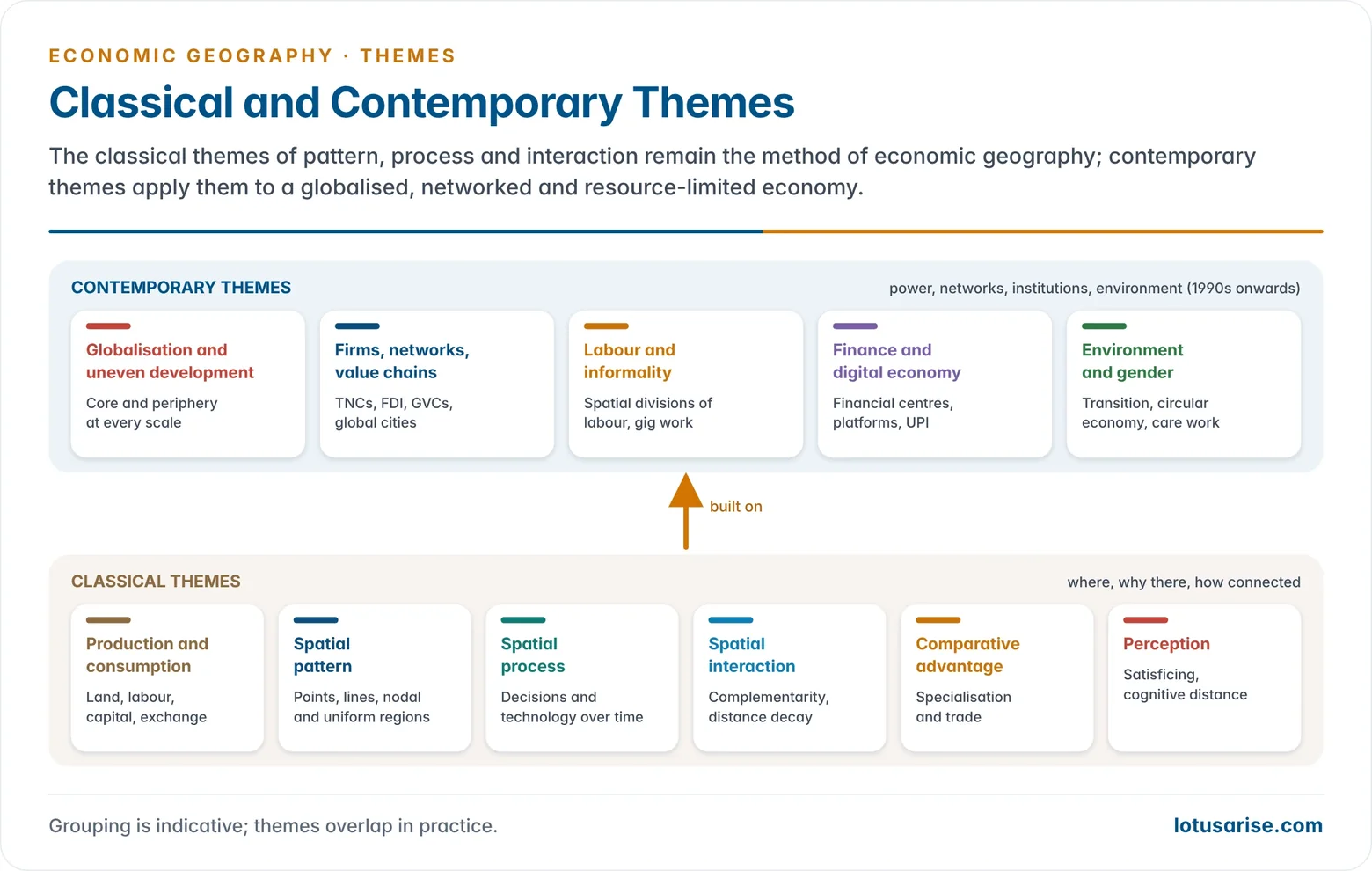
- The classical themes are production and consumption, spatial pattern, spatial process, spatial interaction, comparative advantage and perception.
- Together they give the discipline its basic method: map the pattern (where), explain the process (why), trace the linkages (how places connect).
- Contemporary themes extend this base to globalisation, uneven development, networks of firms, labour, finance, the digital economy, sustainability and gender.
Production and Consumption

Production
- Primary and secondary activities form the production sectors. Services are also produced, so modern production covers all sectors of the economy.
- People are both producers and consumers of wealth. Many individuals produce more than one commodity or service.
- Production tends to concentrate where physical conditions (climate, soil, resources) and human conditions (labour, markets, infrastructure) make it most viable.
Factors of Production
- Labour:
- No productive process is complete without labour.
- Activities differ in labour needs: labour-intensive (garments, tea plucking) versus labour-extensive (refineries, wheat farming in Canada).
- Wages depend on the value of output and the skill required. Higher skills command higher wages, which shapes where firms locate.
- Capital:
- Capital means the tools, equipment and materials used in production. It is fixed (factories, machines) or variable (raw materials, working capital).
- Some activities need little capital, others very large investment, such as a steel plant or a semiconductor fab.
- Mechanised production yields higher output per worker than manual work.
- Land:
- Every activity needs space. The amount varies greatly: extensive grazing needs vast areas, while a city office needs very little.
- Abundant land lets the other factors be used more freely.
- Entrepreneurship and technology organise the other factors and are now treated as factors in their own right.
- Combination and substitution:
- Factors are combined in different proportions and can partly replace one another.
- Machines replace labour where wages are high. Intensive land use replaces extensive use where land is scarce, as in the paddy fields of Kerala and the Nile valley.
Consumption
- Consumption is the final use of goods and services to satisfy human needs.
- Non-durable goods are used up quickly (food). Durable goods are used gradually (machines, cars).
- Non-material consumption leaves the item unchanged, as when tourists view a landscape.
- Levels of consumption vary:
- Some people consume far more than others. Many consume less than they want, and many less than a decent standard of living requires.
- Self-sufficiency to specialisation:
- At one end are near self-sufficient peasant households that consume most of their own produce. At the other end is highly specialised factory production for distant markets.
- No family is fully self-sufficient. All are part of a wider, interdependent system.
- Because producers and consumers are usually far apart, three kinds of linkage are needed:
- flows of information,
- flows of goods,
- networks of transport and communication.
- Exchange adds value: transport, storage, finance and retailing add place and time utility to goods on the way to the consumer.
- The analysis of the spatial patterns of production and consumption, and the links between them, is the core subject matter of economic geography.
Locational Analysis and Location Theory
- Locational analysis explains why activities are already where they are, and helps choose locations for new ones.
- Location theory looks for the basic, universal factors that influence the location of all economic activities.
- It offers general explanations that may not fit every case exactly.
- It is constantly refined by deductive reasoning (from assumptions) and inductive analysis (from observed cases).
- It gives a framework for reading each element of the economic landscape, from von Thünen’s land-use rings to Weber’s least-cost location.
- Five themes organise this analysis: spatial pattern, spatial process, spatial interaction, comparative advantage and perception.
Spatial Patterns
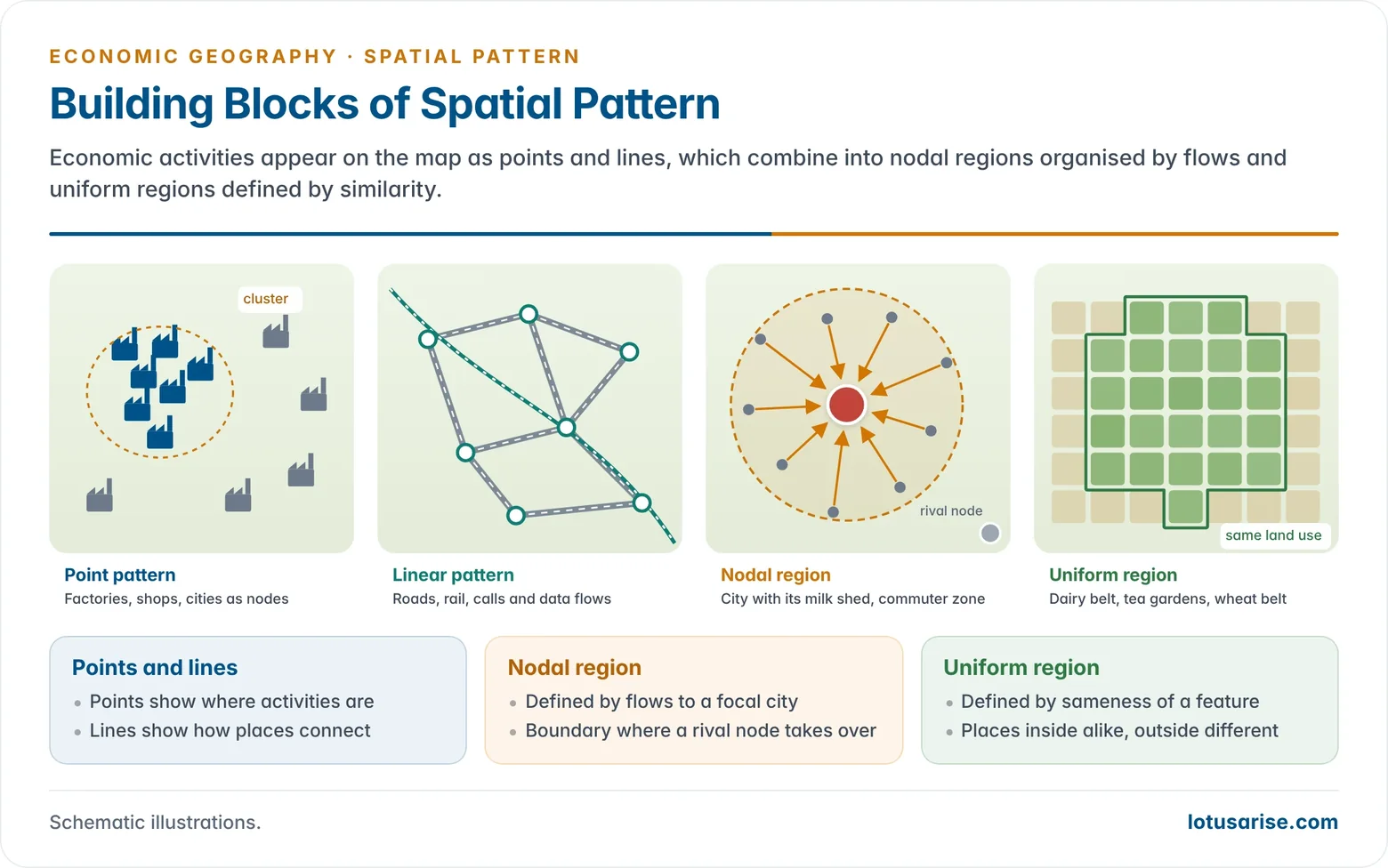
- The arrangement of an economic activity over the earth’s surface, or within a region, forms a pattern or spatial distribution. It answers the basic question “Where?”
- Point pattern:
- Each occurrence of an activity is treated as a node or point: houses, factories, shops, cities.
- At this level relative location matters, not the area each point occupies.
- Points may be clustered (IT firms in Bengaluru), random or regular (central places on a plain).
- Linear pattern:
- Any movement or connection between places forms a linear pattern, whether or not a physical route exists.
- Examples are road and rail networks, pipelines, airline routes, and the volume of calls or data between offices.
- Linear patterns depend on the layout of points; they are not independent of them.
- Nodal (functional) region:
- Combining points and lines gives a region organised around a focal node, usually a city.
- Goods, services and people flow to and from the node. The boundary lies where the node’s pull weakens and another node’s pull begins.
- Examples: newspaper circulation areas, commuting zones (labour sheds), milk sheds that feed a city’s dairies, and a port’s hinterland, such as that of Mundra or JNPA.
- Uniform (homogeneous) region:
- An area defined by common characteristics, so that places inside are more alike than places outside.
- Examples: dairy farming zones, cash-grain belts, goat-herding areas, the tea gardens of upper Assam.
Spatial Processes
- A spatial process is a change in some or all elements of a spatial economic system. It happens at different rates in different places and can be mapped.
- Pattern and process:
- A pattern is the distribution of activities “frozen” at one moment and answers “Where?”
- A process explains the pattern and answers “Why?” Every pattern is the outcome of processes acting over time.
- Drivers of process:
- Patterns change through human decisions, shaped by economic goals, perception of alternatives, preferences and cultural systems.
- Technological change widens or narrows the range of choice and so reshapes the landscape.
- Layers of influence: an observed (cross-sectional) pattern combines processes still operating with others that began in the past and have since stopped.
- Example: manufacturing in a metropolis:
- Past processes: centralising forces, as industry clustered near rivers, canals, railway stations and the docks, the most accessible points of the old transport technology.
- Current processes: motor transport, ring roads and cheap suburban land decentralise industry to the city edge. Mumbai’s textile mills at Girangaon gave way to industrial estates at Bhiwandi and along the Thane–Belapur belt.
Spatial Interaction
- Spatial interaction is the movement of goods, services, people, money and information across space. Every economic system, traditional or advanced, depends on it.
- It concerns both the layout of connections (a street or route map) and the volume of flows between places.
- Principle of least effort: people try to minimise distance and effort, which governs the length and intensity of movement.
- Friction of distance: the farther the places, the greater the effort, time and cost of moving between them.
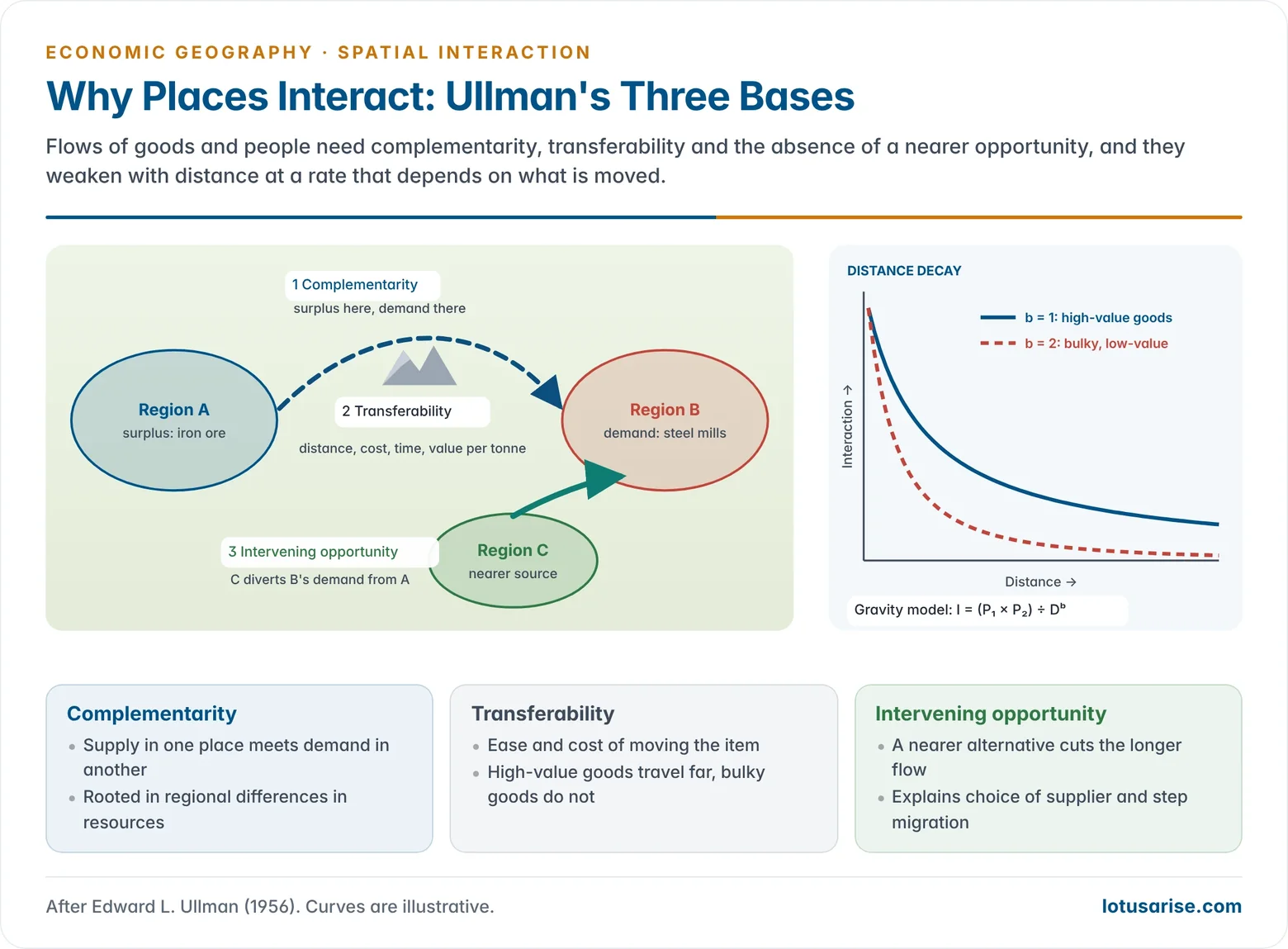
- Gravity model: interaction rises with the size of places and falls with distance.
- Simple form: I = M ÷ D, where I is interaction, M the mass or attraction (population or economic size) and D the distance.
- Fuller form: I₁₂ = (P₁ × P₂) ÷ D₁₂ᵇ, where b is the friction of distance. Larger masses and shorter distances give more interaction.
Bases of Spatial Interaction (Edward L. Ullman, 1956)
- Complementarity:
- One place must have a surplus of something that another place demands.
- It arises from regional differences in natural and human resources, for example iron ore from Odisha to steel plants in China.
- Moving a resource to where it is needed raises its value: this is place utility.
- Transferability:
- The ease with which an item can be moved. It depends on distance in time and cost, and on the value of the item per unit weight.
- Bulky, low-value goods (timber, coal, sand) do not travel far, and nearer substitutes are used. High-value goods (electronics, medicines) bear high transport costs and are rarely substituted.
- Political barriers, transport quality, congestion, terrain and technology also affect it.
- The result is distance decay: interaction falls as distance grows.
- Intervening opportunity:
- A nearer alternative source or destination reduces interaction with a farther one.
- It explains which supplier a buyer chooses, and why migrants stop in a nearer city.
- The three conditions act together. They are most useful for studying migration and commodity flows.
Bases of Information Flow
- Ullman’s triad explains goods and people better than modern information flows. Information follows three other principles:
- Information genesis:
- Information flow is driven more by supply than by demand. It is often sent without being requested.
- Hierarchy of control:
- The volume of flow depends on the size and status of the sending and receiving places.
- Global cities such as New York, London and Mumbai house the headquarters, financial institutions and agencies that generate most of the specialised and perishable information.
- Distance independence:
- Unlike migration or freight, distance matters little for digital flows. Undersea cables and satellites make Bengaluru’s IT services as close to clients in New York as to clients in Chennai.
Comparative Advantage
- An ideal site that meets every requirement of an activity at all times is rare. There are better and worse sites, and often a region of optimum conditions for a given crop or factory.
- Market conditions can override physical suitability:
- Suppose region A is best for crop A and the neighbouring region B is best for crop B.
- If demand and the price of crop A rise, crop A may be grown even on less suitable land, including in region B.
- Under the new prices, crop A enjoys a comparative advantage over crop B in region B, even though nature favours crop B there.
- David Ricardo’s (1817) principle explains why places specialise in what they produce relatively most efficiently and trade for the rest. This drives regional specialisation and patterns of world trade.
- Indian example:
- Assured procurement prices for paddy and wheat gave these crops a comparative advantage in Punjab and Haryana.
- Rice spread into semi-arid tracts better suited to pulses, oilseeds and millets, at the cost of falling groundwater.
Perception
- As producers and consumers, people react to reality as they perceive it, not to reality itself.
- Influences on perception: history and tradition, social class, education, and personal ideas of what is desirable.
- Example of shopping choice:
- A person living midway between a large town (many shops) and a small town (few) may still prefer the small town. It has less traffic, easier parking, less pollution and a pleasanter setting.
- A farther town may seem nearer because the road is better or the drive more pleasant. This is cognitive distance.
- Perception is the foundation of the behavioural approach: decisions are satisficing, not optimising.
| Theme | Key question | Core idea | Example |
|---|---|---|---|
| Spatial pattern | Where? | Points, lines, nodal and uniform regions | Clusters of IT firms in Bengaluru |
| Spatial process | Why there, and how did it change? | Decisions and technology over time | Mills moving from Girangaon to Bhiwandi |
| Spatial interaction | How are places connected? | Complementarity, transferability, intervening opportunity | Iron ore from Odisha to China |
| Comparative advantage | Why specialise? | Relative efficiency and prices | Paddy in Punjab |
| Perception | How do people decide? | Perceived, not objective, reality | Choice of a smaller market town |
Contemporary Themes
- Since the 1990s, economic geography has widened from location and interaction to power, networks, institutions and the environment. The major themes today:
Globalisation and Uneven Development
- Globalisation is the deepening functional integration of dispersed activities through trade, investment, finance and information.
- It does not erase geography. It sharpens differences between places that are well connected and places that are left out.
- Uneven development is built into capitalism. Investment moves to places of higher return, producing core–periphery patterns at global, national and local scales.
- Example: the gap between India’s coastal and southern states and the eastern hinterland. Such problems in world economic development are a central concern.
Firms, Networks and Global Production
- Transnational corporations (TNCs) organise production across borders through subsidiaries, subcontractors and suppliers.
- Global value chains and global production networks split a product into stages located in different countries. An iPhone is designed in California, its chips are made in Taiwan, and it is assembled in China and, increasingly, in India.
- Foreign direct investment fell for a second year in 2024, by 11% to about US$1.5 trillion (UNCTAD, World Investment Report 2025). Investment is shifting towards the digital economy and towards “friend-shored” locations.
- The shift of manufacturing from the old industrial core to Asia is examined under the new international division of labour.
Labour and the Informal Economy
- Labour is less mobile than capital, which gives firms bargaining power over places and workers.
- Doreen Massey’s spatial divisions of labour describe how firms put headquarters, research and routine assembly in different regions.
- Informal work is the norm for most of the world’s workers: about 58% of the global workforce, roughly 2 billion people (ILO). In India the share is close to 90%.
- Gig and platform work is the new frontier. India had about 7.7 million gig workers in 2020–21, projected to reach 23.5 million by 2029–30 (NITI Aayog).
Consumption, Finance and the Digital Economy
- Consumption geographies:
- Retail chains, malls, quick-commerce “dark stores” and ethical consumption (fair trade, geographical indications such as Darjeeling tea).
- Financialisation:
- The growing power of finance over firms, housing and cities. Global financial centres such as London, New York, Singapore and GIFT City dominate these flows.
- Global cities:
- A small number of global cities act as command-and-control centres of the world economy and spread its culture. Saskia Sassen (1991) named New York, London and Tokyo.
- They concentrate corporate headquarters, advanced producer services (law, accounting, advertising), stock exchanges and media.
- Digital economy:
- Data centres, cloud services, e-commerce and digital payments create new clusters and new divides.
- India’s Unified Payments Interface (UPI) has spread digital transactions deep into rural and small-town markets.
Environment, Sustainability and Gender
- Environment and economy: resource limits, climate risk, the energy transition and the circular economy now shape location and trade. Coal regions such as Jharkhand face a “just transition” challenge.
- Gender:
- Feminist economic geography shows how work, pay and mobility differ for women and men.
- Women do about three-quarters of the world’s unpaid care work (ILO). India’s female labour force participation remains low despite recent gains.
- Institutions and culture: trust, norms, caste and community networks (for example the diamond trade of Surat) shape how regional economies work.





Nice foundations sir