

- Insolation (incoming solar radiation) is the short-wave radiant energy from the sun received by the Earth. It supplies more than 99.9% of the energy that heats the planet and drives all atmospheric and oceanic motion.
- The heat budget (energy balance) is the long-term equality between the solar energy absorbed by the Earth–atmosphere system and the long-wave energy it radiates back to space.
- Because of this balance, the global mean surface temperature stays near 15 °C instead of warming or cooling year after year.
- The balance holds for the planet as a whole, not for each latitude or season. The resulting surplus in the tropics and deficit near the poles is what sets the winds and ocean currents in motion.
Insolation

Solar Radiation and the Solar Constant
- The sun (surface about 5,800 K) radiates as a near black body with peak emission at about 0.5 µm (visible light).
- About half of the energy arrives as infrared, 40–45% as visible light and under 10% as ultraviolet.
- The Earth (about 288 K) radiates at much longer wavelengths, peaking near 10 µm. Hence:
- Solar radiation = short-wave
- Terrestrial radiation = long-wave
- This difference is the basis of the greenhouse effect.
- Solar constant (total solar irradiance) is the energy received per unit area perpendicular to the sun’s rays at the top of the atmosphere at the Earth’s mean distance from the sun:
- about 1,361 W/m² (about 1.96 cal/cm²/min, close to the classical “two langleys per minute”)
- spread over the whole sphere (area four times the intercepting disc), this gives a global mean of about 340 W/m²
- It is not quite constant: it rises by only about 0.1% at the peak of the 11-year sunspot cycle, too little on its own to explain modern warming.
- The Earth intercepts less than one two-billionth of the sun’s output, yet that is the power source for weather, the hydrological cycle and photosynthesis. Coal, oil and wood are stored solar energy.
Factors Controlling Insolation
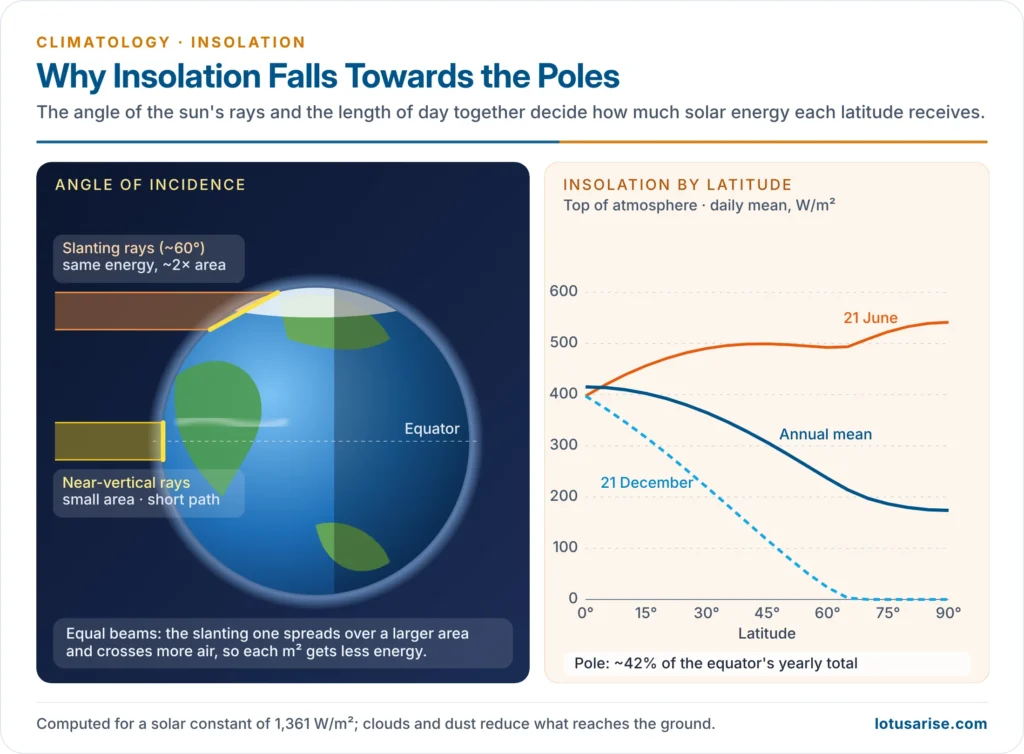
- Angle of incidence (sun’s altitude):
- A vertical beam falls on the smallest area, so energy per unit area is highest.
- An oblique beam spreads over a larger area and travels a longer path through the atmosphere, losing more energy by scattering, reflection and absorption.
- The angle depends on latitude, season and time of day: midday sun is stronger than morning or evening sun, and summer sun stronger than winter sun.
- Duration of daylight:
- Day length is 12 hours at the equator throughout the year.
- Away from the equator it varies with the season, reaching 24 hours at the polar circles at the solstice and six months at the poles.
- Long polar summer days partly offset the low sun.
- Distance between earth and sun:
- At perihelion (about 3 January, 147 million km) the Earth receives about 7% more insolation than at aphelion (about 4 July, 152 million km).
- The northern winter therefore falls when the Earth is closest. Distance matters far less than angle and day length.
- Solar output: sunspot and faculae cycles cause small variations. Longer-term orbital (Milankovitch) changes matter over tens of thousands of years.
- Transparency of the atmosphere:
- Clouds, water vapour, dust and smoke deplete the beam.
- Clear-sky deserts and high plateaux receive more insolation at the surface than humid lowlands at the same latitude.
- Aspect and slope of land: in the northern hemisphere, south-facing (adret) slopes receive more insolation than north-facing (ubac) slopes. In Himalayan valleys this sets the pattern of settlement and cultivation.
Spatial and Seasonal Distribution
- Annual insolation at the top of the atmosphere falls from the equator to the poles, but the poles still receive about 40% of the equatorial amount:
| Latitude | 0° | 10° | 20° | 30° | 40° | 50° | 60° | 70° | 80° | 90° |
|---|---|---|---|---|---|---|---|---|---|---|
| Annual insolation (% of equator) | 100 | 99 | 95 | 88 | 79 | 68 | 57 | 48 | 43 | 42 |
- Seasonal swing grows with latitude:
- The tropics get two maxima a year (two overhead suns) and little seasonal change.
- Between the tropics and the polar circles, the maximum and minimum fall at the summer and winter solstices.
- At the June solstice, the North Pole receives more daily insolation at the top of the atmosphere than the equator (24 hours of daylight). Ice and snow reflect much of it, so the surface warms little.
- At the surface, the maximum is subtropical, not equatorial:
- The highest annual totals fall near 20–30° N and S in the cloud-free subtropical deserts (Sahara, Arabia, Thar), where the descending air of the subtropical highs keeps skies clear.
- The cloudy equatorial belt receives less at the surface than its sky position suggests.
- Continents receive more than oceans at the same latitude, because there is less cloud over land.
- India:
- The highest insolation is received over western Rajasthan, Gujarat and Ladakh: clear dry air there, and in Ladakh high altitude as well.
- The lowest is over the north-east and the Western Ghats during the monsoon, when cloud cover cuts direct sunshine.
- This geography underlies the siting of large solar parks such as Bhadla (Rajasthan).
Atmospheric Depletion of Solar Radiation
- On its way down, part of the solar beam is scattered, reflected or absorbed:
- Scattering:
- Gas molecules and fine particles, smaller than the wavelength of light, scatter shorter wavelengths far more than longer ones. This is Rayleigh scattering, which varies with 1/λ⁴.
- It produces the blue sky, and the red and orange sun at dawn and dusk, when the path is longest.
- Diffuse reflection (diffusion):
- Particles larger than the wavelength, such as cloud droplets and coarse dust, scatter all colours equally (Mie or non-selective scattering).
- It makes clouds white, haze grey and the sun white through fog.
- It also gives twilight and light in shade.
- Absorption:
- Ozone and oxygen absorb ultraviolet shorter than about 0.3 µm.
- Water vapour and carbon dioxide absorb in the infrared.
- Dust and clouds absorb a little.
- The atmosphere absorbs about one-fifth to one-quarter of the incoming beam directly.
- Reflection: part of the beam bounces back to space without heating anything. The reflectivity of a surface is its albedo.
- Scattering:
Albedo
| Surface | Albedo (%) | Surface | Albedo (%) |
|---|---|---|---|
| Fresh snow | 80–85 | Forest | 5–15 |
| Old snow | 50–60 | Water, sun high | 3–5 |
| Thick cloud | 70–80 | Water, sun low | 50–80 |
| Sand, desert | 20–40 | Grassland | 20–25 |
| Dry soil | 15–25 | Asphalt, dark city surfaces | 5–10 |
- Planetary albedo is about 0.29–0.30. Satellites (NASA’s CERES) show the Earth reflects about 29–30% of incoming sunlight.
- Most of this reflection comes from clouds, then from the air and aerosols, and only a small part from the surface.
- Older textbook estimates of 34–35% have been revised downward.
- Albedo feedbacks: when sea ice and snow melt, dark ocean and land are exposed, more energy is absorbed and warming accelerates. This ice–albedo feedback is a main reason the Arctic is warming about three to four times faster than the global average.
Heat Budget of the Earth and Atmosphere
Classical Model (100 Units of Insolation)
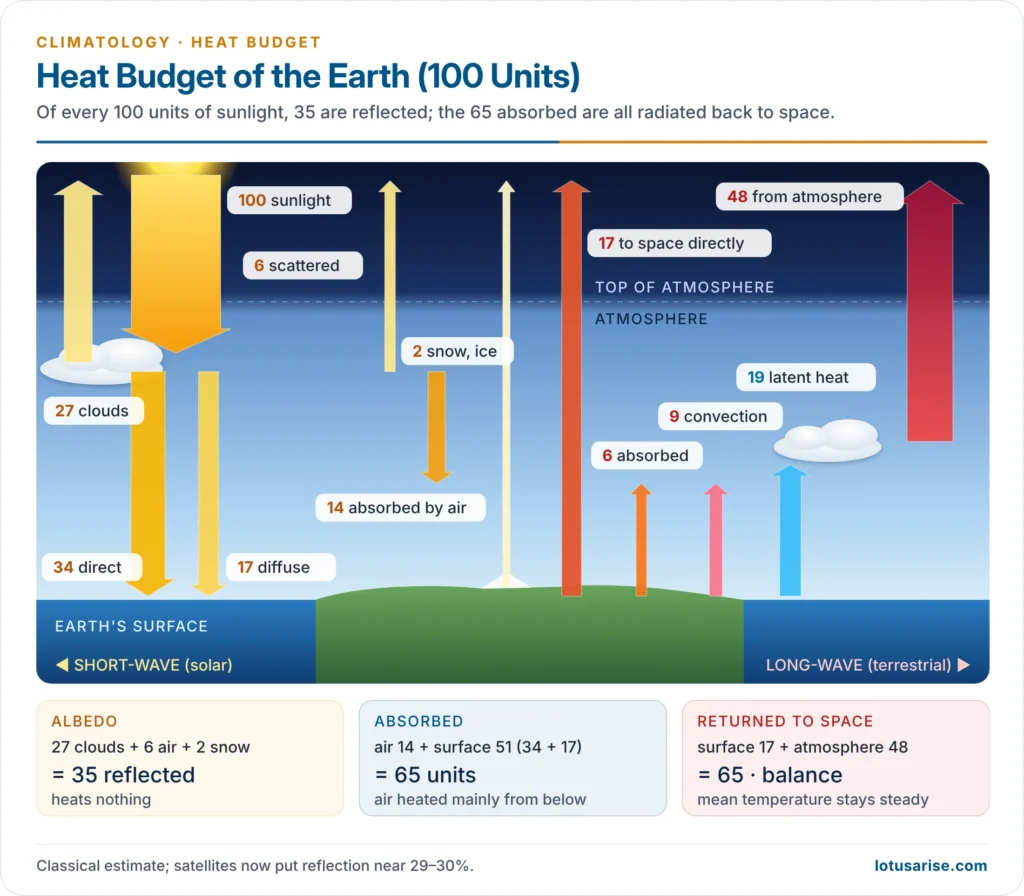
- Take 100 units of insolation at the top of the atmosphere:
- 35 units are reflected to space without heating anything. This is the albedo:
- 27 units from cloud tops
- 6 units scattered back by air and dust
- 2 units from snow and ice
- 14 units are absorbed by the atmosphere (water vapour, ozone, dust and clouds).
- 51 units are absorbed by the surface: 34 units as direct sunlight and 17 units as diffuse skylight.
- 35 units are reflected to space without heating anything. This is the albedo:
- The surface returns its 51 units:
- 17 units escape directly to space through the atmospheric window (8–13 µm).
- 34 units are absorbed by the atmosphere:
- 6 units by direct absorption of long-wave radiation
- 9 units by conduction, convection and turbulence (sensible heat)
- 19 units as latent heat of condensation
- The atmosphere, holding 14 + 34 = 48 units, radiates them to space.
- Balance: 17 (surface) + 48 (atmosphere) = 65 units out, which equals the 65 units absorbed.
- What the model shows:
- The atmosphere is heated mainly from below: it absorbs only 14 units of sunlight directly but 34 units from the ground. This explains why temperature normally falls with height in the troposphere.
- Latent heat is the biggest single channel of heat from surface to air. Evaporation over oceans and condensation in clouds act as a planetary heat engine.
- The surface and atmosphere trade heat back and forth many times before it leaves. This is why the surface is about 33 °C warmer than an airless Earth of the same albedo would be.
Modern Satellite-Era Budget
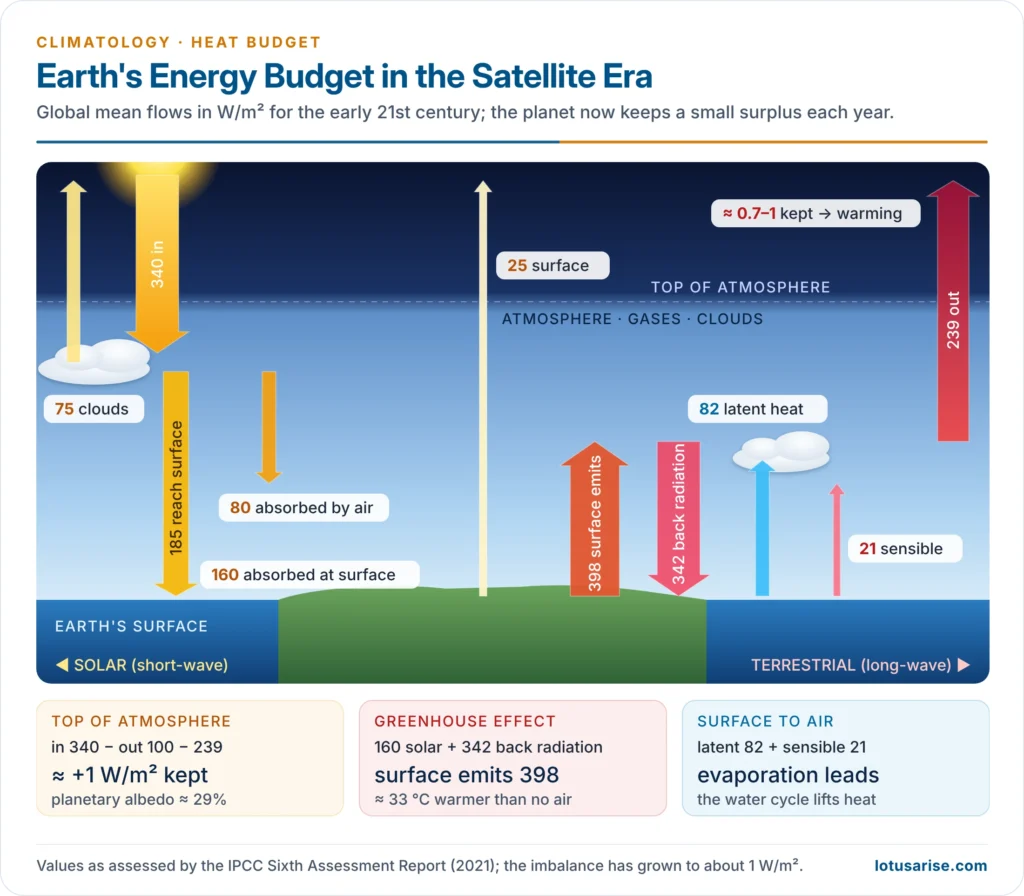
- Satellite measurements (CERES) and surface networks give a more detailed budget. The values below, in W/m² for the early 21st century, are those assessed by the IPCC Sixth Assessment Report (2021):
| Flux | W/m² | % of incoming |
|---|---|---|
| Incoming solar at top of atmosphere | 340 | 100 |
| Reflected to space (clouds, air, surface) | 100 | 29 |
| Absorbed by the atmosphere | 80 | 24 |
| Absorbed by the surface | 160 | 47 |
| Emitted by the surface (long-wave) | 398 | — |
| Back radiation from atmosphere to surface | 342 | — |
| Latent heat flux (evaporation) | 82 | — |
| Sensible heat flux | 21 | — |
| Outgoing long-wave radiation at top of atmosphere | 239 | — |
| Net imbalance (absorbed in the climate system) | about 0.7 | — |
- The surface emits far more (398) than it receives from the sun (160), because it also receives 342 W/m² of back radiation. This is the greenhouse effect in numbers.
- Water vapour, CO₂, methane, nitrous oxide and clouds absorb long-wave radiation and re-emit much of it downward.
- Earth’s energy imbalance: the planet now absorbs more than it emits.
- Satellite and ocean-float records show the imbalance roughly doubled between 2005 and 2019, to about 1 W/m² (Norman Loeb and colleagues, 2021).
- The causes are rising greenhouse gases and fewer reflective clouds and less sea ice.
- About 90% of the surplus heat goes into the oceans.
| Aspect | Classical 100-unit model | Modern satellite budget |
|---|---|---|
| Basis | Early estimates (mid-20th century) | CERES satellites, surface networks, ocean floats |
| Planetary albedo | 35% | about 29% |
| Direct atmospheric absorption | 14% | about 24% |
| Surface absorption | 51% | about 47% |
| Greenhouse back radiation | Implicit | Explicit (342 W/m²) |
| Balance | Exact | Small positive imbalance (warming) |
Heat Transfer Processes
- Radiation:
- Transfer by electromagnetic waves, needing no medium.
- Sun to earth is short-wave; earth to atmosphere and space is long-wave.
- Conduction:
- Transfer by contact, from warmer to cooler.
- It heats only the lowest few metres of air by day and chills them at night, so air, a poor conductor, warms slowly by this route.
- Convection:
- Vertical transfer by rising warm air and sinking cool air.
- It carries heat and moisture up through the troposphere and builds cumulus clouds.
- Advection:
- Horizontal transfer by winds and ocean currents.
- It dominates day-to-day temperature change in middle latitudes.
- In India the hot, dry loo winds of May–June bring advected heat across the northern plains.
- Latent heat transfer:
- Energy is absorbed in evaporation and released in condensation.
- It moves heat both upward and poleward.
Short-Term Variations: Diurnal and Seasonal Heat Budgets
- Daily cycle:
- Insolation peaks at noon, but the surface keeps gaining more than it loses until about 2–3 p.m. So the maximum temperature lags behind the sun.
- The minimum comes just before sunrise, after a night of net radiative loss.
- Seasonal cycle:
- The surplus peaks after the summer solstice. The hottest month lags (July on land, August over oceans in the northern hemisphere) because land and especially water store heat.
- In India, May (before the monsoon clouds) is hotter than June or July over much of the north. Clouds and rain then cut insolation and spend energy on evaporation.
- Clouds and moisture cut both ways:
- Cloudy days are cooler, because clouds reflect insolation.
- Cloudy nights are warmer, because clouds return long-wave radiation.
- This is why deserts have the largest daily ranges: clear skies and dry air allow strong heating by day and rapid radiative cooling at night.
- These short-term imbalances between receipt and loss of energy produce the daily and seasonal march of temperature. They also set up temperature inversions on still, clear nights.
Latitudinal Heat Balance and Poleward Transfer
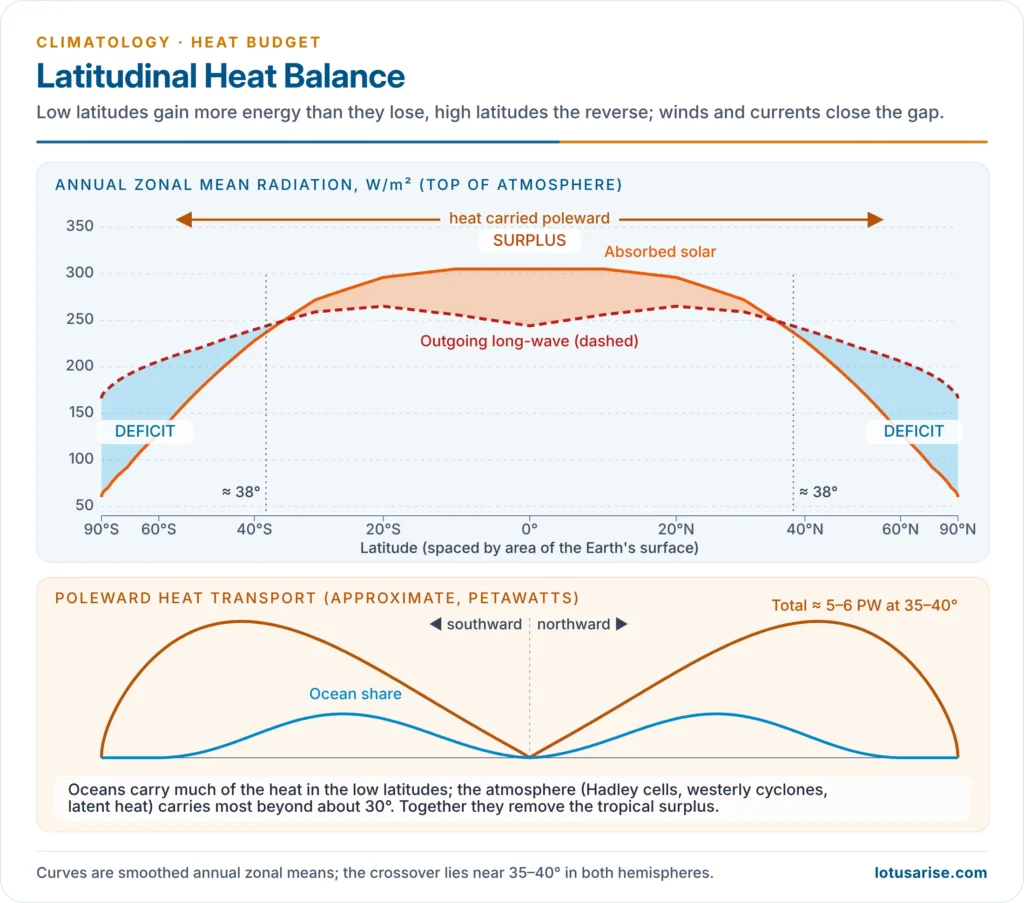
- Between about 35–40° N and S, the absorbed solar energy exceeds the outgoing long-wave radiation, giving a surplus. Poleward of these latitudes outgoing radiation exceeds absorption, giving a deficit.
- The tropics do not grow ever hotter, nor the poles ever colder, because heat is carried poleward:
- Atmospheric circulation (Hadley cells, mid-latitude cyclones and anticyclones, and movement of latent heat) carries most of it, especially beyond about 30° latitude.
- Ocean currents (the Gulf Stream, the Kuroshio) carry a large share in the low latitudes.
- The total transport peaks near 35–40°, at roughly 5–6 petawatts in each hemisphere. This is the zone of the westerlies and frontal cyclones.
- This energy imbalance is the ultimate driver of the general circulation of the atmosphere, the pressure belts and the planetary winds.
Significance
- The heat budget explains:
- the global mean temperature and the natural greenhouse effect
- the vertical temperature structure of the troposphere, heated from below
- the temperature belts, pressure belts, winds and ocean currents, through latitudinal imbalance
- It is the framework for climate change:
- Any change in albedo (ice, clouds, aerosols), greenhouse gases or solar input alters the balance.
- The climate then warms or cools until a new equilibrium is reached.
- Applied relevance: solar-energy planning, urban heat islands (dark low-albedo surfaces), and crop and water planning, through evapotranspiration.
Previous Year Questions
2025Examine the distribution and balance of energy in the Earth’s atmosphere system.2022Describe how short term variations in temperature are related to the processes of receiving energy from the sun to the Earth’s surface and dissipating it to the atmosphere.2016Differentiate between insolation and temperature and explain anomalous temperature.





Thanks
I think some more points to be added for urban heat Island .
otherwise good
lower albedo-cause urban heat island