

Planning for Sustainable Development

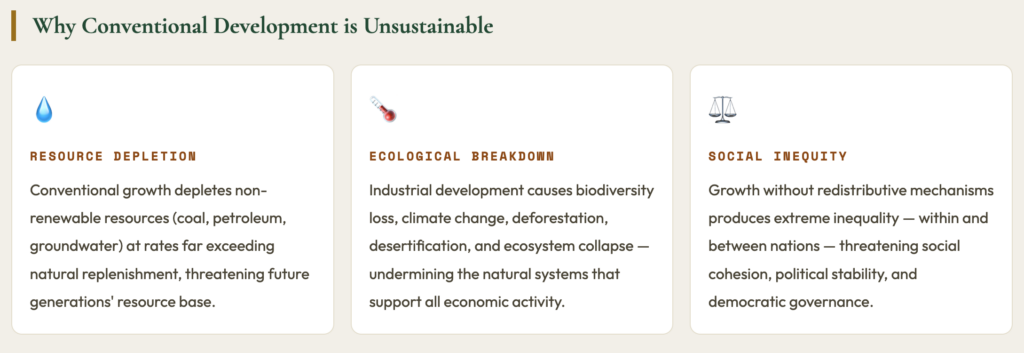
- The concept of sustainable development emerged from the recognition that conventional development models — prioritizing economic growth above all else — were depleting natural resources, degrading ecosystems, and creating social inequities that undermined the long-term basis for human wellbeing.
- For geographers and regional planners, sustainable development is not just an environmental slogan — it is a fundamental reconceptualisation of how development should be planned across space and time.
The Core Challenge
- The developing countries concentrate on mobilizing local resources for sustainable development and regional planning. Natural resources encompass land, water, fisheries, and mineral resources.
- The principal objective of regional planning is to maximize resource development potential by maximizing national output — but this can only be achieved through optimum utilization of resources in the short term and sustainable utilization of resources in the long term.
- The tension between short-term exploitation and long-term sustainability defines the central planning challenge of our era.
Definition and Origin of Sustainable Development
Origin: World Conservation Strategy (1980)
The term first came into use in 1980 in the World Conservation Strategy held under the aegis of the International Union for Conservation of Nature (IUCN). The World Conservation Strategy (1980) identified three main objectives:
- The maintenance of essential ecological processes
- The preservation of genetic diversity
- The sustainable utilization of natural resources
The Brundtland Commission and Our Common Future (1987)
The term was popularised by the study by the World Commission on the Environment and Development (WCED), Our Common Future (1987), also known as the Brundtland Report — named after its chair, Gro Harlem Brundtland, then Prime Minister of Norway.
Brundtland Commission Definition (1987)
“Sustainable development is development that meets the needs of the present without compromising the ability of future generations to meet their own needs.”
This definition contains two key concepts: (1) the concept of needs — in particular, the essential needs of the world’s poor, to which overriding priority should be given; and (2) the concept of limitations — imposed by the state of technology and social organization on the environment’s ability to meet present and future needs.
Allen’s Earlier Definition (1980)
Sustainable development is “the development that is likely to achieve lasting satisfaction of human needs and improvement of the quality of life under the condition that ecosystems and/or species are utilized at levels and in ways that allow them to keep renewing themselves.” (Allen, 1980 — the only pre-Brundtland definition that links quality of life explicitly to ecosystem preservation.)
Key Dimensions of the Brundtland Definition
- Intragenerational Equity
- Meeting the needs of all people alive today, especially the poor. Development must be inclusive — benefits cannot accrue only to wealthy nations or classes while the poor bear the costs of environmental degradation.
- Intergenerational Equity
- Not compromising future generations’ ability to meet their needs. This requires maintaining the stock of natural capital — renewable resource bases, ecological functions, and environmental quality — for those not yet born.
UNESCO’s Distinction: Sustainability is often thought of as a long-term goal (i.e., what we aim for), while sustainable development is the set of processes and pathways to achieve it. Sustainable development is specifically “a way of organizing society so that it can exist in the long term” — taking into account both present imperatives (poverty, inequality) and future ones (environmental preservation, resource conservation).
The Three Pillars (Triple Bottom Line) of Sustainable Development
Sustainable development rests on three fundamental, interdependent pillars: Environmental, Social, and Economic. Sustainable development is found at the intersection of all three. An action that promotes one pillar while degrading another cannot be considered truly sustainable.
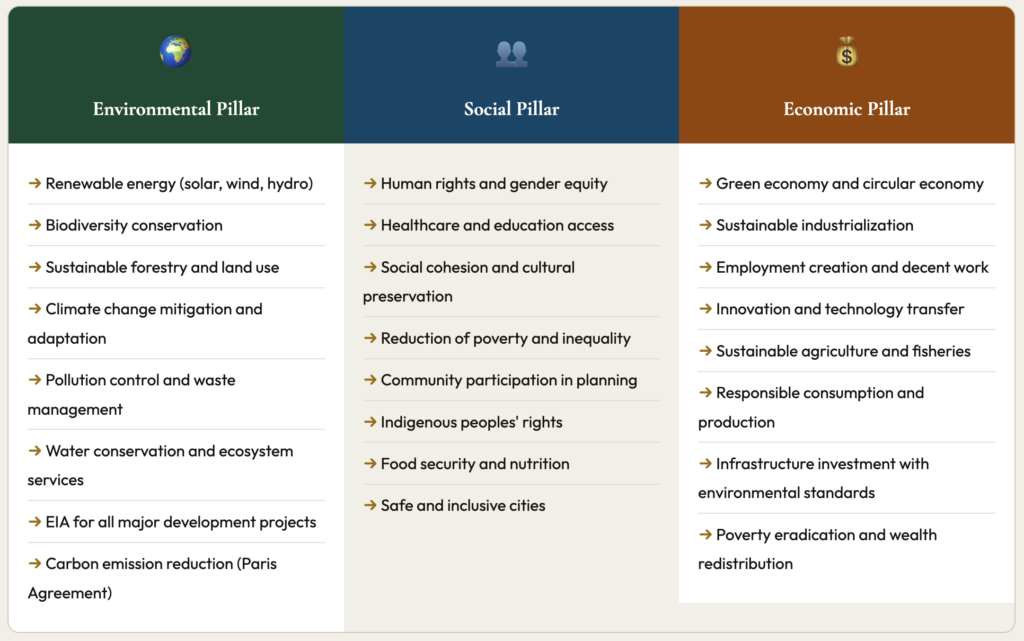
Key Insight: The three pillars interact — they have both synergies and trade-offs. Clean energy (environmental) creates jobs (economic) and improves health (social). Industrial growth (economic) can degrade air quality (environmental) and harm marginalized communities (social). The core task of sustainable development planning is to maximize the synergies while managing the trade-offs. When economic growth overwhelms the other two pillars — as it has historically — the system moves toward unsustainability.
Types of Sustainability: Weak vs. Strong
Weak Sustainability
- Substitutability between human-made capital and natural capital is acceptable
- Total capital stock (human + natural) must be non-declining
- Technology and human innovation can compensate for natural resource depletion
- Economic growth compatible with sustainability as long as total capital is maintained
- Associated with mainstream neoclassical economics
- Allows trade-off: lose forest → gain hospital if total welfare maintained
- Critique: ignores critical ecological thresholds and irreversibility
Strong Sustainability
- Natural capital must be maintained separately — not substitutable by human capital
- Certain ecological thresholds must not be crossed
- Some ecosystems (biodiversity, climate system) cannot be compensated by technology
- Economic activity must operate within planetary boundaries
- Associated with ecological economics (Daly, Costanza)
- Cannot trade forest for hospital — both must be maintained
- Basis for precautionary principle and critical natural capital
India’s Position: India’s development approach has historically leaned toward weak sustainability — accepting environmental trade-offs for economic growth and poverty reduction. Post-2015 (SDG era) and post-Paris Agreement (2015), India has moved toward stronger sustainability commitments — National Mission for Enhanced Energy Efficiency, LiFE (Lifestyle for Environment), and NDC targets reflecting greater alignment with strong sustainability principles.
Principles of Planning for Sustainable Development
Planning for sustainable development involves several major principles that guide both project-level decisions and macro-level policy frameworks.
- Economical Exploitation of Resources
- Resources must be exploited in an economical manner. This minimizes waste of resources and converts waste products into economically viable by-products. Technological upgradation is needed to achieve such a goal — cleaner technologies, zero-waste processes, circular economy models. Example: converting coal fly ash (waste) into construction material; biogas from organic waste.
- Conservation of Renewable and Non-Renewable Resources
- Society has to be aware enough to conserve renewable resources (forests, water, biodiversity) and also to conserve non-renewable resources (coal, petroleum, metallic ores). For renewable resources, conservation means not exceeding the natural regeneration rate. For non-renewable resources, conservation means extending their productive life through efficiency and substitution — transitioning to renewable energy alternatives before fossil fuels are exhausted.
- Integrated Planning
- Integrated planning is important for the development of the economy in a sustainable manner. Examples are found in the case of multi-purpose river valley projects where the same water resource has been used for different purposes — irrigation, hydro-power generation, pisciculture, domestic supply, etc. The multi-level planning in India aims at integrating the planning mechanism from the panchayat level to the Central level for the betterment of society and economy.
- Optimal Industrial Location Planning
- Industrial locations should be planned in economically viable regions. For example, weight-losing industries such as iron and steel should be located near the source of raw materials for achieving maximum profit and optimum utilization of resources (Weber’s least-cost location principle). This reduces unnecessary transport of raw materials, lowering emissions and energy costs — a spatial dimension of sustainability.
- Prevention of Environmental Hazards
- Prevention of environmental hazards such as pollution created by automobiles and industries is important for the developmental aspect of planning. Environmental Impact Assessment (EIA) — mandatory for large development projects in India — ensures that environmental costs are identified and mitigated before projects are approved. The precautionary principle requires avoiding actions with uncertain but potentially severe environmental consequences.
- Ecological Database and Remote Sensing
- A concrete database of ecological resources should be prepared by conducting an extensive field survey and using remote sensing technology. Evaluation of ecological resources should be undertaken systematically. The Biological Record Centre of the Nature Conservancy Council (UK) elaborated a scheme calculating threat value for individual species of plants — such systematic ecological accounting is essential for sustainable regional planning.
- Nature Conservation for Sustainable Development
- Conservation of nature for sustainable development has two objectives: (a) to preserve a quality environment that has aesthetic value, and (b) to ensure a steady yield of flora and fauna along with renewal of resources. Ecological conservation measures: protected areas for endangered species (Project Tiger, Project Elephant), wildlife corridors, biosphere reserves, mangrove protection, environmental awareness campaigns.
Additional Planning Principles from International Literature
- Precautionary Principle: When an action raises threats of harm to the environment or human health, precautionary measures should be taken even if some cause-and-effect relationships are not fully established scientifically. The burden of proof lies with the developer, not the environment.
- Polluter Pays Principle: The costs of pollution and environmental degradation should be borne by those who cause them, not by society at large. Internalizing environmental externalities through carbon pricing, green taxes, and environmental liability law.
- Carrying Capacity Principle: Development must not exceed the ecological carrying capacity of the region — the maximum level of resource use and waste generation that an ecosystem can sustain without long-term degradation.
- Subsidiarity Principle: Decisions about development should be made at the lowest level at which they can be effectively made — enabling local communities to manage local resources sustainably. 73rd Constitutional Amendment embodies this for India.
- Public Participation Principle: Sustainable development requires broad public participation in decision-making — as Agenda 21 stated, participation is “a fundamental prerequisite” for sustainability.
Resource Classification for Sustainable Planning
- For sustainable planning and development, resources must be understood in terms of their regeneration rates and substitutability. LotusArise provides a critical classification:
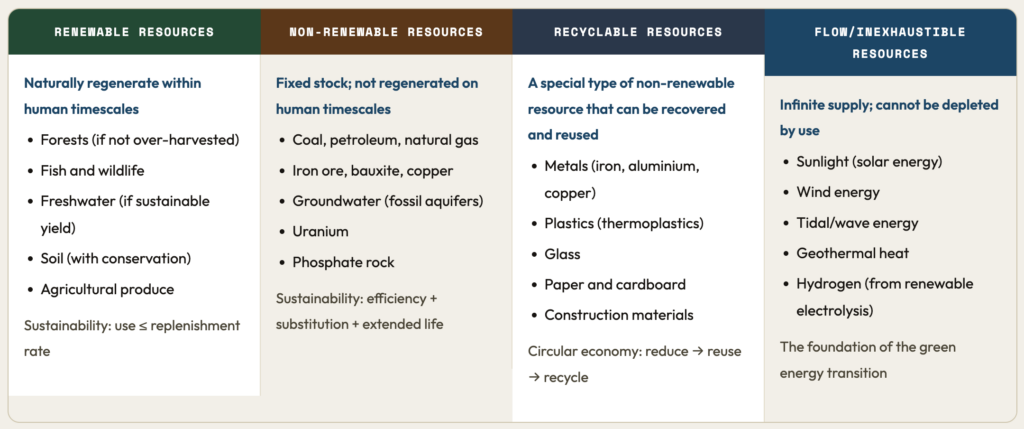
Planning Implication: It is extremely important for planners to consider the ecological aspect for our future survival. Recyclable resources (metals) and inexhaustible resources (solar, wind) are the two categories that offer the most hope for decoupling economic growth from resource depletion — the central goal of the circular economy and the green energy transition. Regional planners must assess which resource types dominate their region and plan accordingly.
Jeffers’ Five-Stage Iterative Planning Model (1973)
- J.N.R. Jeffers formulated a classic five-stage iterative planning process for land use and resource management (1973). This model is specifically designed for sustainable resource planning and is cited in the LotusArise article as the standard procedural framework for planning for sustainable development.
- The model is iterative — meaning it is not a one-time linear process but a continuous cycle. After Stage 5 (monitoring and modification), the planner returns to Stage 1 to reassess goals in light of new information. This adaptive management quality is essential for sustainable planning, where environmental conditions and human values continuously evolve.
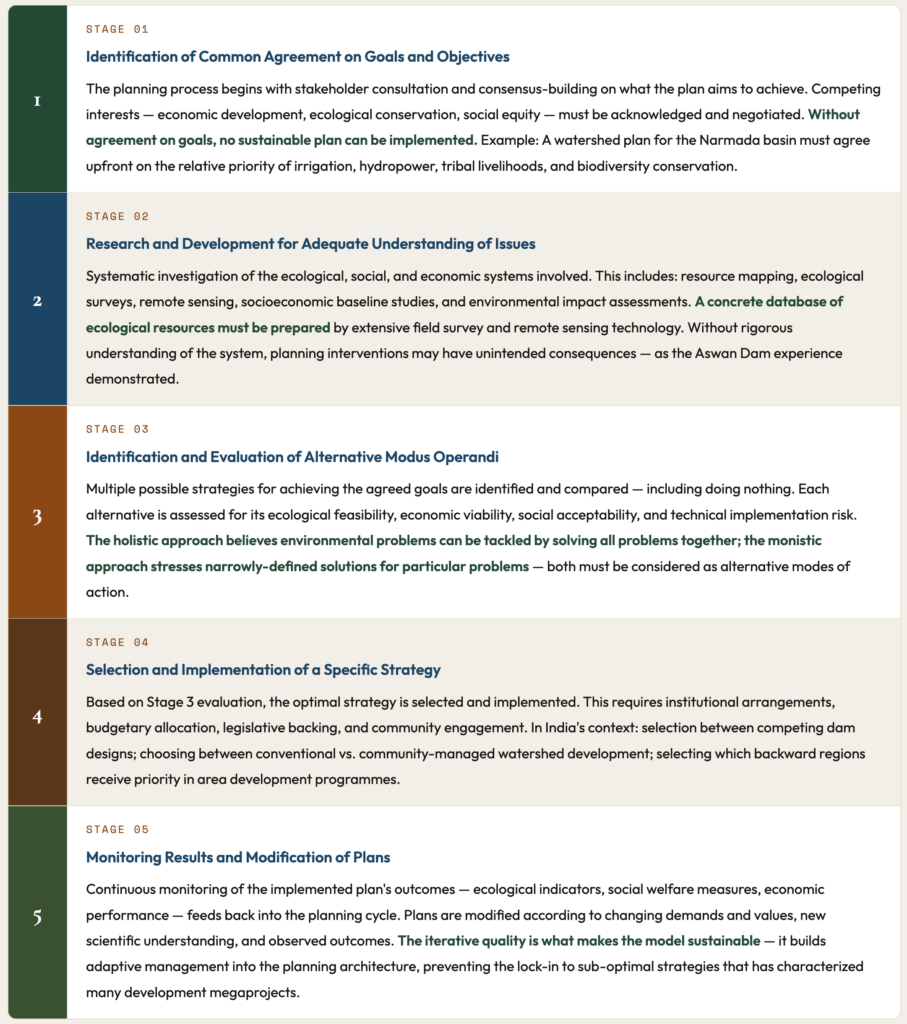
Jeffers’ five-stage iterative model is the precursor to modern Adaptive Management — a structured, iterative approach to resource management under uncertainty. Used in India’s IWMP (Integrated Watershed Management Programme), the Aspirational Districts Programme’s real-time delta-ranking system, and coastal zone management plans. The key principle: learning by doing, rather than implementing a plan and never revisiting it. The periodic revision of India’s National Action Plan on Climate Change (NAPCC) missions embodies this iterative spirit.
Ecological Planning and the Man-Made Development Problem
Two Approaches to Environmental Problem-Solving
- Holistic Approach
- Environmental problems can be tackled by solving all the problems together. Recognizes that ecological, social, and economic systems are interconnected — addressing one in isolation produces unintended consequences in others. Basis for integrated planning and ecosystem management.
- Monistic Approach
- Stresses on narrowly-defined solutions for particular problems. More practical for immediate crises but risks ignoring systemic linkages. Example: using DDT for malaria control — solved one problem but created pesticide resistance and ecosystem disruption.
Tubbs and Blackwood’s Ecological Evaluation Framework
- C.R. Tubbs and J.W. Blackwood evolved a systematic ecological evaluation framework with three components:
- Primary ecological zones — broad-scale classification of the landscape into ecological units based on geology, topography, soils, and vegetation
- Ecological evaluation for each ecological zone — assessment on the basis of general land use and biodiversity of habitat — species richness, rarity, naturalness, size, and fragility
- Relative ecological evaluation map — a composite map showing the relative ecological value of different parts of the planning area, used to guide development allocation decisions
Cautionary Case Study: The Aswan High Dam, Egypt
Classic Example of Inadequate Ecological Planning
- The Aswan High Dam (Egypt) was built without adequate ecological planning. It provides an instructive lesson in the consequences of ignoring ecological systems in development planning:
- Problems created: (1) Silting of reservoirs — the dam traps the Nile’s silt load that previously fertilized the floodplain, reducing downstream agricultural productivity; (2) Reduction of plankton in the lower Nile course — affecting species like sardine, mackerel, lobster, etc. — collapsed the Eastern Mediterranean fishing industry; (3) Reservoirs and canals affected by snails that cause deadly diseases — bilharzia/schistosomiasis spread; (4) Reservoirs increased occurrence of malaria; (5) Increased soil salinity, which led to reduced soil fertility in the Nile delta.
- On the contrary, the Trans-Alaska Pipeline Project was implemented only after adequate planning — including ecological surveys, engineering adaptations for permafrost and caribou migration, and environmental monitoring systems — demonstrating that sustainable megaproject planning is achievable.
- Contrast — India’s Dam Planning: Like the Aswan Dam, many of India’s large river valley projects (Tehri, Sardar Sarovar, Hirakud) were implemented with inadequate ecological assessment. Problems: massive displacement of tribal communities, loss of forest biodiversity, downstream ecological impacts, siltation of reservoirs, and social unrest. Post-EIA legislation (1994, amended 2006) has improved the framework, but implementation remains weak — as India’s experience with the environmental clearance process shows.
Global Milestones in Sustainable Development Planning
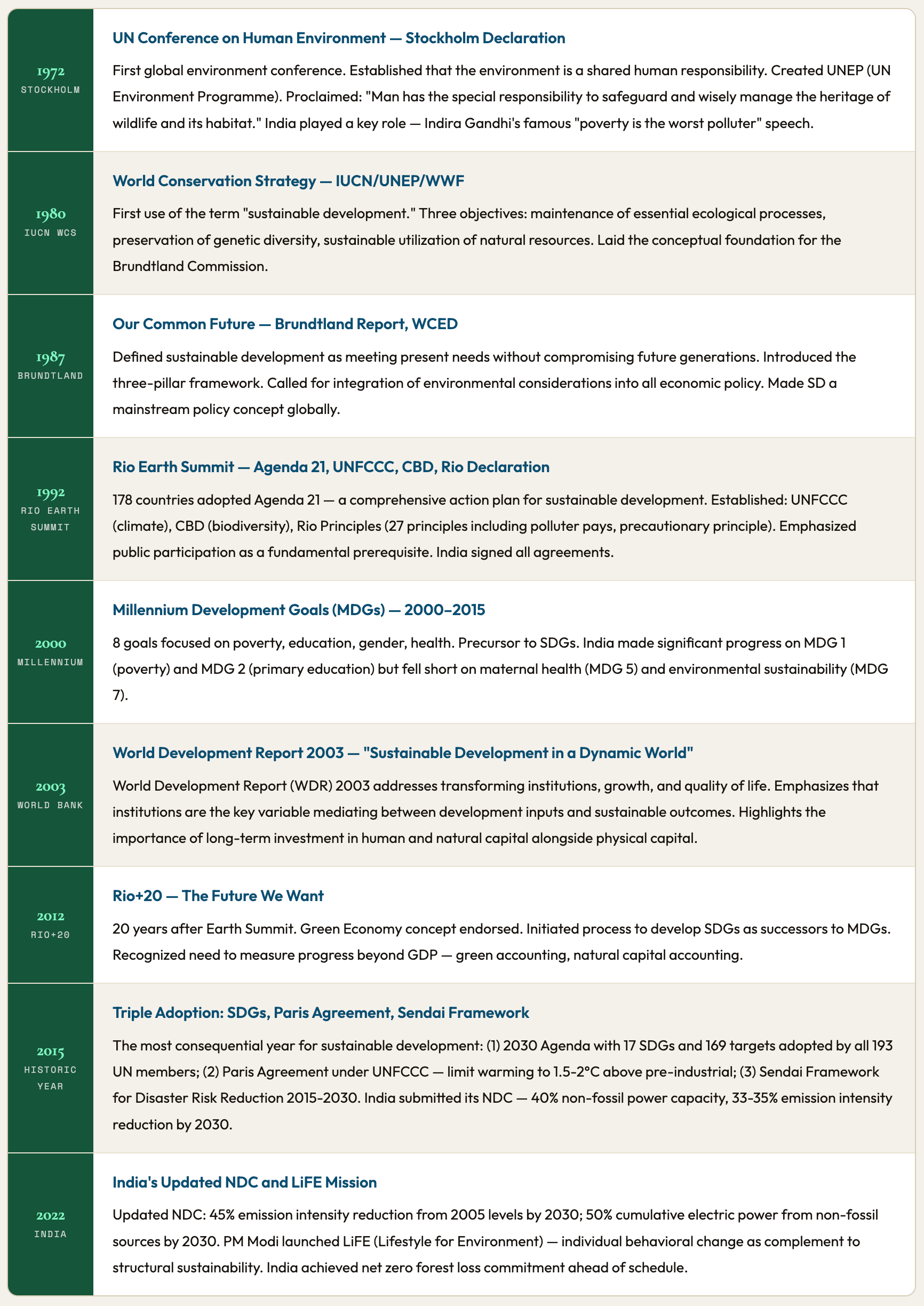
Sustainable Development Goals (SDGs) — 2030 Agenda
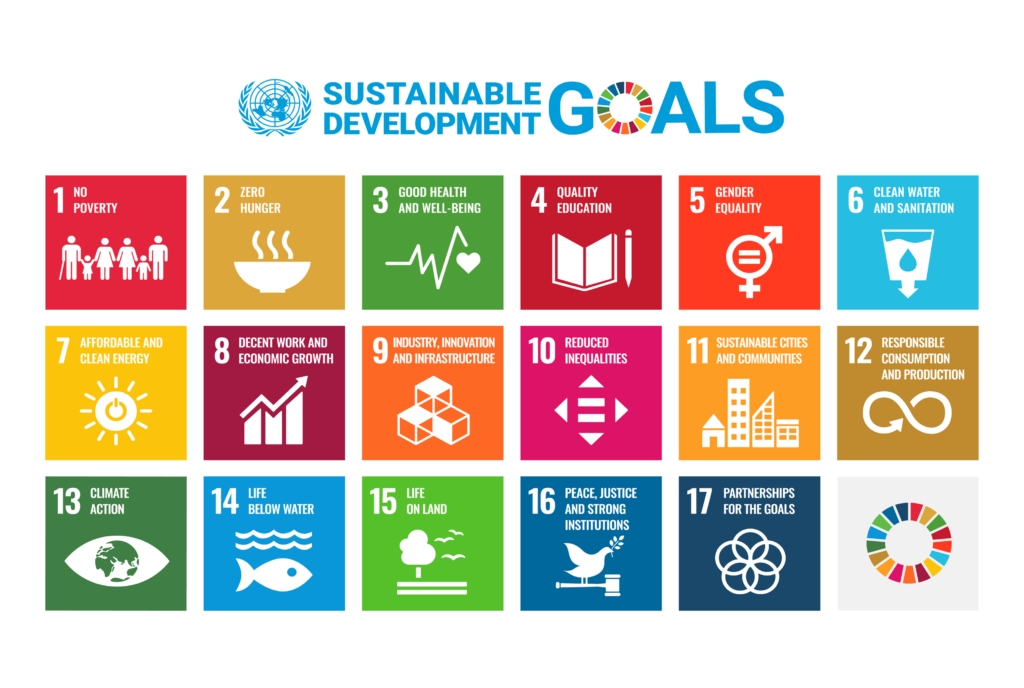
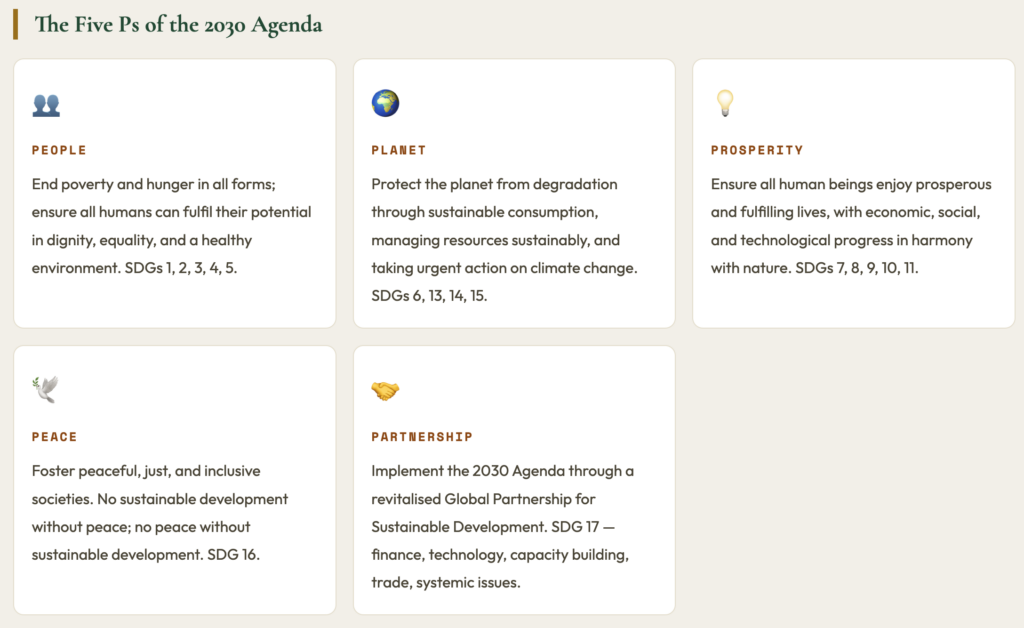
The 17 Sustainable Development Goals were adopted by all 193 UN member states on 25 September 2015 as part of the “2030 Agenda for Sustainable Development.” They are organized around five overarching principles — the 5 Ps: People, Planet, Prosperity, Peace, Partnership.
SDG Implementation in India
| SDG | India’s Progress | Key Programme |
|---|---|---|
| SDG 1 (No Poverty) | Significant — extreme poverty declined from 28% (2014) to ~5% (2024) per NITI Aayog MPI | PM-KISAN, MGNREGS, PMJDY, Ujjwala Yojana |
| SDG 2 (Zero Hunger) | Moderate — food production record highs but malnutrition (especially stunting) persists | PM-POSHAN, PMFBY, food security entitlements |
| SDG 7 (Clean Energy) | Strong — 175 GW renewable capacity target exceeded; 500 GW non-fossil target by 2030 | National Solar Mission, PM-KUSUM, One Sun One World One Grid |
| SDG 11 (Sustainable Cities) | Ongoing — Smart Cities Mission (100 cities), AMRUT, PM-UDAY | Smart Cities Mission, PMAY-Urban |
| SDG 13 (Climate Action) | Updated NDC — 45% emission intensity reduction, 50% non-fossil power by 2030 | National Action Plan on Climate Change (NAPCC), LiFE Mission |
| SDG 15 (Life on Land) | Forest cover increased 2,261 sq. km (2019-21); but biodiversity loss continues | Project Tiger, Project Elephant, National Mission for Green India |
India’s Policy Framework for Sustainable Development
- Environment Protection Act (1986)
- Umbrella legislation for environmental protection. Empowers the Centre to take measures for environmental protection, prevention of pollution, and regulation of hazardous substances. Basis for all subsequent environmental regulation.
- EIA Notification (1994 / Amended 2006)
- Environmental Impact Assessment mandatory for 29 categories of projects before clearance. Requires public hearing. Post-2006 amendment introduced staged appraisal. Key tool for project-level sustainable development planning.
- National Action Plan on Climate Change (NAPCC, 2008)
- Eight National Missions: Solar, Enhanced Energy Efficiency, Sustainable Habitat, Water, Green India, Sustainable Agriculture, Himalayan Ecosystem, Strategic Knowledge for Climate Change. India’s comprehensive SD planning framework.
- Forest Rights Act (2006)
- Recognizes rights of forest-dwelling communities including Scheduled Tribes. Prevents displacement without consent and community benefit-sharing — critical for sustainable tribal area development planning.
- Coastal Regulation Zone (CRZ) Notification
- Regulates development in coastal areas to protect coastal ecosystems, livelihoods, and biodiversity. Critical for sustainable island territory planning (Andaman, Lakshadweep) and coastal development.
- SDG Localization — NITI Aayog
- India’s SDG Index ranks states on 115 indicators across all 17 SDGs. Incentivizes competitive federalism for sustainability. Aspirational Districts Programme aligned with SDG targets for backward regions.
- National Water Policy (2012)
- Prioritizes water as a scarce national resource requiring sustainable management. Integrated watershed approach; community-based water governance; equitable access; demand-side management. Guides river basin planning.
- PM’s Council on Climate Change
- Coordinates climate-related sustainable development policy across all ministries. India’s updated NDC (2022): 45% emission intensity reduction from 2005 levels; 50% cumulative power from non-fossil sources — both by 2030.
India’s Urban Sustainable Development Programmes
- Smart Cities Mission (2015): 100 cities selected to develop sustainable urban infrastructure — ICT, renewable energy, green buildings, public transit, integrated water management. Area-Based Development (ABD) for specific precincts + Pan-City solutions.
- AMRUT (Atal Mission for Rejuvenation and Urban Transformation, 2015): 500 cities; focus on water supply, sewerage, stormwater drains, urban transport, and urban greening — the basic resilience infrastructure for medium cities.
- PMAY-Urban (Pradhan Mantri Awas Yojana): Housing for all — sustainable urban housing with rainwater harvesting, solar panels, and accessibility for disabled persons built into design standards.
- National Urban Heat Island Management Plan: Emerging policy to address urban heat islands through green infrastructure, cool roofs, and urban forestry — climate adaptation in cities.
- Eco-Sensitive Zones around urban areas: Western Ghats ecosystem services, Aravalli hill protection for NCR — integrating ecological sustainability into urban planning boundaries.
“Rural sustainability is necessary for urban sustainability” (UPSC 2014): Cities depend on rural areas for food, water, ecosystem services, and labour. Unsustainable rural land use — deforestation, soil erosion, groundwater depletion — ultimately undermines urban sustainability by disrupting food systems, water supply, and climate regulation. The integrated development approach recognizes that urban and rural areas are functionally linked and must be planned as a single system. India’s River Basin Authorities (DVC, Cauvery Water Management Authority) embody this integrated approach.
Urban Resilience and Sustainable Development Planning
- Urban resilience is the capacity of a city and its systems — physical, social, environmental, and economic — to withstand, adapt, and recover from acute shocks (floods, earthquakes, pandemics) and chronic stresses (climate change, economic inequity, infrastructure decay) while maintaining continuity of essential functions and services.
- It is a critical dimension of planning for sustainable development in the context of towns and cities.
Dimensions of Urban Resilience
- Physical Resilience
- Robust infrastructure (flood defences, earthquake-resistant buildings, redundant power and water systems). Green infrastructure (urban forests, wetlands, permeable pavements). Example: Chennai’s flood resilience after 2015 floods — integrated stormwater management.
- Ecological Resilience
- Urban biodiversity, urban forests, restored wetlands, green corridors. Delhi Ridge Forest, Bengaluru’s lakes, Mumbai’s Aarey Forest — ecological buffers against heat, flooding, and air pollution.
- Social Resilience
- Strong community networks, inclusive governance, social capital, reduced inequality. Communities that trust each other and their governments recover faster from shocks. Kerala’s response to 2018 floods — community mobilization showed high social resilience.
- Economic Resilience
- Diversified economic base, strong informal sector safety nets, universal social protection. Cities dependent on a single industry or employer (Bokaro — steel) are economically fragile; diversified cities (Bengaluru — IT + manufacturing + services) are more resilient.
Summary





Thnks
Thanku