

Seeds
- Seed quality accounts for an estimated 20–25% of agricultural productivity in India. Seeds are one of the technological determinants of agriculture.
- Seeds help meet the country’s food and nutritional security needs.
- They are a critical, basic input for raising production and productivity across India’s agro-climatic regions, and the efficiency of fertilizers, pesticides and irrigation largely depends on them.
The Seed Chain
- The Indian seed programme recognises three generations of seed:
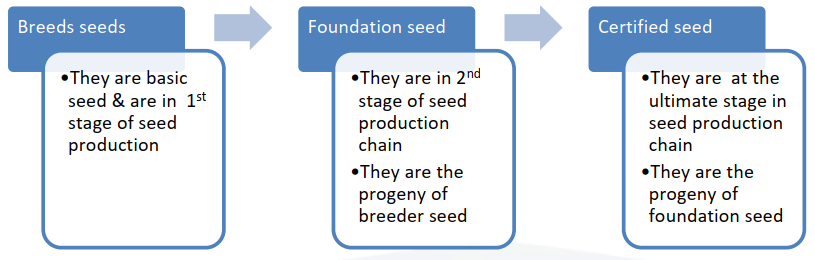
- Read “Breeder seeds” in the first box.
| Stage | What it is | Who produces it |
|---|---|---|
| Breeder | First stage, the source of all quality seed | ICAR and selected agricultural universities |
| Foundation | Second stage, progeny of breeder seed | National Seeds Corporation, selected universities and other agencies |
| Certified | Final stage, progeny of foundation seed, certified before sale | Central and State seed farms, State departments, private producers and cooperatives |
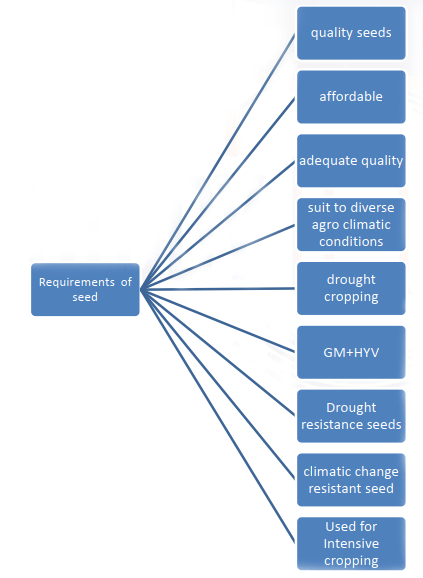
- On this chart, “adequate quality” should read adequate quantity.
High-Yielding Varieties
- HYV seeds drove the Green Revolution. Dwarf wheats came in the 1960s and new rice varieties in the late 1960s.
- Traits:
- Strong response to fertilizers and other inputs.
- A high ratio of grain to stalk.
- Photo-period insensitivity and early maturity in most cases.
- Dwarf, sturdy stems that resist wind and carry a heavy grain load, with large leaf surface for photosynthesis.
- Merits:
- Fertilizer response: more grain from the same dose.
- Shorter cycle: about 100 days for new rice and 110 days for new wheat, against 130 and 150 days. This opens up multiple cropping.
- Water use per quintal falls, although total need rises.
- Employment: more work per hectare and in the old slack period between rabi and kharif.
- Easy adoption after basic training, though sowing dates shift. HYV wheat is sown in November–December in Punjab, Haryana and western Uttar Pradesh, later than the older varieties.
- Constraints:
- They do not tolerate water shortage, and need water in the proper dose at the proper stage.
- They need heavy fertilizer doses.
- They are vulnerable to pests and diseases in India’s warm, humid conditions.
- They need capital for inputs, which small and marginal farmers lack.
- They need machines, power, markets, storage, extension services and open-minded farmers.
- Deficiencies of the programme:
- Weak inspection and certification have let non-certified seed reach the market as truthfully labelled seed.
- Low seed replacement: poor supply leads farmers to keep their own seed, which lowers quality and yield. The rate long stayed below 20% for most crops.
- Narrow focus on wheat and rice left other crops behind.
- Multinational entry brought genetically modified seed in high-value crops such as Bt cotton. Cotton yield rose from 106 kg/ha in 1970-71 to 499 kg/ha in 2010-11, then levelled off. Spurious seed and bad weather ruined many cotton farmers.
Government Efforts
- National Seeds Corporation (NSC) was set up in 1963, and the State Farms Corporation of India in 1969.
- The HYV Programme was launched in 1966-67 to raise foodgrain output. It covered 18.9 lakh hectares, or 2.2% of the area of its six crops (rice, wheat, jowar, bajra, maize and ragi), in that first year.
- The Seeds Act, 1966 is the legal base for quality regulation. A New Policy on Seed Development (1988) opened up seed imports.
- Protection of Plant Varieties and Farmers’ Rights Act, 2001 safeguards breeders and farmers.
- A Seeds Bill was introduced in the Rajya Sabha in 2004. The draft Seeds Bill, 2025 was released in November 2025, to replace the 1966 Act and the Seeds (Control) Order, 1983, with compulsory registration and stiffer penalties for spurious seed.
National Seeds Policy 2002
- Objectives:
- More production of quality seeds, with the private sector playing a major role.
- Genetic engineering to develop varieties with the highest tolerance of biotic and abiotic stress.
- Dismantling needless regulation of seed production and import, in the wake of globalisation and liberalisation.
- Protection of farmers’ interests.
- Thrust areas:
- Research: the policy rests on the Indian Council of Agricultural Research (ICAR), the premier body for seed research and development, which dates from 1929.
- Varietal development and improved plant varieties.
- Plant variety protection for new and improved varieties.
- Researchers’ rights: seed or planting material of protected varieties stays open for bona fide research and breeding.
- Seed production: public seed bodies are encouraged to produce more, alongside a private sector that then held about 40% of production.
- Distribution and marketing: high-quality seed, better delivery and an efficient market.
- Infrastructure: new and stronger facilities to meet rising demand for certified seed.
- Transgenic varieties: biotechnology for tolerance of disease, pests and climatic stress, and better productivity and nutrition.
- Imports of seed and planting material: to give farmers the best material, for:
- Higher productivity.
- Higher farm income.
- Higher export earnings.
- Less harm to environment, health and bio-safety.
- Exports: a long-term aim of raising India’s share of world seed exports from 1% to 10% by 2020.
- Domestic industry: promotion of the Indian seed sector.
- Monitoring: a stronger system under the Department of Agriculture and Cooperation.
Other Efforts
- Sub-Mission on Seed and Planting Material, under the National Mission on Agricultural Extension and Technology (NMAET).
- Seed banks and a national seed grid.
- National Mission on Seeds in the Twelfth Plan, which provided for:
- Quality seed production for 45 crops.
- A higher seed replacement rate.
- Better quality of farm-saved seed.
- More certified quality seed.
- Regional seed reserves for use in natural calamities.
- Seed Village Programme: a seed village is one where trained farmers grow seed of various crops, meeting their own needs and those of fellow farmers and neighbouring villages, on time and at an affordable cost.
- Objectives:
- More seed production.
- A higher seed replacement rate.
- Seed production in clusters or compact areas, replacing local varieties with HYVs.
- Village self-sufficiency and self-reliance.
- Timely supply to meet local demand.
- Two phases:
- Seed production: an area suited to a crop is chosen, and sown to a single variety.
- Seed processing unit: without proper processing and handling, the earlier effort can be lost, so processing and packaging are vital.
- Benefits:
- Seed at the farm’s doorstep at the right time.
- Affordable cost, even below market price.
- Farmer confidence in quality from a known source.
- Mutual gain for producer and consumer.
- Faster spread of new cultivars.
- Objectives:
- New technologies: transgenic crops, tissue culture and soil-less agriculture.
- Upgrading public seed agencies.
- Central scheme for seed infrastructure: in place since 2005-06. Availability of certified seed rose from 126.75 lakh quintals in 2005-06 to 328.6 lakh quintals in 2012-13.
- Transport subsidy moves seed to the hilly and remote areas of the North-East.
- Seed banks store seed as gene banks to conserve biodiversity:
- Millennium Seed Bank of the United Kingdom, with partners in the USA and Australia.
- Svalbard Global Seed Vault in Norway, for vulnerable seed species.
- Community seed banks across the country improve access to quality seed.
- OECD Seed Schemes: they use labels and certificates for seed produced and processed for international trade.
- Seed testing: India takes part in the OECD schemes to build its seed export capacity and production.
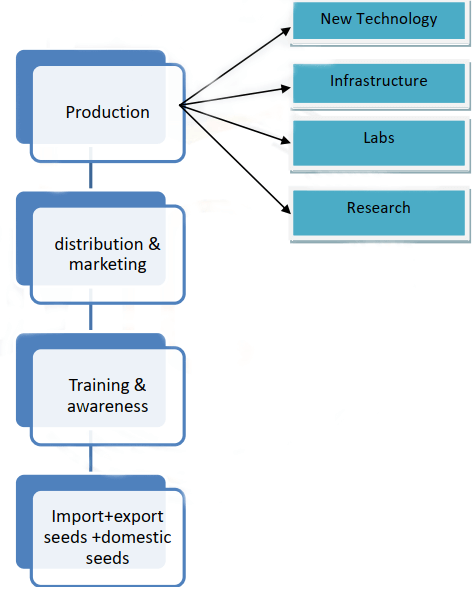
- Seed production and distribution in India (chart above) rests on production, marketing, awareness and trade.
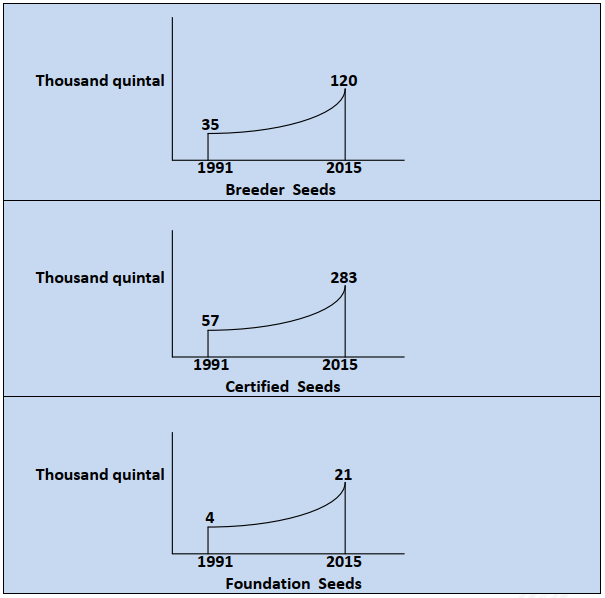
- Units on this chart: breeder seed is in thousand quintals, while foundation and certified seed are in lakh quintals, despite the common label. The figures run from 1991-92 to about 2011-12, although the axis reads 1991 and 2015.
| Year | Breeder (thousand quintals) | Foundation (lakh quintals) | Certified or quality distributed (lakh quintals) |
|---|---|---|---|
| 1991-92 | 34.90 | 3.75 | 57.50 |
| 2005-06 | 68.64 | 7.40 | 126.75 |
| 2012-13 | 110.20 | 16.17 | 313.44 |
| 2020-21 | 91.16 | 24.12 | 421.09 |
| 2023-24 | 92.50 | 18.29 | 442.64 |
- Crop priority: food crops come first, so that foodgrains keep pace with population. Oilseeds also get attention, because India relies heavily on imported edible oil.
Previous Year Questions
- No direct PYQ has been asked on this sub-topic yet.





Very well summarized article on Seeds in India.
Kudos to team lotus for this wonderful achievement.
Very well explained tq lotus arise