

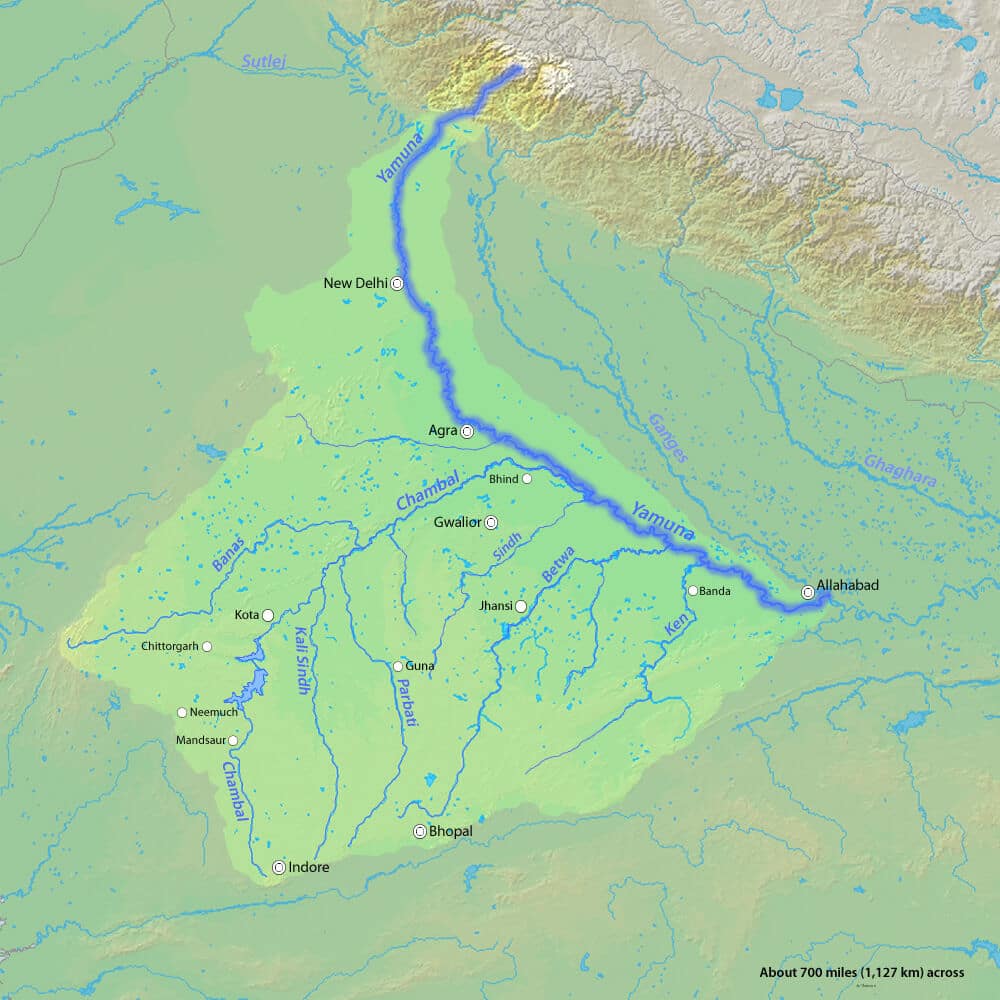
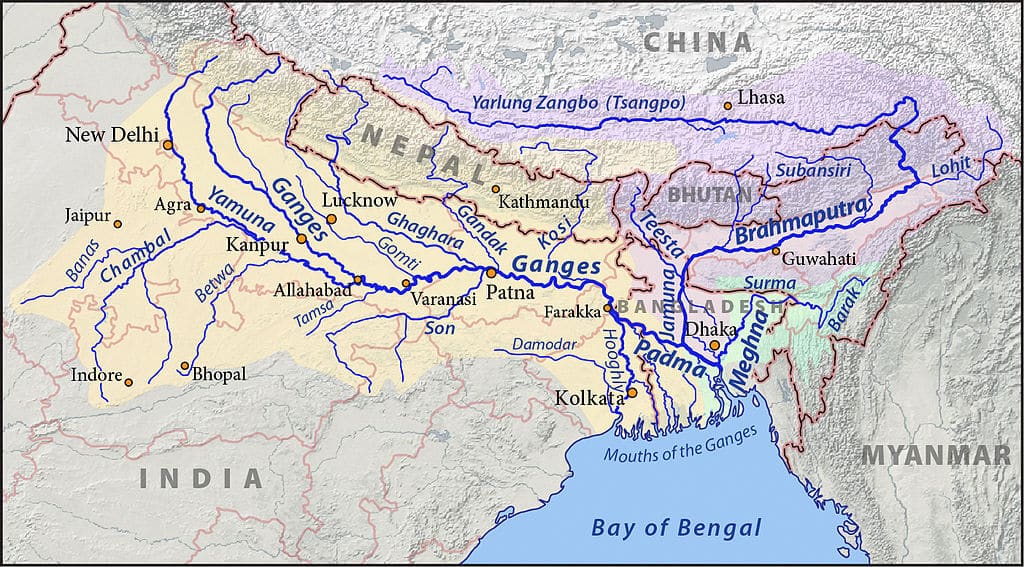
- The Yamuna is the largest and longest tributary of the Ganga and its westernmost one in the northern plains.
- It rises at the Yamunotri Glacier on the south-western slopes of Bandarpunch (Banderpoonch, about 6,316 m) in Uttarakhand. Older accounts give the glacier source about 6,330 m.
- It is 1,376 km long from source to its meeting with the Ganga at the Triveni Sangam, Prayagraj (Allahabad).
- Its basin covers 3,66,223 sq km, with average water resources of about 57.2 BCM a year.
The Main River
Course
- In the hills: it cuts across the Nag Tibba, Mussoorie and Shiwalik ranges. Small streams such as the Rishiganga, Uma and Hanuman Ganga join it here.
- The range is sometimes described as the Mussoorie range of the Lower Himalaya. Bandarpunch itself is a high massif behind that range, and the river crosses the Mussoorie range lower down.
- Tons: its main upper feeder also starts from the Bandarpunch glacier, at about 3,900 m, and joins below Kalsi, before the Yamuna leaves the hills.
- At this confluence, the Tons carries about twice the water of the Yamuna.
- Into the plains: it emerges near Tajewala, and the Eastern and Western Yamuna Canals are drawn from it near that point, now at Hathnikund.
- Through the plains: it flows along or across Uttarakhand, Himachal Pradesh, Haryana, Delhi and Uttar Pradesh, running south to Mathura and south-east on to Prayagraj. The Agra Canal also takes its water.
- Doab: it encloses, with the Ganga, the highly fertile alluvial Yamuna–Ganga Doab of the Indo-Gangetic plain.
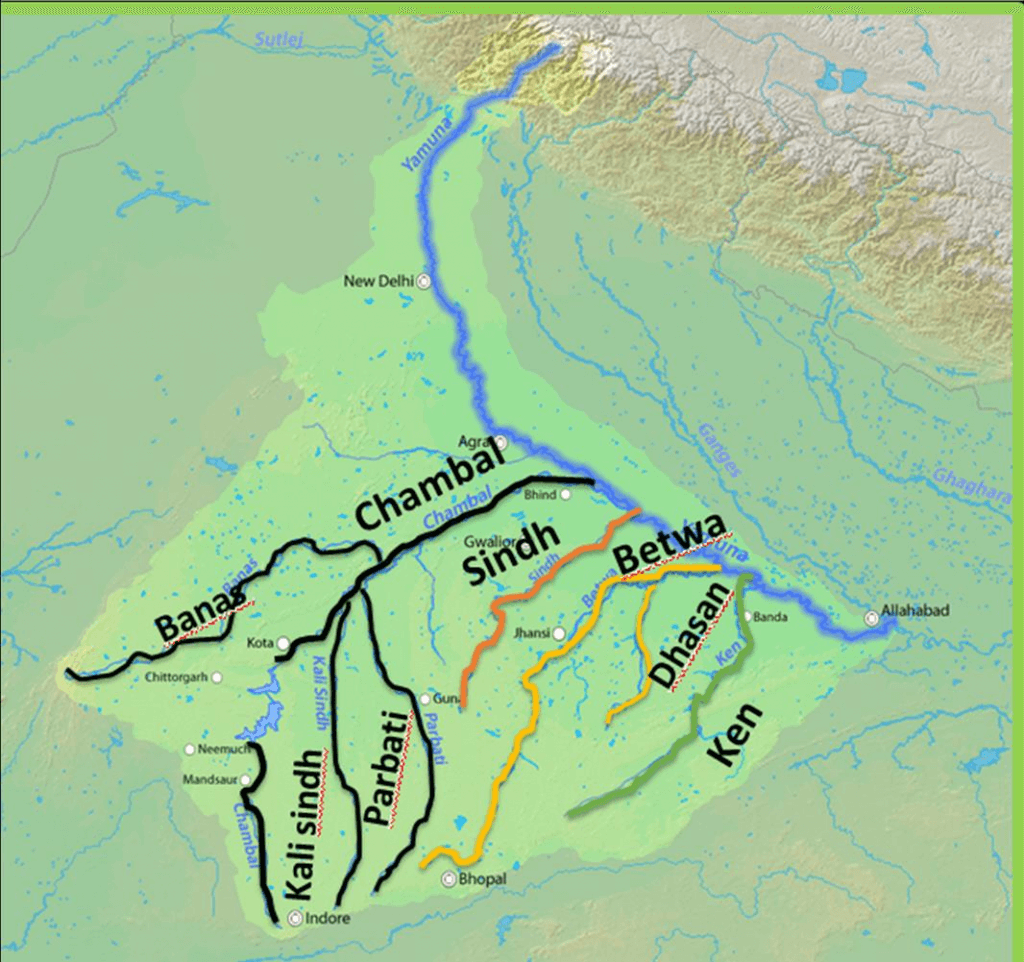
- Between Agra and Prayagraj, it receives its big Peninsular tributaries: the Chambal, Sind, Betwa and Ken. On the left bank, the Hindon, Rind, Sengar and Varuna are the main ones.
- Cities on its banks: Baghpat (Bhagpat), Delhi, Noida, Mathura, Agra, Firozabad, Etawah, Kalpi, Hamirpur and Prayagraj.
- History: the Yamuna is believed to have once drained towards the Indus side through the Ghaggar, or independently to the Rann of Kachchh, before earth movements near the Aravalli turned it to the Ganga, a change tied to the wider evolution of the Indian river system.
Floods and Water Quality
- July 2023 flood: heavy rain over Himachal Pradesh, Uttarakhand and Haryana raised the river at the Old Delhi Railway Bridge to a record 208.66 m on 13 July 2023, against the earlier high of 207.49 m in September 1978.
- Flow is managed by the Upper Yamuna River Board among the basin States, and much of the dry-season flow is drawn off for canals and cities.
- Sewage treatment in the basin is carried out under Namami Gange, for example the 100 MLD plant at Dhandhupura, Agra, which was in trial testing in mid-2026.
Major Tributaries of Yamuna River
- Tons
- Giri
- Hindon
- Chambal
- Banas
- Kali Sindh
- Parbati
- Sind
- Betwa
- Dhasan
- Ken
| River | Source | Length (km) | Basin (sq km) | Joins |
|---|---|---|---|---|
| Tons | Bandarpunch glacier | Not given | Not given | Yamuna below Kalsi |
| Hindon | Upper Shiwalik | About 400 | 7,083 | Yamuna near Noida |
| Chambal | Janapao hills, near Mhow | 960–1,050, sources differ | 1,39,468 to 1,43,219 | Yamuna, Etawah district |
| Sind | Vidisha plateau | 415–470 | 25,085 to 26,699 | Yamuna, Etawah district |
| Betwa | Vindhya Range, Raisen area | 590 | 45,580 | Yamuna at Hamirpur |
| Ken | Kaimur–Barner hills, Katni area | 360–427 | Not given | Yamuna at Chilla |
Tons River
- It is the largest Himalayan tributary of the Yamuna, and flows through Garhwal, the western part of Uttarakhand (formerly Uttaranchal).
- It is sometimes called the Yamuna’s longest and biggest tributary overall. That applies only in the Himalayan part. Overall, the Chambal is the longest.
- It rises at about 3,900 m and joins below Kalsi near Dehradun.
- It is one of the major perennial Himalayan rivers.
- It should not be confused with the Tamsa or southern Tons, a right-bank tributary of the Ganga itself.
Giri River
- A leading tributary and the main water source of south-eastern Himachal Pradesh.
- It rises at Kupar peak above Jubbal town, and is well known in the Jubbal and Rohru hills.
- It crosses the Shimla hills, then flows south-east, dividing Sirmaur district into roughly equal Cis-Giri and Trans-Giri parts.
- It joins the Yamuna upstream of Paonta, below Mokkampur.
Hindon River
- It lies between two big rivers: the Ganga on its left and the Yamuna on its right.
- It starts in the upper Shiwalik of the Lower Himalaya and is purely rain-fed, with a catchment of about 7,083 sq km.
- It runs about 400 km, as against the 256 km of older accounts, passing near Ghaziabad.
- Its width ranges from 20 m to 160 m.
Chambal River
- Also known as Charmanwati or Charmawati.
- Length is given as 960 km in most Indian texts, about 1,024–1,050 km in others.
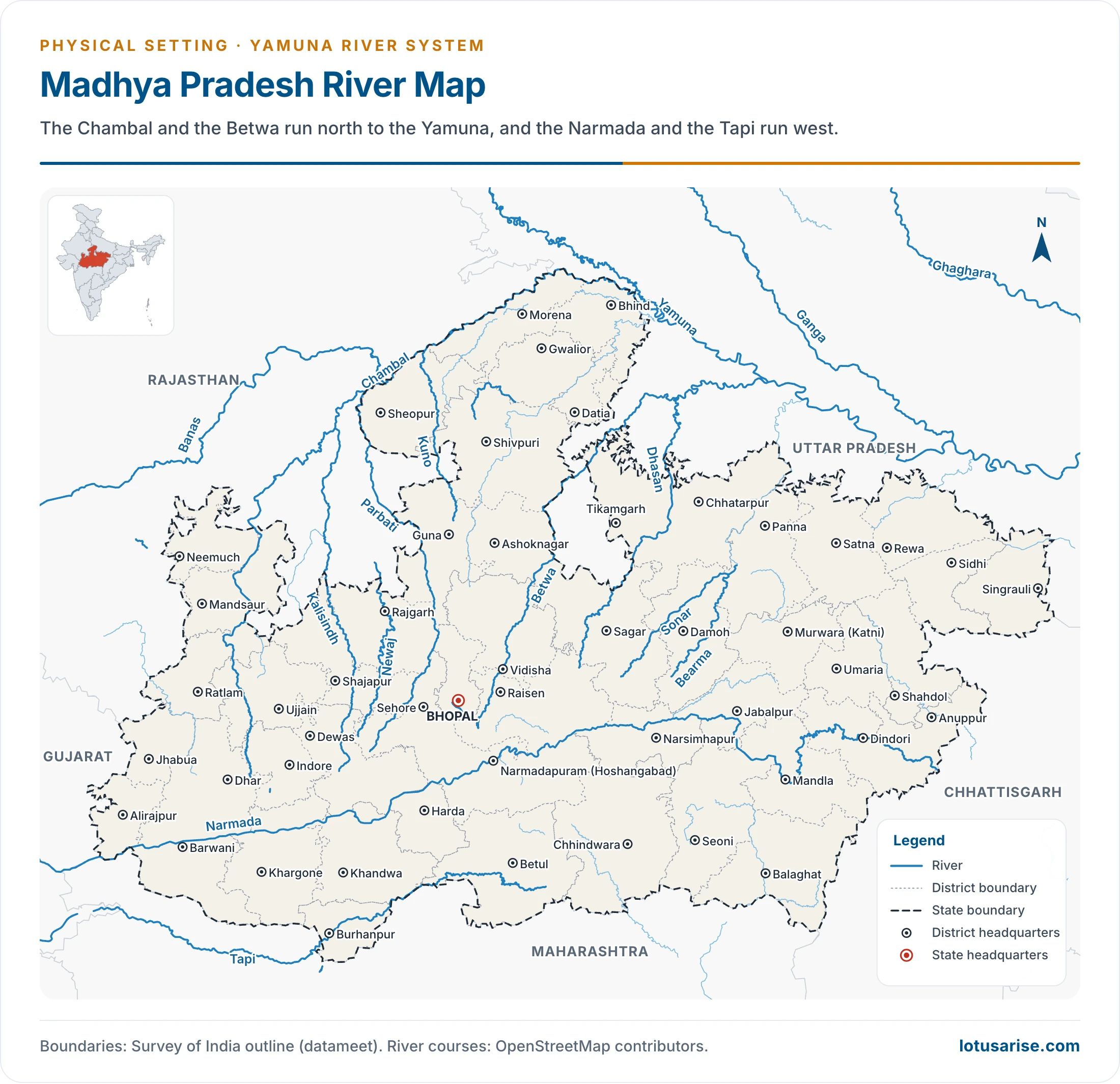
- It rises in the Janapao Hills of the Vindhya Range, about 15 km west-south-west of Mhow, Indore district, Madhya Pradesh.
- Course: north-west across the Malwa plateau, then a 96 km gorge from Chaurasigarh to Kota. Below Kota it turns north-east, and at Pinahat it turns east, running almost parallel to the Yamuna, which it joins in Etawah district.
- Hydropower and irrigation: at Gandhi Sagar, Rana Pratap Sagar and Jawahar Sagar dams and the Kota Barrage.
- Ravines:
- The river runs far below its banks. Severe erosion, under poor rainfall, has cut deep ravines in the valley, giving badland topography.
- Ravines reach across Rajasthan, Madhya Pradesh and Uttar Pradesh. A slight recent uplift is also thought to have helped them along.
- Parts are being reclaimed for farming, pasture and forestry.
- Wildlife: the National Chambal Sanctuary protects the river. Recent surveys found 3,037 gharials across 22 rivers, and riverside hatcheries protect the Batagur turtle in the Chambal.
- Link project: the Modified Parbati–Kalisindh–Chambal Link is a priority link in the national plan.
- The Mahananda lies far to the east of this basin, in north Bengal and Bihar.
Dams on the Chambal
| Project | Position in the series | Location |
|---|---|---|
| Gandhi Sagar | First of the four | On the Rajasthan–Madhya Pradesh border |
| Rana Pratap Sagar | Second | 52 km below Gandhi Sagar, Chittorgarh district, Rajasthan |
| Jawahar Sagar | Third | 26 km below Rana Pratap Sagar, 29 km upstream of Kota |
| Kota Barrage | Fourth | About 0.8 km upstream of Kota city |
- Water released after power generation at the three dams is diverted by Kota Barrage for canal irrigation in Rajasthan and Madhya Pradesh.
- Keoladeo National Park also gets water from the Chambal irrigation system.
Banas River
- Also known as “Van Ki Asha” (hope of the forest).
- It rises in the Aravalli Range in Rajsamand district, Rajasthan, and runs north-east, reaching the Chambal near Sawai Madhopur.
- Nathdwara, Jawanpur and Tonk lie on the river.
- Its entire course is in Rajasthan.
Kali Sindh
- It rises in Madhya Pradesh, near Bagli in Dewas district, and flows through the Malwa region.
- It joins the Chambal in Rajasthan, given in some accounts as near Sawai Madhopur.
Parbati
- Starting on the northern Vindhya slopes in Madhya Pradesh, it crosses Kota and Jhalawar districts of Rajasthan.
- It runs for about 436 km, with a catchment of nearly 3,070 square miles.
- It joins the right bank of the Chambal.
- Guna in Madhya Pradesh lies on it.
Sind River
- It rises on the Malwa plateau in Vidisha district at about 543 m.
- It flows north-north-east through Guna, Ashoknagar, Shivpuri, Datia, Gwalior and Bhind districts of Madhya Pradesh.
- It joins the Yamuna in Etawah district, Uttar Pradesh.
- It is therefore a river of Madhya Pradesh and Uttar Pradesh, 415 km long in older accounts and about 470 km in others.
Betwa River
- Also called the Vetravati.
- It rises in the Vindhya Range north of Hoshangabad, in Madhya Pradesh, at about 470 m. Older accounts place this in Bhopal district.
- It meets the Yamuna at Hamirpur town, Uttar Pradesh.
- Dhasan is its main tributary.
- Rajghat Dam stands on it.
Dhasan River
- A right-bank tributary of the Betwa.
- It rises in Raisen district, Madhya Pradesh, and flows through Madhya Pradesh and Uttar Pradesh.
Ken River
- Its head lies on the Kaimur slopes near Ahirgawan. The area was earlier in Jabalpur district and now falls in Katni district. Older accounts name the Barner Range.
- It merges with the Yamuna at Chilla, on the Banda–Fatehpur stretch, about 60 km below the Betwa’s mouth.
- The Ken valley separates the Rewa plateau from the Satna plateau.
- It passes through Panna National Park and Tiger Reserve.
- Ken–Betwa Link Project:
- The first link under the national river-linking plan to enter implementation, it moves water to the drought-prone Bundelkhand through the 96.7 m Daudhan Dam and a 216.465 km canal.
- Status: the foundation stone was laid on 25 December 2024. The dam is under construction, the canal yet to begin, and completion is scheduled for 2030. Spending to June 2026 was ₹12,381.94 crore of ₹44,605 crore.
- The main concern is that 5,578.92 hectares of Panna Tiger Reserve fall within the forest land required.
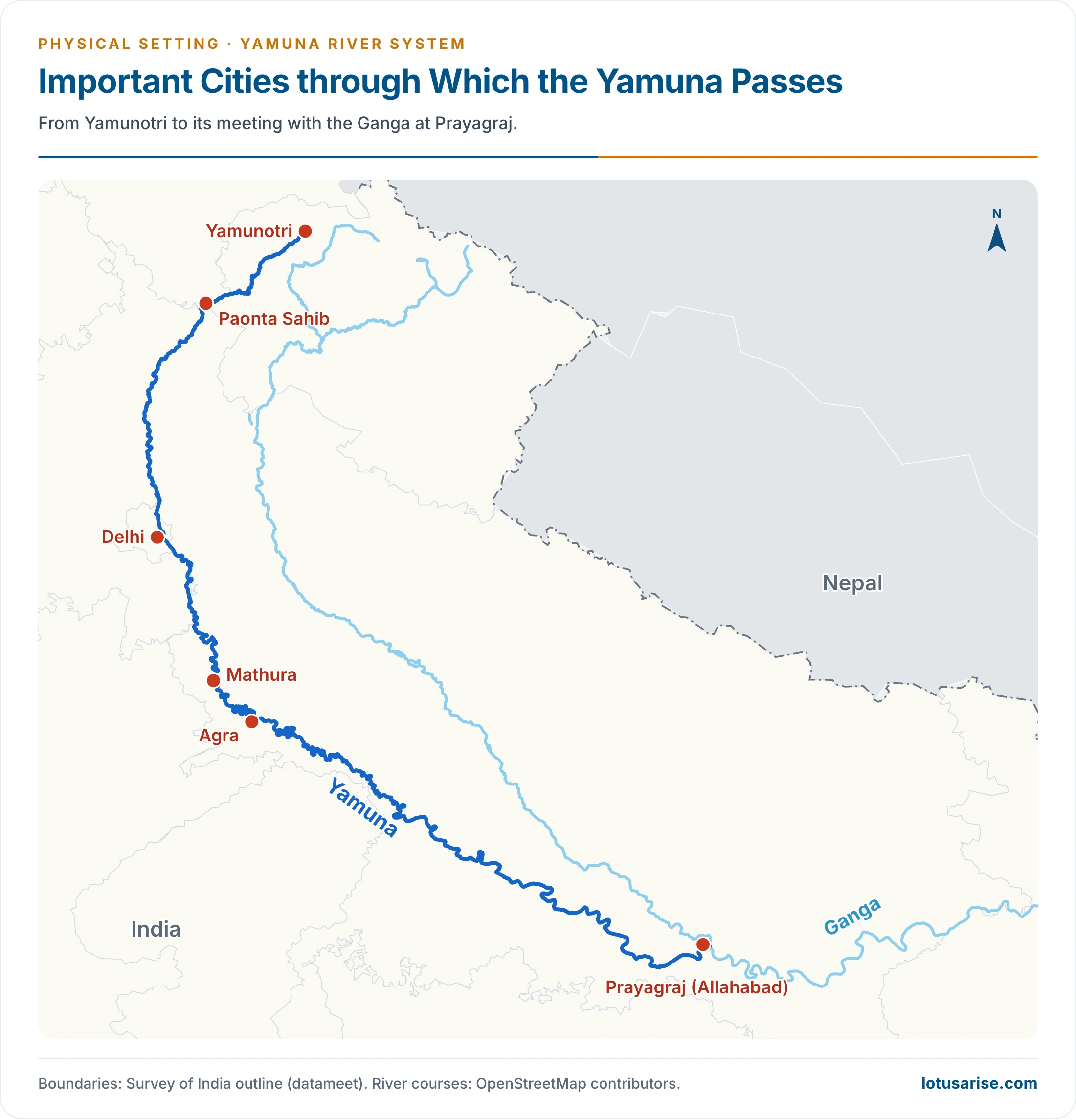
Important Cities through which Yamuna Passes
| Item | Detail |
|---|---|
| States | Uttarakhand, Himachal Pradesh, Uttar Pradesh, Haryana, Delhi |
| Cities | Delhi, Noida, Mathura, Agra, Firozabad, Etawah, Kalpi, Hamirpur and Prayagraj |
- The catchment is wider than the States the main river touches, and also takes in Rajasthan and Madhya Pradesh.
Previous Year Questions
2017Explain the inter-State issues involved in implementation of the Satluj-Yamuna Link Canal Project.2011Identify the ravine-affected areas in India and discuss the environmental and economic impacts of their reclamation.



Very useful for upsc exam, plz provide history and other topics details.
Yeah, Sure Anup, I will provide other subjects as well.
Excellent Sir… informative data..sir kindly provide west bengal river system.. humble request
Okay
Tumi ki geography optional rakecho ….wbcs er jonne
Just wow 👏
Keep it up!
awesome…. useful material… thanks
Thanks for this information.
I want the entire India physical part…with a detailed map. sir.
Good
quite useful complilation, thanks
Best article on river system ✍🏻
Super Mind Blowing,How Can I Download it?