

The DPAP — India’s Earliest Area Development Programme

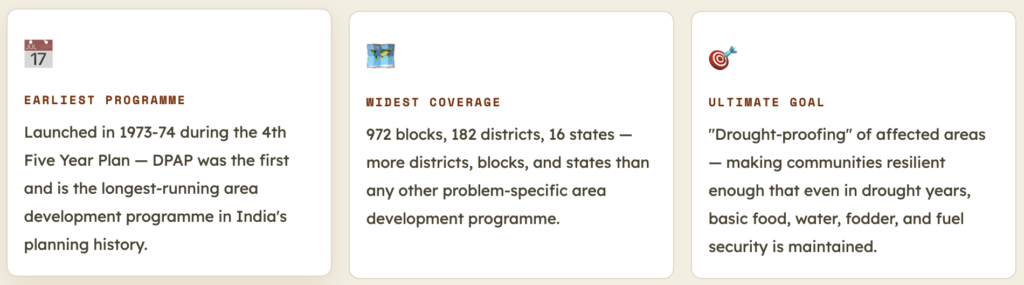
- The Drought Prone Area Development Programme (DPAP) is the earliest area development programme launched by the Central Government of India in 1973-74 (during the Fourth Five-Year Plan). It was conceived to tackle the special problems faced by those fragile areas that are constantly affected by severe drought conditions. DPAP has completed the maximum duration of all area development programmes – over 37 years of continuous operation — reflecting the persistence of drought as India’s most widespread natural hazard.
- India is among the most drought-vulnerable nations in the world. About 68% of the country is prone to drought at various levels – 35% of regions receiving rainfall between 750 and 1,125 mm are considered drought-prone, and 33% receiving less than 750 mm are subject to chronically drought-prone conditions. This scale of vulnerability – affecting hundreds of millions of people, livestock, and agricultural systems – demanded a dedicated national programme, which DPAP became.
Drought in India – Types, Extent, and Impact
Types of Drought
| Type | Definition | Trigger | India Context |
|---|---|---|---|
| Meteorological Drought | Rainfall deficit below 25% of normal in an area (India’s IMD definition); chronic drought when rainfall is <75% of normal | Weak SW monsoon; El Niño; ENSO | Declared by IMD; basis for government relief activation; 2002 drought was unique with widespread dryness in July |
| Hydrological Drought | Depletion of surface and groundwater below functional thresholds — rivers, reservoirs, groundwater below minimum levels | Extended periods of below-normal rainfall; over-extraction | Falling water tables in drought-prone Deccan; seasonal rivers going dry |
| Agricultural Drought | Soil moisture insufficient for crop requirements — crop failure possible even with some rainfall | Irregular rainfall distribution; poor soil water retention; wrong crop choices | Vidharbha, Marathwada, Bundelkhand; even monsoon years see agricultural drought on thin soils |
| Socio-Economic Drought | When agricultural and hydrological drought impact income, employment, and social welfare — triggering distress migration, famines, rural poverty | Combination of above + weak institutional support; market failures | Historical famines in colonial era; contemporary farmer suicides in chronically drought-prone zones |
Characteristics of Drought-Prone Areas
- Drought-prone areas in India have three defining characteristics that make them uniquely vulnerable:
- Large human and cattle populations: These areas are characterized by large human and cattle populations continuously putting heavy pressure on the already fragile natural resource base for food, fodder, and fuel. The very density of dependent population amplifies the ecological stress.
- Continuous depletion of vegetation cover: Overgrazing, fuel wood collection, and cultivation on marginal lands strip the thin vegetation — leaving soils exposed to wind and water erosion.
- Increase in soil erosion and falling groundwater levels: The major problems are continuous depletion of vegetation cover, increase in soil erosion, and fall in groundwater levels due to continuous exploitation without any effort to recharge underground aquifers.
The Vicious Cycle: Drought → crop failure → overgrazing of pasture → deforestation for fuel → soil exposure → increased runoff → reduced groundwater recharge → deeper drought next year. DPAP aims to break this self-reinforcing cycle through ecological restoration and livelihood diversification — converting the vicious cycle into a virtuous one.
Identifying Drought Prone Areas in India
The identification of drought-prone areas in India uses multiple criteria — rainfall-based, agricultural performance-based, and composite index-based. Districts are classified as “drought-prone” based on the frequency and intensity of drought events over a historical period, combined with assessments of their vulnerability (soil type, irrigation coverage, agricultural dependence, livestock density).
Rainfall Criteria for Drought Identification
- Chronic drought areas: Average annual rainfall below 750 mm — permanently water-deficient; dryland farming conditions
- Seasonal drought areas: Rainfall between 750-1,125 mm with high inter-annual variability — good monsoon years alternate with severe drought years
- IMD drought declaration: Meteorological drought declared when rainfall is below 75% of normal; severe drought below 50% of normal
Multi-Criteria Identification Framework
| Criterion | Indicator | Threshold for Drought Classification |
|---|---|---|
| Rainfall Availability | Mean annual rainfall; monsoon dependence; drought frequency (years with <75% normal) | High frequency (>3 drought years per decade); low mean rainfall (<750-1000 mm) |
| Hydrological | Groundwater depth; surface water bodies; river flow | Groundwater below critical levels; rivers seasonal/intermittent |
| Agricultural Vulnerability | % cultivated area irrigated; crop yield variability; soil moisture retention | Low irrigation coverage (<30%); high yield variation year to year; thin soils |
| Physiographic | Soil type; terrain; slope; drainage pattern | Thin skeletal soils; undulating terrain with high runoff; poor natural drainage |
| Demographic | Population pressure on natural resources; livestock density; fuel dependence | High livestock density; heavy biomass dependence; limited non-farm employment |
Major Drought-Prone Regions of India
| Region | States | Drought Type | Specific Districts / Zones |
|---|---|---|---|
| Rajasthan Arid Zone | Rajasthan | Chronic — semi-arid to hyper-arid | Barmer, Jaisalmer, Jodhpur, Bikaner; western districts bordering Thar Desert |
| Gujarat Dry Zone | Gujarat | Chronic + seasonal; Saurashtra notably drought-prone | Kutch, Surendranagar, Amreli, Bhavnagar; recurrent drought despite coastal location |
| Marathwada-Vidarbha | Maharashtra | Seasonal; high variability; Vidarbha especially severe | Osmanabad, Latur, Beed, Solapur (Marathwada); Yavatmal, Wardha, Amravati (Vidarbha) |
| Rayalaseema-Telangana Plateau | AP, Telangana | Seasonal; Rayalaseema is India’s most drought-prone sub-region | Anantapur (India’s most drought-prone district); Kurnool; Kadapa; Nalgonda |
| Karnataka Plateau | Karnataka | Seasonal; north Karnataka especially vulnerable | Bijapur (now Vijayapura), Gulbarga, Bellary, Raichur, Chitradurga |
| Bundelkhand | MP + UP | Seasonal; river-rain dependent; recurrent | Tikamgarh, Chattarpur, Sagar (MP); Banda, Chitrakoot (UP) |
| Tamil Nadu Interior | Tamil Nadu | Seasonal; dependent on NE monsoon | Dharmapuri, Salem, Erode interior; rain-shadow areas |
Drought Prone Area Development Programme (DPAP)
- The Drought Prone Area Development Programme (DPAP) is the earliest area development programme launched by the Central Government in 1973-74 to tackle the special problems faced by those fragile areas which are constantly affected by severe drought conditions. These areas are characterised by large human and cattle populations continuously putting heavy pressure on the already fragile natural resources base for food, fodder, and fuel.
- The major problems are continuous depletion of vegetation cover, increase in soil erosion, and fall in groundwater levels due to continuous exploitation without any effort to recharge underground aquifers.
Historical Placement
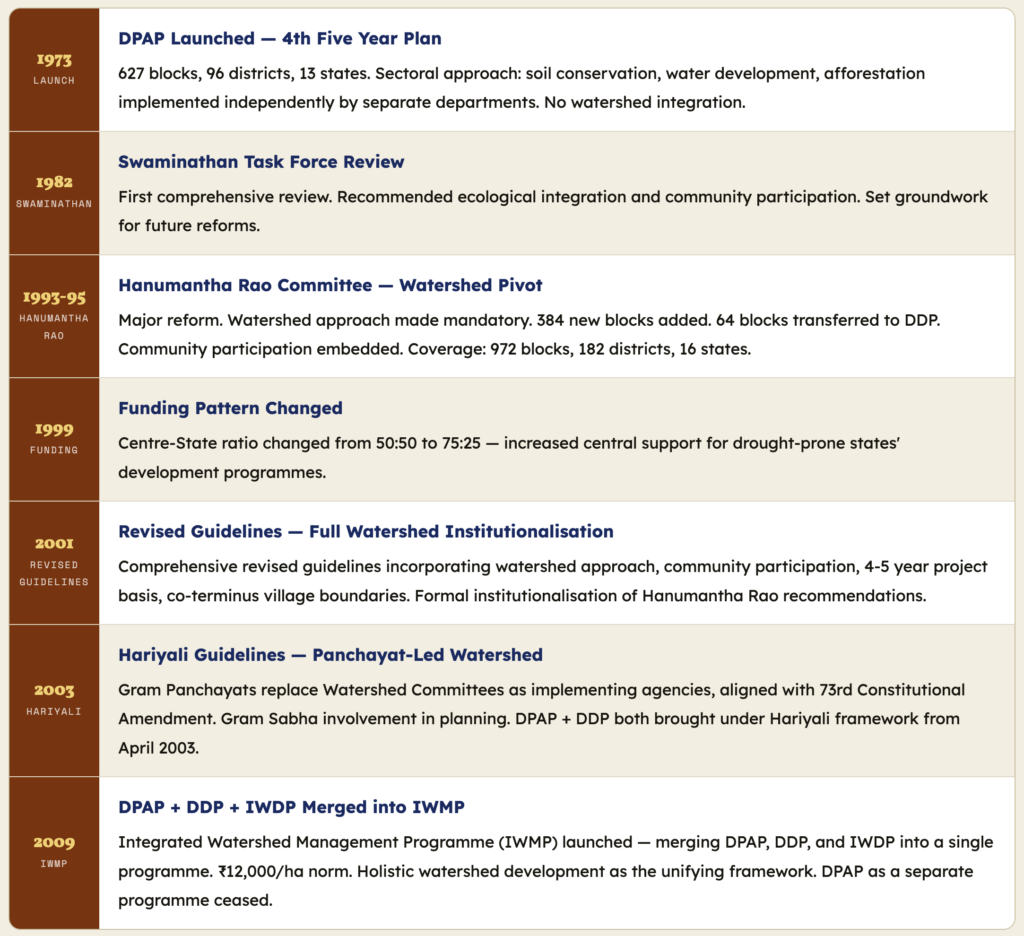
- DPAP was conceived during the 4th Five Year Plan (1969-74) and launched in 1973-74.
- It was the first programme to recognise drought-prone areas as requiring a specific, area-based planning approach — different from both the growth pole approach (industries as development engines) and the target group approach (SFDA for small farmers).
- DPAP represented a third path: ecological restoration as the foundation for development.
Historical Context
- DPAP was launched in the aftermath of two successive severe droughts (1965-66 and 1966-67) that had brought India to its knees, creating acute food grain shortages and import dependence under the PL-480 programme.
- The 1972-73 drought, which severely affected Maharashtra and other states, provided the immediate trigger. India’s planners recognised that ad hoc drought relief was insufficient — a long-term structural programme was needed to reduce drought vulnerability, not just respond to drought events.
Coverage of DPAP
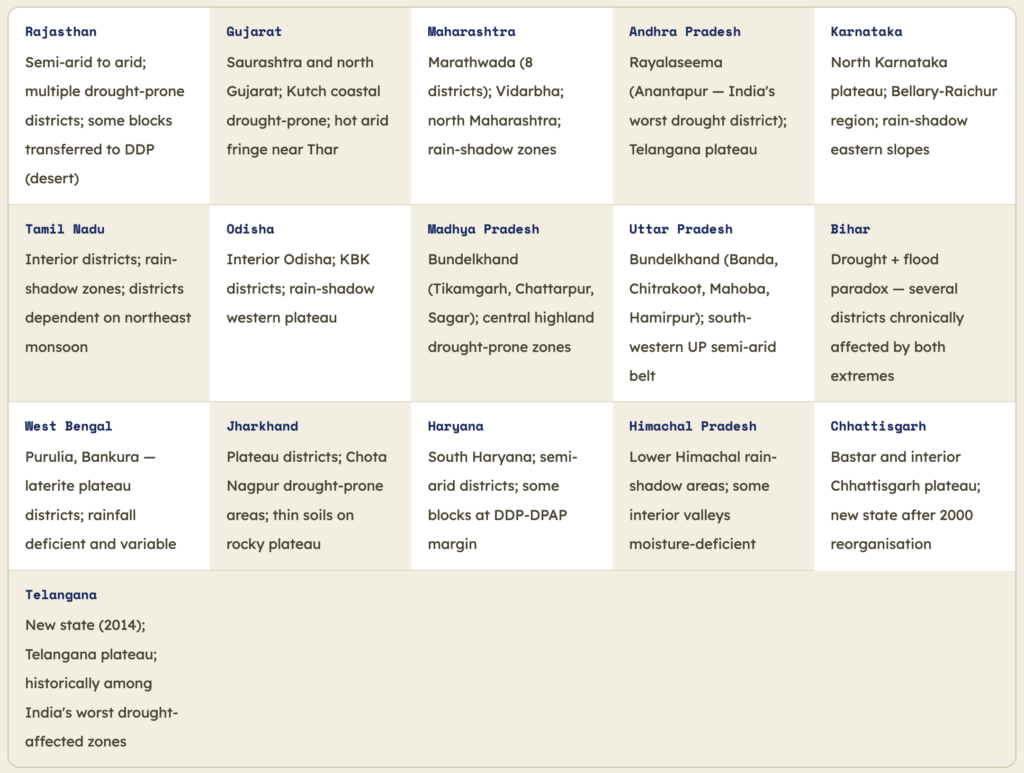
- Drought Prone Area Development Programme covers 972 blocks, in 182 districts, in 16 states. This represents the largest block-level coverage of any specific problem area programme in India — wider even than the Desert Development Programme.
- Expansion history:
- Initially operated in 627 blocks of 96 districts in 13 states (1994-95). On the recommendation of the Hanumantha Rao Committee, 384 new blocks were identified and brought into the purview of this programme, and 64 were transferred from DPAP to DDP.
- Consequently, coverage was extended to 947 blocks of 164 districts in 13 States. With the reorganisation of states, districts, and blocks, the programme is currently under implementation in 972 blocks of 182 districts in 16 States.
States Covered Under DPAP
- The 16 states covered under DPAP represent the full range of India’s drought-prone geography — from the arid northwest to the semi-arid peninsular plateau:
DPAP vs DDP Coverage:
- DPAP covers drought-prone areas (semi-arid, seasonal rainfall deficiency); DDP covers hot and cold desert areas (Thar Desert fringe, Ladakh cold desert).
- Some blocks have been transferred between the two programmes as ecological conditions are better categorised.
- The distinction: DPAP = drought-prone but not desert; DDP = true desert or near-desert conditions.
- Together, they address the full spectrum of India’s arid and semi-arid development challenges.
Objectives of DPAP
- The basic objective of the Drought Prone Area Development Programme is to minimize the adverse effect of drought on the production of crops and livestock and productivity of land, water, and human resources — thereby ultimately leading to the “drought-proofing” of the affected areas.
Complete Set of Objectives
- Minimize drought’s adverse effects: Reduce the impact of drought on crop production, livestock survival, land productivity, and human livelihoods — so that even in drought years, communities can maintain basic subsistence
- Drought-proofing of affected areas: The ultimate goal — building structural resilience so that drought, even when it occurs, does not become a humanitarian crisis. This requires transformation of the ecological base, not just emergency relief
- Development of land, water, and human resources: Watershed-based land development; water resource development (harvesting, conservation, recharge); human skill development for non-farm livelihoods
- Restoration of ecological balance: Afforestation, pasture development, soil conservation — rebuilding the natural resource base that chronic drought has degraded
- Employment generation: Creating durable productive assets (soil conservation works, water harvesting structures) through labour-intensive programmes that simultaneously generate employment and build infrastructure
- Livestock and pasture development: Cattle and livestock are the primary drought-risk buffer for many rural households — their survival during drought depends on maintained pasture and fodder availability
- Promote overall economic development and improve socio-economic conditions of drought-affected communities through integrated rural development
The “Drought-Proofing” Vision:
- This is the most ambitious and distinctive concept in DPAP — not merely “drought relief” (reactive) or even “drought mitigation” (reducing impact), but drought-proofing — transforming the very ecological and economic conditions of an area so that drought, though it may still occur as a meteorological phenomenon, no longer results in agricultural failure, livestock loss, and human crisis.
- This vision required decades of sustained watershed investment — and honest evaluation has found that 37+ years of DPAP has brought only partial success.
Tools and Methods for Achieving DPAP Objectives
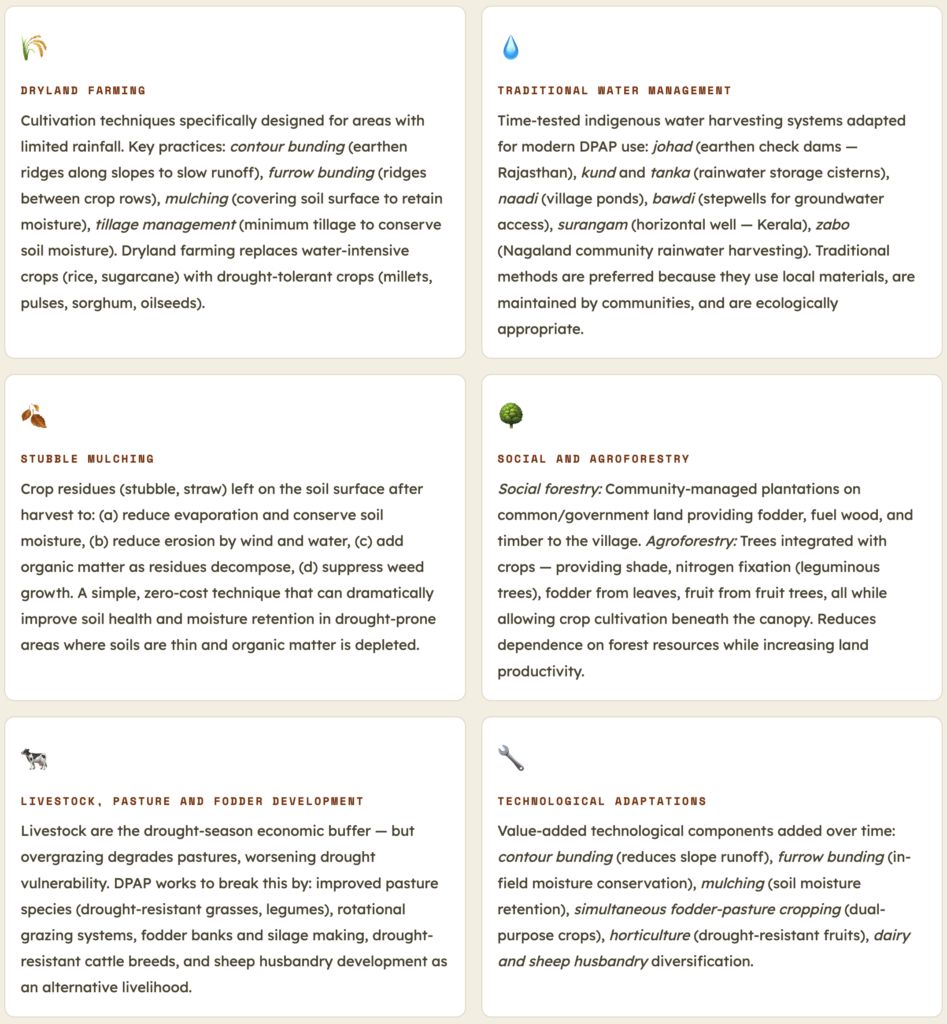
- The tools through which the objectives for the development of Drought Prone Areas can be achieved are:
- Dryland farming;
- Proper management of water resources through traditional methods;
- Soil conservation through stubble mulching;
- Afforestation by social and agroforestry;
- Development of livestock, pasture, and fodder.
Major Components of DPAP
The objectives are being met through development projects undertaken through the watershed approach for land development, water resource development, and afforestation/pasture development. These projects constitute the major component of the programme:
Soil and Water Conservation + Land Development
- The core ecological component — simultaneously protecting soils from erosion, conserving rainfall where it falls, and preparing degraded lands for productive use. Activities:
- Contour bunding and graded bunding on slopes to slow runoff and promote infiltration
- Gully plugging and check dam construction to prevent gully formation and harvest water
- Land levelling for efficient water use in cultivated fields
- Terracing of steep slopes for sustainable cultivation
- Soil health improvement through organic matter addition and green manuring
Water Resource Development
- Creating and managing water storage, conservation, and recharge infrastructure to bridge the gap between rainfall and agricultural water demand. Activities:
- Farm ponds and percolation tanks for in-situ water storage
- Construction and deepening of existing tanks (talao, naadi)
- Groundwater recharge structures (check dams, percolation wells, injection wells)
- Revival of traditional water bodies (johad, kund, stepwells)
- Efficient irrigation technologies (drip, sprinkler) to maximise water productivity
Afforestation and Pasture Development
- Ecological restoration of degraded common lands and slopes to rebuild vegetation cover — the foundation of ecological drought-proofing. Activities:
- Social forestry on government common land — multi-purpose tree species providing fuel, fodder, timber, and fruit
- Pasture development on degraded grazing lands — drought-resistant grass and legume species
- Windbreak and shelter belt planting to reduce wind erosion and evapotranspiration
- Agro-forestry on private farmland — trees integrated with crops
- Promotion of private nurseries for multipurpose tree seedlings
Technological Innovations and Agricultural Diversification
- Components added through successive plan revisions to make DPAP more comprehensive:
- Technological adaptations: contour bunding, furrow bunding, mulching, in-situ moisture conservation
- Simultaneous cropping of fodder and pasture — dual-purpose land use maximising output
- Agroforestry and horticulture — drought-resistant fruit trees (ber, amla, pomegranate, guava)
- Dairy farming development — milk production as stable off-season income
- Sheep husbandry — drought-resilient livestock requiring minimal water and thriving on rangeland
Cropping Pattern Restructuring and Subsidiary Occupations
- Restructuring of cropping pattern — shifting from water-intensive crops (paddy, sugarcane) to drought-tolerant crops (sorghum, bajra, arhar, groundnut, sunflower)
- Changes in agricultural practices — minimum tillage, conservation agriculture, seed treatment with drought-resistant varieties
- Development of subsidiary occupations — non-farm livelihoods (crafts, small trade, food processing) to reduce exclusive dependence on rain-fed agriculture
Hanumantha Rao Committee (1993-94) — The Watershed Pivot
Though the programme had a positive impact in terms of creating durable public assets, its overall impact in effectively containing the adverse effects of drought was found to be not very encouraging. A high-level technical committee was set up under Prof. C.H. Hanumantha Rao in 1993 (reviewed 1994-95) to review all area development programmes. Based on the recommendation of this committee, the watershed development approach was adopted — which consisted of the participation of local people.
Key Findings of the Hanumantha Rao Committee
- DPAP’s earlier approach was sectoral and spatially dispersed — investments in soil conservation, water development, and afforestation were implemented by different departments without coordination
- The programme lacked a unified spatial unit — the watershed. Without treating the entire watershed as a unit, upstream treatments were undermined by downstream land use, and water conservation efforts were fragmented
- Activities needed to be confined to watersheds of about 500 hectares and executed on a project basis spanning 4-5 years to ensure integrated, time-bound impact
- People’s participation was inadequate — a top-down, departmental implementation model excluded local communities from planning and maintenance
- The programme needed to be co-terminus with village boundaries wherever possible, to align institutional management with ecological units
Recommendations That Transformed DPAP
- Watershed approach mandatory: All DPAP activities to be implemented on watershed basis exclusively — no more sector-by-sector investments without spatial coordination
- Community participation mandatory: Direct participation of people in planning and development of watershed areas — from identifying priorities to making decisions about watershed treatment
- Project-based implementation: Watershed projects of ~500 ha, time-bound (4-5 years), with clear accountability and completion criteria
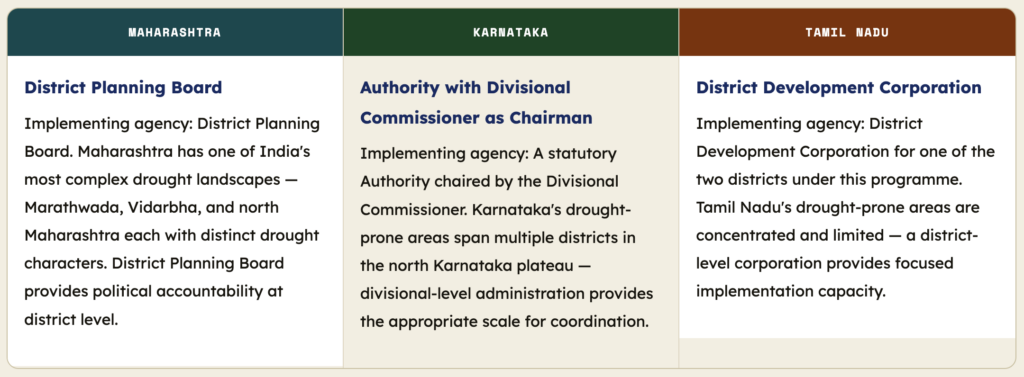
- Revised guidelines (2001): Based on Hanumantha Rao recommendations, the Ministry of Rural Development issued comprehensive revised guidelines in 2001 integrating watershed, community participation, and time-bound project completion
- Block expansion: 384 new blocks added to DPAP coverage; 64 blocks transferred to DDP (more appropriate classification)
Swaminathan Committee (1982)
Before Hanumantha Rao, a Task Force under Dr. M.S. Swaminathan (1982) was commissioned to review DPAP and DDP. Swaminathan’s recommendations focused on the need for integrated area development, ecological restoration, and community participation — laying the intellectual groundwork for what the Hanumantha Rao Committee would formalize a decade later. The Swaminathan-Hanumantha Rao sequence represents the gradual maturation of India’s thinking about drought area development — from relief-focused → asset creation → ecological watershed restoration → community-led watershed management.
Watershed Approach — The Core Planning Unit
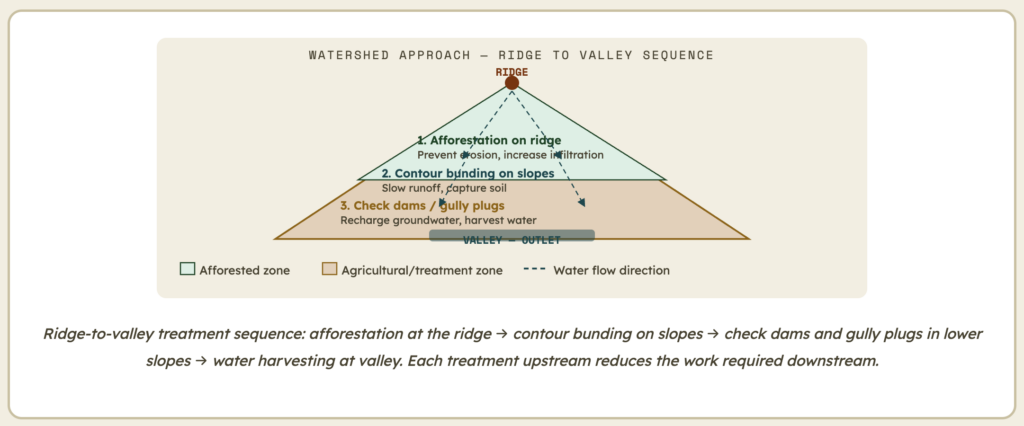
- A watershed is a hydrological unit — all land draining to a common outlet. Watersheds range from micro-watersheds (100-1,000 ha) to macro-watersheds (river basins).
- The watershed approach treats the watershed as the basic planning unit, recognising that water, soil, and vegetation management must be coordinated across the entire catchment to be effective. Treatment follows the “ridge-to-valley” sequence — treating upstream first so benefits flow downstream.
Key Principles of DPAP’s Watershed Approach (Post-Hanumantha Rao)
- Watershed as the exclusive unit: All DPAP area development projects to be implemented on watershed basis — no piecemeal sectoral investments outside the watershed framework
- ~500 ha watershed unit: Projects confined to watersheds of about 500 ha — small enough to be manageable, large enough to have ecological significance
- Project basis, 4-5 years: Time-bound project implementation with specific deliverables, monitoring milestones, and completion criteria
- Co-terminus with village boundaries: Where possible, watershed boundaries should align with village boundaries to ensure institutional alignment between ecological and governance units
- Community participation mandatory: Direct participation of people in planning and development of watershed areas — from needs identification to maintenance of completed structures
- Panchayati Raj Institutions: Under Hariyali Guidelines (2003), Gram Panchayats (instead of Watershed Committees) become the implementing agencies — embedding watershed management in democratic local governance
ICRISAT Assessment of DPAP Watersheds
A study titled “Comprehensive Assessment of Watershed Programmes in India” by ICRISAT, Hyderabad, identified the reduction of wastelands by about 8.58 million hectares during 2000 and 2005 using various techniques of integrated development of drought-prone areas. This represents a significant ecological achievement — nearly 8.6 million hectares of degraded land brought under productive or protective vegetation cover in just 5 years. Properly implemented watershed programmes have demonstrably reversed land degradation at scale.
State Implementation Arrangements
Each state has evolved its own organisational setup for DPAP. The decentralised implementation reflects both the diversity of drought conditions across states and the principle that implementation must be adapted to local administrative and ecological conditions.
Evolution to Hariyali and IWMP
Problems in DPAP Implementation
⚠️ Sectoral and Spatially Dispersed
- The implementation of DPAP has been sectoral and spatially dispersed. Different departments (soil conservation, agriculture, forest, minor irrigation) implemented their activities independently — a bund here, a plantation there, a check dam somewhere else — without spatial coordination on a watershed basis. This dispersal prevented the synergistic effects of integrated watershed treatment from materialising. The whole was less than the sum of its parts.
💸 Inadequate and Lopsided Funds
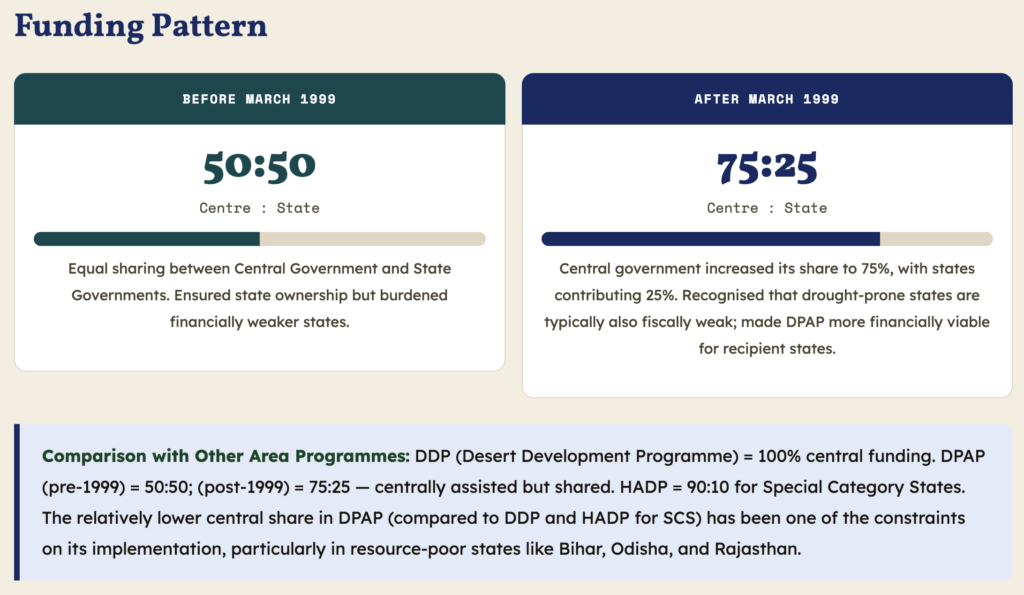
- The allocation of funds has been inadequate for DPAP. Apart from that, there has been lopsided implementation and utilisation of available funds — some districts/blocks received disproportionate allocations while others were starved. The 50:50 pre-1999 sharing was particularly burdensome for resource-poor drought states. Even post-1999 75:25 arrangement, absolute allocations remained below what was required for the scale of the problem.
👥 Lukewarm People’s Participation
- The participation of people has been lukewarm — the major hurdle in proper DPAP implementation. Top-down departmental implementation models excluded communities from planning, creating low ownership of completed structures. Without community ownership, watershed structures (check dams, bunds) were not maintained and failed within years of construction. The Hanumantha Rao Committee’s watershed approach attempted to fix this, but changing institutional culture from departmental delivery to community-led implementation has been slow.
📊 Monitoring and Evaluation Gap
- DPAP lacked robust impact measurement systems. Success was measured by physical targets (km of bunds, number of check dams) rather than outcome indicators (water table recovery, crop yield improvement, drought days reduced). This output-orientation — “counting structures rather than measuring outcomes” — meant that programme failures were not detected early enough to enable course correction. Real-time satellite-based monitoring now available through NRSC/ISRO could transform DPAP-era approaches.
“The Rao Committee found that the activities were being taken up in a piecemeal fashion, and not on a watershed basis. There was also inadequate people’s participation. Based on these findings, DPAP was restructured to adopt a watershed basis for implementation with mandatory people’s participation.”— Planning Commission of India, Review of DPAP
Outcomes, Achievements, and Legacy of DPAP
Positive Outcomes
- Creation of durable public assets: Despite overall limitations, DPAP created significant durable assets — check dams, bunds, plantation cover, farm ponds — that provided long-term benefits to drought-prone communities
- Institutionalising the watershed approach: DPAP’s post-1995 evolution institutionalised watershed management as India’s standard approach to dryland area development — a conceptual legacy that outweighs its direct outcomes
- ICRISAT evidence of impact: ICRISAT’s comprehensive assessment identified reduction of wastelands by about 8.58 million hectares during 2000-2005 through watershed programmes, including DPAP-funded interventions
- Scaling of traditional knowledge: DPAP systematically scaled traditional water harvesting technologies — johad, kund, naadi — integrating indigenous wisdom with modern watershed science
- Framework for MGNREGS: DPAP’s emphasis on labour-intensive watershed works as employment generation directly influenced MGNREGS’s design — under MGNREGS, up to two-thirds of activities are for water conservation (52%) and land development (14%), a step toward sustainable development in drought-prone areas
DPAP’s Legacy: The IWMP (Integrated Watershed Management Programme)
- DPAP → IWMP (2009)
- In 2009, DPAP, DDP, and IWDP were merged into the Integrated Watershed Management Programme (IWMP).
- IWMP corrected DPAP’s main deficiencies:
- Unified programme structure — one programme, one guideline, one implementing agency per watershed;
- ₹12,000/ha norm — adequate, transparent funding;
- Community participation as mandatory structural requirement;
- Livelihood integration — economic outcomes, not just ecological outputs;
- Convergence with MGNREGS, NHM, and NRLM for comprehensive watershed-livelihood development.
- IWMP was subsequently renamed Pradhan Mantri Krishi Sinchai Yojana — Watershed Development (PMKSY-WD).
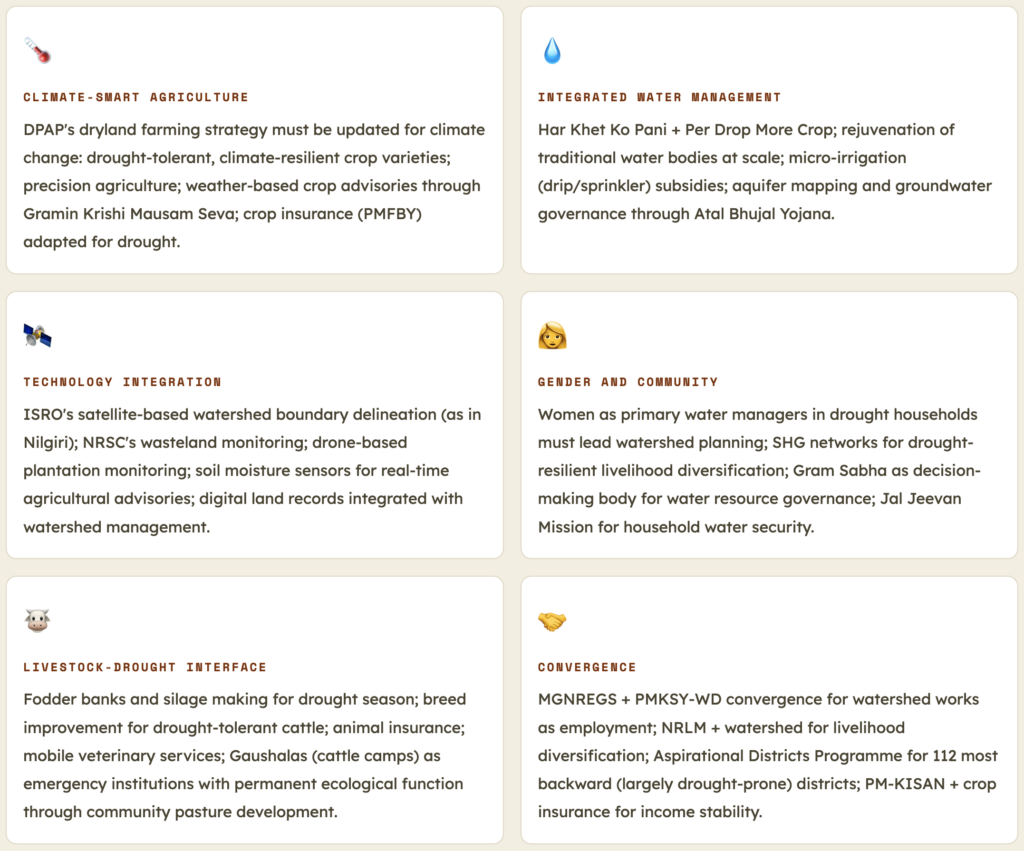
Modern Strategies for Drought-Prone Areas





Excellent
Thnq..
Very helpful notes