

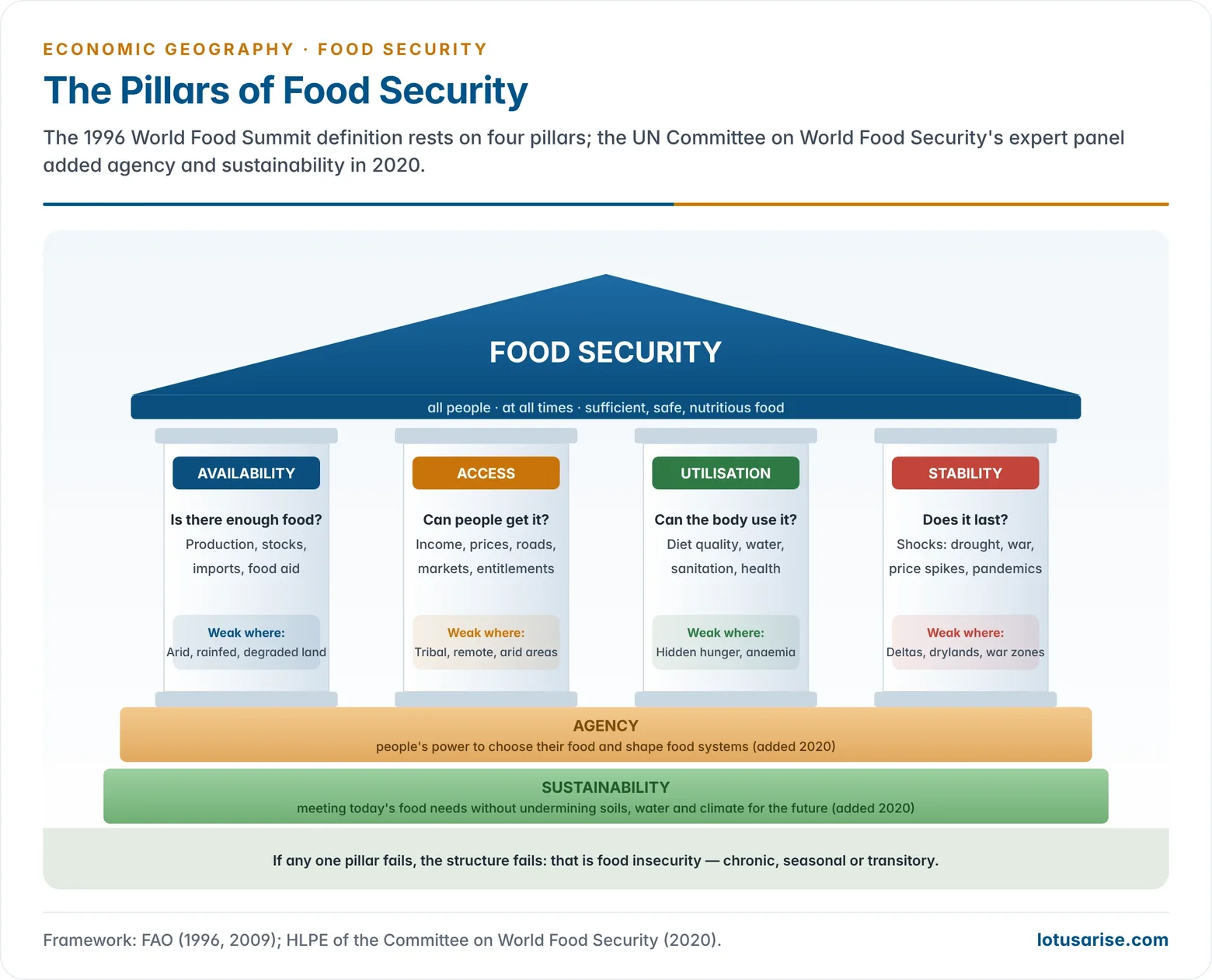
- Food security exists “when all people, at all times, have physical and economic access to sufficient, safe and nutritious food that meets their dietary needs and food preferences for an active and healthy life” (World Food Summit, Rome, 1996). FAO later added social access to the definition.
- Food security is a multidimensional concept. For economic geography it concerns not only food production but also the spatial pattern of access, infrastructure, regional inequality and socio-environmental vulnerability.
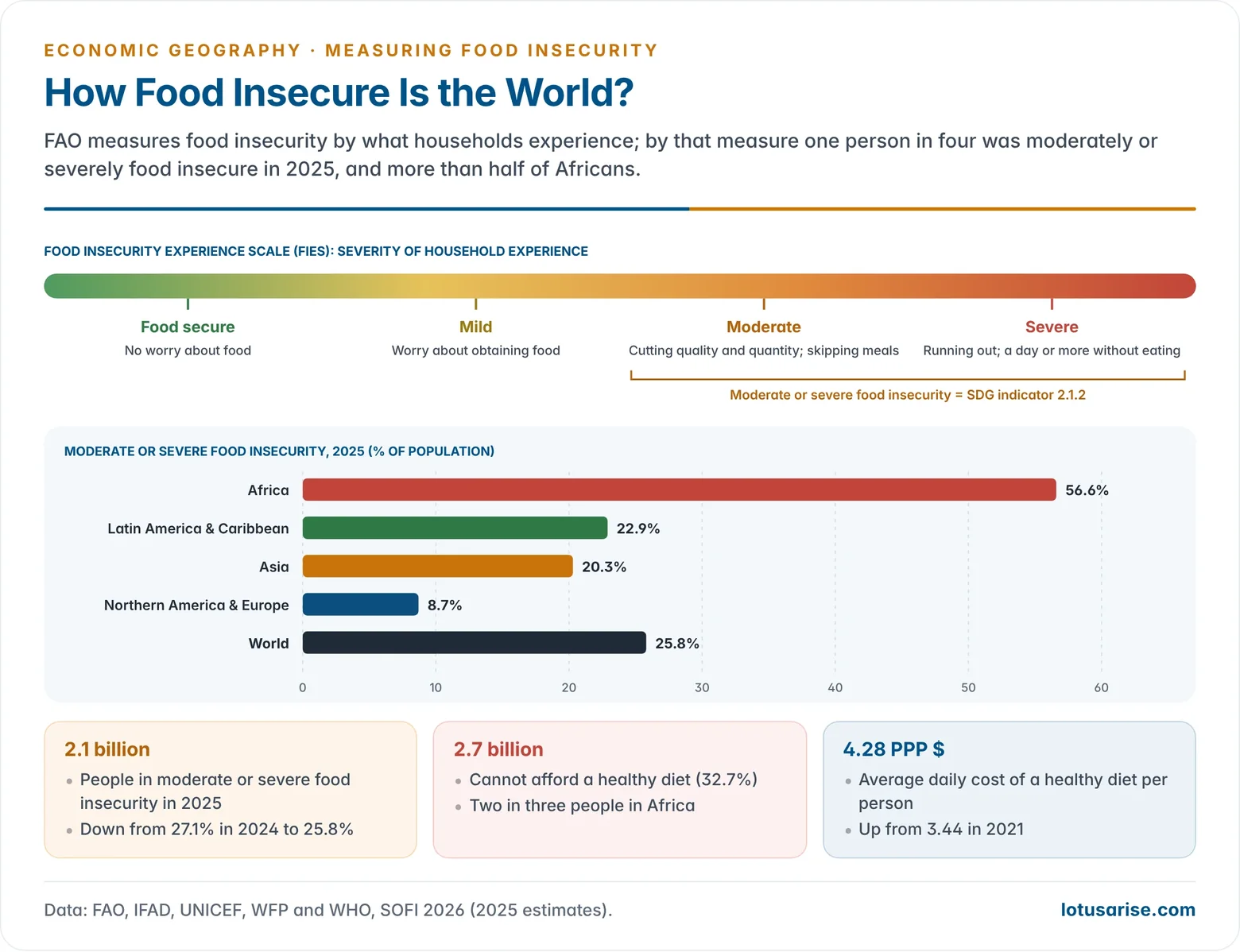
- In 2025, about 2.1 billion people (25.8%) faced moderate or severe food insecurity, and 2.7 billion could not afford a healthy diet (FAO, SOFI 2026). SDG 2 (Zero Hunger) is far off track.
Concept of Food Security

Evolution of the Concept
- 1970s: national supply. After the World Food Conference (1974), food security meant enough aggregate food supply and stable prices at the national and global level, through production and grain reserves.
- 1980s: household access. Amartya Sen’s Poverty and Famines (1981) shifted the focus to entitlements: people starve because they cannot command food, not only because food is absent.
- 1990s: nutrition and the individual. The 1996 World Food Summit definition added safety, nutrition and preferences. Food security became an individual, not just national, condition.
- 2009 onwards: four pillars and stability. The World Summit on Food Security (2009) formalised availability, access, utilisation and stability.
- 2020: six dimensions. The UN Committee on World Food Security’s expert panel (HLPE, 2020) added agency (people’s power to choose their food and shape food systems) and sustainability (meeting today’s needs without undermining future food systems).
Four Pillars of Food Security
- Availability: a sufficient quantity of food must be available consistently.
- It is determined by production, stocks, imports and food aid.
- Areas with fertile soils, irrigation and modern technology show high availability, such as India’s Indo-Gangetic plains.
- Access: households must be able to acquire adequate food through purchase, own production, barter, gifts or public transfers.
- Economic access depends on income, employment, food prices and entitlements. Physical access depends on roads, markets and distance.
- Tribal and hilly regions, arid zones and remote areas often face problems of both.
- Utilisation: food must be nutritious, safe and biologically absorbed.
- It depends on clean water, sanitation, health care, food habits and knowledge, so geography acts through environmental conditions, cultural practices and regional dietary diversity.
- Stability: availability, access and utilisation must hold at all times, even during droughts, price spikes, conflict or pandemics.
- Unstable areas include flood-prone deltas, conflict zones and drought-prone semi-arid regions.
Food Insecurity and Its Types
- Food insecurity occurs when any one pillar fails.
- Chronic food insecurity is long-term and persistent, caused by poverty, low productivity and poor farming systems, as in the Sahel or tribal central India.
- Transitory food insecurity is short-term, triggered by shocks such as drought, flood, conflict or price spikes. Seasonal food insecurity recurs in the lean season before harvest in rainfed areas.
- FAO measures household experience on the Food Insecurity Experience Scale (FIES):
- Mild: worrying about obtaining food;
- Moderate: compromising on quality and quantity, sometimes skipping meals;
- Severe: running out of food and going a day or more without eating.
- Food security differs from nutrition security, which adds health, care and sanitation, and from food sovereignty, which stresses people’s control over their own food systems.
Determinants of Food Security
Geographical Factors
- Agro-climatic conditions: rainfall, temperature, soil fertility and length of the growing season set productivity.
- Food-secure regions: the Indo-Gangetic Plain (Punjab, Haryana, western Uttar Pradesh) with fertile alluvium and irrigation.
- Food-insecure regions: the arid west (Rajasthan), the semi-arid Deccan and drought-prone areas with erratic rainfall.
- Irrigation and water: irrigation reduces dependence on the monsoon. Punjab’s canal and tubewell network sustains high output, while rainfed Odisha, Chhattisgarh and Jharkhand remain vulnerable to seasonal food insecurity.
- Land use and farming practices:
- Conversion of farmland to urban, industrial and infrastructural use reduces local supply.
- Cash-crop dominance (sugarcane in Maharashtra, cotton in Vidarbha) can reduce local food availability.
- Subsistence and commercial farming differ in the market surplus they generate.
- Transport and market access: poor roads, missing storage and long distances to markets raise losses and isolate remote tribal and mountain areas, such as parts of Northeast India.
- Soil quality and land degradation: erosion, salinisation, acidification and nutrient depletion depress yields. Bundelkhand and western Rajasthan face chronic insecurity.
- Climatic extremes: floods (Bihar), droughts (Marathwada) and cyclones (Odisha coast) periodically disrupt production and access, and climate variability destabilises local prices.
Human and Institutional Factors
- Population pressure and urbanisation: dense states such as Uttar Pradesh and Bihar face pressure on land, and peri-urban farmland shrinks as cities expand.
- Regional inequality: core–periphery patterns produce food surpluses in core zones (Punjab, Gujarat) and deficits in backward areas (eastern India, tribal belts), where infrastructure, education and market institutions are weak.
- Governance: the efficiency of the Public Distribution System (PDS) varies by state. Tamil Nadu and Chhattisgarh reformed their PDS early and deliver better than poorly governed states.
- Access to inputs: credit, seed, fertiliser and extension services vary spatially, so backward regions remain at subsistence level.
- Culture and diet: regional food preferences shape demand and utilisation. Some low-producing communities remain food secure through forest produce or alternative diets.
Accessibility and Affordability in the Developing World
- In developing countries the binding constraint is usually access, not availability.
- Economic access (affordability):
- Poor households spend half or more of their income on food, so price rises cut diet quality first. They give up pulses, milk, fruit and vegetables before staples.
- A healthy diet cost about 4.28 PPP dollars per person per day in 2025. Two-thirds of Africans cannot afford one, against a small share in high-income countries.
- Food price inflation (2021–23), currency depreciation and debt distress eroded purchasing power across Africa and South Asia.
- Entitlements come from wages, crops, livestock and public transfers. Unemployment, landlessness and the collapse of informal work (as in the COVID-19 lockdowns) destroy them.
- Physical access:
- Remote villages, poor roads, missing cold chains and long distances to fair price shops limit access.
- Urban food deserts in slums lack affordable fresh food, and conflict and sieges block access entirely, as in Gaza and Sudan.
- Social access: gender, caste and ethnicity restrict access even within households and communities.
- Policy responses target both: safety nets (cash and food transfers, school meals), employment guarantees, price stabilisation, rural roads and decentralised storage.
Food Security and Population Growth
- The relationship goes back to Thomas Robert Malthus (1798): population grows faster than food unless checked.
- Global experience has largely disproved the strict Malthusian forecast.
- World population grew from about 3 billion (1960) to about 8.2 billion (2025), yet food output per person rose through the Green Revolution, irrigation, fertiliser and trade.
- Ester Boserup (1965) argued that population pressure itself stimulates agricultural intensification.
- Regional reality is different. In Sub-Saharan Africa, where population still grows about 2.5% a year and yields are low, food demand outpaces domestic supply, so import dependence and hunger rise.
- India’s case:
- With about 1.46 billion people, India is the most populous country. It has turned from a food-deficit country dependent on PL-480 imports (1960s) into a grain-surplus and the largest rice exporter. Foodgrain output reached a record 357.73 million tonnes in 2024–25.
- Yet population growth, shrinking per capita farmland (average holding about 1.08 ha), groundwater depletion and climate stress threaten future supply. Rising incomes also raise demand for protein, fruit, vegetables and feed.
- The challenge has shifted from quantity to nutrition, sustainability and access: stagnating pulses and oilseeds, high malnutrition and the ecological cost of the rice–wheat system.
- The neo-Malthusian argument of the Limits to Growth model and neo-Malthusian theory therefore survives mainly as a warning about ecological limits, not calorie limits.
Climate Change and Food Security
- Climate change threatens every pillar of food security, and it hits hardest where hunger and poverty are already concentrated.
- Availability:
- Rising temperatures, heat stress at flowering, erratic monsoons, droughts and floods reduce yields of wheat, rice and maize in the tropics.
- Climate change has already slowed growth in global agricultural productivity since 1961 (IPCC AR6).
- India’s wheat heatwave of March 2022 cut yields, and the Pakistan floods of the same year destroyed crops over millions of hectares.
- Access: climate shocks raise food prices and destroy the incomes of smallholders, fishers and pastoralists. Poverty and hunger reinforce each other, which undermines poverty eradication (SDG 1).
- Utilisation: higher CO₂ lowers the protein, zinc and iron content of cereals, and heat and floods spread water-borne disease.
- Stability: more frequent extreme events and El Niño years make supply volatile, as in Southern Africa’s 2024 drought.
- Spatial unevenness: losses are greatest in the low latitudes. Some high-latitude regions (Canada, Russia) may gain growing season. This widens the North–South gap.
- Responses: climate-resilient seed, micro-irrigation, crop insurance, early warning, agroforestry, diversification into millets, and adaptation finance. Mitigation from agriculture (methane, nitrous oxide) is also needed.
Global and Regional Patterns of Food Security
Global Trends
- Progress with persistent inequality: global output has grown with the Green Revolution and biotechnology, and hunger has now fallen for three years (2023–25). Food insecurity nevertheless remains above pre-pandemic levels in many regions.
- Africa, the epicentre: 56.6% of Africans faced moderate or severe food insecurity in 2025. Somalia, South Sudan, Sudan and Ethiopia face recurrent famine-like crises and dependence on food aid, and desertification and erratic rainfall worsen vulnerability in the Sahel.
- South Asia, high hunger with moderate availability: aggregate production is sufficient, but undernutrition remains high because of poor distribution, poverty and gender inequality. India, Pakistan and Bangladesh have high child malnutrition and hidden hunger.
- Southeast Asia, improved access and new urban problems: Vietnam, Thailand and Indonesia have improved availability but face urban food deserts and dietary transition. Rising obesity creates a double burden.
- Latin America and the Caribbean, crisis-induced insecurity: economic collapse and instability in Venezuela and Haiti raised hunger despite fertile land. Unequal land ownership and export-oriented farming reduce domestic access.
- Developed world, high availability but uneven access: food waste, overnutrition and poor diet quality are the issues. Migrants, the elderly and the homeless face local insecurity even in the USA and UK, where food banks have spread.
Food Security Issues in Developing Countries
- Low and stagnant productivity: smallholders on rainfed land use little irrigation, fertiliser or improved seed. Cereal yields in Sub-Saharan Africa are among the world’s lowest.
- Import dependence: many low-income food-deficit countries import a large share of their cereals. They need foreign exchange, which leaves them exposed to world prices, freight costs and currency shocks. Egypt, Yemen, Lebanon and the Sahel states are examples.
- Poverty and weak entitlements: landlessness, informal work and low wages mean food is often present in markets but out of reach.
- Conflict and fragile states: most people in crisis-level (IPC Phase 3+) hunger live in conflict-affected countries.
- Climate vulnerability: drought in the Horn of Africa and Southern Africa, floods in South Asia, and cyclones in coastal deltas.
- Competing land uses: large-scale land acquisitions (“land grabs”) by foreign investors in Africa and Southeast Asia, and biofuel demand for maize, sugarcane and palm oil, divert land from local food.
- Weak storage, roads and markets, which raise post-harvest losses and price gaps between surplus and deficit areas.
- Debt and fiscal stress, which limit spending on safety nets, irrigation and research.
- The double burden: urbanisation and cheap processed food add obesity to undernutrition.
Emerging Global Challenges
- Climate change and extreme weather disrupt crop cycles. The Global South is disproportionately affected.
- Trade disruption: the Russia–Ukraine war cut wheat, maize, sunflower oil and fertiliser exports, hurting Africa, West Asia and parts of Asia. The Red Sea shipping crisis (2024) raised freight costs.
- Pandemics and health crises: COVID-19 disrupted food access, especially for informal workers and the urban poor.
- Conflict: it is now the main driver of acute food insecurity (Sudan, Gaza, Yemen, Haiti, the Sahel, eastern DRC).
- Urbanisation and dietary shifts: demand for processed and meat-based diets reshapes food systems, contributing to both obesity and the loss of traditional staples.
Food Security in India
Regional Analysis
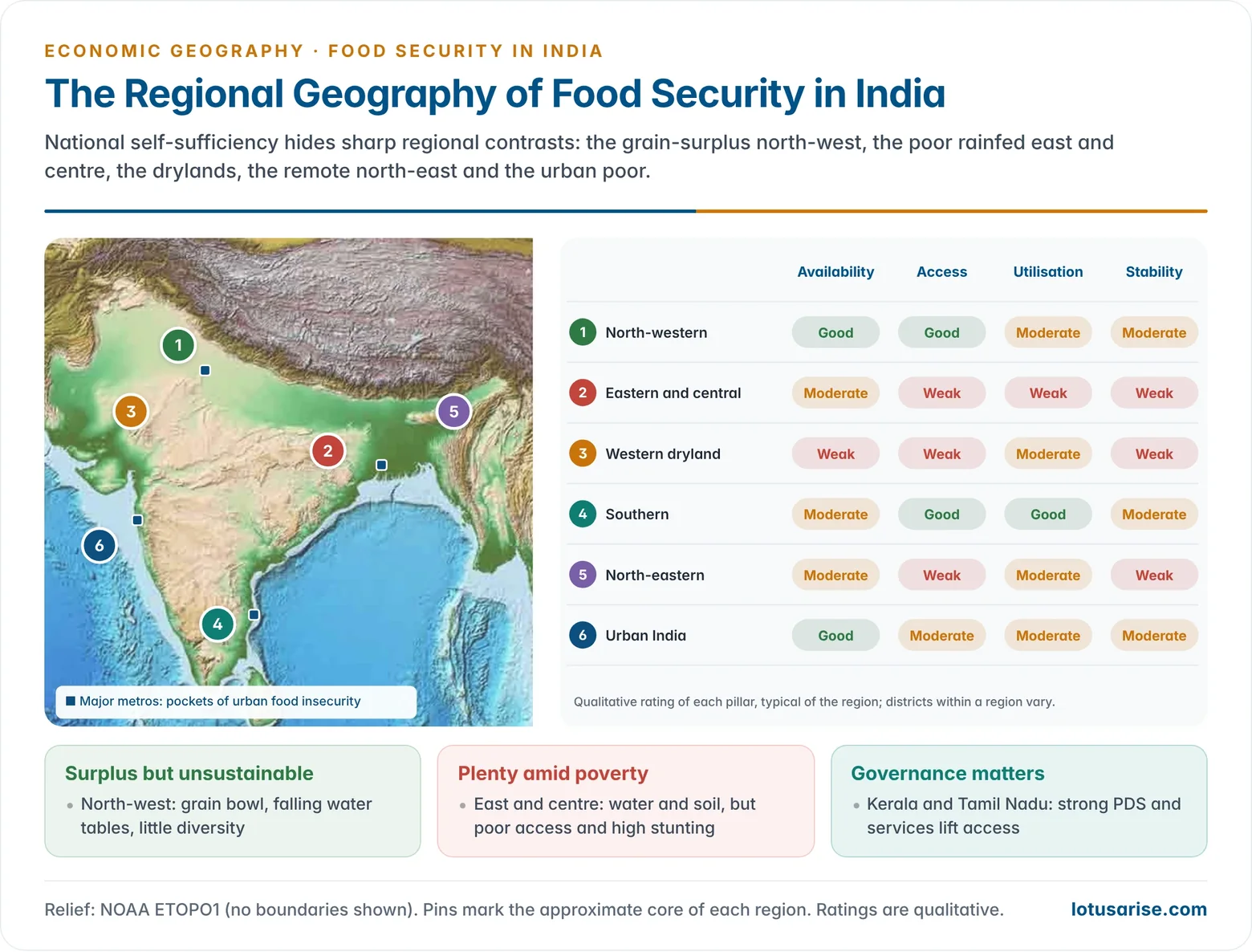
- India shows a paradox: national food sufficiency coexists with regional disparities and household insecurity.
- Agro-climatic diversity, socio-economic inequality, infrastructure gaps and governance determine regional variation. Availability is assured at the macro level, but access and utilisation are uneven, especially among tribal people, women and urban informal workers.
| Region | States | Characteristics | Food security status |
|---|---|---|---|
| North-western | Punjab, Haryana, western Uttar Pradesh | Green Revolution heartland; canals and tubewells; rice–wheat; strong procurement | High availability and access; low dietary diversity; salinity and falling groundwater threaten sustainability |
| Eastern and central | Bihar, Jharkhand, Chhattisgarh, Odisha, eastern Uttar Pradesh, West Bengal | Dense population, abundant water, rainfed farming, floods and droughts, weak markets, high poverty | Moderate availability but poor access; high stunting and undernourishment; tribal and SC groups most vulnerable |
| Western dryland | Rajasthan, Gujarat, parts of Maharashtra and Madhya Pradesh | Arid to semi-arid, erratic rainfall, groundwater and livestock dependence | Low availability and access in drought-prone and tribal districts; seasonal migration; heavy reliance on public schemes |
| Southern | Tamil Nadu, Kerala, Karnataka, Andhra Pradesh, Telangana | Better governance and services, diversified crops, high literacy and female empowerment | Better access and utilisation (Kerala, Tamil Nadu); irrigated vs dry-zone contrasts in Karnataka and Telangana |
| North-eastern | Assam and the hill states | Mountainous, fragile, shifting cultivation, high transport costs | Seasonal shortages; nutrition insecurity despite local self-sufficiency; logistical bottlenecks for schemes |
| Urban India | Large cities and towns | Urban poor, informal work, slum food deserts, market dependence | Economic access is the main barrier; migrants and the homeless most at risk; rising diet-related disease |
- A geographically differentiated policy is needed: one that fits local cropping patterns, involves communities, invests in infrastructure, follows a nutrition-sensitive strategy and uses GIS and remote sensing for targeting.
Food Security and Economic Policy
- Economic policy shapes all four pillars: availability through production and distribution, access through incomes and prices, utilisation through nutrition and health, and stability across time and regions.
Pricing, Procurement and Buffer Stocks
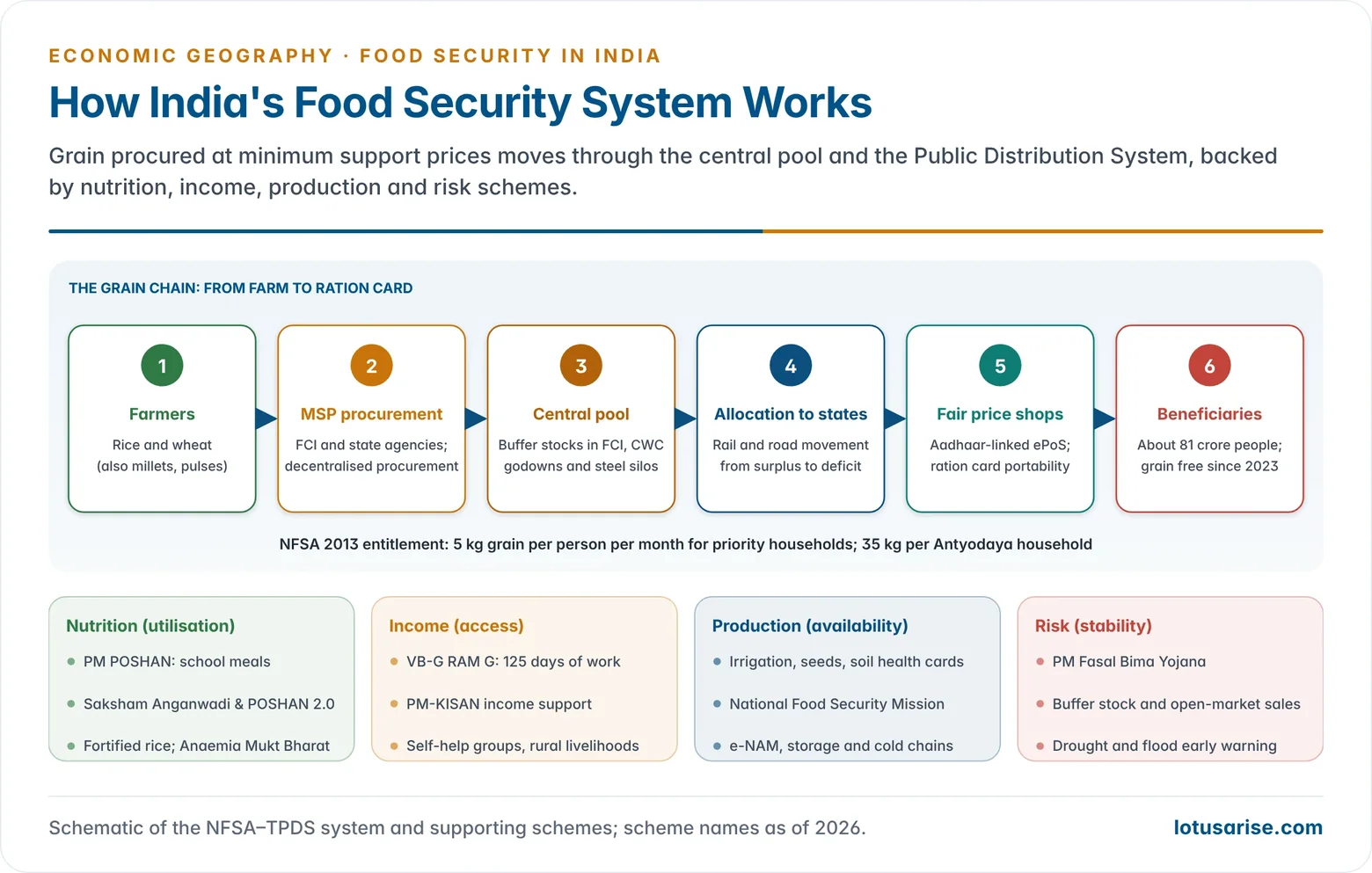
- Minimum Support Prices (MSP) guarantee farmers a remunerative price and stabilise markets. Procurement by the Food Corporation of India (FCI) and the states builds the central pool and buffer stocks.
- MSP procurement is skewed towards rice and wheat and towards a few states. This causes overproduction in the north-west, groundwater depletion, stubble burning and environmental degradation.
Public Distribution System and the National Food Security Act, 2013
- The PDS is India’s main instrument of food access. The NFSA (2013) made it a legal entitlement:
- It covers up to 75% of the rural and 50% of the urban population, about 81 crore people.
- Priority households get 5 kg of grain per person per month; Antyodaya Anna Yojana households get 35 kg per household.
- It gives maternity benefit and meals for children and pregnant and lactating women, and names the eldest woman as head of the ration card.
- Since January 2023 grain under the NFSA has been free under the Pradhan Mantri Garib Kalyan Anna Yojana (PMGKAY), extended in 2024 for five years.
- Reforms: Aadhaar-linked ePoS machines, digitised ration cards and One Nation One Ration Card (portability for migrants, in force across all states and UTs since 2022).
- Challenges: leakages, inclusion and exclusion errors, and regional variation in delivery (Chhattisgarh and Tamil Nadu versus Bihar historically).
Subsidy, Income and Employment Policies
- The food subsidy costs the Centre about ₹2 lakh crore a year. It improves access but is fiscally heavy, and over-support for some crops discourages diversification.
- Rural employment guarantees raise purchasing power. MGNREGA (2005) gave 100 days of wage work a year; from July 2026 it is replaced by the VB-G RAM G Act, 2025, which guarantees 125 days. PM-KISAN provides direct income support to farmers. These improve economic access, not just availability.
Trade Policy and Global Rules
- Export bans (rice in 2007–08 and 2023–24, wheat in 2022, onions) and import liberalisation are used to control domestic prices, but they transmit volatility to world markets.
- At the WTO, India defends public stockholding for food security. The “peace clause” agreed at Bali (2013) protects such programmes from challenge, and India was the first to invoke it (for rice, in 2020). A permanent solution is still pending.
Nutrition, Infrastructure and Resilience
- Nutrition-sensitive schemes: PM POSHAN (mid-day meals), ICDS / Saksham Anganwadi and POSHAN 2.0, POSHAN Abhiyaan and fortified rice link food distribution to nutrition outcomes.
- Infrastructure: irrigation, cold chains, roads, warehouses and silos reduce post-harvest losses. e-NAM, solar pumps and climate-resilient seed support availability.
- Sustainability: fertiliser, power and diesel pricing affect the cost and ecology of production. Paramparagat Krishi Vikas Yojana and natural farming promote sustainable agriculture.
- Risk management: the Pradhan Mantri Fasal Bima Yojana protects farmers against yield loss, and climate-smart agriculture builds resilience.
- Regional equity: procurement and support have favoured surplus states (Punjab, Haryana), while populous deficit states (Uttar Pradesh, Bihar, Jharkhand) remain under-served. Decentralised procurement and region-specific plans are needed.
Geospatial Tools in Food Security Planning
- GIS, remote sensing (RS) and GPS help map, monitor and implement food security strategies. They show spatial patterns of production, resources, climate impact and vulnerability.
Applications
- Mapping food-insecure hotspots by combining yield, poverty, population density and market access, to target PDS zones and priority nutrition districts.
- Crop monitoring and yield forecasting with satellite indices such as the NDVI (Normalized Difference Vegetation Index). These show crop stress, drought intensity and pest outbreaks early.
- Land use and land cover mapping to track degradation, shifting cultivation and the loss of farmland.
- Water monitoring: rainfall, soil moisture and reservoir levels for rainfed planning and irrigation scheduling.
- Infrastructure and logistics: siting warehouses and cold stores, and optimising PDS supply chains. GIS-linked ePoS data track distribution and leakage in real time.
- Post-disaster damage assessment for relief and crop-insurance claims.
- Nutrition mapping: linking food availability, health infrastructure and malnutrition data (NFHS, SECC) to find double-burden districts.
Programmes and Platforms
- India: FASAL (crop forecasting from space, agrometeorology and land observations), CHAMAN (horticulture assessment), NADAMS (district-wise agricultural drought monitoring) and location-specific advisories through Krishi Vigyan Kendras and the Kisan Call Centre.
- Global: FAO’s GIEWS (Global Information and Early Warning System), the FEWS NET network and the Integrated Food Security Phase Classification (IPC) for crisis analysis.
- Limits: data gaps, outdated maps, weak district-level capacity, high cost and poor coordination among agriculture, health and food departments.
Challenges and Global Initiatives
Challenges to Food Security
| Type | Key challenges |
|---|---|
| Environmental and climatic | Climate change, soil degradation, groundwater depletion (Punjab, Bundelkhand), loss of seed diversity and pollinators |
| Agricultural | Fragmented holdings, low productivity, post-harvest losses, falling public investment in research, extension and irrigation |
| Economic and market | Price volatility, speculation and hoarding, PDS leakages, loss of employment and entitlements |
| Social and demographic | Population pressure, urbanisation, poverty and inequality, women’s limited access to land, credit and decisions |
| Political and institutional | Policy inconsistency, incomplete land reform, conflict and displacement (Sudan, Yemen, Gaza), delays in scheme delivery |
| Global and trade | Export bans (rice, 2008 and 2023), import dependence, farm subsidies in the Global North that undercut poor farmers |
| Nutritional | Calorie sufficiency without micronutrients; shift to processed food |
Global Initiatives for Food Security
- SDG 2 (Zero Hunger) aims to end hunger and all forms of malnutrition by 2030.
- UN agencies: the FAO (policy and data), the World Food Programme (emergency food assistance) and IFAD (smallholder finance) work through the Committee on World Food Security.
- Global Alliance Against Hunger and Poverty, launched at the G20 Rio summit (November 2024) under Brazil’s presidency, pools policies and finance.
- Emergency reserves and trade cooperation: the ASEAN Plus Three Emergency Rice Reserve, the SAARC Food Bank, and the Black Sea Grain Initiative (2022–23).
- Research: CGIAR centres such as IRRI and ICRISAT (Hyderabad) develop improved and biofortified varieties.
Conclusion
- Food security is a multifaceted problem shaped by environmental, economic, social and political factors.
- Lasting food security needs a holistic approach: higher productivity, equitable access, better governance and climate-resilient farming.
- Regional cooperation, geospatial tools, community participation and nutrition-sensitive policy can make global and national food systems resilient and inclusive.
Previous Year Questions
2022Climate change is a serious problem to global food security and poverty eradication Critically examine.2022Evaluate the role of the National Food Security Act, 2013 in providing access of food to the poor in India.2021Describe the role of accessibility and affordability in the food security of the developing world.2020Analyse India’s food security in the context of population growth.2014Give an account of food security issues in developing countries.2013Snags in the Food Security Policy of India2011Write short explanatory note on population and Food Security.





Please provide some written material as you do in other articles
Added contents, and updated!