

Famine

- All through human history, we see the frequent occurrence of famine dating back to 400 B.C. when data becomes first available.
- It is not difficult to understand the reasons for famine in the past centuries when poor technology and static economic systems hampered human beings from getting access to food, especially in the face of regional natural disasters. But why does food insecurity persist? The number of countries currently experiencing severe food shortages has almost tripled since 1990.
- Even though current global food supplies are sufficient to feed the world’s population, an estimated 20 percent of people in developing countries – more than 800 million people — still lack access to enough food on a regular and predictable basis.
- What is Famine? Of course, the word “famine” is difficult to define and is a political “hot potato.” Famine is like insanity, hard to define but glaring enough when recognized. There are dozens of definitions, but not yet one that everyone agrees on. No government likes to hear the “F-word” in connection with its country; neither do aid agencies or international donors. It implies that they have failed to stop a food shortage from turning into a major humanitarian crisis.
- According to common usage as found in Wikipedia, famine is a widespread shortage of food that may apply to any faunal species, a phenomenon which is usually accompanied by regional malnutrition, starvation, epidemic, and increased mortality.
- According to Médecins Sans Frontières, famine is a situation where more than five people in 10,000 are dying every day due to malnutrition and hunger.
- USAID says famine is a “catastrophic food crisis that results in widespread acute malnutrition and mass mortality. It is a process, rather than an event, with a beginning, a middle, and an end.”
- The World Food Program says a famine occurs when a serious food crisis is made worse by “governments’ failure to deal with the situation”. In most of the 80 countries where WFP operates, people are on the brink of a food crisis.
- According to the New Palgrave Dictionary of Economics, Thomas Malthus, the eighteenth-century British economist, theorized that famine, along with war and disease, was an adaptation to the imbalance between available food and population size.
- Stephen Devereux and Paul Howe, from the Institute of Development Studies of the University of Sussex, in their article about “Intensity and Magnitude Scales for Famine”, suggest the definition of famine is “where the number of people dying is between 2-4 people per 10,000 population per day, and/or wasting is between 20-40 percent (that is the proportion of children aged between six months and five years old who are less than 80 percent of the average weight-for-height). Coping strategies are exhausted and people adopt survival strategies. Markets begin to close or collapse.”
- The international famine center (www.ucc.ie) defines famine as follows: Famine may be seen as “the regional failure of food production or distribution systems, leading to sharply increased mortality due to starvation and associated disease”
- The definitions above suggest the following points:
- First, it is regional, not family failure, and points to the importance of markets and, by implication, of shifting market demand for different foods in addition to their aggregate supply.
- Second, the famine also identifies “excess deaths”– deaths that otherwise would not have occurred as the core feature of famine; and attributes those deaths to morbidity as well as to seriously reduced consumption. Abnormally high mortality may be the hallmark of famine, but societal breakdown is its essence. Most famine-induced mortality tends to occur after the worst of the food crisis is over but while the crisis of infectious disease persists.
- Third, famine is the endpoint of a lengthy process in which people in increasing numbers lose their access to food. Most famines have long gestation periods, typically covering two or more crop seasons. Because it is also typically shrouded in ambiguity, early detection is rarely definitive and seldom produces an early response.
- Moreover, famine entails more than a severe shortage of food and grotesque distortions of normal food prices. Famine features a deepening recession in the entire rural economy, one affecting production and exchange, employment, and income of farm and non-farm households alike.
- It is the occurrence of prolonged and extreme scarcity of food. It leads to mass mortalities within a short duration.
- Famine is concentrated in few geographical pockets of the world.
- Nutritional intake in the condition of famine is less than 2000 calories per day and protein intake is less than 30 gm per day.
- Famine is the situation where a group of the population faces acute hardship in the minimum availability of food grains for survival. Lack of food grains for survival leads to starvation and hunger deaths.
- FAO and other international agencies are of the view that the problem of starvation death all over the world is almost solved. But at the same time, Red Cross Society has observed that the large size population of Africa receives food just to survive. Per day intake of food in Africa is less than 30 gm and calorie intake is between 1500-1600 calories. This is a situation which creates a disease-prone or epidemic-prone society that is almost a famine-like situation.
- Hunger death is a global problem even at present, which is due to the non-availability of food.
- According to FAO, every day about 24000 persons die due to food shortage, and these deaths are reported in famine-prone areas of the world. Simple food availability does not solve the problem. About 120 crore population of the world is not receiving adequate calorie and protein. They receive calorie less than 2000 per day and protein less than 30 gm per day which creates a permanent hunger-like situation.
Famine is characterized by the following factors:
- Severe food shortage triggered causes like conflict, drought, crop failure, demographic disequilibrium, governmental policies, and so on.
- Widespread death dues to diseases, starvation, and scarcity of food.
- Malnutrition and other deficiency diseases plaguing a huge amount of population.
- Crop failure leading to a nationwide scarcity of food.
- Poverty with various social disorganization consequences that include overcrowding, the break-up of hygiene, escalated vermin, failure to bury the deceased, and unregulated population growth and/or camp advancement that support the occurrence of epidemics and diseases.
Causes of famine
Africa:
- Many countries of the world are facing the problem of both open hunger and hidden hunger. The problem has been seen in various parts of the world, but they are sporadic.
- Regional continuity is problem of Africa. In Africa about 34 countries are facing these problems. Worst affected are the countries of sub Saharan Africa particularly Sudan, Chad, Mauritania, etc. (from Somalia to Sierra Leone and from Djibouti to Lesotho)
- In Africa only few countries are in good condition like Morocco to Egypt in North Africa, Zaire in Central Africa and South Africa.
Factors of Africa’s famine:
- Climate uncertainty and society’s total dependency on primary activities:
- Since 1984, sub-Saharan Africa is under drought, and rapidly the region is changing to hot and dry land. Food availability has worsened.
- Tanzania, Mozambique and South West African countries have increased frequency of floods and that have caused the famine-like situation. Drought and flood are the natural hazards that are creating famine as a permanent situation in Africa.
- Poverty:
- Poor countries have very low purchasing capacity so they are unable to buy from the world market. Some international aid are coming which are providing food only to survive- no protein food is made available.
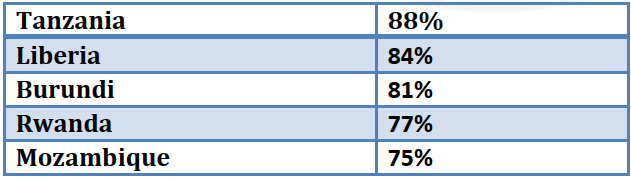
- International aid is not based on standard medical norms. Large population is living below $1.25 per day income (as per HDR 2009) [see image]
- Per capita income is not enough to provide food. Once the crop fails, the income system collapses.
- Since 1984, food shortage, famine, hunger, starvation has become the culture of Africa.
- Tribal culture:
- Many tribes are a wandering society. They instead of settling at a site for development, wander.
- Tribal groups are unable to realise international boundaries. Tribal groups are also responsible for state rivalry. E.g. Rwanda-Burundi, Uganda-Kenya. Such rivalry causes the problem of refugee and displaced persons. These persons depend completely on aid.
- Tribal groups are also creating problems in food distribution. Tribal groups loot and hoard the government food.
- Lack of government’s effort to transform agriculture. This drought situation in Africa has persisted from long time. The government hasn’t taken any program to counter it.
- Food politics: developed countries or food suppliers do not provide food without political bargaining. International aids are not medically good (maize, wheat and some oilseeds)
- Famine in Africa is not only due to natural factors but also due to human factors. All play a more than equal role.
South Asia:
- Although South Asia received Green Revolution in many parts, inspite of that there are famine situations in many parts. Factors are:
- Drought and Floods:
- Natural calamities create famine-type situations in many parts. Bangladesh is worst effect by floods, while Nepal by floods and landslides. India, Pakistan and Afghanistan are affected by floods, landslides and earthquakes.
- However, the problem of South Asia is of regional continuity. There was a similar problem up to the drought of 1966. Thereafter there have been government efforts to solve the problem.
- Green Revolution has taken place at many parts and famine is at micro level.
- Low income and inadequate transformation of economy: India and Bangladesh have populations below $1.25 per day with the percentage of 42% and 50% respectively. Sri Lanka and the Maldives are better off. The problem not is as in Africa but large size of the population is still facing the problem.
- Social factors: “Famine is a social problem of South Asia”- Amartya Sen. According to FAO, in this part SC and ST are the worst sufferers groups. SC and ST are landless people. Once the crops fail landless workers are the worst affected.
- Family famine situation:
- In Bangladesh according to Amratya Sen, the crop is lost due to floods which reduce the income of a family, which leads to their exploitation by moneylenders. Thus, the family is compelled for limited food intake till the next cropping season.
- Worst sufferers are the mothers in the family. Kids are the first getters but they are malnourished and the remaining money is spent on medications.
- Male members get the food and mothers get the remaining food. Thus, female mortality is high and sex ratio is low.
- Political and strategic factors: These factors lead to political tensions. Due to these factors, people are compelled to live tent life. E.g. Herat province of Afghanistan, the Afghan war, Chakma tribe migration to India, Kashmir refugee, etc.
- Public distribution system is not effective: When Public distribution system is not effective, food does not reach to its target. It leads to the development of the culture of famine for socially neglected and displaced persons.
Central and Andean America:
- From Chile to Dominican Republic, countries like Jamaica, Trinidad and Tobago are better off. The factors for famine in these countries are:
- Natural hazards, climatic uncertainty
- Tribal society which are not much involved in economy
- Lack of alternate economy.
- The famine regions are specific. Guatemala, Nicaragua, Honduras, Costa Rica, Peru, Ecuador are the worst affected countries.
South East Asia:
- The famine-affected countries in South East Asia includes- Myanmar, Laos, Cambodia, Philippines, East Timor, South Sumatra.
- The factors for famine in these countries are:
- Drought and floods- In Indonesia, even volcanoes and earthquakes
- Lack of agricultural development programmes
- Poverty
Eastern and northern Asia:
- This is the area of drought and famine. The worst affected country is North Korea which witnessed the worst drought in 1996. A large number of the population is affected by poverty in these countries.
- China, North Manchuria, Inner Mongolia, South, and Central China has seasonal famine mainly due to floods.
- Kazakhstan, Uzbekistan, south Siberia are often disturbed by drought and sleet fall.
- Steppe and chestnut regions of Russia are having fertile soil, but the drought is a problem.

Famines in India
- India is a developing nation with its economy and population majorly dependent on agriculture. Although various advancements in the field of agriculture have improved its quality it is still primarily dependent on climatic conditions.
- For example- Rain during summer is crucial for the process of irrigation in agriculture. Lack of rainfall leads to a lack of proper irrigation and the failure of crops. Thus, these consequences lead to famines.
- Many such conditions like lack of rainfall or drought had led to several famines in India 11th to 17th Century. The most severely recorded famines in India are as follows:
- The famine of 1943 in Bengal.
- The famine of 1783 in Chalisa.
- The famine of 1770 in Great Bengal.
- Skull Famine of 1791.
- The famine of 1866 in Orissa.
- The famine of 1630 in Deccan.
- The famine of 1873 in Deccan.
- The famine of 1837 in Agra.
- Widespread scarcity of food was caused as a result of these great famines. This also led to many deaths across the country. The most serious of all these famines was the famine of 1770 in Great Bengal that caused around 10 million deaths, the skull famine of 1791 caused about 11 million deaths and the Chalisa famine of 1783 also caused 11 million deaths on average.
Types of Famine
- Famine, being a multi-causal phenomenon, can be categorized into distinct types based on the nature of causation and the processes involved. The following classification reflects the geographical and economic perspectives commonly used in famine studies:
- Food Availability Decline (FAD) Famine
- This type of famine is caused by an absolute decline in the availability of food, often due to natural factors such as drought, crop failure, floods, or pest infestations.
- It assumes a direct relationship between food supply and famine—that famine arises when food production falls below subsistence levels.
- FAD famine often affects subsistence economies where local production is the primary source of food security.
- Example: The Bengal Famine of 1943 is partly attributed to the destruction of rice crops by a cyclone and fungal disease, leading to an acute shortage of food grains in the region.
- Food Entitlement Decline (FED) Famine
- The Food Entitlement Decline model was introduced by Amartya Sen in his seminal work “Poverty and Famines” (1981).
- It shifts the focus from food availability to economic access to food, arguing that famine can occur even when food is available in the market if certain groups are unable to afford it.
- This approach emphasizes the erosion of livelihood entitlements, such as wages, employment, or barter options, preventing people from acquiring food.
- Example: The Sahelian famine of the 1970s, where pastoral communities lost purchasing power due to the collapse of livestock prices, despite adequate food supply in nearby markets.
- Man-made or Conflict-induced Famine
- These famines are primarily the result of armed conflicts, forced migration, political oppression, or deliberate destruction of resources (scorched-earth tactics).
- They may be used as a weapon of war or arise from state failure in ensuring food supply and humanitarian access.
- Such famines often coincide with breakdown of governance, disruption of markets, and insecurity, making both food production and distribution impossible.
- Example: Famines in Sudan and Ethiopia during the 1980s were largely due to prolonged civil wars, displacement, and political neglect, despite some regions being food-surplus zones.
- Market Failure and Speculative Famine
- This form of famine arises not from real scarcity, but from market distortions such as hoarding, speculation, panic buying, and price manipulation.
- It is driven by information asymmetry, fear-induced consumer behavior, and the breakdown of price regulation mechanisms.
- In such cases, food remains available but is either inaccessible due to skyrocketing prices or is withheld from the market for profit.
- Example: The Great Bengal Famine of 1943 is also an example of speculative famine, where British wartime policies, excessive procurement, and black-market trading led to an artificial scarcity despite adequate regional food availability.
- Food Availability Decline (FAD) Famine
Effects of famine
- This hunger and famine has regional and global impact. It is creating an undernourished, epidemics and disease prone society.
- Nearly 20% of the world population is facing the problem which may lead to the genetic degradation of mankind. So, genetic scientists have also shown concerns to large scale survival of ill health society. These people easy come under money lenders, debt trap, the problem of landless labour, child labour, bonded labour, etc.
- There are political, social and community tensions. War like situation emerges between neighbouring countries. It further aggravates the poverty situation which increases mortality.
- It leads to still births, underweight and undernourished delivery of babies. According to a UNICEF report of 1996, in Bangladesh, about 67% of babies born are underweight, in India 53%, Ethopia-48%, Nigeria-36%, Tanzania-29%.
- Ethiopia has the lowest per capita calorie intake per day (1600 cal), USA has 3600 cal.
- Famine creates multidimensional problems for the society. Social and administrative mismanagement occurs.
Remedies for the famine problem
- There is a need to have global effort to solve the problem
- Agriculture development: most of the sufferer countries are agrarian countries. They need to take a lesson from the countries like India, Pakistan. Most of the sub-Saharan countries need to improve irrigation and watershed management.
- To create alternate economy: it was first emphasised in 1863 Famine Commission Report on India. It gave a two-dimensional approach to solve the problem:
- Agriculture development by developing irrigation
- Revival of some old canal-like Sirhind canal
- Many Anicuts were developed
- Revival of India’s traditional alternative economies like cottage industries and livestock.
- Agriculture development by developing irrigation
- To provide relief operations for immediate help to suffering groups, international trade of food should be rationalized. Its shipment should be based on humanitarian grounds. Food politics should be avoided. Global hunger is due to three factors- social, economic and political. As Amartya Sen observes “While drought and other naturally occurring events may trigger famine conditions, it is government action or inaction that determines its severity, and often even whether or not famine will occur.”
- These countries need to improve their PDS so that all can get access to food. China has very effective PDS. Others should learn from China.
- There should be international cooperation for forecasting natural hazards, flood control, drought control etc.
- Famine affected countries are not technically advanced so developed countries should provide them support
- Population control measures should also be taken. Countries which have controlled population growth have also controlled famine.
- Social development is needed like literacy, education development
- Some international organizations like Red Cross, UNICEF, World Bank, NGOs should take an active part in famine eradication
- Other remedies:
- Need of relief policy
- Maintenance of buffer stock
- Proper agro-climatic planning
- Use of modern and scientific methods such as remote sensing, GIS to accurately locate the crisis point.
- UNO Board on food and nutrition, FAO, WHO- all are concerned that foods are not needed only for life-saving but to provide better health.
Geographical Approaches to Understanding Famine
- Geographers contribute significantly to the study of famine by examining spatial patterns, regional disparities, and the interaction of physical and socio-economic factors. Several conceptual and analytical frameworks have emerged to interpret famine through a spatial lens:
Spatial Interaction Theory
- This theory emphasizes the role of physical and economic connectivity in influencing access to food during crises.
- It examines how the movement of food commodities, people, and information across space affects local availability and affordability.
- During a famine, areas poorly connected to major markets or food-surplus zones may experience acute shortages, even when food is available elsewhere.
- Factors such as distance from urban centers, transport infrastructure, and market integration are crucial in determining the spatial dynamics of famine.
- This approach highlights that access is as important as availability—echoing the logic of entitlement theory in a spatial context.
Core-Periphery Models
- Derived from regional development theories, the core-periphery model explains how economic disparities between developed (core) and underdeveloped (periphery) regions affect famine outcomes.
- Peripheral regions, typically rural, agriculturally dependent, and poorly serviced in terms of infrastructure, are more vulnerable to famine.
- In contrast, core areas benefit from economic concentration, market accessibility, and institutional support.
- This framework reveals how spatial inequality, shaped by historical and political processes, underpins differential vulnerability to famine.
- For example, in many Sub-Saharan African countries, famine mortality is highest in marginalized peripheral regions lacking state presence or investment.
Vulnerability and Resilience Mapping
- This approach focuses on mapping areas based on their susceptibility to famine and their capacity to recover.
- Vulnerability mapping identifies regions at high risk due to factors like:
- Arid or semi-arid climate conditions
- Frequent droughts or floods
- Conflict-prone zones
- Poor governance or weak state institutions
- Resilience mapping, on the other hand, assesses the strength of local institutions, infrastructure, and coping mechanisms.
- The combination of these two dimensions helps in designing early warning systems and targeted humanitarian interventions.
- This spatial analysis is especially useful for disaster risk reduction (DRR) and development planning in famine-prone areas.
GIS and Remote Sensing Applications
- Modern technological tools such as Geographic Information Systems (GIS) and remote sensing have revolutionized famine monitoring and prediction.
- These tools allow for:
- Tracking of rainfall anomalies using satellite data
- Monitoring of vegetation indices (NDVI) to assess crop health
- Mapping of soil moisture and land use changes
- Real-time surveillance of drought progression and flood impact
- GIS platforms can overlay socio-economic data (like poverty and malnutrition rates) with environmental variables to produce composite famine risk maps.
- Remote sensing data, when integrated with ground-level surveys, enhances the accuracy of famine early warning systems (e.g., FEWS NET).
- These innovations allow for proactive interventions rather than reactive responses to famine.
Policy Measures and Responses to Famine
- The occurrence of famine is not merely the result of food scarcity, but often the failure of public policy and institutional mechanisms to prevent and mitigate its impact. Hence, policy responses play a central role in both famine prevention and post-crisis recovery. A multi-scalar and multi-dimensional policy framework is essential to address the complex causes and consequences of famine.
1. Early Warning Systems (EWS)
- The establishment of effective early warning systems is considered the first line of defense against famine.
- These systems use indicators such as rainfall deficits, crop yield anomalies, market prices, malnutrition levels, and conflict intensity.
- Institutions like FEWS NET (Famine Early Warning Systems Network) and India’s Crop Weather Watch Group (CWWG) monitor these variables.
- Real-time monitoring enables governments and international agencies to issue alerts and pre-emptively mobilize resources.
2. Public Distribution Systems (PDS)
- A robust Public Distribution System ensures that essential food grains are made available at subsidized rates, particularly to vulnerable populations.
- In India, the PDS, supplemented by schemes like Antyodaya Anna Yojana, Mid-Day Meal Scheme, and Integrated Child Development Services (ICDS), plays a critical role in nutritional security and famine mitigation.
- However, issues like leakages, inclusion/exclusion errors, and logistical inefficiencies require constant policy reform.
3. Employment Guarantee and Cash-for-Work Programs
- Programmes such as the Mahatma Gandhi National Rural Employment Guarantee Act (MGNREGA) in India ensure income security during lean agricultural periods or food stress.
- Such schemes serve dual purposes—employment generation and asset creation (e.g., water harvesting structures, rural roads).
- Cash-for-work initiatives during droughts or famines help restore purchasing power, especially when food is available but economically inaccessible.
4. Food Stockpiling and Buffer Reserves
- Maintaining strategic food grain reserves acts as an insurance mechanism against crop failures and price shocks.
- The Food Corporation of India (FCI), under the Ministry of Consumer Affairs, manages procurement, storage, and distribution of food grains.
- During localized famines or price volatility, buffer stocks are released into the market to stabilize prices and ensure supply continuity.
5. Nutrition and Public Health Interventions
- Famine often leads to malnutrition, disease outbreaks, and mortality, especially among children and the elderly.
- Immediate policy responses must include supplementary feeding programs, immunization drives, and mobile health clinics in affected regions.
- Community kitchens, distribution of ready-to-eat fortified food, and safe drinking water provisions are also critical components.
6. Agricultural Insurance and Climate Resilience
- Crop insurance schemes such as the Pradhan Mantri Fasal Bima Yojana (PMFBY) offer risk coverage for farmers against crop loss due to droughts or floods.
- Long-term policies promoting drought-resistant crops, soil conservation, micro-irrigation, and agroforestry increase agricultural resilience to climate shocks.
- Integration of climate-smart agriculture can reduce the structural vulnerability to famine-like conditions.
7. Conflict Resolution and Peace-building
- In regions where famine is conflict-induced, humanitarian interventions must be combined with conflict resolution and political stability.
- Peace-building efforts, demilitarized humanitarian zones, and negotiation of food corridors are essential to ensure unhindered aid delivery.
8. International Aid and Multilateral Cooperation
- Famine-affected countries often depend on bilateral aid, UN agencies (like WFP, FAO), and NGOs for immediate relief.
- Long-term international cooperation in the form of capacity-building, agricultural investment, and technology transfer helps prevent recurring food insecurity.
- Programs under the Sustainable Development Goals (SDG-2: Zero Hunger) provide a broader framework for coordinated famine eradication.
Conclusion
- Famine is not an inevitable outcome of food shortages, but often a result of institutional failure and lack of political will.
- Therefore, policy responses must go beyond reactive relief to include preventive, protective, and promotive strategies. The emphasis should be on resilience-building, inclusive development, and decentralized governance to ensure that food security is universal, equitable, and sustainable.
- Integration of geospatial tools, community participation, and climate-responsive planning is vital to ensure that famine becomes a historical relic rather than a recurring tragedy.





thank you😃..!!sir
Thank you very much for your support in providing the notes. These are extremely beneficial. One place to get all topics of Geography Optional.
Need to provide case studies