

Rural Settlements: Concept, Nature and Characteristics

- The concept of rural settlement has evolved significantly in settlement geography, moving from a static, descriptive understanding to a more dynamic, process-oriented interpretation.
- Early attempts at definition, such as that by K.H. Stone (1965), viewed rural settlements primarily as clusters of buildings associated with primary production activities, emphasizing their spatial distribution and linkage with land.
- However, this perspective was later refined by scholars like Jordon (1966), who argued that rural settlements should not be seen merely as physical aggregates of houses, but as living systems emerging from continuous interaction between human activities and the environment.
- Thus, a rural settlement represents not just a location, but a functional and socio-ecological unit, shaped by economic practices, cultural norms and environmental conditions.
- In contemporary geographical understanding, a rural settlement may therefore be defined as a territorial unit where people reside and engage predominantly in primary activities, and whose structure and organization are determined by the interplay of natural, economic, social and cultural forces.
Structural Basis of Rural Settlements
- The study of rural settlements involves analysing their structure, pattern and landscape evolution, which together reflect the underlying human–environment relationship.
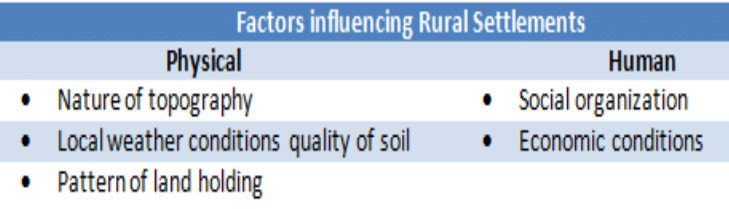
- Rural settlements are closely tied to physical geography, including landforms, climate, soil fertility and water availability. These factors influence not only their location (site) but also their form, density and distribution.
- For instance, the fertile Indo-Gangetic plains support compact and nucleated villages due to high agricultural productivity, whereas the American Prairies are characterised by dispersed farmsteads reflecting mechanised agriculture and large landholdings.
- In mountainous regions like the Himalayas, settlements are sparse and often confined to valleys or near water sources, while in arid regions, oases and riverbanks become focal points of habitation.
- Rural settlements are closely tied to physical geography, including landforms, climate, soil fertility and water availability. These factors influence not only their location (site) but also their form, density and distribution.
- Geographers, therefore, analyse rural settlements through multiple components such as site, situation, area, function, shape and population, in order to understand their spatial organization and functional relationships.
Nature and Characteristics of Rural Settlements
- The distinction between rural and urban settlements is commonly based on population size, density and occupational structure, though these criteria vary across countries. In India, the Census provides a functional definition of urban areas, and all remaining settlements are categorized as rural.
- Demographic Characteristics
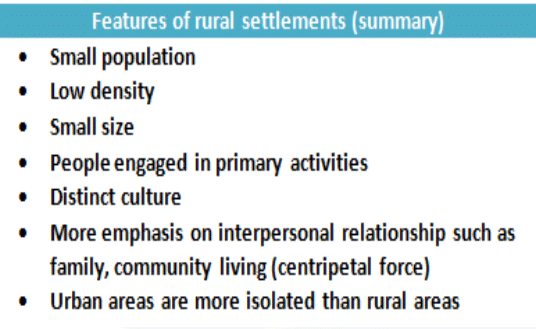
- Rural settlements generally have low population size and low density, reflecting limited economic diversification and dependence on land.
- The scattered or compact nature of population distribution is influenced by environmental and socio-economic conditions.
- Economic Characteristics
- The most defining feature is the dominance of primary economic activities, particularly agriculture.
- In addition to farming, rural populations engage in animal husbandry, fishing, forestry, mining and collection of forest produce, indicating a direct dependence on natural resources.
- This close linkage with nature makes rural settlements highly sensitive to environmental changes such as monsoon variability, soil degradation and resource depletion.
- Social and Cultural Characteristics
- Rural societies often exhibit a high degree of social homogeneity, especially in traditional settings where occupation and social status are historically determined.
- In the Indian context, the caste system has played a significant role in structuring rural society, influencing settlement morphology as well as occupational distribution.
- There is generally limited social mobility, though this is gradually changing due to education, migration and economic diversification.
- Strong community bonds and kinship ties are characteristic, often supported by joint or extended family systems and shared cultural practices.
Dynamic Nature of Rural Settlements
- It is important to note that rural settlements are not static entities. With processes such as urbanization, industrialization, transport development and rural transformation, many villages are acquiring urban characteristics.
- Villages located near cities often function as peri-urban or “rurban” spaces, exhibiting mixed occupational structures.
- Improved connectivity and market integration are transforming traditional rural economies into diversified systems.
- Government initiatives such as rural development programmes, smart villages and infrastructure expansion are further accelerating this transition.
- Thus, the traditional view of rural settlements as isolated and homogeneous units is increasingly being replaced by a more nuanced understanding of their dynamic and transitional nature.
Morphology of Rural Settlement
- Morphology in settlement geography refers to the layout, internal structure, and spatial organization of a settlement. It goes beyond mere physical arrangement and includes the functional, social and economic components that shape settlement form.
- It explains how buildings, streets, fields and open spaces are arranged.
- It reflects the interaction between physical environment and human society.
- Thus, rural morphology is both spatial (visible) and functional (invisible processes) in nature.
- Morphology of Rural Settlement includes the internal structure or the constructional plan of a village, which includes the layout of streets and roads, arrangement of houses, pattern of housing, geometrical size and shape of the village and agricultural fields, and location of either the water body, religious site, or the house of the village headman.
Types of Morphology
- Rural settlement morphology can broadly be classified into:
- Physical Morphology
- Deals with site, situation, ground plan and built-up area.
- Includes street patterns, house arrangement, land use and settlement density.
- It is the most visible aspect and forms the basis of classification like linear, clustered, dispersed settlements.
- Social Morphology
- Reflects social structure, caste composition, occupational groups and cultural patterns.
- Particularly important in India where caste-based segregation influences settlement layout (e.g., separate hamlets for different castes).
- Physical Morphology
Physical Morphology
- Physical Morphology includes the study of the relationship between the following:
- Road to lane relationship: It includes how roads are connected to lanes.
- Lane to lane relationship:
- It is description of geometrical arrangement of lanes. How they are connected to each other and ending at what points.
- In Indian villages, lanes are extremely narrow meandering and ending abruptly. This shows unplanned character of Indian villages.
- In UK, cruciform villages have all the lanes cutting across 90 degree, because they are planned villages.
- Lane to house relationship:
- Geometry of lanes determines the arrangement of houses because houses grow along lanes.
- In India, lanes are largely unplanned and arrangement of houses determines the lane type.
- House to house relationship:
- Physical morphology is also determined by the spacing between the houses.
- In clustered villages, houses are unevenly spaced or they have wall to wall arrangement.
- Houses are hardly according to geometrical plan and their average height is variable.
- There is clustering of houses based on social structure/cast system.
- Role of geometrical shape of the agriculture field also determines the village pattern.
- House type can range from ‘Pucca’ to ‘Kutcha’ and in older parts of villages, ventilation is closed to the roof (depends on whether village is developed or not).
Components of Physical Morphology
- Ground Plan
- Refers to the arrangement of buildings, streets, markets and public spaces.
- Determines functional efficiency and accessibility within the village.
- Examples:
- Grid-like layout in planned settlements
- Irregular pattern in traditional villages
- Built-up Area Structure (Doxiadis Model)
- According to Constantinos A. Doxiadis (Ekistics), rural settlements exhibit a functional zoning within built-up areas, which evolve over time.
- Homogeneous Core (Village Core)
- Central part of settlement with dominant social group.
- Contains headman’s house, religious structures, water sources.
- Represents historical nucleus of settlement.
- 👉 Indian example: Upper caste-dominated central core in North Indian villages.
- Transitional Zone (Artisan Zone)
- Occupied by service providers like blacksmiths, carpenters, weavers.
- Acts as a link between core and periphery.
- Reflects occupational interdependence in rural economy.
- 👉 Indian relevance: Jajmani system historically structured this zone.
- Circulatory Zone (Peripheral Expansion Zone)
- Located at the outer margins with roads, transport links and new housing.
- Area of recent migrants and expansion.
- Indicates dynamic growth and modernization.
- Special Use Zone
- Includes schools, temples, farms, ponds, grazing lands.
- Provides institutional and economic support to settlement.
- Homogeneous Core (Village Core)
- According to Constantinos A. Doxiadis (Ekistics), rural settlements exhibit a functional zoning within built-up areas, which evolve over time.
Social Morphology
- It refers to the social structure of a village which is based on cast, or class.
- In Indian villages, caste hierarchy is reflected in the morphology of villages.
- Social factors like division of work, untouchability (not so prominent now), social prohibition over the work of women and lower casts had all led to a distinct social morphology of Rural Settlements from urban ones.
- The following factors affect the following morphological character of villages:
- Arrangement of buildings
- Pattern of streets and fields
- Functional characteristics of settlement.
- For example, the houses of higher cast people like Brahmins and Rajputs would be large and people from the lower cast would have huts, kutcha houses with cattle.
- The intermediate regions of rural settlement comprise of the people of service casts like Ahirs, Jats, Loth, etc.
- Cast based hamlets at times emerge. These are closely linked with centre under the Jajmani system (inter cast cooperation like higher cast people requiring lower cast people for some specific work like ironsmith) and act like a unit.
- K. N. Singh in his religious ritual and secular dominance model highlighted the importance of two concepts:
- Development of twin settlement which included:
- Caste Hindus
- Outcasts
- The segregation was much pronounced during the past favouring the outgrowth of the helmeted structure of villages, In the case of compact settlements out-castes generally lived on the outer parts of the built-up area in a direction (south, south-east, and north, etc.) less conducive for wind movement, for even air gets polluted after coming in contact with a Shudra‘s body.
- How and why these traditions came into being is a matter of debate amongst scholars, but the author believes these untouchables to be the remnant of the pre-Aryan tribes who were always despised by the Aryans and later Rajput settlers.
- Secular dominance model: Under this model, all caste and religion came together as functional units under the old Jajmani system. For example, landowners required the services of landless people for the cultivation of fields.
- Development of twin settlement which included:
- Thus, the socio-cultural traits of rural settlement is also a field of study in the settlement system
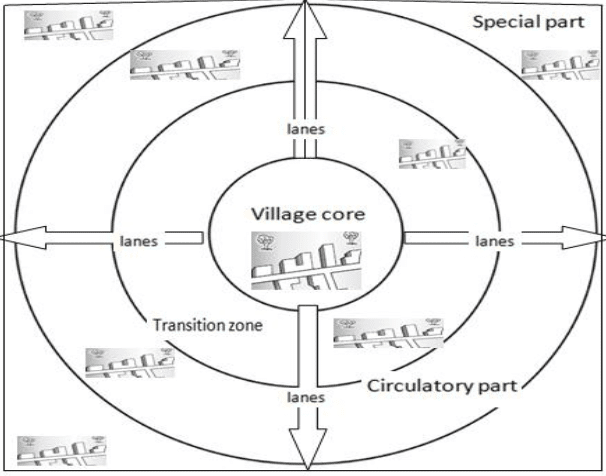
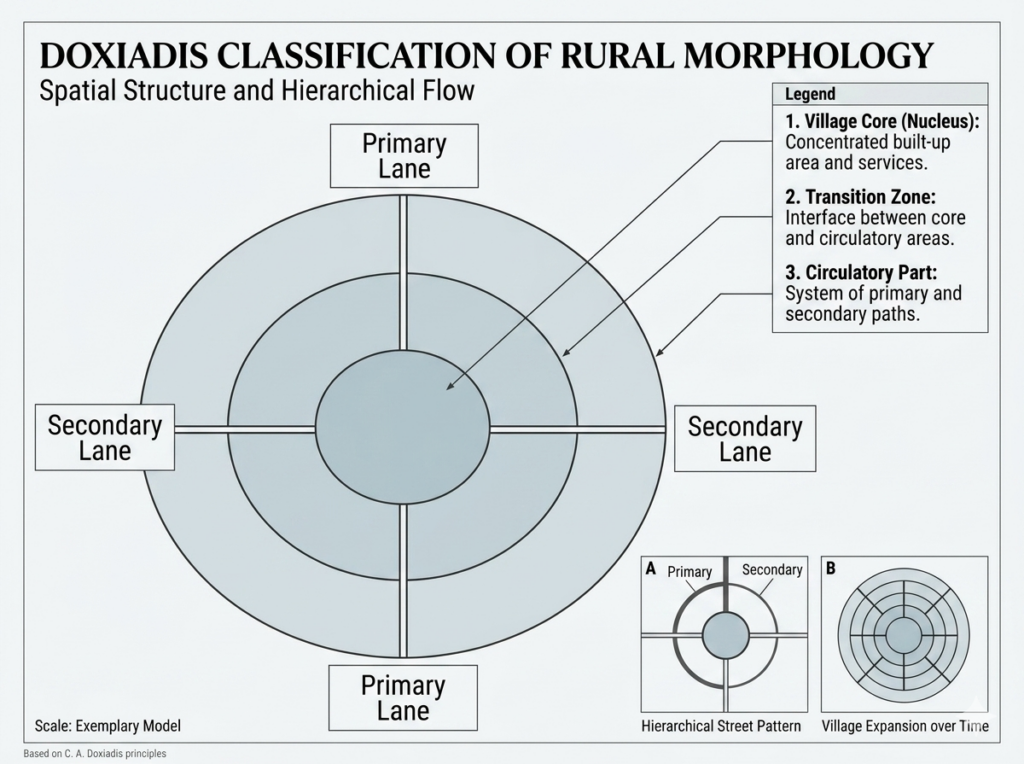
Doxiadis Classification of Rural Morphology
- The earliest attempt to classify Rural Morphology was made by Constantinos A. Doxiadis.
- He classified rural morphology into four sectors:
- Homogenous sector or Village core:
- It consists of the central part of the village.
- It has a religious site, water body or Zamindar/ Village headman’s house, or community land.
- It is surrounded by the own caste man of village Zamindar.
- It is the most densely populated region and congested part of the village reflecting patriarchal society and security concerns.
- Transitional zone
- This part is occupied by the village servicemen e.g. Goldsmith, Blacksmith, Milkman, weavers, etc.
- This zone is attached with the core of the village where middle caste people are mixed with poor upper caste people.
- This zone is also known as the Artisans zone.
- Circulatory part:
- It is the outer periphery of the village where new houses and settlers have been migrated or settled outward due to congestion of the core.
- Thus, this zone has mixed land use in terms of social structure.
- Special part:
- It was occupied by landless labours outside the village close to farmlands because of work opportunities on-field and social segregation.
- They are usually the people from the lower castes.
- Homogenous sector or Village core:
Doxiadis’ Ekistics Framework
- Ekistics, developed by Constantinos A. Doxiadis, is the scientific study of human settlements, aimed at understanding their structure, growth and functioning in a systematic and interdisciplinary manner. It provides a holistic framework that integrates physical, social, economic and cultural dimensions of settlements.
- Doxiadis viewed settlements as dynamic, evolving systems rather than static entities.
- He emphasized that settlements grow through the interaction of multiple elements, and therefore must be studied in an integrated way.
- Ekistics attempts to bridge the gap between geography, sociology, architecture, planning and economics.
- Five Fundamental Elements of Ekistics – Doxiadis identified five core elements that together shape any human settlement:
- Nature (Physical Environment)
- This is the foundation base of any settlement.
- Includes landforms, soil, climate, water resources, vegetation.
- Determines:
- Location (site selection)
- Type of agriculture
- Settlement pattern (compact vs dispersed)
- 👉 Example:
- Fertile alluvial soils of the Indo-Gangetic Plains support dense and compact settlements.
- Harsh desert conditions in Rajasthan lead to dispersed and sparse settlements.
- Man (Human Agency)
- Refers to the biological and technological capacity of humans.
- Includes:
- Population characteristics
- Skills and knowledge
- Technological advancement
- 👉 Role:
- Humans modify nature and create settlements suited to their needs.
- Determines adaptability and innovation in settlement formation.
- 👉 Example:
- Terrace farming and stepped settlements in the Himalayas reflect human adaptation to slope conditions.
- Society (Social Organization)
- Represents the collective organization of people.
- Includes:
- Social structure (caste, class)
- Institutions (family, panchayat)
- Cultural norms and traditions
- 👉 Role:
- Influences settlement layout and internal zoning.
- Determines social segregation or cohesion.
- 👉 Example:
- Indian villages often exhibit caste-based spatial segregation, with different hamlets for different communities.
- Shells (Physical Structures)
- Refers to the built environment:
- Houses
- Buildings
- Infrastructure
- 👉 Role:
- Provides protection and functional space for human activities.
- Reflects:
- Economic status
- Cultural identity
- Technological level
- 👉 Example:
- Mud houses in rural India vs RCC structures in peri-urban villages indicate economic and technological differences.
- Refers to the built environment:
- Networks (Linkages and Connectivity)
- Includes:
- Transport systems (roads, railways)
- Communication networks
- Trade and service linkages
- 👉 Role:
- Determines interaction between settlements.
- Expands functional reach and economic opportunities.
- Crucial for integration into regional and global systems.
- 👉 Example:
- Villages near highways or railway junctions (e.g., around Mughal Sarai / Pt. Deen Dayal Upadhyay Nagar) show rapid growth and transformation.
- Includes:
- Nature (Physical Environment)
Dynamic Interaction of Elements
- These five elements do not act independently; rather, settlement morphology emerges from their interaction.
- Change in one element leads to transformation in others.
- 👉 Example:
- Development of roads (network) → increases trade → changes occupational structure (society) → leads to new housing (shells) → modifies settlement form.
Ekistic Scale (Hierarchy of Settlements)
- Doxiadis also proposed a hierarchical classification of settlements:
- Room → House → Village → Town → City → Metropolis → Megalopolis → Ecumenopolis
- This reflects the evolution from micro to macro settlements, useful in understanding urbanisation processes.





Great compilations!! Please provide notes for the entire course asap. Its of great help.
Thanks
Yeah, Sure
https://store.lotusarise.com/
This is an awesome website, with very relevant content & examples for UPSC. Way to go.
Thanks, Manoj for your very kind words.
The way you present a content is awesome.
THANK YOU SIR,
Thank you so much sir ….. really helpful content
the best website i have even seen for geography optional
Brain washing site
Can I download it
https://store.lotusarise.com/
Thank you sir