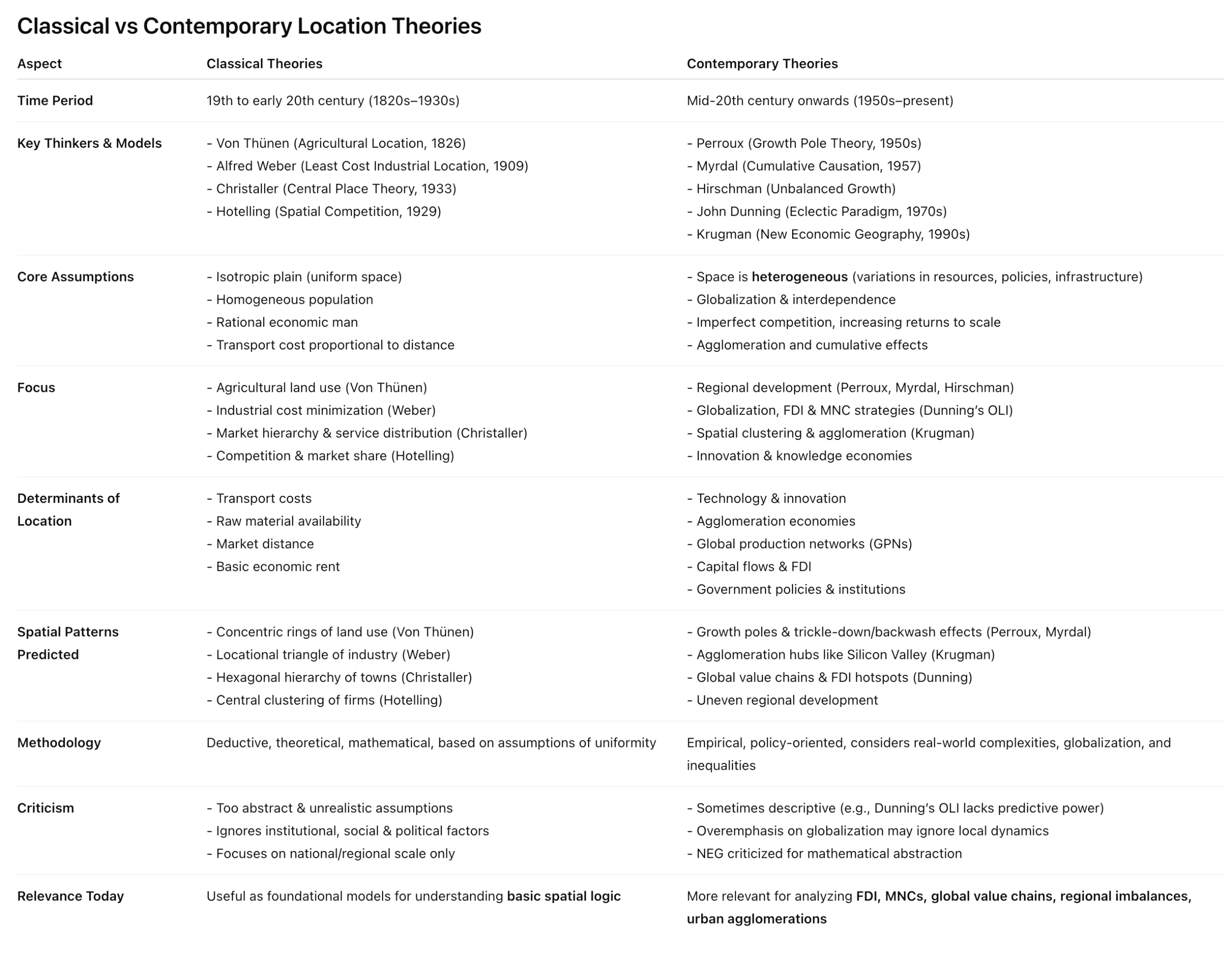
- Industrial and economic activities are unevenly distributed across space. Location theories explain the geographic distribution of economic activities and the rationale behind the location choices of firms and individuals.
- To explain why industries are located where they are, geographers and economists have developed several location theories, broadly categorized as classical and contemporary.
- While classical theories were developed with simpler assumptions to explain industrial patterns, contemporary theories incorporate technological advancements and behavioral factors to provide a more realistic and complex understanding of modern spatial patterns.
Classical Location Theories

- Classical theories were developed during the 19th and early 20th centuries, when industrialization, transport costs, and raw material availability were the dominant concerns.
- They focus on cost minimization, profit maximization, and distance-decay principles.
- They typically assume a uniform (isotropic) plane with perfectly rational, profit-maximizing actors and perfect information.
Von Thünen’s Agricultural Location Theory (1826)
- Von Thünen, a German economist, was the first to link agricultural land use with market distance and transport costs.
- He imagined an “Isolated State” — a uniform plain with a single central market and no external influences. Farmers in this state used a single form of transport (e.g., horse-drawn carts), and costs increased proportionally with distance from the market.
- The core idea was that farmers aim to maximize profits, and profit (or “locational rent”) depends on the balance between the market price of produce and the combined production and transport costs. The outcome, he argued, was a series of concentric land-use rings around the central city:
- The first ring, nearest to the market, contained dairy farming and market gardening—activities producing highly perishable and high-value goods.
- The second ring was devoted to firewood and timber, bulky commodities that were costly to transport.
- The middle rings produced cereals and field crops, which are less perishable and lighter relative to their value.
- The outermost ring was reserved for extensive livestock ranching, since animals could walk to market on their own.
- Though highly abstract, this model introduced key geographical concepts such as economic rent, distance decay, and the trade-off between land cost and transport cost. Even today, the theory helps explain peri-urban agriculture, vegetable belts around large Indian cities, and the rise of “food miles” debates in sustainable geography.
Alfred Weber’s Industrial Location Theory (1909)
- Alfred Weber extended spatial analysis from farming to industry, developing his famous Least Cost Theory. His central concern was to identify the optimum industrial location where overall costs would be minimized.
- Weber’s model assumes an isotropic plain with fixed positions of raw materials and a single market. Industries, he argued, are influenced by three main factors:
- Transport Costs – Industries locate either near raw materials (in case of “weight-losing industries” such as steel, where bulky ore and coal lose weight in processing) or near markets (in case of “weight-gaining industries” like soft-drink bottling, where water is added close to the consumer base).
- Labour Costs – If cheaper labour is available in a different location, industries may shift there, provided the savings outweigh the increased transport costs. This explains the migration of textile industries from developed to developing countries such as Vietnam and Bangladesh.
- Agglomeration Economies – Firms often cluster together to share skilled labour, infrastructure, and services. Examples include Detroit for automobiles or Silicon Valley for IT.
- Weber’s theory was revolutionary because it moved beyond transport to include labour and agglomeration, thereby foreshadowing modern supply chain analysis. While critics argue that it ignores demand, government policy, and technological change, it still provides a useful framework for analyzing industrial shifts—such as why India’s steel plants are near mineral belts or why IT clusters thrive in Bengaluru.
Walter Christaller’s Central Place Theory (1933)
- Christaller, a German geographer, turned his attention to the distribution and hierarchy of settlements. His Central Place Theory (CPT) explained why towns and cities develop where they do, and how they interact with their surrounding hinterlands.
- He assumed an isotropic plain with evenly spread population and resources. According to Christaller, settlements (or “central places”) exist to provide goods and services. Their distribution is shaped by two factors:
- Threshold – the minimum population required to support a good or service. Low-order goods like bread need small thresholds, while high-order services like specialized hospitals need large populations.
- Range – the maximum distance consumers are willing to travel for a service. Daily needs like milk have a short range, while luxury goods like cars have a long range.
- Christaller demonstrated that settlements organize in a hexagonal pattern, the most efficient way of covering space without overlaps or gaps. Within this framework, settlements form a hierarchy, where small towns provide everyday goods and services, while larger cities offer specialized, high-order functions.
- Three principles were proposed:
- Marketing principle (K=3) – optimizes consumer coverage.
- Transport principle (K=4) – optimizes transport efficiency.
- Administrative principle (K=7) – optimizes political and administrative control.
- Despite its rigid assumptions, CPT remains highly influential, forming the basis of urban planning, retail location studies, and rural service provision. In India, it explains the hierarchy of settlements from villages to metro cities and is applied in planning service centers in rural development schemes.
Harold Hotelling’s Model of Spatial Competition (1929)
- Hotelling introduced the role of competition into location theory, using the example of two ice-cream vendors on a beach.
- He assumed a straight-line market with consumers evenly distributed along it. Since consumers always buy from the nearest vendor to minimize travel costs, each vendor continually shifts towards the center to capture a larger market share. Eventually, both vendors cluster together in the middle—this is known as the “principle of minimum differentiation.”
- The model highlighted that firms often do not spread evenly across space but cluster in central locations, even if this raises total travel costs for consumers.
- This insight has wide applications:
- Clustering of petrol pumps along highways.
- Car showrooms concentrated in one locality (e.g., Delhi’s Mathura Road).
- Political parties adopting centrist policies to attract the “median voter.”
- Hotelling’s model remains important in game theory and market geography, showing how competition drives spatial choices.
Contemporary Location Theories
- Contemporary location theories evolved to address the limitations of classical models, which were based on idealized, simplistic assumptions.
- These modern theories incorporate the complexities of globalization, technological change, and human behavior to provide a more realistic explanation of why economic activities are located where they are.
- Contemporary location theories represent a paradigm shift from simple cost-distance models to multi-dimensional frameworks incorporating:
- Profit maximization (Lösch).
- Regional growth drivers (Perroux).
- Connectivity and flows (Network models).
- Human psychology (Behavioral theories).
- State policies (Institutional approaches).
- Global inequalities (World Systems).
- Agglomeration and scale economies (Krugman’s NEG).
August Lösch’s Profit Maximization Model (1940)
- Lösch extended and modified Christaller’s Central Place Theory. While Christaller emphasized service coverage and settlement hierarchy, Lösch focused on profitability and demand-driven patterns.
- Core Principles:
- Firms aim to maximize profits, not merely minimize costs.
- Market areas are determined by the interaction of demand, price, and transport costs.
- Instead of neat concentric rings or rigid hierarchies, Lösch predicted overlapping hexagonal market zones for different goods and services.
- Features:
- Each commodity has its own threshold demand and range of supply.
- Different industries create a complex mosaic of market areas.
- Larger centers emerge where multiple profit zones overlap.
- Example:
- Automobile clusters in Germany (Stuttgart, Munich) thrive due to high purchasing power and overlapping markets for related industries (components, finance, R&D).
- In India, the NCR (National Capital Region) acts as a profit-maximizing zone for industries ranging from automobiles (Gurugram, Manesar) to electronics and consumer goods.
- Contribution: Lösch brought a demand and profit perspective, making location theory more aligned with real-world business strategies.
Perroux’s Growth Pole Theory (1950s)
- François Perroux (French economist) proposed this theory in the post-war period to explain uneven regional development.
- Core Idea:
- Growth does not occur uniformly across space but around “growth poles”—dynamic industries or sectors with strong forward and backward linkages.
- Growth poles attract investment, create multiplier effects, and stimulate surrounding industries.
- Spatial Impact:
- Development radiates outward in a polarized pattern, creating prosperous core regions surrounded by lagging peripheries.
- Growth is sector-led (e.g., steel, IT, petrochemicals).
- Examples:
- Silicon Valley (USA): ICT as a growth pole attracting electronics, software, and venture capital.
- Jamshedpur (India): Steel industry acting as a nucleus for engineering, cement, and transport industries.
- Detroit (USA, early 20th century): Automobile industry as a growth pole shaping the Midwest economy.
- Criticism:
- Can widen regional inequalities, concentrating growth in a few “poles” while leaving hinterlands underdeveloped.
- Contribution: The theory influenced regional planning strategies (e.g., India’s industrial corridors, French regional planning, Brazilian industrial hubs).
Network and Flow Models (1960s–70s onwards)
- By the late 20th century, globalization and transport revolutions shifted attention from point locations to flows of goods, people, and capital.
- Core Idea:
- Economic geography is increasingly shaped by networks of transport, communication, and trade.
- Locations gain importance not only by proximity to resources but also by their position in global and regional networks.
- Applications:
- Airline hub-and-spoke systems: Dubai, Singapore, and Atlanta have become global aviation hubs due to connectivity.
- Shipping and logistics hubs: Rotterdam, Hong Kong, and Singapore dominate as central nodes in global trade.
- Financial networks: New York, London, Tokyo function as global financial nodes, not because of local raw materials but due to network centrality.
- Significance: Anticipated global supply chains, e-commerce flows, and logistics-based competition.
Behavioral Location Theory (1960s–70s)
- Developed as a reaction to overly rational assumptions of classical models. Inspired by Herbert Simon’s concept of bounded rationality.
- Core Idea:
- Location decisions are influenced by human perceptions, imperfect knowledge, cultural values, inertia, and personal preferences.
- Firms may not choose the mathematically “best” location but the one they perceive as less risky or more familiar.
- Examples:
- Family-owned businesses often expand in their home regions despite higher costs (e.g., Maruti Suzuki sticking to NCR despite congestion).
- Multinationals like Toyota and Honda initially preferred coastal Japan due to cultural familiarity and workforce loyalty, even when inland areas offered lower costs.
- Significance: Adds a psychological and cultural dimension to location theory, especially important in studying small-scale firms and local entrepreneurs.
Institutional and Policy Approaches
- Governments and institutions actively shape industrial locations through planning, regulations, and incentives.
- Instruments of Influence:
- Tax concessions, subsidies, cheap land, infrastructure (e.g., Special Economic Zones in India, Export Processing Zones in China).
- State-led industrialization (e.g., Soviet Union’s planned cities like Magnitogorsk).
- Regional balancing policies (e.g., India’s backward area development programs, Brazil’s Manaus Free Trade Zone).
- Examples:
- Shenzhen (China): Transformed from a fishing village to a global electronics hub due to SEZ policies.
- Hyderabad (India): Developed into a pharma and IT hub due to government investments in HITEC City and biotech parks.
- Contribution: Recognized the state as an active agent, not just a background actor.
World Systems Theory (Wallerstein, 1970s)
- Immanuel Wallerstein developed this theory to explain industrial location within the political economy of globalization.
- Core Idea:
- The world economy is structured into a core–periphery hierarchy.
- Core nations (USA, Western Europe, Japan) dominate advanced industries, R&D, and finance.
- Semi-periphery nations (China, Brazil, India, Mexico) specialize in mid-level manufacturing.
- Periphery nations (Sub-Saharan Africa, parts of Latin America) remain dependent on raw material and low-wage labor.
- Examples:
- Shifting textile industries from UK → Japan → China → Bangladesh illustrates this global restructuring.
- Electronics: high-value R&D in the USA and Japan, assembly in East Asia, and raw materials from Africa (e.g., coltan from Congo for smartphones).
- Contribution: Showed how industrial geography reflects global inequalities, dependency, and neo-colonialism.
Eclectic Paradigm (Dunning’s OLI Model)
- In the era of globalization, industrial location cannot be understood merely through classical theories focusing on transport costs or market size. The rise of Multinational Corporations (MNCs) and their Foreign Direct Investment (FDI) decisions demand a broader framework.
- The Eclectic Paradigm, also known as the OLI Model, was proposed by John H. Dunning in the 1970s to explain why and where firms internationalize their operations. It integrates insights from trade theory, industrial organization, and location theory.
- Core Idea: According to Dunning, an MNC will invest abroad only if it simultaneously possesses three sets of advantages:
- Ownership-Specific Advantages (O)
- These are unique assets or capabilities that give the firm a competitive edge over local competitors.
- Examples: strong brand reputation, patents and proprietary technologies, efficient managerial expertise, global supply chain networks.
- Illustration: Apple’s brand value and proprietary design technology allow it to compete effectively even in foreign markets.
- Location-Specific Advantages (L)
- These refer to the attractiveness of a host country as a production or investment site.
- Factors include: natural resource endowments, cheap and skilled labor, access to large consumer markets, political stability, favorable tax and trade policies, and infrastructure.
- Illustration: Vietnam and Bangladesh attract textile industries due to abundant low-cost labor; India attracts IT and back-office outsourcing due to skilled English-speaking manpower.
- Internalization Advantages (I)
- These reflect the benefits of internalizing foreign operations rather than outsourcing or licensing.
- By retaining direct control, firms can protect their proprietary knowledge, maintain quality standards, reduce transaction costs, and safeguard their global reputation.
- Illustration: Toyota prefers wholly-owned subsidiaries over licensing to ensure strict quality control in global car manufacturing.
- Ownership-Specific Advantages (O)
- The OLI Framework in Action:
- An MNC will choose exporting if only ownership advantages exist.
- It will prefer licensing/joint ventures if ownership and location advantages are present but not internalization advantages.
- It will undertake FDI (direct investment abroad) when all three (O+L+I) advantages are fulfilled.
- Examples:
- Technology Industry (Apple, Microsoft, Google):
- Ownership: Proprietary software, strong brand equity.
- Location: Large markets in Asia (China, India), access to skilled engineers.
- Internalization: Direct subsidiaries to protect intellectual property.
- Automobile Industry (Toyota, Volkswagen, Hyundai):
- Ownership: R&D strength, global reputation, efficient production systems.
- Location: India, Mexico, and Eastern Europe offer cost advantages and market access.
- Internalization: Own plants instead of licensing to control design and quality.
- Pharmaceutical Industry (Pfizer, Novartis):
- Ownership: Patents, advanced biotech R&D.
- Location: Clinical research and generic production in India due to cheap skilled labor.
- Internalization: Controlled subsidiaries to safeguard intellectual property rights.
- Technology Industry (Apple, Microsoft, Google):
- Significance in Economic Geography:
- Moves beyond transport and cost-based theories to incorporate global capital flows.
- Explains FDI patterns and why industries shift to developing countries while headquarters remain in developed countries.
- Provides insight into the creation of global production networks (GPNs) and global value chains (GVCs).
- Demonstrates the role of state policies (tax incentives, SEZs, liberalization) in attracting foreign industries.
Krugman’s New Economic Geography (1990s)
- Nobel laureate Paul Krugman integrated trade theory, economies of scale, and spatial analysis into what is known as New Economic Geography (NEG).
- Core Idea: Industrial clusters emerge due to the interaction of:
- Increasing returns to scale: Large firms reduce costs as they grow.
- Transport costs: Firms cluster near markets to minimize distribution costs.
- Circular causation: Industries attract workers → workers create demand → more industries come in → reinforcing clusters.
- Outcomes:
- Agglomeration economies: Clusters of industries (e.g., Silicon Valley, Bengaluru IT hub) become self-reinforcing.
- Regional inequalities: Core regions grow faster, while peripheries lag behind.
- Examples:
- USA: Silicon Valley as a high-tech hub.
- India: Bengaluru and Hyderabad for IT; Jamshedpur for steel.
- China: Pearl River Delta and Yangtze River Delta as mega-clusters.
- Contribution: Provided a rigorous economic explanation for industrial clustering and globalization-driven spatial disparities.