- Climatology is the science of climate: the study of the long-term state of the atmosphere, its spatial patterns, the processes that produce them, and their changes and uses.
- The word comes from the Greek klima (inclination, that is, of the Sun’s rays) and logos (study).
- It is the geographical sister of meteorology:
- Meteorology explains the physics of the atmosphere and forecasts day-to-day weather.
- Climatology generalises weather over decades and asks where and why climates differ.
- In Geography Optional, climatology forms a core unit of Paper I (Physical Geography). Its ideas run through the Indian climate and monsoon in Paper II and through environmental geography.
Weather and Climate
| Basis | Weather | Climate |
|---|---|---|
| Meaning | State of the atmosphere at a place at a given moment | Average and extremes of weather over a long period |
| Time span | Hours to days | 30 years or more: the WMO’s standard climatic normal, now 1991–2020 |
| Area | Local, changes over short distances | Regional to global |
| Variability | Changes constantly | Stable over decades, but changes over long periods |
| Studied by | Meteorology | Climatology |
| Example | A heatwave over Delhi this week | Delhi’s hot, semi-arid climate with a summer monsoon |
- Climate is therefore not just an average: it includes variability, seasonality and the frequency of extremes, such as cyclone tracks and drought return periods.
Elements of Weather and Climate
- Temperature
- Air pressure
- Wind (speed and direction)
- Humidity
- Clouds
- Precipitation
- Sunshine and solar radiation
- Visibility
- Pressure and wind act as the links: they move heat and moisture and so control the temperature and precipitation that define climatic types.
Controls of Climate
- Latitude: sets the angle of the Sun’s rays and day length, hence insolation. Temperature falls poleward, from the temperature belts of the torrid zone to the frigid zones.
- Altitude: temperature falls about 6.5 °C per km, so Shimla and Ooty are far cooler than the plains at their latitude.
- Distribution of land and water:
- Water heats and cools slowly, so coasts have maritime climates and interiors continental ones.
- Mumbai has a small annual range of temperature; Delhi has a large one.
- Ocean currents: warm currents warm the coasts they wash (north-west Europe), while cold currents chill them and create coastal deserts (Atacama, Namib).
- Pressure belts and winds:
- Pressure belts and the planetary winds carry heat and moisture.
- Onshore winds bring rain and offshore winds bring dryness.
- Mountain barriers:
- The Himalaya shields India from Central Asian cold.
- The Western Ghats produce heavy windward rain and a rain-shadow on the Deccan.
- Air masses, fronts and storms: cyclones and western disturbances bring much of the variability of weather.
- Local factors:
- slope aspect
- soil and vegetation
- cities, which create heat islands
Branches and Scales
- Physical (thermal) climatology: energy and heat exchanges.
- Dynamic climatology: atmospheric motion and circulation.
- Synoptic climatology: weather types and pressure patterns.
- Regional climatology: classification and description of climatic regions.
- Applied climatology: climate for agriculture, health, buildings, cities.
- Palaeoclimatology: past climates.
- Scales:
- microclimate: a field, street or slope
- mesoclimate: a valley or city
- macroclimate: a region or continent
The Climate System
- Climate is produced by the interaction of five components:
- the atmosphere
- the hydrosphere (oceans, lakes)
- the cryosphere (ice and snow)
- the lithosphere (land surface)
- the biosphere (plants, animals, humans)
- Energy from the Sun drives the system; exchanges of heat, water and carbon among the components create feedbacks, which explain both variability (El Niño) and long-term climatic change.
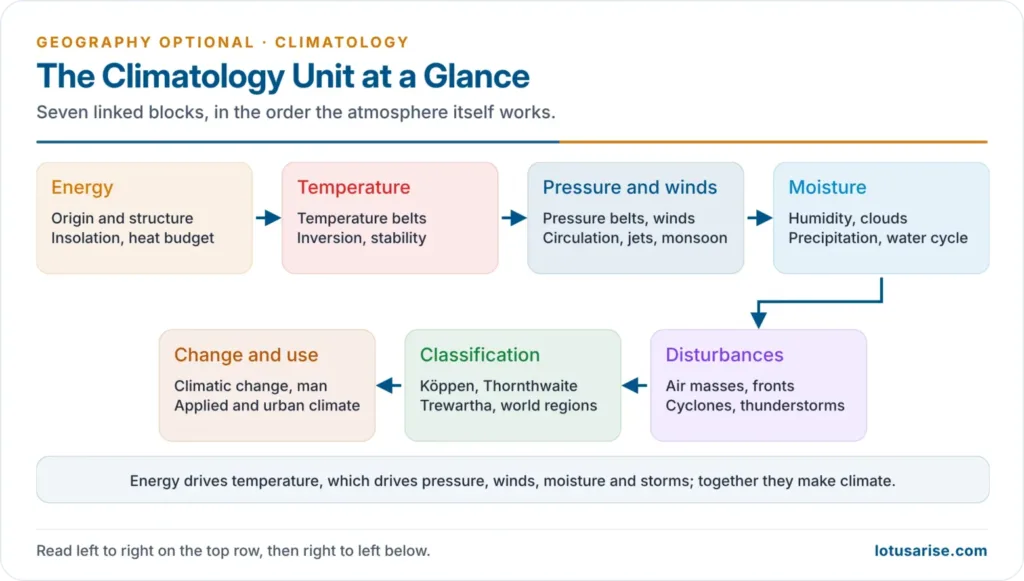
The Climatology Unit at a Glance
- The UPSC syllabus lists:
- temperature and pressure belts; heat budget; atmospheric circulation; stability and instability
- planetary and local winds; monsoons and jet streams
- air masses and frontogenesis; temperate and tropical cyclones
- types and distribution of precipitation; weather and climate
- Köppen’s, Thornthwaite’s and Trewartha’s classifications; hydrological cycle
- global climatic change and the role and response of man; applied climatology and urban climate
- The topics below follow the logical order of study: energy → temperature → pressure and wind → moisture → disturbances → classification → change and application.
The Atmosphere and Its Energy
- Origin of the atmosphere:
- The atmosphere evolved from a primordial hydrogen–helium envelope, through volcanic outgassing, to an oxygen-rich air built by photosynthesis.
- Composition and structure:
- Nitrogen, oxygen, argon and the variable gases (water vapour, CO2, ozone) make up the air.
- The atmosphere is layered into the troposphere, stratosphere, mesosphere and thermosphere.
- Heat budget:
- Incoming insolation is balanced by outgoing terrestrial radiation in the heat budget of the Earth.
- A tropical surplus and polar deficit drive the winds and ocean currents.
- Aurora: the polar lights mark the meeting of the solar wind with the upper atmosphere.
Temperature
- Temperature belts: world temperature depends on latitude, land and sea, currents and relief, shown by isotherms and annual ranges.
- Temperature inversion: layers where temperature rises with height trap fog, frost and smog.
- Stability and instability: comparing lapse rates decides whether air rises into clouds and storms or stays stable.
Pressure, Winds and Circulation
- Pressure belts: the pressure belts are the equatorial low, subtropical highs, subpolar lows and polar highs, which shift with the Sun.
- Forces and winds:
- The pressure gradient, Coriolis force and friction shape the winds.
- Winds are classed as planetary, periodic and local, such as the loo, foehn and mistral.
- General circulation: the Hadley, Ferrel and polar cells and Rossby waves move heat poleward.
- Jet streams: fast upper-air westerly and easterly jets steer storms and influence the monsoon.
- Monsoons:
- Monsoons are explained by thermal, dynamic, jet-stream and ENSO theories.
- The Indian monsoon is the classic case.
Moisture and Precipitation
- Humidity, evaporation and condensation: humidity is measured as absolute, relative or specific; condensation produces dew, frost, fog and clouds.
- Clouds: high, middle and low cloud types, and clouds of vertical development such as cumulonimbus.
- Precipitation:
- Raindrops form by the Bergeron ice-crystal and collision–coalescence processes.
- Rain is convectional, orographic or cyclonic, and its world distribution follows from these causes.
- Hydrological cycle: water circulates among ocean, air, land and ice.
Air Masses, Fronts and Storms
- Air masses: large bodies of uniform air, classified by their source regions (cP, mT and others) and modified as they travel.
- Fronts:
- Fronts are the warm, cold, stationary and occluded boundaries between air masses.
- Frontogenesis and frontolysis describe their birth and decay.
- Cyclones and anticyclones:
- Low- and high-pressure systems have contrasting winds and weather.
- The temperate cyclone forms on the polar front; the tropical cyclone draws on warm seas.
- Thunderstorms and tornadoes: convective storms pass through cumulus, mature and dissipating stages, and violent vortices form within them.
Classification of Climates
- Köppen: an empirical scheme based on vegetation, temperature and rainfall (A, B, C, D, E).
- Thornthwaite: a scheme based on precipitation effectiveness and potential evapotranspiration.
- Trewartha: a modified Köppen scheme that adds a subtropical group and highland climates.
- Climatic regions: the world’s climatic types, from equatorial to tundra, with their vegetation and economy.
Climatic Change and Applied Climatology
- Climatic change:
- Evidence of past climates comes from ice cores, sediments, pollen and tree rings, through the Quaternary glaciations and the Little Ice Age.
- Causes include orbital, solar, volcanic and tectonic factors, greenhouse gases and feedbacks.
- Role and response of man: greenhouse gases and aerosols drive present warming; the response runs through the UNFCCC, Paris and India’s NDCs and missions.
- Applied climatology and urban climate: climate is applied to agriculture, health, comfort and architecture; cities create heat islands, pollution domes and urban rainfall, met by heat action plans.
Previous Year Questions
- No direct PYQ has been asked on this sub-topic yet.