

- The interior of the Earth, from the surface to the centre about 6,371 km down, lies almost entirely beyond direct observation.
- It matters to geomorphology because the endogenetic forces that raise mountains, plateaus and volcanoes originate there.
- The interior can be divided in two ways:
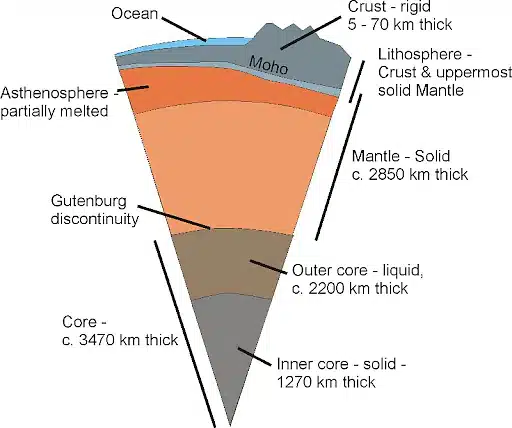
- Chemically (by composition) into the crust, mantle and core, the mantle and core each split into two parts.
- Mechanically (by how the material deforms) into the lithosphere, asthenosphere, mesosphere, outer core and inner core.
- Knowledge of the deep interior comes from indirect evidence, above all seismology.
Sources of Knowledge about the Interior
- The sources fall into direct sources (material that can be seen and sampled) and indirect sources (inferences from physical properties, meteorites, origin theories and earthquake waves).
| Direct sources | Indirect sources |
|---|---|
| Surface rocks | Density, pressure and gravity |
| Mines and boreholes | Temperature with depth |
| Ocean-floor drilling | Meteorites |
| Volcanic material | Theories of the origin of the Earth |
| Magnetic field and seismic waves |
Direct Sources
- Surface rocks show the upper crust, including deep rocks exposed by folding, faulting and erosion.
- Mines and boreholes sample only the outermost few kilometres.
- The Kola Superdeep Borehole (Russia) reached 12,262 m in 1989, still the deepest hole, yet only about 0.2% of the Earth’s radius.
- All confirm that temperature, pressure and density rise with depth.
- Indian example: the Ministry of Earth Sciences has drilled a 3 km pilot borehole in the Koyna–Warna region (Maharashtra), supported by the Borehole Geophysics Research Laboratory, Karad, to study reservoir-triggered earthquakes in situ.
- Ocean drilling samples the thin oceanic crust.
- In 2023 the drill ship JOIDES Resolution recovered a 1,268 m core of mantle peridotite from the Atlantis Massif on the Mid-Atlantic Ridge, where mantle rock is exposed on the sea floor.
- Volcanoes erupt lava and carry xenoliths (fragments of deep rock); kimberlite pipes bring up diamonds from more than 150 km down, as at Majhgawan near Panna (Madhya Pradesh).
- The limitation: the exact depth of origin of volcanic material cannot be fixed.
Indirect Sources
Density, Pressure and Gravity
- The average density of the Earth is about 5.5 g/cm³, while surface rocks average only 2.6–3.0 g/cm³, so the interior must be far denser.
- Henry Cavendish (1798) first estimated it from Newton’s law of gravitation (5.48); satellite measurements give about 5.51.
- Early workers explained the dense interior by the pressure of the overlying load (superincumbent load).
- This fails because every rock has a limit beyond which pressure cannot raise its density.
- Hence the core must be made of intrinsically heavy metal, mainly iron and nickel, a view supported by the Earth’s magnetic field and by iron meteorites.
- Gravity anomalies reveal uneven distribution of mass below; satellites now map them continuously.
- Indian example: the Indian Ocean Geoid Low, south of the Indian peninsula, where sea level is depressed by more than 100 m; a 2023 Indian Institute of Science study linked it to hot mantle plumes rising from the deep mantle anomaly beneath Africa, set off by the sinking Tethys ocean floor about 20 million years ago.
Temperature with Depth
- Mines and boreholes show temperature rising by about 2–3 °C per 100 m (20–30 °C per km) near the surface: the geothermal gradient.
- It varies with setting: about 1,000 °C at 43 km in active areas such as the Basin and Range Province (USA), against about 500 °C at 40 km in stable shields.
- Indian example: high heat flow feeds the hot-spring fields of Puga (Ladakh), Tattapani (Chhattisgarh) and Manikaran (Himachal Pradesh).
- The gradient cannot continue unchanged: extended to 2,900 km it would give about 25,000 °C, and most of the Earth would be molten.
- It falls off with depth because radioactive elements are concentrated in the crust.
- Pressure raises the melting point, so most of the hot interior stays solid.
- Magma forms where pressure is released along faults or at spreading ridges (decompression melting), so volcanoes do not prove a molten layer beneath the crust.
- Sources of internal heat:
- Radioactive decay of uranium, thorium and potassium.
- Primordial heat from accretion, compression and the sinking of molten iron into the core about 4.5 billion years ago, which separated crust, mantle and core.
- The two contribute roughly equally to today’s heat flow.
- Transfer of heat:
- Conduction is too slow: rocks conduct poorly, and heat from 400 km depth would not yet have reached the surface.
- Radiation is ineffective because deep minerals are opaque.
- Convection of hot, slowly creeping solid mantle is the main carrier and drives plate motion.
- The internal heat engine builds relief; solar energy drives the exogenic processes that wear it down.
| Depth | Boundary or zone | Approximate temperature |
|---|---|---|
| 0–40 km | Continental crust | Surface to 500–1,000 °C |
| ~100 km | Base of lithosphere | ~1,100–1,300 °C |
| 410–660 km | Mantle transition zone | ~1,500–1,900 °C |
| 2,900 km | Core–mantle boundary | ~3,500–4,000 °C |
| 6,371 km | Centre | ~5,000–6,000 °C |
Meteorites
- Meteorites formed from the same solar nebula as the Earth, so they indicate its bulk composition.
- Stony chondrites resemble the silicate mantle; iron meteorites (iron–nickel) resemble the core.
Theories of the Origin of the Earth
- Each origin theory implies a different state for the interior:
- The planetesimal hypothesis (accretion of solid particles) implies a solid core.
- The tidal hypothesis (material pulled from the Sun) implies a liquid core.
- The nebular hypothesis of Pierre-Simon Laplace (1796) implies a gaseous core.
- A gaseous core was argued in the nineteenth century but is rejected; the question of solid versus liquid was settled only by seismology.
Seismology
- Seismology is the only source of authentic evidence on the deep interior: earthquake waves recorded by seismographs change speed and direction wherever density and rigidity change.
- P waves (compressional) pass through solids and liquids; S waves (shear) cannot pass through liquids; surface (L) waves stay near the surface.
- Earthquake foci lie at most about 700 km deep.
- Curved paths: waves follow paths concave towards the surface, which proves that density increases with depth and the Earth is not homogeneous.
- Shadow zones: S waves vanish beyond about 103° from the epicentre, and P waves are bent to leave a gap between about 103° and 142°.
- Richard Dixon Oldham (1906) read this as evidence of a core; its liquid outer part follows from the missing S waves.
- Wave sets: early seismologists separated three sets of waves of different speeds, revealing layers in the crust.
| Wave set | P / S velocity (km/s) | Identified by | Layer inferred |
|---|---|---|---|
| Pg–Sg | ~5.4 / 3.3 | Andrija Mohorovičić, 1909 Kupa Valley (Croatia) earthquake | Upper granitic crust, density ~2.7 |
| P*–S* | ~6–7 / 3–4 | Victor Conrad, 1923 Tauern (Austria) earthquake | Intermediate (basaltic) layer, density ~3.0 |
| Pn–Sn | ~7.8–8.1 / 4.5 | Mohorovičić, 1909 | Upper mantle (peridotite, dunite) |
- The rock of the intermediate layer was debated: Reginald Aldworth Daly and Harold Jeffreys proposed glassy basalt, Alfred Wegener and Arthur Holmes amphibolite; most workers settled on basalt.
Classical Views on the Layering of the Earth
Eduard Suess: Sial, Sima and Nife
- Eduard Suess divided the Earth below a thin sedimentary cover into three chemical zones:
- Sial (silica + aluminium): granitic, acidic, density about 2.7–2.9; forms the continents.
- Sima (silica + magnesium): basaltic, basic, rich in silicates of magnesium, calcium and iron, density about 2.9–4.7; underlies the oceans and was thought to supply magma.
- Nife (nickel + iron, ferrum): the heavy metallic core, density about 11, whose iron also explains the Earth’s magnetism.
- Evaluation: the terms survive as shorthand for felsic continental and mafic oceanic crust, but the scheme is obsolete: its thicknesses were guesses, and the mantle is solid peridotite, not a molten basaltic sima.
Other Classical Schemes
| Scheme | Layers | Key figures |
|---|---|---|
| Reginald Aldworth Daly | Outer silicate zone; intermediate iron–silicate zone; central iron zone (solid) | Thickness 1,600 km and 1,280 km; core diameter 7,040 km; densities 3.0, 4.5–9, 11.6 |
| Harold Jeffreys | Sedimentary layer; granite; tachylyte (glassy basalt) or diorite; dunite, peridotite or eclogite | Four layers from seismic velocities |
| Arthur Holmes | Crust (all of sial + upper sima); substratum (lower sima) | Sial under continents 15–30 km, from heat, L-wave, P-wave and geosyncline evidence |
| W. A. J. M. van Waterschoot van der Gracht | Outer sialic crust; inner silicate mantle; mixed metal–silicate zone; metallic nucleus | 0–60 km (20 km under the Atlantic, absent under the Pacific); 60–1,140 km; 1,140–2,900 km; 2,900–6,371 km; densities 2.75–2.9 to 11 |
| Generalised classical view | Lithosphere; pyrosphere; barysphere | ~100 km granitic; ~2,780 km basaltic (density ~5.6); iron–nickel (8–11) |
- Evaluation: these schemes disagree on the number, depth and density of layers because they rested on few seismic records; Holmes’s thin sial and van der Gracht’s missing sial under the Pacific came closest to today’s thin, patchy continental crust.
Modern Structure of the Earth’s Interior
- Wave velocities and travel paths from earthquakes and explosions reveal three concentric zones, crust, mantle and core, separated by sharp boundaries called discontinuities.
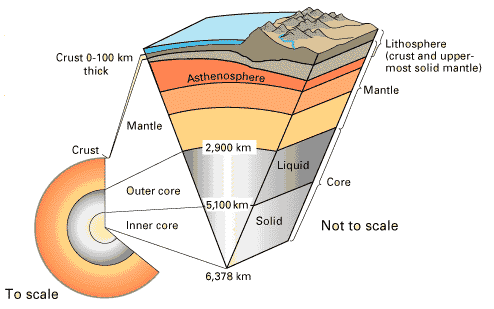
| Layer | Depth (km) | Density (g/cm³) | State | Share of volume / mass |
|---|---|---|---|---|
| Crust | 0 to 5–70 | 2.7–3.0 | Solid | ~1% / <0.5% |
| Mantle | Moho to 2,900 | 3.3 to ~5.6 | Solid, slowly flowing | ~83% / ~67% |
| Outer core | 2,900–5,150 | ~9.9–12.2 | Liquid | Core together: ~16% / ~32% |
| Inner core | 5,150–6,371 | ~12.8–13.1 | Solid |
Crust
- The crust is the thin, rigid outer shell, with thickness varying sharply between continents and oceans.
| Feature | Continental crust | Oceanic crust |
|---|---|---|
| Thickness | ~35–40 km average; 70 km or more under the Himalaya–Tibet | ~5–10 km (about 7 km average) |
| Rocks | Felsic: granite, gneiss, sediments (sial) | Mafic: basalt, gabbro (sima) |
| Density | ~2.7 | ~3.0 |
| Age | Up to ~4 billion years | Mostly under 200 million years |
- Upper and lower crust: P waves average about 6.1 km/s in the upper crust and 6.9 km/s in the lower crust.
- Density rises from about 2.8 to 3.0, largely because the lower crust’s minerals formed under greater pressure.
- The boundary between them, the Conrad discontinuity, is not found everywhere.
- The Mohorovičić (Moho) discontinuity marks the base of the crust: P-wave speed jumps from about 6.9 to 7.9–8.1 km/s, first recognised by Andrija Mohorovičić (1909).
| Element | Share of crust by weight (%) |
|---|---|
| Oxygen | 46.6 |
| Silicon | 27.7 |
| Aluminium | 8.1 |
| Iron | 5.0 |
| Calcium | 3.6 |
| Sodium | 2.8 |
| Potassium | 2.6 |
| Magnesium | 2.1 |
Mantle
- The mantle extends from the Moho to about 2,900 km. It is less than half the Earth’s radius but holds about 83% of its volume and 67–68% of its mass; mean density about 4.6 g/cm³.
- Composition: iron- and magnesium-rich silicate rock, chiefly peridotite (olivine and pyroxene); by weight about 44% oxygen, 23% magnesium and 21% silicon.
- Subdivisions: an older scheme split the mantle at 1,000 km; the International Union of Geodesy and Geophysics scheme uses three zones:
- Moho to about 200 km, which includes the low-velocity zone (about 100–200 km), where P waves slow to about 7.8 km/s because rock is partially molten.
- 200–700 km, containing the transition zone (410–660 km), where olivine changes to denser crystal forms; ringwoodite from this zone, found in a diamond, holds water.
- 700–2,900 km, the lower mantle; the boundary near 700 km is often called the Repetti discontinuity.
- At the base, the D″ layer and two continent-sized large low-shear-velocity provinces beneath Africa and the Pacific are thought to feed mantle plumes.
- Indian example: the Deccan Traps are linked to the plume now beneath Réunion.
- The mantle is solid but hot enough (about 1,000 °C at the top to 3,500–4,000 °C at the base) to creep and convect, which is expressed at the surface as plate motion.
- Earthquakes as deep as about 700 km occur only in cold subducting slabs.
Lithosphere, Asthenosphere and Mesosphere
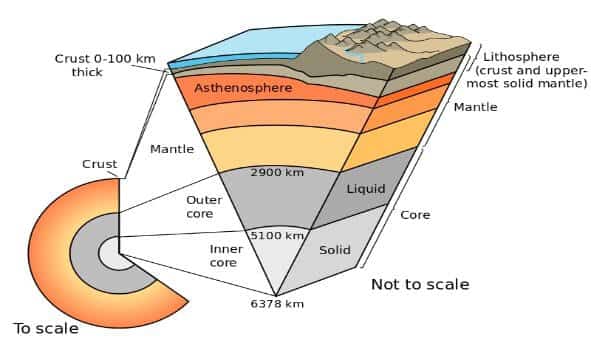
- These are the mechanical layers, defined by strength rather than composition.
- Lithosphere: the crust plus the uppermost mantle, rigid, about 10–200 km thick (thin under mid-ocean ridges, thick under old continental shields); it is broken into the plates of plate tectonics.
- Indian example: the Indian lithosphere is only about 100 km thick, against 180–300 km under South Africa, Australia and Antarctica; this thin root helps explain why India drifted at 18–20 cm a year in the Late Cretaceous before slowing to about 5 cm a year after colliding with Asia.
- Asthenosphere: below the lithosphere, to about 350–400 km, weak and ductile, with a small fraction of melt.
- The rigid plates glide over it, it allows vertical adjustment by isostasy, and partial melting here supplies much basaltic magma.
- Mesosphere: the lower, stronger mantle below the asthenosphere to 2,900 km, stiffened by pressure.
- Surge tectonics (Arthur A. Meyerhoff and colleagues, 1990s) pictured magma surging through channels in the lithosphere, even linked to El Niño; it remains a fringe hypothesis unsupported by seismic imaging.
| Chemical layer | Mechanical layer | Nature |
|---|---|---|
| Crust + uppermost mantle | Lithosphere | Rigid, brittle |
| Upper mantle | Asthenosphere | Weak, ductile, partly molten |
| Rest of mantle | Mesosphere | Solid, strong |
| Outer core | Outer core | Liquid |
| Inner core | Inner core | Solid |
Core
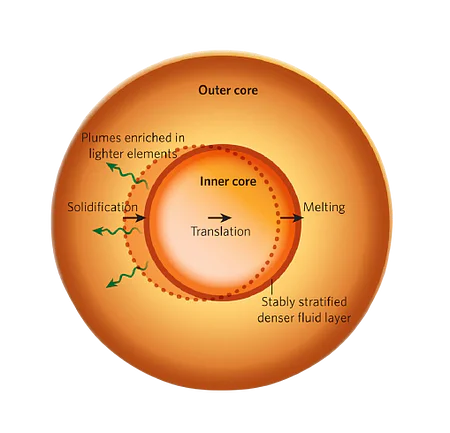
- The core extends from 2,900 km to the centre (6,371 km). It fills only about 16% of the volume but holds about 32% of the mass.
- At the core–mantle boundary, the Gutenberg (Wiechert–Gutenberg) discontinuity, located by Beno Gutenberg (1913), density jumps from about 5.5 to 10 g/cm³, P waves slow abruptly and S waves disappear.
- Composition: mainly iron with nickel (hence NIFE), plus about 10% lighter elements such as sulphur, oxygen, silicon and hydrogen, needed to explain its density.
- Older alternatives, a core of silicates or of hydrogen turned metallic under a pressure of over 3 million atmospheres, are rejected: pressure alone cannot produce such density.
- Mercury, the smallest planet, is among the densest, so a large metallic core, not compression, must explain high density.
Outer Core
- The outer core (about 2,900–5,150 km) is liquid iron–nickel with lighter elements: it does not transmit S waves.
- Its composition is close to the inner core’s, but the pressure is not high enough to keep it solid at its temperature.
- Convection in this liquid metal, organised by the Earth’s rotation (Coriolis effect), generates the magnetic field through the geodynamo.
Inner Core
- The inner core (about 5,150–6,371 km, radius about 1,220 km) is solid, discovered by Inge Lehmann (1936) from P waves reflected at its boundary.
- It stays solid because a pressure of about 3.3–3.6 million atmospheres raises the melting point above its temperature of roughly 5,000–6,000 °C.
- P waves cross it at about 11 km/s; P waves converted into S waves at its boundary confirm its rigidity.
- It is far too hot to hold a permanent magnetism (above the Curie point).
- It grows slowly as iron freezes out, and the released heat and light elements help drive outer-core convection.
- Recent findings:
- An innermost inner core of about 650 km radius, with a distinct crystal alignment, was identified in 2023 by Thanh-Son Phạm and Hrvoje Tkalčić from seismic waves bouncing up to five times through the centre.
- The inner core was long thought to rotate slightly faster than the mantle; repeating earthquakes show it slowed from about 2010 and now moves slightly slower than the mantle, changing day length by only about a thousandth of a second.
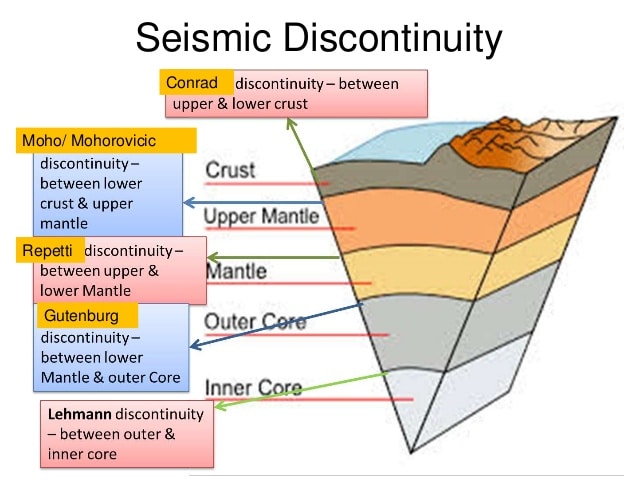
Seismic Discontinuities
- A discontinuity is a sharp boundary where seismic waves change speed and direction.
| Discontinuity | Depth | Separates |
|---|---|---|
| Conrad | ~15–20 km (continents only) | Upper and lower crust |
| Mohorovičić (Moho) | ~5–10 km (oceans), ~35 km (continents), 70 km+ (Himalaya) | Crust and mantle |
| Repetti | ~700 km | Upper and lower mantle |
| Gutenberg | ~2,900 km | Mantle and outer core |
| Lehmann | ~5,150 km | Outer and inner core |
Chemical Composition of the Earth
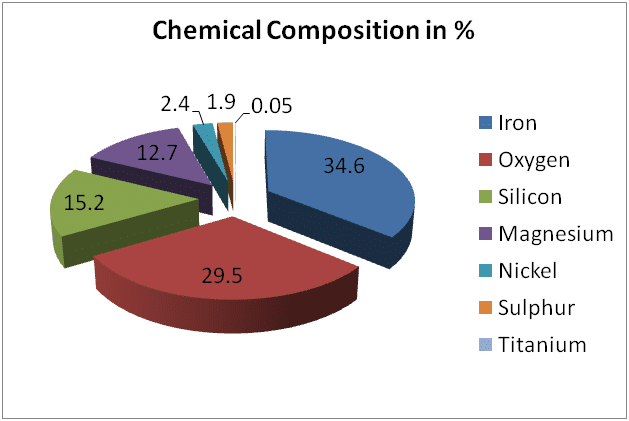
- The Earth’s mass is about 5.97 × 10²⁴ kg; as a whole it is dominated by iron, oxygen, silicon and magnesium (over 90% of mass), because the iron-rich core is so heavy.
| Element | Share of the whole Earth by mass (%) |
|---|---|
| Iron | 32.1 |
| Oxygen | 30.1 |
| Silicon | 15.1 |
| Magnesium | 13.9 |
| Sulphur | 2.9 |
| Nickel | 1.8 |
| Calcium | 1.5 |
| Aluminium | 1.4 |
| Others | 1.2 |
Previous Year Questions
2010Bring out the relevance of seismic study in determining the structure of the interior of the earth.2005Write short note: Role of seismic waves in the study of earth’s interior.





Very helpful for aspirants. Thank you sir…🙏
Sir is this sufficient for GS 1 for geography part
It’s more than enough for static portion keep adding your ca with this and booomm your GS 1 geography covered
Ha
Can after studying your notes is it necessary to read ncert
I would suggest to make the diagrams more legible.
Okay, done
Is it enough notes for geography optional?
A convective material circulation occurs in the mantle as a result of the temperature differential (although solid, the high temperatures within the mantle cause the silicate material to be sufficiently ductile).
can u explain what this line means
A convective material circulation occurs in the mantle as a result of the temperature differential (although solid, the high temperatures within the mantle cause the silicate material to be sufficiently ductile).
The motions of tectonic plates represent the mantle’s convection at the surface.
It is a type of cycle occurring inside in which hotter magma rises up and goes down after cooling in form of cycle
very helpful contents thanks lotus arise team for providing such a splended contents
Thankyou So Much For These Information , It will Help Other Students Also.
Thank you Very helpful