

The Concept of Backwardness

- Backwardness is relative, multi-dimensional, and is based on perception. It differs in time, space, and nature. It also refers to spatial as well as structural disparity. Due to the complexity of backwardness, there is no unanimously accepted definition. Despite the government’s investments in development projects, the free play of market forces favours the polarisation of economic growth at certain favourable locations, which results in regional inequalities in development.
- Relative in Time
- What is considered backward today may not have been backward in the past — or may not be backward in the future. Bengal was advanced before Partition; Singrauli was remote before coal mining. Context and era define the reference point.
- Relative in Space
- Backwardness is always relative to some reference area. A district backward relative to Maharashtra may be advanced relative to Bihar. The reference frame determines who is “backward” and by how much.
- Multi-Dimensional
- Backwardness has economic (low income, unemployment), social (low literacy, high IMR, gender inequality), and physiographic (drought, desert, hill terrain) dimensions — no single indicator captures it fully.
- Relative in Time
- The backwardness of a place and that of the people living there get impacted upon each other. This is so because the people and places are interwoven in symbiotic relationships — a person born in a backward area inherits the constraints of that area; those constraints are simultaneously perpetuated by the collective deprivation of the people. Both must be addressed together for meaningful backward area development.
The Backward Place ↔ Backward People Distinction
- In Indian perception, backwardness is associated with rural areas — but in reality: all backward areas are rural, but all rural areas are not backward. Similarly, the majority of people in a backward area are backward — but all backward people are not found only in backward areas. This implies that in spatial coverage, backward areas and backward people are NOT synonymous. Planning must address both the spatial dimension (backward regions) and the social dimension (backward people in all areas).
- Planning implication: Two distinct strategies are needed:
- Target Area Programmes — for backward regions regardless of who lives there; and
- Target Group Programmes — for backward people regardless of where they live. The
- Fourth Five Year Plan pioneered this two-pronged approach with the recognition that spatial and social backwardness must be addressed simultaneously but through different instruments.
- India is among the few developing nations that have started comprehensive development programmes for their backward areas. Indian planning for area backwardness — growth with justice — is one of the main objectives of planning in India. It promises the promotion of socio-economic upliftment of backward people on one hand, and the development of resource potentials of backward areas on the other. Hence, it involves both social justice and spatial justice. India is a vast country with a variety of landforms and ethnic groups — the interplay of people with the land has brought out different patterns of development.
Identifying Backward Areas — Two Broad Approaches
- There are two broad approaches for operationalising the concept of backwardness:
- 📊 Index-Based Approach
- Relies on an overall composite index for ranking areas. All areas below some cut-off point are treated as backward. Used for identifying industrially backward areas. More quantitative; allows cross-regional comparison; transparent and replicable. Limitation: choice of indicators and weights is subjective; may hide specific problem types within a composite score.
- ⚠️ Problem Area Approach
- Identifies problem areas in different categories by specifying the constraints on development that can only be mitigated by special measures. Used for drought-prone, desert, hill and other geographically specific areas. More qualitative; recognizes structural uniqueness; enables tailored intervention. Limitation: may not allow cross-regional comparison.
- 📊 Index-Based Approach
- India’s Hybrid Strategy:
- In India, both approaches have been adopted — the former (Index-Based) was used for identifying industrially backward areas, while the latter (Problem Area) was used for drought-prone, desert, and hill areas.
- This hybrid reflects the recognition that economic backwardness and physiographic/ ecological backwardness require different diagnostic and intervention frameworks.
Three Criteria for Qualifying as a “Backward Area” for Planning
- The areas identified as backward for the purpose of planning must have three characteristics:
- Potential for development — the area must have unrealised resource potential; purely resource-poor areas may need humanitarian assistance but not development planning per se
- Inhibiting factors preventing them from realising their potential — there must be identifiable structural, geographic, or institutional bottlenecks blocking development
- A need for special programmes to remove the bottlenecks — market forces alone cannot overcome the barriers; public intervention is necessary and justified
Key Committees for Identifying Backward Areas
Committee on Dispersal of Industries (1960)
- First systematic committee to identify backward areas for industrial development. Proposed initial criteria to define industrially backward districts based on absence of industrial activity.
- Recommended dispersal of industries as a tool for backward area development — the forerunner of the growth pole approach for backward regions.
Pande Committee (1968/1969)
- Appointed during the 4th FYP. Emphasized broadly on the percentage of the population engaged in industry and techno-industry parameters (road length, railway length, industry, electricity consumption). Recommended minimizing regional imbalance by establishing industries of all types in backward areas through financial and fiscal incentives.
- Criteria for backward districts:
- District outside a radius of 50 miles from large cities or large industrial projects
- Low per capita income (25% below the state average)
- High density of population in relation to utilization of resources
- Low level of industrial development
- Output: After studying a set of 15 parameters and statistically mapping them, identified 238 districts across India as industrially backward.
Wanchoo Committee
- Proposed fiscal incentives to promote industry in backward areas.
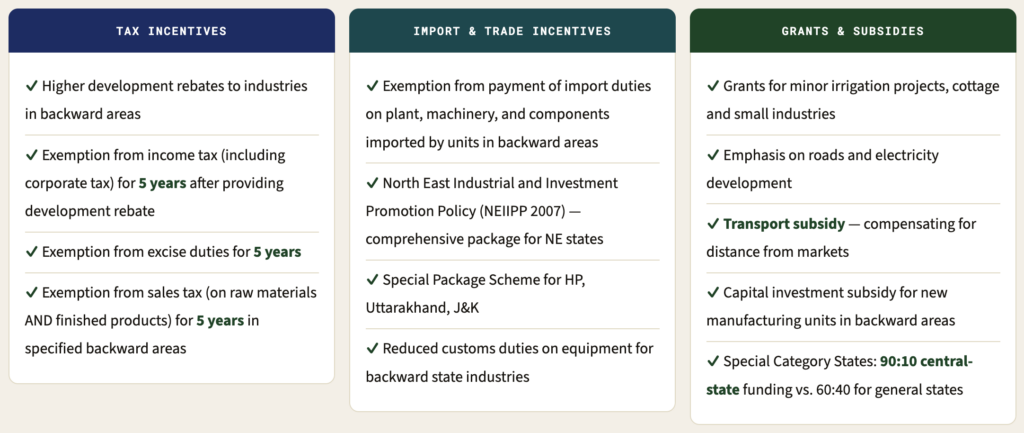
- Recommended a comprehensive package of tax exemptions, development rebates, import duty exemptions, and transport subsidies — forming the basis of India’s fiscal incentive framework for backward area industrial development.
- The Wanchoo Committee’s recommendations were the foundation of the concessional fiscal package.
Chakravarty Committee
- Stressed on the percentage of agricultural population, irrigated areas, net sown area, and literacy for identifying backward areas — emphasizing socio-agricultural criteria rather than purely industrial criteria.
- Provided a more comprehensive, multi-dimensional index of backwardness that incorporated rural livelihood dimensions.
National Committee on Development of Backward Areas (1981)
- Recommended that all hill areas with elevation above 600 metres and not already covered under the Tribal Sub-Plan be treated as Backward Hill Areas.
- This provided a clear physiographic criterion for hill area identification — used for HADP implementation and Special Category State status decisions.
Planning Commission — 100 Most Backward Districts (1997)
- Identified 100 most backward/poorest districts using multi-dimensional composite criteria including: poverty ratio, agricultural productivity, urbanisation level, literacy rate, and infrastructure deficit.
- Basis for the Backward Regions Grant Fund (BRGF) — later expanded to 272 districts.
Raghuram Rajan Committee on Evolving a Composite Development Index (2013)
- Proposed a composite multi-dimensional index of underdevelopment using 10 parameters: per capita consumption expenditure, education outcomes, health outcomes, household amenities, poverty rate, female literacy, SC/ST population share, urbanisation rate, financial inclusion, and connectivity.
- Used to identify the 272 backward districts for BRGF and as the conceptual basis for NITI Aayog’s Aspirational Districts selection.
Geographical Unit and Data Requirements
In the identification and demarcation of backward areas, two conditions are essential:
- The geographical unit needs to be defined (state, district, block, village cluster — the planning unit determines the granularity of targeting).
- Quantitative data for the units on the chosen indicators must be available — data scarcity at sub-district levels is a persistent constraint on micro-level backward area planning in India.
| Planning Unit | Data Availability | Used For | Limitation |
|---|---|---|---|
| State | Excellent — NSDP, HDI, all census data | Special Category Status, Finance Commission devolution | Too broad — masks intra-state disparities (e.g., Vidarbha vs. Mumbai) |
| District | Good — Census, NFHS, DLHS data | BRGF, Aspirational Districts Programme, DPAP, DDP, HADP | India’s standard planning unit; some indicators only available at state level |
| Block / Taluk | Moderate — limited economic data | MADA pockets (tribal), watershed planning, MNREGS targeting | Many economic indicators not available at block level |
| Village / Gram Panchayat | Limited — Village Household Survey, socioeconomic census | Gram Panchayat Development Plans, MGNREGS targeting | Extremely data-poor; planning must rely on participatory assessments |
Types of Backwardness in India
- In a large and diversified country like India, fundamental / physiographic backwardness is the most widespread. Hence, the majority of area development programmes have been launched for the restoration of ecological balances in areas such as drought-prone, desert, and hill areas. Economic backwardness is no less widespread, whereas social backwardness is confined to tribal pockets.
- 🏔️ Physiographic / Ecological Backwardness
- Most widespread. Results from adverse physical geography — aridity (Thar), slope/inaccessibility (Himalayas, NE India), drought-proneness (Deccan, semi-arid zones), flooding (Brahmaputra plains). These conditions constrain agricultural productivity, connectivity, and human settlement patterns.
- 💰 Economic Backwardness
- Widespread — low per capita income, absence of industries, dependence on subsistence agriculture, high unemployment. BIMARU states (Bihar, MP, Rajasthan, UP) exemplify economic backwardness in a non-physiographically constrained setting. Industrial backwardness is addressed through fiscal incentives and growth poles.
- 👥 Social Backwardness
- Confined to tribal pockets. Low literacy, high gender inequality, absence of modern services, cultural isolation. Not synonymous with poverty — many tribal communities are resource-rich but socially backward due to exploitation and historical exclusion. Addressed through Tribal Sub-Plan, Forest Rights Act, PESA.
- 🏔️ Physiographic / Ecological Backwardness
| Type | Primary Indicator | Spatial Pattern | Planning Response |
|---|---|---|---|
| Industrial Backwardness | % population in industry; per capita industrial output | Largest coverage — ~70% of India’s area; 238 districts (Pande) | Fiscal incentives, industrial estates, growth poles |
| Agricultural/Drought-prone | Rainfall deficit, dry spells, soil moisture | 70+ districts across Rajasthan, AP, Karnataka, Maharashtra, MP, Gujarat, Odisha | DPAP — watershed management, soil conservation, water harvesting |
| Desert | Aridity index, sand dune extent, sparse population | Hot arid (Rajasthan 16, Gujarat 2, Haryana 2); Cold arid (Ladakh, Lahaul-Spiti) | DDP — sand dune stabilisation, shelter belts, solar energy |
| Hill Area | Elevation >600m, slope gradient, forest cover | 15 hill districts — Uttarakhand, WB (Darjeeling), Assam (Mikir Hill, N. Cachar), TN (Nilgiri) | HADP — horticulture, animal husbandry, erosion control |
| Tribal | ST population %, literacy rate, land alienation, forest dependence | Central tribal belt (CG, JH, MP, OD) + NE India + scattered pockets | Tribal Sub-Plan (TSP) — ring-fenced funds, ITDPs, PESA |
| Border Areas | Proximity to international border, sparseness, strategic isolation | Smallest coverage — ~5% of India’s area; border districts of J&K, HP, Sikkim, Arunachal, etc. | Border Area Development Programme (7th FYP) |
Evolution of Backward Area Planning in India {Plan-wise}
Development of backward areas was always given emphasis even in the embryonic stage of Indian planning. A large majority of Area Development Programmes were identified during the 3rd and 4th Plans and became operative during the 5th Plan. No such programme came into operation after the 7th Plan. HADP was the first and Border Area Development was the last in the order of identification. Industrially Backward Area Development was the first to come into operation.
| Plan | Backward Area Planning Milestone | Significance |
|---|---|---|
| 1st FYP (1951-56) | Allocations for development of scarcity-prone areas | First acknowledgement of backward area problem; limited and ad hoc |
| 2nd FYP (1956-61) | Large industrial complexes in mineral-rich backward areas (tribal belts of central India — Bhilai, Rourkela, Durgapur) | Growth pole strategy — industries in backward regions as multiplier engines; limited local benefit |
| 3rd FYP (1961-66) | Full chapter on balanced regional development; identification of cement/fertilizer/paper plants for backward regions; Growth Centres & Growth Points | First explicit policy statement on regional balance; HADP conceptualised |
| 4th FYP (1969-74) | Watershed period — two-pronged strategy launched: (a) Target Group (SFDA, MFAL) and (b) Target Area (DPAP, hill, border, drought-prone, industrially backward). Pande Committee’s 238 districts identified | Most important plan for backward area planning framework; conceptual architecture established |
| 5th FYP (1974-79) | Programmes conceived in 4th Plan implemented: CADP, HADP, DDP, Tribal Sub-Plan, DPAP scale-up | Operational phase — all area programmes activated; special area approach mainstreamed |
| 6th FYP (1980-85) | No new backward area programme; existing programmes continued and strengthened | Consolidation period; IRDP national rollout was the major poverty initiative |
| 7th FYP (1985-90) | Border Area Development Programme — last new backward area programme | Strategic dimension of backward area planning; border security integrated with development |
| Post-7th FYP | No new area programmes; focus shifted to convergence, BRGF, Aspirational Districts | Programme multiplication ceased; rationalisation and convergence became the strategy |
| Post-2015 (NITI Aayog) | Aspirational Districts Programme (2018), Aspirational Blocks Programme (2023) | Data-driven, competitive, outcome-focused successor to FYP-era area programmes |
Target Group Programmes — Backward People
Target group programmes focus on specific categories of people rather than geographic areas. Conceived during the 4th Five Year Plan, they addressed the social dimension of backwardness that area programmes alone could not reach:
🌾 Small Farmers Development Agency (SFDA)
- Target Group: Small Farmers
- Conceived: 4th FYP (1969-74)
- Operated: 5th FYP onwards
- Target: Households with landholdings of 2 hectares or less — accounting for 52% of total rural households in India. Small farmers were excluded from the Green Revolution benefits that required irrigation, credit, and market access — assets they lacked. SFDA provided subsidized credit, technical inputs, marketing support, and linkage to institutional credit for this class. It was the first programme in India to systematically recognise that geographic area programmes could not reach the most marginalised within even benefiting regions.
🏚️ Marginal Farmers and Agricultural Labourers Development Agency (MFAL)
- Target Group: Marginal Farmers + Landless Labourers
- Conceived: 4th FYP
- Operated: 5th FYP
- Target: Formed to look after the interests of marginal farmers (those with landholdings below even the small farmer category) and agricultural labourers — the landless poor who depended entirely on wage labour. Provided credit, training, and diversification opportunities (animal husbandry, fishery, sericulture) to reduce dependence on seasonal agricultural labour markets. These are the poorest of India’s rural population — a group that area programmes never directly reached.
🌿 Tribal Sub-Plan (TSP)
- Target Group: Scheduled Tribes
- Launched: 1974-75 (5th FYP)
- Target: Scheduled Tribe (ST) populations in tribal sub-plan areas. Operated through Integrated Tribal Development Projects (ITDPs) and Integrated Tribal Development Agencies (ITDAs).
- The key principle: plan funds must flow to tribal areas in proportion to their population share in the state plan — a ring-fencing mechanism to prevent tribal development funds from being absorbed by non-tribal regions. The Modified Area Development Approach (MADA) addressed smaller tribal pockets with 50%+ ST concentration not covered by ITDPs. The Primitive Tribal Groups (PTGs/PVTGs) — 75 communities — received special conservation-cum-development programmes.
👩 IRDP, DWCRA, and TRYSEM
- Target Groups: BPL Households, Rural Women, Youth
- Launched: 5th–6th FYP
- IRDP (Integrated Rural Development Programme, 1978/1980): Asset transfer and subsidised credit for BPL rural households — most comprehensive rural poverty programme. TRYSEM (Training of Rural Youth for Self-Employment): Skills training for rural youth in backward areas. DWCRA (Development of Women and Children in Rural Areas): Women’s self-help groups for income generation in backward regions — precursor to the SHG-bank linkage model that now reaches 7 crore women through NRLM.
Target Area Programmes — Backward Regions
Target area programmes address geographic regions with specific structural constraints — physiographic, ecological, or infrastructural — that prevent normal market-led development. India’s major area development programmes:
💧 Drought Prone Area Programme (DPAP) — 1973
- Area: Drought-prone Districts
- FYP: 4th (conceived), 5th (operated)
- Duration: 37+ years (longest of all)
- DPAP covers 70+ chronically drought-prone districts across Rajasthan, Gujarat, Maharashtra (Marathwada, Vidarbha), Karnataka, Andhra Pradesh (Rayalaseema), Madhya Pradesh, Odisha, and Uttar Pradesh. Key strategy: Watershed as the unit of intervention. Objectives: providing employment, creating productive assets, restoring ecological balance. Financial arrangement: Shared between Centre and States on 50-50 basis (90-10 for Special Category States). DPAP has completed over 37 years of operation — the longest of all area development programmes.
- Key interventions: Soil and water conservation, afforestation, water harvesting structures (johad, kund, talao), pasture development, groundwater recharge, alternative livelihoods.
- Evolved into: Hariyali (2003) → Integrated Watershed Management Programme/IWMP (2009) — merged DPAP, DDP, and IWDP into a single programme with ₹12,000/ha norm and community participation as mandatory principle.
🌵 Desert Development Programme (DDP) — 1977-78
- Area: Hot & Cold Desert Districts
- Fully Financed: By Centre (100%)
- Covers hot arid districts (Rajasthan 16, Gujarat 2, Haryana 2, J&K 1) and cold arid districts (Ladakh, Lahaul-Spiti, Spiti in HP). Fully financed by the Centre — the most comprehensive central financial commitment of any area programme. Objectives: controlling desertification, restoring ecological balance, providing rural employment, raising income levels.
- Key interventions: Sand dune stabilisation (grass/shrub planting), shelter belts (Prosopis juliflora, Acacia tortilis), oasis development, traditional water harvesting systems (kund, bawdi, naadi), alternative energy (solar, wind), afforestation, horticulture promotion.
🏔️ Hill Area Development Programme (HADP) — 5th FYP (1974-79)
- Area: 15 Hill Districts
- HADP was the FIRST area programme identified
- HADP covers 15 districts: all hilly districts of Uttarakhand (then UP), Mikir Hill and North Cachar Hills of Assam, Darjeeling district (West Bengal), and Nilgiri district (Tamil Nadu). National Committee on Backward Areas (1981) later recommended all hill areas above 600m elevation not covered by Tribal Sub-Plan be treated as Backward Hill Areas.
- Key interventions: Harnessing indigenous resources — horticulture and plantation agriculture (apple, kiwi, temperate fruits), animal husbandry and dairy, poultry, forestry-based industries, small-scale and village industries, road connectivity, erosion control and watershed management.
- Significance: HADP was the first to be identified among all area development programmes in India — reflecting the early recognition of hill areas as structurally disadvantaged regions requiring special planning.
🌊 Command Area Development Programme (CADP) — 1974-75
- Area: Major & Medium Irrigation Command Areas
- Bridges Irrigation Potential-Utilization Gap
- CADP addressed the persistent gap between irrigation potential created and actually utilized in major and medium irrigation schemes. A Command Area Development Authority (CADA) was established for each command area. Key activities: construction of field channels and field drains, land levelling (land shaping), introduction of rotational water supply (warabandi) for equitable distribution to individual farm holdings. Medium and minor irrigation projects launched for drought-affected areas within command zones. Special plans for afforestation, soil conservation, orchards, livestock, dairy farming, road construction, drinking water within command areas.
🛡️ Border Area Development Programme (BADP) — 7th FYP (1985-90)
- Area: Border Districts
- BADP was the LAST area programme identified
- Fully Financed by Centre
- BADP addresses the unique development challenges of border districts — strategic isolation, security challenges, sparse population, inadequate connectivity and basic services. Covers border districts of J&K, HP, Uttarakhand, Sikkim, Arunachal Pradesh, Nagaland, Manipur, Mizoram, Tripura, Meghalaya, Assam, and West Bengal. Smallest areal coverage — approximately 5% of India’s area (vs. industrially backward areas at ~70%).
- Key features: Fully financed by the Centre (100% central share, unlike DPAP’s 50-50 sharing). Focus on infrastructure connectivity, security-compatible development, livelihood enhancement for border communities, preventing infiltration of population to safer interior areas. Oldest programme is 23 years (as per LotusArise data).
⚙️ Industrially Backward Area Development — First to Come into Operation
- Area: 238 Districts (Pande Committee) → Largest Coverage (~70% of India’s area)
- Industrial backwardness was the first area programme to come into operation — reflecting the 2nd FYP’s growth pole strategy of placing industries in backward regions. Based on Pande Committee (1968-69) identification of 238 industrially backward districts. Strategy: fiscal incentives + public sector location + industrial estates.
- Largest areal coverage: Industrial backwardness covers approximately 70% of India’s total area — 17 times larger than border areas (5%). This reflects how pervasive industrial underdevelopment is across India’s geography.
- Industrial estates established in backward areas: Okhla (Delhi), Naini (Allahabad), Rajkot (Gujarat), Guindy and Virudhunagar (TN), Kanpur and Agra (UP), Palghat and Trivandrum (Kerala) — to encourage small-scale industry growth in backward locations.
Fiscal and Other Incentives for Backward Area Development
- Various governments gave numerous fiscal and other incentives for the development of agriculture, industries, transport, and social amenities in backward areas.
- These incentives constitute India’s “market-correction” approach — using public fiscal policy to make backward regions commercially attractive to private investment:
Industrial Estates in Backward Areas
Industrial estates were established in backward areas to encourage the growth of small-scale industries by providing shared infrastructure, reducing individual capital requirements, and creating agglomeration economies even in resource-limited locations:
| Industrial Estate | Location | State | Backward Area Context |
|---|---|---|---|
| Okhla Industrial Estate | Delhi | Delhi | Planned industrial zone to prevent ad hoc urban industrial sprawl; small industries cluster |
| Naini Industrial Estate | Allahabad (Prayagraj) | Uttar Pradesh | Backward region of Uttar Pradesh; agri-processing and light manufacturing |
| Rajkot Industrial Estate | Rajkot | Gujarat | Saurashtra — formerly backward peninsula region; now engineering goods hub |
| Guindy Industrial Estate | Chennai | Tamil Nadu | Light engineering and auto components; served as model for SIPCOT later |
| Virudhunagar Industrial Estate | Virudhunagar | Tamil Nadu | Southern TN backward belt; match industry, textile, fireworks |
| Kanpur Industrial Estate | Kanpur | Uttar Pradesh | Leveraging existing textile/leather base; developing diversified industries |
| Palghat Industrial Estate | Palakkad | Kerala | Inland district — least developed part of Kerala; gateway to TN and Karnataka |
Critical Assessment of Fiscal Incentives: The fiscal incentive approach faces a fundamental paradox: incentives help only those who have the capital and entrepreneurship to invest — precisely the resources most lacking in genuinely backward areas. Tax holidays are irrelevant if a firm makes no profits (or is exempt already). Transport subsidies help large manufacturers but not subsistence farmers. The Wanchoo Committee’s incentive framework benefited primarily small-and-medium enterprises from developed states who relocated or set up branch units in backward areas to capture the benefits — not local entrepreneurs. This is why growth poles (Bhilai, Rourkela) created industrial enclaves rather than transformative regional development.
Contemporary Instruments: BRGF and Aspirational Districts Programme
Backward Regions Grant Fund (BRGF) — 2006–2016
- Launched by the Panchayati Raj Ministry in 2006 to reduce regional imbalances across 272 backward districts in 28 states. BRGF provided untied grants directly to PRIs (Panchayati Raj Institutions), bypassing state government bureaucracy to reach grassroots planning. Based on Raghuram Rajan Committee’s composite index of underdevelopment. Discontinued in 2016 after 10 years due to low utilisation (average 23% fund utilisation) and poor outcomes — subsumed into 14th Finance Commission devolution.
- Why BRGF Failed (SSRN Review)
- A review of BRGF showed that whilst funds were available, the average utilisation across 272 districts was only 23%. Problems: low investment in productive assets, overlapping with other flagship programmes where funds were also available (duplication), non-uniformity in progress, weak PRI capacity to plan and implement, poor monitoring mechanisms. The BRGF experience showed that simply making funds available without institutional capacity building at the local level does not translate into development outcomes — a lesson incorporated into the design of the Aspirational Districts Programme.
Aspirational Districts Programme (ADP) — 2018–Present
- Launched by PM Modi in January 2018, the ADP aims to quickly and effectively transform 112 most under-developed districts across the country (originally 117; West Bengal did not join).
- The core philosophy: shift from “backwardness” to “aspiration” — empowering districts to realise their latent potential through data-driven governance. Anchored by NITI Aayog; states as main drivers.
- Essentially localises Sustainable Development Goals (SDGs) at the district level. Extended in 2023 to the Aspirational Blocks Programme (ABP) targeting the 500 most backward blocks.
The 3Cs Framework
- 🔗 Convergence
- Convergence of Central and State Schemes — 42+ flagship schemes converged for each district’s holistic development. Eliminates duplication; maximizes impact of existing resources. District Collector as integration point.
- 🤝 Collaboration
- Collaboration between Central “Prabhari” Officers (IAS champions), State-level nodal officers, and District Collectors. Knowledge partners (NGOs, technical institutions) deployed to each district. Central team embedded with districts.
- 🏆 Competition
- Monthly delta-ranking of all 112 districts on 49 KPIs published publicly via “Champions of Change” dashboard. Performance-based awards (₹10 crore for top-ranked district). Creates healthy competitive pressure among district administrations.
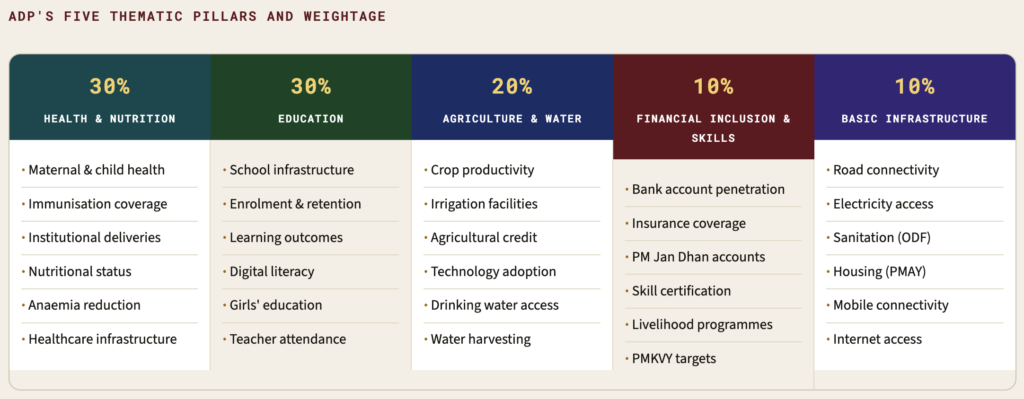
ADP vs. Legacy Programmes — The Key Differences: Earlier area programmes (DPAP, DDP, HADP) were sector-specific, operated through separate ministries, and measured inputs (funds spent) rather than outcomes. ADP is:
- (1) Multi-sectoral — convergence of 42+ schemes;
- (2) Outcome-focused — monthly delta-ranking on actual development indicators;
- (3) Competitive — districts compete with each other, not against a national target;
- (4) Real-time — data updated monthly, not in 5-year plan reports;
- (5) SDG-aligned — localising global sustainability goals at the district level.
Singapore’s President Tharman Shanmugaratnam praised ADP as a globally relevant model.
Key Highlights — Backward Area Planning in India
- India’s uniqueness: India is one of the few developing nations to start comprehensive development programmes for its backward areas. Since inception, development planning has shown concern for regional inequalities — the fourth plan is a landmark in this direction.
- HADP was first, BADP was last: In the order of identification of areas for such programmes — HADP (Hill Area Development Programme) was first and Border Area Development was last. Industrially Backward Area Development was the first to come into operation.
- Most programmes identified in 3rd–4th Plans: A large majority of Area Development Programmes were identified during the 3rd and 4th Plans and became operative during the 5th Plan. No such programme came into operation after the 7th Plan.
- Responsibility shifted to NITI Aayog: The responsibility of implementing area development programmes was with the Planning Commission. After NITI Aayog’s creation, implementation lies with NITI Aayog and respective ministries. Tribal and industrial development programmes are under the administrative control of respective central ministries.
- Physiographic backwardness most widespread: In a large and diversified country like India, fundamental/physiographic backwardness is the most widespread — hence, the majority of programmes have been for drought-prone, desert, and hill areas.
- Areal coverage varies enormously: The largest areal coverage programme (industrial backwardness) covers ~70% of India; the smallest (border areas) covers only ~5% — a 17× difference. The industrial backwardness programme is 17 times larger than the border area programme.
- Most programmes operate for 2+ decades: Majority of area development programmes have been in operation for more than 2 decades. DPAP has completed maximum — 37+ years. Border Area Development is 23 years old.
- Financial arrangements differ: Three types: (a) Fully central (border area, desert); (b) Centrally assisted on 50-50 basis (DPAP — 90-10 for Special Category States); (c) State-funded with central guidance. Most are centrally assisted.
Achievements and Limitations of Backward Area Planning
✅ Achievements
- Two-pronged strategy (target group + target area) institutionalised India’s most comprehensive framework for addressing both social and spatial backwardness simultaneously
- Watershed development under DPAP/IWMP has improved water security and agricultural productivity in 70+ drought-prone districts over 37+ years
- HADP horticulture promotion succeeded — Uttarakhand apple, Darjeeling tea, Nilgiri tea, temperate fruits produced in commercial quantities from formerly subsistence hill areas
- Tribal Sub-Plan ring-fenced funds for ST development — preventing diversion of tribal welfare resources to non-tribal areas
- Industrial estates in backward areas created small industry clusters — Rajkot engineering, Palghat industrial zone
- SFDA and MFAL recognised marginal farmers as a distinct planning category — changed how rural poverty programmes are designed
- Aspirational Districts Programme shows measurable progress: 61% ADs improved on health, 56% on education indicators (2018-2022 NITI Aayog data)
- DDP sand dune stabilisation achieved ecological restoration in Rajasthan desert fringe; solar parks (Bhadla) in former desert wastelands
❌ Limitations
- No new backward area programme after 7th Plan — programme innovation stalled; convergence philosophy replaced programme creation
- Fiscal incentives captured by industries from developed states relocating for tax benefits, not genuine backward area entrepreneurs
- Growth poles in mineral-rich backward areas (Bhilai, Rourkela, Bokaro) created industrial enclaves; local tribal populations received unskilled jobs; displacement without cultural rehabilitation
- BRGF: only 23% average fund utilisation across 272 districts — untied grants without PRI capacity building proved ineffective
- DPAP and DDP: Rao Committee found they “failed their objectives largely because of ad hoc and poor planning, lack of people’s participation and poor coordination between different agencies”
- Industrial backwardness coverage (70% of India) is too broad — treating most of India as backward dilutes targeting and effectiveness
- Spatial planning still secondary to sectoral planning — even backward area programmes are sector-specific rather than holistically spatial
- Naxalism, separatism, demand for separate states persist in backward regions — evidence that planning has not addressed the root causes of backwardness-driven political discontent





Sir please make the notes on remaining topic as far possible..🙏
Yeah, Sure Vishal, I am doing.
Very helpful sir,thanks 🙏