

Tribal Area

- In the context of Indian regional planning and constitutional law, a Tribal Area is not defined by a single metric but through a multi-layered framework based on demographic concentration, constitutional safeguards, and administrative targeting.
- Administrative and Demographic Definition
- At its most fundamental level, a tribal area is an administrative unit characterised by a high concentration of Scheduled Tribe (ST) populations. Under the Tribal Sub-Plan (TSP) strategy, these areas are generally delineated where the tribal population is 50% or more of the total population.
- For planning purposes, these areas are categorized hierarchically:
- Integrated Tribal Development Projects (ITDP/ITDA): Contiguous areas (usually the size of a block or tehsil) where the ST population exceeds 50%.
- Modified Area Development Approach (MADA) Pockets: Specific pockets of tribal concentration containing at least 50% ST population within a minimum total population of 10,000.
- Clusters: Smaller groups of villages with a total population of approximately 5,000, of which at least 50% are tribal.
- Tribal-Majority Villages (PM-JUGA): Modern flagship missions like the Pradhan Mantri Janjatiya Unnat Gram Abhiyan specifically target villages with a population of 500 or more and at least 50% tribal residents.
- Constitutional and Legal Definitions
- The Constitution of India provides a distinct legal status to tribal regions to protect indigenous rights and culture, dividing them into two primary schedules:
- Scheduled Areas (Fifth Schedule): These are tribal-majority areas across ten states in Central India (e.g., Madhya Pradesh, Chhattisgarh, Odisha, Jharkhand). They are governed with the Governor acting as a “guardian” to restrict harmful legislation regarding land and moneylending.
- Tribal Areas (Sixth Schedule): This term is specifically reserved for tribal regions in four North-Eastern states: Assam, Meghalaya, Tripura, and Mizoram. These areas possess high degrees of autonomy through Autonomous District Councils (ADCs), which have legislative, executive, and judicial powers.
- The Constitution of India provides a distinct legal status to tribal regions to protect indigenous rights and culture, dividing them into two primary schedules:
- Socio-Geographic Characteristics
- Beyond statistics, tribal areas are defined by their unique spatial and cultural dimensions:
- Geographical Isolation: These regions are typically located in remote, sparsely populated terrains such as hills, forests, and mountain belts (e.g., the Central Indian Belt or the North-East Frontier).
- Place Identity and Ethnicity: Residents of these areas reflect a strong place belongingness and “ethnic identity,” often identifying as the “first inhabitants” (Adivasis) of their land.
- Ecological Context: Tribal areas are frequently resource-rich (minerals, timber, water) yet remain economically backwards due to historical neglect and geographical barriers.
- Distinct Cultural Ethos: These areas maintain a cultural milieu—including languages, religions, and social customs—that are markedly different from the national mainstream.
- Beyond statistics, tribal areas are defined by their unique spatial and cultural dimensions:
- Planning Perspective: Main Plan vs. Sub-Plan Areas
- In the history of Indian planning, tribal areas are distinguished by how they are integrated into the budget:
- Tribal Majority States: In states like Arunachal Pradesh, Mizoram, and Nagaland, where tribes are the vast majority, the entire state plan is essentially a tribal plan.
- TSP States: In states where tribes are a minority at the state level (e.g., Maharashtra or West Bengal), “Tribal Areas” are specifically delineated units (ITDPs, MADA, or Clusters) that receive specialised funding via a “Sub-Plan”.
- In the history of Indian planning, tribal areas are distinguished by how they are integrated into the budget:
Meaning of Tribal Area Development
- Tribal Area Development refers to the planned, area-specific and community-sensitive development of regions inhabited by Scheduled Tribes, with the objective of improving their quality of life while protecting their land, forests, culture, identity and traditional institutions.
- It is not merely a welfare programme for tribal people. It is a specialised form of regional planning because tribal communities are usually concentrated in specific ecological and cultural regions such as forests, hills, plateaus, borderlands and island territories. These areas often have distinctive problems of accessibility, resource use, livelihood dependence, social exclusion and political marginalisation.
- In simple terms:
- Tribal Area Development means the integrated development of tribal-dominated regions through protection of rights, improvement of livelihoods, expansion of basic services, preservation of culture and sustainable management of natural resources.
- Tribal development has two inseparable dimensions:
- Community development:
- Improvement in education, health, income, nutrition, housing, skill and social security of tribal people
- Area development:
- Development of tribal regions through roads, drinking water, irrigation, communication, markets, schools, health centres and local institutions
- Thus, tribal area development is both people-oriented and region-oriented.
- Community development:
- A tribal area cannot be planned in the same way as a metropolitan, industrial or agriculturally advanced region. Tribal areas are closely linked with forests, common property resources, shifting cultivation, minor forest produce, customary laws and community institutions. Therefore, their development must be based on local ecology, cultural autonomy, resource rights and participatory planning.
- The core aim is not to assimilate tribal communities into the dominant mainstream by weakening their identity. Rather, the aim is to ensure that they receive the benefits of modern development while retaining control over their resources, culture and social organisation.
- Key Elements:
| Element | Explanation |
|---|---|
| Rights-based development | Recognition of land, forest and habitat rights through laws like FRA and PESA |
| Livelihood security | Strengthening agriculture, forest produce, crafts, livestock, wage employment and local enterprises |
| Human development | Improving education, health, nutrition, sanitation and housing |
| Cultural protection | Preserving tribal languages, customs, festivals, institutions and knowledge systems |
| Ecological sustainability | Protecting forests, watersheds, biodiversity and common resources |
| Self-governance | Empowering Gram Sabhas and traditional institutions in decision-making |
| Spatial justice | Reducing regional isolation through roads, digital connectivity, markets and public services |
Tribal Area Development is important because it links regional imbalance, environmental planning, resource development, decentralised governance and sustainable development.
Tribal Population and Spatial Distribution in India
India’s tribal population has a distinct spatial identity. Scheduled Tribes are not uniformly distributed across the country; they are concentrated mainly in forested uplands, hills, plateaus, borderlands, river valleys and island territories. This makes tribal development a major concern of regional planning, because tribal deprivation is strongly linked with geography: isolation, forest dependence, difficult terrain, poor accessibility and resource extraction.
Census Profile of Scheduled Tribes
Census 2001
- According to the Census of India 2001, the Scheduled Tribe population was about 8.43 crore, forming 8.2% of India’s total population.
- The Government of India notifies the Scheduled Tribes under Article 342 of the Constitution.
Census 2011
According to Census 2011:
| Indicator | Status |
|---|---|
| Total ST population | 10.42 crore |
| Rural ST population | About 9.38 crore |
| Urban ST population | About 1.04 crore |
| Share in India’s total population | 8.6% |
| Share in rural population | 11.3% |
| ST sex ratio | 990 females per 1000 males |
| ST sex ratio in 2001 | 978 females per 1000 males |
| State with highest ST population | Madhya Pradesh |
| Madhya Pradesh share in India’s ST population | About 14.7% |
The increase in sex ratio from 978 in 2001 to 990 in 2011 shows that Scheduled Tribes have a relatively better sex ratio than many other social groups, although their health, nutrition and educational indicators still remain areas of concern.
Major Spatial Characteristics
1. Tribal Population is Largely Rural
Most Scheduled Tribes live in rural areas. This is significant because tribal development is closely linked with:
- land
- forests
- shifting cultivation
- rainfed agriculture
- minor forest produce
- common property resources
- local ecology
Thus, tribal planning cannot be separated from rural development, forest management and watershed planning.
2. Concentration in Ecologically Sensitive Regions
Tribal communities are concentrated in:
| Geographical Setting | Examples |
|---|---|
| Forested plateaus | Chotanagpur, Bastar, Odisha highlands |
| Hills and mountains | North-East, Nilgiris, Eastern Ghats |
| River valleys | Narmada, Mahanadi, Godavari basin areas |
| Borderlands | North-East India |
| Island territories | Andaman and Nicobar Islands |
| Semi-arid uplands | Western tribal belt of Rajasthan-Gujarat-MP |
This distribution explains why tribal development is linked with forest rights, displacement, mining, biodiversity conservation and ecological sustainability.
Major Tribal Regions of India
1. North-Eastern Tribal Region
This region includes Nagaland, Mizoram, Meghalaya, Arunachal Pradesh, Manipur, Tripura and hill areas of Assam.
| Feature | Description |
|---|---|
| Terrain | Hills, valleys, forests, borderlands |
| Major tribes | Naga, Mizo, Khasi, Garo, Adi, Bodo, Kuki |
| Planning issues | Connectivity, autonomy, shifting cultivation, border trade, ethnic identity |
| Constitutional mechanism | Sixth Schedule Autonomous District Councils in selected areas |
North-East India has some of the highest proportions of tribal population in the country, especially in Mizoram, Nagaland, Meghalaya and Arunachal Pradesh.
2. Central Indian Tribal Belt
This is the largest and most important tribal belt of India. It extends from Rajasthan and Gujarat in the west to Jharkhand, Odisha and West Bengal in the east.
It includes:
- Madhya Pradesh
- Chhattisgarh
- Jharkhand
- Odisha
- Maharashtra
- Gujarat
- Rajasthan
- Telangana
- Andhra Pradesh
| Feature | Description |
|---|---|
| Terrain | Plateaus, forests, mineral belts |
| Major tribes | Gond, Santhal, Munda, Oraon, Ho, Baiga, Bhil, Khond |
| Major issue | Resource-rich but socially deprived |
| Planning concern | Mining displacement, forest rights, health, education, livelihood |
This region is a classic example of the resource-rich but poor region. It has minerals, forests and water resources, yet many tribal communities remain marginalised.
3. Western Tribal Region
This region includes western Madhya Pradesh, southern Rajasthan, eastern Gujarat and parts of Maharashtra.
| Feature | Description |
|---|---|
| Major tribes | Bhil, Mina, Garasia, Sahariya |
| Terrain | Aravalli hills, semi-arid uplands, forest patches |
| Planning issues | Drought, migration, land degradation, poverty |
| Strategy | Watershed development, livestock, irrigation, livelihood diversification |
4. Southern Tribal Region
This region includes the Nilgiris, Western Ghats, parts of Kerala, Karnataka, Tamil Nadu, Telangana and Andhra Pradesh.
| Feature | Description |
|---|---|
| Major tribes | Toda, Kota, Kurumba, Chenchu, Kadar, Irula |
| Terrain | Hills, forests, plantations, dry uplands |
| Planning issues | Forest rights, displacement, health, cultural preservation |
| Special concern | Some groups are Particularly Vulnerable Tribal Groups |
5. Island Tribal Region
This includes the Andaman and Nicobar Islands.
| Tribe | Region |
|---|---|
| Jarawa | Andaman Islands |
| Onge | Little Andaman |
| Sentinelese | North Sentinel Island |
| Shompen | Great Nicobar |
| Nicobarese | Nicobar Islands |
The Jarawa and Sentinelese are among the smallest and most vulnerable tribal communities. Their development policy requires extreme caution because external contact can threaten their health, culture and survival.
Numerically Important Tribes of India
Some tribal communities are numerically large and spread across multiple states.
| Tribe | Approximate Significance |
|---|---|
| Gond | One of the largest tribes; concentrated in MP, Chhattisgarh, Maharashtra, Telangana |
| Bhil | Major tribe of western India; Rajasthan, Gujarat, MP, Maharashtra |
| Santhal | Major tribe of Jharkhand, West Bengal, Odisha, Bihar |
| Mina | Important tribe of Rajasthan |
| Munda | Jharkhand and adjoining regions |
| Oraon | Jharkhand, Chhattisgarh, Odisha, West Bengal |
| Ho | Jharkhand and Odisha |
| Khond | Odisha and Andhra-Odisha highlands |
| Kol | Central Indian region |
Numerically, the Gonds, Bhils and Santhals are among the most important tribes of India. Gonds are often cited as one of the largest tribal groups, while Bhils and Santhals also have very large populations.

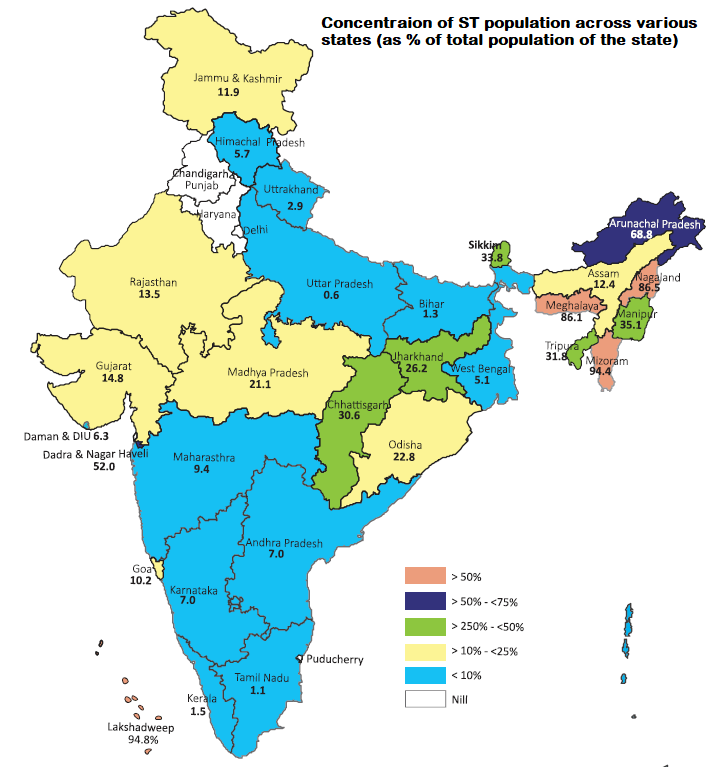
Why Tribal Areas Need Special Planning?
Tribal areas require special planning because their problems are not merely economic; they are also geographical, historical, cultural, ecological, political and constitutional. A uniform development model cannot address the specific realities of tribal regions.
- Challenging Geographical Isolation
- Tribal communities are largely concentrated in geographically isolated and difficult terrains such as:
- dense forests
- hilly and mountainous regions
- plateaus
- river valleys
- borderlands
- remote islands such as the Andaman and Nicobar Islands
- Infrastructure deficit
- Standard models of infrastructure delivery often fail in these regions.
- Roads, schools, health centres, telecom networks and markets are difficult to provide because of:
- rugged terrain
- scattered settlements
- forest cover
- low population density
- poor connectivity
- Targeted outreach
- Tribal communities are often “hard-to-reach”.
- Therefore, special missions such as Dharti Aaba Janjatiya Gram Utkarsh Abhiyan (DAJGUA) are needed to saturate tribal-majority villages with essential services such as roads, housing, education, health, Anganwadi centres and livelihood infrastructure.
- Tribal communities are largely concentrated in geographically isolated and difficult terrains such as:
- History of Marginalisation and Exploitation
- Tribal areas need special planning because tribal communities have faced historical exploitation, especially since the colonial period.
- Colonial isolationism
- The British classified many tribal regions as Excluded Areas or Partially Excluded Areas.
- This isolated tribal regions administratively but did not protect them from exploitation.
- Development was denied, while forests, minerals and land were brought under state and commercial control.
- Criminalisation of traditional livelihoods
- Colonial forest laws declared forests as state property.
- This restricted or criminalised many traditional tribal practices such as:
- shifting cultivation
- hunting
- gathering forest produce
- grazing
- customary forest use
- Land alienation
- Entry of outsiders, moneylenders, traders, contractors and revenue officials led to land loss.
- Many tribal communities were pushed into:
- indebtedness
- bonded labour
- wage dependence
- displacement
- loss of customary resource rights
- Preservation of Cultural Identity and “Genius”
- Standardised development models often fail in tribal areas because they ignore tribal cultural systems, values and institutions.
- Tribal Panchsheel
- Jawaharlal Nehru argued that tribal communities should develop along the lines of their own genius.
- Development should not impose alien values or destroy tribal identity.
- This principle supports culturally sensitive and participatory planning.
- Customary institutions
- Many tribal societies have traditional systems of governance, dispute resolution and resource management.
- Special planning recognises institutions such as:
- Gram Sabhas
- village councils
- clan-based institutions
- customary laws
- community forest management systems
- PESA-based self-governance
- The Panchayats Extension to Scheduled Areas Act, 1996 gives Gram Sabhas special powers in Scheduled Areas.
- This is important for decisions related to land, minor forest produce, local resources and social customs.
- Language barriers
- Tribal children often face difficulty in schools because education is delivered in non-tribal languages.
- Special planning is needed for:
- mother-tongue education
- local primers
- culturally relevant curriculum
- tribal language preservation
- local teachers and residential schools
- Addressing the “Subsistence Trap”
- Tribal economies are often characterised by subsistence production, low monetisation and limited market access.
- Primary sector dependence
- A large section of Scheduled Tribes depends on:
- subsistence agriculture
- shifting cultivation
- forest produce collection
- livestock
- wage labour
- hunting and gathering in some regions
- A large section of Scheduled Tribes depends on:
- Low productivity
- Productivity remains low due to:
- rainfed farming
- poor irrigation
- small landholdings
- low access to technology
- poor credit access
- difficult terrain
- Productivity remains low due to:
- Marketing challenges
- Tribal gatherers often do not receive fair prices for Minor Forest Produce (MFP).
- Middlemen and traders capture a large share of the value.
- Special planning is needed through:
- TRIFED
- Minimum Support Price for MFP
- Van Dhan Vikas Kendras
- value addition
- storage and processing facilities
- tribal cooperatives
- Skill gaps
- Limited access to quality education and vocational training restricts employment opportunities.
- Special programmes are required for:
- skill development
- local enterprise
- forest-based livelihoods
- eco-tourism
- crafts
- digital literacy
- market linkage
- Constitutional and Legal Obligations
- Tribal development is not only a welfare concern; it is a constitutional responsibility.
- Fifth Schedule
- Applies to Scheduled Areas in states other than the North-East.
- Provides special administrative mechanisms for tribal areas.
- Gives Governors special responsibilities regarding administration of Scheduled Areas.
- Sixth Schedule
- Applies to certain tribal areas in the North-East.
- Provides for Autonomous District Councils with powers over land, forests, customs and local governance.
- Article 275(1)
- Provides special grants-in-aid from the Union to states for:
- welfare of Scheduled Tribes
- raising the level of administration in Scheduled Areas
- filling critical infrastructure and service gaps
- Provides special grants-in-aid from the Union to states for:
- Forest Rights Act, 2006
- Recognises individual and community forest rights of forest-dwelling tribal communities and other traditional forest dwellers.
- PESA Act, 1996
- Strengthens tribal self-governance through Gram Sabhas in Scheduled Areas.
- Development-Induced Displacement
- Tribal areas are often rich in minerals, forests, rivers and hydropower potential.
- This makes them major locations for:
- dams
- mines
- industries
- wildlife sanctuaries
- infrastructure corridors
- power projects
- Disproportionate impact
- Although Scheduled Tribes form only 8.6% of India’s population, they have been disproportionately affected by development-induced displacement.
- Many studies estimate that tribals constitute a very large share of displaced populations, especially in mining, dam and forest-related projects.
- For UPSC accuracy, it is safer to write that tribals have been disproportionately displaced, rather than using a single fixed figure for all projects.
- Need for safeguards
- Special planning is required to ensure:
- prior informed consent
- proper rehabilitation
- land-for-land compensation where possible
- livelihood restoration
- community-based resettlement
- protection of cultural sites
- use of District Mineral Foundation funds for local communities
- recognition of forest and habitat rights
- Special planning is required to ensure:
- Severe Socio-Economic Gaps
- Tribal communities continue to lag behind national averages in several human development indicators.
- Literacy gap
- Scheduled Tribe literacy improved over time, but it remains below the national average.
- As per Census 2011, ST literacy was about 59%, compared to the national average of 73%.
- Female literacy among STs was lower, around 49%, which is why the figure 49.5% is often associated with tribal female literacy.
- Health gap
- Tribal areas face higher vulnerability to:
- infant mortality
- maternal mortality
- malnutrition
- anaemia
- malaria
- tuberculosis
- sickle cell anaemia
- poor institutional healthcare access
- Tribal areas face higher vulnerability to:
- Special health planning
- Tribal areas require:
- mobile medical units
- tribal health workers
- nutrition programmes
- sickle cell screening
- telemedicine
- maternal and child health services
- culturally sensitive healthcare delivery
- Tribal areas require:
- Education and nutrition
- High dropout rates, language barriers, poor school access and seasonal migration affect tribal children.
- Special interventions such as EMRS, hostels, scholarships, mother-tongue education and Anganwadi strengthening are necessary.
- Ecological Sensitivity of Tribal Regions
- Many tribal areas overlap with ecologically fragile zones:
- forests
- hills
- biodiversity hotspots
- watersheds
- shifting cultivation areas
- wildlife corridors
- Tribal livelihoods are closely linked with nature.
- Therefore, development must avoid ecological destruction and should promote:
- community forest management
- watershed development
- biodiversity conservation
- sustainable harvesting of MFP
- climate-resilient agriculture
- traditional ecological knowledge
- Many tribal areas overlap with ecologically fragile zones:
- Resource-Rich but Poor Regions
- Many tribal areas are rich in natural resources but poor in human development.
- This paradox is visible in parts of:
- Jharkhand
- Odisha
- Chhattisgarh
- Madhya Pradesh
- Telangana
- Maharashtra
- These regions provide minerals, forests and water resources, but local tribal communities often face:
- displacement
- pollution
- loss of livelihoods
- poor education
- poor health
- limited employment
- Special planning is needed to ensure that resource extraction benefits local communities.
- Need for Participatory and Rights-Based Planning
- Tribal development cannot be successful through top-down administration alone.
- It requires participation of:
- Gram Sabhas
- traditional institutions
- women’s groups
- forest rights committees
- tribal cooperatives
- youth groups
- Special planning must shift from welfare delivery to:
- rights recognition
- self-governance
- local livelihood creation
- cultural protection
- ecological sustainability
Approaches to Tribal Development
Historically, three broad approaches have shaped tribal policy in India.
| Approach | Meaning | Limitation |
|---|---|---|
| Isolationist approach | Keep tribes separate to preserve culture | May deny modern services and rights |
| Assimilationist approach | Merge tribes into dominant mainstream society | Can destroy identity and autonomy |
| Integrationist approach | Provide development while respecting tribal culture | Most accepted in Indian planning |
Nehru’s Tribal Panchsheel
Jawaharlal Nehru advocated an integrationist approach through five broad principles:
- Tribals should develop along the lines of their own genius.
- Tribal rights in land and forests should be respected.
- Tribal teams should be trained for administration and development.
- Tribal areas should not be over-administered.
- Results should be judged by quality of human character, not only statistics.
Evolution of Tribal Development Programmes in India
The evolution of tribal development in India represents a long journey from colonial isolationism and resource exploitation to a post-independence philosophy of integration with cultural protection, and finally to the contemporary phase of rights-based empowerment, targeted saturation and convergence-based development.
- Pre-Independence: Era of Isolation and Exploitation (18th Century–1947)
- During the British colonial period, the administrative approach towards tribal areas was largely isolationist. Many tribal regions were designated as Excluded Areas or Partially Excluded Areas, keeping them outside the framework of normal provincial administration and provincial autonomy.
- This isolation was not meant to protect tribal culture in a genuine sense; rather, colonial tribal policy was driven largely by political control and economic extraction.
- Colonial exploitation of forests and resources
- The British administration treated forests as state-controlled commercial resources.
- The Indian Forest Acts of 1865, 1878 and 1927 declared forests as state property.
- These laws restricted or criminalised many traditional tribal livelihood practices such as:
- shifting cultivation
- hunting
- grazing
- collection of forest produce
- customary forest use
- As a result, tribal communities were gradually alienated from forests that had historically formed the basis of their economy, culture and identity.
- Land alienation and entry of outsiders
- The introduction of colonial land revenue systems such as Zamindari and Ryotwari disturbed customary tribal land relations.
- Outsiders, often called dikus in several tribal regions, entered tribal areas as moneylenders, traders, contractors, landlords and revenue intermediaries.
- This led to indebtedness, debt bondage, forced labour, land dispossession and social exploitation.
- Tribal communities that once had collective or customary control over land and forests became vulnerable to private property regimes and market forces.
- Resistance as a catalyst for protective legislation
- Tribal communities repeatedly resisted colonial exploitation.
- Important rebellions included:
- Santhal Hool of 1855–56
- Birsa Munda’s Ulgulan of 1899–1900
- Kol rebellion
- Bhil uprisings
- Rampa rebellion
- These movements forced the colonial state to introduce limited protective measures.
- For example, the Chotanagpur Tenancy Act, 1908 was enacted to restrict transfer of tribal land to non-tribals in the Chotanagpur region.
- Overall character of this phase
- Tribal development was not the objective.
- The dominant approach was administrative isolation, forest control, revenue extraction and suppression of tribal resistance.
- This phase created the historical roots of land alienation, forest exclusion and distrust of external administration.
- Post-Independence Paradigm Shift: Integration with Protection (1950s)
- After Independence, India rejected the colonial policy of isolation and adopted an integrationist approach.
- The aim was to bring tribal communities into the national development process while preserving their cultural identity, customary institutions and relationship with land and forests.
- Nehru’s Tribal Panchsheel, 1957
- Jawaharlal Nehru, influenced by the ideas of Verrier Elwin, laid down five broad principles for tribal development.
- These principles became the philosophical foundation of post-independence tribal planning.
- Five principles of Tribal Panchsheel
- Tribal communities should develop along the lines of their own genius, and development should not impose alien values on them.
- Tribal rights in land and forests should be respected.
- Teams of tribal people should be trained for administration and development work.
- Tribal areas should not be over-administered or overwhelmed by too many schemes.
- Results should be judged not merely by statistics or money spent, but by the quality of human character and social well-being.
- Constitutional safeguards
- The Constitution recognised Scheduled Tribes under Article 366(25) and provided for their notification under Article 342.
- The Fifth Schedule was created for the administration of Scheduled Areas in states other than the North-East.
- The Sixth Schedule was created for tribal areas of the North-East, providing Autonomous District Councils with powers over land, forests, customs and local governance.
- These safeguards recognised that tribal regions needed special administrative arrangements because of their distinct history, culture and resource systems.
- Overall character of this phase
- The emphasis shifted from colonial isolation to protective integration.
- The state accepted responsibility for tribal welfare, but the actual planning framework was still evolving.
- Early Five-Year Plans: From General Welfare to Tribal Blocks (1951–1974)
- In the early planning period, tribal development was largely included within broader rural development programmes.
- However, general rural development strategies often failed to address the specific needs of tribal areas because they did not adequately account for forest dependence, cultural difference, difficult terrain, land alienation and administrative isolation.
- First Five-Year Plan
- The First Plan emphasised Community Development Programmes and general assistance to tribal communities.
- Tribal welfare was mainly seen as part of rural reconstruction.
- The approach focused on education, health, communication and agricultural improvement, but it lacked a strong area-specific tribal strategy.
- Second Five-Year Plan
- The Second Plan introduced Special Multi-Purpose Tribal Blocks (SMPTBs).
- Around 43 SMPTBs were created to concentrate investment in tribal areas.
- These blocks focused on:
- communication
- education
- health
- agriculture
- cooperation
- welfare services
- This marked an important shift from scattered welfare schemes to a more concentrated block-level approach.
- Third Five-Year Plan
- On the basis of the Verrier Elwin Committee’s recommendations, Special Multi-Purpose Tribal Blocks were renamed Tribal Development Blocks (TDBs).
- TDBs were generally implemented in areas where tribal population exceeded 60%.
- The focus was to bring administrative attention and development investment to areas of high tribal concentration.
- Fourth Five-Year Plan
- The Fourth Plan introduced Tribal Development Agencies (TDAs) on an experimental basis in 1971–72.
- These agencies functioned under District Collectors and were meant to address regional bottlenecks in tribal development.
- The approach recognised that tribal development required coordination among different departments and not only isolated welfare programmes.
- Overall character of this phase
- The policy moved from general rural development to tribal block-based development.
- However, the approach still remained largely administrative and welfare-oriented.
- The need for integrated area development became increasingly clear.
- Fifth Five-Year Plan and the Tribal Sub-Plan Strategy (1974–75 onwards)
- The Fifth Five-Year Plan marked a major watershed in tribal development policy.
- It introduced the Tribal Sub-Plan (TSP) strategy, which represented a shift from welfare schemes to integrated area development.
- Core idea of Tribal Sub-Plan
- TSP required central and state governments to earmark funds for tribal development in proportion to the Scheduled Tribe population.
- The purpose was to ensure that tribal areas received a definite share of development resources.
- It also aimed to reduce the gap between tribal and non-tribal populations in education, health, income, infrastructure and livelihood.
- Main objectives of TSP
- Reduce poverty and unemployment among tribal communities.
- Protect tribal people from exploitation.
- Improve access to education, health, communication and drinking water.
- Promote livelihood and income generation.
- Strengthen infrastructure in tribal areas.
- Ensure area-specific and community-specific planning.
- Area classification under TSP
- Tribal Majority States
- In states such as Nagaland and Mizoram, where tribal population forms a majority, the entire state plan is almost equivalent to a tribal development plan.
- TSP Areas
- These are blocks or tehsils where the Scheduled Tribe population is generally more than 50%.
- These areas are managed through Integrated Tribal Development Projects (ITDPs) or Integrated Tribal Development Agencies (ITDAs).
- Dispersed Tribal Pockets
- These include tribal concentrations in states where tribal people are a minority and are scattered in smaller pockets.
- Tribal Majority States
- Integrated Tribal Development Projects / Agencies
- ITDPs and ITDAs became the main operational units of TSP.
- They were designed to coordinate programmes related to:
- agriculture
- irrigation
- animal husbandry
- education
- health
- roads
- housing
- forest-based livelihoods
- anti-exploitation measures
- Overall character of this phase
- The TSP strategy was the first major attempt to integrate tribal development with regional planning.
- It recognised that tribal problems were spatially concentrated and required area-based planning.
- 1980s: MADA, Clusters and Identification of Vulnerable Groups
- During the 1980s, tribal planning became more differentiated.
- Policymakers realised that many tribal communities lived outside large TSP areas and therefore remained excluded from the benefits of ITDP-based planning.
- Sixth Five-Year Plan and Modified Area Development Approach
- The Sixth Plan adopted the Modified Area Development Approach (MADA).
- MADA was meant for smaller pockets with at least 10,000 population, of which 50% or more were Scheduled Tribes.
- It helped bring smaller tribal pockets under targeted planning.
- Seventh Five-Year Plan and Cluster Approach
- The Seventh Plan further extended targeting through the cluster approach.
- Clusters generally covered areas with at least 5,000 population, with 50% or more Scheduled Tribe population.
- This helped address the needs of dispersed tribal groups who did not fall under ITDP or MADA areas.
- Particularly Vulnerable Tribal Groups
- Identification of Particularly Vulnerable Tribal Groups (PVTGs), earlier called Primitive Tribal Groups, began for communities facing extreme vulnerability.
- PVTGs were identified on the basis of:
- pre-agricultural level of technology
- stagnant or declining population
- very low literacy
- subsistence economy
- relative isolation
- At present, India has 75 PVTGs across 18 states and one Union Territory.
- Overall character of this phase
- The focus shifted from broad tribal-majority areas to smaller pockets, clusters and highly vulnerable groups.
- Tribal planning became more targeted and spatially refined.
- 1990s–Present: Rights-Based and Convergence-Oriented Development
- Since the 1990s, tribal development has gradually moved towards a rights-based, participatory and convergence-oriented model.
- The focus is no longer only on welfare or area development, but also on self-governance, forest rights, livelihood security, cultural protection and saturation of basic services.
- Institutional framework
- The Ministry of Tribal Affairs was established in 1999 to focus specifically on the integrated development of Scheduled Tribes.
- This gave tribal development a separate institutional identity at the Union level.
- Important agencies include:
- TRIFED, established in 1987, for marketing tribal products and minor forest produce.
- NSTFDC, established in 2001, for financial assistance, livelihood support and entrepreneurship among Scheduled Tribes.
- Legislative empowerment
- The PESA Act, 1996 empowered Gram Sabhas in Scheduled Areas and recognised tribal self-governance.
- PESA gave Gram Sabhas powers related to:
- minor forest produce
- land alienation
- local markets
- minor water bodies
- social customs
- consultation before land acquisition
- The Forest Rights Act, 2006 sought to correct historical injustice by recognising the forest rights of Scheduled Tribes and other traditional forest dwellers.
- FRA recognises:
- individual forest rights
- community forest rights
- community forest resource rights
- habitat rights for PVTGs
- rights over minor forest produce
- Vanbandhu Kalyan Yojana
- Vanbandhu Kalyan Yojana (VKY) was launched as a holistic umbrella scheme for tribal development.
- It focuses on convergence of resources and outcome-oriented development.
- Its areas include:
- education
- health
- livelihood
- infrastructure
- housing
- drinking water
- skill development
- culture
- sports
- Eklavya Model Residential Schools are an important educational intervention linked with the broader tribal development framework.
- Van Dhan Vikas Yojana
- Van Dhan Vikas Yojana, implemented through TRIFED, promotes tribal entrepreneurship based on Minor Forest Produce.
- It organises tribal gatherers into self-help groups and Van Dhan Vikas Kendras.
- The focus is on:
- value addition
- processing
- packaging
- branding
- marketing
- better returns for forest produce gatherers
- This marks a shift from raw forest produce collection to value-chain-based tribal livelihood development.
- PM-JANMAN, 2023
- Pradhan Mantri Janjati Adivasi Nyaya Maha Abhiyan (PM-JANMAN) was launched in 2023 for the development of the 75 PVTGs.
- It aims to saturate PVTG habitations with basic amenities such as:
- pucca housing
- safe drinking water
- road connectivity
- mobile medical units
- Anganwadi centres
- hostels
- education
- electricity
- telecom connectivity
- livelihood support
- PM-JANMAN represents a shift towards PVTG-specific saturation planning.
- PM-JUGA / Dharti Aaba Janjatiya Gram Utkarsh Abhiyan, 2024
- The Pradhan Mantri Janjatiya Unnat Gram Abhiyan, also called Dharti Aaba Janjatiya Gram Utkarsh Abhiyan, was launched in 2024.
- It targets around 63,000 tribal-majority villages through inter-ministerial convergence.
- It involves 17 ministries and focuses on saturation of critical gaps in:
- roads
- housing
- drinking water
- education
- health
- Anganwadi services
- livelihood
- telecom
- skilling
- Van Dhan Kendras
- The scheme has an outlay of around ₹80,000 crore and represents a whole-of-government approach to tribal village development.
- Overall character of this phase
- Tribal development has shifted from administrative welfare to rights-based empowerment.
- The modern approach emphasises convergence, saturation, data-based monitoring, Gram Sabha participation, livelihood value chains and targeted support for vulnerable groups.
Summary: Evolution at a Glance
| Phase | Dominant Approach | Main Features |
|---|---|---|
| Pre-Independence | Isolation and exploitation | Excluded Areas, forest control, land alienation, tribal rebellions |
| 1950s | Integration with protection | Tribal Panchsheel, constitutional safeguards, Fifth and Sixth Schedules |
| 1951–1974 | Welfare and block approach | Community Development, SMPTBs, TDBs, TDAs |
| 1974–75 onwards | Tribal Sub-Plan | ITDP/ITDA, earmarked funds, integrated area development |
| 1980s | Targeted tribal pockets | MADA, cluster approach, PVTG identification |
| 1990s–present | Rights-based convergence | MoTA, PESA, FRA, VKY, Van Dhan, PM-JANMAN, PM-JUGA |
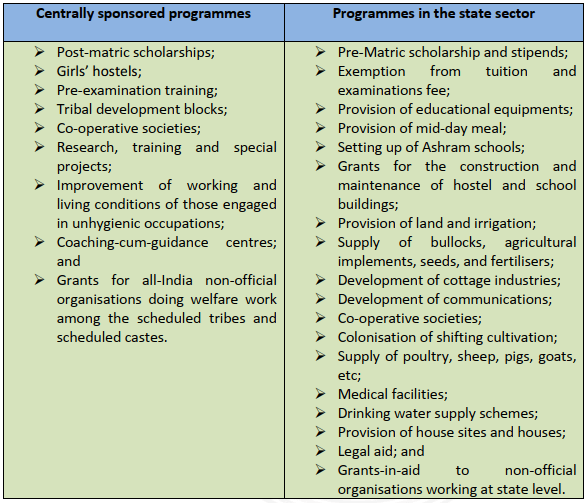
Programmes for the Development of Scheduled Tribes
The development of Scheduled Tribes in India has moved from colonial isolation to welfare planning, area-based development, rights-based empowerment and now saturation through convergence. These initiatives are coordinated primarily by the Ministry of Tribal Affairs, established in 1999 to provide a focused approach to integrated tribal development.
Following is a comprehensive list of programmes and schemes for Scheduled Tribes, categorised by their strategic and functional roles.
1. Overarching Strategic Frameworks
- Tribal Sub-Plan (TSP) / Development Action Plan for Scheduled Tribes (DAPST)
- Launched during the Fifth Five-Year Plan (1974–75).
- It is one of the most important planning strategies for tribal development.
- It mandates that Central Ministries and State Governments allocate funds in proportion to the Scheduled Tribe population.
- At present, the framework is implemented as Development Action Plan for Scheduled Tribes (DAPST).
- It aims to bridge developmental gaps between STs and the general population in education, health, livelihood, infrastructure and social services.
- The strategy is important because it shifted tribal development from scattered welfare schemes to planned and earmarked development expenditure.
- Pradhan Mantri Vanbandhu Kalyan Yojana (PMVKY)
- A holistic umbrella scheme for tribal development.
- The present phase covers 2021–2026.
- It focuses on convergence of resources for education, livelihood, infrastructure, health and overall socio-economic development.
- It seeks to reduce gaps in human development indicators and promote need-based planning for tribal communities.
- Important components under the broader PMVKY framework include education, livelihood, infrastructure support and institutional strengthening.
- Special Central Assistance to Tribal Sub-Scheme
- A central assistance mechanism for states to support tribal development.
- It provides additional funds to fill critical gaps in development programmes.
- It supports livelihood generation, infrastructure, education, health and income-generating activities.
- It is especially important for states where regular plan funds are insufficient to address tribal deprivation.
- Article 275(1) Grants
- These are 100% annual grants provided by the Union Government to states.
- They are meant for promoting the welfare of Scheduled Tribes and raising the level of administration in Scheduled Areas.
- These grants are used for infrastructure, education, health, hostels, Eklavya Model Residential Schools, livelihood support and administrative strengthening.
- They are constitutionally important because they recognise the special responsibility of the Union toward Scheduled Areas.
2. Modern Flagship Missions: Saturation Approach
- Dharti Aaba Janjatiya Gram Utkarsh Abhiyan / Pradhan Mantri Janjatiya Unnat Gram Abhiyan (PM-JUGA / DA-JGUA)
- Launched in 2024.
- It is one of the largest recent tribal village development missions.
- It has an outlay of about ₹79,156 crore.
- It targets around 63,000 tribal-majority villages.
- It follows a saturation approach through 25 interventions across 17 line ministries.
- It converges schemes related to housing, roads, drinking water, education, health, Anganwadi services, livelihood, telecom and skill development.
- Key converging schemes include PMAY-G, PMGSY, Jal Jeevan Mission, health outreach, education infrastructure and livelihood interventions.
- It reflects the modern shift from scheme-based delivery to whole-of-government tribal village transformation.
- Pradhan Mantri Janjati Adivasi Nyaya Maha Abhiyan (PM-JANMAN)
- Launched in 2023.
- It specifically targets the 75 Particularly Vulnerable Tribal Groups (PVTGs).
- It has a total outlay of about ₹24,104 crore.
- It aims to provide saturation of basic services to PVTG habitations.
- Major interventions include pucca housing, road connectivity, safe drinking water, mobile medical units, Anganwadi centres, hostels, telecom connectivity, livelihood support and off-grid solar energy.
- It is significant because it recognises that PVTGs require a more sensitive and targeted approach than general tribal communities.
- Pradhan Mantri Adi Adarsh Gram Yojana (PMAAGY)
- It is a revamped version of Special Central Assistance to Tribal Sub-Scheme.
- It focuses on integrated development of tribal villages.
- It targets 36,428 villages with significant tribal population.
- The approach is based on convergence of existing schemes and gap-filling support.
- It focuses on roads, education, health, Anganwadi infrastructure, drinking water, sanitation, livelihood and community assets.
- It is important for village-level tribal development planning.
3. Educational Empowerment Programmes
- Eklavya Model Residential Schools (EMRS)
- Established to provide quality residential education to Scheduled Tribe students in remote areas.
- They provide education from middle to senior secondary level.
- The target is to establish 728 EMRSs across the country.
- EMRSs aim to provide academic education, sports, cultural activities, skill development and all-round personality development.
- They are especially important for tribal students from remote areas where access to quality schools is limited.
- Pre-Matric Scholarship for ST Students
- Provides financial assistance to ST students studying in Classes IX and X.
- It aims to reduce dropout rates before secondary education.
- It supports students from economically weaker tribal families.
- It is important for improving retention at the school level.
- Post-Matric Scholarship for ST Students
- Supports ST students pursuing post-secondary education.
- It covers higher secondary, undergraduate, postgraduate, technical and professional courses.
- It reduces the financial burden on tribal students and families.
- It is one of the most important schemes for higher education access among STs.
- National Overseas Scholarship for ST Students
- Provides financial support to needy ST students for higher studies abroad.
- It supports postgraduate, doctoral and post-doctoral studies.
- It promotes access to global higher education and research opportunities.
- National Fellowship for ST Students
- Earlier associated with the Rajiv Gandhi National Fellowship framework.
- Supports ST students pursuing M.Phil and Ph.D. degrees.
- It encourages representation of tribal students in higher education and research.
- It helps build a pool of tribal scholars, teachers and researchers.
- Strengthening Education among ST Girls in Low Literacy Districts
- Focuses on improving education among tribal girls in districts with low female literacy.
- It aims to promote enrolment, retention and completion of schooling.
- It addresses gender gaps in tribal education.
- It is important because tribal girls face multiple disadvantages of remoteness, poverty, domestic work and social vulnerability.
- Ashram Schools
- Residential schools for tribal students.
- They provide a supportive educational environment from primary to senior secondary stages.
- They are important in remote and scattered tribal settlements where daily school access is difficult.
- Their success depends on quality of teaching, safety, nutrition, cultural sensitivity and language support.
- Hostels for ST Boys and Girls
- Provide residential facilities for tribal students studying away from their villages.
- They reduce dropout caused by distance and poor connectivity.
- Girls’ hostels are especially important for improving female education in tribal areas.
4. Livelihood and Economic Empowerment
- Pradhan Mantri Janjatiya Vikas Mission (PMJVM)
- Implemented through TRIFED.
- Aims to strengthen tribal entrepreneurship and improve marketing of agricultural and Minor Forest Produce.
- It promotes value addition, branding, processing and market linkage.
- It is important for shifting tribal livelihoods from raw produce collection to higher-value economic activities.
- Van Dhan Vikas Yojana
- A major livelihood initiative implemented through Van Dhan Vikas Kendras.
- It organises tribal gatherers into self-help groups and producer groups.
- It focuses on processing, value addition, packaging and marketing of Minor Forest Produce.
- It aims to transform tribal forest produce gatherers into entrepreneurs.
- It reduces dependence on middlemen and increases income from forest-based livelihoods.
- Minimum Support Price for Minor Forest Produce
- Provides assured prices for selected Minor Forest Produce.
- It protects tribal gatherers from distress sale and exploitation.
- It supports procurement, storage and marketing of forest produce.
- It is important for forest-dependent tribal households.
- TRIFED Initiatives
- TRIFED supports marketing and value addition of tribal products.
- Major initiatives include:
- Tribes India retail outlets
- e-commerce marketing
- TRIFOOD projects
- marketing logistics for North-East tribal products
- promotion of tribal crafts and forest-based products
- These initiatives help connect tribal producers to wider national and global markets.
- NSTFDC Term Loan Scheme
- Provides concessional finance to Scheduled Tribes for viable income-generating activities.
- It supports small businesses, agriculture, service sector activities and enterprises.
- It is important for promoting self-employment among STs.
- Adivasi Mahila Sashaktikaran Yojana
- A scheme of NSTFDC focused on economic empowerment of ST women.
- It provides concessional loans for income-generating activities.
- It promotes women-led entrepreneurship, self-employment and financial inclusion.
- Micro Credit Scheme for Self-Help Groups
- Provides small loans to tribal SHGs.
- It supports livelihood diversification, petty trade, animal husbandry, crafts and local enterprises.
- It is useful for poor tribal households that cannot access formal banking easily.
- Adivasi Shiksha Rrinn Yojana
- Provides educational loans to ST students.
- It supports technical and professional education.
- It helps tribal students pursue higher education that can improve employment outcomes.
- Venture Capital Fund for Scheduled Tribes
- Approved in 2021–22.
- Promotes entrepreneurship and start-up ideas among ST youth.
- It supports commercially viable business ventures.
- It is important because it shifts tribal economic policy from welfare to enterprise creation.
5. Health, Infrastructure and Research
- Sickle Cell Disease Management
- Tribal populations in many regions have higher prevalence of sickle cell disease.
- Programmes focus on screening, counselling, treatment and awareness.
- Centres of Competence and diagnostic facilities are being developed to address the disease burden.
- This is important for reducing hereditary disease vulnerability in tribal regions.
- Mobile Medical Units
- Provided under missions such as PM-JANMAN and PM-JUGA.
- They deliver healthcare services to remote tribal habitations.
- They are important where fixed health facilities are difficult to access.
- Services may include primary care, maternal health, child health, screening, medicine distribution and referral support.
- Health and Wellness Centres in Tribal Areas
- Provide primary healthcare, preventive care and basic diagnostics.
- They are important for reducing dependence on distant hospitals.
- Their effectiveness depends on staffing, medicines, connectivity and community trust.
- Support to Tribal Research Institutes
- Tribal Research Institutes function as knowledge institutions for tribal studies.
- They conduct research, documentation, evaluation and capacity building.
- They document tribal culture, medicine, language, customs and socio-economic conditions.
- They support policy-making and training of officials.
- Viksit Bharat Sankalp Yatra
- A national awareness and saturation campaign.
- It aims to ensure that benefits of government schemes reach remote and deprived populations, including tribal communities.
- It is useful for spreading awareness about agriculture subsidies, education concessions, health benefits, livelihood schemes and financial inclusion.
6. Legislative and Protective Measures
- Panchayats Extension to Scheduled Areas Act, 1996
- Known as PESA.
- Extends Panchayati Raj to Scheduled Areas.
- Empowers Gram Sabhas in tribal areas.
- Gives Gram Sabhas powers over local resources, minor forest produce, minor water bodies, village markets, social customs and prevention of land alienation.
- It is central to tribal self-governance and participatory planning.
- Forest Rights Act, 2006
- Officially, the Scheduled Tribes and Other Traditional Forest Dwellers Recognition of Forest Rights Act.
- Recognises individual and community forest rights.
- Seeks to correct historical injustice done to forest-dwelling communities.
- Provides rights over cultivation, habitation, minor forest produce, grazing, community forest resources and habitat rights for PVTGs.
- It is one of the most important rights-based laws for tribal communities.
- Fifth Schedule
- Provides special administration for Scheduled Areas in states other than the North-East.
- Gives special responsibilities to Governors.
- Enables protective laws for tribal land and resources.
- It is important for states like Jharkhand, Chhattisgarh, Odisha, Madhya Pradesh, Gujarat, Rajasthan, Maharashtra, Telangana and Andhra Pradesh.
- Sixth Schedule
- Provides Autonomous District Councils in certain tribal areas of the North-East.
- Councils have powers over land, forests, customs, local taxation and administration.
- It is important for tribal autonomy in parts of Assam, Meghalaya, Tripura and Mizoram.
7. Historical Area-Based Programmes
- Integrated Tribal Development Projects / Integrated Tribal Development Agencies
- Introduced under the Tribal Sub-Plan strategy.
- Cover blocks or tehsils where ST population is generally more than 50%.
- Focus on integrated area development.
- Coordinate schemes in agriculture, education, health, roads, irrigation, housing and livelihood.
- They are among the most important area-based tribal development units.
- Modified Area Development Approach
- Introduced to cover smaller tribal pockets outside ITDP areas.
- Usually applied to areas with at least 10,000 population and 50% ST concentration.
- It helps reach dispersed tribal groups that do not fall under large tribal-majority blocks.
- Tribal Clusters
- Cover smaller tribal pockets with around 5,000 population and 50% ST concentration.
- Designed to include tribal communities left out of ITDP and MADA areas.
- They represent a finer spatial targeting mechanism.
- Special Multi-Purpose Tribal Blocks
- Introduced during the Second Five-Year Plan.
- They were precursors to later Tribal Development Blocks.
- Focused on communication, education, health, agriculture and welfare in tribal-majority areas.
- Tribal Development Blocks
- Evolved from Special Multi-Purpose Tribal Blocks.
- Applied in areas with high tribal concentration.
- Represented an early shift from general welfare to area-focused tribal development.
8. Additional Supporting Programmes Relevant to ST Development
- MGNREGA
- Provides wage employment and creates durable assets in rural areas.
- In tribal areas, it supports land development, water conservation, farm ponds, roads and natural resource regeneration.
- It is important for reducing seasonal distress migration.
- National Rural Livelihoods Mission
- Promotes self-help groups and livelihood collectives.
- Supports women’s economic empowerment.
- In tribal areas, it helps create livelihood diversification beyond subsistence farming.
- Jal Jeevan Mission
- Provides household tap water connections.
- Important for tribal villages facing drinking water scarcity and poor water access.
- Pradhan Mantri Gram Sadak Yojana
- Improves rural road connectivity.
- Crucial for remote tribal habitations, market access, education and healthcare.
- Pradhan Mantri Awas Yojana-Gramin
- Provides housing support.
- Important for tribal households lacking pucca housing.
- Poshan Abhiyaan and Anganwadi Services
- Address malnutrition among children, pregnant women and lactating mothers.
- Important because tribal regions often show high nutrition vulnerability.
- National Sickle Cell Anaemia Elimination Mission
- Focuses on screening, counselling and management of sickle cell disease.
- Highly relevant for tribal regions with high disease prevalence.
Summary
| Category | Major Programmes |
|---|---|
| Strategic frameworks | TSP, DAPST, PMVKY, SCA, Article 275(1) Grants |
| Saturation missions | PM-JUGA / DA-JGUA, PM-JANMAN, PMAAGY |
| Education | EMRS, Pre-Matric Scholarship, Post-Matric Scholarship, National Overseas Scholarship, National Fellowship, Ashram Schools, Hostels |
| Livelihood | PMJVM, Van Dhan Vikas Yojana, MSP for MFP, TRIFED, NSTFDC loans, Venture Capital Fund |
| Health and infrastructure | Sickle Cell Disease Management, Mobile Medical Units, Health and Wellness Centres, Viksit Bharat Sankalp Yatra |
| Research | Tribal Research Institutes |
| Legal protection | PESA, FRA, Fifth Schedule, Sixth Schedule |
| Historical area programmes | ITDP, ITDA, MADA, Tribal Clusters, SMPTB, Tribal Development Blocks |
| Convergent schemes | MGNREGA, NRLM, JJM, PMGSY, PMAY-G, Poshan Abhiyaan |
Criticism of Tribal Development Programmes
Despite extensive constitutional safeguards and large public expenditure over successive Five-Year Plans, tribal development in India has faced serious criticism regarding its effectiveness, inclusiveness and actual impact on the lives of Scheduled Tribes.
Policies have evolved from colonial isolation to welfare, area development, rights-based empowerment and saturation through convergence. Yet several structural problems continue to limit the success of tribal development programmes.
- Concentration of Benefits and “Elite Capture”
- One of the most persistent criticisms is that the benefits of tribal development have not reached the lowest and most vulnerable sections of tribal society.
- A large share of benefits has often been captured by the more educated, politically connected and economically better-off sections within tribal communities.
- This has created a form of internal dualism within tribal society:
- a small educated tribal elite has benefited from reservations, scholarships, jobs and political representation;
- the majority of poor tribal households continue to depend on subsistence agriculture, wage labour, forest produce and informal work.
- As a result, development has produced limited upward mobility for a small section but has not transformed the structural conditions of the tribal masses.
- This problem is especially visible in access to:
- government jobs
- higher education
- political networks
- contracts
- welfare schemes
- institutional credit
- Weak Tribal Participation and Top-Down Planning
- Tribal development programmes have often been criticised for being designed in a top-down manner by administrators, planners and experts without genuine participation of tribal communities.
- Lack of consultation
- Many programmes are framed in New Delhi, state capitals or district headquarters.
- The people for whom these programmes are designed are often not consulted meaningfully.
- This leads to schemes that do not reflect local ecology, livelihood systems, cultural practices or community priorities.
- Weak Gram Sabha participation
- Laws like PESA, 1996 and Forest Rights Act, 2006 recognise the importance of Gram Sabhas.
- However, in practice, Gram Sabha involvement is often reduced to a formal or perfunctory ritual.
- Consent is sometimes obtained mechanically, without proper information, discussion or community deliberation.
- Planning without cultural context
- Programmes often ignore tribal decision-making traditions, clan structures, customary laws and community resource institutions.
- As a result, schemes may exist on paper but fail to generate ownership among tribal communities.
- Administrative Inefficiencies and Bureaucratic Hurdles
- The administrative machinery responsible for tribal welfare has often been criticised as rigid, distant and poorly adapted to tribal realities.
- Unchanging bureaucracy
- Tribal administration often functions through routine departmental procedures.
- It fails to act as a sensitive development agency.
- Officials may lack understanding of tribal culture, language and customary institutions.
- Bureaucratic delays and corruption
- Implementation is frequently affected by:
- delayed fund release
- corruption
- leakages
- poor coordination
- incomplete projects
- weak monitoring
- Implementation is frequently affected by:
- Lack of coordination
- Tribal development requires convergence among departments such as forests, revenue, rural development, education, health, irrigation, skill development and panchayati raj.
- In reality, these departments often work in silos.
- This weakens integrated area development.
- Shortage of skilled personnel
- Remote tribal areas often face a shortage of:
- teachers
- doctors
- nurses
- engineers
- agricultural extension workers
- forest rights facilitators
- livelihood experts
- Remote tribal areas often face a shortage of:
- Institutional rigidities
- Even motivated civil servants are often constrained by rigid rules, lack of flexibility, political pressure and poor local capacity.
- This reduces the effectiveness of tribal development initiatives.
- Development-Induced Displacement
- A major paradox of tribal development is that many tribal areas are resource-rich but their inhabitants remain poor and displaced.
- Tribal-majority areas often contain:
- minerals
- forests
- rivers
- hydropower potential
- timber
- biodiversity
- land for industries and infrastructure
- Because of this, they have become major sites for:
- dams
- mining projects
- industries
- thermal power plants
- wildlife sanctuaries
- infrastructure corridors
- Disproportionate impact
- Tribal communities have been disproportionately affected by development-induced displacement.
- Several estimates suggest that tribals constitute a very large share of persons displaced by dams, mines and protected areas, even though they form only 8.6% of India’s population.
- Some studies estimate that during 1950–1990, a very high proportion of displaced persons belonged to tribal communities; however, exact figures vary across sources and project types.
- Cultural disintegration
- Displacement is not merely physical relocation.
- For tribal communities, land is linked with:
- ancestry
- sacred groves
- burial grounds
- community identity
- livelihood
- forest knowledge
- spiritual geography
- When tribal communities are displaced from ancestral lands, they often suffer:
- loss of livelihood
- loss of cultural identity
- breakdown of community institutions
- migration to urban fringes
- poverty and informal labour
- social dislocation
- Implementation Gaps in Land and Forest Rights
- Landmark laws such as the Forest Rights Act, 2006 and PESA, 1996 were meant to correct historical injustices, but their implementation remains uneven.
- Slow recognition of rights
- Many individual and community forest rights claims remain pending or rejected.
- Rejections are often poorly explained or based on procedural grounds.
- Communities may lack legal awareness, documentation and administrative support.
- Weak recognition of community forest rights
- Community forest resource rights are crucial for tribal self-governance and sustainable forest management.
- However, recognition of these rights has been slow in many states.
- This limits community control over forests, minor forest produce and local ecological planning.
- Arbitrary rejection of claims
- Bureaucratic hurdles and lack of field verification have resulted in arbitrary rejection of claims in several areas.
- Many eligible forest-dwelling communities remain unaware of their rights.
- Dilution of protective land laws
- In some states, there have been attempts to dilute tenancy protections to facilitate land acquisition for commercial, industrial or infrastructure projects.
- Laws such as the Chotanagpur Tenancy Act and Santhal Parganas Tenancy Act have often been at the centre of such debates.
- UPSC value point: Rights-based laws exist, but the gap between legal recognition and ground-level implementation remains a major weakness.
- Financial Mismanagement and “Notional Expenditure”
- Tribal development has also been criticised for poor fund utilisation under the Tribal Sub-Plan and related funding mechanisms.
- Underutilisation of funds
- Funds allocated for tribal welfare are sometimes not fully spent.
- Delays in project approval, administrative bottlenecks and poor planning lead to underutilisation.
- Diversion of funds
- Funds meant specifically for Scheduled Tribes may be diverted to general infrastructure or schemes that do not directly benefit tribal communities.
- This weakens the purpose of earmarked tribal development funding.
- Notional expenditure
- A major criticism is the practice of showing expenditure on paper without ensuring actual tangible outcomes.
- Funds may be counted as tribal expenditure even when the benefits are indirect, general or poorly targeted.
- Weak outcome tracking
- Financial reporting often focuses on money spent rather than:
- assets created
- livelihoods improved
- rights secured
- dropout reduced
- health outcomes improved
- Gram Sabha capacity strengthened
- Financial reporting often focuses on money spent rather than:
- UPSC value point: Tribal development funding needs outcome-based monitoring, not just expenditure-based accounting.
- Cultural Insensitivity and the Welfare Paradigm
- For a long time, tribal development was viewed through a paternalistic welfare lens rather than a rights-based and development-oriented lens.
- Welfare rather than empowerment
- Tribal communities were treated as passive beneficiaries.
- Programmes focused on delivering schemes rather than enabling self-governance, resource control and cultural dignity.
- Stereotyping of tribal communities
- Policy often treats tribal communities as a homogeneous group.
- In reality, tribes differ widely in:
- language
- economy
- ecology
- religion
- customs
- political institutions
- level of integration with markets
- Failure to recognise internal diversity
- A programme suitable for a North-East hill tribe may not suit a Central Indian forest tribe or an island PVTG.
- Uniform schemes ignore geographical and cultural specificity.
- Language barriers in education
- Many tribal children enter schools where the medium of instruction is unfamiliar.
- This causes:
- poor comprehension
- low classroom participation
- alienation from school
- high dropout rates
- Curriculum disconnect
- School curricula often ignore tribal history, ecology, oral traditions, festivals and knowledge systems.
- This weakens cultural confidence among tribal children.
- UPSC value point: Tribal development must move from welfare delivery to culturally rooted capability building.
- Dormant Constitutional Safeguards
- India has strong constitutional provisions for tribal areas, but many safeguards remain underutilised.
- Fifth Schedule limitations
- Under the Fifth Schedule, Governors have special responsibilities for Scheduled Areas.
- They can restrict or modify laws that may harm tribal interests.
- However, critics argue that these discretionary powers are rarely used effectively.
- Governors often act on the advice of the state cabinet, making these protections weak in practice.
- Weak functioning of Tribal Advisory Councils
- Tribal Advisory Councils are meant to advise on welfare and advancement of Scheduled Tribes.
- In practice, they often have limited influence over major decisions related to land, mining, forests and displacement.
- Sixth Schedule challenges
- Autonomous District Councils in the North-East provide an important model of tribal autonomy.
- However, they face issues such as:
- overlapping jurisdiction with state governments
- limited financial autonomy
- allegations of corruption
- elite capture
- weak administrative capacity
- conflict between customary and modern institutions
- UPSC value point: Constitutional safeguards are strong in design but often weak in implementation.
- Weak Impact on Human Development
- Despite many schemes, tribal communities continue to lag behind national averages in education, health, nutrition, housing and livelihood security.
- Education
- Dropout rates remain high in many tribal regions.
- Causes include poverty, language barriers, distance, seasonal migration, poor school quality and cultural alienation.
- Health
- Tribal areas continue to face:
- malnutrition
- anaemia
- malaria
- tuberculosis
- sickle cell disease
- maternal health risks
- limited institutional healthcare
- Tribal areas continue to face:
- Livelihood
- Dependence on rainfed agriculture, wage labour and forest produce remains high.
- Many livelihood schemes fail due to poor market linkages and weak local institutions.
- Infrastructure
- Roads, telecom, drinking water, electricity and banking access have improved, but many remote habitations still face gaps.
- Environmental and Livelihood Contradictions
- Conservation and development policies have sometimes harmed tribal livelihoods.
- Conservation-related exclusion
- Creation of protected areas, tiger reserves and wildlife sanctuaries has sometimes restricted traditional access to forests.
- In some cases, conservation has been implemented without adequate recognition of community forest rights.
- Mining-related degradation
- Mining in tribal regions often leads to:
- deforestation
- water pollution
- land degradation
- displacement
- health problems
- loss of forest-based livelihoods
- Mining in tribal regions often leads to:
- Climate vulnerability
- Tribal communities are highly dependent on climate-sensitive resources such as forests, rainfed agriculture and streams.
- Climate change increases their vulnerability to droughts, floods, crop failure and forest degradation.
Way Forward for Tribal Development
- Shift from welfare-based approach to rights-based development
- Tribal development should not be treated merely as delivery of welfare schemes.
- The focus must shift toward recognition of rights, dignity, autonomy and control over resources.
- Laws such as PESA, FRA, Fifth Schedule and Sixth Schedule provisions should form the foundation of tribal planning.
- Tribal communities should be treated as rights-bearing citizens and knowledge holders, not passive beneficiaries.
- Ensure full and effective implementation of PESA
- The Panchayats Extension to Scheduled Areas Act, 1996 should be implemented in letter and spirit.
- Gram Sabhas must be given real decision-making authority over local resources, minor forest produce, land alienation, village markets and social customs.
- Consultation with Gram Sabhas before land acquisition or rehabilitation should be meaningful, informed and transparent.
- State laws should be harmonised with PESA so that its provisions are not diluted by ordinary administrative rules.
- Gram Sabha resolutions should be legally respected in matters affecting tribal land, forests and livelihoods.
- Accelerate implementation of the Forest Rights Act
- Individual and community forest rights under the Forest Rights Act, 2006 must be recognised faster.
- Special attention should be given to Community Forest Resource rights, because they empower communities to protect, regenerate and manage forests.
- Arbitrary rejection of forest rights claims should be prevented through transparent procedures and proper appeal mechanisms.
- Tribal communities should be trained and supported in preparing claims, maps and evidence.
- FRA implementation should be linked with livelihood planning, biodiversity conservation and climate resilience.
- Protect tribal land from alienation
- Strong legal safeguards are needed to prevent transfer of tribal land to non-tribals.
- Existing protective tenancy laws such as the Chotanagpur Tenancy Act and Santhal Parganas Tenancy Act should not be diluted.
- Land records in tribal areas should be updated and digitised with community participation.
- Land restoration mechanisms should be strengthened where alienation has already occurred.
- Any land acquisition in tribal areas must follow strict norms of consent, compensation, rehabilitation and livelihood restoration.
- Make development genuinely participatory
- Tribal communities should participate in every stage of planning: problem identification, project design, implementation, monitoring and evaluation.
- Gram Sabhas, traditional councils, women’s groups, youth groups and forest rights committees should be made part of planning institutions.
- Participatory rural appraisal, social mapping, resource mapping and community-based monitoring should be used.
- Planning should move from top-down delivery to community-led development.
- Development priorities should emerge from tribal communities themselves rather than only from district or state headquarters.
- Strengthen Gram Sabha-led micro-planning
- Each tribal village should prepare a local development plan based on land, water, forest, livelihood and cultural resources.
- Micro-plans should be integrated with district plans, Tribal Sub-Plan funds, MGNREGA, PM-JANMAN, PM-JUGA and other schemes.
- Local plans should identify household-level deprivation, common resource needs, livelihood opportunities and infrastructure gaps.
- Gram Sabha-led planning is essential for converting constitutional safeguards into real development outcomes.
- Promote culturally sensitive education
- Education in tribal areas should begin with mother-tongue instruction at the primary level.
- Local languages, oral traditions, folk stories, ecological knowledge and tribal history should be included in the curriculum.
- Teachers posted in tribal areas should be trained in local language and culture.
- Tribal youth should be recruited as teachers, hostel wardens and community educators.
- Eklavya Model Residential Schools, Ashram schools and hostels should be improved with better safety, nutrition, counselling and cultural sensitivity.
- Reduce dropout among tribal children
- High dropout rates should be tackled through residential schools, seasonal hostels, transport support, bridge courses and learning support in local languages.
- Special attention is needed for tribal girls, children from PVTGs and children affected by seasonal migration.
- Scholarship delivery should be timely and transparent.
- Digital education should be expanded, but it must not replace local language-based foundational learning.
- Focus on tribal health and nutrition
- Tribal health planning should address malnutrition, anaemia, malaria, tuberculosis, maternal health, child health and sickle cell disease.
- Mobile medical units and telemedicine should be expanded in remote tribal regions.
- Local tribal youth should be trained as community health workers.
- Nutrition programmes should include local foods such as millets, pulses, forest foods, tubers and traditional nutritious crops.
- Health services should be culturally sensitive and should respect traditional healing systems where appropriate.
- Strengthen action against sickle cell disease
- Screening, counselling and treatment for sickle cell disease should be expanded in tribal regions.
- Genetic counselling should be provided with sensitivity and without stigma.
- Primary health centres and district hospitals in tribal areas should be equipped for diagnosis and management.
- Awareness campaigns should be conducted in local languages.
- Create livelihood security through forest-based economy
- Minor Forest Produce should become a major pillar of tribal livelihood planning.
- Minimum Support Price for MFP should be effectively implemented.
- Van Dhan Vikas Kendras should be strengthened for value addition, storage, processing, packaging and branding.
- Tribal cooperatives and producer companies should be promoted.
- Market linkages should be improved through TRIFED, e-commerce, local haats and district-level marketing centres.
- Forest-based livelihoods should be sustainable and should not damage ecological regeneration.
- Promote agriculture suited to tribal ecology
- Tribal agriculture is often rainfed, low-input and biodiversity-rich.
- Planning should support millets, pulses, oilseeds, tubers, mixed cropping and agroforestry.
- Traditional seed varieties and climate-resilient crops should be promoted.
- Irrigation support should focus on small water harvesting structures, springshed development, check dams, farm ponds and micro-irrigation.
- Chemical-intensive agriculture should not be blindly imposed in fragile tribal ecosystems.
- Develop skill programmes linked to local economy
- Skill development should be based on local livelihoods and regional opportunities.
- Training should focus on forest produce processing, bamboo craft, lac, tasar, handloom, eco-tourism, livestock, food processing, digital services and renewable energy maintenance.
- Skill programmes should not simply train tribal youth for low-paid migration to cities.
- Placement-linked training should include worker protection, wage security and migration support.
- Prevent distress migration
- Tribal migration is often caused by poverty, debt, land alienation and seasonal unemployment.
- MGNREGA should be strengthened in tribal areas to provide local employment.
- Livelihood diversification should reduce forced seasonal migration.
- Migrant tribal workers should be registered and protected through labour rights, portability of ration, health services and legal support.
- Local asset creation through MGNREGA should focus on water conservation, land development, forest regeneration and rural connectivity.
- Ensure fair rehabilitation in displacement cases
- Displacement should be avoided wherever possible.
- If unavoidable, rehabilitation must be completed before displacement.
- Compensation should not be limited to cash; it should include land, housing, livelihood, community infrastructure and cultural restoration.
- Sacred groves, burial grounds, community spaces and forest-use areas should be recognised in rehabilitation planning.
- District Mineral Foundation funds should be transparently used for affected tribal communities.
- Social impact assessment should be mandatory and meaningful.
- Use District Mineral Foundation funds effectively
- DMF funds should be used primarily for communities directly affected by mining.
- Priority should be given to health, education, drinking water, livelihood restoration, pollution control and ecological regeneration.
- Gram Sabhas should participate in deciding DMF priorities.
- DMF expenditure should be publicly disclosed and socially audited.
- Funds should not be diverted to projects that do not benefit mining-affected tribal communities.
- Strengthen PVTG-specific planning
- Particularly Vulnerable Tribal Groups require highly sensitive planning because of their small population, isolation, health vulnerability and cultural fragility.
- PM-JANMAN should be implemented with community consent and cultural caution.
- Habitat rights of PVTGs should be recognised under FRA.
- Development should avoid forced assimilation and excessive external contact, especially in vulnerable island and forest communities.
- Nutrition, health outreach, safe housing, drinking water and livelihood security should be prioritised.
- Improve implementation of PM-JANMAN and PM-JUGA
- These missions should not become target-driven construction programmes alone.
- Saturation of services must be accompanied by rights recognition, livelihood planning and cultural protection.
- Data on each habitation should be updated regularly.
- Community verification should be used to confirm whether benefits have actually reached households.
- Convergence among ministries should be monitored through measurable outcomes, not only expenditure.
- Strengthen Tribal Sub-Plan and DAPST
- Tribal Sub-Plan funds should be non-divertible and non-lapsable in spirit.
- Fund allocation should be proportional to tribal population and linked to measurable outcomes.
- Ministries should clearly show how their expenditure directly benefits Scheduled Tribes.
- Notional expenditure should be avoided.
- Independent audits and social audits should be used to monitor fund use.
- Improve governance in Scheduled Areas
- Governors should actively use their Fifth Schedule responsibilities to protect tribal interests.
- Tribal Advisory Councils should be made more effective and representative.
- State laws inconsistent with PESA should be amended.
- Administrative officers working in tribal areas should receive special training in tribal culture, land laws, FRA, PESA and participatory planning.
- Local recruitment of tribal youth into administration should be promoted.
- Strengthen Sixth Schedule institutions
- Autonomous District Councils should be given adequate funds, staff and technical capacity.
- Overlapping jurisdiction between state governments and councils should be clarified.
- Accountability, transparency and democratic participation within councils should be strengthened.
- Traditional institutions and modern democratic institutions should be harmonised.
- Promote women-centred tribal development
- Tribal women play a central role in agriculture, forest produce collection, household economy and cultural continuity.
- Women’s forest rights, land rights and livelihood rights should be strengthened.
- Women’s self-help groups should be linked with Van Dhan Kendras, NRLM, nutrition gardens and local enterprises.
- Maternal health, menstrual health, anaemia reduction and safety of girls in hostels should receive special attention.
- Women must be represented in Gram Sabha decision-making and forest management institutions.
- Protect tribal culture and language
- Development should not lead to cultural homogenisation.
- Tribal languages, festivals, oral traditions, music, crafts, ecological knowledge and customary practices should be documented and promoted.
- Cultural centres and museums should be community-led, not merely display-oriented.
- Tourism should respect community consent and cultural dignity.
- Tribal knowledge systems should be recognised in biodiversity conservation and climate adaptation.
- Adopt ecosystem-based development
- Tribal development must protect forests, watersheds, biodiversity and common property resources.
- Community forest management should be integrated with climate action.
- Mining, infrastructure and industrial projects should be assessed carefully for ecological and social costs.
- Watershed development, springshed management, soil conservation and afforestation should be prioritised.
- Traditional ecological knowledge should be integrated with scientific planning.
- Use technology without excluding communities
- GIS mapping, remote sensing, digital land records and mobile-based monitoring can improve planning.
- However, technology should not replace community participation.
- Digital platforms should be available in local languages where possible.
- Tribal communities should be trained to use technology for accessing rights, markets, health and education.
- Data privacy and community consent should be respected.
- Improve market access without exploitation
- Tribal producers should get fair prices for forest produce, crafts and agricultural products.
- Local haats should be upgraded with storage, weighing, transport and digital payment facilities.
- Cooperatives and producer companies should reduce dependence on middlemen.
- Branding of tribal products should ensure benefits reach producers, not only retailers.
- Value addition should happen near tribal areas to generate local employment.
- Make monitoring outcome-based
- Evaluation should focus on outcomes rather than only expenditure or physical targets.
- Indicators should include:
- land rights recognised
- community forest rights implemented
- school retention
- nutrition improvement
- livelihood income
- women’s participation
- reduction in distress migration
- health outcomes
- Gram Sabha decisions implemented
- Social audits and community scorecards should be made part of tribal development monitoring.
- Build trust between state and tribal communities
- Many tribal communities have historical distrust of administration due to land loss, forest restrictions, police action and displacement.
- Development must begin with trust-building.
- Officials should work with cultural sensitivity and transparency.
- Coercive conservation, forced relocation and top-down development should be avoided.
- The state must be seen as a partner in justice, not an agent of extraction.
- Adopt region-specific tribal planning
- A single national model cannot work for all tribal communities.
- Planning should differ for:
- North-East hill tribes
- Central Indian forest tribes
- Western semi-arid tribal regions
- Southern hill tribes
- island tribes
- PVTGs
- mining-affected tribal communities
- Each region needs a plan based on ecology, culture, resources, mobility, livelihood and institutional structure.
- Integrate tribal development with sustainable regional planning
- Tribal development should be part of broader regional planning, not an isolated welfare department activity.
- Roads, schools, health centres and livelihood schemes should be planned with land, forests, water, settlement pattern and ecological limits.
- Development should create durable local capabilities rather than short-term dependence.
- The goal should be self-reliant, culturally confident and ecologically secure tribal regions.





Thnq
There is a confusion in the 2nd point from the beginning where u hve mentioned that 427 schedule tribe communities included,given in 8th schedule but 8th schedule deals with the languages? Pls clear it.
These schedule tribe communities are added based on the tribal languages spoken by them which is included in the 8th schedule.
Don’t confuse this with the Fifth or Sixth Schedule of the constitution.
Please add specific initiatives / Programmes by govt. for tribal area development.
Updated!
sir, can help in writing .
elucidate the role of tribal development blocks in the development of tribal areas
1. Origin and Demographic Targeting
2. Role in Holistic Socio-Economic Upliftment
TDBs served as the delivery mechanism for a four-fold developmental strategy designed to bridge the gap between tribal and non-tribal areas:
3. Specialized Funding and Resource Allocation
The role of TDBs was defined by their ability to channelize higher levels of investment into marginalized regions. In addition to the standard allotment for community development (approx. ₹12 lakhs), TDBs received supplementary funding (e.g., ₹10 lakhs for the first stage) specifically for tribal welfare. This laid the groundwork for the Tribal Sub-Plan (TSP) strategy, which later mandated that state and central governments earmark funds in direct proportion to the ST population.
4. Evolutionary Role: From TDBs to ITDPs
By the Fifth Five-Year Plan (1974–79), the experience gained from TDBs led to the creation of Integrated Tribal Development Projects (ITDPs).
5. Modern Role in “Saturation through Convergence”
In current flagship missions like the Dharti Aaba Janjatiya Gram Utkarsh Abhiyan (DAJGUA/PM-JUGA), the block remains the critical layer for grassroots implementation: