

Concept of Region in Geography

- The concept of Region is one of the most fundamental and most contested concepts in geography. It serves simultaneously as a unit of analysis, a tool for planning, and a way of understanding spatial identity. Region is so deeply embedded in geographical thought that some scholars have argued geography itself is the “science of regions.”
- The word ‘region’ comes from the Latin regio , meaning a direction, boundary, or district. In everyday usage, region refers simply to a large tract of land. In geography, however, it has a more precise and theoretically loaded meaning.
- In geography, regions are the areas that are broadly divided by its physical characteristics (physical geography), human impact characteristics (human geography), and the interaction of humanity and the environment (environmental geography).
- Geographic regions and sub-regions are mostly described by their imprecisely defined, and sometimes transitory boundaries, except in human geography, where jurisdiction areas such as national borders are defined in law.
- ‘Regions’ or ‘Landschaft’ is a similar concept that came into existence in Mid 19th centaury from the “German School”.
- At first, geographers where trying to classify the world into a natural region by the homogeneity and uniformity between physical attributes of the area or space.
- In the 20th century regions were classified into different categories ( different functional regions or planning regions) with the help of different statistical methods showing functional homogeneity in multiple attributes
- At present, the Region and regionalization get wide spectrum through the planning process in any country or a state or small unit of a natural, functional, or vernacular region of the word; to achieve the goal of sustainable development.
Definition of Region
- A Region is defined as a part of the Earth’s surface with one or many similar characteristics that make it unique from other areas. It is an area that is different from other areas according to specific criteria. — General consensus in Geographic literature
- Regional geography studies the specific unique characteristics of places related to their culture, economy, topography, climate, politics, and environmental factors including their different species of flora and fauna.
Two Dimensions of the Region Concept
- The concept of Region is generally linked with Space and has a Spatial dimension. However, it operates on two planes simultaneously:
| Dimension | Nature | Description | Example |
|---|---|---|---|
| Spatial Dimension | Objective Reality | Region exists as a physical, measurable, observable territory on the Earth’s surface — linked to real geographic space | Thar Desert, Gangetic Plain, Western Ghats |
| Non-Spatial Dimension | Subjective / Mental Construct | Region as a cognitive framework, a conceptual tool — “spaceless” — existing in the mind as an organizing idea | Backward region, Tribal belt, BIMARU states |
- For most geographers, Region is an Objective Reality linked with space and defined in terms of space.
- The scale of a region is highly flexible — sometimes a part of a district or even a village is called a region; at other times, a group of states or even a continental zone is called a region.
- Scale Flexibility: Region is not fixed to any particular scale. It can refer to a village watershed (micro), a river valley (meso), a physiographic zone like the Indo-Gangetic Plain (macro), or even a continental cultural zone like South Asia.
- This scalar flexibility is both the strength and the challenge of the regional concept.
Definitions by Major Geographers
- The absence of a universally accepted definition of region has been one of the greatest terminological challenges in geography.
- American geographers H.T. Odum and H.E. Moore had already identified 41 different definitions of region by the 1930s.
- Below are the most important definitions:
- C. Aronovic
- “The Region is a geographic area or areas which, given the civilisation and standard of a people, seems to require for the fulfilment of the aspiration through a material resource.”
- Woolfgang & Joerg
- “Any surface over the earth’s surface where physical conditions are homogeneous is a region.”
- A.J. Herbertson (1905)
- “A region is a complex of land, water, air, plant, animal and man, regarded under their spatial relationship as together constituting a definite portion of the earth surface.”
- Vidal-de-La-Blache
- “A region is a domain where many dissimilar things are artificially brought together and have subsequently adapted themselves to a common existence.”
- Richard Hartshorne
- “A region is an area of specific location which in some way is very distinctive from other areas and which extends as far as that distinction extends.”
- G.T. Renner
- “Regions are genuine entities, each of which expresses both natural and cultural differentiation from its neighbours.”
- D.S. Whittlesey (1929)
- “A region is a differentiated segment of the Earth’s surface.” — Region as an areal differentiation tool; the basis for systematic comparison of places.
- Preston James
- “A region is identified by specified criteria and its boundaries are determined by these criteria.” — Emphasizes purpose-based delineation; region as intellectual construct.
- C. Aronovic
Why Geographers Use regions?
- Geographers study a very wide range of issues from a spatial perspective. Regions are one way to organize and simplify this vast amount of information. Even though regions are “made-up” by the geographer, they are designed in such a way that the information they provide will be useful.
- Biologists do the same thing when they divide living organisms into different groups with similar characteristics to better understand the great variety of living organisms.
Evolution of the Concept of Region
- The concept of region has evolved significantly across time, shaped by the broader philosophical movements in geography — from classical empiricism to quantitative revolution to humanistic and critical geography.
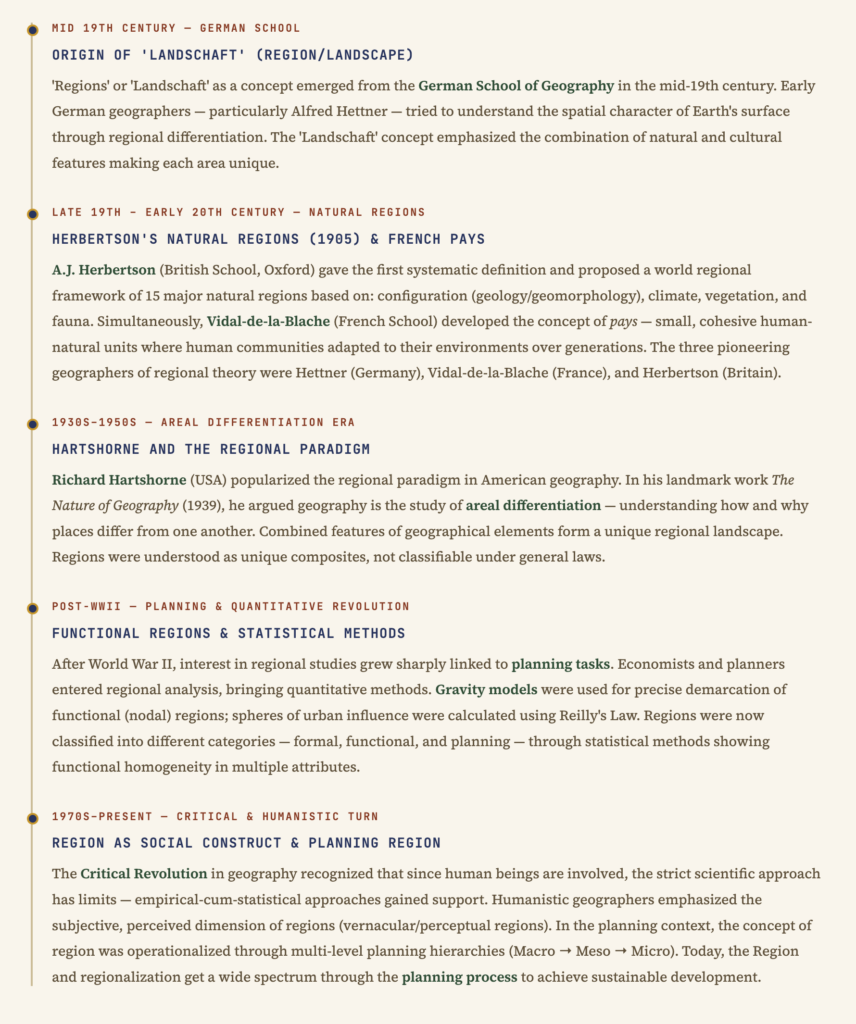
- Regional geography has its roots in Europe; specifically with the French and geographer Paul Vidal de la Blanche. In the late 19th century, De la Blanche developed his ideas of the milieu and pays. The milieu was the natural environment and pays was the country or local region.
- Before becoming the target of systematic concerns, regional studies sought, above all, to identify specificities, curiosities, and descriptions of the most different parts of the globe.
- From the mid-eighteenth century several forms of description, classification and analysis techniques have been created without the intention to develop a more “scientific” point of view about the term region.
- These concerns have become more common in the early twentieth century when the systematization of a “regional geography” began to take its first steps, both in Europe and in the United States.
- Main geographers who developed the first theoretical definitions on the regional phenomenon: Alfred Hettner, in Germany, Vidal-de-la-Blache, in France, and A. J. Herbertson, in Great Britain.
- The first systematic definition of the notion of the region was made by Herbertson, in an article dated 1905. With regard to its more methodological aspects, it can be said that the purpose is to create a “systematic geography“, and seeks to find ” geographical divisions orders on the globe“.
- The concern to define regionalization as a classification process, It makes explicit reference to the biology classification procedures (Organic theory of Regionalisation), thus demonstrating a deductive bias, based on the demarcation criteria, divides the world into major natural regions”.
- Herbertson (1905) proposes four “classes of phenomena” for such regions, in the following order of importance:
- configuration (mainly the elements of geology and geomorphology of the earth);
- climate (air masses, temperature, and precipitation levels);
- vegetation; and
- population densities
- Setting natural regions would be, in this sense, “the necessary step for the final solution of the problems of geography” as these definitions would allow the establishment of a sound and lasting cuts on the earth’s surface even to understand the economic functions, which each portion of the space would fulfill since it was believed that the productive activities had clear causal relationships with natural elements such as climate, geology, landform, vegetation and soil of each area. This true “physical regionalisation” of the world at the time was followed by several similar attempts, mainly conducted by Russian geographers Gregg, 1974.
- Paul shows that in this period the region was a fact of physical geography, a fact of nature in virtually all that was written on the subject.
- Gomes (1995) also noted that “the concept of natural region is born from this idea that the environment has some ownership on the orientation of the society development.” Most of these definitions had a deterministic or “environmentalist” Bias.
- Regional geography began to develop in the United States specifically and parts of Europe in the period between World Wars I and II.
- During this time, geography was criticized for its descriptive nature with environmental determinism and lack of a specific focus. As a result, geographers were seeking ways to keep geography as a credible university-level subject.
- In the 1920s and 1930s, geography became a regional science concerned with why certain places are similar and/or different and what enables people to separate one region from another. This practice became known as areal differentiation.
- In the U.S., Carl Sauer and his Berkeley School of geographic thought led to the development of regional geography, especially on the West Coast. During this time, regional geography was also led by Richard Hartshorne, who studied German regional geography in the 1930s with famous geographers such as Alfred Hettner and Fred Schaefer.
- Hartshorne defined geography as a science “To provide accurate, orderly, and rational description and interpretation of the variable character of the earth surface.”
- For a short time during and after WWII, regional geography was a popular field of study within the discipline. However, it was later critiqued for its specifically regional knowledge, and it was claimed to have been too descriptive and not quantitative enough.
- The economic region was the main focus of regional research from the 1930s to the 1970s. Quite substantial results were reached in that field.
- During the last forty years, regional geography has ceased to appear central to most geographers. In fact, the new interest in place and territory shows a renewal in this field much more than a decline. Some geographers are, however, very critical of the regional idea.
Some Examples of Regions
- Global regions
- Continental regions
- Geographical regions
- Planning Regions
- Palaeogeographic Regions
- Physiographic Regions
- Historical Regions
- Tourism regions
- Natural regions
- Natural resource regions
- Hydrological regions
- Religious regions
- Political regions
- Socio Cultural Region
- Administrative regions
- Local administrative regions
- Traditional or informal regions
- Functional region
- Military regions
- Culture Region
- Geographical regions
Characteristics of Region
A region has the following characteristics:
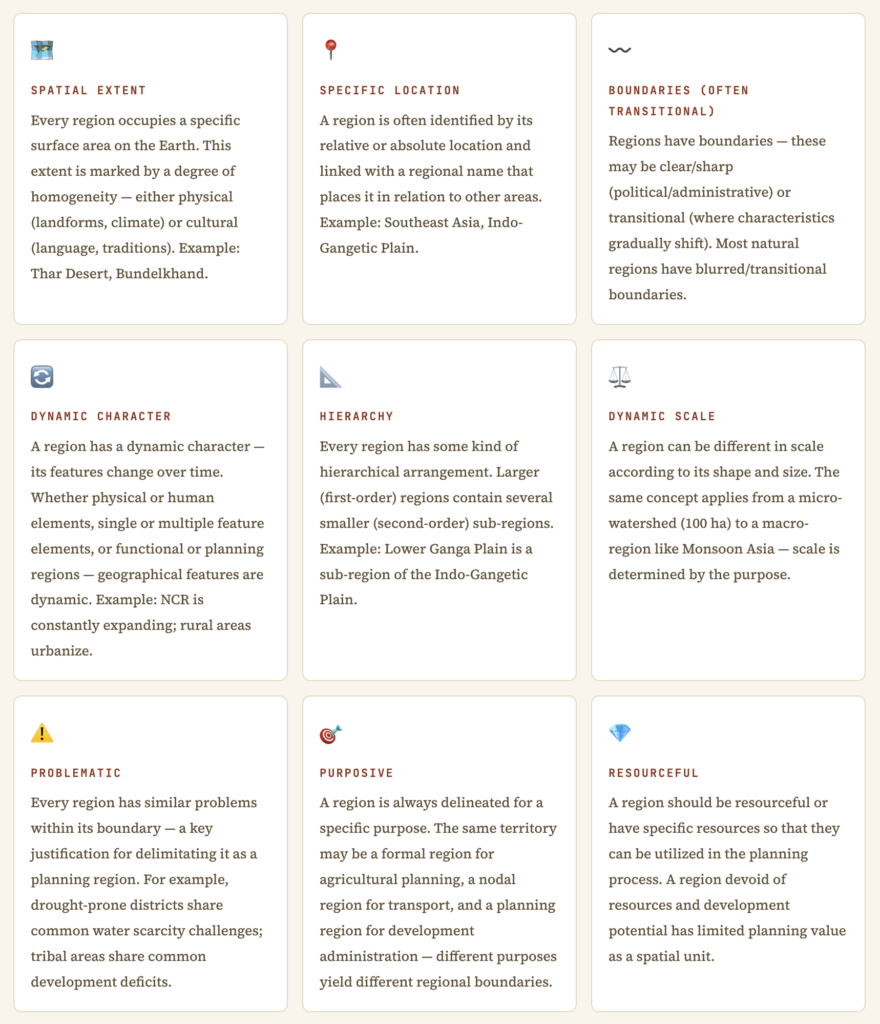
- Location
- Every region occupies a definite location on the earth’s surface. It may be small like a village region or large like the Monsoon Asia region.
- Areal Extent
- A region has spatial extent. However, its boundaries may be clear or transitional.
- For example, a political region like Rajasthan has clear boundaries, but a cultural region like the Hindi Belt has gradual and overlapping boundaries.
- Homogeneity
- A region has some degree of internal similarity. This homogeneity may be physical, cultural, economic, social, political or functional.
- Examples:
- Desert region – aridity
- Rice-growing region – agricultural similarity
- Tribal region – socio-cultural characteristics
- Industrial region – manufacturing concentration
- Distinctiveness
- A region is different from neighbouring areas on the basis of selected criteria. The Western Ghats are distinct from the Deccan Plateau because of relief, rainfall, vegetation and biodiversity.
- Unity or Cohesion
- A region has some internal unity. In formal regions, this unity comes from similarity. In functional regions, it comes from interaction and linkage.
- Dynamic Nature
- Regions are not static. Their character changes over time. For example, the Damodar Valley region changed from a mineral-industrial region to a more diversified economic region.
- Hierarchical Nature
- Regions exist at different scales:
- Macro region – South Asia, Monsoon Asia, Peninsular India
- Meso region – Deccan Plateau, Indo-Gangetic Plain
- Micro region – Chotanagpur Plateau, Malwa Plateau
- Micro-minor region – watershed, block, village cluster
- Regions exist at different scales:
- Purpose-Oriented Nature
- A region is often defined according to the purpose of study. A climate region, agricultural region, planning region and cultural region may have different boundaries even in the same area.
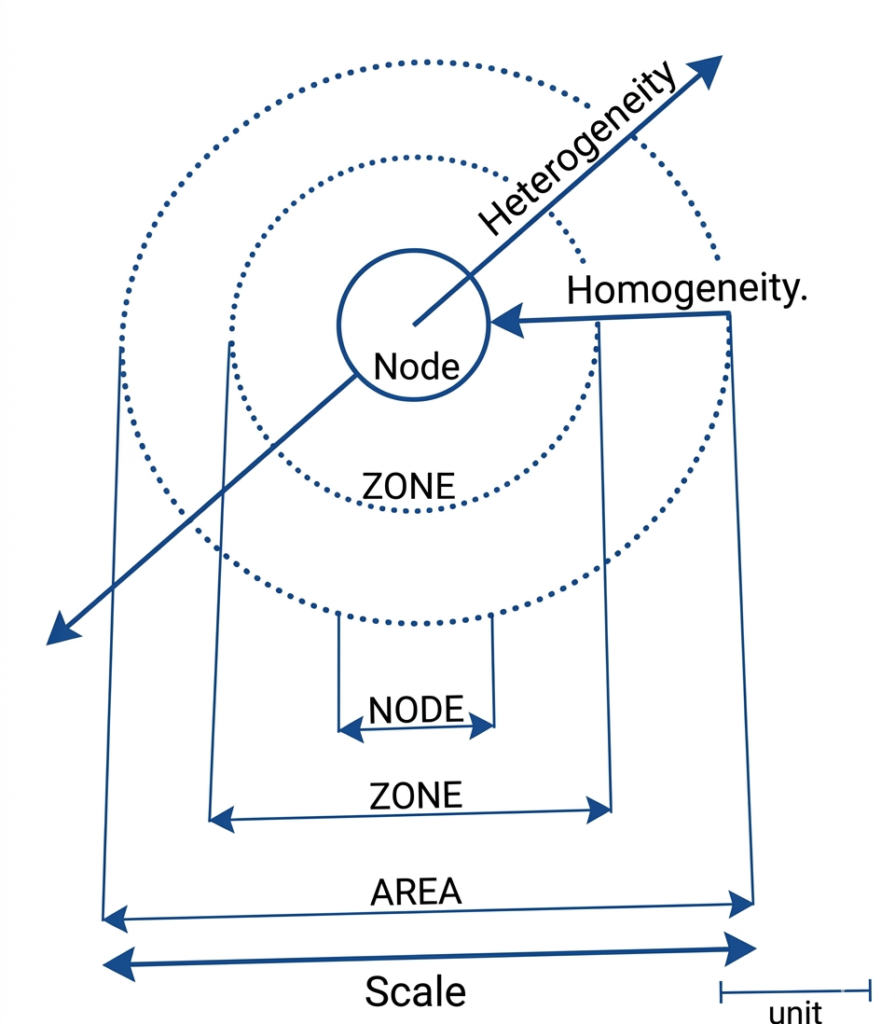
Anatomy of a Region: Node, Zone & Transitional Boundary
- Geographers — particularly those studying functional/nodal regions — have analyzed the internal spatial structure of a region in three nested components.
- Node
- Zone
- Area
- This anatomy is especially relevant to functional regions but has broader applicability:
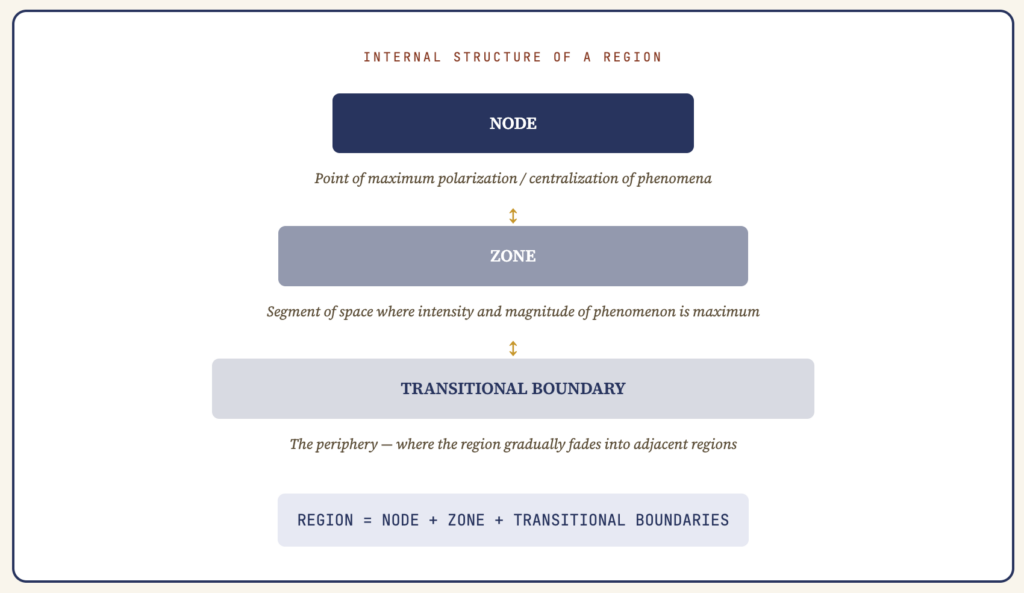
| Component | Description | Present in Formal Regions? | Present in Functional Regions? |
|---|---|---|---|
| Node | Centre of polarization or concentration of phenomena (e.g., a city, a market, a transport hub). Here, the defining characteristic is most intense. | Not clearly identifiable | Yes — central city or hub |
| Zone | The area surrounding the node where the intensity of the defining phenomenon is high — the core area of the region. | Entire region is the zone | Yes — hinterland of city |
| Transitional Boundary | The outer edge where the region’s characteristics gradually weaken and blend into those of neighbouring regions. Rarely a sharp line. | Often blurred in natural regions | Yes — fading sphere of influence |
wow material
Thanks
Descriptive and precise.
Thanks
Thnk you.
Most Welcome
Very very…good material
Thank you so much sir
Most Welcome, Keep reading
Great Work👍🏻
https://images.app.goo.gl/WUgk4WhMfJ7qVsA87
Speechless 👍👏💓🙇
This website is a gem…
Easy as well as to the point….
Thank you 🙂
Thank u
thank you my gratitude to your team is ineffable and beyond this line.ur articles are among the most descriptive and precise . i m preparing for my ba geography honours from ur website. in last 3 weeks ur page helped me 🙏🙏
if i be a successful person in my life i would surely contribute to ur team 🙂
thanks
Rishi Gupta
Nice
thanks for material.It is really helpfull.
Very helpful