- Environmental legislation is the body of statutes, rules and notifications through which the State regulates the use of air, water, land, minerals, forests and wildlife, and assigns duties, regulators and penalties for harming them.
- It is more than a regulatory instrument. Law is also an educational device: by declaring what is forbidden and what is owed, it shapes public awareness of each individual’s responsibility toward the environment.
- India’s framework stands on two foundations:
- the Constitution, which makes environmental protection a duty of the State and of every citizen and lets courts read it into the right to life;
- India’s international commitments made at Stockholm (1972), Rio de Janeiro (1992) and Johannesburg (2002), which Parliament can implement through its treaty power.
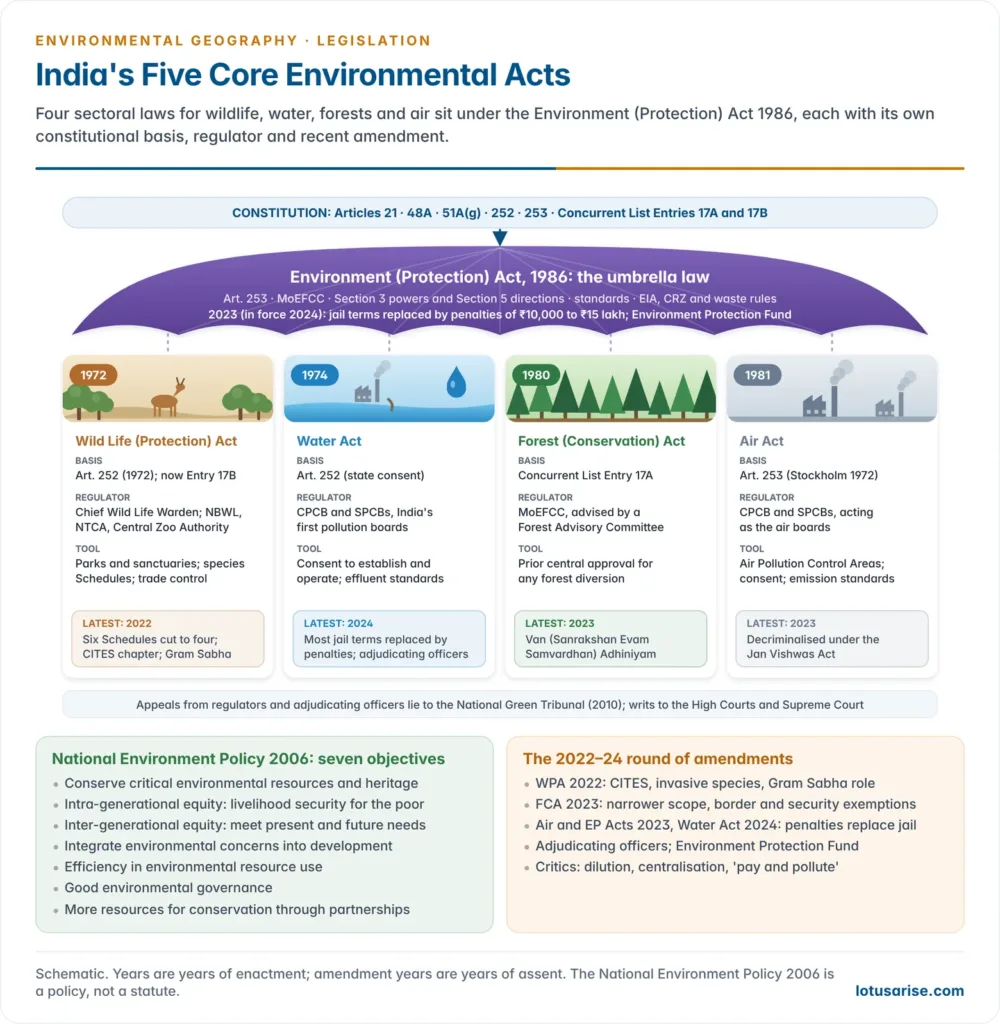
- Five core Acts form the working spine: the Wild Life (Protection) Act 1972, the Water Act 1974, the Forest (Conservation) Act 1980, the Air Act 1981 and the Environment (Protection) Act 1986. All five have been amended between 2022 and 2024.
- Beyond these five, the full body of environmental legislation also includes the Biological Diversity Act 2002, the Forest Rights Act 2006 and the National Green Tribunal Act 2010.
- The central problem is implementation, not enactment. India has one of the most comprehensive environmental statute books in the developing world, yet a fast-growing economy keeps it in tension with development, and enforcement remains the weak link.
Constitutional Foundations

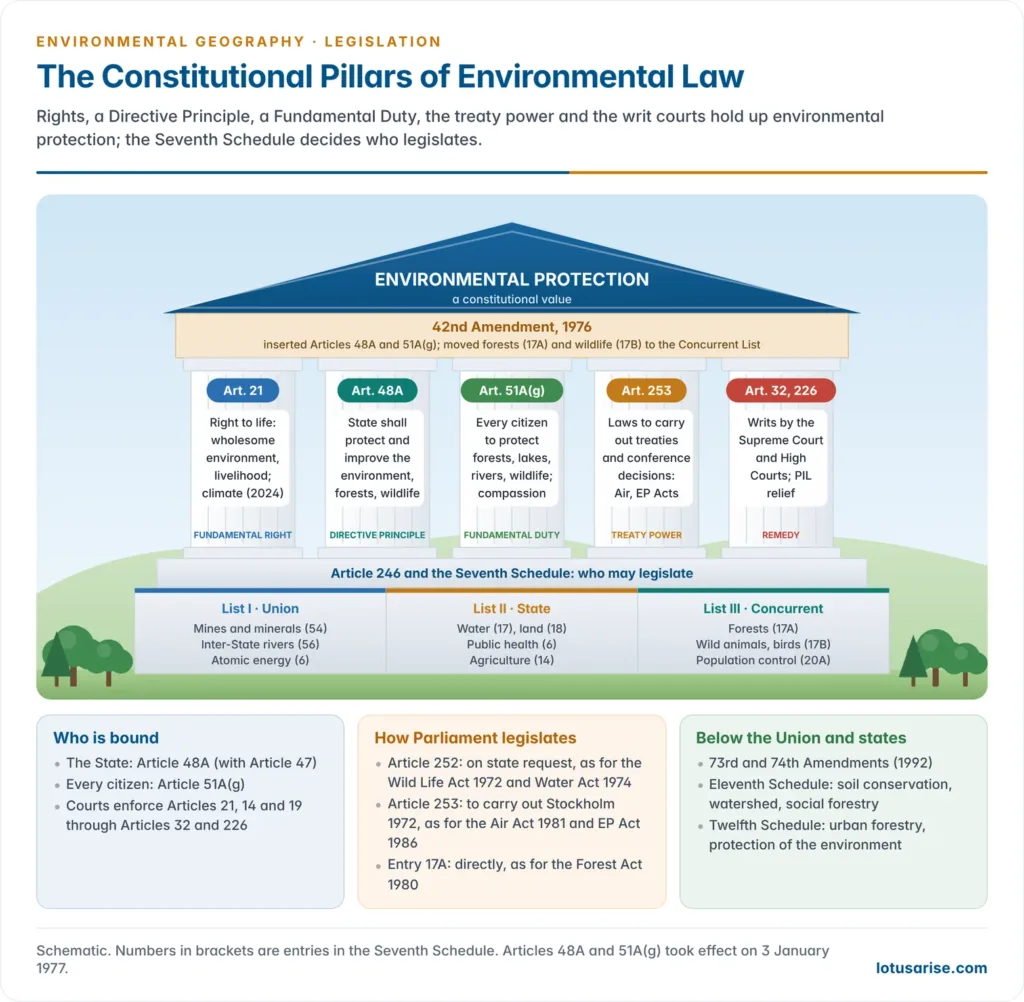
- The Constitution gives environmental protection constitutional status through four kinds of provision: Fundamental Rights, Directive Principles, Fundamental Duties and the distribution of legislative powers.
- It does not confine the environment to one article. The concern runs through the whole framework of State–citizen obligations.
The original Constitution and the 42nd Amendment, 1976
- The Constitution as adopted in 1950 had no explicit environmental provision. Public health (Article 47) and the organisation of agriculture and animal husbandry (Article 48) touched it only indirectly.
- The Constitution (Forty-second Amendment) Act, 1976 changed this through three insertions:
- Article 48A, a Directive Principle binding the State;
- Article 51A(g), a Fundamental Duty binding every citizen;
- two new entries in the Concurrent List: Entry 17A “Forests” and Entry 17B “Protection of wild animals and birds”, moved from the State List (old Entries 19 and 20).
- Why the transfer mattered: before 1976 Parliament could legislate on wildlife only by state consent under Article 252, which is how the Wild Life (Protection) Act 1972 was passed. After 1976 it could legislate directly, and the Forest (Conservation) Act 1980 followed on Entry 17A.
- The same amendment also added Entry 20A, “Population control and family planning”, to the Concurrent List.
Article 48A: the State’s duty (Directive Principle)
- Article 48A: “The State shall endeavour to protect and improve the environment and to safeguard the forests and wild life of the country.”
- Part IV Directive Principles are not enforceable as rights in a court. Courts nevertheless read them as complementary to the Fundamental Rights, and Article 48A has guided the expansive reading of other provisions in many environmental cases.
- Article 47, which obliges the State to raise the level of nutrition and improve public health, had earlier given an indirect basis for claims to a pollution-free environment.
Article 51A(g): the citizen’s duty (Fundamental Duty)
- Article 51A(g): it is the duty of every citizen “to protect and improve the natural environment including forests, lakes, rivers and wild life, and to have compassion for living creatures”.
- Article 48A binds the State; Article 51A(g) binds the citizen. This twin obligation of State and individual is the moral and legal bedrock of Indian environmental jurisprudence.
- Duties are not directly enforceable either, but courts use Article 51A(g) to interpret statutes and to justify environmental education and public-interest litigation.
Fundamental Rights and the environment
- Part III rights are judicially enforceable, and the Supreme Court has widened their environmental content along four lines.
Article 21: right to a wholesome environment
- In Maneka Gandhi v. Union of India (1978) the Supreme Court held that any law affecting life and liberty must be fair, just and reasonable. This opened Article 21 to a substantive reading.
- Courts then extended the right to life to include the right to a wholesome, pollution-free environment.
- In Subhash Kumar v. State of Bihar (1991) the Court said the right to life includes the enjoyment of pollution-free water and air.
- Pollution that harms a person’s life or health therefore violates Article 21. This reading is the single most powerful tool in Indian environmental jurisprudence.
- In M.K. Ranjitsinh v. Union of India (2024), a case on the great Indian bustard, the Court recognised a right against the adverse effects of climate change under Articles 14 and 21.
Article 21: right to livelihood
- In Olga Tellis v. Bombay Municipal Corporation (1985) the Court held the right to livelihood to be an integral part of the right to life: to deprive a person of livelihood is to deprive him of life.
- This has served as a check on projects that disrupt the livelihoods of fishers, forest dwellers and other resource-dependent communities.
Article 14: right to equality
- Article 14 guarantees equality before law and equal protection of the laws, and so forbids arbitrary State action.
- Environmental groups have used it to challenge arbitrary official sanctions, for instance mining or construction permissions granted without adequate environmental impact assessment.
Article 19(1)(g): freedom of trade, with reasonable restrictions
- Article 19(1)(g) guarantees the right to practise any profession or carry on any trade, but Article 19(6) allows reasonable restrictions in the public interest.
- In Abhilash Textiles v. Rajkot Municipal Corporation (Gujarat High Court, 1988) the court held that no one may carry on a business in a way that creates health hazards for society. Profits cannot be earned at the cost of public health.
Constitutional remedies: Articles 32 and 226
- The Supreme Court (Article 32) and the High Courts (Article 226) can issue directions, orders and writs (mandamus, certiorari, prohibition) to prevent environmental damage.
- Writ relief is speedy, inexpensive and technically simpler than a civil suit.
- Writs of mandamus have compelled municipal bodies to build drains and sewers, clean streets and clear garbage.
- Limitation: where facts are disputed and evidence must be weighed, as in claims of health injury from pollution, a civil suit may suit better, because High Courts are reluctant to take evidence in writ proceedings.
Article 246 and the Seventh Schedule: who legislates
- Article 246 distributes legislative power through the three lists of the Seventh Schedule, and environmental subjects are spread across all three.
| List | Who legislates | Environmental entries |
|---|---|---|
| List I (Union) | Parliament alone | Atomic energy (6); industries declared by Parliament (52); regulation of mines and mineral development (54); inter-State rivers (56); fishing beyond territorial waters (57) |
| List II (State) | State legislatures | Public health and sanitation (6); agriculture (14); water (17); land (18); fisheries (21); mines subject to List I (23) |
| List III (Concurrent) | Both | Forests (17A); protection of wild animals and birds (17B); population control (20A); factories (36) |
- Article 254: when a Central and a State law on a Concurrent subject conflict, the Central law prevails.
- Article 248 (with Entry 97 of the Union List) gives Parliament the residuary power over subjects in none of the lists.
- Article 252 lets Parliament legislate on a State subject for two or more states that request it by resolution. Other states may adopt the law later. The Water Act 1974 rests on it.
- The 73rd and 74th Amendments (1992) carried environmental functions to local bodies: soil conservation, watershed development and social forestry in the Eleventh Schedule, and urban forestry and protection of the environment in the Twelfth Schedule.
Article 253: the treaty power
- Article 253 empowers Parliament to make laws for the whole or any part of India to implement any treaty, agreement or convention, or any decision taken at an international conference.
- It lets Parliament legislate even on State List subjects where an international commitment requires it. This is vital because India is party to many multilateral environmental agreements.
- The Air Act 1981 and the Environment (Protection) Act 1986 were both enacted under Article 253 to carry out the decisions of the UN Conference on the Human Environment, Stockholm (June 1972).
| Article | Part | Environmental role |
|---|---|---|
| 21 | III (Fundamental Rights) | Right to life read to include a wholesome environment and livelihood |
| 14 | III | Bars arbitrary environmental permissions |
| 19(1)(g), 19(6) | III | Trade freedom subject to environmental restrictions |
| 32 and 226 | III and VI | Writ jurisdiction for environmental relief |
| 47, 48A | IV (Directive Principles) | Public health; State duty to protect environment, forests and wildlife |
| 51A(g) | IVA (Fundamental Duties) | Citizen’s duty to protect nature and show compassion to living creatures |
| 246, 252, 253 | XI | Distribution of powers; consent legislation; treaty legislation |
The Five Core Acts
Wild Life (Protection) Act, 1972
- Enacted on 9 September 1972 under Article 252, it is regarded as one of India’s most successful environmental laws.
- Objectives at enactment:
- prohibit the hunting of wild animals;
- protect and manage wildlife habitats, and set up national parks and sanctuaries;
- control trade in wildlife and wildlife products.
- It created the institutional machinery of wildlife conservation. Amendments added each body:
- the Central Zoo Authority (1991);
- the National Board for Wild Life, chaired by the Prime Minister, and the community and conservation reserves (2002);
- the National Tiger Conservation Authority and the Wildlife Crime Control Bureau (2006).
- It is one of India’s most amended laws, changed in 1982, 1986, 1991, 1993, 2002, 2006 and 2022.
- Habitat and species protection under the Act is the legal core of wildlife conservation and of India’s protected-area network.
Wild Life (Protection) Amendment Act, 2022
- Passed by the Lok Sabha (2 August 2022) and the Rajya Sabha (8 December 2022) after review by a Parliamentary Standing Committee, it received assent on 19 December 2022 and came into force on 1 April 2023.
| Change | Detail |
|---|---|
| Long title | “Protection of wild animals, birds and plants” became “conservation, protection and management of wild life“ |
| Schedules cut from six to four | Schedule I: animals with the highest protection; Schedule II: lesser protection; Schedule III: protected plants; Schedule IV: CITES-listed specimens |
| Vermin | The vermin schedule was deleted; the Centre may still declare a species vermin by notification under Section 62 |
| CITES | New Chapter VB: a Management Authority grants trade permits; a Scientific Authority advises on the impact of trade on survival |
| Sanctuary management | Sanctuaries managed under approved management plans; in Scheduled Areas and Forest Rights Act areas, plans prepared after consulting the Gram Sabha (Section 33) |
| Local rights | Grazing, movement of livestock and bona fide use of drinking and household water by local communities, until resettled, are not prohibited acts (Section 29) |
| Invasive alien species | Section 62A: the Centre may regulate or prohibit their import, trade, possession or proliferation |
| Captive elephants | Section 43: transfer or transport of a captive elephant for a religious or any other purpose allowed on conditions (contested) |
| Surrender | Section 42A: captive animals or products may be surrendered voluntarily, without compensation |
| Arms licences | Section 34(4): no renewal of an Arms Act licence for anyone within 10 km of a sanctuary without intimating the Chief Wild Life Warden |
| Zoo redefined | Now covers ex-situ conservation, rescue centres and conservation breeding centres, not only exhibition |
| Penalties | General violations: maximum fine raised from ₹25,000 to ₹1 lakh; specially protected animals: minimum fine from ₹10,000 to ₹25,000 |
- Gaps: critics note that the amendment does little on human–wildlife conflict, the use of animals on religious grounds, illegal wildlife trade and marine biodiversity.
Water (Prevention and Control of Pollution) Act, 1974
- Enacted on 23 March 1974 under Article 252, after several state legislatures passed consent resolutions. It aims to prevent and control water pollution and to maintain or restore the wholesomeness of water.
- Key provisions:
- It created the Central Pollution Control Board (CPCB) and the State Pollution Control Boards (SPCBs), India’s first pollution regulators.
- Consent system: no industry, process or treatment and disposal system may be established or operated without the prior consent of the State Board.
- No discharge of sewage or trade effluent into a stream, well, sewer or on land beyond prescribed standards.
- The Boards have powers of entry, inspection and sampling. The 1988 amendment added the power to issue directions, including closure of a unit and cutting off water or power (Section 33A).
- The Act was amended in 1978 and 1988.
- The Water (Prevention and Control of Pollution) Cess Act, 1977 levied a cess on water consumed by industries and local bodies to fund the Boards. It was repealed in 2017 when GST subsumed such cesses.
Water (Prevention and Control of Pollution) Amendment Act, 2024
- Assent on 15 February 2024. It applied first to Himachal Pradesh, Rajasthan and the Union Territories; other states adopt it by resolution under Article 252.
- Decriminalisation: imprisonment for most violations, including breach of discharge standards and tampering with monitoring devices, was replaced by penalties of ₹10,000 to ₹15 lakh.
- Running an industry without consent still carries imprisonment of up to six years.
- Adjudicating officers of Joint Secretary rank (Centre) or Secretary rank (state) impose penalties. Appeals go to the National Green Tribunal on deposit of 10% of the penalty.
- The Centre may exempt categories of industry from prior consent and may set guidelines for consent and for nominating SPCB chairpersons.
- Penalties go to the Environment Protection Fund under the EP Act. Its use was set out in rules notified in January 2026, with 75% of the money going to the state where it is collected.
Forest (Conservation) Act, 1980, now the Van (Sanrakshan Evam Samvardhan) Adhiniyam
- Promulgated as an ordinance on 25 October 1980 and enacted in December 1980, it was the Centre’s answer to the rapid conversion of forest land. It is a short Act, amended in 1988.
- Objectives and features:
- Prior approval of the Central Government is needed before a state de-reserves a forest or uses forest land for any non-forest purpose.
- It aims to protect forests with their flora, fauna and ecological components and to arrest the loss of forest biodiversity.
- It stops conversion of forest land to agriculture, grazing or commerce, and compensatory afforestation is a condition of approval.
- An Advisory Committee advises the Centre on diversion proposals; violations attract penalties.
- The definition question: in T.N. Godavarman Thirumulpad v. Union of India (1996) the Supreme Court held that “forest” must be read in its dictionary sense, covering all forests whatever their ownership or recorded status.
Forest (Conservation) Amendment Act, 2023
- Assent on 4 August 2023; in force from 1 December 2023. Its preamble ties forests to the Net Zero by 2070 target and to the NDC goal of an additional carbon sink of 2.5–3 billion tonnes of CO₂-equivalent by 2030.
| Provision | Detail |
|---|---|
| New name | Van (Sanrakshan Evam Samvardhan) Adhiniyam, 1980 (Forest Conservation and Augmentation Act) |
| Applicability | Land notified as forest under the Indian Forest Act 1927 or any other law, and land recorded as forest in government records on or after 25 October 1980 |
| Excluded | Land lawfully changed from forest to non-forest use on or before 12 December 1996; plantations on non-forest land |
| Exemptions | Forest land along rail lines and public roads giving access to habitation, with roadside amenities up to 0.10 ha; strategic linear projects within 100 km of the international border, LoC or LAC; security infrastructure up to 10 ha; defence, paramilitary or public utility projects up to 5 ha in Left Wing Extremism-affected areas |
| New forestry activities | Government zoos and safaris outside protected areas, eco-tourism in approved plans, silviculture, and infrastructure for frontline forest staff; certain surveys not treated as non-forest use |
| Leasing | Prior Central approval now needed to assign forest land to any entity, including government-owned ones, on conditions set by the Centre |
- Criticism: environmentalists and tribal-rights groups argue that the amendment narrows the definition of forest, leaving out unrecorded “deemed” forests, and widens exemptions, especially in the ecologically fragile border Himalaya and North-East.
- In February 2024 the Supreme Court directed states to keep applying the Godavarman definition until forest-like areas are fully recorded. In September 2026 it said it would test the constitutional validity of the new definition against that standard, while the challenge remains pending.
- Forest diversion is one driver of deforestation in India, and its clearance runs in parallel with environmental impact assessment.
Air (Prevention and Control of Pollution) Act, 1981
- Enacted on 29 March 1981 under Article 253, to carry out the decisions of the Stockholm Conference (1972), where nations agreed to take steps to preserve natural resources, including the quality of air.
- Key provisions:
- It applies to the whole of India. The CPCB and SPCBs set up under the Water Act also act as the air boards.
- Section 19: a state government, in consultation with its SPCB, may declare Air Pollution Control Areas; several states have declared their entire territory one.
- Section 21: no industrial plant in such an area may be established or operated without the SPCB’s consent; the Board must decide an application within four months.
- Sections 22 and 22A: no emissions beyond the standards laid down by the Board, which may seek a court order to restrain an apprehended violation.
- The Boards hold powers of entry, inspection, sampling and direction.
- It regulates emissions of particulate matter, lead, carbon monoxide, sulphur dioxide, nitrogen oxides, volatile organic compounds and other toxic substances from industries, power plants, vehicles and other engines.
- The 1987 amendment brought noise within the definition of an air pollutant, and gave the Boards power to issue closure directions (Section 31A). It also let any citizen take an offender to court after giving notice.
- The National Ambient Air Quality Standards (2009) are notified under this Act. The Delhi region now also has a dedicated Commission for Air Quality Management (2021).
- The Jan Vishwas (Amendment of Provisions) Act, 2023 decriminalised most Air Act offences, replacing jail terms with penalties of ₹10,000 to ₹15 lakh set by adjudicating officers. Operating without consent remains punishable with imprisonment.
- The Act is the legal base for India’s response to urban air pollution.
Environment (Protection) Act, 1986
- Enacted on 23 May 1986 under Article 253, after the Bhopal gas disaster (December 1984), and in force from 19 November 1986. It is India’s umbrella environmental law, filling the gaps between the sectoral Acts.
- “Environment” (Section 2(a)) includes water, air and land and the inter-relationships among them and human beings, other living creatures, plants, micro-organisms and property.
- Section 3 empowers the Central Government to take all measures it deems necessary to protect and improve the environment and to prevent, control and abate pollution.
- It may lay down emission and discharge standards, restrict the location of industries, and constitute authorities under Section 3(3), such as the Central Ground Water Authority.
- Section 5 lets the Centre issue binding directions, including the closure, prohibition or regulation of any industry or the stoppage of electricity and water.
- The Ministry of Environment, Forest and Climate Change (MoEFCC) administers the Act. It is the source of most of India’s delegated environmental law:
- the Environmental Impact Assessment notifications (1994, 2006);
- Coastal Regulation Zone notifications (1991, 2011, 2019) and Eco-Sensitive Zones;
- rules on hazardous, plastic, solid, bio-medical and e-waste.
- 2023 amendment (Jan Vishwas): imprisonment was removed for contraventions. Penalties of ₹10,000 to ₹15 lakh are imposed by adjudicating officers, and an Environment Protection Fund receives them.
- These provisions came into force on 1 April 2024. In October 2024 the Supreme Court called the amended penalty provision “toothless” because rules were still missing. The adjudication rules followed in November 2024.
| Act | Constitutional basis | Regulator | Main tool | Latest change |
|---|---|---|---|---|
| Wild Life (Protection) Act 1972 | Art. 252, then Entry 17B | Chief Wild Life Warden, NBWL, NTCA | Protected areas, Schedules, trade control | 2022: four Schedules, CITES chapter |
| Water Act 1974 | Art. 252 | CPCB, SPCBs | Consent to establish and operate; effluent standards | 2024: decriminalised, adjudicating officers |
| Forest (Conservation) Act 1980 | Entry 17A | MoEFCC, Advisory Committee | Prior central approval for diversion | 2023: renamed, narrower scope, exemptions |
| Air Act 1981 | Art. 253 | CPCB, SPCBs | Air Pollution Control Areas; consent; emission standards | 2023: decriminalised (Jan Vishwas) |
| Environment (Protection) Act 1986 | Art. 253 | MoEFCC, Section 3(3) authorities | Standards, directions, EIA and CRZ notifications | 2023: penalties, Environment Protection Fund |
The policy frame: National Environment Policy, 2006
- The National Environment Policy (May 2006) turned the constitutional mandate of Articles 48A, 51A(g) and 21 into national environmental policy. It set seven objectives, from conserving critical resources and intra- and inter-generational equity to integrating the environment into development, efficient resource use, good governance and more resources for conservation. It rests on fourteen principles, such as polluter pays, the precautionary approach and the public trust doctrine.
- It holds that people dependent on a resource must gain more from conserving it than from degrading it. Being a policy, not a statute, it has no binding force of its own and works through the Acts above.
Legislative Timeline
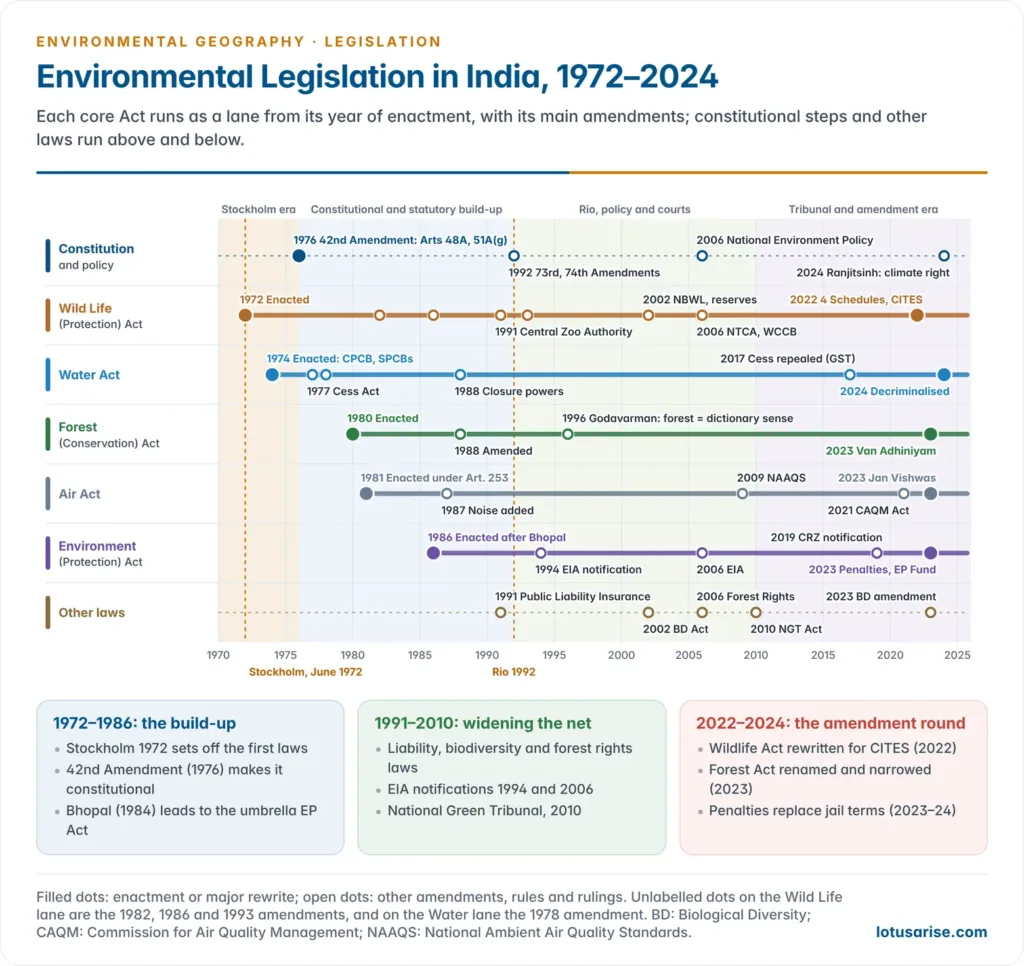
| Year | Milestone | Significance |
|---|---|---|
| 1972 | Wild Life (Protection) Act | Hunting banned; national parks and sanctuaries; same year as Stockholm |
| 1974 | Water Act | CPCB and SPCBs; consent system |
| 1976 | 42nd Amendment | Articles 48A, 51A(g); forests and wildlife to the Concurrent List |
| 1977 | Water Cess Act | Cess to fund the Boards (repealed 2017) |
| 1980 | Forest (Conservation) Act | Central approval for forest diversion |
| 1981 | Air Act | Under Article 253; Air Pollution Control Areas |
| 1986 | Environment (Protection) Act | Umbrella law after Bhopal; basis for EIA |
| 1987–88 | Air, Water and Forest amendments | Noise added; closure directions; citizen complaints |
| 1991 | Public Liability Insurance Act; WPA amendment | Insurance for hazardous industries; Central Zoo Authority |
| 2002 | Biological Diversity Act; WPA amendment | National Biodiversity Authority; NBWL; community reserves |
| 2006 | Forest Rights Act; NEP; EIA notification; WPA amendment | Forest dwellers’ rights; policy frame; NTCA and WCCB |
| 2010 | National Green Tribunal Act | Specialised environmental court |
| 2022 | WPA amendment | Four Schedules; CITES chapter |
| 2023 | Forest (Conservation) amendment; Jan Vishwas Act; Biological Diversity amendment | Adhiniyam; decriminalisation of EP and Air Acts |
| 2024 | Water amendment | Penalties in place of imprisonment |
Critical Evaluation
- India’s environmental legal architecture is among the most comprehensive in the developing world, but persistent gaps separate legislative intent from outcomes on the ground.
| Strength | Weakness or gap |
|---|---|
| Constitutional status: Articles 21, 48A and 51A(g) give protection legal standing | Weak enforcement: many SPCBs are understaffed, short of technical experts and underfunded |
| Broad coverage: air, water, forests, wildlife, biodiversity, with the EP Act as umbrella | Fragmentation: poor coordination among MoEFCC, Jal Shakti, CPCB, SPCBs and local bodies |
| Judicial activism: writs and PILs have filled enforcement gaps | Writs are ill-suited to complex, evidence-heavy pollution cases; court orders often go unimplemented, as with the municipal solid-waste directions of the 2000s |
| National Green Tribunal (2010): specialised, faster environmental justice | Heavy case load; compliance with its orders is uneven |
| Amendments bring in CITES, invasive species and climate goals | 2022 WPA and 2023 FCA amendments seen as diluting protection in favour of development |
| Decriminalisation (2023–24) promises quicker, proportionate penalties | Critics call it “pay and pollute”; penalty rules lagged the law, and the consent exemptions centralise power |
| NEP 2006 offers a coherent set of principles | A policy without statutory teeth |
- Command and control dominates. The Acts rely on consents, standards and penalties, with little use of market-based instruments or of local communities, though the 2022 Gram Sabha clause is a start.
- Federal strain: Article 252 laws such as the Water Act apply only where states adopt them, and the 2024 amendment shifts consent guidelines and Board appointments toward the Centre.
- Equity concerns: forest diversion and protected-area rules bear hardest on tribal and forest-dwelling communities. This keeps the Forest Rights Act and the right to livelihood under Article 21 central to the debate.
- The way forward: independent, well-staffed regulators; continuous emission monitoring with public data; a single, consolidated environmental code; and laws that treat the forest, water and climate commitments behind the 2070 net zero target as one agenda.
Previous Year Questions
- No direct PYQ has been asked on this sub-topic yet.