

- Walther Penck (1888–1923), the German geomorphologist and son of Albrecht Penck, offered the main alternative to the geographical cycle of William Morris Davis (1899).
- His model appeared posthumously as Die morphologische Analyse (1924), edited by his father; an English translation followed only in 1953.
- The core claim: landforms express the ratio between the rate of uplift (endogenetic) and the rate of erosion (exogenetic), and the two act at the same time.
- Landscape is therefore read as a record of crustal movement, not as a stage in a time-bound sequence of youth, maturity and old age.
- Penck called it a morphological system or morphological analysis; whether he ever used the word “cycle” is itself disputed.
The Morphological System
Why Penck Rejected Davis
- Short, rapid uplift followed by long stillstand, the Davisian starting point, did not match what Penck saw in the Andes of the Puna de Atacama (Argentina), Anatolia and the Black Forest (Germany).
- He argued that uplift is slow, prolonged and variable, and that erosion begins as soon as the land starts to rise.
- He replaced “stage” with Entwicklung (development), making landform change time-independent: the same form can arise at any time if the uplift–erosion ratio is the same.
Basic Premises
- Competition principle: the form of any region results from the contest between crustal movement and denudation.
- Inverse reasoning: the type, rate and cause of tectonic movement can be deduced from landforms, so the model is essentially deductive.
- Hillslope form depends on the relative rates of valley incision by rivers and removal of debris from the slope.
- Uplift and erosion coexist at all times.
- Three crustal states:
- stability, with no active displacement;
- initial domed uplift of a limited area, later spreading outward;
- extensive regional uplift.
- Three states of adjustment between uplift and valley deepening, all tending to equilibrium:
- uplift steady for long: incision keeps pace and the two balance;
- uplift faster than incision: channel gradient steepens until incision catches up;
- incision faster than uplift: gradient falls until the rates match again.
- Pattern of uplift: slow start, acceleration, deceleration and finally quiescence; most tectonic movements begin and end slowly.
Primärrumpf: The Starting Surface
- Primärrumpf (primary peneplain) is the initial surface of low altitude and low relief before uplift.
- It may be a surface newly raised from below sea level, or a worn-down surface (Fastebene) lifted without first gaining high relief.
- It can show truncated beds and structures yet need never have stood higher.
- Development begins with regional updoming of the Primärrumpf.
Phases of Development
| Phase (Penck’s term) | Uplift vs erosion | Absolute altitude | Relative relief | Valley and slope form |
|---|---|---|---|---|
| Waxing (aufsteigende Entwicklung) | Uplift accelerates, exceeds incision | Rises | Rises | Deep, narrow V-valleys; convex slopes |
| Uniform (gleichförmige Entwicklung) | Uplift steady, then ceasing; incision matches summit lowering | Rises, then constant, then falls | Constant | Straight (rectilinear) slopes |
| Waning (absteigende Entwicklung) | No uplift; lateral erosion dominates | Falls | Falls | Wide valleys; concave slopes |
Waxing Development
- Uplift quickens; steeper channels and higher velocity drive accelerated downcutting, yet uplift still outpaces it.
- Both divide summits and valley floors rise, so absolute height and relative relief both increase.
- Valley sides steepen and become convex in profile; the radius of convexity shrinks as the steep segments retreat.
- Piedmonttreppen (piedmont benchlands) form: as the dome widens, its slowly rising margins carry successive piedmont flats (Piedmontflächen), leaving a staircase of benches around the Primärrumpf.
- Penck’s type area was the southern Black Forest.
- Indian parallel: the Himalaya shows uplift and incision acting together.
- A 2021 study of the Chenab valley in the Kishtwar Window (Jammu and Kashmir) found bedrock incision above 3 mm per year, close to the long-term exhumation rate of about 3 mm per year, the balance Penck predicted.
- The Indus, Sutlej and Siang gorges are the deep V-valleys of a rising mountain belt.
Uniform Development
- Sub-phase (a): uplift still exceeds summit erosion, so altitude keeps rising slowly and reaches its maximum; relative relief is constant.
- Sub-phase (b): uplift is exactly matched by lowering of summits, so both altitude and relief stay constant.
- Sub-phase (c): uplift stops; summits begin to fall, but relief stays constant because valley deepening equals summit lowering.
- Valley sides stay straight through parallel retreat.
Waning Development
- Lateral erosion and valley widening replace downcutting as channel gradient and energy decline; altitude and relief both fall.
- Each valley side splits into two segments:
- Böschung (gravity slope): the steep upper face, which keeps its angle as it retreats;
- Haldenhang (wash slope): the gentler talus-covered lower slope, which grows upslope at the gravity slope’s expense.
- Their junction is a sharp knick (break of slope).
- Böschungen of adjoining valleys intersect and lower the divides, then shrink to steep-sided residuals, the inselbergs.
- Finally the inselbergs are consumed and a surface of coalescing concave wash slopes, the Endrumpf (end peneplain), results.
- The Endrumpf corresponds to Davis’s peneplain.
- Indian parallel: granite and gneiss inselbergs rise from the worn surfaces of the Peninsular plateau, as in Bundelkhand and around Ranchi.
Slope Development in Penck’s Model
Retreat of a Slope Unit
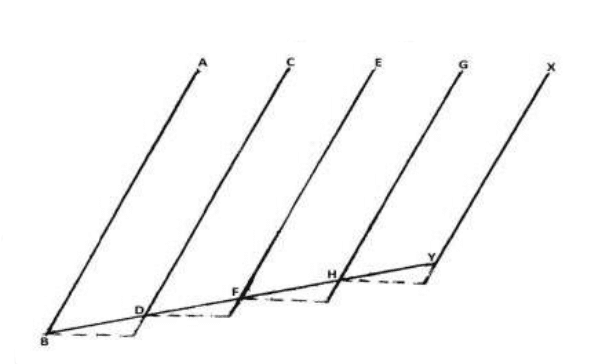
- Penck took a straight, steep slope unit bordering a river and assumed equal weathering over its whole face.
- Weathered debris falls to the foot; the lowest particle is not removed because there is no gradient below it.
- The face therefore retreats parallel to itself (AB to CD to EF and on to XY), shortening as it goes.
- Some debris stays at the foot as a transport slope down to the river, which is not eroding at this point.
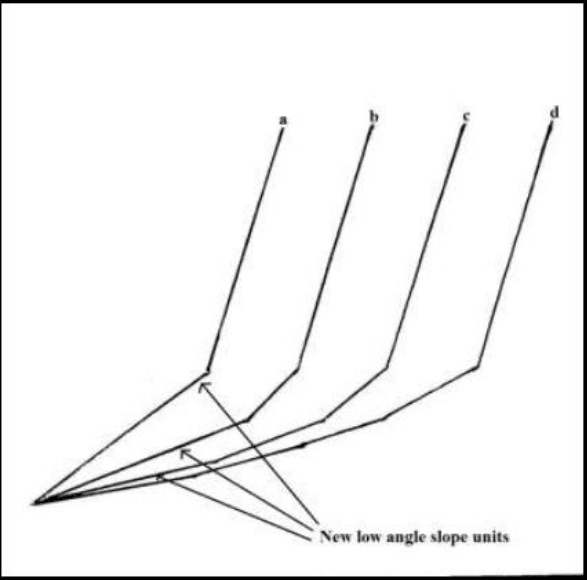
- Result: a steep slope retreats upslope, keeps its angle and leaves a basal slope of lower gradient.
Slope Replacement and Basal Concavity
- The basal slope is weathered in turn to finer debris; its lowest part again stays, so a still gentler unit is added beneath it.
- Repeated, this builds a series of units, each gentler than the one above, all migrating upslope.
- The outcome is a basal concavity: flattening proceeds from below upwards.
- The original steep face is eventually destroyed; relief is lowered and slope angle declines.
- This is slope replacement, the idea behind the Böschung–Haldenhang pair.
Slope Form and Rate of River Incision
- The rate of downcutting at the slope foot is the overriding control on slope form.
| Rate of river incision | Slope form | Penck’s term |
|---|---|---|
| Accelerating | Convex | Waxing slope |
| Constant | Rectilinear | Uniform slope |
| Decelerating | Concave | Waning slope |
- The link runs through incision, not uplift directly: uplift matters only as it changes the river’s cutting rate.
Evaluation
Penck and Davis Compared
| Aspect | Davis | Penck |
|---|---|---|
| Uplift | Short and rapid, then long stillstand | Slow, prolonged, varying in rate |
| Uplift and erosion | Erosion mostly after uplift | Simultaneous |
| Time | Stages: youth, maturity, old age | Entwicklung: waxing, uniform, waning |
| Slope change | Slope decline from above | Slope replacement from below |
| End surface | Peneplain | Endrumpf |
| Method | Descriptive, time-dependent | Deductive, time-independent |
Criticism
- Misread more than refuted: his work was unfinished at his early death, written in difficult German with ill-defined terms, and some ideas were contradictory.
- Davis’s critical review (1932) of the Primärrumpf and piedmont benchlands shaped the English-speaking view before the text itself was translated.
- Parallel retreat or replacement? Early English readings credited Penck with parallel slope retreat; Martin Simons’s 1962 reassessment showed that he argued for slope replacement, with parallel retreat only of the individual units.
- Long-continued uplift and the dome model of piedmont benchlands found little support.
- Staircase surfaces elsewhere are more often explained by repeated rejuvenation, as for the stepped surfaces of the Chotanagpur plateau.
- Incision alone is not enough: structure, rock type and climate also shape slopes.
Current View
- Penck’s lasting insight is that tectonics and erosion must be analysed together, which is the starting point of modern tectonic geomorphology.
- The idea of topographic steady state, where uplift and erosion balance so relief stays constant, restates his uniform development.
- Studies of the Indus near Nanga Parbat found incision of 2–12 mm per year, with hillslopes held at a threshold angle by landsliding.
- His slope concepts survive; the purely deductive link between uplift history and slope form does not.
- Lester Charles King built parallel retreat into pediplanation.
Previous Year Questions
2012Explain how Bosche and Haldenhang lead to the Theory of Slope Replacement.2008Critically examine the concept of geomorphic cycle and discuss the views of W.M. Davis and W. Penck.1994Discuss the concept of cycle of erosion and bring out clearly the difference between the views of Davis and Penck.1990Analyse the differences in the models of slope evolution proposed by Davis and Penck.1986Discuss the views of W.M Davis and Walter Penck on the cycle of erosion.





Good
Sir, the sentences in bold are enough to write as an answer or can I write answers even from normal sentences?