

Growth Pole and Growth Centre Theory

- Economic development is the most coveted goal for an economy and a nation. Various policy frameworks, economic plans and regional strategies are formulated by governments to overcome stagnation and accelerate growth.
- The theory of Growth Pole and Growth Centre emerged from this concern. It tries to explain how rapid economic growth can be generated in a short span of time by concentrating investment around selected propulsive activities and places.
- Growth Pole Theory argues that development does not begin everywhere at the same time. It begins at selected poles of economic dynamism and later spreads through linkages, agglomeration, innovation and multiplier effects.
- In regional geography, the theory is important because it explains both development concentration and regional imbalance. A growth pole may become an engine of regional development, but if benefits do not diffuse, it may also become a source of inequality.
Origin and Intellectual Background
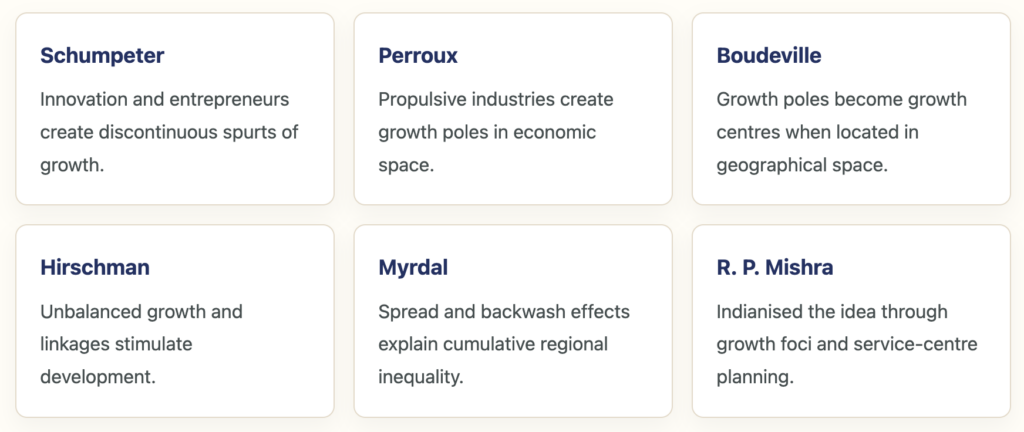
- François Perroux proposed Growth Pole Theory in 1955 as part of economic planning in France. He was concerned with the phenomenon of economic development and the process of structural change.
- The concept of Growth Centre was later developed by Jacques Boudeville, who gave a regional character and specific geographical content to Perroux’s conception.
- Boudeville’s studies of Minas Gerais, a major iron-ore region of Brazil, helped translate the abstract idea of growth pole into a real spatial planning concept.
- Growth Pole Theory is an inductive economic model with a geographical analysis of space. Inductive means moving from particular observations to general principles.
Context: Alternative to Central Place Theory
- Growth Pole was projected as an alternative model to the Central Place Theory (CPT) of Christaller and Lösch, where an idealistic, hierarchical distribution of various centres (production centres, service provider centres) was organized.
- However, CPT could not serve the purpose of the overall development of a country — it described the existing settlement hierarchy but did not explain how to generate development in lagging regions. The Growth Pole Theory provided that missing policy instrument.
| Dimension | Central Place Theory (CPT) | Growth Pole Theory (GPT) |
|---|---|---|
| Purpose | Describe hierarchy of service centres | Explain and direct uneven economic development |
| Focus | Consumer services and market areas | Propulsive industries and production linkages |
| Space concept | Geometric/isotropic geographic space | Abstract economic space → later geographic space |
| Development model | Equilibrium — uniform distribution | Disequilibrium — growth poles dominate |
| Policy relevance | Service planning, settlement hierarchy | Industrial location, regional development strategy |
| Proposer | Christaller (1933), Lösch (1940) | Perroux (1955), Boudeville (1960s) |
Perroux’s fundamental insight: “Growth does not appear everywhere at the same time. It manifests itself in points or poles of growth with variable intensities. It spreads by different channels and with varying terminal effects for the economy as a whole.” This single observation — that growth is inherently uneven and spatially concentrated — is the foundation of the entire theory.
| Concept | Main Thinker | Nature | Core Meaning |
|---|---|---|---|
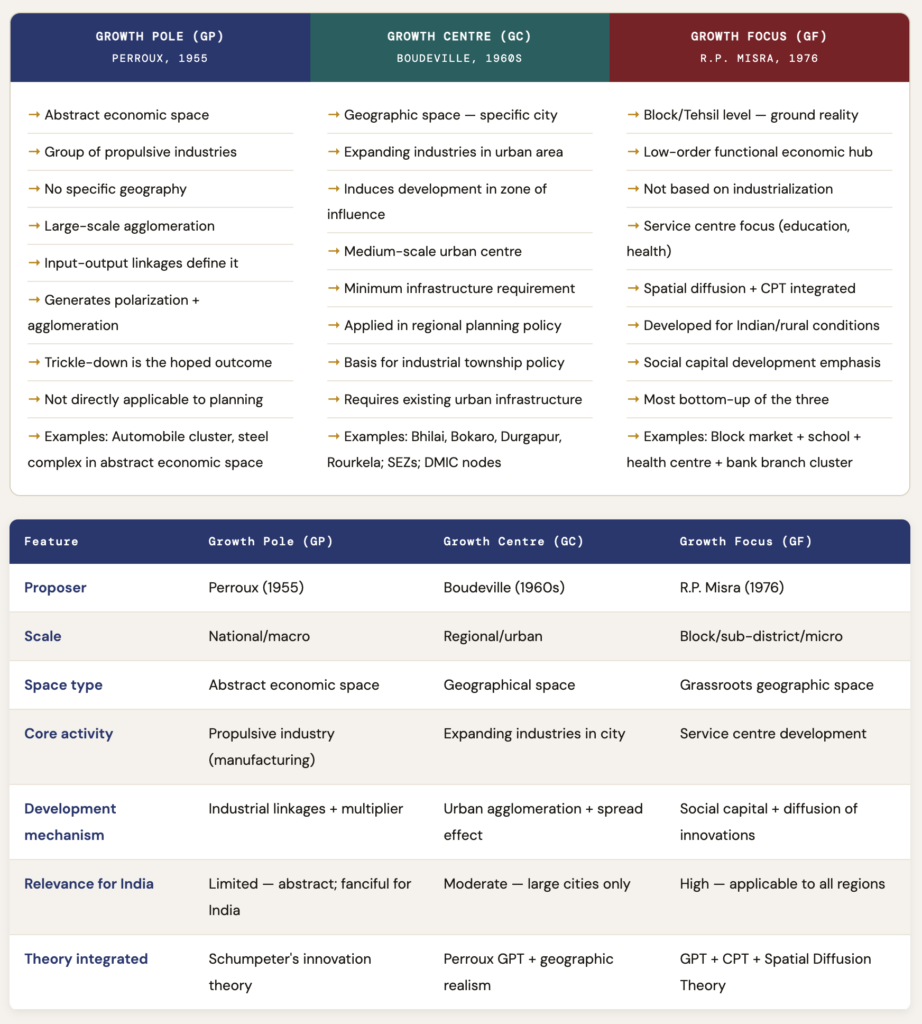
| Growth Pole | François Perroux | Economic and abstract | Dynamic industry or firm generating growth impulses. |
| Growth Centre | Jacques Boudeville | Geographical and regional | Spatial location where growth impulses are concentrated. |
| Growth Foci | R. P. Mishra | Indianised and local-level | Low-order functional hub at block or tehsil level. |
Schumpeterian Base
- Perroux’s arguments were influenced by Joseph Schumpeter. Schumpeter argued that development takes place through discontinuous spurts caused by innovation and innovative entrepreneurs. These entrepreneurs usually operate through large-scale firms that introduce new products, new techniques, new markets and new forms of organisation.
- Thus, growth pole theory is not merely about location. It is about innovation, dominance, linkages and structural transformation.
Growth Pole Theory
- Francois Perroux attempted to explain how the modern process of economic growth deviated from the stationary conception of equilibrium growth. His arguments were based on Schumpeter’s theoriesof the role of innovations and large-scale firms.
- In Schumpeter’s analysis, development occurs as a result of discontinuous spurts in a dynamic world. The cause of discontinuous spurts is the innovative entrepreneur whose activities take place in large-scale firms. These firms are able to dominate their environment in the sense of exercising reversible and partially reversible influences on other economic units by reason of their dimension and negotiating strength, and by the nature of their operations.
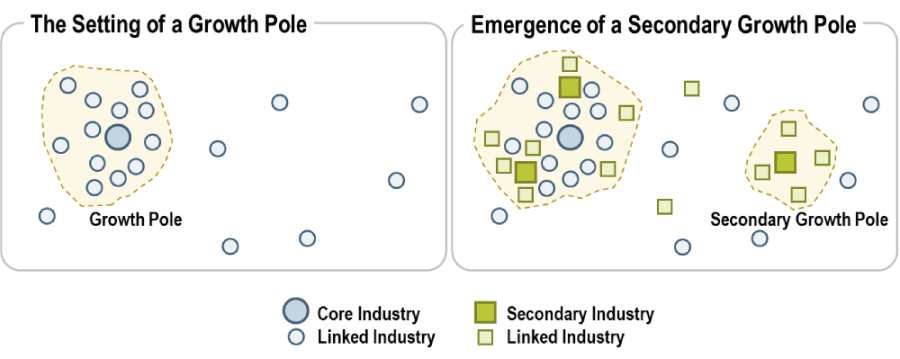
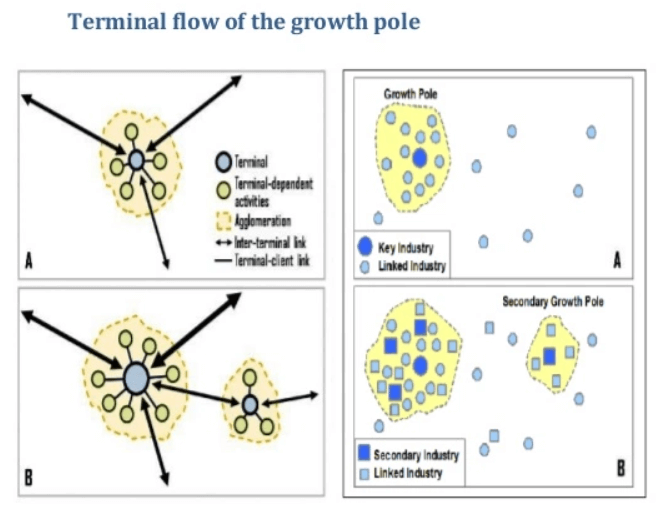
- A Growth Pole (GP) is a dynamic and highly integrated set of industries organized around a propulsive leading industry.
- E.g- the TISCO plant (Iron & steel) which leads to the establishment of a dynamic & integrated set of industries around it and is linked to it. Then the whole region around this TISCO will be known as the Growth Pole which will propel the growth of the whole region.
- The central idea of the growth poles theory is that economic development, or growth, is not uniform over an entire region, but instead takes place around a specific pole (or cluster). This pole is often characterized by core (key) industries around which linked industries develop, mainly through direct and indirect effects.
- Core industries can involve a wide variety of sectors such as automotive, aeronautical, agribusiness, electronics, steel, petrochemical, etc.
- Direct effects imply the core industry is purchasing goods and services from its suppliers (upstream linked industries) or providing goods and services to its customers (downstream linked industries).
- Indirect effects can involve the demand for goods and services by people employed by the core and linked industries supporting the development and expansion of economic activities such as retail.
- The expansion of the core industry implies the expansion of output, employment, related investments, as well as new technologies and new industrial sectors.
Perroux’s Growth Pole Theory (1955)
- A Growth Pole is an abstract economic area — a cluster of propulsive industries organized around a leading/dominant industry — that acts as a field of force from which centrifugal forces emanate to the periphery and to which primary products are attracted for value addition. Growth poles do not mean geographical areas such as cities or towns. They may be single firms, industries, or groups of industries in abstract economic space.
- Perroux’s contribution was to recognize that the economic landscape is not homogeneous — it contains dominant and dominated units, poles and peripheries, and the interaction between them drives both growth and inequality. His growth pole theory is built on three interconnected concepts:
- Dynamic Propulsive Firm
- A large, innovative, fast-growing firm that dominates its sector and transmits growth impulses to linked firms and sectors through forward and backward linkages.
- Inter-Industry Linkages
- The growth pole generates growth through forward linkages (outputs used by other sectors) and backward linkages (inputs demanded from other sectors), spreading development through the production system.
- Innovation & Multiplier
- Schumpeterian innovation in the propulsive firm lowers costs, expands output, induces new investment, and generates local multiplier effects — income, employment, and technology spillovers to the region.
- Dynamic Propulsive Firm
- Three Primary Characteristics of a Growth Pole
- It is dominated by a propulsive industry with Schumpeterian characteristics — large scale, high innovation capacity, and strong inter-industry connections
- It produces polarization and agglomeration effects — drawing capital, labour, and enterprise from the hinterland toward the pole (centripetal forces/backward linkages)
- It generates spread effects / trickle-down — sending finished goods, technology, income, and employment to the surrounding region (centrifugal forces/forward linkages)
The Dynamic Propulsive Firm & Leading Propulsive Industry
- A Dynamic Propulsive Firm is a firm that is relatively large, has a high ability to innovate, belongs to a relatively fast-growing sector, and whose quantity and intensity of interrelations with other sectors of the economy is important enough for the induced effects to be transmitted to them.
- Examples: Walmart, Flipkart, automobile industries — any dominant, technologically advanced, fast-expanding enterprise that generates multiplier effects throughout the economy.
- Characteristics of a Dynamic Propulsive Firm
- Relatively Large Scale
- Size and dominance allow the firm to set prices, define standards, and influence the entire supply chain. Smaller firms orbit the propulsive firm as suppliers or customers.
- High Innovation Ability
- Schumpeterian innovations — new products, new processes, new markets, new organizations — continuously lower costs and expand output, making the firm a technology leader.
- Fast-Growing Sector
- Belongs to a sector with high income elasticity of demand — as incomes rise, demand for its products rises disproportionately (e.g., automobiles, electronics, petrochemicals).
- Strong Inter-Industry Linkages
- Marked local multiplier effects and strong forward-backward linkages — its expansion triggers expansion in supplier and user industries, creating a cascade of induced investments.
- Relatively Large Scale
- Leading Propulsive Industry
- When multiple dynamic propulsive firms cluster together in a single sector, they form a Leading Propulsive Industry. Such an industry has:
- Highly advanced level of technology and managerial expertise
- High income elasticity of demand for its products — demand grows faster than income
- Marked local multiplier effects — expansion generates ripple effects throughout the local economy
- Strong inter-industry linkages with other sectors — both forward (outputs) and backward (inputs)
- When multiple dynamic propulsive firms cluster together in a single sector, they form a Leading Propulsive Industry. Such an industry has:
| Industry Type | Example | Forward Linkage | Backward Linkage |
|---|---|---|---|
| Steel | Bhilai, Bokaro, Rourkela plants | Automobile, construction, machinery manufacturing | Iron ore, coal, limestone mines |
| Automobile | Maruti Suzuki (Gurugram), Tata Motors (Pune) | Transport services, logistics, tourism | Rubber, steel, glass, electrical components, petrochemicals |
| Petrochemicals | Jamnagar refinery (Reliance) | Plastics, fertilizers, pharmaceuticals, synthetic textiles | Crude oil extraction, pipeline infrastructure |
| IT/Software | Bengaluru tech hub | BPO, fintech, e-commerce, smart city applications | Hardware manufacturing, telecom infrastructure, education |
| Textiles | Ahmedabad, Ludhiana, Coimbatore | Garment manufacture, retail, export logistics | Cotton farming, yarn spinning, dyeing industry |
How innovation creates development through the pole: Innovation in the propulsive firm → lower cost of production → lower price → demand increases → industry expansion → more employment and income → induced investment in linked industries → new industrial sectors emerge → technology spillovers to smaller firms. Thus the Schumpeterian theory of development, combined with backward and forward linkages, acts as the fulcrum establishing activities in urban areas, from which centrifugal forces originate and to which centripetal forces are attracted.
Growth Pole Model
The growth pole model is based on following postulates:
- Concept of economic space: This theory was devised to revive France’s economy. Hence we are talking mainly about the economy.
- Concept of a leading industry: A leading industry is one that is basic and fundamental to the growth of other complementary, parasitic, peripheral industries. Cotton Textile was the leading industry in Lancashire which invited industries, manufacturing machinery (complementary industry) for cotton textile as the machines were demanded by the cotton textile industry.
- Concept of the propulsive firm: A propulsive firm means the accumulation of factors of production and the risk-taking capacity to venture into new economic sectors. A firm can be internal to an industry that functions as a part of the industry to propel its growth and proliferation. A Firm can also be external to the industries which can develop certain industries in various economic sectors.
- Concept of polarisation: Polarisation means centralization (concentration) of factors of production, resources- both physical & human, labour- both skilled & unskilled in an area. The place which develops infrastructure grows in centrality and pulls capital, resources, labours, entrepreneurship from the surrounding area. This is an essential stage for the development of the growth pole.
- Concept of linkages: Linkages means the forward and backward linkage of an industry or an economic system that is functional and interdependent and characterized by epiphytic (parasitic) tendencies E.g. Motor vehicles industry has forward linkages with the marketing, advertising, insurance, and backward linkages with iron & steel industry, rubber industry, etc Backward linkage: An industry which encourages investment in the earlier stage of production by expanding its demand for inputs Forward linkage: An industry which encourages investment in the subsequent stage of production. E.g: Loan and Banking services requirement by the motor vehicle industry
- Concept of Agglomeration: Agglomeration means the accumulation of a number of basic & heavy industries with their respective set of ancillary industries and their linkage. It involves the growth of infrastructure, R&D.
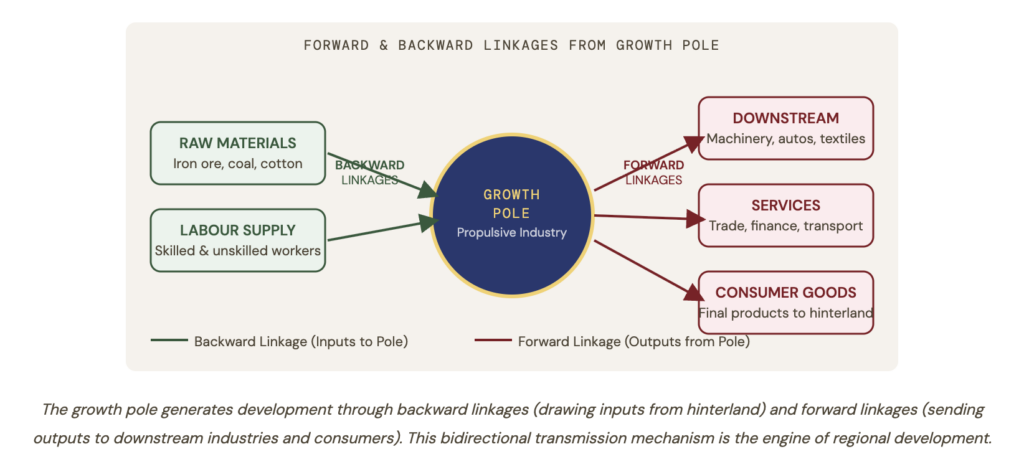
Forward and Backward Linkages:
- Backward linkages refer to the supply of raw materials and primary goods by producers in the hinterland to the growth pole. The propulsive industry draws inputs from the surrounding region, creating demand for raw materials, labour, and intermediate goods — stimulating hinterland production.
- Forward linkages refer to the sale of finished products by the growth pole to the hinterland or other regions. The propulsive industry’s output becomes input for downstream industries — stimulating further processing, manufacturing, and services.
Effects of Linkages on Regional Development
- Income effect: The growth pole contributes to the concentration and growth of income due to expansion of services and dependence on demand and profit
- Psychological effect: Based on optimistic anticipation of future demand in the propelled region — entrepreneurs invest because they expect continued growth
- Geographical effect: Based on concentration of economic activity in a geographically expanding zone — the functional region of the pole expands
- Multiplier effect: Each unit of income generated in the pole generates additional income in linked sectors through the regional economic multiplier
Phases of Growth Pole Development
- Stationary Growth: It is the stage of economic stagnancy and no utilization of resources, immobile capital, immobile capital & labour, and lesser propensity to development.
- Centralisation: It means factors of production are moving towards the economic space and new ventures, economic activities have been initiated
- Polarisation: It reflects the cumulative causation as suggested by Myrdal and a leading industry or a propulsive firm develops at the point of centralization over the economic space. In polarisation, the economic growth has started and the backwash effect (by Gunner Myrdal) can be seen which drains out the resources from surroundings, rendering them poor and backwardness surrounds the growth pole.
- Agglomerative Phase: The backwash effect is more accentuated and the surrounding areas are desertified while the centre develops into the growth pole (set of integrated and dynamic industries) and it is disproportionately larger than the other urban centres. Thus, the growth pole is developed over the economic space where polarisation and agglomeration have taken place.
- Trickle Down: This is the last phase of Growth Pole development. Trickle-down is synonymous to the spread-out effect (no scope for further development in the Growth Pole region) as suggested by Gunner Myrdal. Trickle-down was coined by Hirschmann. The benefits spread out in the otherwise desertified region. This stage is marked by
- i) Decentralisation of industries
- ii) Dispersal of capital investments
- iii) Diffusion of innovation
- iv) Diversification of industries (venturing into other industries or products)
- Thus the whole landscape develops and economic equilibrium is established and due to the trickling down of benefits, the backward areas can be developed into developed areas.
Keeping in mind the Growth Pole Concept, India in 2nd Five Year Plan (Nehru- Mahalonobis Model) has established Iron & Steel Plant in Durgapur, Bhillai, and Rourkela which will act as leading industry and result in the development of the area and ultimately by Trickle Down effect. But it has not achieved that much due to any trickle-down effect.
Economic Space vs. Geographical Space
One of the most important conceptual debates in Growth Pole Theory is the distinction between Perroux’s abstract economic space and Boudeville’s concrete geographical space. This distinction has profound implications for the theory’s applicability — especially in developing countries like India.
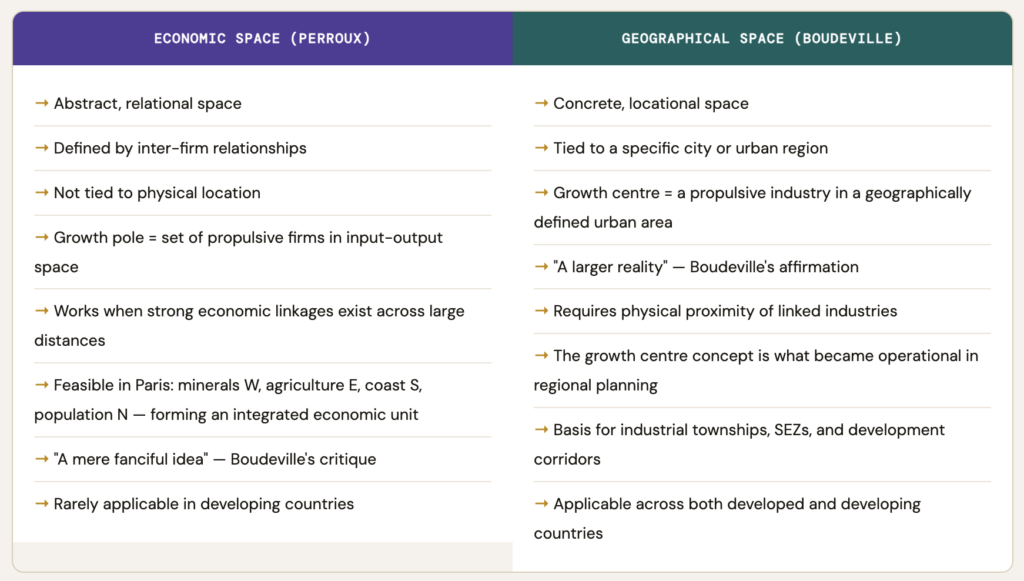
Why Economic Space fails in India: Economic space was feasible as a concept for Paris because Paris has minerals in the west, agriculture in the east, coasts in the south, and population in the north — creating a naturally integrated economic field. Such a thing is fanciful in India and the majority of other places, where the spatial distribution of resources, production, and markets is far more fragmented. This is why Boudeville’s geographical space and the Growth Centre concept became the operational framework for regional planning globally.
Boudeville’s Growth Centre Theory
- Boudeville gave a regional character and specific geographic content to Perroux’s conception. He replaced abstract economic space with geographic space. He defined a Growth Centre as “a set of expanding industries located in an urban area and inducing further development of economic activity throughout its zone of influence.” Boudeville’s concept is what became operational in regional planning policy worldwide.
Boudeville’s Empirical Study — Minas Gerais, Brazil
- The concept of Growth Centre was proposed by Boudeville as part of his studies in Minas Gerais — the site of the largest iron ore mines in Brazil. He conducted two key correlations:
- First Correlation (Time Series)
- Boudeville correlated the increase in steel smelting output with a 1% increase in steel fabrication output in Minas Gerais through time. The aim: study the polarization effect of a large industry on the economy of Minas Gerais province. Result: Strong correlation — one large industry leads to increase in the output of related industry through time → polarization is real.
- Second Correlation (Cross-Section)
- He also correlated the relationship between steel smelting and steel fabrication output at one point of time for all the states of Brazil simultaneously. The aim: study the agglomeration effect. Result: Weak correlation — steel smelting (Minas Gerais) and steel fabrication (Rio de Janeiro, São Paolo) are not co-located. Finding: Polarization and agglomeration are separate forces.
Key Implication of Boudeville’s Minas Gerais Study: The forward and backward linkages are spatially uncertain. The propulsive steel smelting industry in Minas Gerais does not establish a clear relationship with steel fabrication in Rio de Janeiro or São Paolo. Therefore, the geographic spread effect is not automatic — the growth pole may develop economic polarization without geographic agglomeration of downstream industries, challenging the trickle-down hypothesis.
Growth Centre: The Geographical Translation of Growth Pole
- Boudeville’s Growth Centre is a growth pole translated into geographic space — it is a designated urban centre where:
- A propulsive industry (or industries) is located that generates linkage effects in the surrounding region
- The urban centre has sufficient infrastructure, services, and labour pools to sustain the propulsive industry
- The geographic zone of influence around the centre receives spread effects — employment, income, technology, consumer goods
- The growth centre functions within a planning region — it is the focal point of a deliberate development strategy
The theoretical progression: Perroux (1955) identifies abstract propulsive industries in economic space → Boudeville (1960s) grounds them in geographic urban centres → Regional planners translate them into growth centre policies (industrial townships, SEZs, development corridors) → R.P. Misra (1976) adapts for Indian/developing country contexts through Growth Foci at the block level. Each step adds geographic and institutional concreteness to Perroux’s original abstract insight.
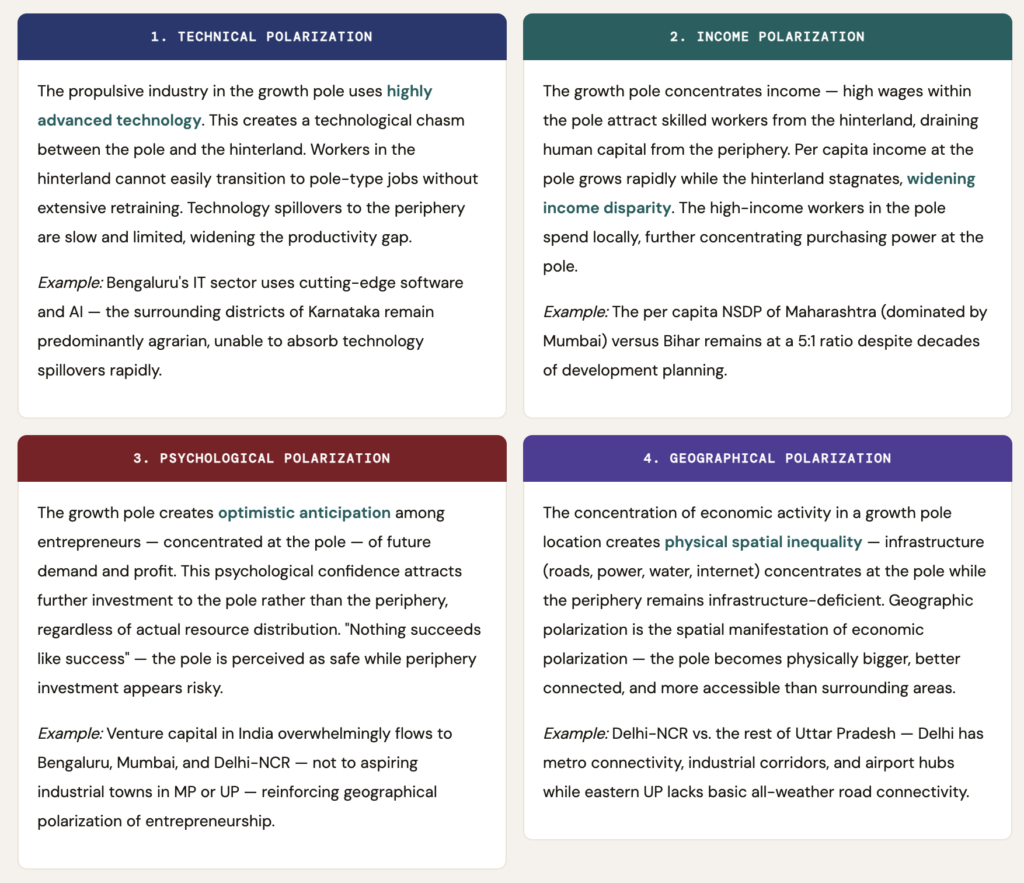
Types of Polarization-Induced Spatial Inequalities
Growth poles generate not just growth but also various forms of polarization-induced spatial inequalities.
Difference between Growth Pole and Growth Centre
| Growth Pole | Growth Centre |
|---|---|
| French Concept proposed by Perroux | American Concept proposed by Boudeville |
| Based on study of France with Paris & the surroundings | Based on study of Minas Geras (Brazil) |
| Based on the idea of economic space, It is an economic & abstract concept and not exist in reality Requires large scale & Huge capital investment | Based on idea of Geographical space GC development is closely linked to development of GP |
| Economic space means where the factor of production can be centralized such that propulsive economic growth can be introduced on the basis of a leading industry or a propulsive firm. It means any point on the surface where resources, land, labour; enterprise can function together and produce the maximum results. Economic space follows the principle of optimum location as proposed in Weber’s model, which is based on 3 principles- Profit maximization, distance minimization, and least cost. Economic space is based on polarisation or agglomeration effect, where a number of basic and heavy industries with their backward and forward linkages develop. | Geographical space means such location which are governed by the principle of accessibility, nearness, location, resource base or such geographical factors which themselves are responsible for propulsive growth. E.g.- The development of satellite towns along the major transport lines is a geographical space, where new industries can be installed as a part of urban decentralization. The location of the iron & steel industry in Chota Nagpur is the occupation of Geographic Space. Similarly, Minas Geras (Brazil) with rich deposits of iron ore and Manganese ore is a geographical space where a leading industry like iron & steel can be developed. |
| Based on agglomeration effect ( 3or more industries and their linkages) | Based on cumulative effect (can be based on one industry or firm) |
| Growth Pole is generally proposed at the National Level. It has inter-regional co-relation. | Growth center is generally proposed at the regional/local. An instrument of regional development. It promotes local goals and has intraregional characteristics |
| Can be applied in a country with a small geographical extent | Large geographical extent |
| Requisite of growth pole in country is 1 | Growth centres could be many |
| Growth Pole functions at the highest hierarchy | Growth centre functions at lower hierarchy, below the Growth Pole |
| Growth Pole is the centre of diffusion of innovation, centre for research and development, capital accumulation, capital reinvestment, and employment generation. | Growth centre is intended to utilize the local resources and develop the local or regional economy. It does not intend to draw resources from all the places and can’t have R&D |
| GP signify greater centripetal forces and behave as the largest economic magnet in a country. It seeks short span growth | It signifies centrifugal forces and dispersal of economic activities. It seeks overall growth and long-term growth. |
| GP has negative results even in the French experience. E.g. After the growth of Paris, the surrounding region was bereft of development and it was titled “Paris and the French Desert”. | GC has positive connotations since it is resource-based development, diffused growth, decentralized, function at the regional level and it contemplates growth of while landscape. |
| GP is a mere economic concept and is based on industrial units, propulsive firms. | GC is based on industries as well as the growth of services. E.g – Schools, Colleges, Health services etc |
Difference between Central Place theory (CPT) and Growth Pole theory (GPT)
| CPT | GPT |
|---|---|
| CPT is normative, deductive based on idealistic assumptions. | It is an empirical, inductive model based on data surveys and observations. |
| CPT assumes that equal distribution of resources and settlements over the landscape. | GPT assumes the unequal/ heterogeneous landscape |
| CPT applies to the fully developed landscape of a country | GPT is based on various stages of development |
| It has a complete picture and network of the various hierarchical patterns of function at different levels. E.g. – 7 level hierarchy CPT is a much more comprehensive model of planning which includes GP at H1, GC at H2, Growth Pole at H3, etc. | GP doesn’t have a hierarchy and it is the single most important magnet of a country. |
| CPT signifies diffusion, dispersal, decentralization | GPT signifies centralisation, polarisation, agglomeration |
| CPT is based on mainly the supply factor from various settlements at different hierarchical levels. | GPT is based on demand and production. |
| Based on services | Based on industries, firms, productions, manufacturing |
| CPT signifies centrifugal forces and the flow from top to bottom. | GPT signifies centripetal forces and bottom to top. |
Growth Pole and Growth Centre theories explain the selective and uneven nature of economic development. Perroux provided the economic logic through propulsive industries, while Boudeville gave it geographical content through growth centres. In India, the strategy inspired steel towns, industrial complexes and modern corridors, but its success has been limited where local linkages, employment generation and decentralised planning remained weak. Therefore, growth pole strategy must be combined with growth foci, service centres, local participation and sustainable regional planning.
R.P. Misra’s Growth Foci — Indianization of Growth Pole Theory
- R.P. Misra Indianised the theory of Growth Pole and Growth Centre by integrating Growth Pole Theory (GPT), Central Place Theory (CPT), and Spatial Diffusion Theory in his own way and presented a new hypothesis on Growth Foci (GF).
- This new concept sought to integrate the main elements of all three theories for application in India’s specific socio-economic context — especially for rural and tribal regions where Perroux-style industrial growth poles were neither feasible nor appropriate.
- What is a Growth Focus (GF)?
- Growth Focus (GF) is a low-order functional, economic hub that functions at Block/Tehsil level. It is not based on industrialization. Rather, it relies on the development of service centres. A Growth Focus is:
- Growth Focus = A block-level market with an education centre + health centre + entertainment centre + evolving social institutions + social organizations + development of social capital → making people more conscious, aware, and knowledgeable. It is essentially the development of human capabilities and service infrastructure at the grassroots level.
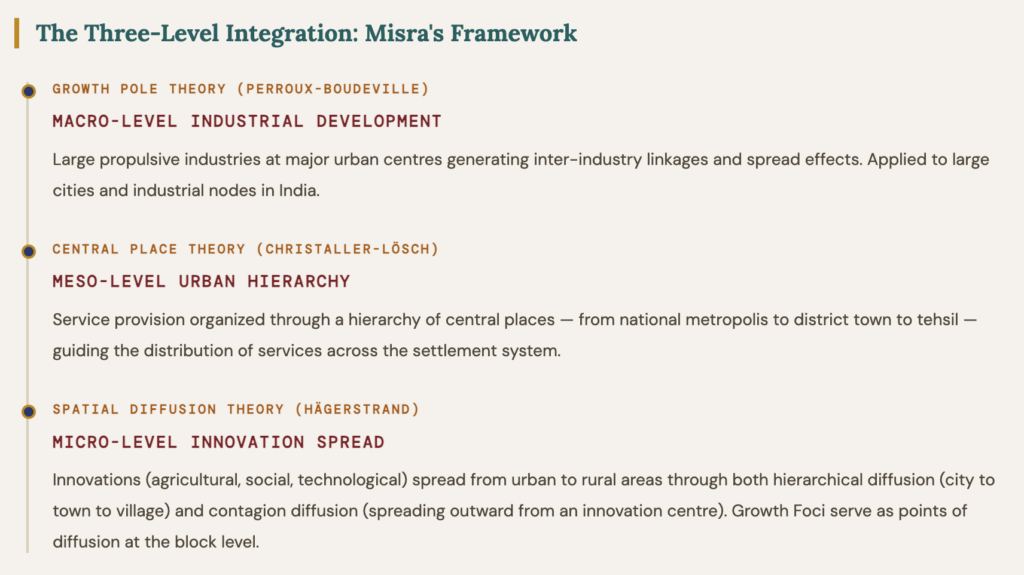
According to Misra: “Planning for the socio-economic development of a region involves decisions regarding the appropriate location for infrastructure and development activities.” Growth Foci are that lowest rung of the planning hierarchy where infrastructure decisions must be concentrated to ensure grassroots development.
Misra’s Empirical Applications — Three Indian Case Studies
- In their book, Misra, Rao, and Sundaram illustrated the theory of Growth Foci by applying it to three distinct regional contexts in India:
- Tribal Region
- Bastar, Madhya Pradesh (now Chhattisgarh) — Growth Foci approach applied to a tribal-dominated, forest-rich, infrastructure-deficient region. Service centres at block level as entry points for development diffusion.
- Agricultural Region
- Muzaffarnagar, Uttar Pradesh — Growth Foci applied to a sugarcane-dominated agricultural zone. Block-level agro-service centres, cooperative credit centres, and market linkage as Growth Foci.
- Industrial Region
- Ranchi, Hazaribagh, Dhanbad, Singhbhum (Bihar/now Jharkhand) + Purulia, Bankura, Burdwan (West Bengal) — Chota Nagpur industrial region with Growth Foci at block level serving mining communities.
- Tribal Region
Application of Growth Pole Theory in India
| Growth Pole / Centre | Location | Propulsive Industry | Intended Effect | Actual Outcome |
|---|---|---|---|---|
| Bhilai Steel Plant | Chhattisgarh (then MP) — tribal/backward region | Integrated steel (public sector, 2nd FYP) | Growth pole for Chota Nagpur hinterland; tribal development | Industrial township created; limited tribal benefit; hinterland still backward; Bhilai town grew but Bastar remained poor |
| Bokaro Steel Plant | Jharkhand (then Bihar) — coal belt | Integrated steel (public sector, 3rd FYP) | Industrial growth centre for Dhanbad coal region | Steel town developed; Jharkhand split from Bihar in 2000 reflecting backwash from Bihar’s core; forest-dwelling tribes displaced |
| Rourkela Steel Plant | Sundargarh, Odisha — tribal area | Integrated steel (public sector, 2nd FYP) | Industrial development of Odisha tribal backward region | Urban enclave; surrounding KBK districts (Kalahandi-Bolangir-Koraput) remain among India’s most backward — spread effects did not reach them |
| Bengaluru IT Hub | Karnataka | IT/ITeS (organic + policy-promoted) | Technology and innovation growth pole for South India | Strong forward-backward linkages; but severe urban congestion, rising inequality within Karnataka; rural Karnataka lagging |
| DMIC (Delhi-Mumbai Industrial Corridor) | Along NH-8: Delhi, Rajasthan, Gujarat, Maharashtra | Multi-sector industrial clusters + infrastructure spine | Linear growth corridor; 7 industrial cities as growth poles | Ongoing — mixed progress; AURIC (Aurangabad Industrial City), DMIC Ahmedabad node advancing; full corridor integration pending |
| Special Economic Zones (SEZs) | Pan-India — Tirunelveli, Surat, Noida, Mundra, etc. | Manufacturing/IT/export-oriented industries | Export-led growth poles generating employment and technology | Limited spread effects beyond SEZ boundary; “enclaves of prosperity” criticism; employment mostly from outside region |
| SIPCOT Growth Centres | Tamil Nadu — 17 complexes in 12 districts | Chemical, auto, electronics, pharma | Distribute industrial growth across Tamil Nadu — from Chennai to interior districts | Relatively successful — attracted industries to Hosur (electronics), Cuddalore (chemicals), Perundurai (textiles); partial decentralization achieved |
Critical Evaluation of Growth Pole Theory
- The Growth Pole Theory has been criticised on numerous counts. According to Glasson (1974), the theory is attractive as a policy framework, but its implementation across different contexts varies enormously. The critiques can be organised into four categories:
I. Theoretical Weaknesses
- Abstract economic space is inapplicable: Perroux’s economic space is a “mere fanciful idea” (Boudeville) — it does not translate into real geographic space except in rare cases like Paris. In India and most developing countries, propulsive industries are not geographically proximate to their forward and backward linkage partners.
- Underdeveloped concepts of distance and accessibility: The original theory ignores transport costs, distance friction, and the importance of accessibility — factors that Christaller made central to CPT. The lack of attention to geographic distance weakens the theory’s spatial predictions.
- Forward and backward linkages are spatially uncertain: Boudeville’s own Minas Gerais study showed that polarization (steel smelting growing → related steel output growing in Minas Gerais) and agglomeration (steel smelting and fabrication co-located) are separate forces. Trickle-down through linkages is not guaranteed.
- Dynamic propulsive firms are normally found only in capitalist countries: Perroux’s economic polarization was unnecessarily transferred to geographical polarization. The self-reinforcing dynamics of capitalist competition that Perroux observed in France do not apply equally in state-dominated or mixed economies.
II. Empirical Failures
- Trickle-down effect rarely materialises at scale: The most damaging criticism — the promised spread effects did not materialize in practice. India’s steel towns (Bhilai, Bokaro, Rourkela) demonstrate this: industrial prosperity did not spread to tribal and rural hinterlands as theorized.
- No trickle-down — income gap persists: Economists observed that the income gap between large cities and smaller cities continues to grow due to cumulative causation (Myrdal vindicated over Hirschman).
- Urban bias of policies: Growth pole policies have an inherent urban bias — the effects on the periphery are very slow and insignificant because the infrastructure, skills, and services required to absorb spread effects are themselves concentrated at the pole.
- Unfair terms of trade: The terms of trade favour the growth pole — raw material suppliers in the hinterland receive lower prices while the pole charges higher prices for manufactured goods. The periphery does not get the same benefit from trade as the pole.
III. Policy and Implementation Problems
- Difficulty identifying propulsive industries: In practice, it is difficult to identify which industries will become propulsive ex ante — governments have often invested in sectors that did not generate the expected forward-backward linkage multipliers.
- Dependency on government support: In the absence of long-term investment and consistent policy support, growth poles stagnate. Detroit (USA) is the global case study — the automobile growth pole collapsed when the propulsive industry declined due to global competition, leading to severe economic contraction.
- Implementation varies across contexts: (a) Neglected regions — growth centres may help but require massive initial public investment. (b) Moderating suburbanization — growth centres away from primate cities may redirect growth. (c) Modifying urban hierarchy — new towns may not grow as intended if market forces pull toward existing poles.
- Draining of hinterland: Hinterland loses the best of its workforce — brain drain and skilled labour migration to growth poles denuded the periphery of human capital needed for local development (Hirschman acknowledged this as polarization effect).
IV. Development Context Limitations
- Conceived in European context: The theory was designed for France’s economic planning — an advanced capitalist economy with existing industrial infrastructure. It is not immediately transferable to developing nations with heterogeneous socio-economic realities (weak institutions, infrastructure deficit, dual economy).
- Spatial inequality accentuation: Polarization effect accentuates regional inequalities, particularly when peripheries are overlooked in policy. India’s BIMARU states vs. Maharashtra/Karnataka divide has deepened over the decades of growth pole-style planning.
- Environmental costs: Growth poles generate concentrated environmental degradation — air pollution, water pollution, waste, and ecosystem destruction in the pole zone. The Chota Nagpur “pollution belt” around steel towns exemplifies this.
- Urban congestion: Growth poles tend to generate infrastructure overloading, slums, and urban environmental degradation — overcritical diseconomies that reduce the quality of life within the pole itself.





Really amazing content we follow it properly in our preparation and Very helpful thanks sir
Keep reading
Amazing……
Very nice and elaborated content…
Hey…do you have new abd different example of this theory and other?
U will close the coaching shops.
Thank u for the Quality content, sir.
Thank you
thank you
very fine content ….sir for needy u r the hope…………………..
Never found such quality material anywhere.Thanks.
Thanks for the help. You are doing fantastic job.
Thanku sir
Truely a blessing
Wonderful 👏🏻👏🏻👏🏻👏🏻