

Conurbations and Metropolitan Regions

- Urbanization in the contemporary world has moved beyond the growth of individual cities to the emergence of large, complex urban systems.
- Two important manifestations of this process are conurbations and metropolitan regions, which reflect the spatial expansion, functional integration and economic dominance of urban centres.
- These concepts are central to understanding urban morphology, hierarchy and regional planning, especially in rapidly urbanizing countries like India.
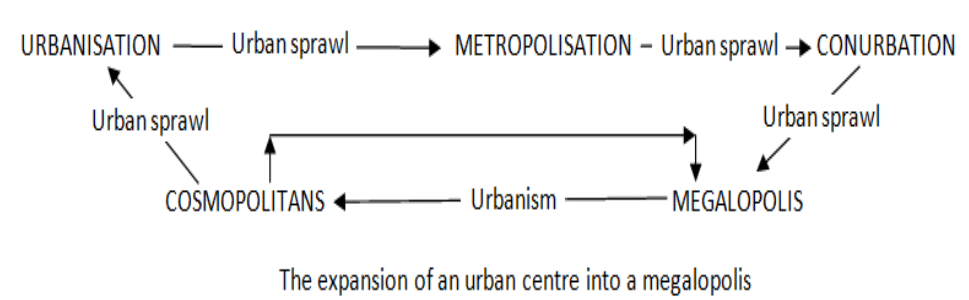
- The urbanization process is given in the flow diagram below –
Metropolitan Regions
- The term ‘metropolitan city’ was first termed by Murphy (‘metro city’) and Mumford (‘metropolitan city’). According to Mumford, a metropolis is one of the stages in the evolution of urban settlement.
- A metropolitan region refers to a large urban region centered around a metropolitan city, including its surrounding towns, suburbs and rural areas that are functionally integrated with it.
- Unlike conurbations, metropolitan regions are:
- Functionally defined rather than purely morphological,
- Organized around a dominant central city (metropolis),
- Characterized by economic, social and administrative linkages.
- As per Census Commission of India, a metropolitan city is one having a population of over 4 million (metropolitan city is the Umland of a metropolitan city). A wider definition would however, include all the cities that are having a population of more than 1 million.
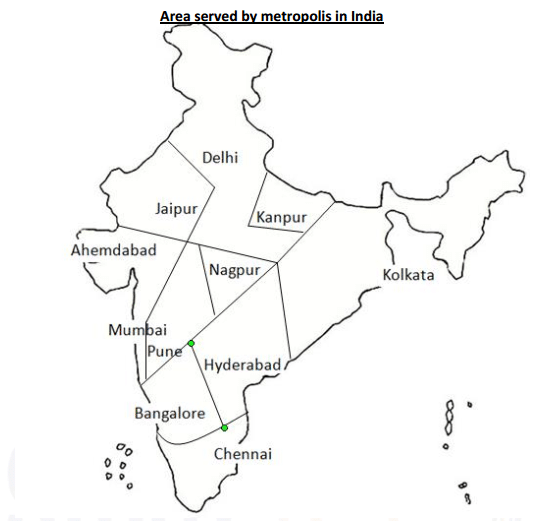
- The areas of influence of metropolitan cities have been demarcated on the basis of
- Air travel
- Railway passenger and commodity flows
- Lang distance telephone calls
- Current trends:
- Secondary metropolitan regions are developing within the primary metro regions except Kolkata region, basically due to linguistic states. The process will accelerate in future which will lead to the emergence of new secondary metro centres, especially the state capitals.
- But the primary metro regions will continue to have pre-eminent position. Delhi’s importance will increase disproportionately since it is the national capital.
- Looking at the meso level, Srinagar in the valley of Kashmir, Shillong in Meghalaya, Aizawl in Mizoram, Agartala in Tripura, Imphal in Manipur and Gangtok in Sikkim are all primate cities in their own way.
Characteristics of Metropolitan Regions
- Metropolitan regions display the following features:
- A dominant metropolitan centre, which acts as the economic, political and cultural hub.
- Extensive commuting patterns, where people travel daily between peripheral areas and the core city.
- Strong functional integration, especially in terms of employment, services and markets.
- Development of suburbanization and peri-urban zones, reflecting urban expansion beyond city limits.
- Presence of diverse economic activities, including industry, services, administration and trade.
Types of Metropolitan Regions
Metropolitan regions can be categorized based on structure:
- Monocentric Metropolitan Region
- Dominated by a single core city
- Example: Chennai Metropolitan Area
- Polycentric Metropolitan Region
- Multiple important centres within the region
- Example: Delhi NCR, where Noida, Gurugram and Ghaziabad are major nodes
Examples of Metropolitan Regions
- Global Examples:
- New York Metropolitan Region
- Tokyo–Yokohama Metropolitan Area
- Indian Examples:
- Delhi National Capital Region (NCR)
- Mumbai Metropolitan Region (MMR)
- Bengaluru Metropolitan Region
- Hyderabad Metropolitan Development Area (HMDA)
- These regions are officially recognized for planning and governance purposes.
Metropolitan Region Planning in India
- India has adopted a formal framework for managing metropolitan regions:
- 74th Constitutional Amendment Act (1992) introduced Metropolitan Planning Committees (MPCs)
- Establishment of regional planning authorities like:
- NCR Planning Board
- Mumbai Metropolitan Region Development Authority (MMRDA)
- The objective is to ensure:
- Coordinated infrastructure development,
- Balanced regional growth,
- Efficient land-use planning,
- Reduction of pressure on core cities.
Conurbations
- Conurbations are coined by Patrick Geddes in 1915 in his book ‘Cities in evolution’ to describe a continuous urban region formed by the coalescence of multiple towns and cities.
- The concept was proposed by empirical studies for the New England region of USA.
- It represents a stage where physical expansion leads to the merging of previously distinct urban settlements into a single built-up area.
- A conurbation refers to the continuous urban growth along the major transportation line connecting the urban centre. It has a mostly linear growth pattern and is contiguous to the metropolitan or metropolis city.
- Conurbation (i.e. continuous urbanisation) is a region comprising a number of cities, large towns, and other urban areas that through population growth and physical extension, have merged to form one continuous urban and industrial developed area.
- A Conurbation can capture several townships, suburbs, satellite towns, and may connect two or more mega cities. This presents a picture of tremendous urban growth along the arterial lines of the urban autonomy. They are part of urban ecology, as functionally integrated with the megalopolis or the larger urban centres. They are characterised by a fused growth pattern and fillups.
- They represents the horizontal urban sprawl, massive building structures, hypermarkets, residential colonies and intervening slums adjacent to the industrial sectors.
- Conurbations are the part of metropolisation which is a process related to the unprecedented physical growth of city in the fringe areas. The wider meaning is not only the physical expansion but also the fusion of various cultures and emergence of new culture and lifestyle, predominantly cosmopolitan in nature and signifying centrifugal forces.
- The emergence of metropolitan cities have been phenomenal after 2nd World war especially in developing countries like India, which has 35 metropolitan cities, showing high primacy, disproportionately larger than other urban centres. Thus, metropolisation has agglomeration effect and primacy shows polarization and centralisation of economic activities.
Characteristics of Conurbations
- Conurbations exhibit distinctive morphological and functional features:
- The physical landscape is almost entirely urbanized, with very little rural land in between, creating a continuous urban fabric.
- Unlike primate city systems, conurbations are typically polycentric, where several cities contribute to the overall structure.
- There is a division of functions, with different towns specializing in industry, trade, administration or residential roles.
- High degree of daily commuting and interaction, leading to functional unity despite administrative fragmentation.
- Often associated with industrial belts, mining regions or transport corridors.
Formation of Conurbations
- The formation of conurbations is a gradual process involving:
- Urban expansion due to population growth and economic development,
- Growth of satellite towns and suburbs around major cities,
- Industrialization, attracting labour and investment,
- Improvement in transport infrastructure, reducing friction of distance,
- Gradual coalescence of adjacent settlements, leading to spatial merging.
Some Examples:
Global Examples:
- The London Conurbation (UK)
- The Randstad (Netherlands)
- The Ruhr Industrial Region (Germany)
Indian Examples:
- Kolkata–Howrah–Hooghly industrial belt
- Mumbai–Thane–Navi Mumbai region
- Delhi–Ghaziabad–Noida–Gurugram urban complex
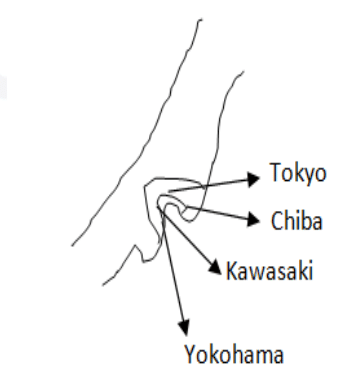
- The most populous Conurbation in the world is the Greater Tokyo Area– comprising of the main cities of Tokyo, Yokohama, Kawasaki, Saitama, and Chiba. This area has largest metropolitan economy in the world.
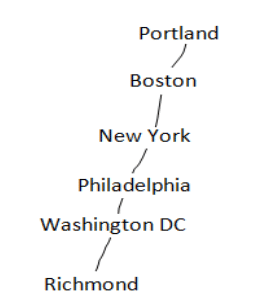
- The first and the largest (in terms of are) Conurbation of the world may be observed in the eastern sea-board of USA. In this region, there is coalescence of the million cities of Boston, New Haven, New York, Philadelphia, Baltimore, Washington DC, New port, Columbia, and Columbus.
- In India, there is huge Conurbation in the process of development from Agra -> Delhi -> Kalka. On branch of this Conurbation moves towards Saharanpur from Delhi.
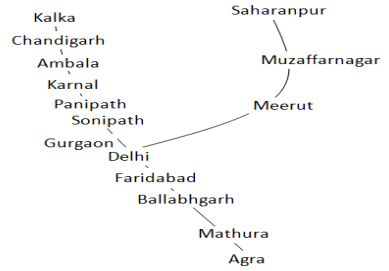
There are three types of Conurbation in India
- Uni-nuclear Conurbation– Conurbation is the resultant of a single city
- Bi-nuclear Conurbation– Conurbation is formed when two expanding cities merge with each other like Kanpur and Lucknow.
- Poly-nuclear Conurbation– It is the coalescence of more than two cities like Mumbai, Thane and Kalyan.
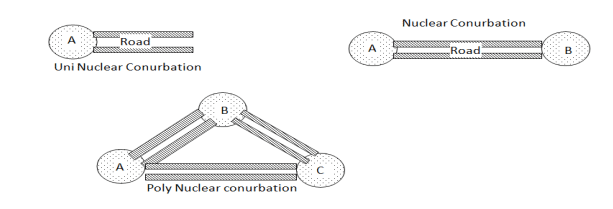
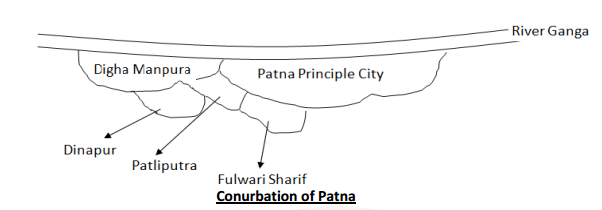
- Delhi Metro Region was a uni-nuclear conurbation but presently it is becoming a polynuclear conurbation. The conurbation of Patna is uni-nuclear.
- Although there are more than 60 conurbations in India, but the concept of conurbation has presently become obsolete in the literature of urban geography, regional science, and regional planning. In fact, this concept failed to get an appreciation of American geographers. After World War II, the concept of the metropolitan region has got more recognition. It is principally due to the tendency of urban concentration, while the tendency of sprawl has caused the rise of the concept of the Metropolitan region. It is more effective for development and planning proposes. But the concept of conurbation continues to be important for urban sociologists and those who are in the study of urban behaviour, urban intra migration, and neighborhood interactions.
Conurbation vs Metropolitan Region (Key Differences)
Basis Conurbation Metropolitan Region Nature Morphological (physical merging) Functional (economic integration) Structure Polycentric Usually monocentric (or semi-polycentric) Formation Coalescence of cities Expansion of a dominant city Boundary Continuous built-up area Includes rural hinterland Planning Often unplanned growth Planned through institutions
Megalopolis
- The term ‘megalopolis’ was coined by Gottmann. It reflects the later stage of metropolisation and it is generally studied under urban ecology, which includes the physical morphology and the socio-economic morphology with spatial interactions and the processes resulting in the unprecedented profuse growth of the city.
- Megalopolis =(Metropolisation + Cosmopolisation), and it represents the following characteristics
- High industrial growth
- Centrifugal force
- High growth of service sector
- Isolationism of the society
- Nuclearisation of family
- Luxurious lifestyle
- High consumption (represents Rostov Stage V)
- High per-capita income
- Agglomerative growth pattern
- Development of derived economic sectors.
- Some examples
- London, Paris, Rome, Moscow
- Chicago
- Shanghai, Tokyo
- Sydney, Toronto





Thanks
Indian examples are well thought out…. Thanks a lot 🙂
There are some minor mistakes in some statements. Like Metropolitan city is the umland of metropolitan city. If corrected, will be…Metropolitan REGION is the umland of metropolitan city. I have seen in other chapters also. Please correct this. Your notes are extremely helpful to aspirants. Love it.