

- Sustainable development of cities means meeting the needs of today’s urban population without degrading the resources and ecosystems that future residents will depend on.
- Cities are where sustainability is won or lost.
- In 2025, 45% of the world’s 8.2 billion people lived in cities and another 36% in towns (UN World Urbanization Prospects 2025).
- Cities are the main consumers and distributors of goods and services, and their ecological impact reaches far beyond their boundaries.
- The idea now goes beyond science and economics to include human development, values and cultural difference.
- Many agencies speak of sustainable human development, to stress gender equality, participation in decisions, and access to education and health.
Concept

Sustainable Development and the City
- The World Commission on Environment and Development (Brundtland Report, Our Common Future, 1987) defined sustainable development as “development that meets the needs of the present without compromising the ability of future generations to meet their own needs”.
- The wider principles are traced in the concept of sustainable growth and development.
- Cities are large consumers. They drain resources from distant regions through trade and rising consumption.
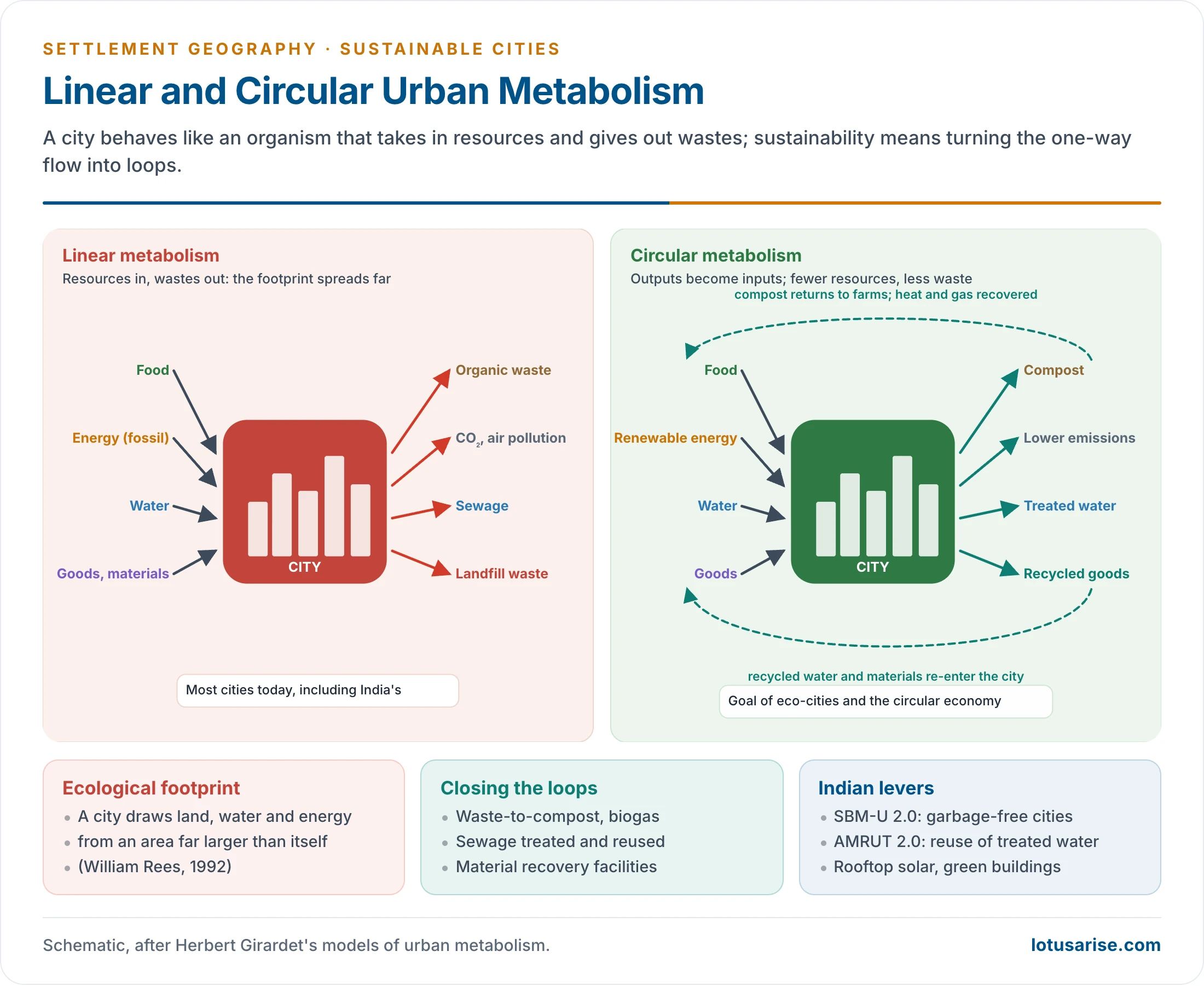
- William Rees (1992) called this area the city’s ecological footprint: the land and water needed to supply a city and absorb its wastes, many times its own area.
- The city can be read as an organism with a metabolism:
- Food, water, energy and materials flow in.
- Sewage, solid waste and emissions flow out.
- Herbert Girardet contrasted the linear metabolism of most cities with the circular metabolism of a sustainable one, in which outputs such as compost, treated water and recycled materials are returned as inputs.
Sustainable Urban Planning
- UN-Habitat defines urban planning as the planning and design of urban land that guides governments and others to support urban growth and improve sustainability, efficiency and equity at every level of governance.
- Sustainable urban planning is the set of strategies and practices that keep communities liveable and self-sustaining over the long term.
- Concerns over climate change, clean air and water, renewable energy and land use have pushed it to the centre of planning.
- It is multidisciplinary. It draws on architecture, engineering, ecology, environmental and materials science, law, transport, technology, economics, finance and public administration.
- It looks for practical ways to manage land use and its impact on natural resources.
- Typical solutions:
- Green buildings and housing.
- Mixed-use development and walkability.
- Greenways and open spaces.
- Solar and wind energy.
- Public transport options.
- Good sustainable land-use planning makes neighbourhoods healthier and more efficient, and improves people’s welfare.
- In India the plan must cover what Census 2011 counts as urban: besides statutory towns, places with at least 5,000 people, 75% of male workers outside agriculture and 400 persons per km².
What Is a Sustainable City?
- The URBAN 21 conference (Berlin, 2000) defined sustainable urban development as improving the quality of life in a city, in its ecological, cultural, political, institutional, social and economic components, without leaving a burden on future generations.
- That burden arises from reduced natural capital and excessive local debt.
- A sustainable city provides for the basic needs of all its people:
- Civic amenities, health care, housing, education, transport, employment and good governance.
- Throughout, it gives due weight to environment, equity and futurity, and serves all sections of society without discrimination.
- It lies where the three Es overlap: economic prosperity, social equity and environmental quality.
- The UN World Economic and Social Survey 2013 listed three marks of a sustainable city:
- It meets its inhabitants’ development needs without unsustainable demands on local or global resources, and does not shift risks to other places or times.
- It integrates socio-economic development, environmental management and urban governance.
- It is inclusive, safe, resilient and sustainable: the wording later adopted in SDG 11.
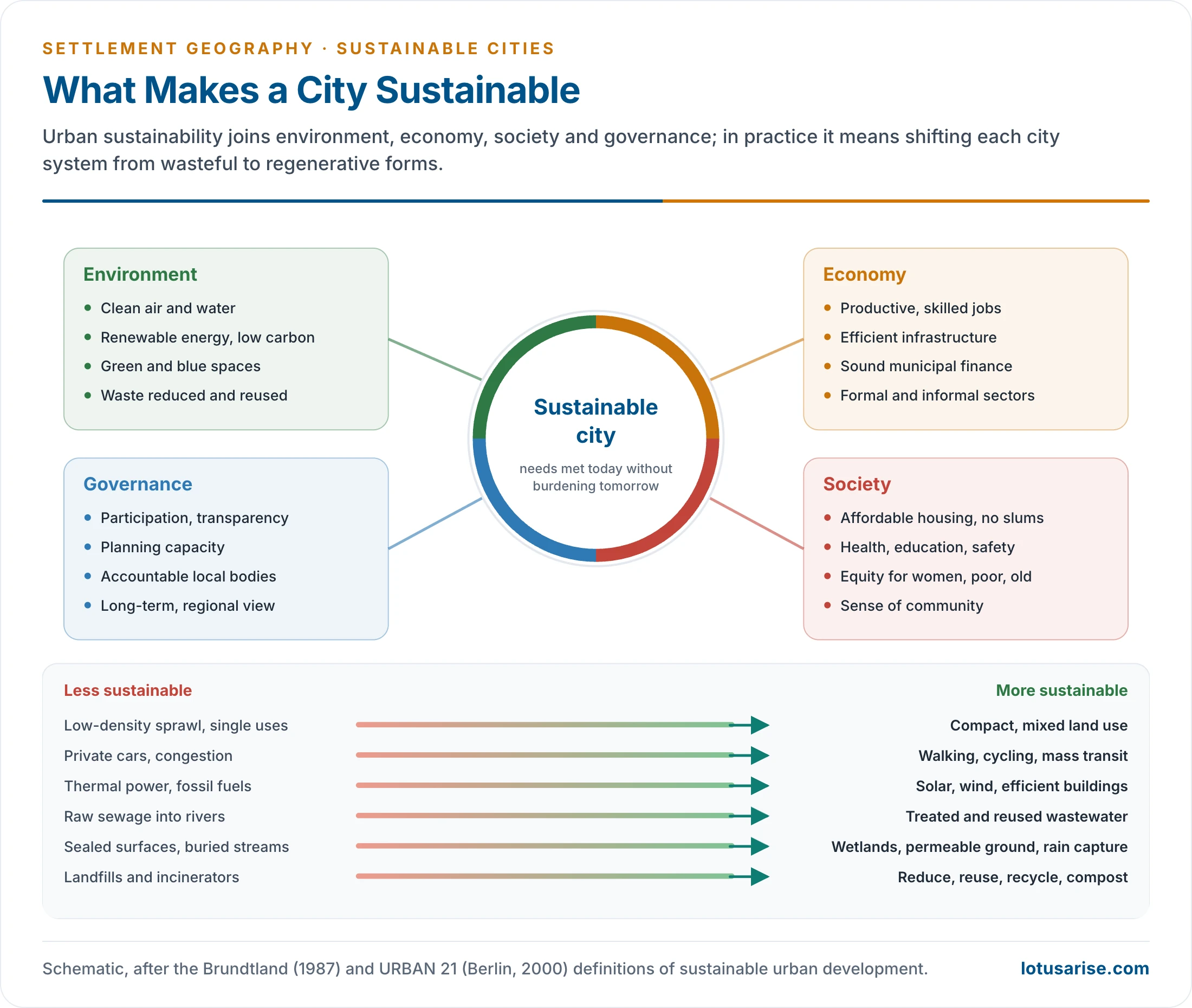
| More sustainable city | Less sustainable city |
|---|---|
| Compact residential development | Low-density, spread-out housing |
| Mixed land use: homes, jobs and shops together | Segregated land uses in separate tracts |
| Jobs based on education and skills | Jobs in polluting or non-renewable resource industries |
| Movement on foot, by bicycle and public transport | Heavy dependence on private cars |
| Solar and wind energy | Thermal and nuclear energy |
| Tertiary or natural treatment of sewage | Untreated or poorly treated sewage into water bodies |
| Natural drainage and hydrology protected | Hard surfaces, channelled streams, no infiltration |
| Wetlands, woods and habitats protected; compost and integrated pest management | Natural landscape destroyed; heavy use of chemical fertilisers and pesticides |
| Waste reduced, recovered, reused and recycled | Landfills and incinerators |
Characteristics of Sustainable Cities
- Awareness of their footprint: a sustainable city accounts for how its consumption affects other regions and ecosystems, and takes responsibility for it.
- Policies to reduce, reuse and recycle consumer goods, and user fees that discourage waste, are two tools.
- Healthy cities make a healthy nation. Other characteristics:
- Population matched by meaningful employment.
- Adequate governance that builds civic duty, participation, identity, transparency and equality in local institutions.
- Efficient basic amenities.
- Electricity theft and non-payment cause revenue losses and poor supply to paying users. Older accounts put illegal use at more than half of the power in some cities.
- Inadequate water supply brings the same losses and the same poor service.
- Planned housing colonies with schools, parks, drainage and local health care.
- Efficient transport planning that offers roads, parking, alternative modes and mass transit, and cuts vehicle-kilometres in congested areas. This reduces pollution and greenhouse gases.
- Environmental infrastructure to stop untreated sewage from polluting rivers, lakes and coastal waters.
- Empowerment of women in the city’s political, social and economic life, and urban policies that reflect women’s needs.
- An efficient private sector, formal and informal, that creates jobs and reduces poverty.
- An efficient health system covering nutrition, family planning and sanitation.
- Responsible citizens who obey the law and take part in the city’s growth.
Models of the Sustainable City
- Compact city: high density and mixed uses, which shorten trips and save land. It is the opposite of urban sprawl.
- Eco-city: designed to minimise energy, water and waste and to close resource loops.
- Examples include Freiburg’s Vauban district and Masdar City in Abu Dhabi.
- Transit-oriented city: growth concentrated along mass transit.
- Curitiba (Brazil) pioneered bus rapid transit (1974) under Jaime Lerner.
- Copenhagen’s “Finger Plan” (1947) steered growth along rail lines into green wedges.
- Resilient city: able to absorb and recover from shocks such as floods, heat waves and epidemics.
- The Rockefeller Foundation’s 100 Resilient Cities network (2013) spread the idea.
- Fifteen-minute city (Carlos Moreno, 2016): daily needs within a short walk or cycle ride.
- Smart city: technology and data used for efficient services. It is sustainable only when the technology serves the goals above.
- Networks such as C40 Cities (2005) and ICLEI link city governments on climate action.
Advantages of Sustainable Cities
- Healthy, viable communities, and protection of the hinterland ecosystems that cities depend on.
- A good quality of life: open space, clean air and water, less waste, equality, access, lower crime and a sense of community.
- Long-term, integrated development that does not compromise future generations. This is the most important advantage.
- Lower costs over time: compact, efficient cities spend less per head on roads, pipes and energy.
The Global Framework
SDG 11 and the New Urban Agenda
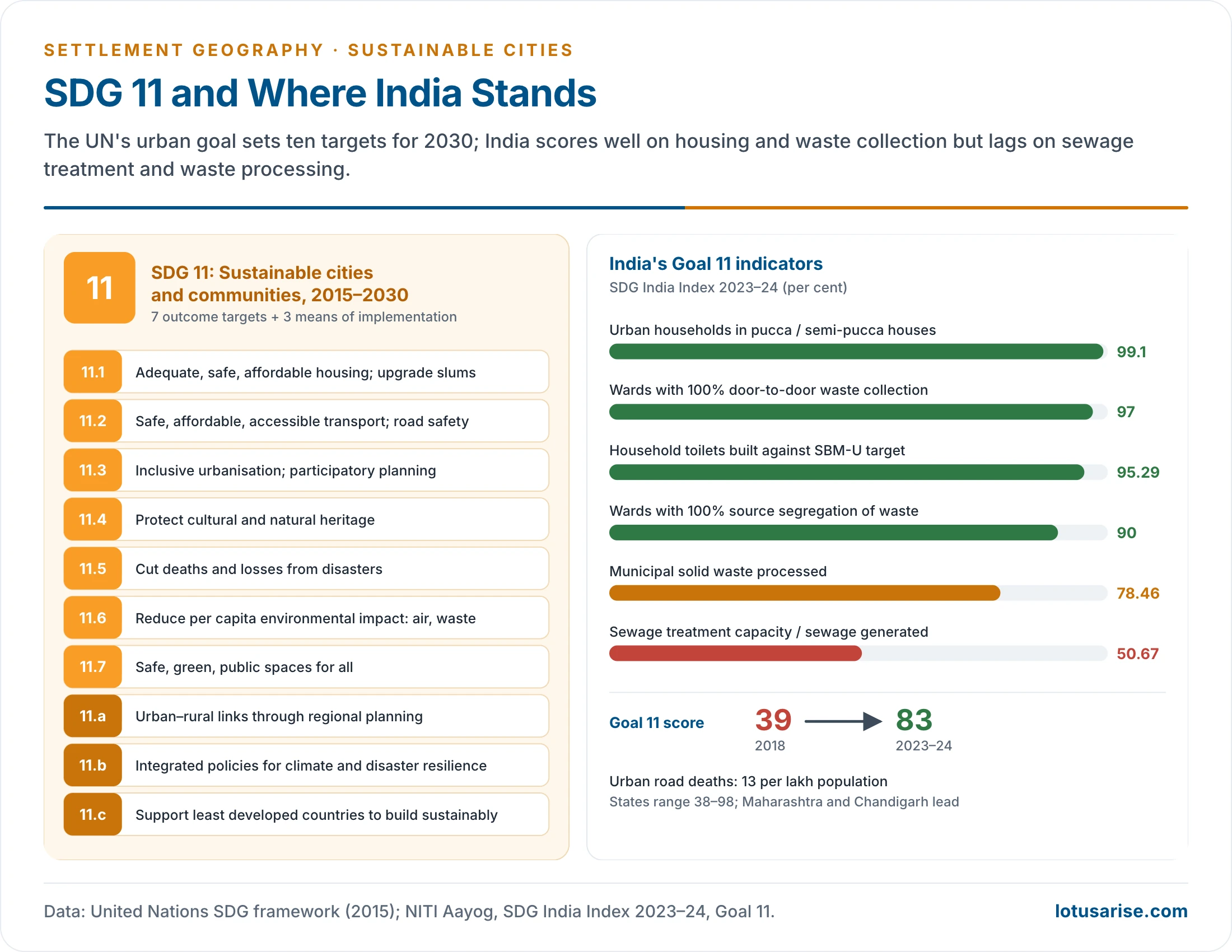
- Sustainable Development Goal 11 (2015) aims to “make cities and human settlements inclusive, safe, resilient and sustainable” by 2030 through ten targets:
- Housing and slum upgrading (11.1), transport (11.2), participatory planning (11.3) and heritage (11.4).
- Disaster losses (11.5), air quality and waste (11.6) and green public space (11.7).
- Three means of implementation (11.a–11.c).
- The New Urban Agenda, adopted at Habitat III (Quito, October 2016), sets out how cities should plan, finance and govern to reach these goals.
- The Paris Agreement (2015) and the Sendai Framework for Disaster Risk Reduction (2015–2030) add climate and risk obligations.
- Global progress is slow. In 2022 about 24.8% of the world’s urban population lived in slums, and the UN’s 2026 report counts 1.16 billion people, again 24.8%, in 2024. In Sub-Saharan Africa the share was over half (UN-Habitat).
- Urban growth to 2050 is concentrated in seven countries led by India, which will add more than 500 million city dwellers between them (UN WUP 2025).
Sustainable Urban Development in India
Need for Sustainable Urban Planning
- India is moving from a largely rural to a quasi-urban society.
- 31.14% of its people lived in towns in 2011 (Census). UN projections (2018) put India at about 53% urban by 2050; the 2025 revision lowers this to 37% in 2030 and 43% in 2050.
- This transition needs green energy, clean water, mass mobility, nutrition, education, health care and waste management to be sustainable.
- Rapid urbanisation:
- Census towns rose by about 186%, from 1,362 to 3,892, between 2001 and 2011.
- The number of villages rose by only 0.36%.
- Unsustainable growth:
- Lateral growth of planned urban land lags far behind population growth.
- The population density of NCT Delhi was 11,320 per km² in 2011, against a national average of 382.
- Migration:
- Lack of jobs, health care and education in villages pushes people to the cities.
- Rapid migration has multiplied slums.
- Shift away from agriculture: population pressure on land and policy changes push workers into non-farm jobs, concentrated in cities.
- Unequal development: the colonial legacy and investment in a few centres have widened regional gaps.
- Concentrated growth poles: urbanisation is focused in a few pockets, and its benefits have not spread laterally.
- Changing climate: warming, erratic monsoons and extreme heat raise the vulnerability of both urban and rural settlements.
- Large cities form urban heat islands, a core feature of urban climate, which make heat waves deadlier.
- Depleting resources: pressure on land, water and energy, and an imbalance between production and consumption.
Challenges
- Economic:
- Production and resources: rising incomes raise demand for consumer goods, which is hard to balance with sustainable resource use.
- Labour and welfare: most migrants are daily-wage and informal workers whose working and living conditions are hard to monitor.
- Technology and infrastructure: environment-friendly technology and sustainable infrastructure are in short supply.
- Finance: municipal revenues are small. Property-tax collection is weak and dependence on transfers from higher governments is high, so basic services cannot be provided at affordable prices.
- Older accounts put around 35% of urban people below the poverty line. The official estimate for 2011–12 was 13.7%.
- Political and administrative:
- Governance: the urban fringe has no clear governing body. Many agencies overlap, so services are uncertain and development lags.
- Weak devolution: the 74th Amendment’s promise of empowered municipalities and metropolitan planning committees is only partly kept.
- Law and order: unplanned, rapid growth brings crime, drug abuse and other illegal activity.
- Security: women and children are the most vulnerable. Cities lack adequate policing and surveillance.
- Ethics and accountability of governing bodies.
- Social:
- Slums: illegal encroachment and unplanned settlements, whose residents are under-represented and denied basic services.
- Social pollution: the erosion of social norms in an anonymous, cosmopolitan society.
- Health and sanitation: poor waste disposal, pollution and adulterated food cause disease. Mental disorders are rising.
- Gender: despite high literacy, sex ratios are low in big cities. NCT Delhi had 868 females per 1000 males in 2011 and Mumbai 852, against 929 for urban India. Crime against women is high.
- Generational change: nuclear families with both partners working leave children and the elderly more vulnerable.
- Environmental:
- Degradation: dense construction and vehicle and industrial emissions degrade the urban micro-climate and raise exposure to hazards.
- Waste: poorly managed landfills pollute air and water. Only about 78% of municipal solid waste was processed in 2024.
- Sewage: installed treatment capacity was only about 51% of the sewage generated (2020–21, SDG India Index). The 2021 national inventory gives 44% (31,841 of 72,368 million litres a day), with 28% actually treated.
- Land-use change: farms, forests and wetlands on the fringe turn into concrete. This depletes resources and raises flood risk, as in the Chennai floods of 2015.
- Deforestation and land degradation in the rural–urban fringe.
Urban Resilience
- Urban resilience is the capacity of a city’s people, institutions, economy and systems to survive, adapt and grow whatever acute shocks (floods, cyclones, earthquakes, epidemics, heat waves) and chronic stresses (water scarcity, poverty, congestion, pollution) they face.
- It adds a time dimension to sustainability: a city must not only use resources wisely but bounce back from disruption and learn from it.
- Dimensions:
- Physical: robust and redundant infrastructure.
- Ecological: wetlands, mangroves and floodplains that buffer hazards.
- Social: cohesion, safety nets and health care.
- Economic: diverse livelihoods.
- Institutional: early warning, plans and coordination.
- Indian lessons:
- Mumbai (26 July 2005) and Chennai (2015) floods showed the cost of building over drains, lakes and floodplains.
- Surat rebuilt its public-health and flood systems after the plague of 1994 and the floods of 2006.
- Ahmedabad’s Heat Action Plan (2013) cut heat deaths through warnings, cool shelters and hospital preparedness.
- Odisha brought cyclone deaths down from about 10,000 in 1999 to a few dozen in later storms through shelters and evacuation.
- Surat, Chennai and Pune were among the Indian members of the 100 Resilient Cities network.
- Resilience is built into SDG 11 (targets 11.5 and 11.b), the Sendai Framework and India’s city disaster management plans.
Rural and Urban Sustainability
- Cities cannot be sustainable alone. They depend on rural areas for food, water, energy, raw materials and labour, and they return markets, services and remittances.
- Distress in the countryside sends migrants into cities faster than jobs and housing can grow.
- An integrated development approach therefore links the two:
- Small and medium towns and rural growth centres spread services and jobs.
- The Shyama Prasad Mukherji Rurban Mission (2016) develops 300 “rurban” clusters of villages with urban amenities, echoing the earlier PURA idea (providing urban amenities in rural areas).
- Watersheds, catchments and peri-urban farmland that supply cities are protected.
- SDG target 11.a asks for exactly these urban–rural links through regional planning.
Measuring Urban Sustainability in India
- Ease of Living Index (MoHUA, 2018, 2019, 2020): quality of life, economic ability and sustainability, with citizen perception.
- In the 2020 index Bengaluru led the million-plus cities and Shimla the smaller ones.
- Municipal Performance Index for the working of urban local bodies.
- Swachh Survekshan for sanitation and waste.
- ClimateSmart Cities Assessment Framework for climate action.
- SDG India Index Goal 11 scores for States and UTs.
SDG 11 in India
- India’s Goal 11 score in the NITI Aayog SDG India Index rose from 39 in 2018 to 83 in 2023–24.
- States range from 38 to 98. Maharashtra and Chandigarh lead among States and UTs.
- Strong indicators:
- 99.1% of urban households live in pucca or semi-pucca houses.
- 97% of wards have door-to-door waste collection.
- 90% have full source segregation.
- Weak indicators:
- Waste processing is 78.46% and sewage treatment capacity about 51%.
- Urban road deaths stand at 13 per lakh.
Government Initiatives
- Ministry of Housing and Urban Affairs (MoHUA) was formed in 2017 by merging the Ministry of Urban Development and the Ministry of Housing and Urban Poverty Alleviation. It is the apex body for urban policy, housing and missions.
- AMRUT (2015) and AMRUT 2.0 (2021):
- AMRUT funds water supply, sewerage, drainage, green spaces and urban transport in 500 cities.
- AMRUT 2.0 aims to make about 4,700 towns “water secure”, with 2.68 crore tap connections, reuse of treated wastewater and revival of water bodies. Its outlay was ₹2.77 lakh crore at launch, later stated as ₹2.99 lakh crore.
- Smart Cities Mission (2015–2025):
- It provided core infrastructure, a clean environment and “smart solutions” in 100 cities.
- By 31 March 2026, 7,790 of 8,064 projects worth about ₹1.56 lakh crore had been completed.
- All 100 cities now run Integrated Command and Control Centres.
- HRIDAY (2015): heritage-based development of 12 cities: Ajmer, Amaravati, Amritsar, Badami, Dwarka, Gaya, Kanchipuram, Mathura, Puri, Varanasi, Velankanni and Warangal.
- Swachh Bharat Mission (Urban):
- It was launched on 2 October 2014 to make cities open-defecation free by 2 October 2019.
- SBM-U 2.0 (2021) aims at garbage-free cities, used-water management and remediation of legacy dumpsites.
- The India Sanitation Conference (INDOSAN, 2016) brought States, cities, NGOs and citizens together to speed up SBM.
- The annual Swachh Survekshan ranks cities. In 2024–25, Indore, Surat, Navi Mumbai and Vijayawada entered a “Super Swachh League”, and Ahmedabad, Bhopal and Lucknow were the cleanest large cities.
- Housing for All, first targeted for 2022: PMAY-Urban (2015) sanctioned 1.18 crore houses, of which over 85 lakh were delivered by August 2024. Its objectives:
- Rehabilitation of slum dwellers with private developers, using land as a resource.
- Affordable housing for weaker sections through credit-linked subsidy.
- Affordable housing in partnership with public and private sectors.
- Subsidy for beneficiary-led construction or enhancement of houses.
- PMAY-U 2.0 (2024) targets 1 crore more houses with ₹2.30 lakh crore of government assistance, and adds an affordable rental housing vertical.
- Climate and environment:
- The National Mission on Sustainable Habitat (under the 2008 National Action Plan on Climate Change).
- The ClimateSmart Cities Assessment Framework (2019).
- The National Clean Air Programme (2019).
- Energy codes for buildings: ECBC and Eco-Niwas Samhita.
- City heat action plans, pioneered by Ahmedabad (2013).
- Mobility:
- Metro Rail Policy and National Transit-Oriented Development Policy (2017).
- PM e-Bus Sewa (2023) for 10,000 electric buses.
- Planned cities such as Chandigarh, Gandhinagar, Navi Mumbai, Nava Raipur and Amaravati show both the promise and the limits of town planning in India on new sites.
- Delhi-NCR is the case at regional scale.
- The private hill city of Lavasa stalled in insolvency.
Suggestive Measures
- Plan compact, mixed-use cities around public transport, with transit-oriented development and safe walking and cycling.
- Blue–green infrastructure: protect wetlands, lakes and floodplains; build sponge features and rainwater harvesting; expand urban forests and parks.
- Close the loops: source segregation, composting and biogas, material recovery, and reuse of treated wastewater for industry and parks.
- Clean energy and buildings: rooftop solar, energy codes, cool roofs and heat action plans.
- Inclusive housing: in-situ slum upgrading, rental housing near jobs, and security of tenure.
- Empowered, financed local governments: real devolution under the 74th Amendment, working metropolitan planning committees, property-tax reform, municipal bonds and land value capture.
- Rural–urban balance: develop small towns and rural growth centres so that migration does not overwhelm a few metropolises. Rural sustainability supports urban sustainability.
- Data and participation: ward-level data, geospatial planning, and citizen involvement in plans and budgets.
- The task is clear: sustainable urban planning is needed to meet the needs of a fast-growing urban population without exhausting the resources it depends on.





Sir will u cover the topics of Geomorphology like applied geomorphology, denudational chronology and slope ? Won’t you?
Yeah, Sure
Sir Please finish it if possible. It is really helpful forus.god bless u
Thanks lotus very useful
O M G….WHAT A UNIQUE CONTENT