

World Trade

- Trade is the exchange of goods and services between countries. Goods bought into a country are called imports, and those sold to another country are called exports.
- World trade refers to the exchange of goods, services, and capital across international borders.
- It is a key component of economic geography, reflecting spatial disparities in resource endowment, industrial development, technology, and market demand.
- WTO (2023): Global merchandise trade volume was ~US$ 25.3 trillion, services trade ~US$ 7.2 trillion.
- Trade patterns are dynamic, shifting from colonial raw material trade → manufacturing dominance → services and digital economy.
- Developed countries have a greater share of global trade than developing countries. Usually developed countries export valuable manufactured goods such as electronics and cars and import cheaper primary products such as tea and coffee. Trading blocks, such as the European Union, dominate world exports.
- The greatest volume of trade occurs between the developed, rich countries, especially between industrial leaders such as Germany, Japan, the United Kingdom and the United States.
Patterns of World Trade
Trade Patterns in Pre-Colonial Era
- The pre-colonial period of trade (before 16th century CE) was characterized by regional networks, intercontinental exchanges, and cultural flows.
- Trade was not dominated by any single world power, but by clusters of trade centers connected via land and sea.
- The system was based on luxury commodities, geography (mountains, deserts, monsoon winds), and caravan/ship technologies.
- Major Trade Routes & Their Characteristics
- Silk Route (Land Trade of Eurasia)
- Stretched from China → Central Asia → Persia → Eastern Mediterranean → Europe.
- Commodities:
- China: silk, porcelain, tea, paper, gunpowder.
- India: spices, cotton textiles, ivory, gemstones.
- Central Asia: horses, furs, jade.
- Europe: wine, olive oil, wool, glassware.
- Key Features:
- Facilitated exchange of ideas (Buddhism, Islam, Christianity) along with goods.
- Cities like Samarkand, Kashgar, Bukhara became thriving trade & cultural centers.
- Declined after the Ottoman control of Constantinople (1453) which disrupted links to Europe.
- Indian Ocean Maritime Trade
- Connected East Africa ↔ Arabian Peninsula ↔ Indian subcontinent ↔ Southeast Asia ↔ China.
- Commodities:
- India: cotton textiles, spices (pepper, cardamom), indigo, diamonds.
- Arabia & Persian Gulf: pearls, horses, incense, dates.
- East Africa (Swahili Coast): ivory, slaves, gold (Zimbabwe), exotic woods.
- SE Asia (Indonesia, Malaya): cloves, nutmeg, camphor, sandalwood.
- China: silk, porcelain.
- Key Features:
- Depended on monsoon wind system (summer winds for outward, winter winds for return journeys).
- Cosmopolitan port cities like Malacca, Calicut, Aden, Kilwa, Zanzibar flourished as hubs.
- Encouraged spread of Islam via merchant communities (Hadhrami Arabs, Gujaratis).
- Trans-Saharan Trade (Africa)
- Linked West Africa (Sahel) → Sahara Desert → North Africa → Mediterranean Europe.
- Commodities:
- West Africa (Mali, Ghana, Songhai empires): gold, kola nuts, slaves.
- North Africa: salt, horses, textiles, manuscripts.
- Key Features:
- Conducted by camel caravans (“ships of the desert”).
- Timbuktu, Gao, Agadez became cultural and trade centers.
- Islam spread deep into West Africa through this trade.
- Mediterranean & European Trade
- Dominated by Italian city-states (Venice, Genoa), and ports like Alexandria, Constantinople.
- Commodities:
- Imports from East: spices, silk, sugar, cotton.
- Exports from Europe: wool, linen, wine, olive oil, glassware.
- Key Features:
- The Crusades (11th–13th centuries) intensified East-West trade by creating demand for luxury goods.
- Venice became a monopoly center for spice trade before Portuguese sea-route discoveries.
- South & East Asian Trade
- India: Known as the “Golden Bird” for its cotton textiles (muslin, calico), indigo, precious stones, spices.
- China: Exports included silk, porcelain, tea, paper, compass, gunpowder.
- Indonesia (Spice Islands: Maluku): Only source of nutmeg, mace, cloves.
- Japan: Silver, copper, swords; limited trade through port Nagasaki with Chinese & later Portuguese.
- Key Features:
- Malacca emerged as the key choke-point of SE Asian trade.
- Trade contributed to cultural diffusion (e.g., Buddhism spread to SE Asia).
- Pre-Columbian American Trade (Before 1492)
- Independent, regionalized trade systems in Maya, Aztec, and Inca civilizations.
- Commodities:
- Mesoamerica: maize, cacao (chocolate), cotton, obsidian, jade, turquoise.
- Andean region (Incas): gold, silver, potatoes, llamas, textiles.
- Key Features:
- No direct Afro-Eurasian links before Columbian voyages (1492).
- Aztec markets like Tenochtitlan were highly organized with regional specialization.
- Silk Route (Land Trade of Eurasia)
- Structural Characteristics of Pre-Colonial Trade
- Decentralized, multi-polar networks → no single empire had global monopoly.
- Luxury items (silk, spices, ivory, gold, porcelain) dominated over bulk goods.
- Cultural exchange: Along with goods, religions, technologies, and scripts spread (Buddhism along Silk Route, Islam via Indian Ocean).
- Urban hubs: Baghdad, Cairo, Delhi, Malacca, Venice, Samarkand, Timbuktu thrived as cosmopolitan centers.
- Transition Towards Colonial Trade
- Ottoman capture of Constantinople (1453) disrupted Silk Route access → Europeans sought new sea routes.
- Voyages of Columbus (1492), Vasco da Gama (1498), Magellan (1521) marked the beginning of European dominance.
- Trade shifted from luxury-based exchanges to bulk commodities (sugar, tobacco, cotton, later minerals and oil) under colonial control.
Trade Patterns in Colonial Era
- The Colonial Era (1500s–mid-20th century) marked the transformation of world trade from pluralistic regional networks (pre-colonial) into a Euro-centric, exploitative, and hierarchical system.
- European colonial powers—Portugal, Spain, Netherlands, Britain, France—established maritime supremacy and reshaped global commerce.
- Trade patterns shifted from luxury goods (silk, spices) to bulk commodities and raw materials (sugar, tobacco, cotton, minerals) to feed Europe’s Industrial Revolution.
- Key Features of Colonial Trade:
- Eurocentric domination: Europe became the hub of global trade; colonies were relegated to suppliers of raw materials and consumers of manufactured goods.
- Shift from balanced trade → Exploitation: Colonies lost autonomy over pricing, markets, and production.
- Maritime supremacy: Oceanic routes (Cape Route, Atlantic trade) replaced overland routes (Silk Road).
- Triangular trade: Intercontinental exchange linked Europe ↔ Africa ↔ Americas, involving raw materials, slaves, and finished goods.
- Integration with Industrial Revolution: Trade patterns were reoriented to supply cotton, coal, metals, and food grains to industrial Europe.
Regional Patterns of Colonial Trade
Latin America & the Caribbean
- Spanish & Portuguese colonies became major exporters of silver, gold, sugar, coffee, cacao, and tobacco.
- Encomienda & plantation systems were established, relying heavily on African slave labor.
- Silver mines of Potosí (Bolivia) and Zacatecas (Mexico) supplied bullion that funded Europe’s expansion and Asian imports.
- Caribbean islands specialized in sugar plantations, supplying European markets.
Africa
- West Africa became a center of the trans-Atlantic slave trade (16th–19th centuries).
- Millions of enslaved Africans were shipped to the Americas to work on plantations.
- Africa exported slaves, ivory, palm oil, gold; imported European manufactured goods (guns, textiles, liquor).
- Later (19th century, “Scramble for Africa”), trade included minerals (gold, copper, diamonds, cobalt) for European industries.
Asia
(a) India (The Jewel in the Crown of Britain)
- Exported: raw cotton, jute, indigo, opium, spices, tea.
- Imported: British manufactured goods (textiles, machinery).
- Deindustrialization: Indian textile industry declined due to British imports; agriculture became cash-crop oriented.
- Opium trade: Britain exported Indian opium to China in exchange for tea, leading to the Opium Wars (1839–42, 1856–60).
(b) Southeast Asia
- Dutch controlled Indonesia (Spice Islands): monopoly in cloves, nutmeg, mace, coffee.
- British controlled Malaya: major exporter of tin and rubber.
- French controlled Indochina: rice, rubber, and minerals exported to Europe.
(c) China
- Exported: tea, silk, porcelain.
- Faced unequal treaties after Opium Wars; ports like Shanghai, Hong Kong became foreign-controlled treaty ports.
(d) Japan
- Initially isolated (Tokugawa period), later integrated into world trade post-Meiji Restoration (1868), exporting silk and tea.
North America
- Colonies (esp. British & French) specialized in tobacco, cotton, fur, timber, wheat.
- Southern US became world’s largest cotton producer, feeding Britain’s textile mills.
- Later, with industrialization, USA exported manufactured goods and machinery (19th century).
Europe
- Became the core of global trade system.
- Imported raw materials (cotton, sugar, tobacco, rubber, metals) from colonies.
- Exported manufactured goods (textiles, weapons, machinery).
- Established mercantilist policies: colonies could only trade with the mother country.
Structural Characteristics of Colonial Trade
- Triangular Trade (Atlantic System):
- Europe → Africa: manufactured goods.
- Africa → Americas: slaves.
- Americas → Europe: sugar, cotton, tobacco.
- Unequal exchange: Cheap raw material exports from colonies ↔ costly manufactured imports from Europe.
- Emergence of plantation economies in the Americas and Caribbean.
- Resource drain: Economic surplus from colonies financed Europe’s growth (e.g., India’s “Drain of Wealth” theory by Dadabhai Naoroji).
- Rise of monopolistic companies: e.g., British East India Company, Dutch VOC, French East India Company controlled trade routes.
Transition Towards Modern Trade
- By the late 19th century, industrial capitalism and imperialism deepened global integration.
- Colonial trade paved way for modern globalization but created dependency structures.
- Colonies faced deindustrialization, monoculture economies, and poverty traps.
Modern Trade (Post–World War II)
- The end of World War II (1945) reshaped global trade patterns, transitioning from colonial, exploitative trade to a more institutionalized and interdependent global trading system.
- Two dominant forces influenced post-WWII trade:
- Decolonization → Newly independent nations reoriented trade.
- Cold War bipolarity → Division of the world into capitalist (USA-led) and socialist (USSR-led) blocs.
- The period witnessed the emergence of multilateral institutions (GATT → WTO), globalization, and regional trade blocs.
- From the 1950s to 1980s, trade was dominated by flows between high-income countries – the latter accounted for most of global GDP, and developing countries maintained high trade barriers
- Trade between the US, Canada, Western Europe, and Japan usually referred to as North-North trade
- Moving to a world where South-South commerce (trade between developing countries), and North-South commerce (trade between developed and developing countries), overtaking North-North trade
- While high-income economies accounted for 80% of world trade in 1985, will account for less than 50% by the middle of the current decade.
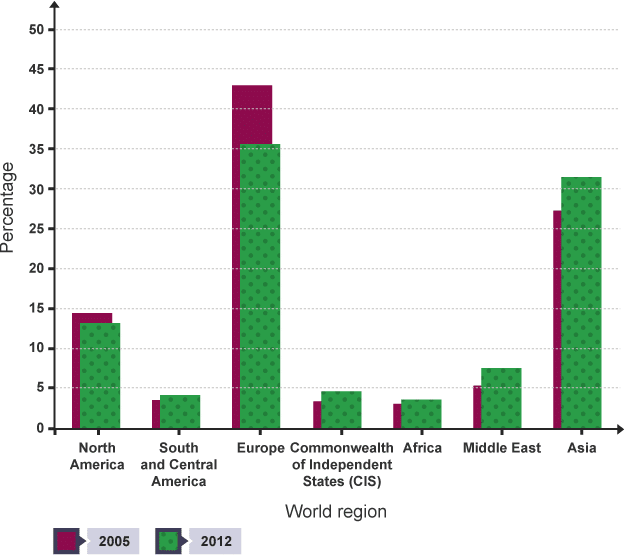
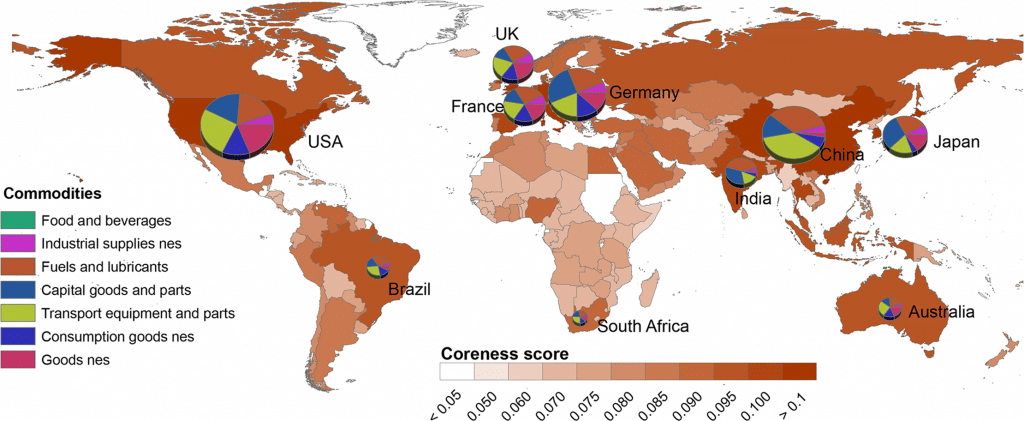
- The diagram below emphasises the dominance developed countries still have in terms of exports. However, there is evidence that the developed countries’ share is decreasing.
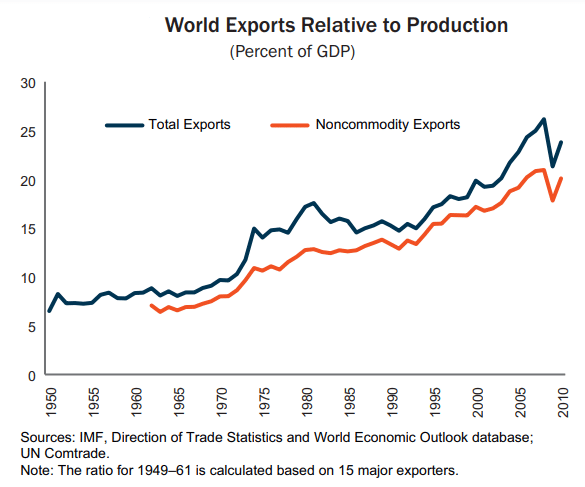
- The past few decades have seen important shifts that have reshaped the global trade landscape. As a share of global output, trade is now at almost three times the level in the early 1950s, in large part driven by the integration of rapidly growing emerging market economies (EMEs).
- The expansion in trade is mostly accounted for by growth in non-commodity exports, especially of high-technology products such as computers and electronics.
- It is also characterized by three important trends:
- the rise of EMEs as systemically important trading partners;
- the growing role of global supply chains;
- and an ongoing shift of technology content toward dynamic EMEs.
- These developments in global trade have been associated with increased trade interconnectedness and carry important implications for trade patterns, in particular in response to relative price changes.
- A chief contributor is the growing role of global supply chains in overall trade, facilitated by lower tariffs and technology-led declines in transportation and communication costs.
Key Features of Post-WWII Trade
- Decline of colonial trade patterns: End of European empires, but economic dependence of Global South continued (neo-colonialism).
- US economic dominance: USA became world’s largest exporter and importer; Marshall Plan rebuilt Western Europe.
- Institutionalization of trade: Creation of Bretton Woods institutions (IMF, World Bank, GATT) to stabilize global economy.
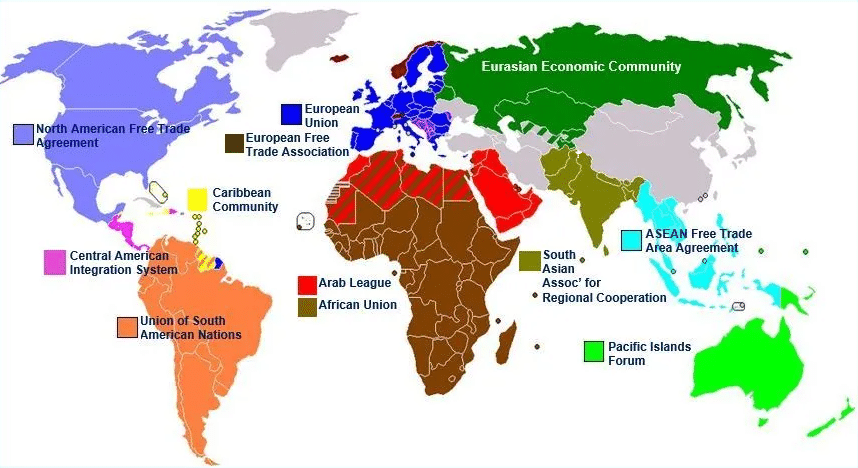
- Rise of regional blocs: EEC (later EU), ASEAN, NAFTA, MERCOSUR shaped trade.
- Technology-driven globalization: Shipping containers, aviation, and IT boosted world trade.
- Shift from primary to manufactured & services trade: Industry and later services overtook raw material exports.
Regional & Global Trade Patterns
United States (Trade Hegemony)
- Emerged as largest exporter of capital, machinery, grain, and later technology and services.
- Dollar became reserve currency under Bretton Woods.
- USA exported industrial products to Europe and Japan, imported raw materials from developing nations.
Western Europe
- Reconstructed under Marshall Plan (1948–1952).
- Intra-European trade expanded through European Economic Community (1957) → later EU.
- Shift from colonial supply dependence → integrated regional market.
- Germany, France, UK became manufacturing hubs, exporting machinery, automobiles, chemicals.
Soviet Bloc (Socialist Trade System)
- USSR created Council for Mutual Economic Assistance (COMECON, 1949).
- Trade remained limited within socialist bloc (Eastern Europe, Cuba, Mongolia, Vietnam).
- Focused on resource exchange (oil, gas, metals) and industrial goods within bloc; minimal integration with capitalist world.
Decolonized Asia & Africa
- Newly independent nations tried to reduce dependence on ex-colonial masters → but terms of trade remained unfavorable.
- Continued reliance on primary commodity exports: oil (Middle East, Nigeria), cocoa (Ghana, Ivory Coast), tea (India, Sri Lanka), jute (Bangladesh).
- Formed Group of 77 (1964) within UNCTAD to demand fairer trade.
- OPEC (1960) symbolized assertiveness of developing nations, especially in petroleum trade.
Latin America
- Continued as exporter of coffee, sugar, copper, oil, and bananas.
- Adopted Import Substitution Industrialization (ISI) in mid-20th century → but external debt crises (1980s) limited success.
- Later integrated into regional blocs (MERCOSUR, Andean Pact).
Japan & East Asia
- Japan emerged as industrial powerhouse post-1950s, exporting automobiles, electronics, and machinery.
- The Asian Tigers (South Korea, Taiwan, Hong Kong, Singapore) followed export-led industrialization.
- This shifted trade towards Asia-Pacific, foreshadowing globalization.
Middle East
- Petroleum dominated exports, especially after OPEC oil shocks (1973, 1979).
- Oil trade became central to global geopolitics.
- Middle East earned petro-dollars, reinvested in Western economies.
Structural Transformations in Trade
- From Bilateralism → Multilateralism: GATT (1947) promoted non-discriminatory trade → evolved into WTO (1995).
- Shift from raw materials → Manufacturing & Services: By 1970s, manufacturing accounted for majority of trade. By 1990s, services (finance, IT, tourism, education) gained importance.
- Rise of Multinational Corporations (MNCs): Nike, Toyota, IBM, Shell expanded trade via global supply chains.
- Containerization & technology: Reduced costs, made global sourcing viable.
- Petroleum’s strategic dominance: Middle East oil shaped trade and geopolitics.
- Dollar dominance: US dollar became central to trade settlements.
Contemporary Trade Patterns (Post-1991 Globalization & WTO era)
- The 21st century global trade is marked by hyper-globalization, digitalization, regionalism, and geopolitics.
- The world has moved from GATT (1947) → WTO (1995) → fragmented globalization (2000s onwards).
- Trade today is shaped by:
- Global Value Chains (GVCs) and supply chain networks.
- Rise of emerging economies (BRICS, ASEAN, Africa).
- Energy trade transition (fossil fuels → renewables).
- Digital trade and services.
- Trade wars, protectionism, and regional blocs.
- Following the financial crisis, a sharp divide in economic performance of high-income vs. emerging economies. US, EU, and Japan slow to recover, while emerging economies such as China have fueled global recovery
- Rise of lower and middle-income countries two decades in making:
- China’s transition accelerated in the 1990s
- India’s growth surge started after its 1991 reforms
- Huge global export shock: 1992-2008 average annual growth rate in exports – China (18%) and India (14%)
- 15 other countries (Brazil, Korea, Mexico, Russia, Argentina, Turkey, Indonesia, Poland, South Africa, Thailand, Egypt, Colombia, Malaysia, the Philippines, and Chile) had an annual growth rate in exports of 8% for 1992-2008
- During the same period, low and middle-income countries saw share of global exports increased from 21 to 43%
- South-South trade driven by:
- urbanization and industrialization in China and India creating demand for raw materials
- lengthening of global production networks has resulted in increasing trade in parts and components
- Growth in North-South trade has rekindled interest in orthodox theories of international trade.
Key Characteristics of 21st Century Trade
- Shift from goods → services:
- Services now account for ~23% of global exports (WTO, 2023).
- IT, finance, tourism, education, healthcare dominate.
- Rise of Asia as global trade hub:
- Asia accounts for 41% of world merchandise exports (WTO, 2023).
- China became world’s largest exporter (2009 onwards).
- Global Value Chains (GVCs):
- Production fragmented across countries (e.g., iPhone parts made in 43+ countries).
- East & Southeast Asia are GVC hotspots.
- Energy Transition in Trade:
- Oil still dominates but renewable energy technologies (solar panels, wind turbines, lithium, rare earths) are reshaping trade.
- China dominates solar PV exports (>80% global share).
- Rise of Regionalism:
- Growth of mega-trade blocs → EU, RCEP (2020), CPTPP, USMCA, AfCFTA (2021).
- Regional trade is growing faster than inter-regional trade.
- Digital Trade Revolution:
- E-commerce, fintech, cloud services = new drivers of trade.
- Digital economy contributes 15.5% of global GDP (UNCTAD 2021).
- Geopolitical Fragmentation:
- US–China trade war, sanctions on Russia (2022 Ukraine war), and reshoring policies.
- Shift from globalization → “friend-shoring” and “near-shoring”.
Changing Patterns of World Trade (1990s – 2008)
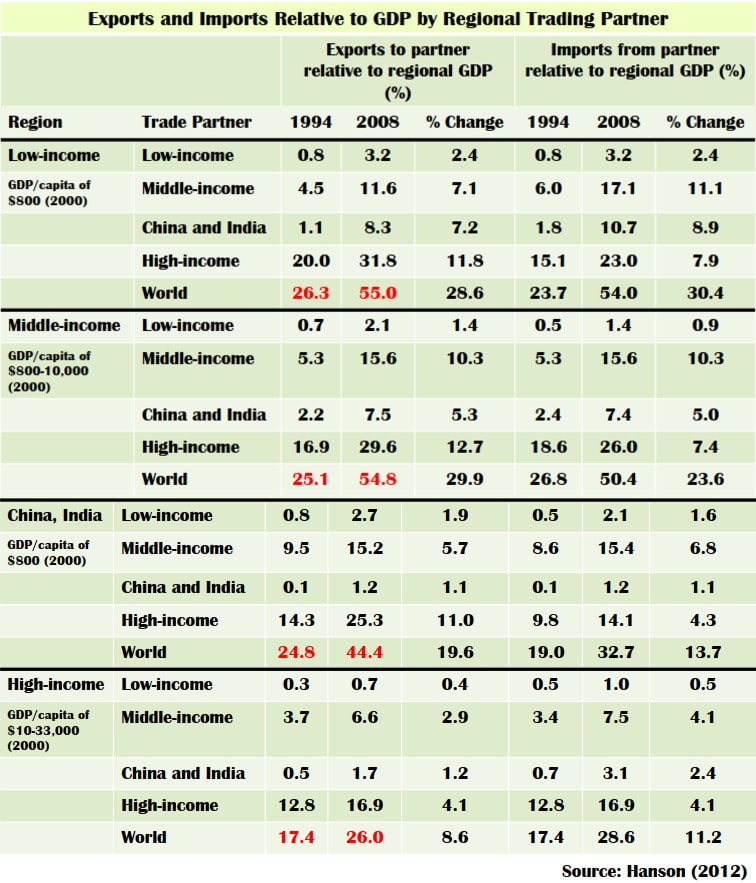
- For low and middle-income countries, exports as share of regional GDP has grown sharply, e.g., 26 to 55% (low-income), 25 to 55% (middle-income), and 25 to 55% (China and India) – similarly for imports.
- Lower trade growth for high-income countries, e.g., 17 to 26% in case of exports
- Change in trade pattern involves much larger South-South trade flows over period 1994-2008:
- share of exports from low to low and middle-income countries rose from 24 to 42%
- share of exports from middle-income to low and middle-income countries rose from 33 to 46%
South-South Trade
- The key explanation put forward for growth in South-South trade is an expansion of multistage global production networks.
- Offshoring of production allows firms to fragment manufacturing across borders by locating specific production stages in countries with the lowest cost.
- Consequently, gross trade flows (total exports) may overstate net trade flows (exports minus intermediates), i.e., expansion of South-South trade is statistical artifact.
- While double-counting is part of the story, there is evidence of increased specialization by emerging economies for global markets.
North-South Trade
- In 1980s and 1990s, due to dominance of high-income countries in global trade, orthodox models of trade (Ricardian/Heckscher-Ohlin) went out of fashion.
- Specifically could not explain observed intra-industry trade among high-income countries, i.e., two-way trade in similar products between similar countries, e.g. the French export cars and import German cars
- Changed in past decade where growth in countries such as China and India suggest differences in technology/resources are strong motivations for trade
- International specialization follows perceived patterns of comparative advantage
- Low-income countries: positive net exports in three resource or labor-intensive sectors: agriculture, raw materials, and apparel and shoes
- China and India: positive net exports in three laborintensive sectors: apparel, shoes and electronics, and other manufactures
- Middle-income countries: negative net exports in three capital-intensive sectors: chemicals, machinery, and transportation equipment
- High-income countries: positive net exports in three capital-intensive sectors: chemicals, machinery, and transportation equipment.
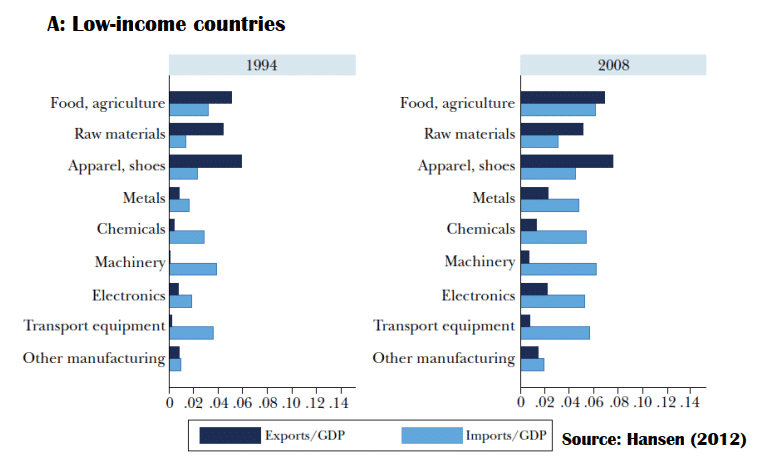
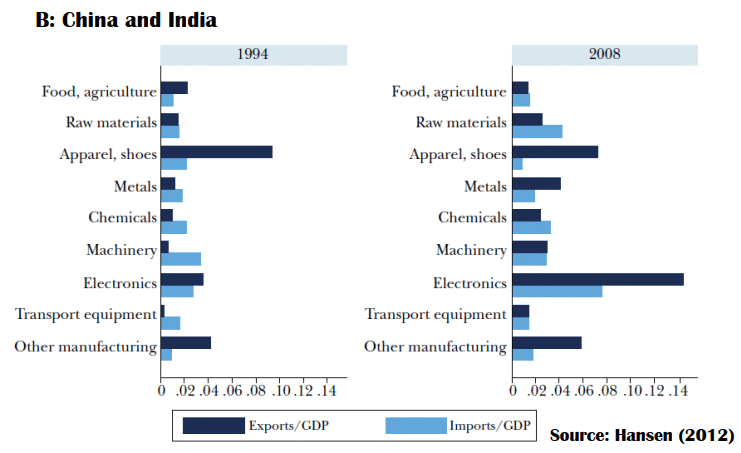
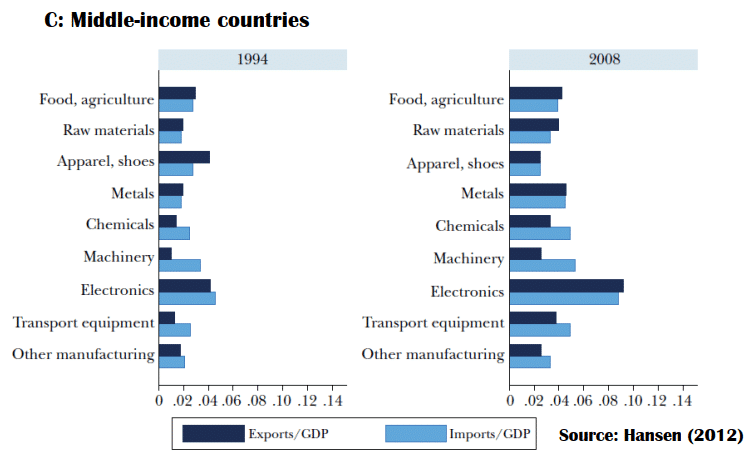
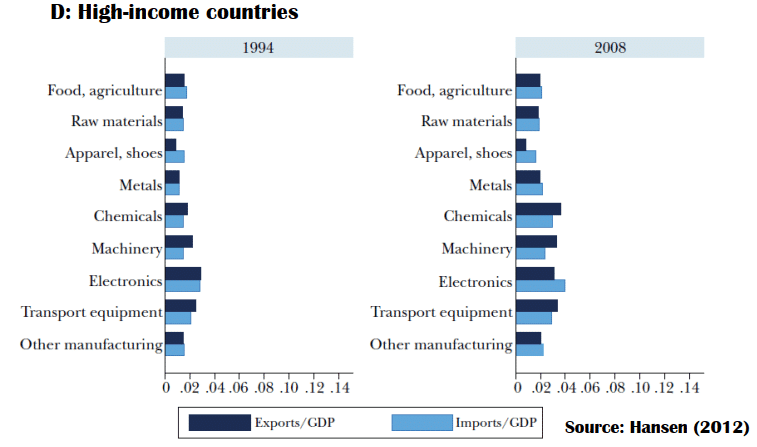
- Growing South-South trade along lines of comparative advantage, i.e., resource-poor emerging economies importing from resource-rich emerging economies. For low-income countries, 70% of agricultural export growth and 73% of raw materials growth are due to shipments to low-/middle-income countries. Low-income countries send most of their output of clothing and shoes to high-income countries.
- Middle-income countries export diverse sets of goods: agriculture (Argentina and Brazil); metals (Russia, Korea, South Africa, and Chile); electronics (Korea, Malaysia, Thailand, and the Philippines); transportation equipment (Korea, Mexico, Poland, and Turkey).
- 50% of middle-income export growth to low-/middleincome countries, except automobiles. China and India accounted for more than 25% of exports of raw materials and electronics from middle-income countries – reflecting the need for iron ore, copper, other minerals, and deepening of production networks.
- China and India are distinct among low-/middle-income countries for being reliant on high-income markets to absorb their exports.
- High-income countries absorbed over 70% of China’s export growth in apparel, footwear, and other manufactures, and over 55% in electronics (China) and metals (India).
Dynamics in Specialization
- Middle-income countries moved from specializing in apparel and footwear in 1994 to electronics by 2008.
- Consistent with middle-income countries accumulating human and physical capital pushing them out of labor-intensive into more capital-intensive goods.
- Low-income countries such as Bangladesh and Vietnam are filling the space vacated by middle-income countries in apparel.
- Large changes in specialization have also occurred in countries such as China.
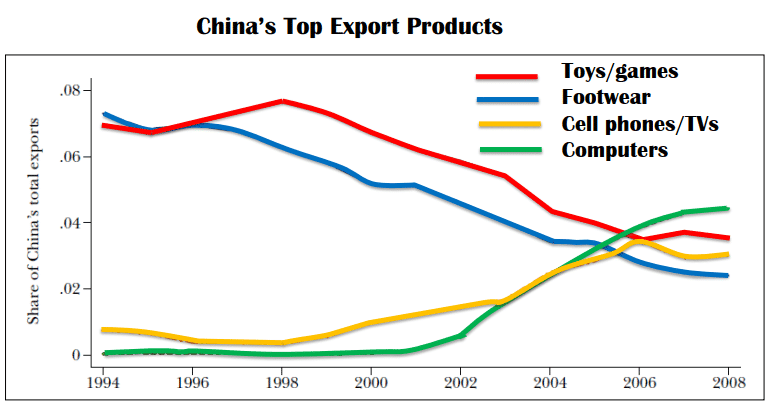
- China not just switching from assembling shoes to assembling computers, but manufacturing more technologically advanced goods and accounting for more value-added, e.g., Huawei (mobile phones) and Lenovo (laptops)
- Some doubt China’s export strength in electronics is due to comparative advantage, but rather to industrial policy (Rodrik, 2006) – but Hanson (2012) argues stock of human capital would indicate specialization is not unwarranted
- China has increased the supply of educated labor, attracted investment by multinational firms, and improved transport and communications – it likely has an increasing comparative advantage in electronics.
Regional Patterns
Asia-Pacific (Epicenter of Trade Growth)
- China:
- Largest exporter of manufactured goods (electronics, machinery, textiles).
- Major importer of oil, iron ore, food grains.
- India:
- Strong in IT services, pharma, textiles, and growing in electronics.
- Major importer of crude oil, gold, defense equipment.
- ASEAN:
- Electronics, palm oil, natural gas; strong intra-ASEAN & China-linked trade.
- Japan & South Korea:
- Exporters of automobiles, electronics, ships, steel.
- Importers of oil, coal, and food.
North America
- USA:
- Still a trade giant in services (finance, IT, software, higher education).
- Shale revolution made USA a net energy exporter (oil & gas).
- Trade deficit in goods, surplus in services.
- Canada: Oil, minerals, wheat exports.
- Mexico: Manufacturing hub (automobiles, electronics) due to USMCA integration.
Europe
- EU = world’s largest trading bloc.
- Germany: Europe’s export powerhouse (automobiles, machinery, chemicals).
- UK (post-Brexit): Strong in services (finance, education, IT).
- EU’s energy imports reshaped post-Ukraine war: shift from Russia → LNG imports from USA, Qatar.
Middle East & North Africa (MENA)
- Still oil & gas dependent.
- Saudi Arabia, UAE, Qatar remain among largest energy exporters.
- Shift towards diversification: UAE & Saudi developing non-oil exports, logistics, and tourism.
- Africa’s intra-continental trade growing under AfCFTA (2021).
Latin America
- Brazil, Argentina: Agricultural exports (soybeans, beef, coffee).
- Chile, Peru: Copper, lithium (critical for EV industry).
- Venezuela: Decline in oil exports due to political instability.
- Regional bloc: MERCOSUR remains key.
Sub-Saharan Africa
- Resource-based exports (oil – Nigeria, Angola; gold – Ghana; cobalt – DRC).
- Still faces unfavorable terms of trade.
- Growing trade ties with China (infrastructure for resources).
Emerging Trade Trends
- South-South Trade:
- Developing countries’ trade with each other now > 25% of global trade (UNCTAD 2022).
- China–Africa, India–Africa, Latin America–Asia links growing.
- Critical Minerals Trade:
- Lithium (Chile, Argentina, Australia), Cobalt (DRC), Rare Earths (China).
- Key for EVs, batteries, renewable energy.
- Green Trade:
- Carbon border taxes (EU CBAM), ESG standards influencing trade.
- Renewable energy products (solar panels, wind turbines) as new export categories.
- Digital & AI-driven trade:
- E-commerce giants (Amazon, Alibaba), fintech exports (India’s UPI model).
- Cross-border data flows surpassing trade in goods.
Challenges in Contemporary Trade
- Protectionism (US tariffs, EU carbon taxes, India’s restrictions on Chinese imports).
- Geopolitical tensions (US–China, Russia–West).
- Global supply chain disruptions (COVID-19, Suez Canal blockage, Ukraine war).
- Inequalities: Developing nations still export primary goods; developed nations dominate high-tech & services.
Conclusion
- The 21st century trade system reflects both integration and fragmentation:
- Integration via digital trade, GVCs, South-South exchanges.
- Fragmentation via trade wars, regional blocs, geopolitics.
- Asia, especially China and India, has emerged as the new center of global trade gravity.
- Future trade will be shaped by:
- Green energy transition,
- Digital economy,
- Multipolar trade alignments (BRICS+, RCEP, AfCFTA).





a student-centric website with comprehensive notes for everything. can’t thank you enough
can you update the content for development in trade pattern uptill now( 2020)
Can you update the content for development in trade pattern as it showing a huge variability as of the 2021/22context.
It’s done ✅
Thank you tonnnnnneeees