

UPSC Mains · Optional Subject
History Optional for UPSC: Complete Notes (Paper I & II)
Free, chapter-wise notes for every unit of History Optional, arranged exactly as the UPSC syllabus runs: Paper I (Ancient and Medieval India, with the map question) and Paper II (Modern India and World History), with topic-wise PYQs for each unit and PDFs for offline revision.
- 51 units
- 470+ free notes
- Topic-wise PYQs since 1985
- PDFs for revision
Go beyond the free notes
- Mains Master KitMost popular
Complete Notes PDF (worth ₹1,180), mapping practice and 12 months of premium₹1,770 - PYQ Master Pack
1,390+ topic-wise model answers, 1985–2025₹1,499 - Complete Notes (PDF)
Both papers in six PDFs, with mapping₹1,180
Compare all three · One-time payment, instant access
LotusArise IAS courses
History Optional courses for UPSC Mains 2027
The free notes take you through the syllabus. These three take you to the score: printable notes for revision, a complete self-study system, and 1,390+ model answers to master answer writing.
Printable PDFs
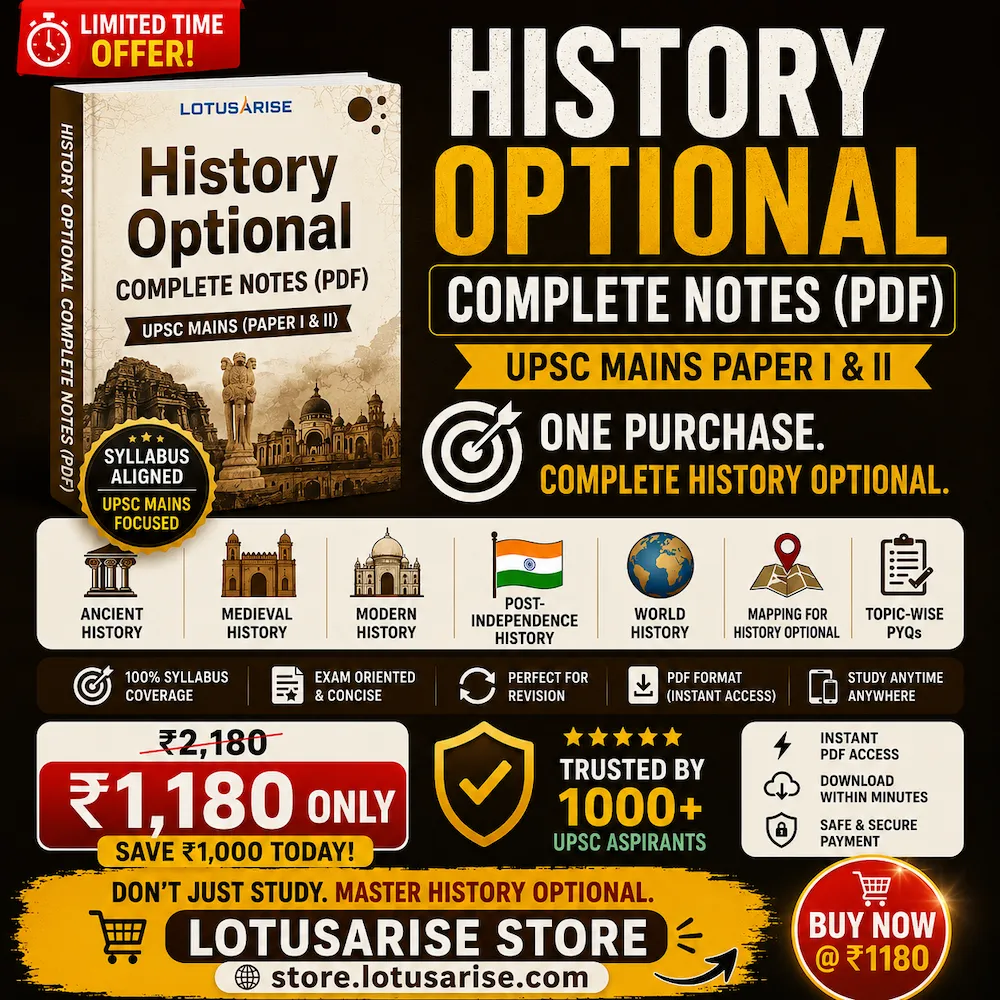
History Optional Complete Notes (PDF)
Both papers in six downloadable PDFs.
- Ancient, Medieval, Modern, Post-Independence and World History
- Mapping notes for the Paper I map question
- Topic-wise PYQs for focused answer practice
- Read offline, print, unlimited downloads, no expiry
₹1,180 ₹2,150 Save ₹970
900+ History Optional notes PDFs sold
Or buy by part: Ancient · Medieval · Modern · World ₹354 each · Post-Independence · Mapping ₹236 each
Most popular
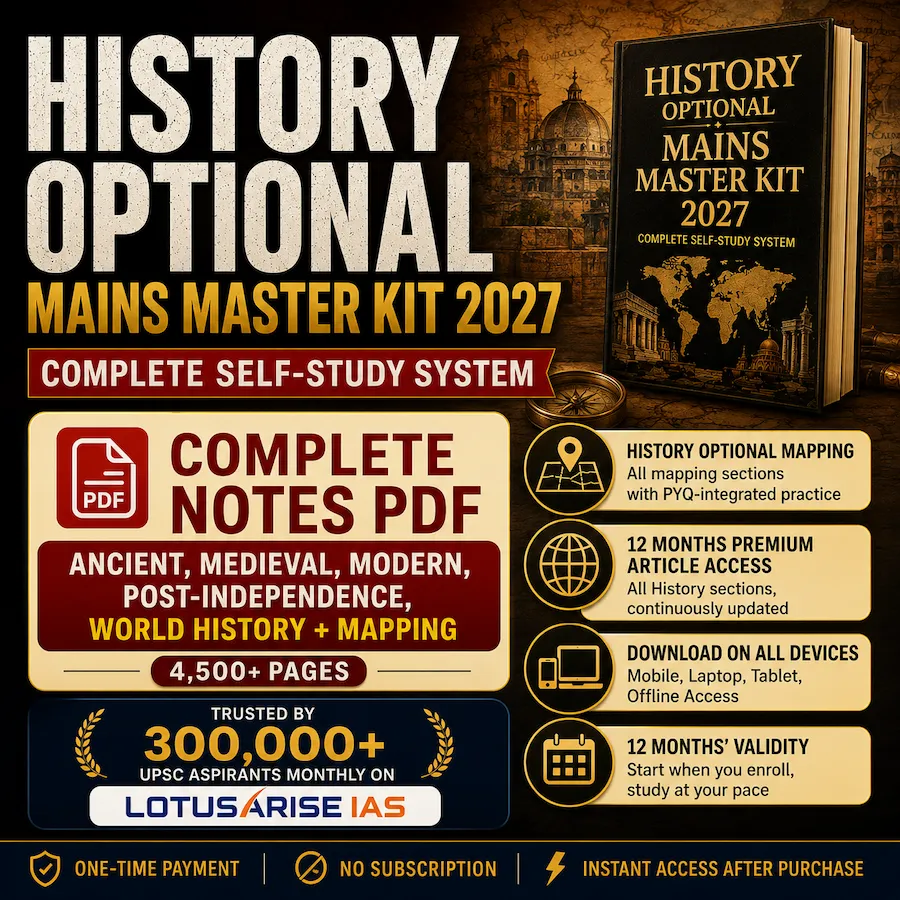
History Optional Mains Master Kit
The complete self-study system for Paper I and Paper II.
- Complete Notes PDF worth ₹1,180: all six parts, 4,500+ pages
- History Optional Mapping with PYQ-integrated practice
- 12 months of premium article access, all History sections
- Mobile, laptop and tablet, with offline downloads
₹1,770 ₹5,000 Save ₹3,230
Includes the ₹1,180 Complete Notes, so the mapping practice and 12 months of premium cost just ₹590 more.
Chosen by 320+ aspirants · 12 months’ validity
For answer writing
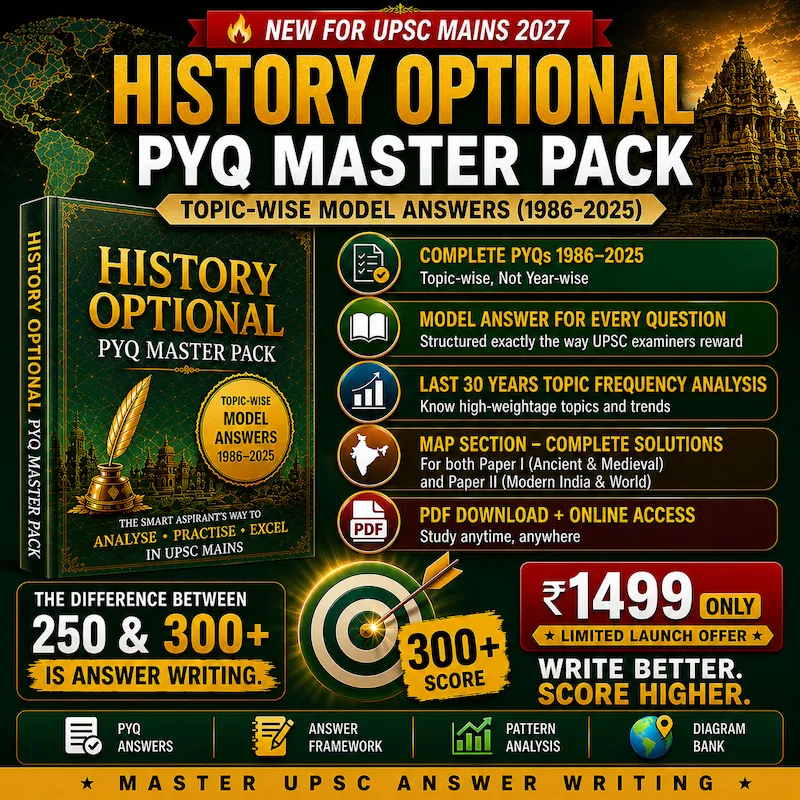
History Optional PYQ Master Pack
Every PYQ since 1985, answered the way UPSC rewards.
- 1,390+ topic-wise model answers, 1985 to 2025
- All 51 units of Paper I and Paper II
- Historiography, sources and map references in each answer
- Map-question solutions included
₹1,499 ₹2,500 Save ₹1,001
PDF download + 550 days of online access
One-time payment · Instant access after purchase · Phone, laptop and tablet · 3,00,000+ aspirants read LotusArise IAS every month
Which one is right for you?
| What you get | Complete Notes (PDF) | Mains Master Kit | PYQ Master Pack |
|---|---|---|---|
| Best for | Revising from printable notes | Studying the full syllabus in one system | Writing answers that score |
| Notes for Paper I and II | All six parts as PDFs | Complete Notes PDF (worth ₹1,180) | — |
| Practice | Topic-wise PYQs | Mapping practice with PYQs | 1,390+ topic-wise model answers |
| Map question | Mapping notes | Mapping notes and practice | Map-question solutions |
| Also includes | — | 12 months of premium articles | Historiography and sources in every answer |
| Access | Unlimited downloads, no expiry | 12 months | PDF download + 550 days online |
| Price | ₹1,180 | ₹1,770 | ₹1,499 |
Best pair: the Mains Master Kit tells you what to study, and the PYQ Master Pack shows you how to write it. Together they cover both halves of the paper.
What is History Optional in UPSC?
History is one of the optional subjects you can choose for the UPSC Civil Services Main Examination, and it has long been one of the most popular. You write two papers of 250 marks each, so the optional decides 500 of the 1,750 marks in the written Mains.
It also pays off beyond the optional. Large parts of the syllabus overlap with GS Paper I (Indian culture, modern Indian history, post-independence India and world history), the Essay paper and Prelims, so one round of preparation serves several papers. Every unit below follows the official History Optional syllabus line by line, so you can tick off topics as you finish them.
History Optional at a glance
| Paper I | Section A, Ancient India (with the map question); Section B, Medieval India |
| Paper II | Section A, Modern India (including post-independence India); Section B, World History |
| Marks | 250 per paper, 500 in all |
| Time | 3 hours per paper |
| Questions | 8 per paper; answer 5. Q1 and Q5 are compulsory, and at least one more must come from each section |
| Map question | Paper I, Q1: identify places marked on a map of India and write a short note on each (50 marks) |
| Units | 24 in Paper I (12 ancient, 12 medieval) and 27 in Paper II |
Start here
- Syllabus (Paper I and II)
- Best books (booklist)
- Preparation strategy
- Question papers (topic-wise)
- PYQ model answers (1985–2025)
- Map material
- Map PYQs solved
- How to cite historians
- Toppers and high-scoring answers
- History and GS overlap
- Notes in Hindi (PDF)
- Join the Mains Master Kit
- Join the PYQ Master Pack
How to study History Optional: the order that works
Fifty-one units look heavy until you take them in the right order. This sequence builds each period on the one before it and keeps answer writing and map practice running from the first week.
- Read the syllabus against recent papers. Before opening a note, go through the last ten years of topic-wise question papers to see which units UPSC returns to and how it frames them.
- Start with Modern India. It overlaps most with GS Paper I and its sources are the easiest to follow, so it builds confidence and speed. Take the units in order, from European penetration to the national movement.
- Take Ancient India with an atlas open. The Paper I map question (50 marks) draws on sites across Ancient and Medieval India, so mark every site as you read and revise them with the mapping notes.
- Read Medieval India as debates, not just dynasties. Units on the Sultanate, Akbar and the Mughal economy reward answers that weigh historians’ views, so note the main interpretations for each unit as you go.
- Study World History by themes. Revolutions, nationalism, imperialism, the world wars and decolonisation recur across units, so prepare comparative points you can reuse.
- Finish Paper II with Post-Independence India. It has only three units, but questions are regular and overlap with GS, so keep these notes short and current.
- Write answers and practise maps from week one. After each unit, attempt its topic-wise PYQs under time: about 7 minutes for a 10-mark answer, 11 for a 15-mark and 14 for a 20-mark answer. Check your answers against the historian citation guide and the 1,390+ model answers in the PYQ Master Pack.
Jump to a unit · Paper I · Ancient India
- Sources
- Pre-history and Proto-history
- Indus Valley Civilization
- Megalithic Cultures
- Aryans and Vedic Period
- Period of Mahajanapadas
- Mauryan Empire
- Post-Mauryan Period
- Early State and Society in the East, Deccan and South
- Guptas, Vakatakas and Vardhanas
- Regional States during Gupta Era
- Themes in Early Indian Cultural History
Paper I · Medieval India
- Early Medieval India, 750–1200
- Cultural Traditions in India, 750–1200
- The Thirteenth Century
- The Fourteenth Century
- 13th and 14th Century Society, Culture and Economy
- 15th and Early 16th Century Politics and Economy
- 15th and Early 16th Century Society and Culture
- Akbar
- Mughal Empire in the Seventeenth Century
- Economy and Society in the 16th and 17th Centuries
- Culture during Mughal Empire
- The Eighteenth Century
Paper II · Modern India
- European Penetration into India
- British Expansion in India
- Early Structure of the British Raj
- Economic Impact of British Colonial Rule
- Social and Cultural Developments
- Social and Religious Reform Movements
- Indian Response to British Rule
- Early Indian Nationalism
- Rise of Gandhi and the Gandhian Era
- Constitutional Developments, 1858–1935
- Other Strands in the National Movement
- Politics of Separatism
Paper II · Post-Independence India
Paper II · World History
- Enlightenment and Modern Ideas
- Origins of Modern Politics
- Industrialization
- Nation-State System
- Imperialism and Colonialism
- Revolution and Counter-Revolution
- World Wars
- The World after World War II
- Liberation from Colonial Rule
- Decolonization and Underdevelopment
- Unification of Europe
- Disintegration of the Soviet Union
Paper I: Ancient and Medieval India (Notes)
Section A covers Ancient India and the map question; Section B covers Medieval India. Within each unit, notes are listed in the order to study them.
Section A · Ancient India
Sources
- Archaeological Sources
- Literary sources
- Foreign account
- Approaches to the Study of Early Indian History
- Ancient Indian Historiography
- Land Ownership in Ancient India
Practise it for marks: solved Sources PYQs from 1985 to 2025, with historiography and sources, are in the PYQ Master Pack.
Pre-history and Proto-history
- Geographical factors
- Paleolithic Period: Hunting and Gathering
- Mesolithic Period: Hunting and Gathering
- Mesolithic Art: Rock Paintings
- Beginning of Agriculture in Neolithic and Chalcolithic
- Chalcolithic Pottery as a Source of History
Practise it for marks: solved Pre-history and Proto-history PYQs from 1985 to 2025, with historiography and sources, are in the PYQ Master Pack.
Indus Valley Civilization
- Indus Valley Civilisation: Origin
- Indus Valley Civilisation: Date and Extent
- Indus Valley Civilization: Characteristics and Significance
- Indus Valley Civilization: Art and Crafts
- Indus Valley Civilization: Architecture
- Subsistence Pattern of Harappan Civilisation
- Harappan Religious and Funerary Beliefs
- Harappan Trade
- Political System of Harappa Civilization
- Harappan Script
- Seals of Harappan Civilization: Seals and Sealings
- Decline and Survival of Indus Valley Civilisation
Practise it for marks: solved Indus Valley Civilization PYQs from 1985 to 2025, with historiography and sources, are in the PYQ Master Pack.
Megalithic Cultures
Practise it for marks: solved Megalithic Cultures PYQs from 1985 to 2025, with historiography and sources, are in the PYQ Master Pack.
Aryans and Vedic Period
- Expansions of Aryans in India
- Vedic Period: Political, Social and Economical life
- Vedic Literature: Religious and Philosophic Literature
- Transformation from Rig Vedic period to the later Vedic period
- Evolution of Monarchy and Varna system.
Practise it for marks: solved Aryans and Vedic Period PYQs from 1985 to 2025, with historiography and sources, are in the PYQ Master Pack.
Period of Mahajanapadas
- Formation of States (Mahajanapadas): Republic and Monarchies
- Rise of Urban Centres; Trade routes; Economic Growth
- Introduction of Coinage
- Spread of Buddhism
- Spread of Jainism
- Similarities & Differences between Jainism and Buddhism
- Rise of Magadha Empire and Nandas
- Iranian and Macedonian Invasions and Their Impact
Practise it for marks: solved Period of Mahajanapadas PYQs from 1985 to 2025, with historiography and sources, are in the PYQ Master Pack.
Mauryan Empire
- Maurya Empire
- Mauryan Empire: Art, Architecture and Sculpture
- Mauryan Empire: Disintegration of the empire
- Sunga Dynasty
- Kanva Dynasty (75 BCE – 30 BCE)
Practise it for marks: solved Mauryan Empire PYQs from 1985 to 2025, with historiography and sources, are in the PYQ Master Pack.
Post-Mauryan Period (Indo-Greeks, Sakas, Kushanas, Western Kshatrapas)
- Post-Mauryan Period: Contact with Outside World
- Indo-Greeks, Sakas, Kushanas, Western Kshatrapas
- Post-Mauryan: Growth of Urban Centres, Economy, Coinage
- Post-Mauryan Period: Development of Religions
- Post-Mauryan Period: Society (Social Conditions)
- Post-Mauryan Period: Literature and Science
- Post-Mauryan Period: Art, Architecture, Culture
Practise it for marks: solved Post-Mauryan Period PYQs from 1985 to 2025, with historiography and sources, are in the PYQ Master Pack.
Early State and Society in Eastern India, Deccan and South India
- Kharavela Dynasty
- The Satavahanas
- Tamil States of the Sangam Age: Cheras, Cholas & Pandyas
- Sangam Age: Economy of the Sangam Age
- Sangam Age: Social Development
- Sangam Literature and Culture
- Sangam Age: Administration
- Sangam Age: Economy, Land grants
- Sangam Age: Coinage
- Sangam Age: trade guilds and urban centres
- Buddhist centres
- Art and architecture
Practise it for marks: solved Early State and Society in the East, Deccan and South PYQs from 1985 to 2025, with historiography and sources, are in the PYQ Master Pack.
Guptas, Vakatakas and Vardhanas
- Guptas: Gupta Empire
- Polity and Administration of Gupta Empire
- Guptas: Caste system, Position of women
- Guptas: Economic conditions
- Guptas: Coinage of the Guptas
- Guptas: Land grants
- Guptas: Decline of urban centres
- Guptas: Indian feudalism
- Guptas: Education and educational institutions; Nalanda, Vikramshila and Vallabhi
- Gupta Period: Literature, Scientific literature
- Gupta Period: Art and Architecture
- Paintings of Gupta period
- Ajanta Art
- Vakataka Dynasty
- Vardhana Dynasty: Harshavardhana
Practise it for marks: solved Guptas, Vakatakas and Vardhanas PYQs from 1985 to 2025, with historiography and sources, are in the PYQ Master Pack.
Regional States during Gupta Era
- Kadamba Dynasty
- Pallava Dynasty
- The Chalukyas of Badami (Badami Chalukyas)
- Regional States during Gupta Era: Polity and Administration
- Growth of Vaishnava and Saiva religions, Tamil Bhakit movement.
- Shankaracharya and Vedanta
- Ramanuja and Vishishtadvaita
- Palas: Polity and administration
- Rashtrakutas: Polity and administration
- Senas: Polity and administration
- Paramaras: Polity and administration
- Palas: Cultural Aspects
- Rashtrakutas: Cultural Aspects
- Arab Conquest of Sind
- Albiruni’s India
- Chalukyas of Kalyani (Western Chalukyas)
- Cholas: Polity and Administration
- Hoysalas: Polity and Administration
- Pandyas: Polity and Administration
- Chola: Local Government
- Cholas: Art and Architecture
- Hoyasala: Art and Architecture
- Pandyas: Art and Architecture
- Cholas : Economy, Society, Education and Literature
- Pandyas : Economy, Society, Education and Literature
Practise it for marks: solved Regional States during Gupta Era PYQs from 1985 to 2025, with historiography and sources, are in the PYQ Master Pack.
Themes in Early Indian Cultural History
- Languages and Texts
- Major Stages in the Evolution of Art and Architecture
- Mathura School of Arts
- Gandhara school of Arts
- Amaravati School of Arts
- Systems of Indian Philosophy
- Six Schools of Indian Philosophy
- Ajivika and Charvaka School
- Tantricism
- Shaktism
- Money lending in Ancient India
- Slavery in Ancient India
Practise it for marks: solved Themes in Early Indian Cultural History PYQs from 1985 to 2025, with historiography and sources, are in the PYQ Master Pack.
History Optional Mapping (Paper I, Q1)
- Palaeolithic Sites
- Mesolithic Sites
- Neolithic Sites
- Early Harappan Sites
- Harappan Sites
- Late Harappan Sites
- Chalcolithic Sites
- Megalithic Sites
- Painted Grey Ware Sites
- Northern Black Polished Ware Sites
- Ancient Ports
- Ancient Cave Sites
- Ancient Education Centres
- Temple Sites
- Buddhist Sites
- Ancient Jain Sites
- Ancient Capital Cities
- Famous Inscriptional sites
- Edicts of Ashoka
- Ashoka’s Inscriptions for Famine Relief
- Ancient Mosque Sites
- Ancient Church Sites
- World Heritage Ancient Sites
- Petroglyph Sites
- Hominid Fossil Sites
Practise it for marks: map-question solutions are part of the PYQ Master Pack.
History Optional Complete Notes (PDF)
Finished Ancient India? Keep all of it as printable notes.
Both papers in six PDFs: Ancient, Medieval, Modern, Post-Independence and World History, plus Mapping, with topic-wise PYQs for focused answer practice.
One-time payment · Unlimited downloads · Printable
Section B · Medieval India
Early Medieval India, 750–1200
- Early Medieval India, 750-1200: Major Political Developments
- Origin and the Rise of Rajputs
- Cholas: Administration, Village economy and Society
- Indian Feudalism in Early Medieval Period
- Agrarian Economy in Early Medieval India
- Urban Settlements in Early Medieval India
- Trade and Commerce in Early Medieval India
- Society in Early Medieval India
- Condition of Women
- Indian Science and Technology
Practise it for marks: solved Early Medieval India, 750–1200 PYQs from 1985 to 2025, with historiography and sources, are in the PYQ Master Pack.
Cultural Traditions in India, 750–1200
- Philosophy: Shankaracharya and Vedanta; Ramanuja and Vishishtadvaita
- Philosophy: Madhva and Brahma-Mimansa
Religion: Forms and Features of Religion
- Religion: Tamil devotional cult, Growth of Bhakti
- Religion: Islam and its arrival in India
- Religion: Sufism
- Literature: Literature in Sanskrit
- Literature: Growth of Tamil literature
- Literature: Literature in the newly developing Languages
- Literature: Kalhan’s Rajtarangini
- Literature: Alberuni’s India
- Temple Architecture: Odisha Temple Architecture
- Temple Architecture: Kashmir Temple Architecture
- Temple Architecture: Khajuraho Temple Architecture
- Temple Architecture: Temples in Gujarat and Rajasthan
- Temple Architecture: Temples in South India
- Art and Architecture: Painting
Practise it for marks: solved Cultural Traditions in India, 750–1200 PYQs from 1985 to 2025, with historiography and sources, are in the PYQ Master Pack.
The Thirteenth Century
- Mahmud of Ghazni (Mahmud Ghaznavi)
- Muhammad Ghori (Muhammad of Ghor)
- The Ghurian invasions, factors behind Ghurian success.
- Foundation of Delhi Sultanate: Rule of Iltutmish
- Foundation of Delhi Sultanate: Rule of Balban
Practise it for marks: solved The Thirteenth Century PYQs from 1985 to 2025, with historiography and sources, are in the PYQ Master Pack.
The Fourteenth Century
- The Khalji Revolution: Jalaluddin Khalji
- Alauddin Khalji: Conquests and territorial expansion, agrarian and economic measure
- Muhammad Tughluq: Major projects, agrarian measures, bureaucracy of Muhammad Tughluq
- Firuz Tughluq: Agrarian Measures, Achievements in Civil Engineering and Public Works, Decline of the Sultanate
- Shams Siraj Afif’s Account: Tarikh-i-Firuz Shahi
- Foreign Contact: Ibn Battuta’s Accounts
- The Mangol threat to India during Sultanate period
Practise it for marks: solved The Fourteenth Century PYQs from 1985 to 2025, with historiography and sources, are in the PYQ Master Pack.
Society, Culture and Economy in the Thirteenth and Fourteenth Centuries
- Government and Administration under the Delhi Sultanate
- Economy: Agricultural Production
- Economy: Rise of Urban Economy and Non-Agricultural Production
- Economy: Trade and Commerce
- Society: composition of rural society, ruling classes under the Sultanate
- Society: town dwellers, women, religious classes, caste and slavery under the Sultanate
- Lekhapaddhati as a Source of History
- Sultanate Architecture and New structural forms
- Persian Literature, Literature in the regional languages of North India, Literature in the languages of South India
- Painting, Music, Evolution of Composite Culture
- Amir Khusrau and his Contribution
- Educational development during Sultanate Period
Practise it for marks: solved 13th and 14th Century Society, Culture and Economy PYQs from 1985 to 2025, with historiography and sources, are in the PYQ Master Pack.
The Fifteenth and Early Sixteenth Century: Political Developments and Economy
- Rise of Provincial Dynasties: Bengal
- Rise of Provincial Dynasties: Gujarat
- Rise of Provincial Dynasties: Malwa
- Rise of Provincial Dynasties: Lodis
- Rise of Provincial Dynasties: Kashmir
- Vijayanagara Empire
- Society in Vijaynagar Empire
- Bahmani Kingdom (Bahmanids)
- Portuguese Colonial Enterprise
- Central Asian Politics & advance of Babar towards India
- Mughal Empire, First Phase: Babur
- Mughal Empire, First Phase: Humayun
- The Sur Empire: Sher Shah’s Administration
- Growth of Bhakti, Bhakti Movement
- Sufi Movements
Practise it for marks: solved 15th and Early 16th Century Politics and Economy PYQs from 1985 to 2025, with historiography and sources, are in the PYQ Master Pack.
The Fifteenth and Early Sixteenth Century: Society and Culture
- Regional Cultures Specificities
- Provincial Architecture: Bengal and Jaunpur
- Provincial Architecture: Gujarat
- Provincial Architecture: Deccan
- Provincial Architecture: Malwa
- Rana Kumbha’s Cultural Contribution
- Architecture, Culture, Literature and Arts in Vijayanagara Empire
Practise it for marks: solved 15th and Early 16th Century Society and Culture PYQs from 1985 to 2025, with historiography and sources, are in the PYQ Master Pack.
Akbar
- Akbar: Conquests and consolidation of empire
- Rajput Policy of Akbar
- Establishment of Jagir & Mansab Systems
- Land Revenue System under Akbar
- Akbar’s Religious Views and Social Reforms
Court Patronage of Art and Technology
Practise it for marks: solved Akbar PYQs from 1985 to 2025, with historiography and sources, are in the PYQ Master Pack.
Mughal Empire in the Seventeenth Century
- Mughal Administration
- Mughal Land Revenue System
- Rajput Policy of Akbar
- Rajput Policy of Jahangir
- Religious Policies of Jahangir
- Religious Policies of Shahjahan
- War of Succession by Shahjahan’s Sons: Aurangzeb and Dara Shikoh
- Religious Policies of Aurangzeb
- Rajput Policy of Aurangzeb
- Revolts against Aurangzeb
The Empire and the Zamindars
- Nature of Mughal State
- Mughal Theory of Sovereignty
- Foreign Policy of Mughals in Northwest
- Deccan Policy of Mughals
- Late Seventeenth Century crisis and the revolts
- Peasant Revolts of Jats, Satnamis, Sikhs and Marathas
- The Ahom Kingdom
- Shivaji and the early Maratha Kingdom
Practise it for marks: solved Mughal Empire in the Seventeenth Century PYQs from 1985 to 2025, with historiography and sources, are in the PYQ Master Pack.
Economy and Society in the 16th and 17th Centuries
- Population in Mughal India
- Fiscal and Monetary System, Prices in Mughal India
- Agriculture Production in Mughal India
- Craft Production in Mughal Period
- Towns
- Commerce with Europe through Dutch, English and French Companies
- Indian Mercantile Classes, Banking, Insurance and Credit Systems
- Potentiality of Emergence of Capitalism in Mughal India
- Condition of Peasants in the 16th and 17th Centuries
- Condition of Women in the 16th and 17th Centuries
- Evolution of the Sikh Community and the Khalsa Panth
- Bernier’s Account of India
Practise it for marks: solved Economy and Society in the 16th and 17th Centuries PYQs from 1985 to 2025, with historiography and sources, are in the PYQ Master Pack.
Culture during Mughal Empire
- Persian Histories and other Literature (Mughal India)
- Hindi and Religious Literatures in Mughal India
- Mughal Architecture
- Mughal Painting
- Rajput Painting
- Provincial Architecture: Bijapur
- Provincial Architecture: Kashmir
- Provincial Painting: Pahari School of Painting
- Provincial Painting: Deccan Painting
- Provincial Painting: Patna Kalam Painting
- Classical Music in Mughal India
- Science and Technology in Mughal India
Practise it for marks: solved Culture during Mughal Empire PYQs from 1985 to 2025, with historiography and sources, are in the PYQ Master Pack.
The Eighteenth Century
- Factors for the decline of the Mughal Empire
- Regional Principalities: Nizam’s Deccan, Bengal, Awadh
- Maratha Ascendancy under the Peshwas
- Nature of Political System of Marathas
- The Maratha Fiscal and Financial System
- Emergence of Afgan Power
- Third Battle of Panipat
- State of Politics, Culture and Economy on the eve of the British Conquest
Practise it for marks: solved The Eighteenth Century PYQs from 1985 to 2025, with historiography and sources, are in the PYQ Master Pack.
History Optional PYQ Master Pack
Reading notes covers half the paper. Writing answers covers the rest.
1,390+ topic-wise model answers to History Optional questions from 1985 to 2025, across all 51 units, with historiography, sources and map references built into each answer, plus map-question solutions.
About ₹1.08 per model answer · PDF download and online access
Paper II: Modern India and World History (Notes)
Section A covers Modern India, from European penetration to post-independence India; Section B covers World History. Within each unit, notes are listed in the order to study them.
Section A · Modern India
European Penetration into India
- The Early European Settlements: The Portuguese in India
- The Early European Settlements: The Dutch in India
- The Early European Settlements: The English in India
- The Early European Settlements: The French in India
- The Carnatic Wars: First, Second, and Third Carnatic Wars
- Conflict between the English and the Nawabs of Bengal
Practise it for marks: solved European Penetration into India PYQs from 1985 to 2025, with historiography and sources, are in the PYQ Master Pack.
British Expansion in India
- British Expansion in India: Bengal
- British Expansion in India: Mysore
- British Expansion in India: The Marathas
- British Expansion in India: The Punjab
Practise it for marks: solved British Expansion in India PYQs from 1985 to 2025, with historiography and sources, are in the PYQ Master Pack.
Early Structure of the British Raj
- The Early administrative structure; From diarchy to direct contol; The Regulating Act (1773)
- The Act of Settlement 1781
- The Pitt’s India Act (1784)
- Charter Act of 1793
- The Charter Act of 1813
- The Charter Act of 1833
- The Charter Act of 1853
The Voice of Free Trade and the Changing Character of British Colonial Rule
Practise it for marks: solved Early Structure of the British Raj PYQs from 1985 to 2025, with historiography and sources, are in the PYQ Master Pack.
Economic Impact of British Colonial Rule
- Permanent Settlement: Land Revenue Systems in British India
- Ryotwari Settlement: Land Revenue System in British India
- Mahalwari Settlement: Land Revenue System in British India
- Commercialization of Agriculture during British Rule in India
- Rise of landless agrarian labourers
- Impoverishment of the rural society
- Deindustrialisation & Decline of traditional crafts
- Rise of Modern Industries in British India
- Drain of wealth: Economic Impact of British Colonial Rule
- Economic transformation of India
- Railroad and Communication Network including Telegraph and Postal Services
- Famine and Poverty in the Rural interior
- European Business Enterprise and its limitations
Practise it for marks: solved Economic Impact of British Colonial Rule PYQs from 1985 to 2025, with historiography and sources, are in the PYQ Master Pack.
Social and Cultural Developments
- The State of indigenous education, its dislocation
- Orientalist-Anglicist Controversy
- The Introduction of Western Education in India
- The Rise of Press, Literature and Public Opinion
- The Rise of Modern Vernacular Literature
- Progress of Science in Colonial India
- Christian Missionary activities in India
Practise it for marks: solved Social and Cultural Developments PYQs from 1985 to 2025, with historiography and sources, are in the PYQ Master Pack.
Social and Religious Reform Movements in Bengal and Other Areas
- Raja Ram Mohan Roy (Brahmo Movement) & Devendranath Tagore
- Ishwar Chandra Vidyasagar
- The Young Bengal Movement
- Arya Samaj & Dayanada Saraswati
- Theosophical Society
- Ramakrishna Movement and Vivekananda
- Sikh and Parsi Reform Movements
- The Social reform movements in India including Sati, Widow remarriage, Child marriage etc
- The Contribution of Indian Renaissance to the growth of Modern India
- Islamic revivalism: The Faraizi Movement
- Islamic Revivalism: The Wahabi Movement
- Islamic Revivalism: The Deoband Movement
- Islamic revivalism: Ahmedia Movement
- Aligarh Movement
Practise it for marks: solved Social and Religious Reform Movements PYQs from 1985 to 2025, with historiography and sources, are in the PYQ Master Pack.
Indian Response to British Rule
- Rangpur Dhing Rebellion (1783)
- Kol Rebellion (1832)
- Mopla Rebellion of 1921 in Malabar
- Santhal Rebellion (1855-56)
- Indigo Revolt (1859-60)
- Deccan Uprising (Deccan Riots): 1875
- Munda Rebellion (Ulgulan Movement): [1899-1900]
- Pabna Revolt (1873–76) – Pabna Peasant Uprising
- The Great Revolt of 1857
- The Shift in the Character of Peasant Uprisings in the Post-1857 Period
- The Peasant Movements of the 1920s and 1930s
Practise it for marks: solved Indian Response to British Rule PYQs from 1985 to 2025, with historiography and sources, are in the PYQ Master Pack.
Early Indian Nationalism
- Factors leading to the birth of Indian Nationalism
- Political Association before Indian National Congress
- The Foundation of Indian National Congress
- Programme and Objectives of Early Congress
- Safety-Valve Thesis relating to the birth of Congress
- The Social Composition of early Congress Leadership
- The Moderates and Extremists
- The Partition of Bengal (1905)
- The Swadeshi Movement in Bengal
- Surat Split of INC, 1907
- The Beginning of Revolutionary Extremism in India
- The Home Rule Movement (1915–1916)
- Lucknow Pact, 1916
Practise it for marks: solved Early Indian Nationalism PYQs from 1985 to 2025, with historiography and sources, are in the PYQ Master Pack.
Rise of Gandhi and the Gandhian Era
- Philosophy and Ideas of Mahatma Gandhi
- Rise of Gandhi and Early Actvism; Rowlatt Satyagraha
- Khilafat Movement and Non-Cooperation Movement
- The Swarajists and No Changers
- Bardoli Satyagraha, 1928
- Simon Commission
- The Nehru Report, Delhi Proposal and Jinnah’s Fourteen Demands
- The Civil Disobedience Movement
- Round Table Conferences
- Communal Award and Poona Pact
- Nationalism and the Peasant Movements
- Nationalism and Working Class Movements
- Praja Mandal Movements in Princely States
- Women in Indian Politics (1885-1947)
Indian Youth and Students in Indian Politics (1885–1947)
- The Election of 1937 and formation of Congress Ministries
- August Offer & Individual Satyagraha
- Cripps Mission
- Quit India Movement (1942-1944)
- C. R. formula or Rajaji Formula (1944)
- The Wavell Plan and Shimla Conference 1945
- INA Trial and RIN Mutiny
- The Cabinet Mission Plan
Practise it for marks: solved Rise of Gandhi and the Gandhian Era PYQs from 1985 to 2025, with historiography and sources, are in the PYQ Master Pack.
Constitutional Developments in Colonial India, 1858–1935
- ViceRoy’s Executive Council & Imperial Legislative Council
- The Government of India Act 1858
- The Indian Councils Act 1861
- The Indian Councils Act 1892
- Morley-Minto Reforms, 1909 (Indian Councils Act 1909)
- Montagu-Chelmsford Reforms & Government of India Act, 1919
- The Government of India Act 1935
Practise it for marks: solved Constitutional Developments, 1858–1935 PYQs from 1985 to 2025, with historiography and sources, are in the PYQ Master Pack.
Other Strands in the National Movement
- The Revolutionaries: Bengal, Punjab, Maharashtra, UP, Madras Presidency, Outside India
- The Left; Left within the Congress: Jawaharlal Nehru, Subhas Chandra Bose, Congress Socialist Party; Communist Party of India, Other Left Parties
- Strategy and Ideologies of the Indian National Movement
Practise it for marks: solved Other Strands in the National Movement PYQs from 1985 to 2025, with historiography and sources, are in the PYQ Master Pack.
Politics of Separatism
Practise it for marks: solved Politics of Separatism PYQs from 1985 to 2025, with historiography and sources, are in the PYQ Master Pack.
Section A · Post-Independence India
Consolidation as a Nation
- Nehru’s Foreign Policy
- India and her neighbours (1947-1964)
- The linguistic reorganisation of States (1935-1947)
- Regionalism and regional inequality
- Integration of Princely States
- Princes in electoral politics
- Question of National Language
Practise it for marks: solved Consolidation as a Nation PYQs from 1985 to 2025, with historiography and sources, are in the PYQ Master Pack.
Caste and Ethnicity after 1947
- Backward castes in postcolonial electoral politics
- Tribes in post-colonial electoral politics
- Dalit movements
Practise it for marks: solved Caste and Ethnicity after 1947 PYQs from 1985 to 2025, with historiography and sources, are in the PYQ Master Pack.
Economic Development and Political Change
- Land reforms
- The politics of planning and rural reconstruction
- Ecology and environmental policy in post – colonial India
- Progress of science
Practise it for marks: solved Economic Development and Political Change PYQs from 1985 to 2025, with historiography and sources, are in the PYQ Master Pack.
Section B · World History
Enlightenment and Modern Ideas
- Enlightenment & Roots of Enlightenment
- Major ideas of Enlightenment: Kant
- Major ideas of Enlightenment: Rousseau
- Enlightened Despotism/ Enlightened Absolutism
- Developments and Legacy of Enlightenment
- Spread of Enlightenment in the Colonies
- Rise of Socialist Ideas upto Marx
- Spread of Marxian Socialism
Practise it for marks: solved Enlightenment and Modern Ideas PYQs from 1985 to 2025, with historiography and sources, are in the PYQ Master Pack.
Origins of Modern Politics
- European State System
- American Revolution
- Causes of the American Revolution
- Effects of the American Revolution
- American Constitution & It’s Main Features
- The Congress of Vienna 1814–1815
- French Revolution and it’s Causes (1789-1815)
- French Revolution: National Assembly 1789-91
- French Revolution: Legislative Assembly 1791-92
- French Revolution: National Convention (1792-1795)
- Nature of French Revolution
- French Revolution: The Consulate (1799-1804)
- Causes of the Excesses of the French Revolution
- American Civil War and Abolition of Slavery
- Causes of American Civil War
- British Democratic Politics 1815-1850: Parliamentary Reformers
- British Democratic Politics, 1815-1850: Free Traders
- British Democratic Politics 1815-1850: Chartists
Practise it for marks: solved Origins of Modern Politics PYQs from 1985 to 2025, with historiography and sources, are in the PYQ Master Pack.
Industrialization
- English Industrial Revolution: Causes and Impact on Society
- Industrialization in USA
- Industrialization in Germany
- Industrialisation in Russia
- Industrialization in Japan
- Industrialisation and Globalisation
Practise it for marks: solved Industrialization PYQs from 1985 to 2025, with historiography and sources, are in the PYQ Master Pack.
Nation-State System
- Emergence of Nation State System
- Rise of Nationalism in 19th century: Nationalism and Nation State
- Eastern Question: Rise and it’s Development
- Eastern Question: Crimean War
- Eastern Question: From Treaty of Paris to Treaty of Berlin
- Nationalism: State-building in Germany
- Nationalism: State-building in Italy
- Unification of Italy
- Comparison between Italian Unification and German Unification
Practise it for marks: solved Nation-State System PYQs from 1985 to 2025, with historiography and sources, are in the PYQ Master Pack.
Imperialism and Colonialism
- Imperialism and Colonialism: South-East Asia
- Imperialism and Colonialism: Latin America
- Imperialism and Colonialism: South Africa
- Imperialism and Colonialism: Australia
- Imperialism and Free Trade: Rise of Neo-imperialism
- Imperialism and Colonialism: The Great Game
Practise it for marks: solved Imperialism and Colonialism PYQs from 1985 to 2025, with historiography and sources, are in the PYQ Master Pack.
Revolution and Counter-Revolution
- 19th Century European revolutions
- The Russian Revolution of 1917-21
- Nazi Counter-Revolution: Germany
- Fascist Counter-Revolution: Italy
- Chinese Revolution
Practise it for marks: solved Revolution and Counter-Revolution PYQs from 1985 to 2025, with historiography and sources, are in the PYQ Master Pack.
World Wars
- World War I: The world in 1914
- World War I: Events Leading To The Outbreak Of War
- World War I: Causes Of The World War I
- World War I: Events And Character of The World War I
- World War I: Impact of the World War I
- World War I: Paris Peace Settlement
- World War I: League of Nations
- International Relations Between Two World Wars
- Interwar Period: Mussolini’s Foreign Policy
- Interwar Period: Hitler’s foreign Policy
- Interwar Period: The Policy of Appeasement
- Munich Agreement to Outbreak of the World War II
- The World War II
Practise it for marks: solved World Wars PYQs from 1985 to 2025, with historiography and sources, are in the PYQ Master Pack.
The World after World War II
- Emergence of Two Power Blocs (World after World War II)
- Emergence of two Power Blocs: Beginnings of the Cold War
- Emergence of two Power Blocs: Thaw and Escalation
- Emergence of two Power Blocs: Confrontation through détente
- Emergence of Third World and Non-alignment
- UNO and the global disputes
- Conflict in Middle East
Practise it for marks: solved The World after World War II PYQs from 1985 to 2025, with historiography and sources, are in the PYQ Master Pack.
Liberation from Colonial Rule
- Latin America- Bolivar
- Arab World-Egypt
- South Africa-Apartheid to Democracy
- Decolonisation of Africa
- Decolonisation of Algeria
- Colonisation and Decolonisation: Vietnam
- Colonisation and Decolonisation: Indonesia
- Colonisation and Decolonisation: Malaya
- Colonisation and Decolonisation of South-East Asia
Practise it for marks: solved Liberation from Colonial Rule PYQs from 1985 to 2025, with historiography and sources, are in the PYQ Master Pack.
Decolonization and Underdevelopment
Practise it for marks: solved Decolonization and Underdevelopment PYQs from 1985 to 2025, with historiography and sources, are in the PYQ Master Pack.
Unification of Europe
- Unification of Europe: Post War Foundations – NATO
- Consolidation and expansion of European Community, European Union
Practise it for marks: solved Unification of Europe PYQs from 1985 to 2025, with historiography and sources, are in the PYQ Master Pack.
Disintegration of Soviet Union and the Rise of the Unipolar World
- Factors leading to collapse of Soviet Communism and Soviet Union, 1985-1991
- Factors Contributing to emergence of a Unipolar World
- Effect of Cold War and Effect of end of Cold War
- Political Changes in Eastern Europe 1989-2001
Practise it for marks: solved Disintegration of the Soviet Union PYQs from 1985 to 2025, with historiography and sources, are in the PYQ Master Pack.
Finished the notes?
Turn these notes into marks
Every unit above is free to read. When you are ready to revise faster, practise for the map question and write answers that score, these three are built for it.
Printable PDFs
History Optional Complete Notes (PDF)
Both papers in six downloadable PDFs.
- Ancient, Medieval, Modern, Post-Independence and World History
- Mapping notes for the Paper I map question
- Topic-wise PYQs for focused answer practice
- Read offline, print, unlimited downloads, no expiry
₹1,180 ₹2,150 Save ₹970
900+ History Optional notes PDFs sold
Or buy by part: Ancient · Medieval · Modern · World ₹354 each · Post-Independence · Mapping ₹236 each
Most popular
History Optional Mains Master Kit
The complete self-study system for Paper I and Paper II.
- Complete Notes PDF worth ₹1,180: all six parts, 4,500+ pages
- History Optional Mapping with PYQ-integrated practice
- 12 months of premium article access, all History sections
- Mobile, laptop and tablet, with offline downloads
₹1,770 ₹5,000 Save ₹3,230
Includes the ₹1,180 Complete Notes, so the mapping practice and 12 months of premium cost just ₹590 more.
Chosen by 320+ aspirants · 12 months’ validity
For answer writing
History Optional PYQ Master Pack
Every PYQ since 1985, answered the way UPSC rewards.
- 1,390+ topic-wise model answers, 1985 to 2025
- All 51 units of Paper I and Paper II
- Historiography, sources and map references in each answer
- Map-question solutions included
₹1,499 ₹2,500 Save ₹1,001
PDF download + 550 days of online access
One-time payment · Instant access after purchase · Phone, laptop and tablet · 3,00,000+ aspirants read LotusArise IAS every month
History Optional: frequently asked questions
Start today
Prepare for Mains 2027 with LotusArise IAS
Free notes for every unit, plus the three tools that turn them into marks.
One-time payment · Instant access · Phone, laptop and tablet · 3,00,000+ aspirants read LotusArise IAS every month