

Neolithic Sites in India

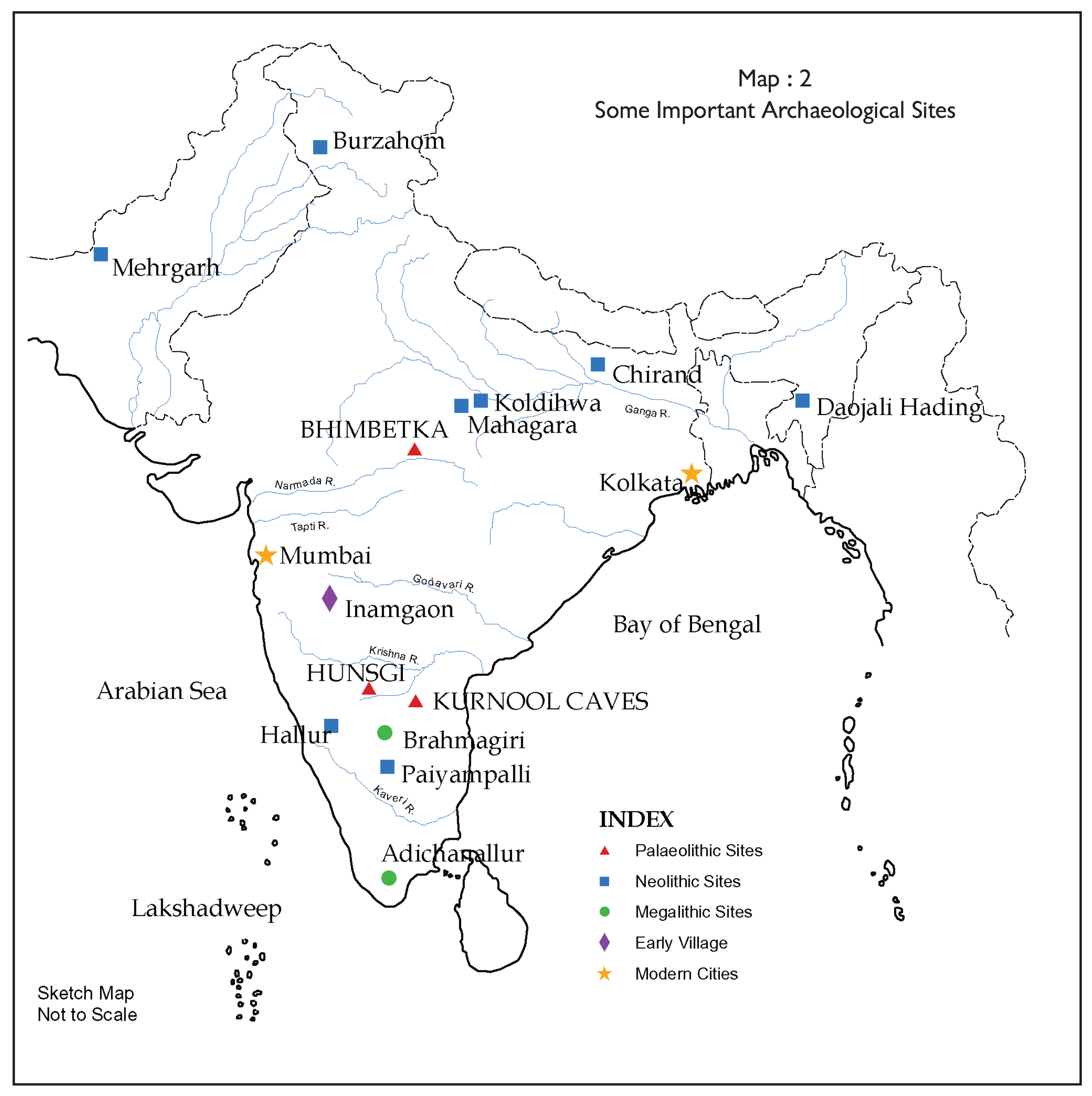
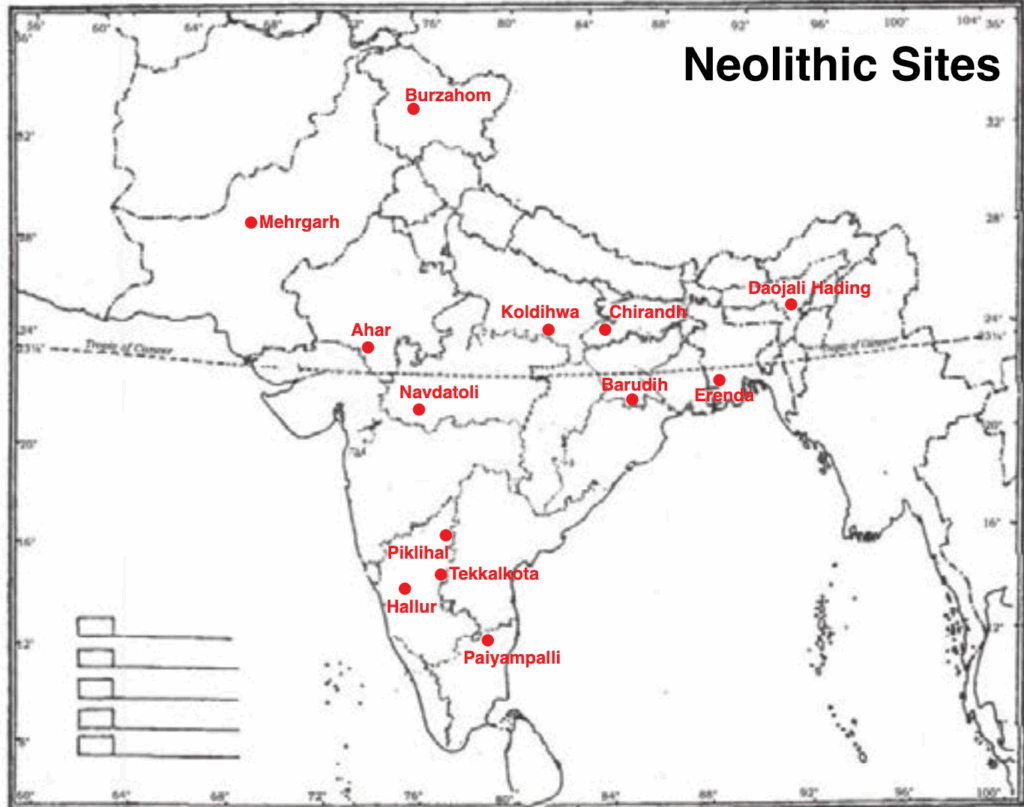
Neolithic sites are found across India, marking a transition to agriculture and settled life. Some key locations include Mehrgarh (Pakistan), Burzahom (Kashmir), Chirand (Bihar), Hallur (Karnataka), and Paiyampalli (Tamil Nadu).

Burzahom
- In northeast of Srinagar, J&K on flood plains of Jhelum river.
- First Neolithic site of Kashmir.
- Megalithic culture followed Neolithic culture.
- Certain features differentiate it from other Neolithic cultures:
- For example: people were not acquainted with agriculture and followed hunting and fishing economy.
- Settlement-Around 2700BC. People lived in mud plastered circular and oval pits with steps and ladders to get inside large pits, but in later period they started to live in houses built on ground level.
- Other important feature:
- Use of a large number of well-polished bone and stone tools.
- Large number of bone tools in form of harpoons, needles, arrowheads etc. is found.
- Human and animal burials found.
- Humans were buried both primarily and secondarily in pits, mostly dug into the house floors. In secondary burials skulls and long bones were preferred.
- Pet animals (e.g. dog) were buried along their masters.
- Dwelling pits and storage pits are found.
- Pottery:
- The early pottery:- crude and handmade.
- Later pottery:- wheel-made.
- Evidence of cultivated wheat, barley and lentil were found.
Gufkral
- South-east of Srinagar, J&K.
- Started as aceramic neolithic site around 3000 B.C.
- Pit dwellings surrounded by storage pits and hearths.
- Polished stone tools found.
- Tools made of bone and horn.
- Other artefacts include steatite beads and a terracotta marble.
- Remains of domesticated sheep, goat as well as barley, wheat and lentil along with wild animals show the transition from hunting to a food producing economy.
- Initially handmade coarse grey ware followed by wheel made pottery in the later phase.
Ahar (Udaipur district, Rajasthan)
- Located on the banks of the Ahar River in the Aravalli foothills.
- Type site of the Ahar–Banas Chalcolithic culture (c. 2500–1500 BCE).
- Key Features:
- Black-and-red ware with white painted linear designs (distinctive pottery style).
- Copper tools, stone blades, terracotta objects found.
- Proximity to Khetri copper belt—important center for copper extraction and tool-making.
- Evidence of trade linkages with Harappan and Malwa cultures.
- Subsistence Pattern:
- Evidence of rice and millet cultivation.
- Domesticated cattle and sheep—indicating agro-pastoral economy.
- Significance:
- Major regional Chalcolithic hub of southeastern Rajasthan.
- Known for ceramic innovation, metal technology, and cultural interaction.
Sarai Khola
- In Punjab province of Pakistan.
- Handmade plain red or brown burnished pottery with mat impressions on the base.
- There were ground and polished stone celts, blades, microliths, and lots of bone points.
- Terracotta wheels and toy carts were found.
Chaligai
- In Swat valley, Pakistan.
- It shares traits with the Neolithic cultures of kashmir.
- Pit dwelling is found.
- Coarse handmade pottery is found.
- Use of copper and bronze,
- Distinctive burial rites and a cult of fire, inferred by the presence of some cremations, etc.
Mahagara
- On right bank of Belan river, Allahabad
- Floors and post-holes associated with 20 huts made up of wattle and daub found.
- Neolithic stone blades, microliths etc found.
- Handmade pottery, bone arrowheads, terracotta beads found.
- An interesting discovery was a cattle pen where nearly 40-60 animals were penned.
- Animal bones included those of cattle, sheep, goat, horse, deer, and wild boar, out of which the first three seem to have been domesticated.
- Rice husk embedded in pottery found.
- The bone and plant remains suggest that people hunted wild animals, collected wild plant food, and domesticated plants and animals.
Kunjhun
- In Son valley, Sidhi district, M.P. 4000 B.C.E.
- Wild and domesticated rice found.
- A factory site specialised in stone artefacts
Lahrudeva
- Sant Kabir Nagar, U.P.
- Amound of 4m surrounded by a lake on three sides.
- Five fold cultural sequence from Neolithic to early centuries CE.
- In early Neolithic, hand made cord impressed red ware and Black and red ware pottery.
- Huts made up of wattle and daub.
- Remains of domesticated rice and wild grasses.
Koldihawa
- Located in Prayagraj district, Uttar Pradesh, on the Belan River in the Vindhyan foothills.
- Dated to around 7000–6000 BCE.
- One of the oldest Neolithic sites in the Indian subcontinent.
- Cultural continuity from Neolithic to Iron Age.
- Remains of rice and impression of rice husk embedded in pieces of burnt clay found.
- People familiar with both wild and domesticated rice (oryza sativa).
- Other discoveries included stone blades, polished stone celts, microliths, querns and mullers (for grinding) and Bone tools also found.
- Handmade pottery of 3 kinds- cord marked pottery, plain red pottery, black and red ware(BRW).
- Cattle pen with hoof marks of cattle discovered.
- Chalcolithic period:
- Pottery:
- Introduction of wheel-made pottery,
- BRW.
- Mud floors with burnt clay and post holes, remnants of wattle-and-daub houses.
- The tool kit includes copper, bone and stone tools.
- Microlithic tools used.
- Copper beads and bone tools.
- Beads of semi-precious stones, ring stones and terracotta found.
- Pottery:
Navdatoli
- Location and Dating
- Located in Khargone district, Madhya Pradesh, on the southern bank of the Narmada River, opposite Maheshwar.
- Occupied during c. 1700–1300 BCE.
- Associated with the Malwa Chalcolithic culture of central India.
- Material Culture
- Pottery:
- Black-and-red ware,
- Painted buff ware,
- Coarse handmade ware.
- Tools and objects:
- Copper tools, microliths,
- Spindle whorls (evidence of textile production),
- Terracotta figurines.
- Pottery:
- Architectural Features
- Houses of rectangular and circular design.
- Constructed with mud walls and wooden posts.
- Indicates planned and permanent settlement patterns.
- Subsistence and Social Life
- Cultivation of lentils, barley, wheat, and millets.
- Domestication of animals confirmed.
- Burial pits indicate formal mortuary practices.
- Community living reflects a complex social organization.
Sohagaura
- Gorakhpur, UP. at confluence of Rapti and Ami rivers.
- Six fold cultural sequence from Neolithic to Medieval.
- Pottery:
- Ill-fired, handmade pottery with a coarse fabric,
- cord impressed pottery
- BRW and NBPW.
- Sohagaura copper plate inscription of 3rd century BC in Brahmi script, Prakrit language.
Senuar/Senuwar(Neolithic and Chalcoiithic both)
- Rohtas, Bihar, on banks of Kudra river.
- Wattle and daub houses.
- Pottery – red ware, burnished red ware and burnished grey ware mostly wheel made.
- Stone tool along with microliths and some bone tools found.
- Beads of semi- precious stones discovered.
- Domesticated animals– cattle, buffalo, sheep, goat, cat, dog, pig, wild animals- nilgai, antelope, chital.
- Crop- Twice a year, rice, barley, dwarf wheat, millet, lentil.
- Shell food consumed as suggested by large remains of molluscs and shells.
Chirand
- Chirandh is located in Saran district of Bihar, on the northern bank of the Ganga River, near its confluence with the Ghaghara River.
- Neolithic, Chalcolithic and Iron Age settlements.
- Neolithic period was earlier than 2500 B.C.
- Settlement- Circular and semi- circular wattle and daub huts with post holes and hearths.
- Practiced agriculture with evidence of wheat, rice, mung, masur, peas found.
- The agricultural tools were made of stone and bone.
- Bone tools are special feature
- They practised hunting also.
- Bones of domesticated and wild animals are found.
- Microliths are also found.
- Pottery:
- Hand-made, ‘red ware’ and BRW.
- Post firing painting on pottery.
- Chalcolithic culture: 1600 BCE
- BRW pottery found.
- Two phases:
- The first phase is without iron.
- Second has iron without NBPW.
- Later period shows the emergence of the N.B.P.W. culture.
- Later Cultural Phases:
- Iron tools and implements in upper layers.
- Reflects Chalcolithic to early Iron Age transition.
- Indicates interaction with broader Ganga plain cultures.
- Significance:
- One of the few sites in Eastern India showing continuous occupation.
- Important for understanding the evolution of early agriculture, technology, and settlement patterns in the Ganga valley.
Sarutaru
- Near Guwahati (Assam).
- A Neolithic site.
- Excavations:
- Stone celts, charcoal, potshards and round-butted axes.
- Pottery:
- Handmade brown, buff, and grey wares, some with cord impressions.
- The pottery of Sarutaro agrees well with that of Daojali Hading in Assam.
Daojali Hading
- In the north Cachar hills, at Daojali Hading in Assam.
- Dated to around 2500 BCE.
- One of the few well-excavated Neolithic sites in Northeast India.
- Cultural and Regional Significance
- Shows strong affinities with Southeast Asian Neolithic traditions.
- Highlights trans-regional diffusion of Neolithic culture into the Indian subcontinent.
- Raw materials – shale sandstone and fossil wood.
- Material Culture & Tools
- Discovery of shouldered celts—a tool type typical of China and Southeast Asia.
- Other tools: polished stone axes, quartzite tools.
- Shouldered celts are unique to Neolithic Northeast India.
- Pottery and Subsistence
- Pottery: Handmade coarse grey ware, sometimes with cord impressions.
- Food habits: Presence of charred rice grains and wild tubers.
- Indicates an agro-forest economy based on shifting cultivation and foraging.
Napchik
- Manipur-Southern part of Imphai valley , on the right bank of Manipur river.
- Period-1650± 350BCE.
- Handmade cordmarked ware found
- Stone choppers, scrappers, flakes, knife, grinding stone and polished celts excavated. Some tools show similarity with tools of Thailand and Myanmar.
- It is on a small hillock near Wangu, in southern part of Imphai Valley, on right bank of Manipur River.
- The edge ground tools and corded ware shows similarity with sites in Thailand and Burma.
Pandu Rajar Dhibi
- In Burdman district of West Bengal.
- Neolithic and Chalcolithic site.
- First chalcolithic culture discovered in the West Bengal.
- It reveals microliths, ground stone tools, bone tools, and pottery.
- In Chalcolithic Period, there were a few copper artefacts, beads of semi-precious stones, terracotta figurines, iron spearheads and points, slag, and oven.
- Iron artefacts found at chalcolithic levels.
- The pottery included mainly BRW.
- Bones of domesticated cattle, buffalo, goat, and deer.
Mahisdal
- Medinipur district, West Bengal.
- House floors rammed with terracotta nodules.
- Microliths and bone tools, beads of semi-precious stones, terracotta ornaments, a terracotta phallus, and copper celts.
- Pottery: BRW.
- A storage pit with charred rice grains found.
Barudih (Singhbhum district, Jharkhand)
- Located in the Chotanagpur plateau, near the Subarnarekha River basin.
- Dates to approximately 2500–1500 BCE.
- Among the easternmost Neolithic sites in India.
- 2 Phases:
- Phase I:
- Polished axes, chalcoal, handmade pottery.
- Phase II:
- Rice grain, wheel made pottery, iron objects, charcoal.
- Phase I:
- Key Features
- Polished stone tools: celts, axes made of quartzite and granite.
- Shows continuity from Mesolithic tool traditions.
- Tools suited for forest clearance and early agriculture.
- Subsistence Pattern
- Evidence of grinding stones suggests shifting cultivation.
- Mixed economy: hunting, gathering, and limited farming.
- Significance:
- Represents tribal plateau-based Neolithic adaptation in Eastern India.
- Highlights early sedentary life in forested zones of Jharkhand.
Kuchai
- Near Mayurbhanj in Odisha.
- Two fold culture – Mesolithic and Neolithic found.
- Tools – chisels, pounders, mare heads and grinding stones.
- Pottery-reddish brown pottery tempered with coarse grit some with slip and incised decoration.
Utnur/ Utnoor
- In Adilabad district, Telngana in Raichur Doab.
- Wooden enclosure of the cattle pen here was rebuilt many times and the dung was likewise burnt repeatedly. Cattle hoof- prints were found in ash.
- Cattle rearing was the major economic activity.
- One of the earliest Neolithic site of South India where evidence of Neolithic-Chalcolithic and Chalcolithic period is also found.
- Small amount of ground stone axes, stone blades and a handmade coarse pottery and both burnished grey or buff were found.
Nagarjunakonda
- In Guntur district of A.P.
- Neolithic and Megalithic culture.
- Post holes found.
- Known as Vijaypuri- capital of the Ikshvaku kings.
- Buddhist site:
- A centre of is Buddhism
- Named after Nagarjuna, a Buddhist philosopher.
- Maha Stupa, Chaitya, vihara etc found.
- The inscriptions show royal (by queen of Ikshvaku) and non-royals sponsership of construction of temples and monasteries.
- Inhabited by merchants and artisans organized in guilds.
Paiyampalli
- Location and Dating
- Located in Tirupattur (earlier Vellore) district, Tamil Nadu, on the southern edge of the Eastern Ghats.
- Dated to around 2000–1000 BCE.
- A multi-phase site with evidence of Neolithic, Chalcolithic, and Megalithic occupation.
- Site Type and Structural Features
- A habitation–cum–burial site.
- Huts had floors levelled with stone chips and plastered, showing early construction techniques.
- No bone tools found—unlike other contemporary Neolithic sites.
- Agriculture and Subsistence
- Cultivated cereals and pulses.
- Charred grains of horse gram and green gram recovered.
- Indicates a mixed agro-pastoral economy.
- Material Culture and Tools
- Tools included:
- Ground stone tools,
- Microliths,
- Early copper tools (Chalcolithic),
- Locally produced iron tools and weapons (Megalithic phase).
- Shows transition from stone to metal technology.
- Tools included:
- Pottery and Ceramics
- Neolithic-Chalcolithic phase: Handmade red ware and black ware.
- Megalithic phase:
- Thin, coarse red ware painted pottery.
- Black-and-red ware (BRW), all black ware, and red ware types present.
T. Narsipur
- In Mysore district, Karnataka.
- Neolithic and Megalithic culture.
- Copper tools, celts, rods, chisel,
- Gold ornaments (also in Hallur)
- Pot burials.
- Skeletons without ankles.
- Post holes.
Brahmagiri
- In Chitradurg district, Karnataka.
- Neolithic-Chalolithic and Megalithic site.
- Wattle-and daub huts with post holes.
- Polished stone tools,
- Microlithic blades, and
- Handmade grey pottery.
- Copper–bronze objects in later period.
- Burials:
- Extended burials of adults.
- Urn burials of children.
- Megalithic monuments have been found.
- Agriculture and domestication of animal.
- Draft animal used.
- Ashokan edicts denotes the southernmost extent of the Mauryan Empire.
Hallur
- In Haveri district, Karnataka, on the bank of the Tungabhadra River.
- Neolithic-chalcolithic and Megalithic site
- Earliest use of iron in South India at Piklihal and Hallur.
- Provides early evidence of copper usage in South India.
- Copper tools and ornaments found alongside stone tools, indicating a technological overlap phase.
- Tools:
- Polished tools
- Microlith blades.
- Ornaments made of carnelian, ceramic and gold found.
- Chalcolithic blade tools
- copper axes
- fish hooks
- Transition to the Iron Age period is marked by megaliths and iron implements.
- Ash-mounds
- Double urn burial
- Agriculture – millet and horse gram, Green Gram,
- Pottery:
- Early phase: Handmade and grey ware.
- Later phase: wheel made, BRW
- Herding – Cattle, Sheep, Goat.
- Animal bones of cattle, sheep, goat and horse were found.
- Habitation:
- Circular floors made of stone chips and river sand.
- Wattle and doab huts, post hole,
- One house with circular fireplace and ash and charcoal.
- Cultural Significance
- Demonstrates adaptive strategies during climatic and technological shifts.
- Marks a critical stage in the emergence of Chalcolithic culture in the Deccan region.
Palavoy
- Anantapur District of Andhra Pradesh
Sanganakallu
- In Bellary district, Karnataka.
- Neolithic–Chalcolithic site.
- Pottery:
- Earlier neolithic phase- a-ceramic, handmade and no copper;
- Later phase: copper tools and wheel made pottery.
- BRW, grey, brown wares and black pottery.
- In both phases:
- Polished stone tools, celts, blades
- microliths
- bone points,
- chisels,
- copper and bronze artefacts.
- Terracotta figurines– bulls and birds.
- Bones of cattle, sheep, goat, and dog were identified.
- Habitation:
- Round wattle-and daub huts.
Maski
- In Raichur district, Karnataka.
- Neolithic-Chalcolithic and Megalithic cultures.
- Minor Rock Edict of the Mauryan Emperor Ashoka found.
- First edict of Emperor Ashoka that contained the name Ashoka.
- Artefacts:
- Polished stone tools, microlithic blades, and copper rod.
- Beads of carnelian, agate, chalcedony, shell, coral, glass, and paste.
- Pottery:
- Red ware
- BRW
- Incised designs on some pottery.
- Animal bones found.
- Rock paintings found.
- Subsistence base:
- agriculture,
- animal domestication,
- hunting.
Mehrgarh
- Location and Dating
- Located in Balochistan, Pakistan, near the Bolan Pass.
- Dates back to around 7000 BCE.
- Acts as a gateway between the Iranian Plateau and the Indus Valley.
- Cultural Phases and Chronology
- Neolithic Phase (Period I):
- Aceramic Neolithic: No use of pottery in the earliest phase.
- Planned small farming and pastoralist village.
- Houses made of mud brick, later sun-dried bricks.
- Bone tools used extensively.
- Cultivation of wheat, barley, and cotton—among the earliest in South Asia.
- Domestication of animals: cattle, sheep, goats.
- Evidence of fishing as a food source.
- Terracotta figurines and animal representations.
- Chalcolithic Phase (Later periods):
- Introduction of pottery and metal use.
- Evidence of craft specialization and early metallurgy.
- Site was later abandoned during Harappan urbanisation, possibly absorbed culturally.
- Neolithic Phase (Period I):
- Material Culture and Technology
- Handmade pottery, bone and flint tools.
- Figurines of terracotta, including human and animal forms.
- Turquoise, shell bangles, lapis lazuli beads found as grave goods—indicative of trade and social differentiation.
- Dental surgery evidence (drilled molars) shows early medical knowledge.
- Craft production: beads and ornaments made of semi-precious stones.
- Trade and Proto-Urban Traits
- Trade items suggest links with Afghanistan, Iran, and coastal regions.
- Gradual evolution from agrarian village to proto-urban society.
- Acts as a precursor to the Indus Valley Civilization.
Kili Gul Mohammad
- In Quetta valley Baluchistan. On the banks of Hannah river Pakistan.
- First three levels of occupation is Neolithic.
- Wattle and daub or mud houses.
- Beginning with aceramic site in 5500 BC, later handmade pottery which evolved to fine wheel made black on red ware in third phase.
- Animal remains of cattle, sheep, goat, horse, wild ass.
- Tools– microliths, a few ground tools , bone points and spatula .
Rana Gundai
- In Anambar Valley, Pakistan.
- Period 4500 to 3100 BC is Neolithic.
- Divided in three periods.
- In initial period semi- nomadic community, and consists of handmade plain pottery.
- Tools-stone and bone tools later microilthic chips and blades and bone points and eye needles.
- Bones of domesticated animals like of sheep, goat, wild ass.
- In later period wheel made pottery with buff or red surface and decorations like humped bulls.
Golbai Sasan
- On left bank of river Mandakani in Puri district, Odisha.
- Neolithic and Chalcolithic site.
- Neolithic period:
- Post-holes found.
- Red and grey handmade pottery with cord impressions.
- Bone tools found including weapons and ornaments.
- Chalcolithic period:
- Circular huts with hearths and post holes.
- Both handmade and wheel-made pottery was found, including BRW.
- Copper artefacts and bone artefacts (including weapons and ornaments) found.
- Agriculture: rice, moong and kulthi.
- Animal Bones of cattle, goat, deer, and elephant.
- The polished stone tools included axes, adzes, and shouldered celts.
- A human figurine found.
Chopani Mando (Near Koldihwa)
- In Allahabad district of Uttar Pradesh.
- All the three stages of the Paleolithic, Mesolithic and Neolithic stage found.
- Paleolithic period:
- Stone tools made from chert.
- Bones discovered included those of wild cattle, sheep, and goats.
- Represents early stage of animal domestication.
- Mesolithic period:
- Geometric and non-geometric microliths such as blades, points, scrapers mostly made of chert.
- Handmade pottery, hammer stones and ring stones found.
- Bones of wild cattle and sheep/goats.
- Pieces of burnt clay with reed impressions showed that people lived in wattle-and-daub huts.
- Wild rice is reported.
Watgal
- Raichur district , Karnataka.
- Grey ware of Brahmagiri fabric and Jorwe fabric has been excavated
- Earliest evidence of use of betel nuts in South Asia.
- Tools – Increase in number of stone tools with time particularly made of chert. Pottery- Handmade coarse pottery consisted of grey and red ware as well as burnished grey, later wheel made pottery dominated.
- Burial-Both urn burial and extended burial marked by stone pots appeared as grave good in later phase.
- Artefacts- microliths and milling stones, beads of marine shells, stone and terracotta, shell pendant.
- Animal and human terracotta figurines (one represents torso of a female).
- Settlement site without ash mounds.
- Fragments of areca nuts have been found.
Budhihal
- Gulbarga district, Karnataka.
- Settlement site with ash mounds.
- Stone tool industry site.
- Ash mound area divided in 2 parts- Cattle pen in East and cow dung disposal area in west.
- Cattle rearing as main occupation shown by cattle pen, domesticated cattle bones.
- An interesting discovery was of a butchering area within the settlement area, with hard floor made up of kankar – like material.
- Time period- 1900-1400 BC.
- Seeds of wild plants like ber, Indian cherry and amla along with a few grains of domesticated horse gram found.
- The site gives a graphic image of community food preparation and feasting.
Piklihal
- Location and Cultural Phase
- Located in Raichur district, Karnataka.
- A Neolithic–Chalcolithic site.
- One of the earliest sites with use of iron in South India (along with Hallur).
- Habitation Features
- Presence of circular huts.
- Use of wattle-and-daub technique for constructing dwellings.
- Evidence of semi-permanent settlement.
- Economy and Subsistence
- Pastoral economy with bones of domesticated cattle, sheep, and goats.
- Seasonal herding and penning of animals indicated by post-holes.
- Tools and Implements
- Neolithic ground tools and microlithic blades discovered.
- Suggests a blend of pastoralism and subsistence farming.
- Pottery and Ceramics
- Handmade and wheel-made pottery.
- Pottery types include:
- Grey ware,
- Black and red ware (BRW),
- Some pottery with painted designs.
- Art and Figurines
- Terracotta figurines of humans, animals, and birds.
- Rock paintings also found at the site.
- Ornaments and Beads
- Carnelian and shell beads recovered.
- Fine disc beads of Harappan origin indicate long-distance trade or cultural contacts.
Sangam Kallu(Kupgal)
- It is situated in Bellary district, Karnataka.
- Began around 2000 BC and shows Neolithic- Chalcolithic characteristics.
- Wattle and daub huts, settlement site with ash mounds.
- Early period was aceramic and devoid of copper followed by phase of copper and bronze tools and wheel made pottery like black on red ware, burnished grey and brown ware.
- Also, microliths and bone tools found.
- Terracotta figurines of bulls and birds .
- Bones of cattle, sheep, goat and dog found.
- Crops – millets and pulses.
Anjira
- In Kalat plateau.
- Five periods of occupation identified.
- Period I had semi- nomadic population and fine wheel made buff ware. Also, chert blades were found.
- Period II had mud structure found and pottery comprised red- shipped ware and grey ware.
- Period Ill-Houses made of blocks of stone.
- Togau ware which is a red pottery with black painted design started. Zari ware with painting in white and black outlines.
Amri
- On right bank of Indus.
- Prominent Pre-Harappan site is Sind.
- Mud brick houses.
- Remains of domesticated cattle, sheep, goat and donkey.
- Pottery-typical handmade red pottery with geometrical design painted in black with red fillings.
- Pieces of copper, shell, terracotta figurines, sling stone found.
- Neolithic phase started in early to mid 4th millennium BC which had transformed to Indus Civilisation Phase.
Tekkalakota
- Very near to Maski
- Location and Cultural Sequence
- Located in Ballari district, Karnataka, in the southern Deccan plateau.
- Shows a multi-period occupation from Neolithic to Iron Age.
- Reflects cultural and technological transitions over time.
- Ashmound Tradition and Economy
- Prominent ashmounds formed by repeated burning of cattle dung.
- Indicates a dominant pastoral economy with cattle, sheep, and goats.
- Presence of organized penning structures confirms semi-nomadic herding.
- Settlement Features
- Evidence of circular huts, often rebuilt in successive layers, indicating long-term habitation.
- Suggests continuity and adaptation of architectural forms.
- Material Culture and Tools
- Tools recovered include:
- Ground stone tools,
- Polished stone axes,
- Microliths (used for hunting and light agriculture).
- Pottery:
- Red-slipped handmade pottery.
- Associated with domestic and storage purposes.
- Tools recovered include:
Mundigak
- In Kandhar province, Afghanistan.
- Neolithic, chalcolithic, Harappan site.
- Early settlers were semi- nomadic, but later houses made of sun baked bricks found. Cooking hearths and wells inside houses found
- Painted pottery– scared fig leaves, tiger like animal etc.
- Hump bulls, Human figurine, shaft hole axes, terracotta drains etc. found.
- Harappan period:
- Palace, temple, city wall.
Erenda
- Location and Dating
- Located in Midnapore district, West Bengal, near the Subarnarekha River and Bay of Bengal.
- Dated to around 2000–1000 BCE.
- A prominent coastal Chalcolithic site of eastern India.
- Material Culture
- Pottery: Red ware and black-and-red ware.
- Tools: Copper tools, microliths, terracotta beads and figurines.
- Evidence of fishing equipment suggests a riverine–coastal economy.
- Agriculture and Occupation
- Cultivated crops: Rice and legumes.
- Animal remains: Cattle, pigs, and goats.
- Likely had mud huts with storage pits, suited to the coastal environment.






thank you
—- this is incorrect about the burzahom site – ( based on ncert r s sharma class 11) , also last point mein lentils, wheat, etc mentioned — so contradictory statements.