Population, Agricultural and craft production;
Towns, commerce with Europe through Dutch, English and French companies: a trade revolution; Indian mercantile classes, banking, Insurance and credit systems;
Condition of peasants, condition of women;
Evolution of the Sikh community and the Khalsa Panth
Economy and Society in the Sixteenth and Seventeenth Centuries is the economic history unit of Mughal India, and one of the most examined in Paper I. UPSC has set 32 questions on it between 1989 and 2026, and it has appeared in nine of the last ten papers — three questions in 2025 alone.
Every question the Commission has asked on this topic is listed below, newest first, with a written model answer linked against each one.
| Questions asked (1989–2026) | 32 |
| Appeared in | 9 of the last 10 papers |
| Paper | Paper I, Section B (Medieval India) |
| Usual mark value | 10, 15 or 20 marks |
| Model answers available | 31 of 32 |
History Optional PYQs: Economy and Society in the 16th and 17th Centuries [1985-2026]

| Year | Question | Answer |
|---|---|---|
| 2026 | "From Asia to Europe, from head to foot, everyone was clothed in Indian textiles." Qualify this statement with a critical account of India's foreign trade with special reference to textiles. | |
| 2025 | Critically assess the role of imperial Karkhanas in Mughal India. How did they reflect the ideological and functional imperatives of the Mughal State? | View answer |
| 2025 | Evaluate the impact of Mughal revenue administration on the agrarian structure of North India. To what extent did it bring continuity and change in the rural socio-economic fabric? | View answer |
| 2025 | Gunpowder changed the character of warfare in India during the Mughal era. Elucidate. | View answer |
| 2024 | Highlight the features of the Portuguese colonial enterprise. | View answer |
| 2024 | Examine the process of urbanization caused by the establishment of European trading companies in India. | View answer |
| 2022 | Trade and commerce in the Mughal Empire brought about the integration of the Indian subcontinent into a single market. Comment. | View answer |
| 2019 | The emergence of early capitalism in the Mughal period was primarily due to urbanisation and commercialisation. Comment. | View answer |
| 2018 | "An important feature of agriculture in Mughal India has been the large number of crops raised by the peasants". Illustrate by giving examples. | View answer |
| 2017 | Assess the condition of peasantry during 13th to 17th centuries C.E. | View answer |
| 2015 | Will it not be correct to say that the rural economy in Mughal India was relatively self-sufficient? | View answer |
| 2014 | Analyse the Mughal monetary system and examine their policy of minting of coins. | View answer |
| 2014 | "India had been for hundreds of years the Lancashire of the Eastern world.” Critically examine this view. | View answer |
| 2013 | Give a sketch of Indian trade with Europe during the Mughal period. | View answer |
| 2013 | On the basis of the accounts of Europeans bring out the agrarian crisis of the 17th century CE India. | View answer |
| 2012 | State the structure of medieval village society in Northern India. What were the passive forms of resistance of the peasants in the medieval period? | View answer |
| 2012 | Medieval Indian towns were merely an extension of villages. Comment. | View answer |
| 2010 | Critically evaluate various approaches to study medieval Indian towns. | View answer |
| 2010 | Discuss different types of Karkhanas in Mughal India. How was the production organized in the Karkhanas? | View answer |
| 2009 | Write short essay: Estimates of population of Mughal India. | View answer |
| 2008 | Delineate the striking features of agricultural and craft production during the sixteenth and seventeenth centuries in India. How did they impact the social fabric of the country? | View answer |
| 2006 | Examine the factors which were responsible for opening and development of European trade in India during the 16th and 17th centuries. | View answer |
| 2005 | Give your opinion on the urban development in India during the Mughal times. | View answer |
| 1995 | Do you agree with the view that the advent of the Turks and the Mughals in India heralded many changes in the means of production? Give reasons in support of your answer. | View answer |
| 1994 | Write brief essay on Mughals and the British East India Company. | View answer |
| 1989 | Write short answer of not more than 200 words: The Mughals and the European trading companies. | View answer |
| 1989 | Analyse the distinguishing features of the land revenue system under the Mughals and point out its influence on the strength of the Mughal State. | View answer |
Evolution of the Siky Community and the Khalsa Panth
| Year | Question | Answer |
|---|---|---|
| 2025 | "The principles of Sikhism represented a harmonious blend of Islamic and Indic religious beliefs and practices." Comment. | View answer |
| 2023 | Analyze the rise of the Sikhs under Ranjit Singh. | View answer |
| 2021 | Discuss the transformation of Sikh community from a Nirguna Bhakti sect into a politico-military organization. | View answer |
| 2017 | The religion of the Sikhs was the main force of their unity. Comment. (150 words) | View answer |
| 2008 | Write short essay on Evolution of the Khalsa Panth. | View answer |
What UPSC keeps asking about Mughal economy and society
The questions fall into five threads. This is the most historiographically demanding unit in Section B: almost every question here is really asking whether you know the Aligarh School and its critics.
1. Agrarian structure, revenue and the peasantry (1989, 2012, 2013, 2015, 2017, 2018, 2025)
- Land revenue under the Mughals (1989), village society (2012), the agrarian crisis in European accounts (2013), the condition of the peasantry (2017), rural economy (2015, 2018), and revenue administration’s impact on agrarian structure (2025).
- Irfan Habib’s Agrarian System of Mughal India is the base text; know his crisis argument and the regional revisions to it.
2. Trade, textiles and early capitalism (1994, 2006, 2013, 2014, 2019, 2022, 2026)
- India as the “Lancashire of the Eastern world” (2014) and clothier of Asia and Europe (2026).
- 2019 asked whether early capitalism emerged in the Mughal period; 2022 whether trade integrated the empire. Set the Aligarh view of a capitalism that never took off against K. N. Chaudhuri and Om Prakash on Indian Ocean trade.
3. Towns, karkhanas and money (2005, 2009, 2010, 2012, 2014, 2025)
- Approaches to medieval towns (2010), whether towns were merely extensions of villages (2012), karkhanas (2010, 2025), the monetary system (2014), population estimates (2009).
- The karkhana question returned in 2025 after fifteen years — a reminder that nothing in this unit is ever finished.
4. Europeans and technology (1989, 1995, 2010, 2024, 2025)
- The Portuguese enterprise and European-driven urbanisation (2024), gunpowder and warfare (2025), Indian response to European technology (2010).
- The newest thread and the one most likely to grow.
5. The Sikhs (2008, 2017, 2021, 2023, 2025)
- Five questions, four since 2017. The Khalsa (2008), religion as the source of unity (2017), the shift from a Nirguna Bhakti sect to a militant community (2021), Ranjit Singh (2023), Sikhism as a blend of traditions (2025).
- J. S. Grewal and W. H. McLeod are the historians to know. Treat the militarisation question as a response to Mughal politics, not as doctrine alone.
The model answers to this unit, in one place
Knowing the questions is half the work. The other half is seeing what a full-mark answer to each one looks like — not a hint or a bullet outline, but a complete answer at the mark and the word limit, with the historians named inside the argument.
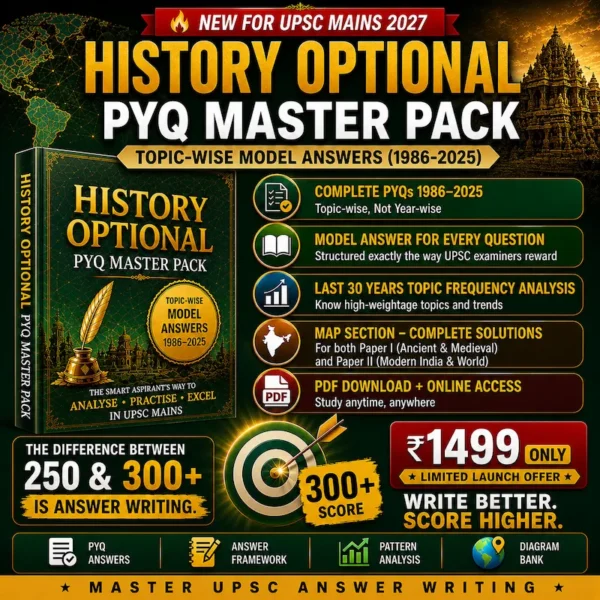
The History Optional PYQ Master Pack carries the same for every question the Commission has set since 1985, across the whole syllabus.
- PYQs 1985–2025, arranged topic-wise — revise a theme and see every way it has been asked
- Model answers with historiography — the debate cited where it belongs, not bolted on
- Map sections solved — the full 50-mark section, every year
- PDF plus online access — any device, permanently, no subscription
₹1,499 (regular ₹2,500). One-time payment, instant access.
How to use this topic list
Reading a question list feels like preparation and is not. Three sittings turn it into marks.
Sitting 1 — sort before you read (30 minutes)
- Copy the questions above into the threads identified in the previous section.
- Note which thread has gone longest without being asked — that is your priority, not the one you find most interesting.
Sitting 2 — write three answers cold (45 minutes)
- Pick the most recent question from three different threads.
- Seven minutes for a 10-marker, fifteen for a 20-marker. Stop when the time is up, even mid-sentence.
- Mark every place you wanted a historian’s name and could not produce one.
Sitting 3 — compare, then rewrite (45 minutes)
- Put your script beside the model answer for the same question.
- Compare structure first: opening claim, evidence, counter-view, judgement.
- Rewrite your weakest answer using that structure and no new content. Most candidates gain four to six marks from structure alone.
Two ways to prepare this optional
Two routes, depending on what is actually missing.
| PYQ Master Pack | Mains Master Kit 2027 | |
| Best when | Your notes are done; answer-writing is the gap | You are still building the subject |
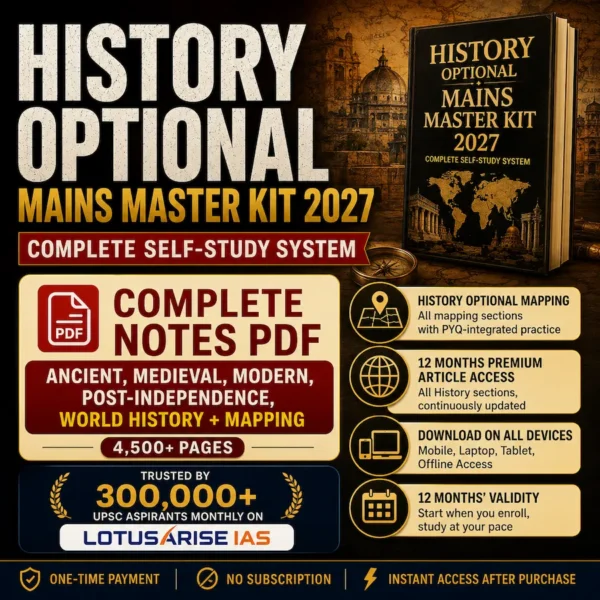
| What you get | Model answers to every question since 1985, topic-wise, map sections included | 4,500+ pages of notes, full mapping coverage, 12 months of article access |
| Price | ₹1,499 (reg. ₹2,500) | ₹1,770 (reg. ₹5,000) |
Frequently asked questions
Related topics
Economic questions from this period often draw on:
- Akbar
- Mughal Empire in the Seventeenth Century
- The Eighteenth Century
- European Penetration into India
- All topics — History Optional PYQs, topic-wise
Prefer to work year by year?
The complete papers, with both papers in full, unit-wise analysis and the official PDFs:
- History Optional Question Paper 2026
- History Optional Question Paper 2025
- History Optional Question Paper 2024
- History Optional Question Paper 2023
- History Optional Question Paper 2022
- History Optional Question Paper 2021
- History Optional Question Paper 2020
- UPSC History Optional Map Solutions (2013–2025)