

The Early European Settlements; The Portuguese and the Dutch; The English and the French East India Companies; Their struggle for supremacy; Carnatic Wars; Bengal – The conflict between the English and the Nawabs of Bengal; Siraj and the English; The Battle of Plassey; Significance of Plassey.
European Penetration into India opens Paper II. UPSC has set 19 questions on it between 1992 and 2026, and it has appeared in seven of the last ten papers. Almost every question is a quotation to be tested — this is a unit where the examiner hands you a verdict and asks whether it holds.
Every question the Commission has asked on this topic is listed below, newest first, with a written model answer linked against each one.
| Questions asked (1992–2026) | 19 |
| Appeared in | 7 of the last 10 papers |
| Paper | Paper II, Section A (Modern India) |
| Usual mark value | 10, 15 or 20 marks |
| Model answers available | 18 of 19 |
PYQs: European Penetration into India [1985-2026]

| Year | Question | Answer |
|---|---|---|
| 2026 | "Superior Maritime strength proved to be England's most powerful weapon in the struggle for colonial supremacy, particularly in the Carnatic Wars." | |
| 2025 | "During the Carnatic Wars, the French position, which at one time dazzled the Indian world by its political successes, was destined to end in humiliation and failure." Explain. | View answer |
| 2024 | After the battle of Plassey, the mercenary became the Kingmaker. | View answer |
| 2023 | The Carnatic Wars, the Anglo-Mysore Wars and the Anglo-Maratha Wars had virtually eliminated the French front the contest of supremacy in South India. Discuss. | View answer |
| 2022 | 'The Battle of Plassey (1757) was a skirmish while the Battle of Buxar (1764) was a real war.' Critically examine. | View answer |
| 2020 | “It was Dupleix who had first showed the way of intervening in disputes of the Indian rulers and thereby acquiring political control over vast territories- a technique which was later perfected by the English East India Company.” Elaborate. | View answer |
| 2018 | Critically examine: "The Battle of Plassey (1757) thus marked the beginning of political supremacy of the English East India Company in India." | View answer |
| 2016 | Comment on the French ambition of building a territorial empire in India. | View answer |
| 2016 | After the Battle of Plassey, how did India transit from the medieval to the modern age? | View answer |
| 2014 | “Plassey did not complete the British conquest of India. Had the English been convincingly defeated in any subsequent battle in India, then (the battle of) Plassey would have remained as a minor episode in the history of India." Critically examine in 150 words. | View answer |
| 2014 | “The Battle of Plassey that decided the fate of Bengal was won by Clive through intrigues." Explain. | View answer |
| 2013 | “Dupleix made a cardinal blunder in looking for the key of India in Madras: Clive sought and found it in Bengal." Critically examine in 150 words. | View answer |
| 2012 | “Compared to their English counterpart, the French East India Company enjoyed little discretionary power and had to always look up to Paris for all major decisions. This partly explains the failure of the French in India.” Critically examine in 150 words. | View answer |
| 2006 | “Neither Alexander the Great nor Napoleon could have won the empire of India by starting from Pondicherry as a base and contending with a power which held Bengal and the command of the Sea.” Comment. | View answer |
| 2000 | The battle of Plassey was “not a great battle but a great betrayal.” Comment. | View answer |
| 1999 | After 1757 there grew up a State of Bengal which was a “sponsored state” as well as a “plundered state”. Comment. | View answer |
| 1998 | How did the British conquer Bengal in the 18th century? What circumstances helped them? | View answer |
| 1995 | “By certain of his actions Clive has marred both the glory and usefulness of his work.” Comment. | View answer |
| 1992 | 'On 23 June 1757, the middle-ages of India ended and her modern age began.’ Comment. | View answer |
What UPSC keeps asking about European Penetration
Nineteen questions fall into three tight threads. The unit is narrow: Plassey and the Anglo-French contest cover nearly all of it.
1. Plassey and the conquest of Bengal (1992, 1995, 1998, 1999, 2000, 2014, 2016, 2018, 2022, 2024)
- Ten questions — half the unit.
- The recurring quotations are worth knowing by heart: “not a great battle but a great betrayal” (2000), the start of the modern age (1992, 2018), Plassey a skirmish while Buxar was decisive (2022), the mercenary as kingmaker (2024).
- The expected answer separates the military event from its consequences, and gives Buxar and the Diwani of 1765 their proper weight. P. J. Marshall and Rajat Kanta Ray on the Bengal “revolution” are the historiography.
2. The Anglo-French contest (2006, 2012, 2013, 2016, 2020, 2025)
- Why the French lost. Dupleix’s method of intervening in Indian disputes (2020), his “cardinal blunder” of seeking India in Madras (2013), French advantages that came to nothing (2012, 2025), French territorial ambition (2016).
- The standard answer weighs company structure and state support, finance, naval power and leadership. Avoid blaming Dupleix’s recall alone.
3. Why Britain won (2006, 2023, 2026)
- The comparative question: sea power (2026), the combined effect of the Carnatic, Mysore and Maratha wars (2023), and 2006’s claim that neither Alexander nor Napoleon could have won India from the Mughals.
- This is the thread to prepare as an essay you can adapt: naval supremacy, credit, Indian collaborators and the fragmentation of rivals.
The model answers to this unit, in one place
Knowing the questions is half the work. The other half is seeing what a full-mark answer to each one looks like — not a hint or a bullet outline, but a complete answer at the mark and the word limit, with the historians named inside the argument.
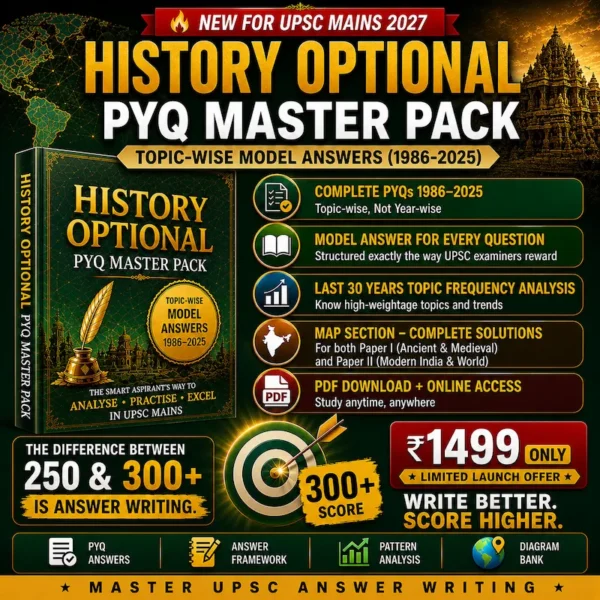
The History Optional PYQ Master Pack carries the same for every question the Commission has set since 1985, across the whole syllabus.
- PYQs 1985–2025, arranged topic-wise — revise a theme and see every way it has been asked
- Model answers with historiography — the debate cited where it belongs, not bolted on
- Map sections solved — the full 50-mark section, every year
- PDF plus online access — any device, permanently, no subscription
₹1,499 (regular ₹2,500). One-time payment, instant access.
How to use this topic list
Reading a question list feels like preparation and is not. Three sittings turn it into marks.
Sitting 1 — sort before you read (30 minutes)
- Copy the questions above into the threads identified in the previous section.
- Note which thread has gone longest without being asked — that is your priority, not the one you find most interesting.
Sitting 2 — write three answers cold (45 minutes)
- Pick the most recent question from three different threads.
- Seven minutes for a 10-marker, fifteen for a 20-marker. Stop when the time is up, even mid-sentence.
- Mark every place you wanted a historian’s name and could not produce one.
Sitting 3 — compare, then rewrite (45 minutes)
- Put your script beside the model answer for the same question.
- Compare structure first: opening claim, evidence, counter-view, judgement.
- Rewrite your weakest answer using that structure and no new content. Most candidates gain four to six marks from structure alone.
Two ways to prepare this optional
Two routes, depending on what is actually missing.
| PYQ Master Pack | Mains Master Kit 2027 | |
| Best when | Your notes are done; answer-writing is the gap | You are still building the subject |
| What you get | Model answers to every question since 1985, topic-wise, map sections included | 4,500+ pages of notes, full mapping coverage, 12 months of article access |
| Price | ₹1,499 (reg. ₹2,500) | ₹1,770 (reg. ₹5,000) |
Frequently asked questions
Related topics
This unit connects directly to:
- The Eighteenth Century
- British Expansion in India
- Early Structure of the British Raj
- Economic Impact of British Colonial Rule
- All topics — History Optional PYQs, topic-wise
Prefer to work year by year?
The complete papers, with both papers in full, unit-wise analysis and the official PDFs:
- History Optional Question Paper 2026
- History Optional Question Paper 2025
- History Optional Question Paper 2024
- History Optional Question Paper 2023
- History Optional Question Paper 2022
- History Optional Question Paper 2021
- History Optional Question Paper 2020
- UPSC History Optional Map Solutions (2013–2025)


this is so helpful. very grateful to the admin. i never hoped i’d get topicwise pyqs of optionals anywhere