Akbar Conquests and consolidation of Empire
Establishment of Jagir and Mansab systems; Rajput policy;
Evolution of religious and social outlook, theory of Sulh-i-kul and religious policy;
Court patronage of art and technology
Akbar is the single most heavily examined ruler in the medieval section of the History Optional. The table below gathers 24 questions set between 1987 and 2026, of which 22 carry a linked model answer, and eight fall within the last ten cycles — so this is a topic that has not cooled at all. Read the questions before the notes: the wording tells you which of Akbar’s several reputations the examiner wants.
Every question the Commission has asked on this topic is listed below, newest first, with a written model answer linked against each one.
| Questions asked (1987–2026) | 24 |
| Appeared in | 8 of the last 10 papers |
| Paper | Paper I, Section B (Medieval India) |
| Usual mark value | 10, 15 or 20 marks |
| Model answers available | 22 of 24 |
History Optional PYQs: Akbar [1985-2026]

| Year | Question | Answer |
|---|---|---|
| 2026 | Trace the formulation of the Mughal imperial authority from Akbar to Aurangzeb. Focus on the influence of Persian ideas of kingship in the construction of Mughal royalty. | |
| 2026 | Analyze the influence of Persian traditions on the development of architecture and painting under the Mughals. To what extent did these art forms reflect a synthesis of Indian and Persian cultural elements? Discuss. | |
| 2025 | Akbar's Rajput policy was shaped by considerations of factional politics in the Mughal court. Discuss. | View answer |
| 2025 | Discuss the structural features of Todar Mal's revenue system and evaluate its effectiveness in standardized land revenue assessment in India. | View answer |
| 2024 | Instead of bringing credit, the Ibadat Khana brought growing discredit to Akbar.” Comment. | View answer |
| 2022 | Examine the nature of the Mansabdari system during the reign of Akbar. | View answer |
| 2021 | Discuss with relevant illustrations the relations between Akbar and the Rajput states. | View answer |
| 2019 | Critically analyse whether the success of the Mughals is to be credited to their robust Jagirdari and Mansabdari system. | View answer |
| 2018 | Akbar wished to assert his strong belief in God, but his concept of the way God is to be worshipped was independent of either orthodox Islam or Hinduism”. Comment. | View answer |
| 2017 | Do you think that akbar’s Rajput policy was a conscious attempt to incorporate the Indian ruling elite with the Mughal Imperial System? | View answer |
| 2015 | In medieval Indian history Akbar was unique for his religio – political ideas and policies.” Analyse this statement. | View answer |
| 2013 | Analyze how the political process of state formation of Mewar from 10th-15th century CE was challenged in the 16th century CE by imperialist policy of Akbar. | View answer |
| 2011 | Examine the mansab and jagir system by Akbar and its subsequent failure in the 18th century. | View answer |
| 2009 | Write short essay on Implications of Akbar’s notions of Sulh-i-kul. | View answer |
| 2009 | Give an estimate of Akbar as a promoter of technology. | View answer |
| 2006 | Write brief essay on Religious Tolerance of Akbar. | View answer |
| 2004 | Write brief essay: Was Din-i-Ilahi ‘a monument of Akbar's folly'? | View answer |
| 2002 | Write brief essay on Mansabdari System. | View answer |
| 2002 | Trace the evolution of the religious views of Akbar. Write a note on his policy of Sulh-i-kul. | View answer |
| 1999 | Write brief essay-Rana Pratap's patriotism was his only offence. | View answer |
| 1997 | Highlight the catholicity of Akbar’s regime with suitable examples. | View answer |
| 1993 | Analyse the merits and demerits of the Mansabdari System. How did it work under Akbar’s successors? | View answer |
| 1990 | 'In medieval Indian history Akbar is unique for his religiopolitical ideas and policies.’ Discuss the statement and compare Akbar with Sher Shah in regard to their administrative policies and revenue administration. | View answer |
| 1987 | Bringout the main features of the MANSAB and JAGIR systems with special reference to the reign of Akbar. | View answer |
What UPSC keeps asking about Akbar
Twenty-four questions sort into six recognisable demands. Three of them — religion, the mansab–jagir machinery and Rajput policy — account for the great bulk of the paper, and the remaining three are recent arrivals worth watching.
1. The religious experiment: Ibadat Khana, Sulh-i-kul and Din-i-Ilahi (1990, 1997, 2002, 2004, 2006, 2009, 2015, 2018, 2024)
- Nine of the 24 questions sit here, which makes it the densest thread on the page and the one to prepare first.
- Notice the drift in framing. The older papers asked you to praise (“catholicity”, “religious tolerance”); from 2004 onwards the stem carries a hostile proposition — Din-i-Ilahi as “a monument of Akbar’s folly” (2004), the Ibadat Khana bringing “growing discredit” (2024). You are being asked to arbitrate, not to eulogise.
- Separate the three things candidates routinely merge: the Ibadat Khana as a debating chamber, sulh-i-kul as a principle of governance, and the tauhid-i-ilahi as a small discipleship order. Only the second was a state policy.
- Athar Ali’s reading of sulh-i-kul as an instrument of imperial integration, and Iqtidar Alam Khan on the political context of the 1579 mahzar, give you the analytical spine. Abul Fazl is a source to be handled critically, not quoted as verdict.
2. Mansab and jagir: design, working and later breakdown (1987, 1993, 2002, 2011, 2019, 2022)
- Six appearances, and note how often the question refuses to stop at Akbar: 1993 asks how it worked under his successors, 2011 asks about failure in the eighteenth century, 2019 asks whether Mughal success can be credited to the jagirdari system at all.
- That means the institutional answer must be written with an exit. Zat and sawar, the dagh and chehra checks, the mansab–jagir link, then jagirdari crisis: be-jagiri, the shrinking khalisa, the gap between jama and hasil.
- The debate to name is Athar Ali’s jagirdari crisis against Satish Chandra’s stress on the zamindar–jagirdar relationship, with J.F. Richards questioning whether the fiscal squeeze was as general as claimed.
- The common mistake is to describe the system for three pages and offer no judgement. A 2022-style question on “the nature of the mansabdari system” is asking whether it was a bureaucracy, a nobility, or an army pay-scale — answer that.
3. Rajput policy and the Mewar exception (1999, 2013, 2017, 2021, 2025)
- A steadily productive thread, and the most recent question (2025) is the sharpest: it asks you to read Rajput policy through factional politics in the Mughal court rather than through sentiment about integration.
- That is a real shift. The 2017 stem offered you “a conscious attempt to incorporate the Indian ruling classes”; the 2025 stem quietly suggests the policy was driven by the need to balance Turani and Irani blocs with a third group of nobles.
- Carry the counter-case with you. Mewar under Rana Pratap (1999) and the Mewar state-formation question (2013) exist precisely because the policy was not uniformly successful, and the Deccan and Marwar episodes complicate any tidy story.
- Muzaffar Alam and Sanjay Subrahmanyam on Mughal political culture, and Norman Ziegler on Rajput kinship and service ideals, are the readings that lift this above narrative.
4. Land revenue and the Todar Mal settlement (2025)
- One clean appearance, in 2025, asking for the structural features of the zabt system and an evaluation of its effectiveness.
- Because the sample is thin, do not pretend this is a pattern. Treat it instead as a gap that has just opened: revenue was previously examined under the Economy and Society topic rather than under Akbar.
- The structural points that earn marks are the ten-year averaging of prices and yields, the dastur-ul-amal circles, measurement by the bigha-i-Ilahi, and the areas where zabt was never applied at all.
- Irfan Habib’s Agrarian System of Mughal India remains the standard account; Shireen Moosvi supplies the quantitative check.
5. Imperial ideology as a long arc, Akbar to Aurangzeb (2026)
- The 2026 paper asked candidates to trace the formulation of Mughal imperial authority from Akbar to Aurangzeb. This is a new shape of question and worth taking seriously.
- It rewards candidates who can hold four reigns in one argument: Akbar’s sacral kingship and farr-i-izadi, Jahangir’s adjustment, Shah Jahan’s formalised court ceremonial, Aurangzeb’s shift towards a sharia-framed legitimacy.
- Do not write four separate biographies joined by paragraph breaks. The examiner wants continuity and rupture identified explicitly.
6. Technology, Persian taste and court culture (2009, 2026)
- Two appearances, seventeen years apart: Akbar as a promoter of technology (2009), and Persian influence on architecture and painting under the Mughals (2026).
- Thin, but the 2026 return suggests the cultural register is live again. Keep Fatehpur Sikri, the Akbarnama and Hamzanama ateliers, and the Persian–Indian synthesis in the Mughal style ready as evidence.
- Ahsan Jan Qaisar on technology and Milo Beach on painting are the specialist names; use them sparingly and accurately.
The model answers to this unit, in one place
Knowing the questions is half the work. The other half is seeing what a full-mark answer to each one looks like — not a hint or a bullet outline, but a complete answer at the mark and the word limit, with the historians named inside the argument.
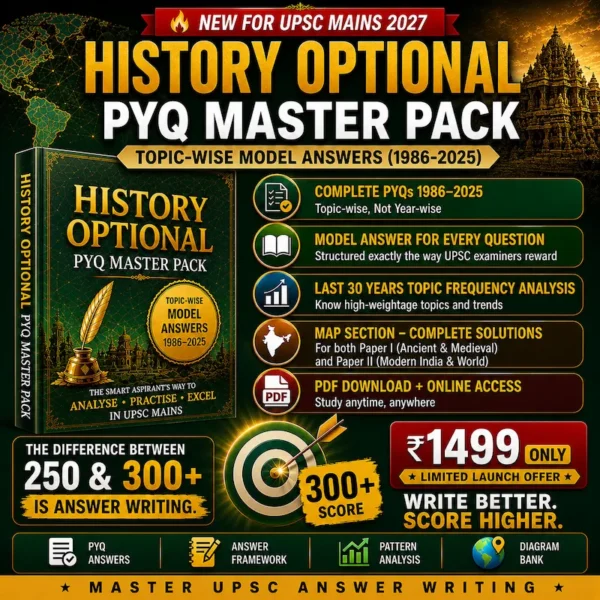
The History Optional PYQ Master Pack carries the same for every question the Commission has set since 1985, across the whole syllabus.
- PYQs 1985–2025, arranged topic-wise — revise a theme and see every way it has been asked
- Model answers with historiography — the debate cited where it belongs, not bolted on
- Map sections solved — the full 50-mark section, every year
- PDF plus online access — any device, permanently, no subscription
₹1,499 (regular ₹2,500). One-time payment, instant access.
How to use this topic list
Reading a question list feels like preparation and is not. Three sittings turn it into marks.
Sitting 1 — sort before you read (30 minutes)
- Copy the questions above into the threads identified in the previous section.
- Note which thread has gone longest without being asked — that is your priority, not the one you find most interesting.
Sitting 2 — write three answers cold (45 minutes)
- Pick the most recent question from three different threads.
- Seven minutes for a 10-marker, fifteen for a 20-marker. Stop when the time is up, even mid-sentence.
- Mark every place you wanted a historian’s name and could not produce one.
Sitting 3 — compare, then rewrite (45 minutes)
- Put your script beside the model answer for the same question.
- Compare structure first: opening claim, evidence, counter-view, judgement.
- Rewrite your weakest answer using that structure and no new content. Most candidates gain four to six marks from structure alone.
Two ways to prepare this optional
Two routes, depending on what is actually missing.
| PYQ Master Pack | Mains Master Kit 2027 | |
| Best when | Your notes are done; answer-writing is the gap | You are still building the subject |
| What you get | Model answers to every question since 1985, topic-wise, map sections included | 4,500+ pages of notes, full mapping coverage, 12 months of article access |
| Price | ₹1,499 (reg. ₹2,500) | ₹1,770 (reg. ₹5,000) |
Frequently asked questions
Related topics
Akbar’s reign rarely stands alone in an answer. These neighbouring topics supply the before and after, and several questions in the table can only be answered well by borrowing from them.
- Mughal Empire in the Seventeenth Century
- Economy and Society in the 16th and 17th Centuries
- Culture during the Mughal Empire
- The Eighteenth Century
- All topics — History Optional PYQs, topic-wise
Prefer to work year by year?
The complete papers, with both papers in full, unit-wise analysis and the official PDFs:
- History Optional Question Paper 2026
- History Optional Question Paper 2025
- History Optional Question Paper 2024
- History Optional Question Paper 2023
- History Optional Question Paper 2022
- History Optional Question Paper 2021
- History Optional Question Paper 2020
- UPSC History Optional Map Solutions (2013–2025)