The History Optional Question Paper 2023 was set for UPSC Civil Services Mains 2023. Both papers are reproduced below exactly as UPSC asked them, followed by a unit-wise breakdown of what the paper tested, what the 2023 pattern tells you about how the Commission frames History questions, and how to work through these questions instead of only reading them.
| Examination | UPSC Civil Services Mains 2023 — History Optional |
| Papers | Paper I (Ancient and Medieval India) and Paper II (Modern India and World History) |
| Marks | 250 per paper — 500 total |
| Duration | 3 hours per paper |
| Structure | Section A and Section B, four questions each. Q1 and Q5 are compulsory; one question from the remaining three in each section. |
| Map question | Paper I Q1 — 20 locations at 2.5 marks each, 50 marks, given as locational hints rather than place names. |
Every question on this page, already answered
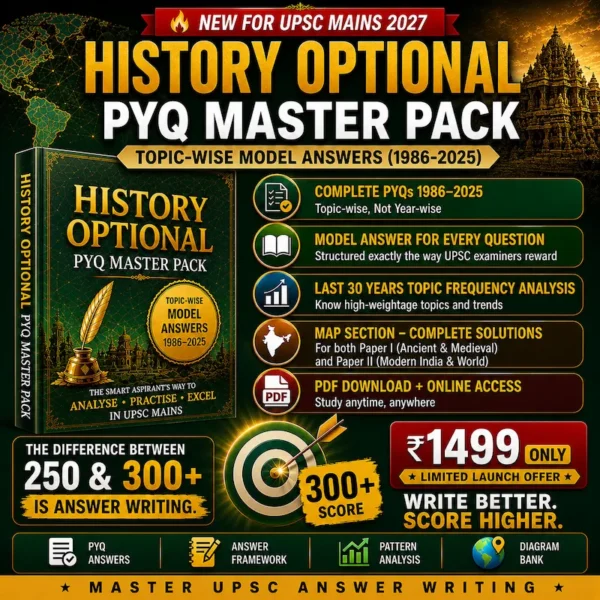
Reading a past paper tells you what UPSC asked. It does not tell you what a 16-plus answer to it looks like — and in History Optional that gap is the whole difference between knowing the period and scoring on it. The History Optional PYQ Master Pack carries a written model answer for every question the Commission has set since 1985, including every question on this 2023 paper.
- PYQs from 1985 to 2025, arranged topic-wise — Ancient India, Medieval India, Modern India, Post-Independence and World History, every question solved
- Model answers with the structure written out — the historians named and cited, the argument sequenced, diagram and timeline suggestions in place
- Map section solutions included — the full 50-mark section most aspirants give up on, at no extra cost
- PDF download plus online access — both included, on any device, permanently rather than for the length of a subscription
₹1,499 (regular ₹2,500) for all of it. One-time payment, no subscription, instant access.
History Optional Question Paper-1 (2023)
Paper I covers Ancient India in Section A and Medieval India in Section B. Q1 and Q5 are compulsory, and Q1 is the map question — 50 marks, a fifth of the paper. The 2023 hints were unusually object-led: a terracotta figure, a coin hoard, botanical remains, a stone axe factory, an iron-smelting workshop.
Paper I — Section A (Ancient India)
Q1. Identify the following places marked on the map supplied to you and write a short note of about 30 words on each of them in your Question-cum-Answer Booklet. Locational hints for each of the places marked on the map are given below seriatim (2.5 × 20 = 50)
- (i) A Neolithic site
- (ii) Site of a mother-and-child terracotta figure
- (iii) A hoard of Gupta coins
- (iv) Site of botanical remains
- (v) A Harappan site with a mud-brick platform
- (vi) A Mauryan reservoir site
- (vii) Capital of the Maitraka dynasty
- (viii) A dockyard
- (ix) A rock shelter
- (x) A stone axe factory
- (xi) A Satavahana inscription site
- (xii) A minor rock inscription of Ashoka
- (xiii) A Buddhist stupa
- (xiv) A Mesolithic site
- (xv) An iron-smelting workshop
- (xvi) A Megalithic site
- (xvii) A temple site dedicated to Surya
- (xviii) A Roman factory site
- (xix) Site of the Muvar Koil (Temple of Three)
- (xx) A megalith stone site

Q2. (50)
- (a) “The Neolithic Age represents a revolution due to significant changes that took place during this period.” Examine.
- (b) The Indus-Saraswati cultural zone exhibited both homogeneity and diversity. Discuss.
- (c) How do the comparative study of languages, archaeological sources and the vast corpus of Vedic literature help to determine the Aryan problem in Indian history? Discuss.
Q3. (50)
- (a) How far does Sangam literature act as a window into the social and cultural traditions of ancient South India?
- (b) Analyse the contours of imperial ideology as exhibited during the Mauryan period.
- (c) Evaluate the status of women in the Gupta period as compared to the pre-Gupta era.
Q4. (50)
- (a) Analyse the tenets, spread and impact of the Bhakti movement.
- (b) How far did temple architecture under the Cholas become more refined and grandiose as compared to the early South Indian temple architecture style?
- (c) Is it correct to say that the post-Gupta period was remarkable for the expansion of religious cults in India?
Paper I — Section B (Medieval India)
Q5. Answer the following questions in about 150 words each (10 × 5 = 50)
- (a) Discuss the various proponents of Indian feudalism.
- (b) Examine the defects in Alberuni’s assessment of Indian society.
- (c) Discuss the importance of Sufi literature as an important source of history.
- (d) What factors do you attribute to the decline of the Delhi Sultanate?
- (e) The motive of Alauddin Khalji’s agrarian policy was to curb the powers of the intermediaries. Examine the measures which he adopted to achieve his objective.
Q6. (50)
- (a) Discuss the role of Nur Jahan in Mughal court politics during the reign of Jahangir.
- (b) Why did Balban prefer ‘consolidation’ over ‘expansion’ of the Delhi Sultanate?
- (c) What features of European paintings were incorporated in Mughal miniature painting?
Q7. (50)
- (a) The Marathas posed a significant threat to the integrity of the Mughal Empire. Discuss.
- (b) “Haidar Ali was born to build an empire, and Tipu Sultan to lose one.” Comment.
- (c) Analyse the rise of the Sikhs under Ranjit Singh.
Q8. (50)
- (a) Mughal architecture was syncretic in character. Comment.
- (b) The economy of India was not stagnant in the eighteenth century. Discuss.
- (c) Discuss the nature of the Mughal state under Akbar.
Could you actually write these answers — in 12 minutes each?
That is the honest test of a History past paper. Most aspirants can recognise every question above and still score 10 to 13 on them, because the marks do not sit in knowing what happened. They sit in naming the historian whose reading you are using, sequencing the argument instead of narrating it, and closing with a judgement rather than a summary. The PYQ Master Pack gives you the written form of each of these 2023 answers, so you are studying a structure instead of inventing one under pressure.
Paper II is reproduced below. Before you scroll on, mark the three questions above where you could name the events but not a single historian — those are the answers to read first.
History Optional Question Paper-2 (2023)
Paper II covers Modern India in Section A and World History in Section B. Q1 and Q5 are compulsory, and both are sets of five statements to examine critically in about 150 words each.
Paper II — Section A (Modern India)
Q1. Critically examine the following statements in about 150 words each (10 × 5 = 50)
- (a) “Colonialism had a twisted logic of its own for commercialisation. It emerges on analysis to have been often an artificial and forced process.”
- (b) After 1857, “the peasants emerged as the main force in agrarian movements”.
- (c) “Awakened political consciousness of the Indian masses, bound with dishonourable and cowardly insults of the British, led to the movement of Non-Cooperation.”
- (d) When Gandhiji launched the Civil Disobedience Movement he was “desperately in search of an effective formula”.
- (e) “If abdication of British responsibility at the time of transfer of power was callous, the speed with which it was done made it worse.”
Q2. (50)
- (a) The Carnatic Wars, the Anglo-Mysore Wars and the Anglo-Maratha Wars had virtually eliminated the French from the contest of supremacy in South India. Discuss.
- (b) While introducing the Indian Councils Bill of 1861, the British thought that the only government suitable for India ‘is a despotism controlled from home’. Comment.
- (c) “The root of the whole question behind the Indigo Revolt is the struggle to make the raiyats grow indigo plants without paying them the price of it.” Analyse.
Q3. (50)
- (a) Do you agree that ‘the decline of traditional Indian artisan production was a fact, sad but inevitable’? Discuss.
- (b) The historical significance of tribal and peasant uprisings in India ‘lies in that they established strong and valuable traditions of resistance to British rule’. Discuss.
- (c) To accomplish the aims of education, ‘political propaganda and formation as well as propagation of nationalist ideology’, the press became the chief instrument. Comment.
Q4. (50)
- (a) The universalist perspective of socio-religious reform movements was not a ‘purely philosophic’ concern; it strongly influenced the political and social outlook of the time. Examine.
- (b) The Congress Socialist Party agenda was not to cut off from the Congress, but ‘intended to give the Congress and the national movement a socialist direction’. Analyse.
- (c) How did the factionalised Dalit leadership in Hyderabad undergo a period of intense re-organisation between 1948 and 1953?
Paper II — Section B (World History)
Q5. Critically examine the following statements in about 150 words each (10 × 5 = 50)
- (a) “The American War of Independence finally ended in 1783 when Britain acknowledged the independence of the United States of America.”
- (b) “The Chartist movement not only fulfilled some of the demands of the middle class, but its ramifications were felt among the working class and the colonies as well.”
- (c) “The Revolutions of 1848 were shaped by the ideas of democracy and nationalism.”
- (d) “British imperialism in South Africa from 1867 to 1902 was influenced to a large extent by the capitalist mining of diamonds.”
- (e) “The supremacy of the USA after the end of the Cold War had its challenges as well.”
Q6. (50)
- (a) The philosophers and thinkers may have laid the foundation of the French Revolution, but it was precipitated by social and economic reasons. Explain.
- (b) Marxian socialism claims itself to be a scientific socialist theory capable of explaining the history of humankind. Discuss.
- (c) The Enlightenment was not confined to the scientific revolution alone, but humanism and ideas of progress too were its inseparable constituents. Examine.
Q7. (50)
- (a) The impact of the Industrial Revolution on the middle-class worldview is reflected in the views of Adam Smith, Thomas Malthus and Jeremy Bentham. Comment.
- (b) Discuss the different stages of the unification of Italy from 1848 to the occupation of Rome in 1870.
- (c) The Treaty of Versailles contained in itself the seeds of the Second World War. Examine.
Q8. (50)
- (a) “The UNO was the necessity of the time when the Second World War ended.” Critically examine its achievements and shortcomings.
- (b) The historical causes for the rise of the anti-colonial movement in South-East Asia were cultural differences, the spread of western education and the emergence of communist ideas. Discuss.
- (c) Arab nationalism was not only a cultural movement, but also an anti-colonial struggle. Comment.
What the 2023 History Optional paper actually tested
Mapping the questions onto the syllabus shows the shape of the paper at a glance — and shows which units the Commission chose to spend its marks on.
Paper I — unit-wise spread (2023)
| Syllabus unit | Questions |
| Map (object-led hints, 50 marks) | Q1 |
| Pre-history and the Neolithic | Q2(a) |
| Indus Valley Civilization | Q2(b) |
| Aryans and the Vedic Period | Q2(c) |
| Early State and Society in South India (Sangam) | Q3(a) |
| Mauryan Empire | Q3(b) |
| Guptas (status of women) | Q3(c) |
| Cultural Traditions and Bhakti | Q4(a) |
| Early Medieval India (Chola temples, feudalism) | Q4(b), Q5(a) |
| Themes in Early Indian Cultural History | Q4(c) |
| Sources (Alberuni, Sufi literature) | Q5(b), Q5(c) |
| The Fourteenth Century | Q5(d), Q5(e) |
| Mughal Empire in the Seventeenth Century | Q6(a) |
| The Thirteenth Century | Q6(b) |
| Culture in the Mughal Empire | Q6(c), Q8(a) |
| The Eighteenth Century | Q7(a), Q7(b), Q7(c), Q8(b) |
| Akbar | Q8(c) |
Paper II — unit-wise spread (2023)
| Syllabus unit | Questions |
| Economic Impact of British Colonial Rule | Q1(a), Q3(a) |
| Indian Response to British Rule | Q1(b), Q2(c), Q3(b) |
| Rise of Gandhi and the Gandhian Era | Q1(c), Q1(d) |
| Politics of Separatism and the transfer of power | Q1(e) |
| British Expansion in India | Q2(a) |
| Constitutional Developments, 1858–1935 | Q2(b) |
| Social and Cultural Developments | Q3(c) |
| Social and Religious Reform Movements | Q4(a) |
| Other Strands in the National Movement | Q4(b) |
| Caste and Ethnicity after 1947 | Q4(c) |
| Origins of Modern Politics | Q5(a), Q5(b), Q6(b) |
| Revolution and Counter-Revolution | Q5(c), Q6(a) |
| Imperialism and Colonialism | Q5(d) |
| Disintegration of the Soviet Union | Q5(e) |
| Enlightenment and Modern Ideas | Q6(c) |
| Industrialization | Q7(a) |
| Nation-State System | Q7(b), Q8(c) |
| World Wars | Q7(c) |
| The World after World War II | Q8(a) |
| Liberation from Colonial Rule | Q8(b) |
Five things the 2023 paper tells you about UPSC’s pattern
- The map asked about objects, not just places. A mother-and-child terracotta figure, botanical remains, a stone axe factory, an iron-smelting workshop, a Roman factory site, the Muvar Koil. The hint names what was found there, which means the note you write has to be about the find, not a general description of the site.
- The eighteenth century took four Section B questions. The Marathas against Mughal integrity, Haidar Ali and Tipu, Ranjit Singh, and whether the eighteenth century economy was stagnant. That last one is the historiographical heart of the unit — the Aligarh school’s decline thesis against the revisionists — and it is worth knowing by name.
- Historiography was asked directly. “Discuss the various proponents of Indian feudalism” is not a question about feudalism; it is a question about R. S. Sharma, Harbans Mukhia, D. N. Jha and their critics. An answer that describes land grants without naming the debate misses the question.
- Paper II Section A tracked one argument from 1757 to 1953. Forced commercialisation, peasants after 1857, Non-Cooperation, Civil Disobedience, the transfer of power, and then Dalit leadership in Hyderabad between 1948 and 1953. That last question is the most specific post-1947 question in any recent paper.
- World History Section B was Europe-heavy but ended outside it. South Africa and diamonds, South-East Asian anti-colonialism, Arab nationalism. Three of the fourteen slots, and consistent with the direction of travel since 2019.
How to use this paper (rather than just read it)
- Do the map question first, from a blank outline. 2023 is the object paper: for each site, know the single find or feature it is famous for, in one line.
- Learn the eighteenth century debate by name. Decline or dynamism, the Aligarh position and the revisionist reply. Four questions here, and the framing recurs constantly.
- Treat “proponents of” as a historiography prompt. When the paper asks for the proponents of Indian feudalism, it wants scholars and their positions, not a description of the phenomenon.
- Have one specific post-1947 case ready per theme. Dalit politics, land reform, linguistic states, environment. 2023 asked for Hyderabad between 1948 and 1953; generalities do not survive that level of specificity.
- Compare your answer against a model answer, not against the syllabus. The gap you need to close is a writing gap. Reading more sources does not close it; seeing the finished shape of a high-scoring answer does.
Two ways to prepare for the papers above
Past papers are the syllabus UPSC actually examines. What you do next with them decides the marks. Two LotusArise systems are built for the two different gaps History aspirants have at this stage.
| PYQ Master Pack | Mains Master Kit 2027 | |
| Best for | You know the content and your gap is answer writing | You are starting History Optional and want one complete system |
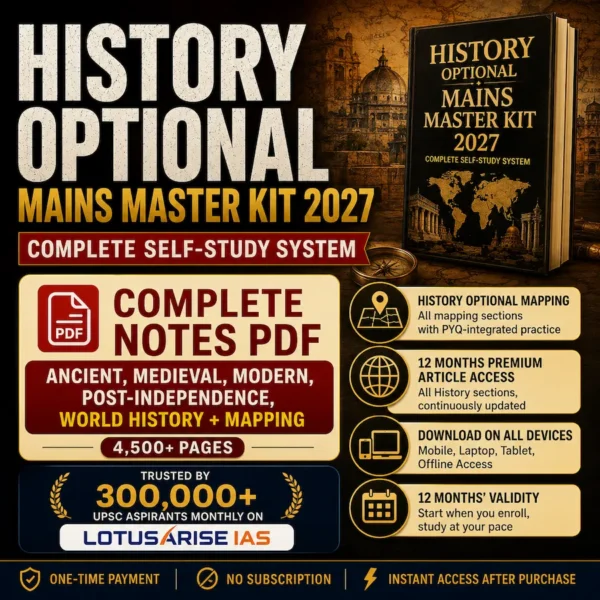
| Core content | Every PYQ from 1985 to 2025, solved and arranged topic-wise across Ancient, Medieval, Modern, Post-Independence and World History | Complete Notes PDF — Ancient, Medieval, Modern, Post-Independence, World History and Mapping, 4,500+ pages |
| Also inside | Historian citations inside each answer, diagram and timeline suggestions, and the full 50-mark map section solved | Mapping with PYQ-integrated practice; 12 months premium article access, continuously updated |
| Access | PDF download plus online access, permanently | 12 months, all devices, offline |
| Price | ₹1,499 (regular ₹2,500) | ₹1,770 (regular ₹5,000) |
Both are one-time payments with instant access and no subscription. If you are unsure, start with the PYQ Master Pack — for most aspirants who have already read the syllabus once, answer writing is the constraint, not content.
History Optional Question Paper 2023 — FAQs
History Optional question papers — other years
- History Optional Question Paper 2011
- History Optional Question Paper 2012
- History Optional Question Paper 2013
- History Optional Question Paper 2014
- History Optional Question Paper 2015
- History Optional Question Paper 2016
- History Optional Question Paper 2017
- History Optional Question Paper 2018
- History Optional Question Paper 2019
- History Optional Question Paper 2020
- History Optional Question Paper 2021
- History Optional Question Paper 2022
- History Optional Question Paper 2024
- History Optional Question Paper 2025
- History Optional Question Paper 2026
- History Optional question papers — topic-wise PYQ hub
- History Optional PYQ Master Pack — solved model answers (1985–2025)