The History Optional Question Paper 2015 was set for UPSC Civil Services Mains 2015. Both papers are reproduced below exactly as UPSC asked them, followed by a unit-wise breakdown of what the paper tested, what the 2015 pattern tells you about how the Commission frames History questions, and how to work through these questions instead of only reading them.
| Examination | UPSC Civil Services Mains 2015 — History Optional |
| Papers | Paper I (Ancient and Medieval India) and Paper II (Modern India and World History) |
| Marks | 250 per paper — 500 total |
| Duration | 3 hours per paper |
| Structure | Section A and Section B, four questions each. Q1 and Q5 are compulsory; one question from the remaining three in each section. |
| Map question | Paper I Q1 — 20 locations at 2.5 marks each, 50 marks, given as locational hints rather than place names. |
Every question on this page, already answered
Reading a past paper tells you what UPSC asked. It does not tell you what a 16-plus answer to it looks like — and in History Optional that gap is the whole difference between knowing the period and scoring on it. The History Optional PYQ Master Pack carries a written model answer for every question the Commission has set since 1985, including every question on this 2015 paper.
- PYQs from 1985 to 2025, arranged topic-wise — Ancient India, Medieval India, Modern India, Post-Independence and World History, every question solved
- Model answers with the structure written out — the historians named and cited, the argument sequenced, diagram and timeline suggestions in place
- Map section solutions included — the full 50-mark section most aspirants give up on, at no extra cost
- PDF download plus online access — both included, on any device, permanently rather than for the length of a subscription
₹1,499 (regular ₹2,500) for all of it. One-time payment, no subscription, instant access.
History Optional Question Paper-1 (2015)
Paper I covers Ancient India in Section A and Medieval India in Section B. Q1 and Q5 are compulsory, and Q1 is the map question — 50 marks, a fifth of the paper.
Paper I — Section A (Ancient India)
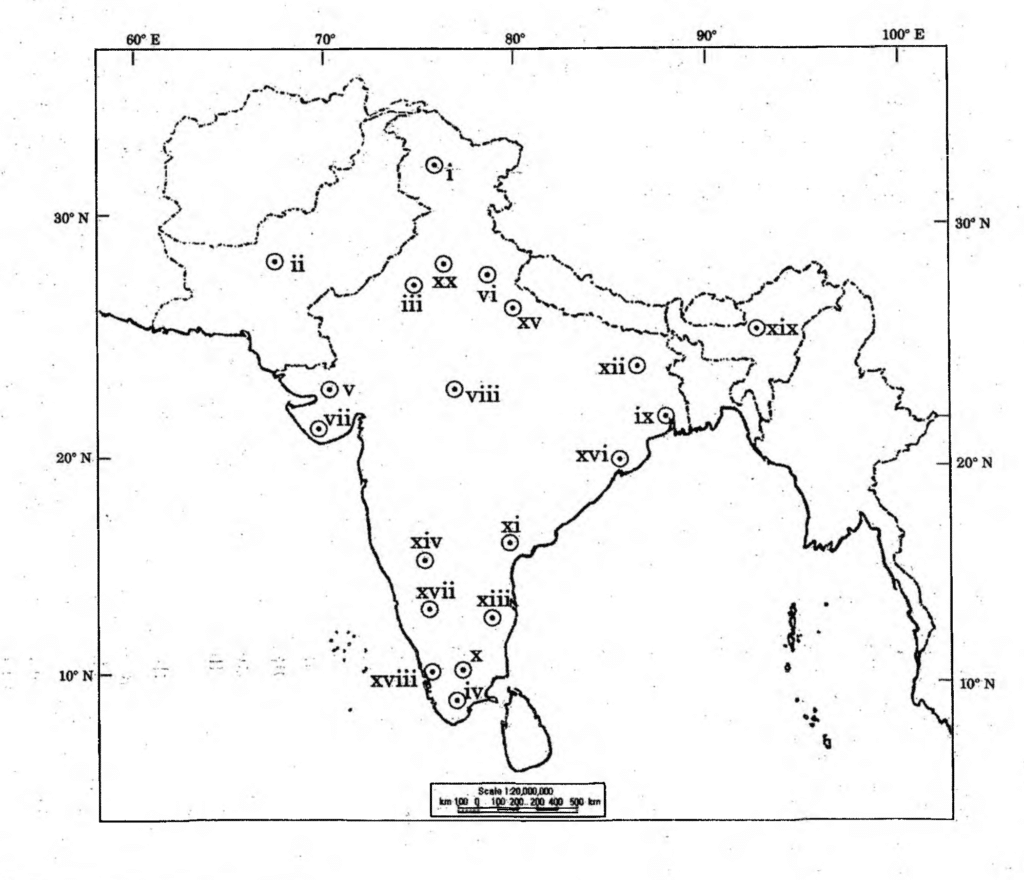
Q1. Identify the following places marked on the map supplied to you and write a short note of about 30 words on each of them in your Question-cum-Answer Booklet. Locational hints for each of the places marked on the map are given below (2.5 × 20 = 50)
- (i) A Neolithic site
- (ii) A Neolithic site
- (iii) A Harappan site
- (iv) A Megalithic site
- (v) A Harappan site
- (vi) A Painted Grey Ware site
- (vii) An inscriptional site
- (viii) An important ancient city
- (ix) An ancient port
- (x) A site of ancient cave paintings
- (xi) A Buddhist site
- (xii) An educational centre
- (xiii) A brahmadeya village
- (xiv) An ancient capital
- (xv) An ancient capital
- (xvi) A temple site
- (xvii) An ancient capital
- (xviii) An ancient sea port
- (xix) An archaeological temple site
- (xx) A Harappan site
Q2. (50)
- (a) How far can the ancient Indian Sruti literature be used as historical sources?
- (b) The decline of the Harappan civilization was caused by ecological degradation rather than external invasion. Discuss.
- (c) “Archaeology knows of no Aryans; only literature knows of Aryans.” Examine critically.
Q3. (50)
- (a) How far is it correct to say that changes in the post-Vedic economy gave birth to new religious movements in India?
- (b) Delineate the nature and impact of India’s contact with Western Asia and the Mediterranean world during the Mauryan period.
- (c) “Not only does ancient Tamil literature furnish an accurate picture of widely disparate classes, it also describes the social condition of the Tamil country as it was.” Discuss.
Q4. (50)
- (a) Trace the role of guilds and trade organisations in the development of the early Indian economy.
- (b) The Kailasa temple built at Ellora marks the culmination of rock-cut architecture in India. Elucidate.
- (c) How could the local self-government under the Cholas adjust with their centralised administrative structure?
Paper I — Section B (Medieval India)
Q5. Answer the following questions in about 150 words each (10 × 5 = 50)
- (a) Give a brief account of the early medieval temple architecture of Kashmir.
- (b) Why is Mamallapuram famous?
- (c) Mention the salient features of the polity of the Vijayanagara Empire under Krishnadevaraya.
- (d) What measures did Balban adopt to combat the Mongol menace?
- (e) How does the Tuzuk-i-Baburi testify that Babur had been a cultured man?
Q6. (50)
- (a) Do the evidences of land ownership at our disposal support the theory of the prevalence of feudalism in early medieval India?
- (b) Discuss in brief the land revenue system and judicial administration of the Delhi Sultanate.
- (c) “Sufis and medieval mystic saints failed to modify either the religious ideas and practices or the outward structure of Islamic and Hindu societies to any appreciable extent.” Comment.
Q7. (50)
- (a) Make an estimate of Rana Kumbha as a patron of literature and art.
- (b) Why should the sixteenth century be regarded as the period of the Indian Renaissance?
- (c) “Tantrism, if not in practice, at least on a conceptual level challenged patriarchy.” Examine Tantrism specially keeping in mind the above context.
Q8. (50)
- (a) “In medieval Indian history Akbar was unique for his religio-political ideas and policies.” Analyse this statement.
- (b) Will it not be correct to say that the rural economy in Mughal India was relatively self-sufficient?
- (c) Compare the Peshwas’ bureaucratic management with that of the imperial Mughal administration.
Could you actually write these answers — in 12 minutes each?
That is the honest test of a History past paper. Most aspirants can recognise every question above and still score 10 to 13 on them, because the marks do not sit in knowing what happened. They sit in naming the historian whose reading you are using, sequencing the argument instead of narrating it, and closing with a judgement rather than a summary. The PYQ Master Pack gives you the written form of each of these 2015 answers, so you are studying a structure instead of inventing one under pressure.
Paper II is reproduced below. Before you scroll on, mark the three questions above where you could name the events but not a single historian — those are the answers to read first.
History Optional Question Paper-2 (2015)
Paper II covers Modern India in Section A and World History in Section B. Q1 and Q5 are compulsory, and both are sets of five statements to examine critically in about 150 words each.
Paper II — Section A (Modern India)
Q1. Critically examine the following statements in about 150 words each (10 × 5 = 50)
- (a) “Annexation of Punjab was part of a broad north-west frontier policy set in motion after the exit of Maharaja Ranjit Singh.”
- (b) “The Regulating Act (1773), Pitt’s India Act (1784) and eventually the Charter Act of 1833 left the East India Company as a mere shadow of its earlier political and economic power in India.”
- (c) “The Indigo Revolt of 1859–60 holds a very significant place in our history of the national liberation movement. For the first time in the history of our anti-colonial struggle, its two independent currents — spontaneous peasant resistance and constitutional agitation in defence of the peasantry — came into mutual contact.”
- (d) “The very idea of the bomb and the secret society, and of propaganda through action and sacrifice, were imports from the West.”
- (e) “This retention of Rowlatt legislation in the teeth of universal opposition is an affront to the nation. Its repeal is necessary to appease national honour.”
Q2. (50)
- (a) “Swami Dayanand’s philosophy represents both elements of extremism and social radicalism.” Substantiate.
- (b) “To characterise the Quit India Movement as a ‘spontaneous revolution’ would be a partial interpretation; so also would be to look upon it as the culmination of Gandhian satyagraha movements.” Elucidate.
- (c) “A powerful left-wing group developed in India in the late 1920s and 1930s, contributing to the radicalisation of the national movement.” Critically examine.
Q3. (50)
- (a) “Under the forceful thrust of British colonialism, the Indian economy was transformed into a colonial one, the structure of which was determined by the requirements of Britain’s fast developing industrial economy.” Examine.
- (b) “James Mill, the apostle of utilitarian philosophy, proposed a revolution of Indian society through the ‘weapon of law’ solely. But in actual policy framing, other influences and considerations weighed much more than the colonial state.” Elucidate.
- (c) “The Royal Indian Navy Revolt was seen as an event which marked the end of British rule almost as finally as Independence Day.” Explain.
Q4. (50)
- (a) Analyse the nature of peasant movements during the nationalist phase and bring out their shortcomings.
- (b) “Jawaharlal Nehru, though a declared socialist, was pragmatist enough to focus on providing building blocks to the making of a new India.” Examine.
- (c) “Although the Government of India Act 1935 replaced dyarchy with provincial autonomy, the overriding powers of the Governor diluted the spirit of autonomy.” Elucidate.
Paper II — Section B (World History)
Q5. Critically examine the following statements in about 150 words each (10 × 5 = 50)
- (a) “France was even more fertile than Britain in producing new socialist theories and movements, though it bore less concrete results in France than in Britain.”
- (b) “The multiple contradictions that quickly undermined the new edifice had been expressed even before the meeting of the Estates General in France. The internal conflict among the Estates had manifested itself.”
- (c) “The whole episode that is known as the July Revolution (1830) was fought and won not for the establishment of an extreme democracy but to get rid of the aristocratic and clericalist attitude of the restored Bourbons.”
- (d) “Mazzini’s conception of Italian nationality was not exclusive and his dominant ideal was the recreation of the moral unity of mankind.”
- (e) “The Continental Blockade was a misconceived idea of economically defeating Great Britain.”
Q6. (50)
- (a) “The Berlin Congress (1878) failed to unlock the Eastern Question. Though there was no major war in Europe for nearly three decades after it, the treaty contained the seeds of many future wars.” Critically evaluate.
- (b) “History of Africa appears to be simply an extension or mere sub-theme under the broad headings of European and American history.” Elucidate.
- (c) “The Truman Doctrine and the Marshall Plan were considered by the Russian bloc as a weapon against Russia in order to restrict her influence.” Critically examine.
Q7. (50)
- (a) How far is it correct to say that the First World War was fought essentially for the preservation of the balance of power?
- (b) “The failure of the Kuomintang against the communist onslaught was unimaginable, and it was Mao Tse-tung whose tenacity and innovative approach had accomplished the unthinkable.” Discuss.
- (c) “The oppressive exploitation of the working class in the wake of the Industrial Revolution had jolted the social conscience of England.” Elucidate.
Q8. (50)
- (a) “The UNO was created in the light of the experience of the League of Nations, but in spite of the mandate contained in the UNO constitution, its effective role in maintaining world peace has lacked cohesiveness and a collective approach.” Examine.
- (b) “The European Union, a diplomatic marvel, continues to grapple with intermittent fissures arising out of contentious economic issues that pose a challenge to an effective integration of the Union.” Critically examine.
- (c) “The role of the Non-Aligned Movement in world affairs has suffered greatly due to the theatre of internecine conflicts among the Third World countries who spearheaded it.” Elucidate.
What the 2015 History Optional paper actually tested
Mapping the questions onto the syllabus shows the shape of the paper at a glance — and shows which units the Commission chose to spend its marks on.
Paper I — unit-wise spread (2015)
| Syllabus unit | Questions |
| Map (Ancient and Medieval sites, 50 marks) | Q1 |
| Sources | Q2(a) |
| Indus Valley Civilization | Q2(b) |
| Aryans and the Vedic Period | Q2(c) |
| Period of Mahajanapadas and new religious movements | Q3(a) |
| Mauryan Empire | Q3(b) |
| Early State and Society in South India | Q3(c), Q5(b) |
| Economy of early India (guilds and trade) | Q4(a) |
| Themes in Early Indian Cultural History | Q4(b) |
| Early Medieval India, 750–1200 (Cholas, feudalism) | Q4(c), Q6(a) |
| Cultural Traditions, 750–1200 (architecture, Sufism, Tantrism) | Q5(a), Q6(c), Q7(c) |
| The Fifteenth and Early Sixteenth Century | Q5(c), Q5(e), Q7(a) |
| The Thirteenth and Fourteenth Centuries | Q5(d), Q6(b) |
| Economy and Society, 16th–17th centuries | Q7(b), Q8(b) |
| Akbar | Q8(a) |
| The Eighteenth Century | Q8(c) |
Paper II — unit-wise spread (2015)
| Syllabus unit | Questions |
| British Expansion in India | Q1(a) |
| Early Structure of the British Raj | Q1(b), Q3(b) |
| Indian Response to British Rule | Q1(c), Q4(a) |
| Other Strands in the National Movement | Q1(d), Q2(c), Q3(c) |
| Rise of Gandhi and the Gandhian Era | Q1(e), Q2(b) |
| Social and Religious Reform Movements | Q2(a) |
| Economic Impact of British Colonial Rule | Q3(a) |
| Economic Development and Political Change | Q4(b) |
| Constitutional Developments, 1858–1935 | Q4(c) |
| Origins of Modern Politics | Q5(a) |
| Revolution and Counter-Revolution | Q5(b), Q5(c), Q5(e) |
| Nation-State System | Q5(d), Q6(a) |
| Imperialism and Colonialism | Q6(b) |
| The World after World War II | Q6(c), Q8(a) |
| World Wars | Q7(a) |
| Liberation from Colonial Rule | Q7(b) |
| Industrialization | Q7(c) |
| Unification of Europe | Q8(b) |
| Decolonization and Underdevelopment | Q8(c) |
Five things the 2015 paper tells you about UPSC’s pattern
- Section A opened on the evidentiary status of the sources themselves. Can Sruti literature be used as history? Does archaeology know of Aryans? Does Tamil Sangam literature describe society as it was? Three of the nine Section A questions asked what the evidence can and cannot bear — a recurring habit that rewards reading historiography, not just narrative.
- Culture and religion outweighed dynastic history in Paper I. Kashmiri temple architecture, Mamallapuram, the Kailasa temple, Sufis and mystic saints, Tantrism and patriarchy, Rana Kumbha as patron. Aspirants who treat art and religion as optional garnish had a thin choice set in both sections.
- The Tantrism question is the one to notice. “Tantrism, if not in practice, at least on a conceptual level challenged patriarchy” — a gender-history framing applied to a medieval religious tradition. The Commission has kept returning to gender across both papers since, and it is almost never prepared as a theme in its own right.
- Paper II Section A was a historiography paper in disguise. The Indigo Revolt as a meeting of two currents, the bomb as a Western import, the Quit India Movement as spontaneous or Gandhian, Nehru as socialist or pragmatist. Every one asks you to place yourself in an existing debate.
- World History ran from 1789 to the present, with the weight in the nineteenth century. The Estates General, the July Revolution, Mazzini, the Continental Blockade, the Berlin Congress, French socialism. Six of the World History slots sat before 1914.
How to use this paper (rather than just read it)
- Do the map question first, from a blank outline. Fifty marks, twenty categories and no names. It is the largest single block in either paper and the one where preparation converts most directly into marks.
- Prepare source criticism as its own topic. The Vedas, Sangam literature, archaeology against texts, Alberuni, Barani, inscriptions. What each is good for, what it distorts, and who has said so.
- Add a gender thread to your notes. Women in the Dharmasastra, Tantrism and patriarchy, women in the national movement. Small, recurring, and almost never revised on purpose.
- Cover the long nineteenth century in World History. 1789 to 1914 carried most of Section B here, and it is the half of the syllabus aspirants most often skim on the way to the world wars.
- Compare your answer against a model answer, not against the syllabus. The gap you need to close is a writing gap. Reading more sources does not close it; seeing the finished shape of a high-scoring answer does.
Two ways to prepare for the papers above
Past papers are the syllabus UPSC actually examines. What you do next with them decides the marks. Two LotusArise systems are built for the two different gaps History aspirants have at this stage.
| PYQ Master Pack | Mains Master Kit 2027 | |
| Best for | You know the content and your gap is answer writing | You are starting History Optional and want one complete system |
| Core content | Every PYQ from 1985 to 2025, solved and arranged topic-wise across Ancient, Medieval, Modern, Post-Independence and World History | Complete Notes PDF — Ancient, Medieval, Modern, Post-Independence, World History and Mapping, 4,500+ pages |
| Also inside | Historian citations inside each answer, diagram and timeline suggestions, and the full 50-mark map section solved | Mapping with PYQ-integrated practice; 12 months premium article access, continuously updated |
| Access | PDF download plus online access, permanently | 12 months, all devices, offline |
| Price | ₹1,499 (regular ₹2,500) | ₹1,770 (regular ₹5,000) |
Both are one-time payments with instant access and no subscription. If you are unsure, start with the PYQ Master Pack — for most aspirants who have already read the syllabus once, answer writing is the constraint, not content.
History Optional Question Paper 2015 — FAQs
History Optional question papers — other years
- History Optional Question Paper 2011
- History Optional Question Paper 2012
- History Optional Question Paper 2013
- History Optional Question Paper 2014
- History Optional Question Paper 2016
- History Optional Question Paper 2017
- History Optional Question Paper 2018
- History Optional Question Paper 2019
- History Optional Question Paper 2020
- History Optional Question Paper 2021
- History Optional Question Paper 2022
- History Optional Question Paper 2023
- History Optional Question Paper 2024
- History Optional Question Paper 2025
- History Optional Question Paper 2026
- History Optional question papers — topic-wise PYQ hub
- History Optional PYQ Master Pack — solved model answers (1985–2025)