The History Optional Question Paper 2013 was set for UPSC Civil Services Mains 2013 — the first year of the restructured pattern, and the template every paper since has followed. Both papers are reproduced below exactly as UPSC asked them, with the official mark distribution, followed by a unit-wise breakdown of what the paper tested, what the 2013 pattern tells you about how the Commission frames History questions, and how to work through these questions instead of only reading them.
| Examination | UPSC Civil Services Mains 2013 — History Optional |
| Papers | Paper I (Ancient and Medieval India) and Paper II (Modern India and World History) |
| Marks | 250 per paper — 500 total |
| Duration | 3 hours per paper |
| Structure | Section A and Section B, four questions each. Q1 and Q5 are compulsory; one question from the remaining three in each section. |
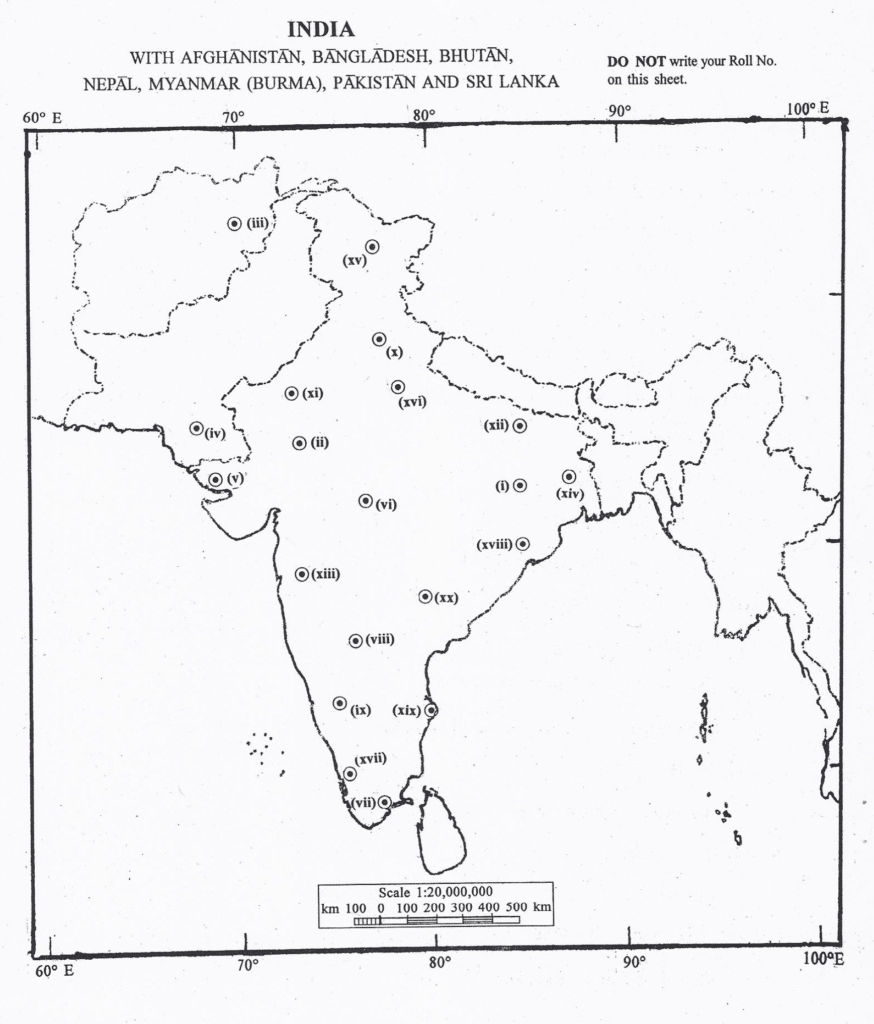
| Map question | Paper I Q1 — 20 locations at 2.5 marks each, 50 marks, given as locational hints rather than place names. |
Every question on this page, already answered
Reading a past paper tells you what UPSC asked. It does not tell you what a 16-plus answer to it looks like — and in History Optional that gap is the whole difference between knowing the period and scoring on it. The History Optional PYQ Master Pack carries a written model answer for every question the Commission has set since 1985, including every question on this 2013 paper.
- PYQs from 1985 to 2025, arranged topic-wise — Ancient India, Medieval India, Modern India, Post-Independence and World History, every question solved
- Model answers with the structure written out — the historians named and cited, the argument sequenced, diagram and timeline suggestions in place
- Map section solutions included — the full 50-mark section most aspirants give up on, at no extra cost
- PDF download plus online access — both included, on any device, permanently rather than for the length of a subscription
₹1,499 (regular ₹2,500) for all of it. One-time payment, no subscription, instant access.
History Optional Question Paper-1 (2013)
Paper I covers Ancient India in Section A and Medieval India in Section B. Q1 and Q5 are compulsory, and Q1 is the map question — 50 marks, a fifth of the paper, and the single largest block in either paper.
Paper I — Section A (Ancient India)
Q1. Identify the following places marked on the outline map in the Question-cum-Answer Booklet supplied to you and write short notes of about 30 words on each of them in the space provided in the Booklet. Locational hints for each of the places marked on the map are given below seriatim (2.5 × 20 = 50)
- (i) A Palaeolithic and Mesolithic site
- (ii) A Mesolithic site
- (iii) An important halting place
- (iv) A pre-Harappan site
- (v) An important Harappan site
- (vi) Site of important fossils
- (vii) A sea port
- (viii) A Palaeolithic site
- (ix) A Neolithic, Megalithic and Chalcolithic site
- (x) A Harappan site
- (xi) A Palaeolithic site
- (xii) A Neolithic site
- (xiii) A Chalcolithic site
- (xiv) A Chalcolithic site
- (xv) A site of a Buddhist monastery
- (xvi) A Painted Grey Ware site
- (xvii) Site related to a famous Indian philosopher
- (xviii) Historical rock-cut caves
- (xix) A famous fort
- (xx) Capital of a famous kingdom
Q2. (20 + 20 + 15 = 55)
- (a) Evaluate various views regarding human settlements as gleaned from the Vedic sources. (20)
- (b) Discuss the water management and its conservation planning in the Harappan (Indus-Saraswati) cities. (20)
- (c) In the absence of a written script, Chalcolithic pottery gives us a fascinating insight into the culture and lifestyle of the people of those times. Comment critically. (15)
Q3. (15 + 20 + 15 = 50)
- (a) On the basis of contemporary sources, assess the nature of banking and usury in ancient India. (15)
- (b) Social norms for women in the Dharmasastra and Arthasastra tradition were framed in accordance with the Varnashrama tradition. Evaluate critically. (20)
- (c) “The varna concept may always have been largely a theoretical model and never an actual description of society.” Comment in the context of ancient India. (15)
Q4. (15 + 15 + 20 = 50)
- (a) Evaluate the contribution of the Puranas in disseminating secular knowledge among the masses in ancient India. (15)
- (b) Evaluate the ownership of land in ancient India on the basis of literary and epigraphic sources. (15)
- (c) Explain how the early Buddhist stupa art, while using folk motifs and narratives and common cultural symbols, succeeded in transforming these themes for expounding Buddhist ideals. (20)
Paper I — Section B (Medieval India)
Q5. Write short notes in not more than 150 words on each of the following (10 × 5 = 50)
- (a) Evaluate the Malfuzat texts as sources of medieval history.
- (b) Discuss the state of society and economy of the Bahmani kingdom as gleaned from historical sources.
- (c) Give a sketch of Indian trade with Europe during the Mughal period.
- (d) Analyse the steps taken by Razia Sultan to strengthen her position as an independent ruler despite the various obstacles.
- (e) Bhakti and mysticism of Lal Ded emerged as a social force in Kashmir. Comment.
Q6. (20 + 15 + 15 = 50)
- (a) Evaluate the conditions of industries in India from 1200 to 1500 CE. (20)
- (b) On the basis of contemporary sources, evaluate the system of agriculture and irrigation of the Vijayanagara kingdom. (15)
- (c) Critically evaluate the educational development during the Sultanate period. (15)
Q7. (20 + 15 + 15 = 50)
- (a) On the basis of the accounts of Europeans, bring out the agrarian crisis in seventeenth century CE India. (20)
- (b) Evaluate critically the conditions of labour from 1200 to 1500 CE on the basis of historical sources. (15)
- (c) Discuss and evaluate critically various trends in the historiography of Bhakti. (15)
Q8. (15 + 15 + 20 = 50)
- (a) Analyse how the political process of state formation of Mewar from the tenth to the fifteenth century CE was challenged in the sixteenth century CE by the imperialist policy of Akbar. (15)
- (b) Assess the Lekhapaddhati as an important source for evaluating the society and economy of the thirteenth century CE with special reference to Gujarat. (15)
- (c) Assess the development of science and technology in the Mughal period. (20)
Could you actually write these answers — in 12 minutes each?
That is the honest test of a History past paper. Most aspirants can recognise every question above and still score 10 to 13 on them, because the marks do not sit in knowing what happened. They sit in naming the historian whose reading you are using, sequencing the argument instead of narrating it, and closing with a judgement rather than a summary. The PYQ Master Pack gives you the written form of each of these 2013 answers, so you are studying a structure instead of inventing one under pressure.
Paper II is reproduced below. Before you scroll on, mark the three questions above where you could name the events but not a single historian — those are the answers to read first.
History Optional Question Paper-2 (2013)
Paper II covers Modern India in Section A and World History in Section B. Q1 and Q5 are compulsory, and in the restructured pattern both are sets of five quotations to examine critically in about 150 words each.
Paper II — Section A (Modern India)
Q1. Critically examine the following statements in about 150 words each (10 × 5 = 50)
- (a) “Dupleix made a cardinal blunder in looking for the key of India in Madras: Clive sought and found it in Bengal.”
- (b) Swami Vivekananda opined that “We should give our ancient spirituality and culture and get in return Western science, technology, methods of raising the standard of life, business integrity and technique of collective effort.”
- (c) “Ryotwari falls into three stages — early, middle and late, and the only description common to all is that it is a mode of settlement with small farmers, so small, indeed, that their average holding is, on recent figures, only about 6.5 acres.”
- (d) “Many of us who worked for the Congress programme lived in a kind of intoxication during the year 1921. We were full of excitement and optimism. We had a sense of freedom and a pride in that freedom.”
- (e) “Gandhi’s body is in jail but his soul is with you. India’s prestige is in your hands, you must not use any violence under any circumstances. You will be beaten but you must not resist; you must not raise a hand to ward off blows.”
Q2. (25 + 25 = 50)
- (a) “Weaving,” says R. C. Dutt, “was the national industry of the people; spinning was the pursuit of millions of women.” Indian textiles went to England and other parts of Europe, to China and Japan and Burma and Arabia and Persia and parts of Africa. Elucidate. (25)
- (b) “The first point to note is the continuing importance of religion and philosophy as vital ingredients in the modern Indian Renaissance. Indeed, there is as much reason for regarding it as a reformation as there is for treating it as a Renaissance.” Critically examine. (25)
Q3. (25 + 25 = 50)
- (a) “At the dawn of the twentieth century Lord Curzon, the Viceroy of India, was full of hostility towards the Indian Congress and he confidentially reported to the Secretary of State in November 1900: ‘My own belief is that the Congress is tottering to its fall, and one of my greatest ambitions while in India is to assist it to a peaceful demise.’” Examine. (25)
- (b) “Though the Act of 1919 was superseded by that of 1935, the preamble to the former was not repealed — the preservation of the smile of the Cheshire cat after its disappearance; and the latter said nothing about Dominion Status.” Elucidate. (25)
Q4. (25 + 25 = 50)
- (a) “Notwithstanding the quest for modernity and the antagonism that guided Nehru’s attitude towards the inequalities inherent in the social structure in rural India, the Congress Party did not carry out a concerted campaign against discrimination based on caste. Nehru’s own perception was that industrial growth was bound to break the stranglehold of this feudal remnant. This, however, did not happen in India.” Examine. (25)
- (b) “The reorganisation resulted in rationalising the political map of India without seriously weakening its unity. If anything, its result has been functional, inasmuch as it removed what had been a major source of discord, and created homogeneous political units which could be administered through a medium that the vast majority of the population understood. Indeed, it can be said with the benefit of hindsight that language, rather than being a force for division, has proved a cementing and integrating influence.” Examine. (25)
Paper II — Section B (World History)
Q5. Critically examine the following statements in about 150 words each (10 × 5 = 50)
- (a) “For Kant, Enlightenment is mankind’s final coming of age, the emancipation of the human consciousness from an immature state of ignorance and error.”
- (b) “Six hundred thousand men had died. The Union was preserved, the slaves freed. A nation ‘conceived in liberty and dedicated to the proposition that all men are created equal’ had survived its most terrible ordeal.”
- (c) “Colonialism not only deprives a society of its freedom and its wealth, but of its very character, leaving its people intellectually and morally disoriented.”
- (d) “If the 1917 Bolshevik Revolution in Russia inaugurated an international competition for the hearts and minds of people all over the globe, the Chinese Revolution raised the stakes of the struggle.”
- (e) “Decolonisation has finished. It definitely belongs to the past. Yet somehow it has refused to become history.”
Q6. (25 + 25 = 50)
- (a) “In spite of the careful framing of the Charter, the role of the UNO as peacekeeper and international mediator has been somewhat lacklustre and muted, and that continues to be so even after the end of the Cold War.” Elucidate. (25)
- (b) “Change in Britain came comparatively peacefully through the democratic process in the first half of the nineteenth century, and a model of a functioning democracy through the ballot box was successfully put in place.” Elaborate. (25)
Q7. (25 + 25 = 50)
- (a) “New imperialism was a nationalistic, not an economic phenomenon.” Critically examine. (25)
- (b) “By the 1980s the Communist system of the Soviet Union was incapable of maintaining the country’s role as a superpower.” Elucidate. (25)
Q8. (25 + 25 = 50)
- (a) “The European Union is the new sick man of Europe.” Critically evaluate. (25)
- (b) “There must be an end to white monopoly on political power, and a fundamental restructuring of our political and economic systems to ensure that the inequalities of apartheid are addressed and our society thoroughly democratised.” Discuss. (25)
What the 2013 History Optional paper actually tested
Mapping the questions onto the syllabus shows the shape of the paper at a glance — and shows which units the Commission chose to spend its marks on in the first year of the restructured pattern.
Paper I — unit-wise spread (2013)
| Syllabus unit | Questions | Marks |
| Map (Ancient and Medieval sites) | Q1 | 50 |
| Aryans, the Vedic Period and varna | Q2(a), Q3(c) | 35 |
| Indus Valley Civilization | Q2(b) | 20 |
| Megalithic and Chalcolithic cultures | Q2(c) | 15 |
| Economy of early India (banking, land) | Q3(a), Q4(b) | 30 |
| Themes in Early Indian Cultural History | Q3(b), Q4(a), Q4(c) | 55 |
| Sources and historiography | Q5(a), Q7(c), Q8(b) | 40 |
| The Thirteenth and Fourteenth Centuries | Q5(d), Q6(c), Q7(b) | 40 |
| The Fifteenth and Early Sixteenth Century | Q5(b), Q6(b) | 25 |
| Cultural Traditions and Bhakti | Q5(e) | 10 |
| Economy and Society, 16th–17th centuries | Q5(c), Q7(a) | 30 |
| Society, Culture and Economy, 13th–14th centuries | Q6(a) | 20 |
| Akbar and Mughal culture | Q8(a), Q8(c) | 35 |
Paper II — unit-wise spread (2013)
| Syllabus unit | Questions | Marks |
| European Penetration into India | Q1(a) | 10 |
| Social and Religious Reform Movements | Q1(b) | 10 |
| Economic Impact of British Colonial Rule | Q1(c), Q2(a) | 35 |
| Rise of Gandhi and the Gandhian Era | Q1(d), Q1(e) | 20 |
| Social and Cultural Developments | Q2(b) | 25 |
| Early Indian Nationalism | Q3(a) | 25 |
| Constitutional Developments, 1858–1935 | Q3(b) | 25 |
| Caste and Ethnicity after 1947 | Q4(a) | 25 |
| Consolidation as a Nation | Q4(b) | 25 |
| Enlightenment and Modern Ideas | Q5(a) | 10 |
| Origins of Modern Politics | Q5(b), Q6(b) | 35 |
| Imperialism and Colonialism | Q5(c), Q7(a) | 35 |
| Revolution and Counter-Revolution | Q5(d) | 10 |
| Decolonization and Underdevelopment | Q5(e) | 10 |
| The World after World War II | Q6(a) | 25 |
| Disintegration of the Soviet Union | Q7(b) | 25 |
| Unification of Europe | Q8(a) | 25 |
| Liberation from Colonial Rule | Q8(b) | 25 |
Five things the 2013 paper tells you about UPSC’s pattern
- This is the paper that set the current template. 250 marks, Q1 and Q5 compulsory, a 50-mark map question with locational hints, and 150-word short notes. Every History paper since has used this shape, which makes 2013 the earliest paper worth sitting as a timed mock rather than reading as a question bank.
- Sources and historiography were worth 40 marks in Paper I alone. The Malfuzat texts, the Lekhapaddhati, and the trends in the historiography of Bhakti. The Commission was signalling from year one of the new pattern that it wanted candidates who know how medieval history is written, not only what happened.
- Paper I Section A leaned on society and culture rather than dynasties. Water management at Harappa, Chalcolithic pottery, banking and usury, the position of women in the Dharmasastra and Arthasastra, the varna model, the Puranas, stupa art. Not one question on a king. Aspirants who prepare Ancient India as a sequence of rulers had very little to write.
- Both Paper II compulsory questions were quotation sets of five. Dupleix and Clive, Vivekananda, ryotwari, 1921, Dharasana — then Kant, the American Civil War, Aimé Césaire on colonialism, the Chinese Revolution, decolonisation. Ten statements, 100 marks, no choice at all. This is where breadth beats depth.
- Post-1947 India carried 50 marks in Paper II. Nehru and caste, and the linguistic reorganisation of states. Both are essay-length 25-markers, and both reward a clear verdict rather than a survey.
How to use this paper (rather than just read it)
- Sit this one against the clock. 2013 is the first paper in the current format, so the time arithmetic is real: five answers in 180 minutes, with the 50-mark map question inside that. Most candidates discover they have no map time left.
- Do the map from a blank outline. The hints give you a category, not a name — “a Painted Grey Ware site”, “site related to a famous Indian philosopher”. Only location practice answers that.
- Write your verdict in the first sentence of every quotation answer. Agree, disagree or qualify, then defend it. Narrating the topic without engaging the claim is the single most common reason these score 10 rather than 16.
- Build a historiography page per unit. 2013 asked about the historiography of Bhakti directly and about two source-texts. Who wrote what, and what the standard objection is, is examinable content in itself.
- Compare your answer against a model answer, not against the syllabus. The gap you need to close is a writing gap. Reading more sources does not close it; seeing the finished shape of a high-scoring answer does.
Two ways to prepare for the papers above
Past papers are the syllabus UPSC actually examines. What you do next with them decides the marks. Two LotusArise systems are built for the two different gaps History aspirants have at this stage.
| PYQ Master Pack | Mains Master Kit 2027 | |
| Best for | You know the content and your gap is answer writing | You are starting History Optional and want one complete system |
| Core content | Every PYQ from 1985 to 2025, solved and arranged topic-wise across Ancient, Medieval, Modern, Post-Independence and World History | Complete Notes PDF — Ancient, Medieval, Modern, Post-Independence, World History and Mapping, 4,500+ pages |
| Also inside | Historian citations inside each answer, diagram and timeline suggestions, and the full 50-mark map section solved | Mapping with PYQ-integrated practice; 12 months premium article access, continuously updated |
| Access | PDF download plus online access, permanently | 12 months, all devices, offline |
| Price | ₹1,499 (regular ₹2,500) | ₹1,770 (regular ₹5,000) |
Both are one-time payments with instant access and no subscription. If you are unsure, start with the PYQ Master Pack — for most aspirants who have already read the syllabus once, answer writing is the constraint, not content.
History Optional Question Paper 2013 — FAQs
History Optional question papers — other years
- History Optional Question Paper 2011
- History Optional Question Paper 2012
- History Optional Question Paper 2014
- History Optional Question Paper 2015
- History Optional Question Paper 2016
- History Optional Question Paper 2017
- History Optional Question Paper 2018
- History Optional Question Paper 2019
- History Optional Question Paper 2020
- History Optional Question Paper 2021
- History Optional Question Paper 2022
- History Optional Question Paper 2023
- History Optional Question Paper 2024
- History Optional Question Paper 2025
- History Optional Question Paper 2026
- History Optional question papers — topic-wise PYQ hub
- History Optional PYQ Master Pack — solved model answers (1985–2025)