


Burzahom

- In northeast of Srinagar, J&K on flood plains of Jhelum river.
- First Neolithic site of Kashmir.
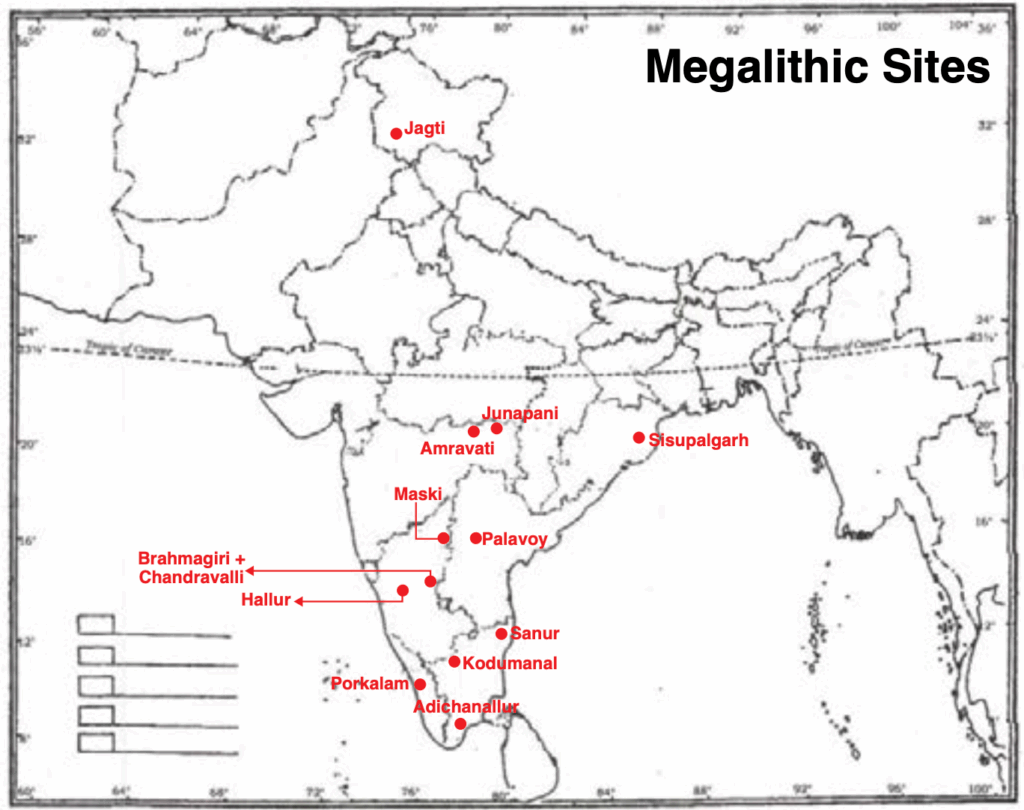
- Megalithic culture followed Neolithic culture.
- Certain features differentiate it from other Neolithic cultures:
- For example: people were not acquainted with agriculture and followed hunting and fishing economy.
- Settlement-Around 2700BC. People lived in mud plastered circular and oval pits with steps and ladders to get inside large pits, but in later period they started to live in houses built on ground level.
- Other important feature:
- Use of a large number of well-polished bone and stone tools.
- Large number of bone tools in form of harpoons, needles, arrowheads etc. is found.
- Human and animal burials found.
- Humans were buried both primarily and secondarily in pits, mostly dug into the house floors. In secondary burials skulls and long bones were preferred.
- Pet animals (e.g. dog) were buried along their masters.
- Dwelling pits and storage pits are found.
- Pottery:
- The early pottery:- crude and handmade.
- Later pottery:- wheel-made.
- Evidence of cultivated wheat, barley and lentil were found.
Jagti
- Location
- Situated near the Tawi River on the outer edge of the Shivalik hills, Jammu district, J&K.
- Chronology
- Belongs to the Iron Age Megalithic period.
- Significance
- One of the northernmost megalithic sites in India.
- A rare example of megalithic culture in the sub-Himalayan region, where such sites are uncommon.
- Burial Features
- Presence of stone circle burials and pit burials.
- Burials include urns with human bones and ashes, suggesting cremation and secondary burial practices.
- Material Culture
- Finds include:
- Red ware pottery
- Iron tools
- Beads
- Reflects iron technology, agriculture, and craft production.
- Finds include:
- Cultural Importance
- Demonstrates the spread of megalithic traditions beyond South India.
- Shows cultural parallels between the northwestern plains and the Deccan megalithic communities.
- Expands the geographical extent of Iron Age rituals in India.
Kakoria
- Varanasi district UP, near Hatania hills.
- Belong to pre – Iron age.
- Pottery- III- fired red pottery and black and red pottery.
- Megalith– Cist circle and Cairn circle exist, for both a pit was dug.
- Grave goods included pottery, beads, microliths
Banimilia-Banhera
- Mirzapur district,U.P.
- Belong to Pre -Iron age.
- Pottery– III fired dull red ware and BRW, over fired red ware.
- Megaliths-not associated with any pit. Cairn circle and Cairn chamber found.
- Only pottery formed the grave good.
Kotia
- On the right bank of Belan river, Allahabad.
- Period- around 400 BC.
- Pottery- BRW, red ware and dull grey ware of thick fabric.
- Megalith– Cist both unicameral and multicameral, Cairn cist and Cairn circle also found.
- Remains of domesticated animals found in Kotia megaliths.
Kuntitoli
- Ranchi,Jharkhand.
- Yielded evidence of a pit dug within larger pit, containing grave goods including pottery and personal ornaments.
- The whole pit was filled with earth and covered with capstone.
- Pottery- Plain red ware.
Nartiang
- Jaintia Hills, Meghalaya.
- Megaliths– Menhirs and Dolmens.
- Also, very large monoliths of 8 m in height found.
- Largest table stones are found.
Naikund
- Junapani is very near, Maharashtra
- Both habitation and burial site.
- Megalith-Stone circle burials.
- Grains-Barley, rice, lentil. Agricultural settlement.
- Iron hoes found which suggest local smelting of iron.
- Iron and copper artefacts found.
Junapani & Takalghat
- Location
- Situated in Nagpur district, Maharashtra.
- Part of the Vidarbha megalithic cultural zone.
- Chronology
- Dates to the Iron Age, approx. 1000 BCE to 300 BCE.
- Burial Features
- Megalithic stone circle burials.
- Over 150–300 stone circles found.
- Circles made of aligned stone pebbles or cairns.
- Urn or pit burials under stone circles.
- Some contain double urn burials.
- No cremation—indicates primary burial of the dead.
- Megalithic stone circle burials.
- Material Culture
- Iron objects: rings, chisels, horse-bits, flat axes.
- Pottery:
- Predominantly Black-and-Red Ware (BRW).
- Red pottery with graffiti.
- Bead making centre: semi-precious stone beads found.
- Animal bones and charcoal remains suggest funerary rituals.
- Astronomical Features
- Some cup-marked stones within circles.
- Believed by scholars to have astronomical alignments, possibly used for calendrical or ritual purposes (still debated).
- Cultural Significance
- Represents a regionally distinct megalithic tradition of central India.
- Indicates ritual complexity, funerary practices, and iron-working technology.
- Shows deep symbolism in space, death, and memory.
- Junapani is declared an ASI National Important Monument.
Dhanora
- In Durg district, Chattisgarh.
- Menhirs, cap stones, cairns circles found.
- Absence of any skeleton:– possibility of cremation.
Adichanallur
- Location
- In Thoothukudi (Tuticorin) district, Tamil Nadu.
- Situated on the right bank of the Tambraparani River.
- Lies in the southern coastal plains of India.
- Cultural Phase
- Early Iron Age Megalithic site.
- Dated between 905 BCE – 696 BCE (radiocarbon dating).
- Burial Practices
- Known for urn burials without any megalithic appendages.
- Over 160 burial urns discovered.
- Three-tier burial system identified.
- Skeletal remains found:
- Placed in crouched position inside the urns.
- Two examples of double burial discovered.
- Pottery
- Pottery types found:
- Black and Red Ware (BRW)
- Red Ware
- Black Ware
- Pottery features:
- Decorated with graffiti symbols.
- Some sherds contain writing in early Tamil-Brahmi script.
- Pottery types found:
- Metal and Craft Artifacts
- Iron objects recovered:
- Arrowheads
- Spearheads
- Axes
- Sword with rice husk and cloth impression.
- Bronze artifacts and copper ornaments found.
- Potter’s kiln discovered in habitation area, indicating industrial activity.
- Iron objects recovered:
- Economic Life
- Evidence of agriculture (e.g., rice husk remains).
- Evidence of craft production:
- Bead-making areas
- Metalwork
- Indications of fishing practices.
- Cultural and Historical Significance
- Presence of Tamil-Brahmi script suggests knowledge of writing before the Sangam period.
- Reflects social differentiation through grave goods.
- Shows cultural continuity between Megalithic and early historic periods.
- One of the few sites showing both ritual and everyday life in the same archaeological context.
Amaravati (Ancient Dhanyakataka)
- Location
- Located in Guntur district, Andhra Pradesh.
- Cultural Phases
- Site associated with:
- Megalithic culture
- Black-and-Red Ware (BRW)
- Northern Black Polished Ware (NBPW)
- Site associated with:
- Historical Significance
- Known as Dhanyakataka, capital of Satavahanas.
- Inscriptions in Mauryan Brahmi script found.
- Buddhist Significance
- Major center of Buddhism in ancient India.
- Home to a grand Buddhist Stupa and Mahachaityas:
- Made of marble and limestone.
- Carved panels depict stories of Buddha.
- Visited by Chinese traveler Hiuen Tsang in 7th century CE.
- Artistic Contribution
- Ancient School of Art:
- Flourished for nearly six centuries (c. 200 BCE – 400 CE).
- Initially patronized by Satavahanas, later by Ikshvakus.
- Features Buddhist sculptures with Greco-Roman influence.
- Ancient School of Art:
Amravati (Maharashtra)
- Location
- Located in Amravati district, Maharashtra.
- Part of the Vidarbha region in central India.
- Burial Practices
- Stone Circle Burials:
- Large stones arranged in circular pattern.
- Urn or pit burials found beneath circles.
- Some multiple burials with grave goods.
- Offerings include food vessels and weapons, indicating belief in afterlife.
- Stone Circle Burials:
- Material Culture
- Iron tools: axes, spearheads, sickles.
- Pottery: Black-and-Red Ware (BRW).
- Beads and occasional animal bones.
- Indicates knowledge of iron technology and rural crafts.
- Chronology
- Dated between 1000 BCE – 300 BCE.
- Belongs to the Iron Age Megalithic phase.
- Part of the Vidarbha Megalithic Culture in central India.
- Cultural Importance
- Provides insights into social and ritual life of Iron Age communities.
- Connects Deccan region with pan-Indian megalithic traditions.
Nagarjunakonda
- In Guntur district of A.P.
- Neolithic and Megalithic culture.
- Post holes found.
- Known as Vijaypuri- capital of the Ikshvaku kings.
- An extended skeleton of a female with ornaments of gold and silver found.
- Buddhist site:
- A centre of is Buddhism
- Named after Nagarjuna, a Buddhist philosopher.
- Maha Stupa, Chaitya, vihara etc found.
- The inscriptions show royal (by queen of Ikshvaku) and non-royals sponsership of construction of temples and monasteries.
- Inhabited by merchants and artisans organized in guilds.
Maski
- Location
- Located in the Raichur district, Karnataka, on the banks of the Maski River.
- Chronology
- Multi-period settlement with remains from:
- Neolithic–Chalcolithic period
- Megalithic period (c. 1000 BCE – 300 BCE)
- Early Historic period
- Multi-period settlement with remains from:
- Megalithic Features
- Burial Types:
- Cairn circles
- Pit burials
- Urn burials
- Menhirs (erected stones possibly for commemorative purposes)
- Burial Customs:
- Post-cremation deposits in some burials
- Stone alignments marking the burial spots
- Reflects varied funerary practices
- Burial Types:
- Material Culture
- Tools and Implements:
- Polished stone tools
- Microlithic blades
- Copper rod
- Iron tools (typical of Megalithic phase)
- Pottery:
- Red ware
- Black-and-Red Ware (BRW)
- Some pottery with incised designs
- Beads and Ornaments:
- Made of carnelian, agate, chalcedony, shell, coral, glass, and paste
- Animal Bones:
- Indicate use of domesticated and hunted animals
- Rock Paintings:
- Found at the site, adding to the artistic-cultural profile
- Tools and Implements:
- Subsistence Pattern
- Based on a mixed economy of:
- Agriculture
- Animal domestication
- Hunting
- Based on a mixed economy of:
- Ashokan Inscription
- Minor Rock Edict of Emperor Ashoka discovered
- First inscription to clearly mention the name “Devanampiya Asoka”
- Crucial for identifying the historical Ashoka with the epigraphic record
- Cultural Significance
- Shows long-term cultural continuity from Neolithic to Mauryan era
- Highlights the early development of iron technology, craft specialization, and ritual traditions
- Links prehistoric megalithic traditions with historic Mauryan polity
Hire Benakal
- Location
- Situated on a granite hilltop in the Hirehalla valley, Koppal district, Karnataka.
- very near near to Maski.
- Chronology
- Dated to 1200 BCE – 800 BCE.
- Belongs to the Megalithic Iron Age period.
- Significance
- Largest dolmen site in South India with over 400 megalithic dolmens.
- Considered one of the best-preserved necropolises of the Indian subcontinent.
- Burial Structures
- Dolmens constructed with large stone slabs arranged vertically and topped with a capstone.
- Shapes include rectangular and trapezoidal forms.
- Some dolmens have circular entrance holes, possibly symbolic of passage to the afterlife.
- Material Culture
- Black-and-Red Ware (BRW) pottery.
- Iron tools, stone axes, beads found in and around the site.
- Evidence points to an iron-using pastoral and agrarian community.
- Religious and Cultural Importance
- The large scale and precision of the dolmens suggest ritual or ceremonial significance.
- Likely used for ancestor worship or as status memorials for elite individuals.
Palavoy
- Location:
- Located in Anantapur District, Andhra Pradesh
- Situated near the foothills of the Nallamala range, in the Rayalaseema region of the Deccan Plateau
- Chronology:
- Iron Age megalithic tradition
- Dated approximately between 1000 BCE and 300 BCE
- Megalithic Burial Types:
- Cairn circles
- Dolmens (some with portholes in front slabs, symbolizing passage to the afterlife)
- Pit burials
- Burial Architecture:
- Constructed using large granite boulders
- Stone circles and cairns built over burial pits
- Material Culture:
- Iron implements
- Pottery: Black-and-red ware (BRW) and red slipped pottery
- Spindle whorls
- Terracotta figurines
- Society and Belief System:
- Inclusion of grave goods indicates ritualized death practices
- Evidence of ancestor worship and status differentiation
- Cultural Significance:
- Demonstrates regional variation within South Indian megalithic culture
- Reflects how local environment and materials shaped burial practices and rural social organization
Veerapuram
- Kurnool district, A. P.
- BRW and other pottery, iron objects like sickle, rings, knives found.
- Beads of various sizes also recovered.
- Crops- Barley, rice, horse gram, black gram etc
- Period- 1000 B.C to 300 B.C.
- Cist burial.
Brahmagiri
- Location
- Situated in Chitradurga district, Karnataka, near the Brahmagiri hill range.
- Cultural Phases
- A multi-period settlement:
- Neolithic–Chalcolithic phase
- Megalithic phase (c. 1000 BCE – 300 BCE)
- Early historic period
- A multi-period settlement:
- Habitation Features
- Wattle-and-daub huts with post holes.
- Polished stone tools and microlithic blades used in early phases.
- Handmade grey pottery found in Neolithic phase.
- Megalithic Features
- Presence of stone cist burials and dolmens.
- Some dolmens marked by stone circles.
- Extended burials for adults and urn burials for children.
- Grave Goods and Tools
- Iron tools: swords, sickles, arrowheads.
- Pottery: Black-and-Red Ware (BRW).
- Beads and animal remains found in burials.
- Indicates practice of iron-based farming, hunting, and rituals.
- Religious and Social Life
- Careful placement of grave goods implies ritual beliefs and concept of afterlife.
- Variation in grave items suggests social stratification.
- Economic Activities
- Evidence of agriculture and domestication of animals.
- Use of draft animals for agrarian purposes.
- Later Period Finds
- Copper–bronze objects in the later historic levels.
- Presence of Ashokan edicts, marking the southernmost extent of the Mauryan Empire.
- Cultural and Archaeological Significance
- Excavated by Mortimer Wheeler in 1947.
- One of the earliest scientifically studied megalithic sites in India.
- Key site for establishing the chronological framework of South India’s Iron Age.
Hallur
- Location
- Situated on the banks of the Tungabhadra River, Haveri district, Karnataka.
- Cultural Phases
- Neolithic–Chalcolithic to Megalithic transition site.
- Represents early Iron Age culture in South India.
- Chronological Significance
- Among the earliest sites in South India to show use of iron (c. 1000 BCE).
- Iron use also reported from Piklihal and Hallur.
- Habitation
- Circular floors made of stone chips and river sand.
- Wattle and daub huts with post holes.
- A house found with circular fireplace, ash, and charcoal.
- Material Culture
- Iron tools: sickles, arrowheads, ploughshares.
- Chalcolithic tools: copper axes, fish hooks, blade tools.
- Polished stone tools and microlithic blades.
- Ornaments made of carnelian, ceramic, and gold.
- Pottery:
- Early phase: Handmade grey ware.
- Later phase: Wheel-made Black-and-Red Ware (BRW) and painted ceramics.
- Burial Practices
- Double urn burials and extended inhumations.
- Grave goods suggest ritualized funerary practices and possible social hierarchy.
- Agriculture and Herding
- Cultivated crops: millet, horsegram, green gram.
- Domesticated animals: cattle, sheep, goat, and horse.
- Presence of ash-mounds, indicating early agricultural activities.
- Cultural Importance
- Shows continuity from Neolithic to Iron Age without major disruption.
- Indicates adoption of metallurgy, agro-pastoral economy, and evolving ritual systems.
Chandravalli
- Location
- Situated in Chitradurga district, Karnataka.
- Located in a valley surrounded by low granite hills.
- Cultural Phases
- A multi-period site:
- Neolithic
- Megalithic (c. 1000 BCE – 300 BCE)
- Early historic period
- A multi-period site:
- Megalithic Features
- Presence of:
- Dolmenoid cists
- Pit burials
- Stone circles
- Burials often contained human skeletons in stone-lined chambers with grave goods.
- Presence of:
- Material Culture
- Iron tools such as swords and sickles.
- Pottery types:
- Black-and-Red Ware (BRW)
- Red slipped ware
- Beads and semi-precious stones indicating craft production and trade.
- Ritual and Belief Systems
- Presence of grave offerings indicates belief in afterlife and ancestral rituals.
- Historical Importance
- Roman coins found in later layers.
- Continued occupation into early historic period.
- Indicates long-distance trade connections.
Jadigenahalli
- Bangalore Rural district in Karnataka
Paiyampalli
- In Vellore district, Tamilnadu.
- Neolithic & Megalithic settlements.
- The habitation — cum burial site.
- Absence of bone tools.
- Huts with floors levelled with stone chips and plastered.
- Agriculture:
- Cereals and pulses.
- Charred grains of horse gram and green gram found.
- The megalithic pottery:
- Thin, coarse red ware painted.
- BRW, all black ware and the red ware found.
- Metallurgy:
- Smelted iron
- Produced tools and weapons locally.
T. Narsipur
- In Mysore district, Karnataka.
- Neolithic and Megalithic culture.
- Copper tools, celts, rods, chisel,
- Gold ornaments (also in Hallur)
- Pot burials.
- Skeletons without ankles.
- Post holes.
Sanur
- Location:
- Situated in Kanchipuram district (formerly Chingleput), near the eastern coastal plains of Tamil Nadu
- Chronology:
- Dated to approximately 1000 BCE to 300 BCE
- Type of Megaliths:
- Cist burials, stone circles, and rock-cut chambers
- Dolmenised cists also present
- Some burials marked by stone circles above ground
- Funerary Features:
- Underground chambers built with large stone slabs
- Circular disk with hole in the centre (possibly ritual or structural use)
- Animal bones along with human remains found
- Material Culture:
- Iron objects: weapons, tools, horse bits, and a distinctive bar-bit of iron
- Pottery: Mainly black-and-red ware (BRW)
- Beads and occasional copper ornaments
- Cultural Insights:
- Reflects ritual burial practices, metalworking, and early agro-pastoral economy
- Part of the broader Tamil Nadu Iron Age Megalithic tradition
Pazhayannur (Porkulam)
- In Thrissur district, Kerala.
Sittanavasal
- In Pudukkottai district, Tamilnadu.
- Meghalithic and Jain Cave site.
- Burials:
- Stone circles,
- Cist burials
- urn burials,
- Pottery, glass manufacturing site, iron objects,
- Sittanavasal Cave is a Jain caves with painting and sculptures.
- Temple-cave dated to Pallava King Mahendravarman I (580–630 AD).
- Painting:
- Mural painting
- Fresco-secco technique
- Painting depicts:
- lotus pond with lotus flowers,
- people collecting lotuses from the pond,
- dancing figures,
- fish, buffaloes, elephants etc.
Kodumanal
- Kodumanal is located in Erode district of Tamil Nadu.
- Chronology
- Occupied during the Iron Age and Early Historic period.
- Dated roughly from 500 BCE to 300 CE.
- Nature of Site
- A unique megalithic-cum-industrial settlement.
- Functioned as both a burial site and an industrial-craft production center.
- Megalithic Burials
- Types of burials found:
- Stone cairn circles
- Urn burials
- Cist graves
- Burials often contained personal belongings, reflecting:
- Belief in afterlife
- Social status differentiation through grave goods
- Types of burials found:
- Material Culture
- Iron tools and furnaces: indicate iron smelting activities.
- Bead-making industry:
- Semi-precious stones (agate, carnelian)
- Evidence of unfinished beads and tools for polishing
- Pottery types:
- Black-and-Red Ware (BRW)
- Russet-Coated Painted Ware (RCPW)
- Roman coins and Mediterranean-style beads:
- Show strong trade contacts with the Roman world
- Trade and Urban Links
- Likely connected to the Muziris port on the Malabar coast.
- Was part of the Indo-Roman trade network during the early historic period.
- Cultural Significance
- Demonstrates a transitional culture:
- From megalithic funerary traditions to urban-industrial economy
- Reflects integration of:
- Craft production
- Long-distance trade
- Ritual and burial customs
- A key site for understanding early Tamilakam’s cultural evolution.
- Demonstrates a transitional culture:
Mangadu
- In Kollam district, Kerala.
- (Write general stuffs about Meghalithic sites)
Porkalam
- Location:
- Situated in Thrissur district, Kerala
- Part of the Malabar megalithic tradition
- Chronology:
- Dated to around 1000 BCE to 500 BCE
- Excavated by B.K. Thapar in 1948
- Types of Megaliths:
- Urn burials
- Stone circle graves
- Cist burials
- Rock-cut laterite chambers (often below ground level, used for secondary burials)
- Funerary rock-cut caves with central pillar
- Menhirs
- Material Culture:
- Pottery: Black-and-red ware, earthen pots, ceramic jars
- Iron tools: Indicating advanced metalworking
- Beads and decorated pearls
- Human remains found in burial chambers
- Ritual and Cultural Life:
- Variety of burial types and careful grave placement reflect:
- Complex beliefs about death
- Ancestor worship
- Possible social stratification or status recognition
- Variety of burial types and careful grave placement reflect:
Sisupalgarh (Khurda district, Odisha)
- Location:
- Situated in Khurda district of Odisha, near the Chilika Lake on the coastal plain.
- Chronology:
- Occupied from the Iron Age into the early historic period, approximately 500 BCE to 400 CE.
- Nature of the Site:
- Both a Megalithic burial site and an early historic urban settlement.
- Considered one of the earliest planned urban centres in eastern India.
- Burial and Urban Features:
- Megalithic urn burials found on the outskirts of the settlement.
- Fortified urban core with:
- Massive mud fortification walls
- Well-planned streets
- Grid-like town layout with streets intersecting at right angles
- Four gateways on cardinal directions
- Material Culture:
- Black-and-red ware pottery
- Punch-marked coins
- Iron implements
- Terracotta figurines
- Roman amphorae fragments, indicating long-distance trade
- Cultural and Urban Significance:
- Reflects coexistence of ritual burial customs and early urban institutions
- Demonstrates a high degree of civic organization and planning, rare in Iron Age Indian contexts





I am very thankful for this freely available resources 🙏 🙏.