

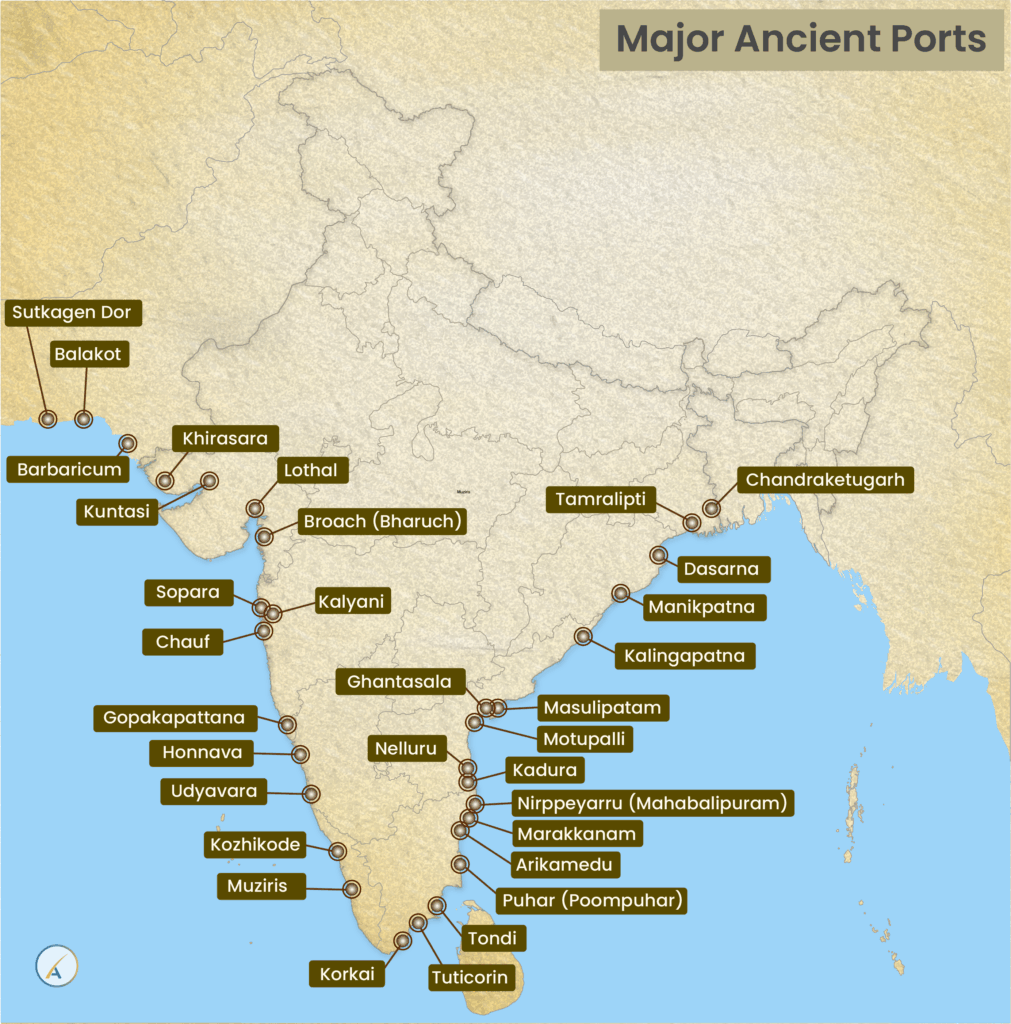
Bhagatrav

- Location: Bharuch district, Gujarat.
- Cultural Phase: Site of the Indus Valley Civilization (IVC).
- Significance:
- Functioned as an important port or trading outpost during the Harappan period.
- Strategically located near the estuary of Narmada River, enabling maritime and inland trade.
- Archaeological Evidences:
- Presence of typical Harappan pottery, beads, and other artefacts.
- Discovery of terracotta figurines, bangles, and seals suggesting interaction with core Harappan centres.
- Environmental Factor:
- Evidence of flood deposits suggests that flooding led to the decline or abandonment of the settlement.
- Cultural Context:
- Likely acted as a satellite or feeder port for larger Harappan urban centres like Lothal or Dholavira.
Bhrigukachha / Bharukachchha (Bharuch)
- Location: Bharuch district, Gujarat; situated at the mouth of the Narmada River, flowing into the Gulf of Khambhat.
- Historical Importance:
- One of the earliest and most prominent sea ports of ancient India, active since the 6th century BCE.
- Known to Greeks, Romans, Persians, and Arabs as Barygaza.
- Played a vital role in land-sea trade routes, using monsoon winds for navigation.
- Economic Role:
- Served as a major shipbuilding centre in ancient India.
- Functioned as a terminus for goods coming from the Far East, facilitating transshipment to western markets.
- Arab traders used this port to enter Gujarat.
- The British and Dutch established their commercial outposts here during the colonial period.
- Trade and Commerce:
- Exports:
- Cotton textiles, spices, ivory, gemstones.
- Imports:
- Roman silverware, Mediterranean wines, glassware, perfumes.
- The port was integrated into the global maritime trade network, linking India to:
- Mediterranean, West Asia, Africa, and Southeast Asia.
- Exports:
- Cultural and Political Continuity:
- Controlled by successive rulers including:
- Indo-Scythian Kshatrapas, Guptas, Gurjara-Pratiharas, Mughals, and later the British.
- Despite political shifts, its identity remained closely tied to ancient port culture and international trade.
- Controlled by successive rulers including:
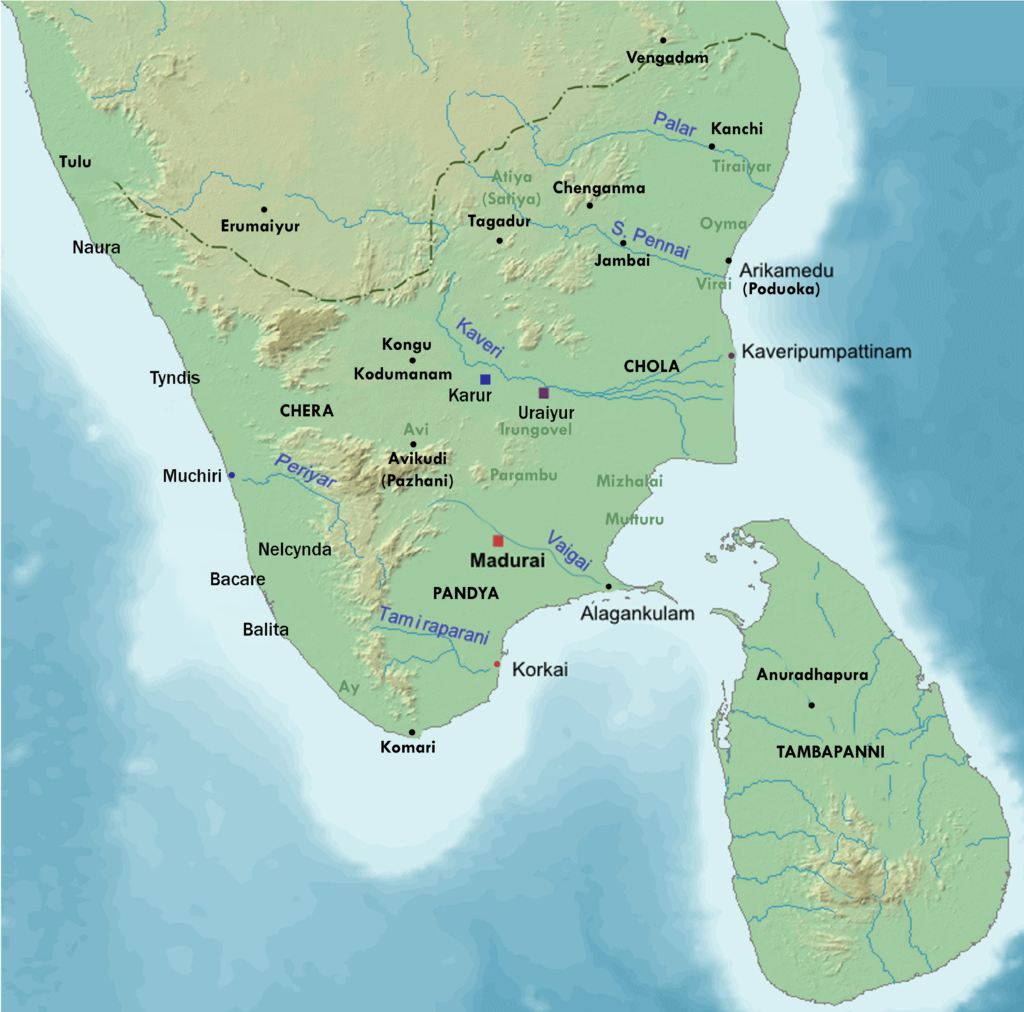
Muziris
- Location: Pattanam–Kodungallur area in Ernakulam and Thrissur districts, Kerala; on the Periyar River, near the Arabian Sea coast.
- Historical Identity:
- Ancient port of the Chera Kingdom during the Sangam Age.
- Referred to in ancient texts as Muciripattanam or Poduke.
- Mentioned in Sangam literature, Greek and Roman sources like Pliny the Elder and Periplus of the Erythraean Sea.
- Described by Pliny as the first emporium of India and featured on Roman maps.
- Trade Significance:
- A key centre of Indo-Roman trade (1st century BCE – 5th century CE).
- Exports: Black pepper, spices, ivory, muslin, semi-precious stones, pearls, sapphires, diamonds, tortoise shells.
- Imports: Roman gold coins, figured linens, copper, tin, lead, coral, raw glass, wine, and other luxury goods.
- Acted as a trade hub between South India and Rome, Greece, Arabia, and West Asia.
- Archaeological Discoveries at Pattanam:
- Roman amphorae, West Asian and Sassanian pottery, glass beads, metal coins.
- Structural remains like wharf, warehouse areas, and a wooden boat, indicating vibrant port activity.
- Signifies a thriving maritime community with overseas connections.
- Cultural and Religious Diversity:
- Long settlement continuity from Megalithic to Medieval periods.
- Presence of temples, mosques, and Jewish synagogues in nearby Kodungallur, highlighting religious plurality.
- Decline:
- Muziris port declined after the 1341 CE flood, which changed the course of the Periyar River and caused siltation, rendering the harbour defunct.
- Modern Recognition:
- The Muziris Heritage Project launched by the Kerala government aims to preserve and promote the ancient legacy of Muziris through archaeological conservation and cultural tourism.
Puhar/ Pumpuhar/ Kaveripattinam (Lost Port)
- Location:
- In Nagapattinam district, Tamil Nadu.
- Situated near the estuary of the Kaveri River, on the Bay of Bengal coast.
- Historical Identity:
- Known as Puhar in Sangam literature.
- Served as the capital of early Chola kings during the Sangam Age.
- Referred to in classical texts like Pattinappalai, Silappadikaram, and the Periplus of the Erythraean Sea.
- Trade and Maritime Importance:
- Functioned as a major sea port and international trade hub during the Sangam period.
- Connected Tamilakam with Sri Lanka, Southeast Asia, and the Roman Empire.
- Exports: Spices, pearls, precious stones, fine textiles.
- Imports: Gold, horses, wine, Roman amphorae.
- Archaeological Findings:
- Remains of brick wharves, ring wells, warehouses, and urban roads.
- Fragments of Roman amphorae indicate Indo-Roman trade.
- Drainage systems, residential quarters, and ancient pottery highlight advanced urban planning.
- Medieval Chola coins show continuity of port activity into later periods.
- Cultural and Literary Significance:
- Celebrated in Tamil epics and Sangam texts as a cosmopolitan port city.
- Known for blending urban sophistication with maritime trade excellence.
- Contributed to the spread of Tamil culture across the Indian Ocean.
- Decline:
- Believed to have been submerged by the sea, possibly due to tsunami or coastal erosion.
- Submergence likely occurred during the early medieval period, marking the end of its prominence.
Arikamedu/ Poduka
- Location:
- Near Puducherry, about 4 km south of the present city, on the Bay of Bengal coast.
- Historical Identity:
- Known as Poduka in the Periplus of the Erythraean Sea.
- Functioned as a Sangam Age port under the Early Cholas.
- Active from 2nd century BCE to 7th century CE.
- Role in Indo-Roman Trade:
- A major Indo-Roman maritime trade centre.
- Exported beads, textiles, semi-precious stones.
- Imported goods included Roman wine, luxury items, and ceramics.
- Roman artifacts found:
- Amphorae bearing potters’ marks.
- Arretine ware, Rouletted ware.
- Roman lamps, glassware, and gems.
- Roman gold coins, evidencing that India received gold in return for its exports.
- Craft and Industrial Activities:
- Major centre for bead-making, glass production, and textile dyeing.
- Indo-Pacific beads and semi-precious stone beads indicate high-volume export-based industry.
- Archaeological evidence of workshops and kilns.
- Cultural and Archaeological Significance:
- Continuous habitation across Megalithic, Sangam, and early medieval periods.
- Tamil-Brahmi inscriptions and structural remains show an urban and literate society.
- Excavated by Mortimer Wheeler and subsequent archaeologists.
Tamralipti
- Location:
- Situated in Tamluk, near the confluence of the Rupnarayan and Hooghly rivers in Purba Medinipur district, West Bengal.
- Close to the Bay of Bengal, at the eastern end of the Gangetic trade route.
- Historical Significance:
- Functioned as the principal eastern seaport of ancient India.
- Flourished from the Mauryan period to the Gupta era.
- Mentioned in:
- Periplus of the Erythraean Sea.
- Accounts of Fa-Hien and Hiuen Tsang.
- Trade and Connectivity:
- Connected by land and river to Taxila, and by sea to Southeast Asia and Sri Lanka.
- Key player in the maritime Silk Route.
- Traded:
- Exports: Textiles, spices, metals.
- Imports: Luxury goods including Roman items.
- Religious and Cultural Role:
- Associated with Buddhism.
- Tradition holds Ashoka’s children, Mahendra and Sanghamitra, departed from here to spread Buddhism to Sri Lanka.
- Associated with Buddhism.
- Archaeological Findings:
- Antiquities from the Chalcolithic period and NBPW phase.
- Rouletted ware and Red polished ware of Roman origin — evidence of Roman contact.
- Terracotta figurines, coins, semi-precious stone beads, and brick structures — indicating urban character.
- Seals and stamped pottery also found.
- Historical Importance:
- Highlights the economic and religious vitality of coastal Bengal.
- Illustrates the role of riverine-maritime integration in fostering long-distance trade and cultural exchange across Asia.
Lothal
- In Ahmedabad district, Gujarat
- During pre harappan: It was a small village.
- Centre of harbour, cotton and rice-growing and bead-making industry.
- City divided into a citadel and a lower town.
- The constructions were made of fire dried bricks, lime and sand mortar. The remains of the city give evidence to a sophisticated drainage system.
- Important findings:
- Dockyard,
- Persian Gulf Seals,
- Shell ornaments maker’s shop,
- Bead maker’s shop,
- Metal worker’s shop,
- Fire altars,
- terracotta figurine of house,
- warehouse,
- merchant house,
- impression of cloth on some of the sealing,
- twelve bathrooms in the citadel area.
- An ivory scale:- smallest-known decimal divisions in Indus civilisation.
- connected to other cities through river route.
- A coastal trade route had existed linking sites such as Lothal and Dholavira to Sutkagan Dor on the Makran coast.
Later Harappan culture:
- Continued to be inhabited,
- Much smaller population
- Devoid of urban influences.
- Trade and resources of the city were almost gone,
- The people retained several Harappan ways in writing, pottery and utensils.
Sopara (Surparaka)
- Location:
- Located in Palghar district, Maharashtra.
- Situated on the Arabian Sea coast, identified with ancient Supara in Puranas and foreign texts.
- Historical Significance:
- Known to Ptolemy and the author of the Periplus of the Erythraean Sea.
- Important Satavahana-era seaport, active from around the 3rd century BCE to 5th century CE.
- A major rock edict of Ashoka was discovered here, affirming its political and cultural relevance.
- Trade and Economic Activities:
- Functioned as a seaport and international trade centre.
- Connected with Roman Egypt, Persia, and Southeast Asia.
- Major export hub for western-bound goods.
- Known for artisanal production, especially:
- Swords, leather goods, shoes, etc., which were in high demand in the western world.
- Archaeological Findings:
- Brick wharves, warehouses, and stone anchors indicate port infrastructure.
- Coins of Indian rulers and foreign origins, Brahmi inscriptions, Roman and Indian pottery, and glass beads have been discovered.
- Relics of a Buddhist stupa and Ajivika memorial stones found.
- Cultural and Religious Importance:
- A centre of religious plurality.
- Remains linked to Buddhism, Ajivikas, and Hinduism suggest a cosmopolitan religious environment.
- The coexistence of different faiths reflects maritime-driven cultural interactions.
- A centre of religious plurality.
Masulipatnam (Machilipatnam)
- In Krishna district, Andhra Pradesh.
- Existed during Satavahana period.
- Mentioned by Ptolemy, The Periplus of the Erythraean Sea
- Muslin was traded by ancient Greeks from the town
- Served as the settlement of European traders : English and Dutch
Mamallapuram
- In Kancheepuram district, Tamil Nadu.
- Developed by the Pallava King Narsimhavarman Mamalla and Rajasimhavarman in the 7 century AD.
- Cave temples, monolithic rathas, sculpted reliefs and structural temples built.
- UNESCO World Heritage Site.
- Famous monuments:
- Descent of the Ganges – a giant open-air rock relief
- Pancha Rathas (Five Chariots) –
- Of the nine monolithic temples found in Mahabalipuram, the most important are Five Rathas known after the famous five Pandava brothers of the Mahabharata fame.
- Each of these is carved from one single large piece of granite stone.
- Shore Temple, a structural temple along the Bay of Bengal with the entrance from the western side away from the sea.
- Pallavas used the port to launch trade and diplomatic missions to Sri Lanka and Southeast Asia.
Korkai
- In Tirunelveli district, near the mouth of the Vaigai,.
- Early capital of Early Pandya.
- Pandya port, celebrated for its pearls in Sangam poems and Greek accounts.
- Important pearl fishing centre- excavation evidence and mentioned in The Arthashastra
- BRW and locally made rouletted ware with Brahmi letters belonging to c. 200 BCE–200 CE.





Thank you 😊