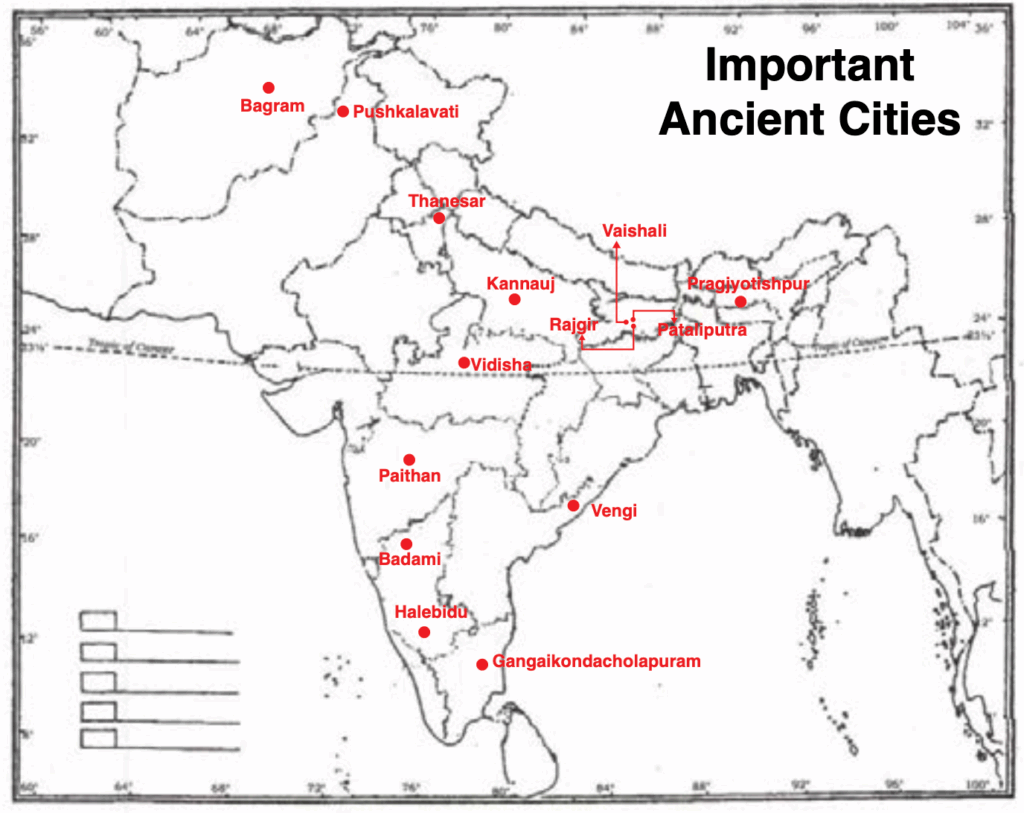
Purushpura

- Modern Peshawar in NWF province of Pakistan.
- Capital of Kushana ruler Kanishka (2 century AD).
- Kushana period:
- Sculptures,
- Buddhist stupa,
- Buddhist Chaitya.
- Trade centre as it lied on old silk route..
- Centre of Buddhist learning.
- Mentioned by Chinese pilgrim Faxian and Xuanzang.
Taxila
- In Rawalpindi district, Pakistan.
- Ancient political, commercial and cultural centre.
- Commercial centre:
- At junction of 3 major trade routes: West Asia, northern India and Central Asia.
- Centre of artisanal production.
- Centre of education:
- Amongst the earliest universities.
- Many do not consider it a university as:
- teachers did not have official membership of particular colleges, and
- there was no purpose-built lecture halls and residential quarters, like Nalanda University.
- Charaka, Chanakya, Jivaka, Panini etc are related to Taxila University.
- Political centre:
- Capital of Gandhara satrapy, under Achaemenian.
- Alexander received submission of ruler of Taxila, Ambhi.
- Taxila became a provincial capital of Mauryas.
- Capital of Indo-Parthian Kingdom, and one of the capitals of Kushanas.
- The Chinese pilgrims Fa Hian (5 century) and Hieun Tsang (7 century) visited Taxila. In ruin during Huen Tsang.
Sagala/ Sakala/ Sialkot
- In Sialkot, West Punjab of Pakistan.
- Ancient name:- Sakala.
- Greek historical texts mention it.
- Greek historians state that it was productive Silk regions of the Achaemenid Empire.
- This was the capital of the Indo-Greek king Menander in 2 century BCE. During his reign it was centre of Buddhism.
- Trading centre.
- Greek coins, ancient Zoroastrian temples and Buddhist Stupas found.
- Later Muhammad Ghouri established a fortress in 1181 AD.
Parihaspura
- Established by Lalitaditya Muktapida of Karkota dynasty in 8th century AD, one of the greatest monarchs who ever ruled Kashmir.
- The great monarch founded his capital at Parihaspura and built numerous temples of Vishnu, Shiva and Buddha.
- He built agraharas viharas, and palaces at and around Parihaspura. According to Kalhana, a silver image of Vishnu was installed in the Govardanahara temple at Parihaspura.
- Was an important cultural and trade centre during Lalitaditya reign, but after his death the city lost
its glory.
Avantipur/ Awantipora
- In Pulwama district, Jammu & Kashmir.
- Kalhana’s Rajatarangini:
- Temples dedicated to Shiva and Vishnu:- built by King Awantivarman (AD 855- 883) of Utpala dynasty when he chose the site as his capital.
- Avantishvara temple:
- Dedicated to lord shiva.
- Built by Avantivarman.
- Panchayatana type.
- Gateway is double chambered.
- Devoid of any ornamentation.
- Main sanctum is raised on a high platform.
- The ruins of temples constructed by Lalitaditya of Karkota dynasty located here.
Sisupalgarh
- In Khurda disctrict, Odisha.
- A ruined fortification.
- One of the largest and preserved early historic fortifications in India.
- Probably represents Tosali mentioned in the edicts of Ashoka at Dhauli.
- Also identified by some scholars with Kalinganagara noted as the capital of the king Kharvela in Hathigumpha inscription at Udayagiri cave.
- Antiquities which give urban touch include
- plenty of iron objects,
- bangles of glass and ivory,
- semi-precious stones,
- coin-mould.
- Rouletted ware associated with the Romans and the lockets imitating the Roman coins suggests trade contacts with the foreign countries.
Sirpur(Political and Cultural centre)
- On the banks of river Mahanadi, Chhattisgarh.
- Once the capital of Somavanashi dynasty.
- Has a rich background of traditional cultural heritage and architecture.
- The Laxman temple dedicated to Vishnu, Gandheswar temple dedicated to Shiva, Buddha viharas, 1 Jain vihara, monolithic statue of Buddha and Mahavir, a 6th century Ayurvedic Snaan Kund etc are important architectural creations.
- Important Buddhist centre from 6th- 10th century A.D and Hieun-Tsang visited this place.
- The devastating earthquake of 12th century destroyed this city.
Viratnagar (Bairat)
- Near Jaipur in Rajasthan.
- Capital of the Mahajanapada of Machcha or Matsya.
- Later became part of the Mauryan Empire.
- Artefacts:
- Ruins of Buddhist monastery,
- a wood and timber shrine, and
- rock-cut edict of Emperor Ashoka.
- Buddhist Chaitya here is considered as the earliest free standing religious building.
Mathura
- In Mathura district, UP.
- Centre of craft and trade.
- Textile
- Junction of trade route: Uttarpatha and dakshinapatha.
- Religious centre:
- Buddhism,
- Jainism, and
- early Hinduism.
- Southern capital of the Kushana/
- Mathura School of Arts under the patronage of the Kushanas.
- BRW, PGW, NBPW
- At Sonkh, near Mathura, PGW, BRW and grey ware found.
- Post-holes and a double ditch.
- Beginnings of urbanization during Kushana period.
- NBPW: Coins came and specialized crafts such as the manufacture of terracotta figurines, copper and iron working, and bead making.
Ahichchhatra
- In Bareilly district, Uttar Pradesh.
- Capital of Northern Panchala, Mahajanapada.
- A brick fortification excavated.
- PGW was first identified at Ahichchhatra.
- PGW was followed by NBPW Period.
- Panchala and Kushana coins have been found here.
Kampilya
- In Farukhabad district, UP.
- Capital of south Panchala, Mahajanapada.
- Occupation from the PGW phase onwards.
- Structural remains at PGW levels: wattle-and-daub and mud huts.
Kanyakubja/ Kannauj
- Location:
- Situated on the banks of the Ganga River in Kannauj district, Uttar Pradesh, it occupied a strategic position in the Gangetic plains, making it a vital centre of power and culture.
- Political Importance:
- Known in ancient texts as Kanyakubja, it served as the capital of multiple dynasties including the Maukharis, Pushyabhuti dynasty under Harshavardhana, Gurjara-Pratiharas, and later Rashtrakutas.
- In the 7th century CE, Harshavardhana made Kannauj his imperial capital, uniting much of northern India under his rule.
- After Harsha’s death, the city became the epicentre of the Tripartite Struggle (8th–10th century CE) between the Palas, Gurjara-Pratiharas, and Rashtrakutas, each vying for control of this resource-rich and strategically crucial region.
- Cultural and Diplomatic Significance:
- Described by Xuanzang (Hiuen Tsang) as a flourishing, prosperous metropolis with numerous Buddhist monasteries, Hindu temples, gardens, and bustling markets.
- It was an intellectual and religious hub during Harsha’s reign, hosting scholars, envoys, and pilgrims.
- Visited by Chinese pilgrims Faxian and Xuanzang, affirming its importance in international Buddhist networks.
- Urban and Architectural Heritage:
- Although much of its ancient grandeur has vanished, archaeological evidence—such as terracotta plaques, inscriptions, structural remains, and coins—points to a well-planned city with monumental architecture and civic infrastructure.
- Later Historical Events:
- During the late 12th century, Kannauj was ruled by Raja Jaichandra of the Gahadavala dynasty, a rival of Prithviraj Chauhan, around the time of Muhammad Ghori’s invasions.
- In the Battle of Kannauj (1540 CE), Sher Shah Suri decisively defeated Mughal emperor Humayun, leading to the rise of the Sur Empire.
- Legacy:
- Though it lost political prominence, Kannauj remains celebrated for its ancient perfume industry—famous for the production of “ittar” (natural fragrances), a craft that continues to thrive.
- Its rich history reflects a blend of political power, cultural vitality, religious pluralism, and enduring artisanal traditions.
Shravasti
- In Shravasti district, U.P.
- Centre of Buddhists and Jainas.
- Capital of the Kosala Mahajanapada during 6 century BC.
- On the northern trade routes.
- Many ancient idols, inscriptions, stupas and viharas were found.
- Birthplace of the Tirthankara Sambhavanath in Jainism.
- The Chinese Pilgrim Xuanzang found the city in ruins.
- PGW and NBPW site.
- Structural remains at PGW levels: wattle-and-daub and mud huts.
Kaushambi
- In Kashambi district, Uttar Pradesh.
- Capital of Vatsa, a Mahajanapada of the 6 century B.C.
- Ashokan Pillars found here.
- Centre of trade.
- Chinese pilgrim Hieun Tsang visited.
- Excavations reveal settlements dating back to 2 millinum B.C.
- PGW pottery, trace of iron etc pointing to a later Vedic settlement.
Varanasi/ Banaras
- In Varanasi district, Uttar Pradesh.
- Related to Hinduim, Buddhism and Jainism.
- Varanasi:- Capital of Kashi Mahajanapada in 6th Century BC.
- Center of education for Hindus, Buddhism and Jainism.
- Teaching of Vedas, the Upanishads etc. in the ashrams.
- Nearby Deer Park at Sarnath, Buddha delivered his first sermon.
- Chinese Pilgrim Hieun Tsang visited and attested the city as a centre of religious and artistic activities.
- Parshvanath Jain temple located here.
- In medieval times, several Bhakti saints (Kabir, Ravidas, Tulsidas) were related to Varanasi.
- One of the 12 Jyotirlinga sites:- Kasi Vishwanath temple.
- Related to salvation of Hindus.
- Banaras Gharana of Hindustani Classical Music developed.
Kusinagar
- In Deoria district, Uttar Pradesh.
- Capital of the Mallas Mahajanapadas.
- Buddhist Pilgrim place because Buddha passed away here in 483 BC.
- Ashoka has visited and built a stupa.
- Chinese pilgrim Hieun Tsang visited.
- Artifacts and structures related to all sects of Buddhism found.
Patlaliputra
- Location:
- Situated in Patna district, Bihar, at the confluence of the Ganga, Son, and Gandak rivers, forming a natural “jaldurga” (water fort).
- Its location provided strategic advantages for defense, communication, and control of riverine trade routes across the Indo-Gangetic plains.
- Political Significance:
- Originally established as a fortified outpost called Pataligrama, it became the imperial capital under Ajatashatru and later under Udayin in the 5th century BCE.
- It served as the capital of several major dynasties—Nandas, Mauryas, Shungas, Guptas, and Palas—making it one of India’s longest-serving political capitals.
- Later renamed Patna by Sher Shah Suri, who also made it his capital.
- Urban Planning and Architecture:
- Described by Megasthenes in Indica as a grand, rectangular, wood-fortified city with 570 towers and 64 gates.
- Excavations at Kumrahar have revealed:
- 80-pillared hall, brick structures, wooden trusses, drainage systems, and punch-marked coins, reflecting sophisticated urban planning and statecraft.
- Centre of Learning and Religion:
- Flourished as a major intellectual and religious centre during the Mauryan and Gupta periods.
- Home to scholars like Chanakya (Kautilya) and Aryabhata, and an important site for Buddhist and Jain councils:
- Third Buddhist Council held here during Ashoka’s reign.
- First Jain Council was also convened in the city.
- Cultural and Diplomatic Hub:
- Visited by foreign emissaries and pilgrims:
- Megasthenes, the Greek ambassador at Chandragupta Maurya’s court, documented city life and administration.
- Fa-Hien (Faxian) in Gupta era and Xuanzang (Hiuen Tsang) in the 7th century described it as a prominent but partly ruined city.
- Attracted merchants, scholars, monks, and artisans, reflecting its diverse and urbanized character.
- Visited by foreign emissaries and pilgrims:
Vaishali
- Location:
- Located in Vaishali district, Bihar, near the Gandak River.
- Political Significance:
- Served as the capital of the Vajji Confederacy (Vrijji Mahajanapada) during the 6th century BCE.
- The Licchavis, one of the key clans of this oligarchic republic (ganasangha), ruled from Vaishali.
- Considered one of the earliest examples of republican governance in ancient India.
- Buddhist Significance:
- Gautama Buddha delivered several sermons here.
- He announced his approaching Mahaparinirvana in Vaishali.
- The Second Buddhist Council (383 BCE) was convened here under King Kalasoka.
- Visited by Faxian (4th century CE) and Xuanzang (7th century CE), who described its Buddhist heritage.
- Amrapali, a renowned courtesan of Vaishali, is said to have become a disciple of the Buddha and appears in many Buddhist stories.
- Jain Heritage:
- Birthplace of Lord Mahavira, the 24th Jain Tirthankara, in 599 BCE, in Kundagrama, a suburb of ancient Vaishali.
- Vaishali was an important centre of Jainism and home to a flourishing Jain community.
- Architectural and Archaeological Remains:
- Excavations have revealed:
- A Buddhist stupa,
- Ashokan pillar topped by a single lion capital,
- Monastery ruins and brick stupas,
- Traces of urban planning and religious structures.
- Excavations have revealed:
Rajgir / Rajagriha
- Location:
- Situated in Nalanda district, Bihar, surrounded by five rocky hills.
- Lies close to the modern Nalanda University complex.
- Political Importance:
- Served as the first capital of Magadha, flourishing under Bimbisara and Ajatashatru.
- Continued as a political centre until the capital was shifted to Pataliputra by Udayin in the 5th century BCE.
- Its natural hill fortification made it a highly defensible and impregnable city.
- Religious Significance:
- A major centre for both Buddhism and Jainism.
- Gautama Buddha spent many retreat seasons here, especially at Gridhakuta (Vulture’s Peak), delivering key sermons.
- Venue of the First Buddhist Council, convened shortly after Buddha’s Mahaparinirvana.
- Mahavira, the 24th Jain Tirthankara, also spent time here, and the city is referenced in Jain Agamas.
- Hot water springs and caves in the region are considered sacred and are used for ritual bathing and meditation.
- Archaeological and Architectural Features:
- Remains of cyclopean stone fortification walls, Buddhist stupas, Jain temples, and rock-cut caves.
- The city layout showcases early urban planning and religious infrastructure.
- Mentions in Historical Texts:
- Referred to as “Rajagriha” (“House of the King”) in Buddhist Pali texts, the Mahabharata, and Jain scriptures.
- Described by Faxian (5th century CE) and Xuanzang (7th century CE) in their travelogues.
- Legacy:
- Though Rajgir lost its political primacy after the rise of Pataliputra, it continued to flourish as a pilgrimage centre, monastic hub, and symbol of Magadhan antiquity.
Champa
- Near Bhagalpur, Bihar.
- Ancient capital of Anga, one of the Mahajanapadas of the 6 century.
- Buddhist influence.
- River port and centre of trade and carried on trade with South India and Ceylon.
- Annexed to the Magadhan Empire.
- Hiuen Tsang, a Chinese traveler, visited Champa in the 7 century.
Mahastanagarh
- In Bogra District, Bangladesh.
- Also called Pundranagar, the capital city of ancient Pundra kingdom.
- Provincial capital of the Mauryans, the Guptas, the Palas.
- Artefacts:
- Silver punch marked coins,
- copper cast coins,
- Gupta period coins,
- shards,
- terracotta plaques etc.
- Buddha stone sculpture,
- Buddha bronze sculpture
- Lokesvara stone sculpture – blending of Vishnu and Avalokitsvara,
- sand stone door-frames,
- pillars and lintels.
Vengi
- Location:
- Located in East and West Godavari districts, Andhra Pradesh.
- Situated in the deltaic region of the Godavari River, near the Bay of Bengal.
- A fertile and strategically important area in eastern Deccan.
- Historical Importance:
- Served as the capital of the Eastern Chalukyas from the 7th to 12th centuries CE.
- The Eastern Chalukyas were an offshoot of the Badami Chalukyas, but evolved into an independent regional power.
- Alongside the Chalukyas of Lata, they were one of the three prominent Chalukya branches.
- Earlier Dynastic Phase:
- Prior to the Eastern Chalukyas, the region was ruled by the Shalankayanas, with Hastivarman as a notable king.
- The Allahabad Prashasti of Samudragupta mentions Hastivarman of Vengi among the kings defeated and later reinstated by the Gupta emperor.
- Political Legacy:
- Played a key role in Chola-Chalukya marital alliances during the 10th–11th centuries.
- Became a bridge between northern and southern India in terms of politics, culture, and religion.
- Laid the foundation for the later Chalukya-Chola lineage, influencing broader southern Indian politics.
- Cultural Contributions:
- Vengi was a center of Sanskrit and early Telugu literature.
- Received royal patronage for scholars, poets, and temple architects.
- Development of early Dravidian temple architecture in this region influenced the later Chola architectural style.
- Archaeological and Epigraphic Evidence:
- Discovery of stone inscriptions, temple remains, and hero stones.
- These finds reflect:
- Administrative sophistication,
- Temple-building activities, and
- The formation of a regional Andhra identity under the Eastern Chalukyas.
Amaravati
- In Guntur District, Andhra Pradesh, on banks of Krishna river.
- Meghalithic, BRW and NBPW site.
- Inscription in Maurya Brahmi found.
- Dhanyakataka – capital of Satavahanas.
- Buddhist stupa:
- Buddhist Stupa and Mahachaityas with marble and limestone sculptures.
- Its carved panels tell the story of Buddha.
- Chinese traveller Hiuen Tsang visited in 7 century.
- Sri Amaralingeswara Swamy temple makes it a holy town for the Hindus.
- Ancient School of Arts:
- Flourished for nearly six centuries commencing from 200-100 BC.
- Patronized first by the Satavahanas and later by the Ikshvakus.
- Some Buddhist sculptures with Greco-Roman influence.
Nagarjunakonda (Vijayapuri)
- In Krishna valley, Guntur district, Andhra Pradesh.
- Neolithic and Megalithic culture.
- The city which once stood in the valley is called Vijayapuri and it was the capital of the southern line of the Ikshvaku kings (210-260 A.D) who rose into prominence after the fall of the imperial Satavahanas.
- Under their patronage Buddhism flourished in this part of the country.
- It was a centre of Buddhism and named after Nagarjuna, philosopher of Mahayana Buddhism.
- Also various Buddhist stupas, shrines and monasteries found.
- Yielded remains of canal and stadium-like structure.
- Also several temples have been discovered among which the one dedicated to God Kartikeya is unique.
- Also an important economic centre as large number of artisans and merchant guilds belonged to this region.
Mukhlingam
- Located in Srikakulam district of Andhra Pradesh.
- Capital city of Eastern Ganga.
- Famous for Madhukashvara temple which follows the early Odisan style of art tradition.
- Discovery of sherds of Rouletted Ware of Roman type and a Satavahana coin indicate its
commercial importance and trade activities in early Christian era.
Manyakheta/Malkhed
- Modern Malkhed in Gulbarga district, Karnataka.
- Founded by Rashtrakutas (whose founder was Dantidurga) and subsequently became the capital of Rashtrakutas in 9 and 10 century.
- The capital was moved to Manyakheta by Amoghavarsha.
- Later it came under the control of Western Chalukyas.
- It was a centre of Saivism and Vaisnavism.
Badami (Vatapi)
- Location:
- Located in Bagalkot district, Karnataka, nestled between rugged sandstone hills near the Agastya Lake.
- Historical Significance:
- Capital of the Early Chalukyas from the 6th to 8th centuries CE.
- Founded in 540 CE by Pulakeshin I, the founder of the Chalukya dynasty.
- Badami is also known by its ancient name Vatapi.
- It was a major political, administrative, and military centre during the Chalukya reign.
- Badami witnessed intense political conflicts, including its conquest and destruction by Pallava ruler Narasimhavarman I, who took the title “Vatapikonda” after defeating Pulakeshin II.
- Architectural Importance:
- Famous for its rock-cut cave temples, representing one of the earliest stages of Chalukyan temple architecture.
- Combines elements of both Nagara (north Indian) and Dravida (south Indian) architectural styles—this fusion style later matured at Aihole and Pattadakal.
- The four rock-cut cave temples are carved into a cliffside:
- Cave 1: Dedicated to Lord Shiva, featuring Nataraja in 18 dynamic dancing poses.
- Cave 2 & 3: Dedicated to Lord Vishnu, with depictions of Trivikrama and Narasimha.
- Cave 4: Dedicated to Jain Tirthankaras, especially Adinatha.
- Other temples include:
- Bhutanatha group of temples (on the lake’s edge) – blending Nagara and Dravida styles.
- Mallikarjuna group of temples – stylistically similar to Aihole constructions.
- Muktheeswara temple and Melagutti Sivalaya – early Chalukyan structural temples.
- Ceiling paintings in the caves also exist, representing early attempts at mural art in southern India.
- Epigraphic Evidence:
- One of the earliest known Kannada inscriptions—written in Sanskrit using an early Kannada script—dated to 543 CE, from the reign of Pulakeshin I.
- Inscriptions near the Bhutanatha temple and in the Jain cave provide insights into religious patronage and dynastic history.
- 12th-century inscriptions also found, especially in the Jain cave temple dedicated to Adinatha, indicating continued religious significance.
- Religious Pluralism:
- Badami’s temples represent Shaivism, Vaishnavism, and Jainism, reflecting religious tolerance and artistic diversity.
- This tri-religious expression is an important feature of early Deccan temple art.
- Cultural and Political Legacy:
- Inscriptions and temple iconography refer to military victories of the Chalukyas, including confrontations with the Pallavas and rulers of Central India.
- Despite its eventual decline after conquest by the Rashtrakutas and later powers, Badami retained its religious and cultural importance.
Pratishthana (Paithan)
- Location:
- Situated in Aurangabad district, Maharashtra, on the banks of the Godavari River.
- Strategically located on the ancient trade route linking northern and southern India.
- Political Importance:
- Known in ancient times as Pratishthana, it was the capital of the Satavahana dynasty from around 2nd century BCE to 2nd century CE.
- Played a formative role in shaping early Deccan polity, administration, and culture.
- Trade and Economic Significance:
- Served as a major inland emporium, connected with Tagara, and further to ports like Kalyan and Bharuch (Broach).
- Mentioned in the Periplus of the Erythraean Sea and known to Greco-Roman traders.
- Exports: Cotton textiles, ivory, beads.
- Imports: Wine, metals, horses.
- Religious and Cultural Legacy:
- A centre for Brahmanical, Buddhist, and Jain traditions in the ancient and early medieval periods.
- Later became a Vaishnavite pilgrimage site and was the home of Saint Eknath, a major Bhakti movement figure.
- Archaeological and Literary Evidence:
- Finds include coins, pottery, structural remains, and references in texts like Gatha Saptashati.
- Mentioned in Ashokan edicts and early Sanskrit and Prakrit literature, indicating its role in literary patronage, craft production, and social diversity.
- Continuity and Modern Relevance:
- One of the few ancient cities that has retained its urban character for over 2000 years.
- Famous today for Paithani silk saris, representing a living legacy of textile craftsmanship.
Potali
- Potana/Podana or Potali, identified with modern Bodhan in Maharashtra.
- Capital of Assaka Mahajanapada located on the Godavari river.
- The Godavari separated Assaka from the neighbouring kingdom.
- Jataka stories suggest that Assaka may at some point have come under the sway of Kashi and it achieved a military victory over Kalinga in eastern India.
- The Buddhist text mentions about a ruler of Assaka, Brahmadatta who ruled from Potali.
Mahismati
- It is situated on the bank of river Narmada in Madhya Pradesh.
- Southern capital of Avanti, a Mahajanapada of 6 century BC.
- Trading centre and famous for the cotton goods in ancient times.
- It was well connected with Rajgir and Paithan.
Ujjain
- On the river Shipra, Madhya Pradesh.
- Called Ujjaini and was the northern capital of Avanti Mahajanapadas of the 6 century BC.
- With rise of Magadhan power, it came under the Magadhan Empire.
- During the reign of Mauryan King Bindusara, Ashoka was the provincial governor of Ujjain.
- NBPW found their way to the northern Deccan from the Gangetic plains through Ujjain.
- Coins of Kshatrapas and Kushanas were found.
- There is evidence of bead manufacturing here.
- Associated with a king who called himself Vikramaditya and started the Vikram Samvat Era in 58 BC after defeating the Sakas.
- Kalidasa was related to Ujjayini.
- During Mughal time, Maharaja Sawai Jai Singh built the astronomical observatory here.
- Most of the temples of Ujjain were constructed during Maratha period.
- Mahakaleshwar Temple (among the 12 Jyotirlingas) situated here.
- Famous for the Kumbh Mela.
Halebidu (Dwarasamudra)
- Location:
- Situated in Hassan district, Karnataka, near the Dwarasamudra Lake, Halebidu was historically known as Dwarasamudra, the capital city of the Hoysala dynasty.
- Political Significance:
- Halebidu served as the capital of the Hoysalas from the 12th to 14th centuries CE, especially under rulers like Vishnuvardhana and Ballala II.
- It emerged as a prominent imperial and cultural centre in the Deccan during this period.
- Architectural Grandeur:
- The city is globally renowned for its Hoysala-style temples, especially the Hoysaleswara Temple, dedicated to Lord Shiva.
- Built from soft chloritic schist (soapstone), the temple walls are adorned with exquisite carvings of:
- Scenes from Hindu epics: Ramayana, Mahabharata, and Bhagavata Purana.
- Mythological figures, animals, birds, and shilabalikas (graceful female figures).
- Other notable structures include:
- Kedareshwara Temple (Shaiva tradition)
- Two Jain Basadis with finely carved sculptures and pillars
- Two monolithic Nandi statues guarding the Hoysaleswara Temple.
- Cultural and Religious Pluralism:
- Halebidu reflected the religious diversity and tolerance of the Hoysalas.
- Temples dedicated to Shaivism, Vaishnavism, and Jainism coexisted, showing patronage to multiple faiths.
- The city’s artistic output was marked by refined sculpture, architectural experimentation, and religious syncretism.
- Political Decline:
- The city suffered two major invasions by the Delhi Sultanate:
- 1311 CE by Malik Kafur, general of Alauddin Khalji
- 1326 CE by Muhammad bin Tughlaq
- These attacks led to widespread destruction and the eventual shift of the capital, leaving Dwarasamudra in ruins.
- Its modern name, Halebidu, literally means “Old City,” referring to its abandoned status post-devastation.
- The city suffered two major invasions by the Delhi Sultanate:
- Legacy and Recognition:
- Halebidu today stands as a testament to Hoysala art, architecture, and urban culture.
- Its temples, along with those at Belur and Somanathapura, form part of the UNESCO World Heritage Site nomination titled “Sacred Ensembles of the Hoysalas.”
Kanchipuram
- Kanchipuram district, Tamil Nadu. On the banks of Vegavathi river.
- Capital of Pallavas from 6th to 8th century A.D. later came under influence of Cholas, Vijayanagara empire.
- Centre of art and architecture and learning.
- Kailasanathar Temple (built by Pallava King Rajasimha)
- Vaikuntha Perumal Temple.
- A religious centre education for Jainism and Buddhism.
- Educational institutions called Ghatikas.
- Centre of the religious and literary activity of the Vaishnavites and Saivites Bhakti saints, Alvars and Nayanars.
- Silk industrial center-pure mulberry silk and zari work is the hallmark of products from this centre.
Tanjore/ Thanjavur
- In Thanjavur District, Tamilnadu.
- Capital of medieval Cholas.
- Important center of religion, art, and architecture.
- Chola Temples are UNESCO World Heritage Monuments.
- Brihadeeswara Temple:
- Built in the 11 century by Raja Raja Chola I.
- Dedicated to the Hindu god Shiva.
- Nandi (second largest in India), carved out of a single block of granite, guards the entrance of the sanctuary.
- The walls of the sanctum are covered with wall paintings from the Chola and Nayaka periods.
- It was replicated in the Gangaikonda Cholesvarar Temple constructed by Raja Raja’s son Rajendra Chola I.
- Tanjore painting:
- Dates back to early 17 century, the period of Nayakas of Thanjavur.
- Episodes from religious texts visualised.
- Even secular subjects were depicted.
- Also famous for handicrafts, hand woven silk, on glass and bronze icons.
- Many epigraphs, inscriptions, coins etc belonging to different kings have been discovered.
Madurai/ Madura
- In Madurai district, Tamilnadu.
- Capital of the Pandya.
- Central seat of Tamil literature and learning.
- Third Sangam was held here.
- Mentioned by Megasthenes and Kautilya.Kautilya mentions it as an important center for cotton fabric.
- Maduraikkanchi, part of the Pattuppattu describes Madura city, its palace, temples, houses, and markets.
- Also Sangam text mentions it as important trade center and capital city,
- Centre of crafts:
- making of gold ornaments,
- ivory work,
- inlay work,
- bangle making,
- The Arthashastra mentions Madurai as a centre of fine cotton textiles.
- References to its traders selling pearls and precious stones.
- Historical monuments:
- Meenakshi Amman Temple
- Dedicated to Parvati (Meenakshi) and her consort Shiva (Sundareswara) was rebuilt by Madurai Nayakas,
- Dravida Style
- surrounded by gopurams
- Each gopuram is a multi-storeyed structure, covered with thousands of stone figures of animals, gods and demons.
- 17 and 18 century paintings of Nayaka period.
- Tirumalai Nayak Palace.
- Meenakshi Amman Temple
Korkai
- In Tirunelveli district, Tamilnadu, near the mouth of the Vaigai.
- First capital of Pandyas.
- Pandya port, celebrated for its pearls in Sangam poems and Greek accounts.
- Important pearl fishing centre– excavation evidence and mentioned in the Arthashastra.
- Due to silting of delta it became inaccessible to ships and the city gradually decayed.
- BRW and locally made rouletted ware with Brahmi letters belonging to c. 200 BCE–200 CE.
Vallabhi
- It was situated on an inlet of the Gulf of Khambhat (Cambay), northwest of the port of Bhavnagar in the state of Gujarat.
- Capital of the Maitraka Dynasty (480-775 CE).
- Established by the founder of the dynasty, Senapati Bhatarka.
- Centre of learning, Buddhist monasteries.
- Visited by the Chinese pilgrim Xuanzang and Yijing in 7th century.
- Second Jaina council under Devardhi held in 6th century CE when Jaina scriptures assumed their present form.
- The city has now vanished, but it is identified with a village, Vala, where numerous copper plate inscriptions and seals of the Maitrakas have been found.
Pragjyotishpur
- Location:
- Identified with modern-day Guwahati, in Kamrup district, Assam.
- Strategically located between the Indo-Gangetic plains and the northeastern highlands.
- Etymology:
- The name derives from ‘Prag’ (East) and ‘Jyotisa’ (Light), meaning “City of Eastern Light.”
- Political Significance:
- Served as the capital of the ancient Kamarupa Kingdom, especially under the Varman (c. 350–650 CE), Mlechchha, and Pala dynasties (up to 12th century CE).
- Mentioned in epics and Puranic texts as a powerful eastern frontier kingdom.
- Referred to as a ‘Pratyanta Desha’ (frontier region) in the Allahabad Pillar inscription of Samudragupta, acknowledging its submission through tribute.
- Bhaskaravarman was its most notable ruler, known for his alliance with Harshavardhana.
- Religious and Cultural Importance:
- A major Shaiva-Shakta centre, with the Kamakhya Temple becoming a prominent site of Tantric worship.
- Associated with astrology and ancient observatories, enhancing its identity as a mystical and spiritual city.
- Hosted numerous temples, but was noted by Xuanzang for absence of Buddhist monasteries (sangharamas).
- Epigraphic and Archaeological Evidence:
- Nidhanpur copper plate inscriptions of Bhaskaravarman detail administrative structure, land grants, and temple patronage.
- Xuanzang’s account describes its natural beauty, favourable climate, and people who were devout believers in devas (Hindu deities), not Buddhism.
- Cultural Legacy:
- Pragjyotishpur acted as a gateway to the Northeast, blending Vedic, Puranic, and tribal traditions, and continues to shape the cultural identity of Assam.
Anuradhapura
- In Anuradhapura District, North Central province, Sri Lanka.
- Sacred city for Buddhism
- ancient capital of Sri Lanka.
- This city was established around a cutting from the ‘tree of enlightenment’, the Buddha’s fig tree, brought there in the 3rd century B.C. by Sanghamitta, the founder of an order of Buddhist nuns.
- According to Dipavamsa and Mahavamsa,
- Ashoka had sent his son Mahinda, to Srilanka.
- He met king Devanampiya Tissa and preached the doctrine.
- In later period, the royal family and nobility of Sri Lanka strongly supported Buddhism.
- Art works featuring depictions of Avalokitesvara, the Bodhisattva of Mercy and Compassion, became popular.
- Ancient monuments like Buddhist temples, stupas etc. found.
Saketa/ Ayoddhya
- On the right bank of the river Sarayu in Faizabad district of UP.
- Southern capital of Mahajanpada Kosala. Its other capital was at Savatthi (Sravasti).
- Kosala was ultimately merged into Magadha.
- Birthplace first and fourth Jaina tirthankara.
- A Buddhist text, the Majjhima Nikaya mentions Buddha as a Kosalan.
- Mahavira, the 24th Tirthankara of Jainism taught in Kosala.
- In the time of king Mahakosala, the conquered neighboring kingdom of Kashi had become an integral part of the Kosala kingdom.
- Mahakosala was succeeded by his son Prasenajit. He was a follower of Buddha.
- NBPW phase:
- Houses made of burnt brick and terracotta ring wells.
- A grey terracotta figure of a Jaina saint, assigned to the 4th/3rd century BCE, is among the earliest Jaina images found so far.
- Later period:
- punch-marked coins,
- uninscribed cast coins,
- inscribed copper coins,
- a number of terracotta sealings.
- Rouletted ware suggests trade links with eastern India, where this type of pottery occurs in large quantities.
- In mythology, Ayodhya is related to Lord Rama.
Hastinapur
- In Meerut district, UP.
- Capital of Kuru.
- Jaina tradition:
- Place where Rishabha, the first tirthankara, lived.
- Mahavira visited.
- OCP followed by PGW.
- Habitation:
- Wattle-and-daub and mud huts.
- Unbaked bricks.
- Chert and jasper weights found.
- Horse bones found.
- 2nd century BCE–3rd century CE: (Urbanisation)
- Pottery:
- Wheel-turned red ware.
- Designs such as fish, leaves, flowers, svastikas, triratnas, loops, circles, and other geometric patterns.
- Habitation:
- Planed settlement.
- Burnt brick, ring well found.
- Artefacts:
- Objects: iron, copper, ivory, terracotta figurines.
- rings and beads
- potsherds and seal
- Coins– Yaudheyas and Kushana
- Terracotta:
- Humped bull
- torso of the bodhisattva Maitreya
- Pottery:
Vanji or Kuravur/Karur
- In Tiruchirapalli district, Tamilnadu.
- Inland capital of early Chera dynasty during Sangam age.
- A political centre as well as centre of crafts and trade.
- Pottery:
- BRW,
- Roman amphorae,
- locally made rouletted ware.
- Coins:
- Roman copper coin
- Copper coins with Chera symbols such as the bow and arrow and silver portrait coins, indicate that a Chera mint may have been located here.
- Literary sources refer to jewel making as an craft.
- Confirmed by the discovery of finger rings with various motifs carved on them.
Uraiyur
- On banks of river Kaveri, Tiruchirapalli, Tamil Nadu.
- Capital of the early Cholas.
- Periplus of Erythrean Sea mentions it as Araguru.
- Sangam poems:
- Describe it as a great fortified city.
- mention burial grounds full of stones on its outskirts probably megaliths.
- Was a major cotton trade center and pearl fishing center.
- Mentioned in Ashokan inscription and Satavahana inscription.
- Pottery:
- BRW,
- russet-coated painted ware,
- rouletted ware,
- arretine ware,
- red-slipped ware.
- Graffiti and inscriptions in Brahmi.
- A rectangular cistern found.
Vilinam/ Vizhinjam
- Capital of Ay dynasty in 8th / 9th century AD.
- It was a port located near Thiruvananthapuram.
- The region was the scene of many battles between Kulashekhara dynasty and Chola dynasty.
- Raja Raja Chola defeated the Pandyan King and captured the port of Vilinam.
- Recent excavations show that it had maritime trade with coastal region of Red sea during Roman Period as suggested by discovery of Amphora Potsherd.
Kapilvastu
- In Kapilvastu ditrict, Nepal (25 km northwest of Lumbini).
- UNESCO World Heritage Site.
- Capital of the Shakya kingdom.
- King Suddhodana and Queen Mayadevi of Shakya kingdom gave birth to Gautam Buddha.
- Chinese pilgrims Faxian and Xuanzang made pilgrimages to the site .
- Ancient trade centre.
Gangaikondacholapuram
- Location:
- Situated in Ariyalur district, Tamil Nadu, in the fertile Kaveri delta region.
- Historical and Political Significance:
- Founded by Rajendra Chola I in the 11th century CE to commemorate his victorious expedition to North India, especially to the Ganga River.
- The name literally means “City of the Chola who brought the Ganga.”
- It replaced Thanjavur as the imperial capital of the Chola Empire and remained so for over 250 years.
- Symbolized the Chola pan-Indian imperial ambition and military prowess.
- Architectural Importance:
- Gangaikondacholisvaram Temple, dedicated to Lord Shiva, is the architectural and cultural highlight of the city.
- The temple is part of the UNESCO World Heritage Site under “Great Living Chola Temples.”
- It represents the Dravida style of temple architecture and reflects the mature phase of Chola temple-building tradition.
- Notable features include:
- A graceful vimana, slightly shorter but more elegant than the Brihadisvara Temple at Thanjavur.
- Exquisite sculptures and carvings on hard granite, such as:
- Dancing Nataraja
- Ardhanarishvara (half-Shiva, half-Parvati)
- Use of bronze for idol-making, marking the zenith of Chola bronze art.
- Religious and Cultural Centre:
- The temple was an active site for Shaivite rituals, royal donations, and patronage of temples and priests.
- Tamil inscriptions from the temple provide insight into the administrative structure, endowments, and religious ceremonies.
- It was a centre for Tamil literary activity, religious scholarship, and imperial ideology propagation.
- Strategic Location:
- Positioned strategically to control the Kaveri delta and trade routes to the eastern coast and Southeast Asia.
- Served as both an economic hub and a symbolic assertion of Chola supremacy over peninsular India and beyond.
- Legacy:
- Gangaikondacholapuram stands as a testament to Chola power, architectural brilliance, and cultural grandeur.
- It reflects how art, religion, and statecraft were intricately intertwined in the Chola imperial system.
Aihole
- In Bijapur district, Karnataka.
- It is east of Pattadakal, while Badami is to the west of both.
- First capital of western Chalukyas (later moved to Badami).
- Chalukyan architecture, with many stone temples dating from 5th century CE.
- Earliest structural temples.
- Among the seventy temples found at Aihole, four are important.
- Ladh Khan temple is flat-roofed structure consisting of a pillared hall.
- Durga temple resembles a Buddha Chaitya.
- Huchimalligudi temple.
- The Jain temple at Meguti.
- Caves:
- Ravana Phadi cave- rocks cut temples.
- Jain cave temple
- A Buddhist Chaitya Cave- partly rockcut structure.
- Aihole inscription:
- Aihole Prasasti in Meguti Temple
- Composed by Ravikirti, the court poet of Pulakesin II in 634 A.D.
- In Sanskrit language and old Karnataka script
- Detailed account of Pulakesin II’s exploit against his neighbouring kingdoms like the Pallavas.
- Describes the victory of Pulakesin II against Harshavardhana.
Besnagar (Vidisha)
- Location:
- Located in Vidisha district, Madhya Pradesh, a few kilometers north of Sanchi, and close to Bhopal.
- Anciently known as Besnagar and also referred to as Bhilsa in some texts.
- Political and Administrative Importance:
- Functioned as a regional capital during the Mauryan Empire.
- Later became a prominent administrative and commercial hub under the Shungas, Satavahanas, and Guptas.
- It was also the capital of the Shunga dynasty.
- Cultural and Religious Significance:
- A major site of cultural syncretism, where Brahmanical, Buddhist, Jain, and foreign (Greek) influences coexisted.
- Important mentions in Buddhist, Jain, and Brahmanical literature.
- The site exhibits early instances of Bhagavata (Vasudeva Krishna) worship.
- Heliodorus Pillar (Besnagar Pillar / Garuda Pillar):
- Monolithic freestanding stone column, erected around 113 BCE.
- Raised by Heliodorus, a Greek ambassador of Indo-Greek king Antialkidas to the court of a Shunga king.
- The pillar is surmounted by a sculpture of Garuda.
- Its Brahmi inscription states that it was dedicated to god Vasudeva (Krishna), marking early foreign patronage of Indian religion.
- Archaeological Findings:
- Excavations have revealed:
- Urban structures,
- Coin hoards,
- Terracotta figurines,
- Temples and evidence of craft and trade activity.
- Excavations have revealed:
- Proximity to Other Sites:
- Close to the Udayagiri Caves, which are rich in Gupta-era rock-cut reliefs.
- Near Sanchi, indicating close religious and artistic connections with Buddhist architecture and monastic activity.
Thanesar (Ancient Sthanishvara)
- Location:
- Situated in Kurukshetra district, Haryana, on the banks of the Ghaggar River.
- Political Significance:
- Served as the capital of the Pushyabhuti (Vardhana) dynasty in the 6th–7th century CE.
- Harshavardhana ruled from Thanesar before shifting his capital to Kannauj.
- Functioned as a northern imperial centre during Harsha’s reign.
- Religious and Cultural Centre:
- A prominent Hindu pilgrimage town, closely associated with Mahabharata traditions.
- Famous religious sites include the Mahadev Temple and Bhishma Kund.
- It was a significant centre of Shaivism, Vaishnavism, and Buddhism under Harsha’s patronage.
- Hosted temples, monasteries, and educational institutions, reflecting a vibrant religious and intellectual life.
- Foreign Accounts and Historical Events:
- Described by Xuanzang (Hiuen Tsang) as a prosperous and culturally rich city.
- Mahmud of Ghazni attacked Thanesar in 1011 CE, destroying temples and looting wealth.
- Site of the Battle of Thanesar between Akbar and the Rajputs, marking its later strategic significance.
Bagram (Ancient Kapisa)
- Location:
- Situated in Afghanistan, about 60 km north of Kabul, nestled within the Hindu Kush foothills.
- Historical Significance:
- Known in antiquity as Kapisa, later called Alexandria on the Caucasus.
- Founded or refounded by Alexander the Great around 329 BCE.
- Served as the summer capital of the Kushan Empire during the 1st century CE.
- Strategic Importance:
- Controlled critical east–west and north–south Silk Road trade routes.
- Linked northern India, Central Asia, and Bactria via mountain passes.
- Acted as a vital node for both trade and diplomacy.
- Begram Treasure (Begram Hoard):
- Excavated in the 1930s, it included:
- Bronze artefacts, carved ivories, enamelled glassware, coins, and lacquerware.
- Items originated from Greece, Rome, China, and India.
- Highlights Bagram’s role as a global luxury goods hub.
- Excavated in the 1930s, it included:
- Cultural Syncretism:
- Artefacts show a fusion of multiple cultures:
- Greco-Roman: Enamelled glass and metalwork.
- Chinese: Lacquer bowls.
- Indian: Intricately carved ivory panels.
- Reflects a cosmopolitan society of artisans, traders, and patrons from diverse regions.
- Artefacts show a fusion of multiple cultures:
- Later History and Continuity:
- Remained important under the Hephthalites, Turkic, and early Islamic rulers.
- Modern archaeological layers continue to reveal Bagram’s strategic and cultural relevance across centuries.
Pushkalavati
- Location:
- Situated in Charsadda district, Khyber Pakhtunkhwa province, in present-day Pakistan.
- Historical Significance:
- Served as the earliest capital of the Gandhara region, dating back to 6th century BCE.
- Became part of:
- The Achaemenid Empire,
- The Mauryan Empire,
- And later the Indo-Greek realms.
- Urban and Buddhist Centre:
- Major archaeological sites include Bala Hisar and Shaikhan Dheri.
- Discoveries include:
- Urban planning with mud-brick structures,
- Buddhist stupas, indicating its role as a religious and educational hub, especially during Mauryan and Kushan periods.
- Hellenistic and Central Asian Influence:
- Post-Alexander invasion, it came under:
- Indo-Greek, and later Indo-Scythian control.
- Excavations revealed:
- Greek coins,
- Terracotta figurines,
- Artifacts showing cross-cultural urbanism and fusion of artistic styles.
- Post-Alexander invasion, it came under:
- Mention in Ancient Texts:
- Known as Pushkalavati in Pali literature.
- Identified as Peucelaotis by Greco-Roman geographers, confirming its presence in ancient trans-regional trade and political networks.