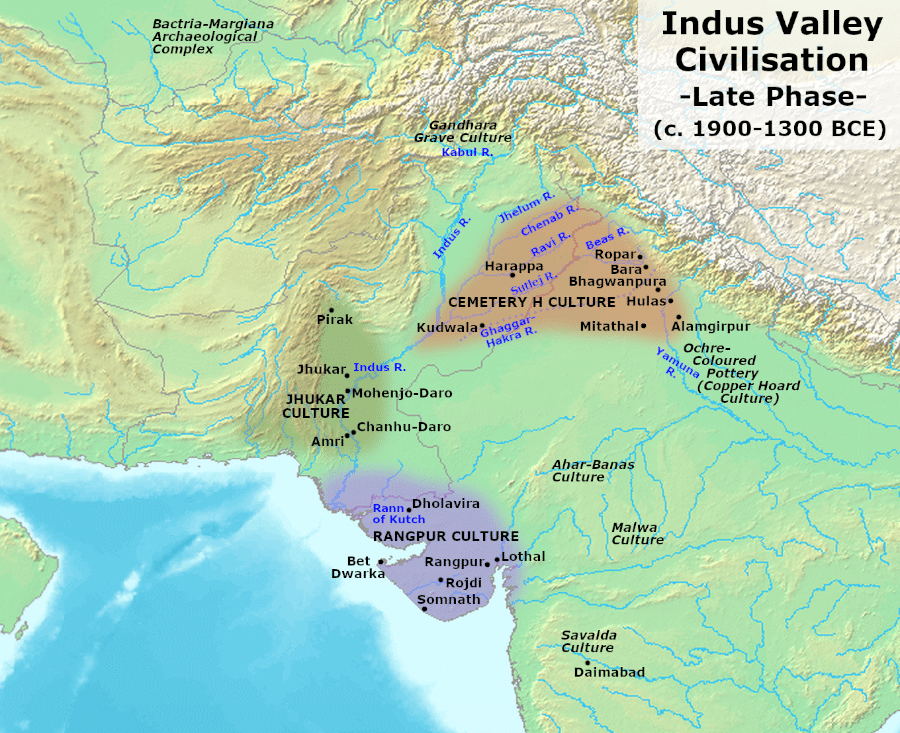
Indus Valley Civilization (IVC): Late Harappan Phase (c. 1900 – 1300 BCE)


Daimabad
- Location
- Situated in Ahmednagar district, Maharashtra
- Lies on the western edge of the Deccan plateau
- Significance
- Southernmost site of the Indus Valley Civilization
- Represents Harappan expansion into the Deccan region
- Important for tracing cultural diffusion from Harappan core areas to Peninsular India
- Chronological Phases
- Period I – Savalda culture (Pre-Harappan Chalcolithic)
- Period II – Late Harappan culture
- Period III – Daimabad-specific culture
- Period IV – Malwa culture
- Period V – Jorwe culture (Iron Age)
- Late Harappan Phase
- Pottery:
- Fine red ware with linear and geometric designs in black
- Seals with Harappan script, inscribed potsherds
- Tools and Objects:
- Microlithic blades, stone and terracotta beads
- Shell bangles, gold beads, terracotta measuring scale
- Evidence of local copper smelting
- Agriculture:
- Crops: Millets, gram, moong, horse gram
- Burials:
- One Late Harappan burial, others belonging to later phases
- Pottery:
- Daimabad-Specific Culture (Period III)
- Pottery:
- Black-on-buff/cream ware
- Craft Activity:
- Copper-smelting furnace found
- Burials:
- Three types:
- Pit burial
- Urn burial
- Symbolic burial
- Mostly infants and young individuals
- Three types:
- Agriculture:
- Similar to Late Harappan phase with addition of Hyacinth bean
- Pottery:
- Notable Artefacts
- Famous bronze sculptures (chariot, bull, elephant, rhinoceros)
- Likely used as ritual or prestige objects
- Famous bronze sculptures (chariot, bull, elephant, rhinoceros)
- Cultural Importance
- Demonstrates Harappan cultural continuity into later Chalcolithic cultures
- Serves as a bridge between northwestern urban traditions and peninsular Chalcolithic societies
- Reflects long-distance trade and cultural interaction with the Harappan core zones
Navdatoli (Navadatoli)
- Location
- Situated in West Nimar district, Madhya Pradesh
- Located on the bank of the Narmada River, near Maheshwar
- Chronology
- Belongs to the Chalcolithic period
- Associated with the Late Harappan and Malwa culture
- Inhabited through four distinct cultural stages
- Cultural Affiliation
- Largest known settlement of the Malwa culture
- Shows interactions with Harappan elements, especially in pottery and tools
- Habitation Features
- Houses were circular or rectangular in shape
- Circular houses made with wattle-and-daub construction
- Evidence of post-holes suggests wooden supports
- Floors were plastered with lime
- Chulhas (hearths) and storage jars were found inside dwellings
- Settlement pattern indicates semi-permanent village life
- Houses were circular or rectangular in shape
- Pottery and Artefacts
- Black and Red Ware (BRW)
- Painted Grey Ware (PGW) with geometric motifs
- Variety of microlithic tools (flakes, blades, scrapers)
- Use of copper tools in later stages
- Pottery styles suggest continuity and interaction with Harappan cultural traditions
- Subsistence Practices
- Evidence of domesticated animals: cattle, sheep, and goats
- Likely practiced mixed farming and herding
- Use of storage jars indicates food surplus and grain storage
- Significance
- Provides insight into regional Chalcolithic life in central India
- Serves as an important link between Harappan urban culture and Deccan Chalcolithic traditions
- One of the earliest settlements in the Narmada Valley showing complex village life and craft activity
Kayatha
- Location
- Located in Ujjain district, Madhya Pradesh
- Situated near the Chambal River on the Malwa Plateau
- Chronology
- Dates to Chalcolithic period (c. 2400–2000 BCE)
- Followed by Late Harappan influence
- Later reoccupied in the Ahar/Banas culture phase
- Abrupt break in occupation around 1800 BCE
- Cultural Significance
- Type site of Kayatha Culture — the earliest Chalcolithic culture in Central India
- Preceded the Malwa culture
- Reflects early agrarian, craft, and metallurgical development
- Habitation Features
- Houses made of mud and reed
- Mud-plastered floors
- Evidence of planned settlement layout
- Pottery
- Fine, sturdy, wheel-made pottery
- Buff and red wares with geometric designs
- Pottery marks indicate local ceramic tradition
- Material Culture and Artefacts
- Microliths made from locally available chalcedony
- Copper tools: axes, chisels, bangles
- Copper axes likely sourced from Ganeshwar
- Ornaments made of agate, steatite, and carnelian beads
- Terracotta figurines also recovered
- Faunal Remains
- Bones of domesticated cattle and horses found
- No evidence of grain remains, possibly due to poor preservation
- Significance
- One of the earliest known Chalcolithic sites in Central India
- Illustrates early use of copper and semi-precious stones
- Important for understanding transitional phases between rural Chalcolithic life and urban Harappan contacts
Ahar
- Location
- Situated on the banks of the Ahar River
- In southeastern Rajasthan, near Udaipur
- Cultural Phases
- Chalcolithic site (Ahar Culture / Banas Culture)
- Also shows Late Harappan influence
- Habitation Features
- Rectangular, square, and circular houses with single, double, or multi-room layouts
- Houses constructed with stones and mud bricks
- Walls plastered with mud
- Evidence of planned domestic architecture
- Pottery
- Distinctive Black-and-Red Ware (BRW)
- Decorated with linear and dotted designs
- Common shapes: bowls, bowls-on-stands, and vases
- Pottery indicates regional ceramic style with Harappan parallels
- Distinctive Black-and-Red Ware (BRW)
- Subsistence Pattern
- Agriculture: cultivation of wheat, barley, and possibly other cereals
- Animal husbandry: evidence of domesticated animals
- Hunting as a supplementary activity
- Material Culture and Artefacts
- Terracotta objects, copper tools, and stone implements
- Beads and ornaments from semi-precious stones
- Tools made from copper and stone indicate early metallurgy
- Trade and External Contacts
- Evidence of trade links with Harappan Civilization
- Possibly exchanged copper, pottery, and beads
- Part of the larger interaction sphere between Chalcolithic Rajasthan and Harappan urban centers
- Evidence of trade links with Harappan Civilization
- Significance
- Type site of Ahar/Banas culture
- Illustrates regional Chalcolithic development with urban contacts
- Important for understanding the spread of copper use and BRW culture in South Asia
Gilund
- Located in Rajsamand district, Rajasthan (Ahar-Banas culture).
- Largest site of the Ahar-Banas Chalcolithic complex.
- Contemporary with Late Harappan culture.
- Houses made of mud bricks and stone, with multi-room structures.
- Pottery: Black-and-Red Ware (BRW) with white painted designs.
- Artefacts: terracotta figurines, beads (agate, carnelian), copper tools, microliths.
- Seal-making workshop discovered – over 100 steatite seals and impressions.
- Economy based on agriculture (wheat, barley), animal husbandry, and hunting.
- Trade links with Harappans indicated by pottery and artefact similarities.
- Chronology: Occupied c. 3000–1700 BCE.
Lothal
- Location:
- Located in Ahmedabad district, Gujarat, near the Bhogava River.
- Pre-Harappan Phase:
- Initially a small village.
- Gradually developed into an important port and industrial town.
- Economic Activities:
- Became a centre of maritime trade.
- Known for cotton and rice cultivation.
- Developed a bead-making industry.
- Urban Planning:
- City was divided into two parts:
- Citadel (acropolis)
- Lower town
- Structures built with fire-dried bricks, lime, and sand mortar.
- Evidence of a well-planned drainage system with soak pits and covered drains.
- City was divided into two parts:
- Important Archaeological Findings:
- Dockyard – One of the world’s earliest known dockyards; major maritime engineering feat.
- Persian Gulf seals – Evidence of trade with West Asia (Mesopotamia).
- Workshops:
- Shell ornament maker’s shop
- Bead maker’s shop
- Metal worker’s shop
- Fire altars – Indicate ritual activities or fire worship.
- Terracotta figurine of house – Represents Harappan domestic architecture.
- Warehouse – For storage of goods, linked to trade activity.
- Merchant house – Indicates presence of wealthy trading class.
- Impression of cloth on sealing – Signifies textile production and trade.
- Twelve bathrooms in the citadel area – Reflect focus on public hygiene.
- Ivory scale – Shows advanced decimal system; smallest-known decimal division in IVC.
- Trade Connections:
- Connected to other cities via river routes.
- Part of a coastal trade network linking Lothal–Dholavira–Sutkagan Dor on the Makran coast.
- Later Harappan Phase:
- Continued habitation, but with a smaller population.
- City became devoid of urban characteristics.
- Trade and economic importance declined.
- Inhabitants retained Harappan traditions in writing, pottery, and tools.
Rangpur
- Location:
- Situated on the Saurashtra peninsula, Gujarat.
- Cultural Phases:
- Mature and Late Harappan phases.
- Also shows post-Harappan occupation.
- Architecture:
- Use of acacia wood in construction.
- Artefacts and Findings:
- Black and Red Ware (BRW) pottery and high-necked jars.
- Dishes used for domestic purposes.
- Evidence of shell working industry.
- Agriculture:
- Plant remains of bajra (pearl millet), rice, and millet indicate a mixed cropping pattern.
Rojdi
- Location:
- Situated in Rajkot district, Gujarat.
- Cultural Phases:
- Belongs to the Mature Harappan, Late Harappan, and even Palaeolithic period.
- Architecture:
- Houses were built on stone foundations.
- No evidence of bricks used in construction.
- Pottery:
- Presence of hard, red-ware pottery.
- Some pottery pieces bear graffiti with Indus script signs (e.g., jar sign).
- A short Harappan inscription has been found on pots.
- Metal Artefacts:
- Flat axes made of copper or bronze have been discovered.
Bet Dwarka
- Location:
- Situated on the coast of Gujarat, near present-day Dwarka.
- Period:
- Belongs to the Late Harappan phase.
- Estimated to date back to around 1500 BCE.
- Key Features:
- Submerged port-city with evidence of fortification walls and stone anchors.
- Suggests the presence of active maritime trade during the Late Harappan period.
- Findings:
- A Late Harappan seal with Harappan script.
- A three-headed animal motif, similar to those on Persian Gulf seals, indicating continued trade relations with the Gulf region.
- Cultural Significance:
- Demonstrates that although core Harappan cities declined, urban elements like script, seals, specialized crafts, and trade persisted in some areas.
- Bet Dwarka is considered a Late Harappan urban site, reflecting residual urbanism and commercial continuity beyond the Mature Harappan phase.
Desalpur
- Location:
- Situated in Kutch district, Gujarat, near the Banni plains, about 25 km north of Bhuj and close to the Rann of Kutch.
- Period:
- Mature and Late Harappan phase.
- No Early Harappan phase present.
- Post-Harappan occupation also continued.
- Urban Features:
- A small fortified town.
- Unique stone fortification walls with mud filling—unusual for Harappan towns, which typically used mud bricks.
- Evidence of planned habitation with internal layout and housing structures.
- Artefacts and Material Culture:
- Black and Red Ware (BRW) pottery.
- Blade tools, terracotta beads, bangles, and cubical weights—typical of Mature Harappan material culture.
- Traces of shell working, including unfinished shell bangles—suggesting craft specialization.
- Significance:
- Demonstrates Harappan expansion into the arid western fringes.
- Possibly played a role in coastal trade networks, given the presence of shell crafts.
- Reflects urban continuity into the post-Harappan period despite the decline of core cities.
Chanhudaro
- Location:
- Situated in Sindh, Pakistan.
- Period:
- Belongs to the Mature and Late Harappan phases.
- No evidence of Early Harappan phase.
- Settlement Features:
- A small Harappan site with no fortification.
- Mud-brick platforms used for construction.
- Burnt-brick covered drains running along the streets indicate urban sanitation.
- Pottery kilns were discovered, indicating local ceramic production.
- Economic and Craft Activities:
- A prominent craft production center of the Indus Valley Civilization.
- Evidence of bead-making industry using carnelian, agate, amethyst, and crystal.
- Presence of a steatite bead factory.
- Seal-making, shell working, and production of stone weights also occurred here.
- Significance:
- Known for its specialized crafts rather than urban planning or political power.
- Highlights the non-urban, industrial specialization aspect of the Harappan economy.
Amri
- Location:
- Situated in Sindh, Pakistan, near the western bank of the Indus River, close to the Kirthar range.
- Chronology:
- Pre-Harappan, Early Harappan, and Mature Harappan phases.
- Late Harappan phase is less significant at this site.
- Settlement Features:
- Structures made of mud-brick and stone.
- Presence of cellular compartments possibly used for grain storage.
- Material Culture and Artefacts:
- Chert blades, stone balls, bone tools, and fragments of copper and bronze.
- Triangular terracotta cakes and microliths found.
- Evidence of early craft activity.
- Pottery:
- Wheel-made wares with geometric painted designs.
- Found in both monochrome and polychrome styles.
- Pre-Harappan Amri Culture:
- Noted for its distinct handmade pottery and rural settlement patterns.
- Pre-dates the urban Harappan phase.
- Cultural Significance:
- Shows stratigraphic transition from Amri culture to Harappan culture, helping trace the urbanization process.
- Acts as a cultural and trade intermediary between the upland Baluchistan cultures and Indus urban centers.
Jhukar
- Location:
- Situated in Sindh, Pakistan.
- Cultural Phase:
- Represents a regional form of Late Harappan culture.
- Urban Features:
- Urban characteristics of the Mature Harappan period disappeared.
- Indicates a rural or de-urbanized phase.
- Pottery:
- Shows continuity with Mature Harappan pottery styles, though with regional variations.
- Artefacts:
- Stone weights and female figurines became rare, unlike earlier phases.
- Circular stamp seal with geometric design but without Indus script.
- Trade and Economy:
- Evidence of decline in long-distance trade and overall economic contraction.
Mitathal
- Location:
- Situated in Bhiwani district, Haryana.
- Cultural Phase:
- A village-type Late Harappan site.
- Shows evidence of continued habitation into the Kushana period.
- Architecture and Habitation:
- Mud-brick houses with domestic features.
- A kitchen area with a chulha (hearth) has been found, indicating everyday domestic life.
- Later Period Finds:
- Coins of the Kushana period were discovered, pointing to post-Harappan occupation and cultural continuity.
Alamgirpur
- Location:
- Situated in Meerut district, Uttar Pradesh, on the left bank of the Hindon River.
- Cultural Phase:
- Mature and Late Harappan site.
- Easternmost extent of the Indus Valley Civilization.
- No Early Harappan level found.
- Settlement Nature:
- No fortifications or public buildings—indicating a rural or craft-based outpost.
- Likely functioned as a satellite settlement rather than a major urban center.
- Archaeological Finds:
- Burnt bricks, copper objects (in Late Harappan phase).
- Typical Harappan pottery, terracotta bangles, beads, faience objects.
- Evidence of textile production—spindle whorls and yarn impressions.
- Cultural Transition:
- Harappan layer is overlain by PGW and NBPW deposits.
- Indicates a break in occupation between Late Harappan and PGW phase.
- Important site for tracing the cultural transition to early historic Ganga plains.
Bhagwanpura
- Location:
- In Kurukshetra district, Haryana, near the seasonal Sarasvati River, close to Thanesar.
- Cultural Phases:
- Shows overlap between Late Harappan and Painted Grey Ware (PGW) cultures (c. 1700–1000 BCE).
- Crucial for understanding the Harappan–Vedic transition.
- Settlement Features:
- Remains of mud houses, storage pits, and hearths.
- Evidence of agriculture and domesticated cattle—semi-urban rural economy.
- A large 13-room house made of baked bricks found.
- Craft and Material Culture:
- Late Harappan phase shows craft activity—clay tablets, sherds with graffiti.
- Artefacts include stone, bone, and terracotta objects.
- PGW phase includes PGW pottery and cultural continuity with changes.
- No iron artefacts found.
- Religious Structures:
- One of the few PGW sites with a fire altar, suggesting early Vedic ritual practices rooted in Harappan traditions.
Ropar (Rupar)
- Location:
- Situated in Rupnagar district, Punjab, on the left bank of the Sutlej River, near the Shivalik foothills.
- Cultural Sequence:
- Associated with Mature Harappan, PGW, NBPW, and early historic phases.
- No Early Harappan level found.
- Notable for the transition from village to town during 600–200 BCE.
- Key Findings (Harappan Phase):
- Terracotta bangles, steatite seals, chert blades, and storage jars.
- Indicates a well-settled urban outpost connected to the broader Indus network.
- Rectangular pit burials with pottery, copper tools, and animal bones—showing regional variations in burial practices.
- Key Findings (Post-Harappan):
- Presence of PGW and NBPW pottery, punch-marked and copper coins.
- An iron workshop, agate beads, and a Brahmi-inscribed seal found during the NBPW phase.
- Architecture:
- Houses built using stone, mud-brick, and burnt brick materials.
- Geographical and Strategic Significance:
- Functioned as a frontier Harappan settlement, facilitating resource extraction from the Himalayan foothills.
- Enabled trade via the Sutlej River, linking upland and plains regions.
- Overall Importance:
- Crucial site to study long-term settlement continuity and the transition from Harappan to Vedic cultures.
Harappa
- In Punjab, Pakistan on bank of Ravi River.
- Early, mature and late Harappan phase found.
- First site of IVC to be discovered.
- Urban culture sustained by surplus agricultural production and commerce.
- Trade with Sumer in southern Mesopotamia.
- Differentiated living quarters, flat-roofed brick houses, and fortified administrative or religious centers.
- City followed grid planning.
- Row of six granaries found.
- Burials:
- Only place having evidenced of coffin burial.
- Evidenced of fractional burial and coffin burial.
- Grave goods
- Cemetery-H of alien people.
- Citadel and fortified city.
- Seal, stone figurines (torso of naked male and female figure in dancing pose)
- Bronze smelting
Gumla
- Location:
- Situated in the Gomal Valley, Pakistan.
- Cultural Phase:
- Associated with Early Harappan and Mature Harappan phases.
- Key Findings:
- Presence of a burnt deposit between the Early and Mature Harappan layers—suggests a major fire event that possibly marks a cultural transition.
- Evidence of agricultural activity, indicating a flourishing agrarian economy.
- Significance:
- Important for understanding settlement continuity and transition dynamics between Early and Mature Harappan phases.
- Highlights the vulnerability of early settlements to natural or accidental disasters like fire.
Mundigak
- Location:
- Situated in Kandahar province, Afghanistan.
- Cultural Phases:
- Shows evidence of Neolithic, Chalcolithic, and Harappan occupation.
- Key Findings:
- Painted Pottery featuring motifs like sacred fig leaves, tiger-like animals, and geometric designs.
- Artefacts include:
- Terracotta drains
- Hump bulls (indicative of Harappan iconography)
- Human figurines
- Shaft-hole axes
- From the Harappan phase:
- Remains of a palace, a temple, and a city wall—pointing to an advanced urban structure and administrative complexity.
- Significance:
- Highlights the Harappan expansion beyond the traditional Indus region into Afghanistan.
- Acts as an important link in understanding Harappan interactions with Central Asian cultures.
Akhnoor / Manda
- In Akhnoor district, J&K on the bank of Chenab.
- Mature and Late Harappan.
- Northern most Harappan site.
- Harappan and Late Harappan site.
- BRW, red ware and grey ware.
- Artefacts:
- Bangles,
- potshards with Harappan writings and
- bone arrow heads.
- Artefacts of Kushana period:- Pottery, terracotta figurines, bone arrow heads, iron daggers and copper rods.
- Source of timber for IVC sites.
- Akhnoor fort built by Raja Alam Singh in 1802.