Origins of Modern Politics: European States System; American Revolution and the Constitution; French revolution and aftermath, 1789- 1815; American Civil War with reference to Abraham Lincoln and the abolition of slavery; British Democratic Politics, 1815-1850; Parliamentary Reformers, Free Traders, Chartists.
Origins of Modern Politics is the largest single unit in the entire History Optional. UPSC has set 75 questions on it between 1985 and 2026 — more than any other topic on this site — and it has appeared in every one of the last ten papers, usually with two or three questions. The French Revolution, Napoleon and the American Revolution alone account for more questions than most whole units.
Every question the Commission has asked on this topic is listed below, newest first, with a written model answer linked against each one.
| Questions asked (1985–2026) | 75 |
| Appeared in | 10 of the last 10 papers |
| Paper | Paper II, Section B (World History) |
| Usual mark value | 10, 15 or 20 marks |
| Model answers available | 72 of 75 |
PYQs: Origins of Modern Politics [1985-2026]

| Year | Question | Answer |
|---|---|---|
| 2026 | "The rise of the Cordelier Club in France was significant for the revolutionary body." | |
| 2026 | The Vienna Settlement of 1815 was based on three principles, restoration, legitimacy and compensation. Elucidate. | |
| 2026 | The conquests of Napoleon were ephemeral but his civilian work was built on granite. Explain. | |
| 2025 | "The French Revolution started and led to the victory in its first phase by the aristocracy." | View answer |
| 2025 | "With the Reform Act of 1832 began an activity in reconstructing legislation to which there had been no parallel in British history." | View answer |
| 2024 | The American Civil War was a result of the disparity of needs of industrial north and agrarian south. | View answer |
| 2023 | "The American War of Independence finally ended in 1783 when Britain acknowledged the independence of the United States of America." Critically examine. | View answer |
| 2023 | The philosophers and thinkers may have laid the foundation of the French Revolution, but it was precipitated by social and economic reasons. Explain. | View answer |
| 2023 | "The Chartist Movement not only fulfilled some of the demands of the middle class, but its ramifications were felt among the working class and the colonies as well." Critically examine. | View answer |
| 2022 | Do you understand that the lack of statesmanship in London during the 1760's and the 1770's was, an important contributory factor in precipitating the American Revolution. Analyse. | View answer |
| 2022 | 'The codification of French Law was perhaps the most enduring of Napoleon's achievements'. Critically examine. | View answer |
| 2022 | 'The first Reformation Act (1832) occupies a significant place in the constitutional development of Britain'. Critically examine. | View answer |
| 2021 | Critically examine the following statement in about 150 words: Napoleon’s continental system may be reckoned as the greatest blunder and may be described as a “monument of misdirected energy”. | View answer |
| 2021 | Critically examine the following statement in about 150 words: The Chartist Movement failed to achieve its stated objectives, but succeeded in seeding the idea that a representative democracy should include all citizens. | View answer |
| 2021 | In the American civil war, the victory of the North had many consequences. Some of them were direct and obvious. However, its indirect effects on American development were perhaps even more important. Comment. | View answer |
| 2020 | "The causes of the French Revolution of 1789 included both long term and structural factors, as well as more immediate events.” | View answer |
| 2020 | “Napoleon was not a revolutionary but he solidified many of the revolutionary changes of 1789 – 1791 and he himself supported most of the ideas and proposals of Enlightenment philosophers.” Substantiate. | View answer |
| 2020 | “Lincoln’s main thesis was that the Slavery issue hadto be decided one way or the other and could no longer be evaded by compromise." Comment in the light of his role in the American Civil War. | View answer |
| 2019 | Critically examine: "The arguments of the free traders were a curious mixture of economic hard-headedness, social benevolence, cosmopolitan idealism and class prejudice” | View answer |
| 2019 | How far did the Napoleonic preferential stance to help out the French economy result in embroiling France in continental conflicts? | View answer |
| 2018 | Critically examine: “The American War of Independence transformed Europe as well as America." | View answer |
| 2017 | Critically examine in 150 words: "The spirit behind the great reforms of Napoleon's Consulate at home was the transference of the methods of Bonaparte the general to task of Bonaparte the statesman." | View answer |
| 2017 | Critically examine in 150 words: "The roots of the Chartist movement in Great Britain were partly political and partly economic.” | View answer |
| 2016 | Explain the main features of the US federal Constitution. | View answer |
| 2016 | "A house divided against itself cannot stand. I believe this government cannot endure permanently, half slave and half free." Explain Abr4ham Lincoln's perspective. | View answer |
| 2016 | Critically examine the statement that the French Revolution was not caused by the French philosophers but by the condition of national life and by the mistakes of the government. | View answer |
| 2015 | Critically examine: "The multiple contradictions that quickly undermined the new edifice, had been expressed even before the meeting of the Estates General in France. The internal conflict among Estates had manifested itself.” | View answer |
| 2015 | Critically examine: “The Continental Blockade was a misconceived idea of economically defeating Great Britain.” | View answer |
| 2014 | "American Revolution seems to have come with remarkable suddenness. A roster of talented leaders emerged during 1763 to 1775 to make it happen.” Elucidate. | View answer |
| 2014 | "… the passing of the ‘Reform Act’ marked the real beginning of modern party organisation in England … In a real sense, the present political system of England dates from 1832."Critically examine in 150 words. | View answer |
| 2014 | “The Declaration of Rights was the death warrant of the system of privilege, and so of the ancient regime … Yet in the history of ideas it belonged rather to the past than to the future." Examine. | View answer |
| 2013 | “Six hundred thousand men had died. The Union was preserved, the slaves freed. A nation ‘conceived in liberty and dedicated to the proposition that all men are created equal' had survived its most terrible ordeal.” Critically examine in 150 words. | View answer |
| 2013 | “Change in Britain came comparatively peacefully through democratic process in the first half of the nineteenth century and a model of a functioning democracy through ballot box was successfully put in place.” Elaborate. | View answer |
| 2012 | “The American Revolution was essentially an economic conflict between American capitalism and British mercantilism.” Critically examine. | View answer |
| 2012 | “The connection between the philosophers’ ideas and the outbreak of the French Revolution (1789) is somewhat remote and indirect." Critically examine. | View answer |
| 2012 | How did Napoleon fuse the France of the ancient regime with the France of the postrevolutionary era? | View answer |
| 2011 | “The roots of Chartism and partly political and partly economic.” Elaborate. | View answer |
| 2010 | How far is it correct to say that every feature of American Constitution was ultimately of English origin? | View answer |
| 2010 | To what extend did Napoleon’s economic war with England become his undoing? | View answer |
| 2009 | How did Napoleon Bonaparte fuse the old France with the new? | View answer |
| 2007 | “No event as encompassing as the French Revolution occurs in an intellectual vacuum." Comment. | View answer |
| 2006 | “No taxation without representation." Comment. | View answer |
| 2006 | “A clever conqueror will always impose his demands on the conquered by installments." Comment. | View answer |
| 2005 | ‘Though reform was inevitable, the Act (1832) by which it was accomplished was open to grave criticism.’ Comment. | View answer |
| 2005 | ‘The writings of the philosophers had a tremendous influence on the minds of the people and created a revolutionary awakening in their minds and formed the intellectual creed of the French Revolution.’ Comment. | View answer |
| 2005 | ‘What were the factors that worked in the drafting of the American Constitution? Do you agree with Beard’s view of the constitution being an Economic Document? | View answer |
| 2004 | ‘Napoleon was the child of the Revolution, but in many ways he reversed the aims and principles of the movement from which he sprang…” Comment. | View answer |
| 2004 | Review the background of the Chartist Movement. Despite its failure how had their demands been met in the succeeding years? | View answer |
| 2003 | 'The French Revolution attacked privileges and not property.’ Comment. | View answer |
| 2002 | ‘If monarchical misrule ignited the French Revolution, lofty ideas both inspired and sustained it.’ Comment. | View answer |
| 2001 | ‘The Napoleonic Empire was doomed because of its inherent and self-defeating contradictions.’ Elucidate. | View answer |
| 2000 | How did Napolean Bonaparte heal the wounds of France inflicted by the Revolution and corrected the errors perpetrated by its leaders? | View answer |
| 1999 | To some extent, the American War of Independence inspired the French Revolution. Comment. | View answer |
| 1998 | The American War of Independence "deprived Great Britain of one empire, but it strengthened the foundations of another.” | View answer |
| 1997 | “If monarchical misrule ignited the French revolution, lofty ideas both inspired and sustained it.” Comment. | View answer |
| 1997 | “The Bill of Rights (1688) set the seal on Parliamentary supremacy in England.” Comment. | View answer |
| 1996 | The French Revolution (1789) sought to remove both “the religious and secular props of the existing social order.” Elucidate. | View answer |
| 1995 | The American Revolution “was a natural and even expected event in the history of colonial people who had come of age.” Comment. | View answer |
| 1993 | ‘The scale, splendour and organized power of the monarchy of Louis XIV was something new in Europe.' Comment. | View answer |
| 1992 | ‘The sponsors of the overseas expansion of Europe were national monarchies.’ Comment. | View answer |
| 1992 | 'Napoleon was the child of the Revolution, but in many ways he reversed the aims and principles of the movement from which he sprang.’ Comment. | View answer |
| 1992 | From the Thirty Years War finally emerged the modern state system of Europe. Do you agree? | View answer |
| 1991 | 'French political writers of the eighteenth century were influenced by Locke and also by the curious contrasts which they perceived between the government of his country and their own.’ Comment. | View answer |
| 1991 | Discuss the view that Louis XIV of France was a great king-‘the grand monarch.’ | View answer |
| 1991 | Examine the issues involved in the American Civil War. Was it a contest between two separate nations? | View answer |
| 1990 | ‘The American war of Independence transformed Europeans as well as America.’ Comment in about 200 words. | View answer |
| 1990 | What issues involved in the conflict between the King and Parliament in England in the seventeenth century? Discuss. | View answer |
| 1989 | Louis XIV ‘was the first French sovereign to make of monarchy a serious profession.’ Comment in about 200 words. | View answer |
| 1989 | The French Revolution (1789) really achieved far less than what it intended to effect. Do you agree? | View answer |
| 1988 | “At the news of the Declaration of Independence crowds gathered to cheer, fire guns and cannon and ring church bells in Philadelphia. Boston and other places, but there were many people in America who did not rejoice.” Comment in about 200 words. | View answer |
| 1988 | Examine the view that the thirty years war (1618-1648) was essentially a contest between the Bourbon and Hapsburg houses for mastery of the Continent of Europe. How far did it settle the issue? | View answer |
| 1987 | Account for the emergence of the national monarchies in Europe in the sixteenth century. Did the monarchs build the national states less by design than by chance? | View answer |
| 1986 | ‘Napoleon was the child of the Revolution, but in many ways he reversed the aims and principles of the movement from which he sprang…” Comment in about 200 words. | View answer |
| 1986 | ‘If I could save the Union without freeing any slave, I would do it ; and if I could save it by freeing all the slaves, I would do it ; and if I could save it by freeing some and leaving others alone, I would also do that.’ Comment in about 200 words. | View answer |
| 1985 | “What mattered in 1789-and what made men revolutionary almost in spite of themselves- was the whole revolutionary situation’; and in producing that situation the work of the philosophers played no very important role." Comment in about 200 words. | View answer |
What UPSC keeps asking about the Origins of Modern Politics
Seventy-five questions fall into six threads. The first three are among the most repeated subjects in the whole optional, and several quotations have been set two or three times word for word.
1. The French Revolution — causes, ideas and achievement (1985, 1989, 1991, 1996, 1997, 2002, 2003, 2005, 2007, 2012, 2014, 2016, 2020, 2023, 2025, 2026)
- Sixteen questions — the largest thread in the largest unit on this site.
- The question of the philosophes has been set again and again: did ideas cause the Revolution (1991, 2005, 2012, 2023)? “If monarchical misrule ignited it, lofty ideals…” appeared in 1997 and 2002.
- The interpretive questions are the ones to prepare: whether it attacked privilege and not property (2003), whether it achieved less than it promised (1989), short and long-term causes (2020). Know the three schools — Lefebvre and Soboul’s social interpretation, Cobban’s revisionism, Furet’s political culture.
2. Napoleon (1986, 1992, 2000, 2001, 2004, 2006, 2009, 2010, 2012, 2015, 2019, 2020, 2022, 2026)
- Fourteen questions. “Napoleon was the child of the Revolution, but in many ways he destroyed it” — set three times (1986, 1992, 2004).
- How he fused old France with new (2009, 2012), healed its wounds (2000), and whether his civil work outlasted his conquests (2020, 2022 on the Code, 2026).
- The Continental System as misconceived (2010, 2015) and the empire doomed by its contradictions (2001) are the military-economic side.
3. The American Revolution and Constitution (1988, 1990, 1995, 1998, 1999, 2005, 2006, 2010, 2012, 2014, 2016, 2018, 2023, 2025)
- Fourteen questions. “No taxation without representation” (2006), an economic conflict (2012), sudden or long in the making (1995, 2014), its effect on Europe (1990, 1999, 2018).
- The Constitution: the factors in its drafting (2005), its main features (2016), and whether every feature was borrowed (2010).
- 2025 framed the Revolution as a manifestation of Enlightenment ideas — a link across units worth preparing.
4. The American Civil War (1986, 1991, 2013, 2016, 2020, 2021, 2024)
- Lincoln’s priorities — the Union before emancipation (1986, 2020), “a house divided” (2016).
- Was slavery the cause, or the disparity between North and South (1991, 2024)? The consequences of Northern victory (2013, 2021).
- Set the slavery-centred reading against the sectional-economic one, and do not let the second erase the first.
5. Britain — Parliament, reform and Chartism (1990, 1997, 2004, 2005, 2011, 2013, 2014, 2017, 2019, 2022, 2023, 2025)
- Twelve questions and very active. The 1832 Reform Act (2005, 2014, 2022, 2025), Chartism (2004, 2011, 2017, 2023), free trade (2019).
- Why Britain changed through reform rather than revolution (2013) is the question that ties it together.
- The older questions — the King against Parliament (1990) and the Bill of Rights of 1688 (1997) — supply the background.
6. Absolutism, the state system and Vienna (1987, 1988, 1989, 1991, 1992, 1993, 2026)
- National monarchies (1987), Louis XIV (1989, 1991, 1993), the Thirty Years War and the modern state system (1988, 1992).
- Silent for thirty years until 2026 asked about the three principles of the Vienna Settlement. Prepare legitimacy, compensation and balance of power.
The model answers to this unit, in one place
Knowing the questions is half the work. The other half is seeing what a full-mark answer to each one looks like — not a hint or a bullet outline, but a complete answer at the mark and the word limit, with the historians named inside the argument.
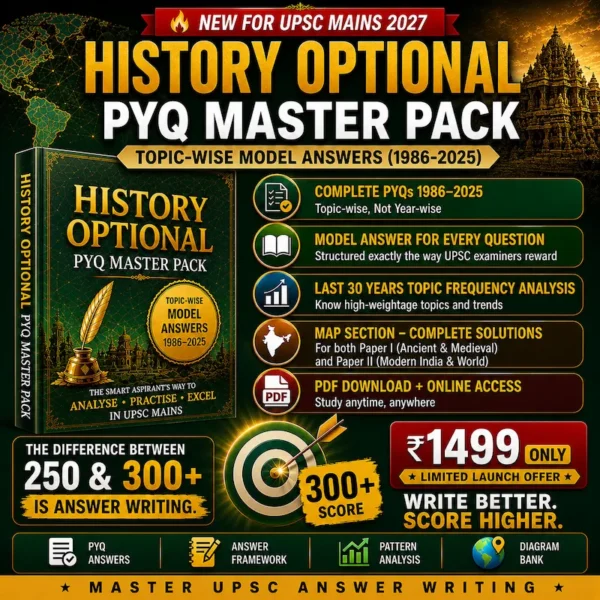
The History Optional PYQ Master Pack carries the same for every question the Commission has set since 1985, across the whole syllabus.
- PYQs 1985–2025, arranged topic-wise — revise a theme and see every way it has been asked
- Model answers with historiography — the debate cited where it belongs, not bolted on
- Map sections solved — the full 50-mark section, every year
- PDF plus online access — any device, permanently, no subscription
₹1,499 (regular ₹2,500). One-time payment, instant access.
How to use this topic list
Reading a question list feels like preparation and is not. Three sittings turn it into marks.
Sitting 1 — sort before you read (30 minutes)
- Copy the questions above into the threads identified in the previous section.
- Note which thread has gone longest without being asked — that is your priority, not the one you find most interesting.
Sitting 2 — write three answers cold (45 minutes)
- Pick the most recent question from three different threads.
- Seven minutes for a 10-marker, fifteen for a 20-marker. Stop when the time is up, even mid-sentence.
- Mark every place you wanted a historian’s name and could not produce one.
Sitting 3 — compare, then rewrite (45 minutes)
- Put your script beside the model answer for the same question.
- Compare structure first: opening claim, evidence, counter-view, judgement.
- Rewrite your weakest answer using that structure and no new content. Most candidates gain four to six marks from structure alone.
Two ways to prepare this optional
Two routes, depending on what is actually missing.
| PYQ Master Pack | Mains Master Kit 2027 | |
| Best when | Your notes are done; answer-writing is the gap | You are still building the subject |
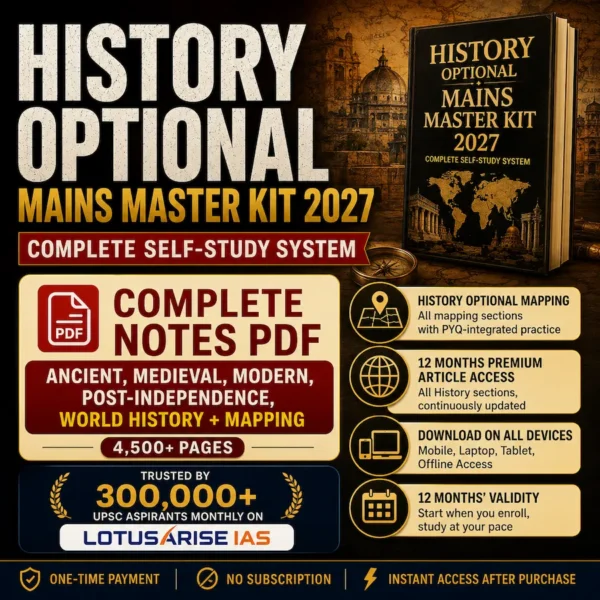
| What you get | Model answers to every question since 1985, topic-wise, map sections included | 4,500+ pages of notes, full mapping coverage, 12 months of article access |
| Price | ₹1,499 (reg. ₹2,500) | ₹1,770 (reg. ₹5,000) |
Frequently asked questions
Related topics
This unit connects to:
- Enlightenment and Modern Ideas
- Revolution and Counter-Revolution
- Nation-State System
- Industrialization
- All topics — History Optional PYQs, topic-wise
Prefer to work year by year?
The complete papers, with both papers in full, unit-wise analysis and the official PDFs:
- History Optional Question Paper 2026
- History Optional Question Paper 2025
- History Optional Question Paper 2024
- History Optional Question Paper 2023
- History Optional Question Paper 2022
- History Optional Question Paper 2021
- History Optional Question Paper 2020
- UPSC History Optional Map Solutions (2013–2025)