Enlightenment and Modern ideas: Major Ideas of Enlightenment: Kant, Rousseau: Spread of Enlightenment in the colonies; Rise of socialist Ideas (up to Marx); spread of Marxian Socialism
Enlightenment and Modern Ideas opens the World History section and is its largest unit. UPSC has set 44 questions on it between 1986 and 2026, and it has appeared in every one of the last ten papers — three questions in 2025 alone. It is also the most philosophical unit in the optional, and the one where quoting a thinker accurately matters most.
Every question the Commission has asked on this topic is listed below, newest first, with a written model answer linked against each one.
| Questions asked (1986–2026) | 44 |
| Appeared in | 10 of the last 10 papers |
| Paper | Paper II, Section B (World History) |
| Usual mark value | 10, 15 or 20 marks |
| Model answers available | 43 of 44 |
PYQs: Enlightenment and Modern ideas [1985-2026]

| Year | Question | Answer |
|---|---|---|
| 2026 | "Immanuel Kant was an advocate of liberalism and nationalism." | |
| 2025 | "The American Revolution was, in many respects, a manifestation of the Enlightenment in political, civil and ecclesiastical spheres." Explain. | View answer |
| 2025 | "Anti-clericalism of the Enlightenment echoed the sentiments of the Renaissance and the Reformation. Yet it neither endorsed the paganism of the Renaissance nor did it share the faith of Reformation." Discuss. | View answer |
| 2025 | "The pre-Marxian socialist thinkers envisioned socialist societies without fully considering the practical mechanisms for achieving or maintaining them." | View answer |
| 2024 | The ideas raised by Enlightenment thinkers were profoundly unsettling and unknowable to old regime society and political order. | View answer |
| 2023 | Enlightenment was not confined to scientific revolution alone, but humanism and ideas of progress too were its inseparable constituents. Examine. | View answer |
| 2023 | Marxian socialism claims itself to be a scientific socialist theory capable of explaining the history of humankind. Discuss. | View answer |
| 2022 | 'Rousseau kindled a hope which became the spirit of the Enlightenment'. Critically examine. | View answer |
| 2022 | Engels did much more than Marx himself to popularise the ideas of Marxism. Critically examine. | View answer |
| 2021 | What was “enlightened” about the Age of Enlightenment? | View answer |
| 2020 | “The principles of Enlightenment were in some ways a continuation of the discoveries and theories of the Scientific Revolution." | View answer |
| 2019 | Critically examine: How would you explain the nature of pre-Marxian Socialism? | View answer |
| 2018 | Critically examine: "With the writings of Karl Marx, Socialism assumed the form of Scientific Socialism." | View answer |
| 2018 | Explain the major ideas of Enlightenment. Discuss the contribution of Rousseau in Enlightenment. | View answer |
| 2017 | Critically examine in 150 words: "Kant’s redefinition of reason and his rehabilitation of conscience marked a high point in the intellectual reaction against dominant rationalism of the Enlightenment.” | View answer |
| 2016 | Karl Marx applied his critical intelligence to Wealth of Nations… Where Smith had seen only the sunlight, Marx saw only the shadows thrown upon the human scene by the unimpeded exercise of individual liberty…" Elucidate. | View answer |
| 2015 | Critically examine: “France was even more fertile than Britain in producing new socialist theories and movements, though bore less concrete results in France than Britain.” | View answer |
| 2015 | “The oppressive exploitation of the working class in the wake of Industrial Revolution had jolted the social conscience of England.” Elucidate. | View answer |
| 2014 | "Rousseau strove to reconcile the liberty of the individual and the institution of Government through a new vision of the Contract-Theory of Government." Critically examine. | View answer |
| 2014 | “Enlightened despots (Europe) were not necessarily politically liberal.” Critically examine in 150 words. | View answer |
| 2014 | “If we were to define our conception of the State, our answer would be that the State is the banker of the poor.The government would finance and supervise the purchase of productive equipments and the formation of social workshops." In light of the above statement of Louis Blanc, throw light on the Pre-Marxist Socialist Thought in Europe. | View answer |
| 2013 | “For Kant, Enlightenment is mankind’s final coming of age, the emancipation of the human consciousness from an immature state of ignorance and error." Critically examine. | View answer |
| 2012 | “The despotic rulers of Europe were influences by the philosophy of Enlightenment and began to follow a benevolent policy towards their subjects." Critically examine. | View answer |
| 2011 | “The promptings of the heart are more to be trusted than the logic of the mind.” – Rousseau. Critically evaluate. | View answer |
| 2010 | Critically evaluate: "… he (Voltaire) was living in the Age of Enlightenment….The age itself was not enlightened.”- E. Kant. | View answer |
| 2008 | “The Enlightenment represented alternative approaches to modernity, alternative habits of mind and heart, of conscience and sensibility.” Discuss. | View answer |
| 2008 | “France was more fertile than Britain in producing new Socialist theories and movements, though they bore less concrete results in France than in Britain”. Comment. | View answer |
| 2007 | Give reasons for the origin of the Renaissance in Italy. | View answer |
| 2006 | “The Renaissance scholars laid the eggs which Luther, the father of the Reformation, later on hatched.” Discuss. | View answer |
| 2004 | 'Rousseau’s political philosophy contains the seeds of Socialism, Absolutism and Democracy.’ Comment. | View answer |
| 2002 | 'The Renaissance was the discovery of the world and of man.’ Comment. | View answer |
| 2001 | 'Marxian Communism is primarily the offspring of German Hegelianism and French Socialism.’ Comment. | View answer |
| 2000 | "Of all forms assumed by the Protestant Reformation, Calvinism has been the most far – reaching in its scope and the most profound in its influence.” Comment. | View answer |
| 1997 | “The Peace of Westphalia ended the reign of theology over the European mind and left the road obstructed but passable for the tentative of reason.” Comment. | View answer |
| 1996 | “The era of discovery and exploration was but another aspect of the Renaissance interest in the world and man.” Comment. | View answer |
| 1995 | “The Renaissance and the Reformation are the two springs of modern history, rival sources of the intellectual and moral freshening of modem life.’’ Comment. | View answer |
| 1994 | “The Renaissance was not a political or religious movement. It was a state of mind.” Comment. | View answer |
| 1993 | Assess the intellectual awakening which occurred in Europe in the fifteenth and sixteenth centuries. How did it influence modem society and civilization. | View answer |
| 1991 | ‘His (Martin Luther’s) rebellion was essentially popular & national.’ Comment. | View answer |
| 1991 | ‘The Heavenly Land system was significant in that it greatly expanded the idea of equalizing rich and poor and landowing which the peasant wars had put forward in the past.’ Comment. | View answer |
| 1990 | ‘The Renaissance was the discovery of the world and of man’ Comment in about 200 words. | View answer |
| 1989 | ‘The discovery of the new world, coinciding with the swift diffusion of printed books, taught the Europeans that ‘‘Truth’’, in Bacon’s noble phrase, “is the daughter not of authority, but of time.’” Comment in about 200 words. | View answer |
| 1988 | “Attempts to put mercantilist doctrine into practice characterised the history of most of the nations of Western European in the 16th and 17th centuries." Comment in about 200 words. | View answer |
| 1986 | What is meant by the ‘rediscovery of ancient civilization’? Show how the ‘New Learning’ was a major element in the beginning of Modem Europe. | View answer |
What UPSC keeps asking about the Enlightenment and Modern Ideas
Forty-four questions fall into five threads. The balance has shifted sharply: before 2008 the Renaissance and Reformation dominated; since then almost everything has been Enlightenment and socialism.
1. The Enlightenment — what it was and what it unsettled (2008, 2013, 2017, 2018, 2020, 2021, 2023, 2024, 2025, 2026)
- Ten questions, nine of them since 2013 — the currently dominant thread.
- The framing has moved from listing ideas to interpreting them: what was “enlightened” about it (2021), whether it continued earlier traditions (2020), how far it reached beyond science (2023), how unsettling its ideas were (2024), its anti-clericalism (2025).
- Kant has been asked three times (2013, 2017, and 2026 on liberalism and nationalism). Prepare “What is Enlightenment?” properly. Peter Gay and Jonathan Israel’s radical Enlightenment give you the historiography.
2. Rousseau, Voltaire and enlightened despotism (2004, 2010, 2011, 2012, 2014, 2022)
- Rousseau: reconciling liberty with the general will (2014), the seeds of socialism and absolutism (2004), the hope that became the spirit of the age (2022), the heart over logic (2011).
- Enlightened despots (2012, 2014) — Frederick, Catherine, Joseph II — and whether they were liberal at all. Voltaire in 2010.
3. Socialism before and after Marx (2001, 2008, 2015, 2016, 2018, 2019, 2022, 2023, 2025)
- Nine questions. Pre-Marxian or utopian socialism (2019, 2025), France as more fertile than Britain in socialist theory (2008, 2015 — set twice in near-identical words).
- Marx: roots in Hegel (2001), the critique of Smith (2016), socialism made scientific (2018, 2023), and Engels as populariser (2022). Distinguish Owen, Saint-Simon, Fourier and Proudhon clearly.
4. Renaissance and Reformation (1986, 1990, 1993, 1994, 1995, 2000, 2002, 2006, 2007)
- Nine questions, but none since 2007 — a heavily examined thread that has gone quiet, which by this paper’s habits makes it overdue.
- “The discovery of the world and of man” has been set twice (1990, 2002). Why Italy (2007), Luther’s rebellion (1991), Calvinism (2000), the Renaissance laying the egg Luther hatched (2006).
- Burckhardt’s thesis and its critics are the historiography.
5. Discovery, mercantilism and Westphalia (1988, 1989, 1996, 1997)
- The age of exploration (1989, 1996), mercantilism in practice (1988), and the Peace of Westphalia ending the reign of theology over politics (1997).
- The smallest thread. One prepared answer on each is enough.
The model answers to this unit, in one place
Knowing the questions is half the work. The other half is seeing what a full-mark answer to each one looks like — not a hint or a bullet outline, but a complete answer at the mark and the word limit, with the historians named inside the argument.
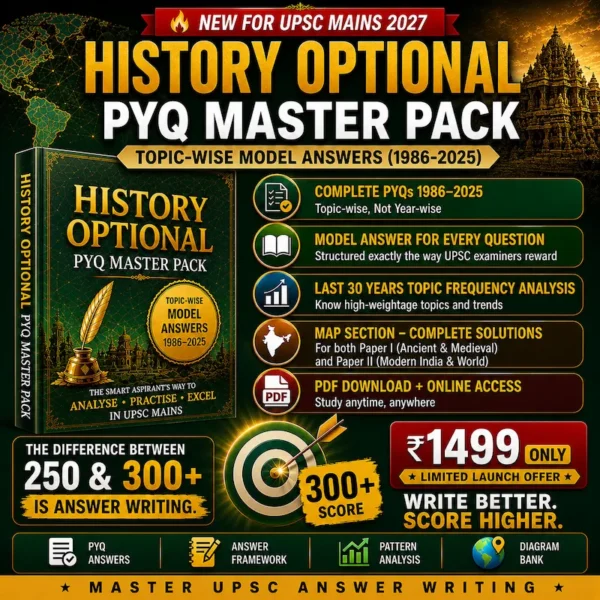
The History Optional PYQ Master Pack carries the same for every question the Commission has set since 1985, across the whole syllabus.
- PYQs 1985–2025, arranged topic-wise — revise a theme and see every way it has been asked
- Model answers with historiography — the debate cited where it belongs, not bolted on
- Map sections solved — the full 50-mark section, every year
- PDF plus online access — any device, permanently, no subscription
₹1,499 (regular ₹2,500). One-time payment, instant access.
How to use this topic list
Reading a question list feels like preparation and is not. Three sittings turn it into marks.
Sitting 1 — sort before you read (30 minutes)
- Copy the questions above into the threads identified in the previous section.
- Note which thread has gone longest without being asked — that is your priority, not the one you find most interesting.
Sitting 2 — write three answers cold (45 minutes)
- Pick the most recent question from three different threads.
- Seven minutes for a 10-marker, fifteen for a 20-marker. Stop when the time is up, even mid-sentence.
- Mark every place you wanted a historian’s name and could not produce one.
Sitting 3 — compare, then rewrite (45 minutes)
- Put your script beside the model answer for the same question.
- Compare structure first: opening claim, evidence, counter-view, judgement.
- Rewrite your weakest answer using that structure and no new content. Most candidates gain four to six marks from structure alone.
Two ways to prepare this optional
Two routes, depending on what is actually missing.
| PYQ Master Pack | Mains Master Kit 2027 | |
| Best when | Your notes are done; answer-writing is the gap | You are still building the subject |
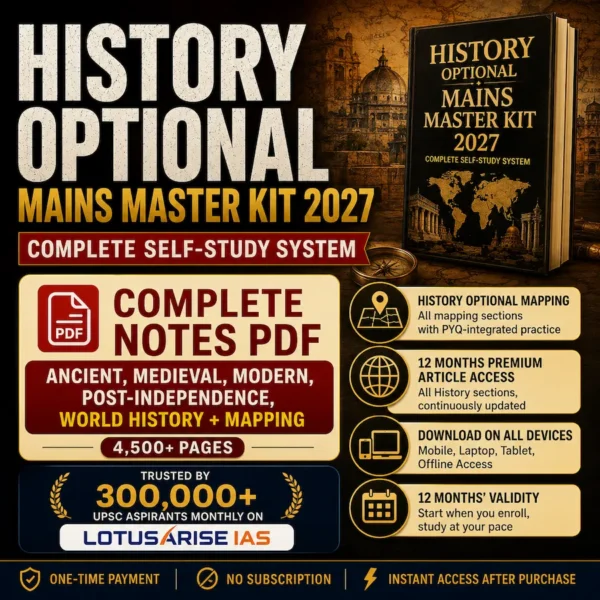
| What you get | Model answers to every question since 1985, topic-wise, map sections included | 4,500+ pages of notes, full mapping coverage, 12 months of article access |
| Price | ₹1,499 (reg. ₹2,500) | ₹1,770 (reg. ₹5,000) |
Frequently asked questions
Related topics
Ideas questions connect to:
- Origins of Modern Politics
- Revolution and Counter-Revolution
- Industrialization
- Nation-State System
- All topics — History Optional PYQs, topic-wise
Prefer to work year by year?
The complete papers, with both papers in full, unit-wise analysis and the official PDFs:
- History Optional Question Paper 2026
- History Optional Question Paper 2025
- History Optional Question Paper 2024
- History Optional Question Paper 2023
- History Optional Question Paper 2022
- History Optional Question Paper 2021
- History Optional Question Paper 2020
- UPSC History Optional Map Solutions (2013–2025)