Nation-State System: Rise of Nationalism in 19th century;
Nationalism: state building in Germany and Italy;
Disintegration of Empires in the face of the emergence of nationalities across the world.
The Nation-State System covers nineteenth-century nationalism — the unification of Germany and Italy and the Eastern Question. UPSC has set 33 questions on it between 1985 and 2025, and it has appeared in eight of the last ten papers. It is one of the most quotation-heavy units in World History, and several quotations have been set more than once.
Every question the Commission has asked on this topic is listed below, newest first, with a written model answer linked against each one.
| Questions asked (1985–2025) | 33 |
| Appeared in | 8 of the last 10 papers |
| Paper | Paper II, Section B (World History) |
| Usual mark value | 10, 15 or 20 marks |
| Model answers available | 33 of 33 |
PYQs: Nation‐State System [1985-2026]

| Year | Question | Answer |
|---|---|---|
| 2025 | "Nationalism in the 19th century was a driving force for both integration and disintegration." Illustrate with examples from Europe and other parts of the world. | View answer |
| 2024 | The unification of Germany was as much a product of coal and iron as it was of blood and iron. | View answer |
| 2023 | Discuss the different stages of the unification of Italy from 1848 to the occupation of Rome in 1870. | View answer |
| 2021 | The rise of nationalism across nations shattered the chains which held together the empires of modem Europe. Discuss. | View answer |
| 2020 | “From Bismarck's 'Blood and Iron' speech and his forceful actions to achieve German unification, Bismarck came to be known as the Iron Chancellor.” Critically examine. | View answer |
| 2019 | How was Italy transformed from a 'geographical expression’ to a nation-state? | View answer |
| 2019 | Do you subscribe to the view that the Greek War of Independence was mired in contrasts of the best and the worst episodes? How did it affect the Concert of Europe. | View answer |
| 2018 | Critically examine: At the end of the Battle of Sedan (1870), "Europe lost a mistress and gained a master." | View answer |
| 2018 | Examine the role of Bismarck in state building in Germany. | View answer |
| 2017 | What determinant factors, along with diplomatic, shaped the process of German Unification? | View answer |
| 2015 | Critically examine: “Mazzini’s conception of Italian nationality was not exclusive and his dominant ideal was the recreation of moral unity of mankind." | View answer |
| 2015 | "The Berlin Congress (1878) failed to unlock the Eastern Question. Though there was no major war in Europe for nearly three decades after the Treaty of Berlin, it contained the seeds of many future wars.” Critically evaluate. | View answer |
| 2014 | “The language of narrow nationalism held at Frankfurt destroyed the German Revolution; as the fatal idea of aggrandisement of the House of Savoy destroyed the Italian Revolution." Discuss. | View answer |
| 2012 | Was German unification achieved more by ‘coal and iron' than by ‘blood and iron'? | View answer |
| 2010 | “The Eastern Question has always been an international question.” Elucidate. | View answer |
| 2005 | ‘They have stopped me from making Italy by diplomacy from the North, I will make it by revolution from the South.' Comment. | View answer |
| 2004 | ‘To Bismarck the conclusion of the Treaty of May 20, 1882, was the culmination of this system.’ Comment. | View answer |
| 2003 | ‘Bismarck united Germany not by majority of votes and speeches but by a policy of “blood and iron". In the light of this statement assess the contribution of Bismarck to the unification of Germany. | View answer |
| 2002 | “Napoleon kindled the national sentiment, but German unity was achieved by Bismarck.” Discuss. | View answer |
| 2001 | “Bismarck created a new Germany with the policy of ‘blood and iron’.” Comment. | View answer |
| 2000 | "The Crimean War was the most useless war ever waged.” Comment. | View answer |
| 1999 | The political unification of Germany was accomplished solely by Bismarck. Comment. | View answer |
| 1998 | Lord Beaconsfield after his return from the Congress of Berlin (1878) boasted: "I have brought peace with honour” Comment. | View answer |
| 1997 | "The unification of Italy completed the destruction of the European order." Comment. | View answer |
| 1997 | Isolation of France constituted the keystone of Bismarck's foreign policy. Elucidate. | View answer |
| 1995 | At the end of the battle of Sedan (1870), "Europe lost a mistress and gained a master.” Comment. | View answer |
| 1995 | The unification of Italy and that of Germany constituted a contrast in respect of the ways they were affected and the impact they left on later international politics. Elucidate. | View answer |
| 1993 | What were the obstacles to Italian unification till 1852? How and with what methods was the unification of Italy achieved? | View answer |
| 1992 | ‘Nominally the new Turkey was republican and democratic.’ Comment. | View answer |
| 1990 | ‘The comparion between Cavour's and Bismark's achievements reveals ‘striking points of resemblance and no less striking points of dissimilarity.’ Comment in about 200 words. | View answer |
| 1989 | ‘The Eastern Question has always been an international question’. Comment in about 200 words. | View answer |
| 1987 | ‘The Unification of Germany was the one thing Bismarck was determined to prevent.’ Comment in about 200 words. | View answer |
| 1985 | “They have stopped me from making Italy by diplomacy from the North, I will make it by revolution from the South." Comment in about 200 words. | View answer |
What UPSC keeps asking about the Nation-State System
Thirty-three questions fall into five threads. German and Italian unification together account for well over half.
1. German unification and Bismarck (1987, 1999, 2001, 2002, 2003, 2012, 2014, 2017, 2018, 2020, 2024)
- Eleven questions — the largest thread.
- “Blood and iron” against “coal and iron” has been set three times (2001, 2012, 2024). The strong answer gives Prussian industry, the Zollverein and railways their weight alongside diplomacy and war, rather than crediting Bismarck alone (1999).
- Frankfurt 1848 and liberal nationalism’s failure (2014) is the necessary prelude.
2. Italian unification (1985, 1990, 1993, 1995, 1997, 2005, 2015, 2019, 2023)
- Nine questions. The stages from 1848 to 1870 (2023), from “geographical expression” to nation (2019), and the roles of Mazzini, Cavour and Garibaldi.
- Cavour’s remark about making Italy by diplomacy from the north has been set twice (1985, 2005). The Cavour-Bismarck comparison (1990, 1995) is a ready-made essay.
3. Bismarck’s diplomacy and Sedan (1995, 1997, 2004, 2018)
- Europe losing a mistress and gaining a master at Sedan (1995, 2018) — set twice.
- The isolation of France as the keystone of his system (1997), the Triple Alliance of 1882 (2004).
4. The Eastern Question (1989, 1992, 1998, 2000, 2010, 2015, 2019)
- “Always an international question” — set twice (1989, 2010). The Crimean War as useless (2000), the Berlin Congress (1998, 2015), the Greek war of independence (2019).
- Prepare it as a sequence from 1821 to 1878 with the great-power interest at each stage.
5. Nationalism as a force (2021, 2025)
- The two most recent general questions: nationalism shattering old bonds (2021), and as a force for both integration and disintegration (2025).
- The unification cases and the Ottoman and Habsburg empires together supply the answer.
Every question above, already answered
Knowing the questions is half the work. The other half is seeing what a full-mark answer to each one looks like — not a hint or a bullet outline, but a complete answer at the mark and the word limit, with the historians named inside the argument.
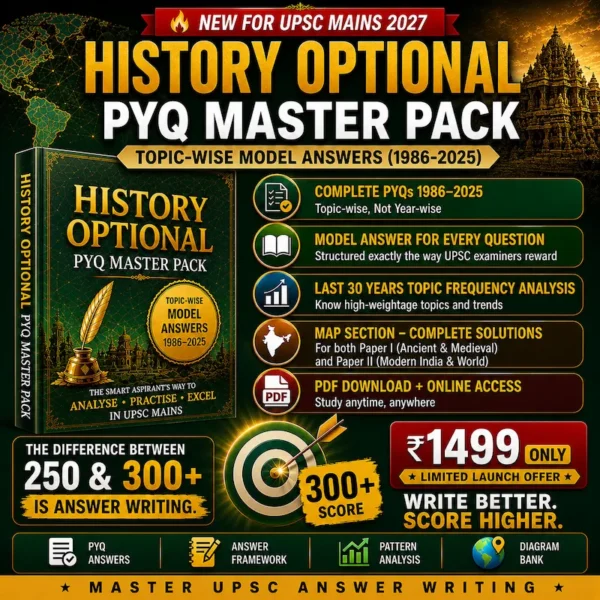
The History Optional PYQ Master Pack carries the same for every question the Commission has set since 1985, across the whole syllabus.
- PYQs 1985–2025, arranged topic-wise — revise a theme and see every way it has been asked
- Model answers with historiography — the debate cited where it belongs, not bolted on
- Map sections solved — the full 50-mark section, every year
- PDF plus online access — any device, permanently, no subscription
₹1,499 (regular ₹2,500). One-time payment, instant access.
How to use this topic list
Reading a question list feels like preparation and is not. Three sittings turn it into marks.
Sitting 1 — sort before you read (30 minutes)
- Copy the questions above into the threads identified in the previous section.
- Note which thread has gone longest without being asked — that is your priority, not the one you find most interesting.
Sitting 2 — write three answers cold (45 minutes)
- Pick the most recent question from three different threads.
- Seven minutes for a 10-marker, fifteen for a 20-marker. Stop when the time is up, even mid-sentence.
- Mark every place you wanted a historian’s name and could not produce one.
Sitting 3 — compare, then rewrite (45 minutes)
- Put your script beside the model answer for the same question.
- Compare structure first: opening claim, evidence, counter-view, judgement.
- Rewrite your weakest answer using that structure and no new content. Most candidates gain four to six marks from structure alone.
Two ways to prepare this optional
Two routes, depending on what is actually missing.
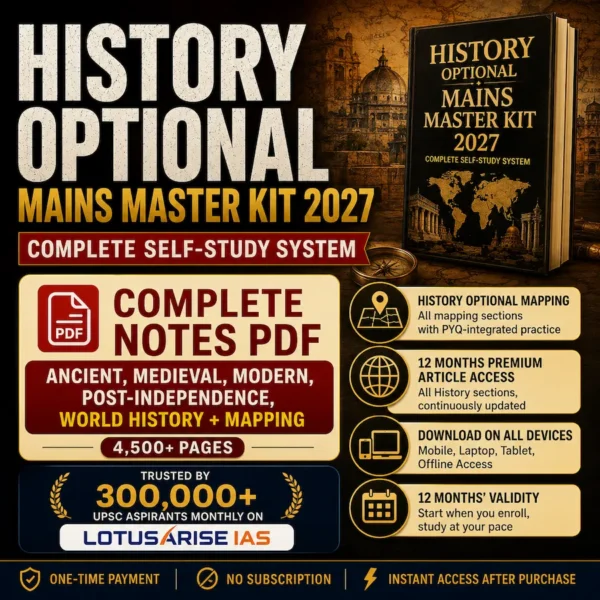
| PYQ Master Pack | Mains Master Kit 2027 | |
| Best when | Your notes are done; answer-writing is the gap | You are still building the subject |
| What you get | Model answers to every question since 1985, topic-wise, map sections included | 4,500+ pages of notes, full mapping coverage, 12 months of article access |
| Price | ₹1,499 (reg. ₹2,500) | ₹1,770 (reg. ₹5,000) |
Frequently asked questions
Related topics
This unit connects to:
- Origins of Modern Politics
- Industrialization
- Imperialism and Colonialism
- World Wars
- All topics — History Optional PYQs, topic-wise
Prefer to work year by year?
The complete papers, with both papers in full, unit-wise analysis and the official PDFs:
- History Optional Question Paper 2026
- History Optional Question Paper 2025
- History Optional Question Paper 2024
- History Optional Question Paper 2023
- History Optional Question Paper 2022
- History Optional Question Paper 2021
- History Optional Question Paper 2020
- UPSC History Optional Map Solutions (2013–2025)