Imperialism and Colonialism: South and South-East Asia; Latin America and South Africa; Australia;
Imperialism and free trade: Rise of neo-imperialism.
Imperialism and Colonialism covers European expansion in Africa, Asia and beyond, and the theories that try to explain it. UPSC has set 35 questions on it between 1985 and 2026, and it has appeared in seven of the last ten papers. It is the World History unit that most rewards comparison across regions.
Every question the Commission has asked on this topic is listed below, newest first, with a written model answer linked against each one.
| Questions asked (1985–2026) | 35 |
| Appeared in | 7 of the last 10 papers |
| Paper | Paper II, Section B (World History) |
| Usual mark value | 10, 15 or 20 marks |
| Model answers available | 34 of 35 |
PYQs: Imperialism and Colonialism [1985-2026]

| Year | Question | Answer |
|---|---|---|
| 2026 | Review the features of the 'New Imperialism' in the context of the revival of colonialism in the nineteenth century. | |
| 2025 | Did new imperialism represent a continuation of old colonial practices or did it mark a fundamental shift in global power structure? Discuss critically. | View answer |
| 2024 | To what extent underdevelopment in Latin America is caused by neo-imperialism? | View answer |
| 2023 | "The British imperialism in South Africa from 1867 to 1902 was influenced to a large extent by the capitalist mining of diamonds." Critically examine. | View answer |
| 2022 | What happened to Malaya after it was liberated from Japanese occupation in 1945? Discuss. | View answer |
| 2019 | Which factors would you attribute to the British colonial intervention in Malaya in the 19th century? How did Malaya react to British colonial rule? | View answer |
| 2017 | Examine the nature of Dutch imperialism in Indonesia. | View answer |
| 2016 | Trace the growth of British imperialism in South Africa from 1800 to 1907. | View answer |
| 2015 | History of Africa appears to be simply an extension or mere sub – theme under the broad headings of European and American history. According to this historiography, Africa seems to be without any history before the European scramble." Elucidate. | View answer |
| 2014 | To what extent did the expansion of European Powers in the late 19th century help in the modernization of Africa? | View answer |
| 2014 | “The commercial and industrial interests created a veritable hothouse atmosphere in Europe for the establishment of colonies." Critically examine in 150 words. | View answer |
| 2014 | Critically examine the socio-cultural and economic impact of migration in Europe and Asia in the 18th and 19th centuries. | View answer |
| 2014 | Discuss the nature of American overseas expansion in Asia and explain the consequences. | View answer |
| 2013 | "Colonialism not only deprives a society of its freedom and its wealth, but of its very character, leaving its people intellectually and morally disoriented." Critically examine in 150 words. | View answer |
| 2013 | “New imperialism was a nationalistic, not an economic-phenomena.” Critically examine. | View answer |
| 2011 | Explain how American imperialism in Philippines differed with European imperialism in Indonesia and Indo-China. | View answer |
| 2010 | What do you understand by Imperialism? State briefly its unique features in the case of Africa. | View answer |
| 2010 | Critically examine the Dutch colonial policy in Indonesia. | View answer |
| 2009 | “In all the long annals of Imperialism, the partition of Africa is a remarkable freak.” Comment. | View answer |
| 2009 | Discuss the emergence of neo-imperialism in the late nineteenth century. | View answer |
| 2007 | "New imperialism was a nationalistic, not an economic phenomena." Comment. | View answer |
| 2006 | “Colonies are like fruits which cling to the tree only till they ripen." Comment. | View answer |
| 2001 | Trace the various stages of European imperialism in Africa in the nineteenth century. | View answer |
| 2000 | The simultaneous expansion of European powers overseas during the last quarter of the 19th century brought them into frequent collisions at remote points all over Africa and Asia.” Comment. | View answer |
| 2000 | To what extent did the Western powers bring China under their domination without annexation? | View answer |
| 1999 | Portugal and Spain, the pioneers in world exploration, were also first in the race to conquer overseas countries. Comment. | View answer |
| 1998 | One great effect of the geographical discoveries of the 15th century was “the growing belief that America, Asia and Africa were to be used extensively for the benefit of Europeans." Comment. | View answer |
| 1996 | Trace the stages in the partition of Africa after 1870. How did it affect international relations? | View answer |
| 1995 | Divided into spheres of influence by foreign powers, China in the 19th century presented a sorry spectacle. How did China react to it? | View answer |
| 1994 | Show how the presence of a weak and helpless China next door brought about the rise of militarism and collapse of democracy in Japan. | View answer |
| 1989 | Write a critique on the partition of Africa from 1870 to 1914, with particular reference to Germany’s imperial designs in the Continent. | View answer |
| 1988 | Why is the period from 1842 to 1900 considered as half a century of humiliations in the history of China? What was the reaction of China? | View answer |
| 1987 | ‘By 1861, China may be said to have been fully though grudgingly opened to the Westerner.' Comment in about 200 words. | View answer |
| 1986 | Discuss the Self-strengthening movement in China. | View answer |
| 1985 | Critically examine the culture system in the Dutch East Indies (Indonesia) during the nineteenth century. Why was it dismantled? | View answer |
What UPSC keeps asking about Imperialism and Colonialism
Thirty-five questions fall into five threads. One is theoretical; four are regional. The strongest answers use the regional cases to test the theory.
1. Theories of the new imperialism (2000, 2007, 2009, 2010, 2013, 2014, 2025, 2026)
- Eight questions, and the core of the unit.
- “New imperialism was a nationalistic, not an economic phenomenon” — set twice (2007, 2013). Whether it continued older colonial practice (2025), its features and revival (2026).
- Know the theories by name: Hobson and Lenin on surplus capital, Robinson and Gallagher on the official mind and informal empire, Cain and Hopkins on gentlemanly capitalism. The examiner is testing whether you can weigh them.
2. The partition of Africa and South Africa (1989, 1996, 2001, 2009, 2015, 2016, 2023)
- The stages of the scramble (1996, 2001), a critique of the partition (1989, 2009), and Africa as a sub-theme of European history (2015).
- British imperialism in South Africa (2016, 2023) — diamonds, gold, the Boers and Rhodes.
3. China and the unequal treaties (1986, 1987, 1988, 1994, 1995, 2000)
- The century of humiliation (1988), spheres of influence (1995), the opening of China (1987), Self-Strengthening (1986).
- Silent since 2000. Prepare it anyway — it is the Asian case that makes a comparative answer possible.
4. Southeast Asia and American expansion (1985, 2010, 2011, 2014, 2017, 2019, 2022)
- Dutch rule in Indonesia and the culture system (1985, 2010, 2017), British intervention in Malaya (2019, 2022), American expansion in Asia and the Philippines (2011, 2014).
- Three Dutch questions make Indonesia the most reliable single case in this thread.
5. Early colonialism and its effects (1998, 1999, 2006, 2013, 2014, 2024)
- Portugal and Spain as the first imperial powers (1999), the effects of the discoveries (1998), colonies as fruit that fall when ripe (2006).
- Colonialism depriving societies of more than wealth (2013), migration (2014), and neo-imperialism and Latin American underdevelopment (2024) — dependency theory is the frame.
The model answers to this unit, in one place
Knowing the questions is half the work. The other half is seeing what a full-mark answer to each one looks like — not a hint or a bullet outline, but a complete answer at the mark and the word limit, with the historians named inside the argument.
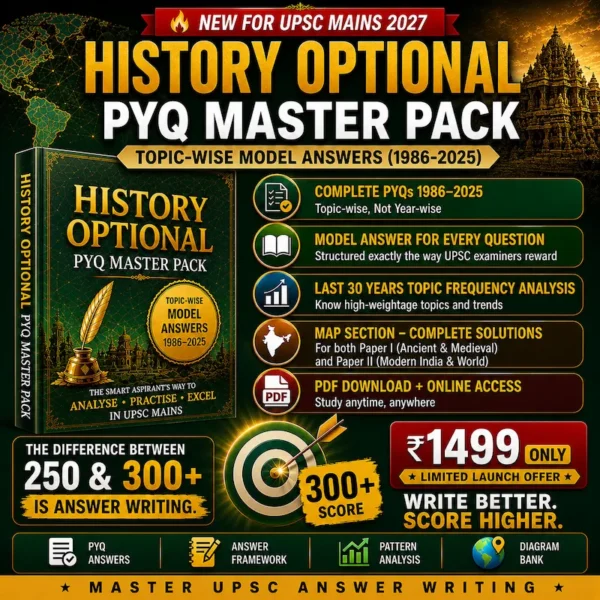
The History Optional PYQ Master Pack carries the same for every question the Commission has set since 1985, across the whole syllabus.
- PYQs 1985–2025, arranged topic-wise — revise a theme and see every way it has been asked
- Model answers with historiography — the debate cited where it belongs, not bolted on
- Map sections solved — the full 50-mark section, every year
- PDF plus online access — any device, permanently, no subscription
₹1,499 (regular ₹2,500). One-time payment, instant access.
How to use this topic list
Reading a question list feels like preparation and is not. Three sittings turn it into marks.
Sitting 1 — sort before you read (30 minutes)
- Copy the questions above into the threads identified in the previous section.
- Note which thread has gone longest without being asked — that is your priority, not the one you find most interesting.
Sitting 2 — write three answers cold (45 minutes)
- Pick the most recent question from three different threads.
- Seven minutes for a 10-marker, fifteen for a 20-marker. Stop when the time is up, even mid-sentence.
- Mark every place you wanted a historian’s name and could not produce one.
Sitting 3 — compare, then rewrite (45 minutes)
- Put your script beside the model answer for the same question.
- Compare structure first: opening claim, evidence, counter-view, judgement.
- Rewrite your weakest answer using that structure and no new content. Most candidates gain four to six marks from structure alone.
Two ways to prepare this optional
Two routes, depending on what is actually missing.
| PYQ Master Pack | Mains Master Kit 2027 | |
| Best when | Your notes are done; answer-writing is the gap | You are still building the subject |
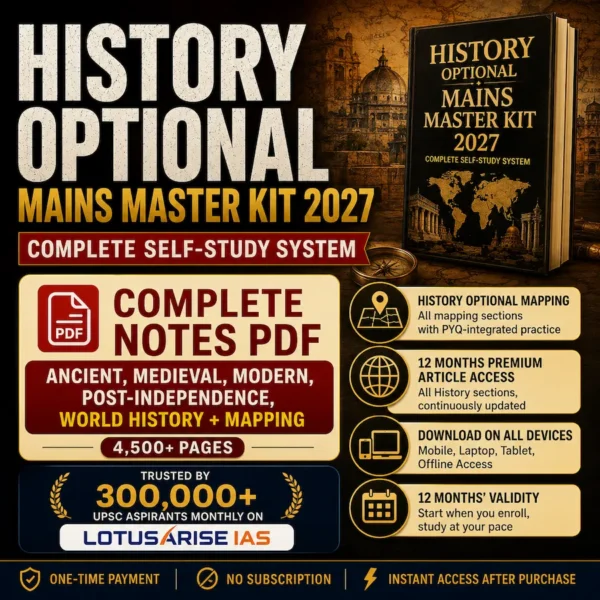
| What you get | Model answers to every question since 1985, topic-wise, map sections included | 4,500+ pages of notes, full mapping coverage, 12 months of article access |
| Price | ₹1,499 (reg. ₹2,500) | ₹1,770 (reg. ₹5,000) |
Frequently asked questions
Related topics
Imperialism questions connect to:
- Industrialization
- Nation-State System
- Liberation from Colonial Rule
- Decolonization and Underdevelopment
- All topics — History Optional PYQs, topic-wise
Prefer to work year by year?
The complete papers, with both papers in full, unit-wise analysis and the official PDFs:
- History Optional Question Paper 2026
- History Optional Question Paper 2025
- History Optional Question Paper 2024
- History Optional Question Paper 2023
- History Optional Question Paper 2022
- History Optional Question Paper 2021
- History Optional Question Paper 2020
- UPSC History Optional Map Solutions (2013–2025)