“The Khaljl Revolution”; Alauddln Khaljl: Conquests and territorial expansion, agrarian and economic measures; Muhammad Tughluq: Major projects, agrarian measures, bureaucracy of Muhammad Tughluq; Flruz Tughluq: Agrarian measures, achievements In civil engineering and public works, decline of the Sultanate, foreign contacts and Ibn Battuta’s account.
The Fourteenth Century is the single most consistently examined unit in Paper I. UPSC has set 39 questions on it between 1985 and 2026, and it has appeared in every one of the last ten papers. No other unit in Paper I has a perfect recent record. If Section B has a banker, this is it.
Every question the Commission has asked on this topic is listed below, newest first, with a written model answer linked against each one.
| Questions asked (1985–2026) | 39 |
| Appeared in | 10 of the last 10 papers |
| Paper | Paper I, Section B (Medieval India) |
| Usual mark value | 10, 15 or 20 marks |
| Model answers available | 37 of 39 |
PYQs: The Fourteenth Century [1985-2026]

| Year | Question | Answer |
|---|---|---|
| 2026 | "Muhammad-bin-Tughlaq's token currency scheme was an innovative economic experiment in medieval India, but its failure exposed the limitations of State control over the medieval economy." Evaluate. | |
| 2026 | Critically analyse Barani's Tarikh-i-Firoz Shahi and identify the shortcomings in his account. | |
| 2025 | "Alauddin Khilji's economic measures aimed at centralising political authority in the Delhi Sultanate." Elucidate. | View answer |
| 2025 | "Barani's Fatwa-i-Jahandari was not a proper account of the Delhi Sultanate, rather a lament." Elucidate. | View answer |
| 2024 | Evaluate Firuz Shah Tughluq’s economic policies. | View answer |
| 2023 | The motive of Alauddin Khilji’s agrarian policy was to curb the powers of the intermediaries. Examine the measures which he adopted to achieve his objective. | View answer |
| 2022 | The market regulations of Ala-ud-din Khilji were useful for the Sultan’s military might but harmful for the economy of the Sultanate. Comment. | View answer |
| 2021 | Why is the reign of the Khaljis known as the ‘Khalji Revolution’? | View answer |
| 2020 | Elaborate upon the agrarian reforms of Alauddin Khilji. | View answer |
| 2019 | "The economic measures of Alauddin Khalji were aimed at greater political control. Discuss | View answer |
| 2018 | "The policy of creating heterogeneous nobility by Muhammad Tughluq started the process of disintegration of Delhi Sultanate". Explain | View answer |
| 2017 | Do you agree that the schemes of Muhammad bin Tughluq were correctly conceived, badly executed and disastrously abandoned? Discuss. | View answer |
| 2017 | To what extent was the Caliphate the source and sanction to the legal authority of the Sultans of Delhi? | View answer |
| 2016 | What measures were initiated by the Sultans for the consolidation of Delhi Sultanate? Discuss | View answer |
| 2016 | Do you think that the economic measures introduced by the Sultanate rulers beneficial to the common people as well? Illustrate with examples. | View answer |
| 2014 | Analyse the ordinances mentioned by Barani which Alauddin Khalji promulgated for market control. (150 words) | View answer |
| 2014 | Evaluating the theory of kingship of the Sultanate, discuss the deviations seen in the reigns of different Sultans. | View answer |
| 2013 | What is your assessment of Ibn Batutah’s Rehla as an important source of Indian history. | View answer |
| 2012 | How did the Mongol invasions affect the Delhi Sultanate and the north – western frontier policy of the Delhi Sultans? | View answer |
| 2011 | Examine critically the agrarian and economic reforms of Alauddin Khalji. How did it strengthen the Sultanate? | View answer |
| 2009 | Write short essay: Muhammad Tughluq as an agrarian innovator. | View answer |
| 2006 | Write brief essay: The Khilji Revolution. | View answer |
| 2006 | Bring out the main features of the administrative system under Delhi Sultanate during Turko-Afghan period. | View answer |
| 2004 | Write brief essay: The Token Currency System introduced by Muhammad Tughlaq. | View answer |
| 2003 | Write brief essay: Experiments of Mohammad Tughluq. | View answer |
| 2002 | Discuss Balban’s concept of kingship. How was it modified by Alauddin Khalji? | View answer |
| 2001 | Assess the impact of the market reforms of Alauddin Khilji on contemporary economy and society. | View answer |
| 2000 | Form an estimate of the personality of Firoz Shah Tughlaq with special reference to his religious policy and public works. | View answer |
| 1999 | Write brief essay – Alauddin Khilji was a typical despot. | View answer |
| 1997 | Discuss the implications of Khilji with reference to administration and economic regulations on the State and people of India. | View answer |
| 1994 | Write brief essay on Ziauddin Barani as a historian. | View answer |
| 1993 | Examine the significance of Alauddin Khalji’s administrative reforms. Was he really successful in implementing these measures? | View answer |
| 1992 | Muhammad Bin Tughlaq's contradictory qualities were beyond the grasp knowledge and common sense. Evaluate the significance of his administrative measures and policies in the light of this statement. | View answer |
| 1991 | What,in your opinion, was the significance of the extensive military expeditions undertaken during the time of Alauddin Khalji ? Do you think his reign is considered significant in terms of such expeditions alone? | View answer |
| 1990 | ‘Firuz Tugluq has been overshadowed by Muhammad Tughluq.’ In the light of this statement evaluate the significance of the policies and actions of Firuz Tughluq. | View answer |
| 1989 | The significance of Alauddin Khilji economic regulations for his imperialism. Write short answer of not more than 200 words. | View answer |
| 1988 | Was the state in the Sultanate period a theocracy? Discuss the new orientation of state policies and administrative principles under Muhammad bin Tughluq. | View answer |
| 1987 | Critically examine the price control measures of Alauddin Khilji. What was the main objective behind them and how far was he able to put them into effect? | View answer |
| 1985 | Examine the responsibility of Firoz Tughluq for the fall of his dynasty. Write short answer of not more than 200 words. | View answer |
What UPSC keeps asking about the Fourteenth Century
Thirty-nine questions sound like a vast unit. They are not. Nearly all of them come back to two rulers and one historian, which is why this unit repays deep rather than broad preparation.
1. Alauddin Khalji’s economic measures (1987, 1989, 2001, 2011, 2014, 2019, 2020, 2022, 2023, 2025)
- Ten questions — the most repeated subject in the whole of Paper I.
- Market regulations, price control and agrarian reform. The framing has settled on motive: were they for the army (2022), for political control (2019, 2025), or to curb the rural intermediaries (2023)?
- Irfan Habib’s reading of the agrarian measures as an attack on the khuts and muqaddams is the historiography to cite. The answer that simply lists the regulations scores in single digits.
2. Muhammad bin Tughluq’s experiments (1992, 2003, 2004, 2009, 2017, 2018, 2026)
- Token currency (2004, 2026), the transfer of capital, the Doab taxation and agrarian schemes (2009).
- 2017 asked whether the schemes were well conceived but badly executed — the standard verdict, which you are expected to test rather than repeat.
- 2018 on his heterogeneous nobility is the question that shows the examiner has read the recent scholarship.
3. Barani and the sources (1994, 2013, 2014, 2025, 2026)
- Barani as historian (1994), his Fatwa-i-Jahandari as political theory rather than record (2025), and the shortcomings of his Tarikh-i-Firoz Shahi (2026).
- Ibn Battuta’s Rehla (2013) is the counterweight source. Barani’s aristocratic and religious bias is the point every answer must make.
4. Kingship, the Caliphate and the nature of the state (1988, 2002, 2014, 2017)
- Was the Sultanate a theocracy (1988)? How far was the Caliphate the sanction for authority (2017)?
- Balban’s theory of kingship and Alauddin’s modification of it (2002) connect this thread to the thirteenth century.
5. The Khalji Revolution and Firuz Shah (1985, 1990, 1997, 2000, 2006, 2021, 2024)
- The “Khalji Revolution” — the widening of the ruling class beyond the Turkish nobility — asked in 2006 and 2021.
- Firuz Shah Tughluq: his economic policies (2024), his personality (2000), his responsibility for the dynasty’s fall (1985).
6. Consolidation, Mongols and expansion (1991, 2006, 2012, 2016)
- Southern expeditions (1991), the Mongol invasions (2012), measures of consolidation (2016).
- The least recently asked thread, and the one most often neglected.
The model answers to this unit, in one place
Knowing the questions is half the work. The other half is seeing what a full-mark answer to each one looks like — not a hint or a bullet outline, but a complete answer at the mark and the word limit, with the historians named inside the argument.
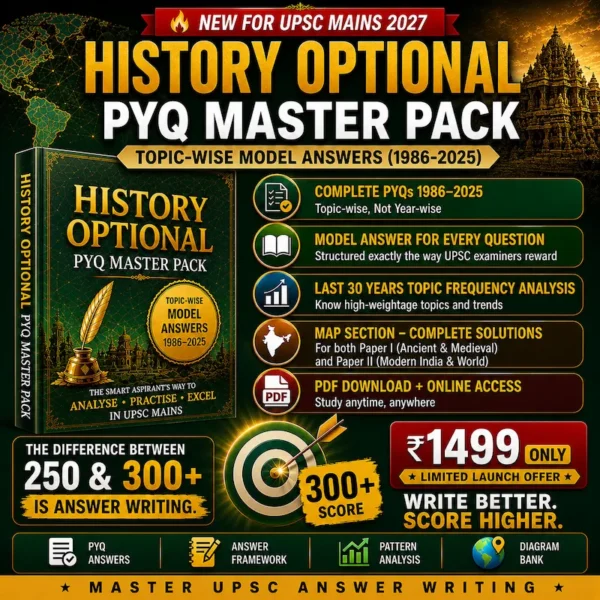
The History Optional PYQ Master Pack carries the same for every question the Commission has set since 1985, across the whole syllabus.
- PYQs 1985–2025, arranged topic-wise — revise a theme and see every way it has been asked
- Model answers with historiography — the debate cited where it belongs, not bolted on
- Map sections solved — the full 50-mark section, every year
- PDF plus online access — any device, permanently, no subscription
₹1,499 (regular ₹2,500). One-time payment, instant access.
How to use this topic list
Reading a question list feels like preparation and is not. Three sittings turn it into marks.
Sitting 1 — sort before you read (30 minutes)
- Copy the questions above into the threads identified in the previous section.
- Note which thread has gone longest without being asked — that is your priority, not the one you find most interesting.
Sitting 2 — write three answers cold (45 minutes)
- Pick the most recent question from three different threads.
- Seven minutes for a 10-marker, fifteen for a 20-marker. Stop when the time is up, even mid-sentence.
- Mark every place you wanted a historian’s name and could not produce one.
Sitting 3 — compare, then rewrite (45 minutes)
- Put your script beside the model answer for the same question.
- Compare structure first: opening claim, evidence, counter-view, judgement.
- Rewrite your weakest answer using that structure and no new content. Most candidates gain four to six marks from structure alone.
Two ways to prepare this optional
Two routes, depending on what is actually missing.
| PYQ Master Pack | Mains Master Kit 2027 | |
| Best when | Your notes are done; answer-writing is the gap | You are still building the subject |
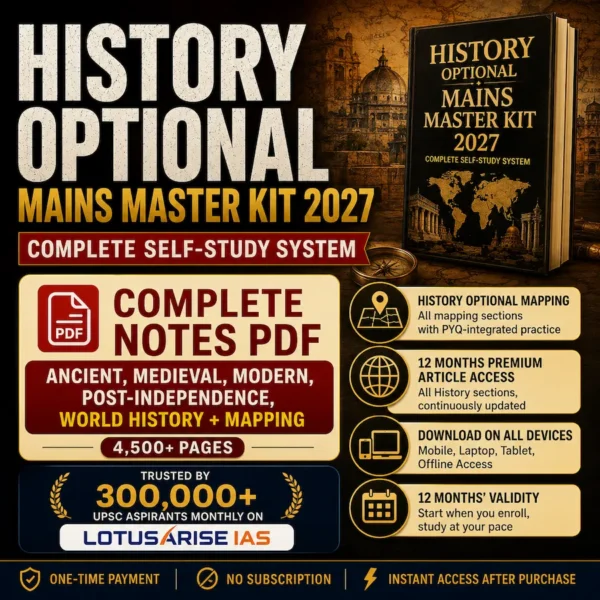
| What you get | Model answers to every question since 1985, topic-wise, map sections included | 4,500+ pages of notes, full mapping coverage, 12 months of article access |
| Price | ₹1,499 (reg. ₹2,500) | ₹1,770 (reg. ₹5,000) |
Frequently asked questions
Related topics
Sultanate questions frequently cross into these units:
- The Thirteenth Century
- Cultural Traditions in India, 750–1200
- Akbar
- Economy and Society in the 16th and 17th Centuries
- All topics — History Optional PYQs, topic-wise
Prefer to work year by year?
The complete papers, with both papers in full, unit-wise analysis and the official PDFs:
- History Optional Question Paper 2026
- History Optional Question Paper 2025
- History Optional Question Paper 2024
- History Optional Question Paper 2023
- History Optional Question Paper 2022
- History Optional Question Paper 2021
- History Optional Question Paper 2020
- UPSC History Optional Map Solutions (2013–2025)