Philosophy: Skankaracharya and Vedanta, Ramanuja and Vlshishtadvalta, Madhva and Brahma-Mlmansa; Religion: Forms and features of religion, Tamil devotional cult, growth of Bhaktl, Islam and Its arrival In India, Sufism; Literature: Literature In Sanskrit, growth of Tamil literature, literature In the newly developing languages, Kalhan’s Rajtaranglnl, Alberunl’s India; Art and Architecture: Temple architecture, sculpture, painting
Cultural Traditions in India, 750–1200, is one of the most reliably examined units in Paper I Section B. UPSC has set 37 questions on it between 1987 and 2026, appearing in seven of the last ten papers — and 2024 alone carried three. Its questions are unusually predictable: the same four subjects have been asked, in rotation, for almost forty years.
Every question the Commission has asked on this topic is listed below, newest first, with a written model answer linked against each one.
| Questions asked (1987–2026) | 37 |
| Appeared in | 7 of the last 10 papers |
| Paper | Paper I, Section B (Medieval India) |
| Usual mark value | 10, 15 or 20 marks |
| Model answers available | 36 of 37 |
PYQs: Cultural Traditions in India, 750‐1200 [1985-2026]

| Year | Question | Answer |
|---|---|---|
| 2026 | The Sufis created a climate in which people belonging to different sects and religions could live in peace and harmony." Discuss. | |
| 2024 | Illustrate the main features of Vesara style temple architecture. | View answer |
| 2024 | Analyze the contributions of Acharya Triumvirate to Indian Vedanta. | View answer |
| 2024 | Evaluate the contribution of Qalandariyyah to medieval Indian culture. | View answer |
| 2023 | Examine the defects in Alberuni’s assessment of Indian society. | View answer |
| 2022 | The Virashaiva Movement of Southern Deccan in the twelfth century was essentially an attempt at social reform. Discuss. | View answer |
| 2021 | Discuss the relationship between emergence of literature in vernacular languages and formation of regional identities in early medieval India. | View answer |
| 2021 | Discuss the attitude of Chishti saints towards the state. How were the Suhrawardi saints different in their attitude towards the government? (in about 150 words) | View answer |
| 2021 | The Chola rulers were not only mighty conquerors, efficient administrators but also builders of fine temples." Comment. | View answer |
| 2019 | Assess the statement that ‘the philosophy of Shankaracharya revolutionized religious thoughts in India.’ | View answer |
| 2017 | The 11th – 12th centuries C.E. saw eventful progression in the cultural history of India. Discuss. (150 words) | View answer |
| 2017 | Discuss the Caurapancashika andJain styles of paintings. Can the Caurapancashika style truly be called the precursor of pothi format? | View answer |
| 2017 | Do you consider the Rajatarangini of Kalhana to be a reliable source of the political history of Kashmir? Why? (150 words) | View answer |
| 2016 | Comment on the veracity of Alberuni's account of Indian society. | View answer |
| 2016 | The Advaita doctrine of Shankara cut at the very root of Bhaktivada." Do you agree? | View answer |
| 2016 | How did the temples of South India, as financial institutions, have deep impact on the social institutions of early medieval period? Critically examine. | View answer |
| 2015 | Give a brief account of the early medieval temple architecture of Kashmir. | View answer |
| 2015 | Why is Mamallapuram famous? | View answer |
| 2014 | Evaluate the ‘Kitab al-Hind' of Alberuni as a source of history of India. | View answer |
| 2012 | Evaluate Rajtarangini as a source of history. | View answer |
| 2012 | Assess the contribution of the Acharyas in the development of the ideological basis of bhakti. | View answer |
| 2010 | How far do you agree with the view that the temples in the early medieval period were catalysts in spreading education? | View answer |
| 2009 | Assess Kalhana’s views on history. | View answer |
| 2008 | What are the manifestations of Tamil devotional cults ? How do you account for their growth between C. 750 and C. 1200 CE? | View answer |
| 2007 | Write brief essay on Alberuni on science in India. | View answer |
| 2003 | Write brief essay on Kalhan as a historian. | View answer |
| 2003 | Attempt a critical essay on the Indian Science and Civilisation in the light of Alberuni’s writings. What merits and drawbacks, do you find in his account? | View answer |
| 2002 | Write brief essay : Origin of the Bhakti Movement. | View answer |
| 2001 | Write brief essay : The Vedanta of Sankaracharya. | View answer |
| 1999 | Trace influence of Islam on Indian culture and civilization. | View answer |
| 1999 | Critically evaluate the contribution of Rashtrakutas to art and culture. | View answer |
| 1998 | Write brief essay on Al-Biruni’s India. | View answer |
| 1994 | Do_you agree with the view that the form and content of temple architecture in South India between c. A.D. 750 and 1200 were products of a specific economic and political milieu? | View answer |
| 1992 | Discuss the role of the Rashtrakutas for the mastery of Kanauj and assess their contribution to art and culture. | View answer |
| 1990 | ‘Sankaracharya brought about a synthesis of ideas and philosophies.’ Discuss the statement and analyse the historical significance of his life and thought. | View answer |
| 1989 | Discuss the salient features of Indian society on the eve of the campaigns of Mahmud of Ghazni, with particular reference to the observations made by AlBiruni. | View answer |
| 1987 | Shankaracharya's philosophy and its impact. Write short answer of not more than 200 words. | View answer |
| Hoysala temple architecture marks a distinctive and innovative phase in the evolution of South Indian art and architecture." Illustrate with examples. (2026) — and |
What UPSC keeps asking about Cultural Traditions, 750–1200
Almost every question on this unit falls into one of five threads, and the first three are among the most repeated subjects anywhere in the optional.
1. Alberuni and Kalhana as sources (1998, 2003, 2007, 2009, 2012, 2014, 2016, 2017, 2023)
- Nine questions, and the demand is always critical: how reliable, how biased, what defects.
- Alberuni: 1998, 2003, 2007, 2014, 2016, 2023 — asked with growing scepticism, ending with the defects of his account of Indian society. Separate what he read in Sanskrit texts from what he observed, and note his dependence on Brahmin informants.
- Kalhana: 2003, 2009, 2012, 2017 — his critical method, his sources, and where the Rajatarangini becomes unreliable for early reigns.
2. Shankara and the Acharyas (1987, 1990, 2001, 2012, 2016, 2019, 2024)
- Seven questions. The recurring framing asks for Shankara’s impact and whether Advaita cut at the root of Bhakti (2016) or revolutionised religious thought (2019).
- 2024 widened it to the Acharya triumvirate — Shankara, Ramanuja and Madhva — so prepare Vishishtadvaita and Dvaita as replies to Advaita, not as separate notes.
3. Bhakti, Sufism and religious movements (2002, 2008, 2021, 2022, 2024, 2026)
- The most recently active thread. Tamil devotional cults (2008), the Virashaiva movement (2022), Chishti and Suhrawardi attitudes to the state (2021), the Qalandars (2024), Sufi tolerance (2026).
- The 2021 Chishti-Suhrawardi contrast is a classic short answer: distance from the court against engagement with it.
4. Temple architecture and temples as institutions (1994, 1999, 2010, 2015, 2016, 2021, 2024)
- Style questions (Vesara in 2024, Kashmir in 2015, Mamallapuram in 2015) sit beside institutional ones: temples as financial institutions (2016) and as centres of economic and social life (2010).
- The institutional framing is the one that separates strong scripts — land, credit, employment and redistribution through the temple.
5. Literature, painting and cultural contact (1989, 1999, 2017, 2021)
- Vernacular literature and regional identity (2021), Caurapancashika and Jain painting (2017), the influence of Islam on Indian culture (1999).
- Thinner and less predictable than the other four, but a single prepared answer on each covers the ground.
The model answers to this unit, in one place
Knowing the questions is half the work. The other half is seeing what a full-mark answer to each one looks like — not a hint or a bullet outline, but a complete answer at the mark and the word limit, with the historians named inside the argument.
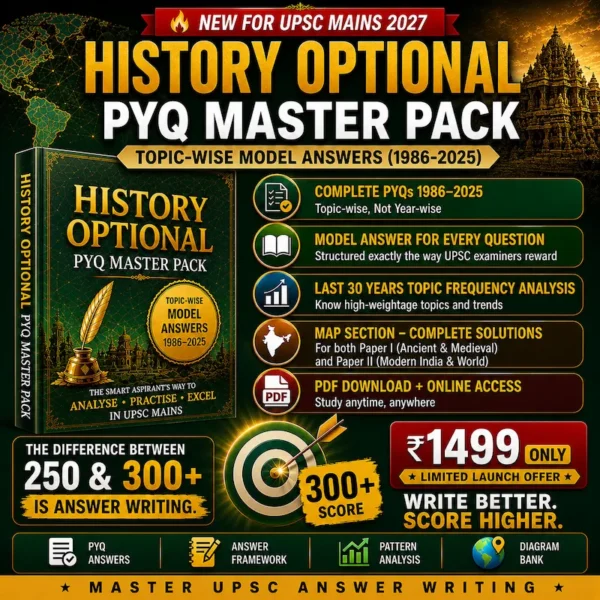
The History Optional PYQ Master Pack carries the same for every question the Commission has set since 1985, across the whole syllabus.
- PYQs 1985–2025, arranged topic-wise — revise a theme and see every way it has been asked
- Model answers with historiography — the debate cited where it belongs, not bolted on
- Map sections solved — the full 50-mark section, every year
- PDF plus online access — any device, permanently, no subscription
₹1,499 (regular ₹2,500). One-time payment, instant access.
How to use this topic list
Reading a question list feels like preparation and is not. Three sittings turn it into marks.
Sitting 1 — sort before you read (30 minutes)
- Copy the questions above into the threads identified in the previous section.
- Note which thread has gone longest without being asked — that is your priority, not the one you find most interesting.
Sitting 2 — write three answers cold (45 minutes)
- Pick the most recent question from three different threads.
- Seven minutes for a 10-marker, fifteen for a 20-marker. Stop when the time is up, even mid-sentence.
- Mark every place you wanted a historian’s name and could not produce one.
Sitting 3 — compare, then rewrite (45 minutes)
- Put your script beside the model answer for the same question.
- Compare structure first: opening claim, evidence, counter-view, judgement.
- Rewrite your weakest answer using that structure and no new content. Most candidates gain four to six marks from structure alone.
Two ways to prepare this optional
Two routes, depending on what is actually missing.
| PYQ Master Pack | Mains Master Kit 2027 | |
| Best when | Your notes are done; answer-writing is the gap | You are still building the subject |
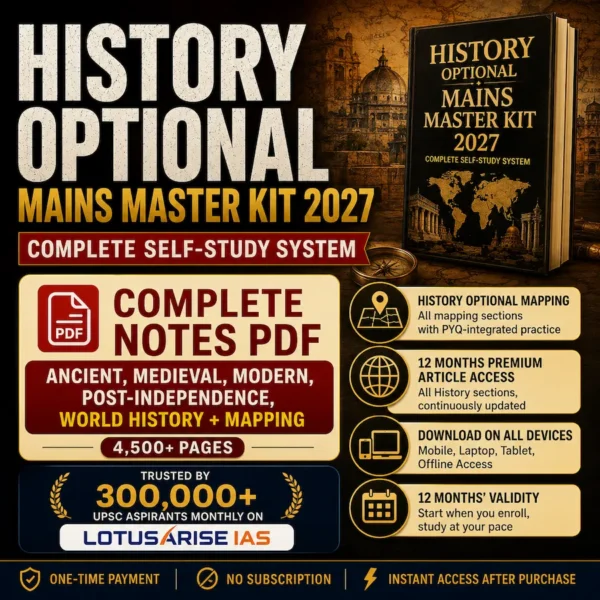
| What you get | Model answers to every question since 1985, topic-wise, map sections included | 4,500+ pages of notes, full mapping coverage, 12 months of article access |
| Price | ₹1,499 (reg. ₹2,500) | ₹1,770 (reg. ₹5,000) |
Frequently asked questions
Related topics
Cultural questions from this period frequently borrow from:
- Early Medieval India, 750–1200
- Themes in Early Indian Cultural History
- Regional States during Gupta Era
- The Fourteenth Century
- All topics — History Optional PYQs, topic-wise
Prefer to work year by year?
The complete papers, with both papers in full, unit-wise analysis and the official PDFs:
- History Optional Question Paper 2026
- History Optional Question Paper 2025
- History Optional Question Paper 2024
- History Optional Question Paper 2023
- History Optional Question Paper 2022
- History Optional Question Paper 2021
- History Optional Question Paper 2020
- UPSC History Optional Map Solutions (2013–2025)