Polity: Major political developments in Northern India and the Peninsula, origin and the rise of Rajputs;
The Cholas: administration, village economy and society;
“Indian Feudalism”: Agrarian economy and urban settlements; Trade and commerce;
Society: the status of the Brahman and the new social order; Condition of women;
Indian science and technology
Early Medieval India, 750–1200, opens Section B of Paper I and is one of its heaviest units. UPSC has set 39 questions on it between 1985 and 2026, appearing in six of the last ten papers. Two subjects carry most of that weight: the Chola state and the Indian feudalism debate.
Every question the Commission has asked on this topic is listed below, newest first, with a written model answer linked against each one.
| Questions asked (1985–2026) | 39 |
| Appeared in | 6 of the last 10 papers |
| Paper | Paper I, Section B (Medieval India) |
| Usual mark value | 10, 15 or 20 marks |
| Model answers available | 37 of 39 |
PYQs: Early Medieval India, 750‐1200 [1985-2026]

| Year | Question | Answer |
|---|---|---|
| 2026 | Critically examine the theories on the origin of the Rajputs. How do the indigenous evidences contradict the European theorists? | |
| 2026 | "The success of the Cholas as an imperial power rested not only on the administrative efficiency, but also on a well-organized army and a formidable navy." Evaluate. | |
| 2025 | "The dynamics of social mobility in early medieval India were shaped by a complex interplay of caste hierarchies, religious legitimation, economic transformation and political patronage." Critically assess how these factors collectively reconfigured the structure of early medieval Indian society. | View answer |
| 2023 | Discuss the various proponents of Indian feudalism. | View answer |
| 2022 | Evaluate the importance of tripartite struggle for the domination over north India during the eighth and ninth centuries. | View answer |
| 2022 | Chola maritime expansion was driven largely by the concerns of overseas commerce. Elucidate. | View answer |
| 2022 | What were 'Brahmdeya' grants? How do you account for the large number of such grants in the early medieval period? | View answer |
| 2021 | Large number of land grants in hitherto non-arable tracts invariably meant expansion of agriculture in early medieval India. How did the management of hydraulic resources (different types of irrigation works) facilitate expansion of agriculture in this period? | View answer |
| 2021 | Discuss the different stages of India feudalism and analyze its impact on Indian political system, (in about 150 words). | View answer |
| 2018 | "Doubtless it was not a free state; it was any rate a state" (KAN Sastri). Reflect upon the nature of local self-government institutions in the Chola country. | View answer |
| 2018 | Critically analyze the changing nature of caste and gender relations during the early medieval period. | View answer |
| 2016 | Analyze the significance of the Uttaramerur inscriptions of the Chola king Parantaka I. | View answer |
| 2016 | Explain the ingredients of the transitory nature of the early medieval India. | View answer |
| 2015 | Do the evidences of land ownership at our disposal support the theory of the prevalence of feudalism in early medieval India? | View answer |
| 2015 | How could the local self – government under the Cholas adjust with their centralised administrative structure? | View answer |
| 2014 | Evaluating various theories regarding the Chola State, throw light on its village assemblies. | View answer |
| 2012 | What kind of changes were visualised by historians on Indian feudalism? Examine critically. | View answer |
| 2012 | Evaluate the role of nadu and nagaram in the growth of urbanisation under the Cholas. | View answer |
| 2011 | Evaluate the socio-economic conditions from the Gupta Period to 1200 C.E. as gleaned from the various types of grants or danashasana. | View answer |
| 2011 | Assess the contribution of Cholas in the expansion of Indian culture outside India. | View answer |
| 2010 | To what extent “monetary anaemia" afflicted the erstwhile commercial economy during the early medieval period? | View answer |
| 2009 | Write short essay on Applicability of the term ‘Indian Feudalism’ to early Medieval society. | View answer |
| 2009 | How far can the village assemblies or communities under the Cholas be really called democratic? | View answer |
| 2007 | Show that the administrative system in India reached a very high level during the Chola period. | View answer |
| 2005 | Write brief essay on The Samanta system. | View answer |
| 2004 | The Cholas are said to have established a strong and well organised administration with an element of self-government at the local level. Do you agree? Give reasons. | View answer |
| 2000 | Were the Chola village assemblies democratic in nature? Give reasons for your answer. | View answer |
| 1998 | Write brief essay on Social structure of the Rajputs. | View answer |
| 1998 | Critically evaluate the achievements of the Cholas. | View answer |
| 1997 | “Achieving dominance in south of the Vindhyas did not satisfy the ambitions of the Rashtrakutas, they also wanted to achieve dominance over the Gangetic Plains." Elaborate and comment. | View answer |
| 1996 | Assess the importance of the Cholas in the history of South India. | View answer |
| 1996 | Give an account of the Society in Northern and Central India since the death of Harsha to the Muslim conquest of North India. | View answer |
| 1995 | Write a brief note on Land charters of north India (c. A-D. 750-1200). | View answer |
| 1993 | Discuss the contribution of Rajaraja I and Rajendra I for the expansion of the Chola empire. Analyse the causes and impact of the naval expeditions of the Cholas. | View answer |
| 1992 | Write brief essay on Local self-government under the Cholas. | View answer |
| 1991 | Critically assess the period of the Cholas in the history of South India. | View answer |
| 1988 | Bring out the salient features of the polity & social structure of the Rajputs. To what extent were they responsible for the weakness of the Rajput resistance to foreign invaders? | View answer |
| 1987 | Main sources of information for the history of the 13th century. Write short answer of not more than 200 words. | View answer |
| 1985 | What were the salient features of the bureaucratic machinery of the Cholas? Write short answer of not more than 200 words. | View answer |
What UPSC keeps asking about Early Medieval India
The questions fall into five threads. If you prepare only two, prepare the first two — between them they account for well over half of everything asked on this period.
1. The Chola state — centralised empire or segmentary polity? (1985, 1991, 1992, 1996, 1998, 2000, 2004, 2007, 2009, 2014, 2015, 2016, 2018, 2026)
- The most examined subject in the whole of Section B — fourteen questions.
- The recurring problem is how a powerful monarchy coexisted with vigorous local assemblies: were the ur, sabha and nagaram democratic (2000, 2009), and how did local self-government fit a centralised state (2015)?
- 2018 quoted K. A. Nilakanta Sastri; 2014 asked you to evaluate the theories of the Chola state. Set Sastri’s centralised reading against Burton Stein’s segmentary state and Y. Subbarayalu’s nadu-based account. The Uttaramerur inscriptions (2016) are the evidence everyone must cite.
2. Indian feudalism (1995, 2005, 2009, 2010, 2012, 2015, 2021, 2022, 2023)
- The historiographical heart of the period — nine questions, three since 2021.
- R. S. Sharma and D. N. Jha argued for feudalism from land grants, monetary anaemia and urban decay; Harbans Mukhia asked whether India had feudalism at all; B. D. Chattopadhyaya and Hermann Kulke reframed the grants as state formation.
- 2010 asked directly about “monetary anaemia”; 2022 about brahmadeya grants; 2023 about the proponents. Know who argued what, and why the argument lost ground.
3. Chola expansion beyond India (1993, 2011, 2022)
- Rajaraja I and Rajendra I (1993), cultural expansion abroad (2011), and whether maritime expansion was driven by commerce (2022).
- The Srivijaya campaign and the merchant guilds — Ayyavole and Manigramam — are the specifics that lift an answer.
4. Rajputs and the struggle for the north (1988, 1997, 1998, 2022, 2026)
- The tripartite struggle for Kanauj (2022) and the Rashtrakuta ambition north of the Vindhyas (1997).
- 2026 asked you to examine the theories of Rajput origin and the role of indigenous elements — agnikula legend against the state-formation reading of local lineages becoming Rajput.
5. Society, caste and gender (1996, 2011, 2016, 2018, 2025)
- Changing caste and gender relations (2018), social mobility (2025), and the transitory character of the period (2016).
- The strong answer connects social change to the land-grant economy: new cultivating castes, the proliferation of jatis, Brahmanical expansion into tribal areas.
The model answers to this unit, in one place
Knowing the questions is half the work. The other half is seeing what a full-mark answer to each one looks like — not a hint or a bullet outline, but a complete answer at the mark and the word limit, with the historians named inside the argument.
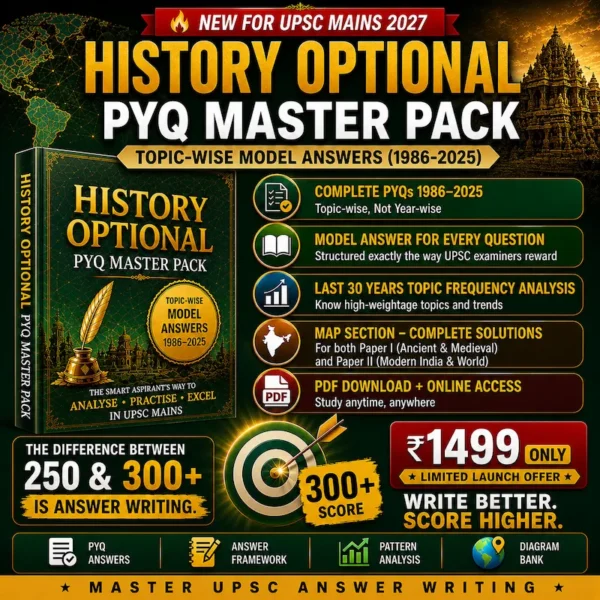
The History Optional PYQ Master Pack carries the same for every question the Commission has set since 1985, across the whole syllabus.
- PYQs 1985–2025, arranged topic-wise — revise a theme and see every way it has been asked
- Model answers with historiography — the debate cited where it belongs, not bolted on
- Map sections solved — the full 50-mark section, every year
- PDF plus online access — any device, permanently, no subscription
₹1,499 (regular ₹2,500). One-time payment, instant access.
How to use this topic list
Reading a question list feels like preparation and is not. Three sittings turn it into marks.
Sitting 1 — sort before you read (30 minutes)
- Copy the questions above into the threads identified in the previous section.
- Note which thread has gone longest without being asked — that is your priority, not the one you find most interesting.
Sitting 2 — write three answers cold (45 minutes)
- Pick the most recent question from three different threads.
- Seven minutes for a 10-marker, fifteen for a 20-marker. Stop when the time is up, even mid-sentence.
- Mark every place you wanted a historian’s name and could not produce one.
Sitting 3 — compare, then rewrite (45 minutes)
- Put your script beside the model answer for the same question.
- Compare structure first: opening claim, evidence, counter-view, judgement.
- Rewrite your weakest answer using that structure and no new content. Most candidates gain four to six marks from structure alone.
Two ways to prepare this optional
Two routes, depending on what is actually missing.
| PYQ Master Pack | Mains Master Kit 2027 | |
| Best when | Your notes are done; answer-writing is the gap | You are still building the subject |
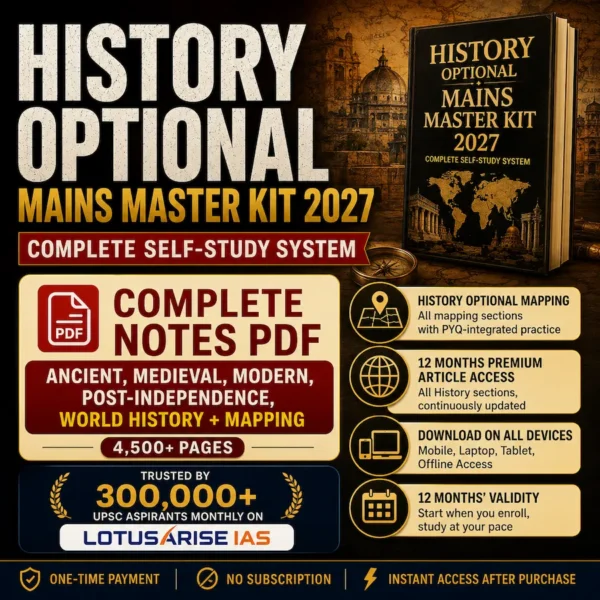
| What you get | Model answers to every question since 1985, topic-wise, map sections included | 4,500+ pages of notes, full mapping coverage, 12 months of article access |
| Price | ₹1,499 (reg. ₹2,500) | ₹1,770 (reg. ₹5,000) |
Frequently asked questions
Related topics
This period links the ancient and medieval halves of Paper I:
- Regional States during Gupta Era
- Guptas, Vakatakas and Vardhanas
- Cultural Traditions in India, 750–1200
- The Thirteenth Century
- All topics — History Optional PYQs, topic-wise
Prefer to work year by year?
The complete papers, with both papers in full, unit-wise analysis and the official PDFs:
- History Optional Question Paper 2026
- History Optional Question Paper 2025
- History Optional Question Paper 2024
- History Optional Question Paper 2023
- History Optional Question Paper 2022
- History Optional Question Paper 2021
- History Optional Question Paper 2020
- UPSC History Optional Map Solutions (2013–2025)