Languages and texts, major stages In the evolution of art and architecture, major philosophical thinkers and schools, Ideas In Science and Mathematics.
Themes in Early Indian Cultural History is a smaller unit — 12 questions between 1991 and 2026, appearing in four of the last ten papers. It is also the unit most likely to overlap with others, because its questions on art, science and historical writing reach back across the whole of Ancient India.
Every question the Commission has asked on this topic is listed below, newest first, with a written model answer linked against each one.
| Questions asked (1991–2026) | 12 |
| Appeared in | 4 of the last 10 papers |
| Paper | Paper I, Section A (Ancient India) |
| Usual mark value | 10, 15 or 20 marks |
| Model answers available | 11 of 12 |
PYQs: Themes in Early Indian Cultural History [1985-2025]

| Year | Question | Answer |
|---|---|---|
| 2026 | Royal patronage and religious institutions significantly contributed to the development of Nalanda, Vikramashila and Vallabhi into prominent centres of learning." Elucidate. (2026) — and "Analyze the significance of the Vedic Age in shaping the social institutions, religious thoughts and intellectual traditions of ancient India. | |
| 2025 | Critically evaluate the major stages in the development of art and literature in early medieval India and explain how these stages reflected the broader changes in society and patterns of patronage during the period. | View answer |
| 2022 | With the help of representative examples, delineate the main differences between the Nagara and Dravida styles of temple architecture. | View answer |
| 2022 | Kalhana’s Rajatarangini is the best example of history writing tradition in early India. Discuss. | View answer |
| 2020 | Trace and identify the changing pattern of Tantrism in Ancient India with examples. | View answer |
| 2016 | The changes in the field of art from the Kushana period to early medieval period are mere reflection of changing outlook" Comment. | View answer |
| 2015 | Kailasa temple built at Ellora marks the culmination of rock – cut architecture in India. Elucidate. | View answer |
| 2011 | Discuss the types of lands and the science of agriculture mentioned in the literature and epigraphs of ancient India. | View answer |
| 2006 | Discuss the major stages in the evolution of architecture during the ancient period. | View answer |
| 2002 | Examine the proficiency of the ancient Indians in various crafts, science and mathematics. | View answer |
| 1994 | Trace the scientific & technological developments in India up to c. A.D. 750. | View answer |
| 1991 | Discuss the scientific and technological developments in ancient India. | View answer |
What UPSC keeps asking about early Indian cultural history
Twelve questions is a modest sample, so these three threads describe what the questions share rather than a firm rotation. The clear signal is a shift: science dominated the 1990s, art and religion dominate now.
1. Art and architecture as a long evolution (2006, 2015, 2016, 2022, 2025)
- The currently active thread. The recurring demand is evolution across periods, not description of a single monument.
- 2016 asked whether changes from the Kushana to the early medieval period were merely stylistic; 2022 wanted Nagara and Dravida differences with representative examples; 2015 made Kailasa at Ellora the culmination of rock-cut architecture.
- Hold one worked sequence with a named example at each stage.
2. Science, technology and crafts (1991, 1994, 2002, 2011)
- Dominant in the 1990s, largely quiet since — which makes it overdue rather than dead.
- Mathematics, astronomy, metallurgy, medicine and agricultural knowledge. 2011 narrowed it to types of land and the science of agriculture in the sources, the kind of specific turn to expect.
3. Religion and historical writing (2020, 2022, 2026)
- 2020 on the changing pattern of Tantrism; 2022 on Kalhana’s Rajatarangini as the best of the early Indian historical tradition; 2026 on royal patronage and religious institutions.
- These look unrelated but share a demand: treat a cultural form as a product of patronage and changing social context.
The model answers to this unit, in one place
Knowing the questions is half the work. The other half is seeing what a full-mark answer to each one looks like — not a hint or a bullet outline, but a complete answer at the mark and the word limit, with the historians named inside the argument.
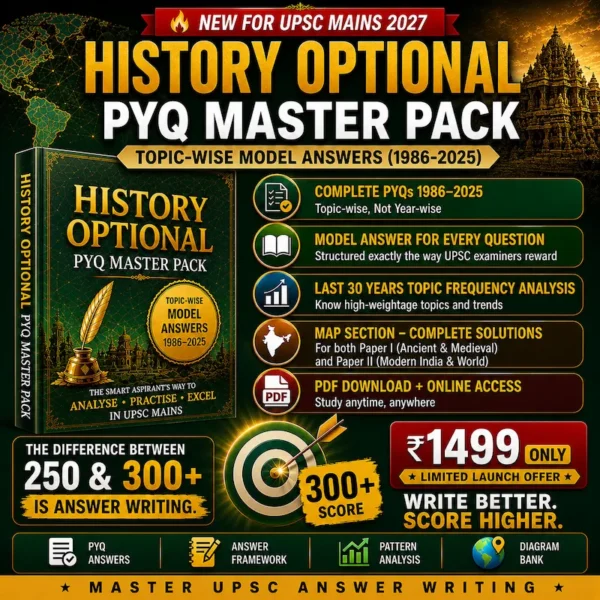
The History Optional PYQ Master Pack carries the same for every question the Commission has set since 1985, across the whole syllabus.
- PYQs 1985–2025, arranged topic-wise — revise a theme and see every way it has been asked
- Model answers with historiography — the debate cited where it belongs, not bolted on
- Map sections solved — the full 50-mark section, every year
- PDF plus online access — any device, permanently, no subscription
₹1,499 (regular ₹2,500). One-time payment, instant access.
How to use this topic list
Reading a question list feels like preparation and is not. Three sittings turn it into marks.
Sitting 1 — sort before you read (30 minutes)
- Copy the questions above into the threads identified in the previous section.
- Note which thread has gone longest without being asked — that is your priority, not the one you find most interesting.
Sitting 2 — write three answers cold (45 minutes)
- Pick the most recent question from three different threads.
- Seven minutes for a 10-marker, fifteen for a 20-marker. Stop when the time is up, even mid-sentence.
- Mark every place you wanted a historian’s name and could not produce one.
Sitting 3 — compare, then rewrite (45 minutes)
- Put your script beside the model answer for the same question.
- Compare structure first: opening claim, evidence, counter-view, judgement.
- Rewrite your weakest answer using that structure and no new content. Most candidates gain four to six marks from structure alone.
Two ways to prepare this optional
Two routes, depending on what is actually missing.
| PYQ Master Pack | Mains Master Kit 2027 | |
| Best when | Your notes are done; answer-writing is the gap | You are still building the subject |
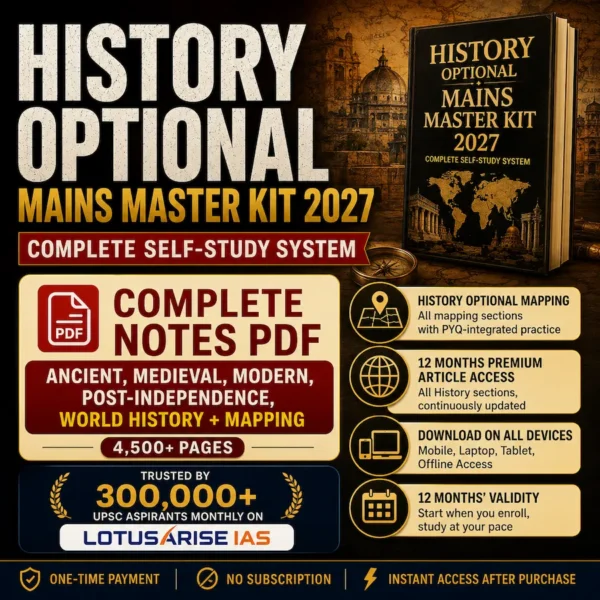
| What you get | Model answers to every question since 1985, topic-wise, map sections included | 4,500+ pages of notes, full mapping coverage, 12 months of article access |
| Price | ₹1,499 (reg. ₹2,500) | ₹1,770 (reg. ₹5,000) |
Frequently asked questions
Related topics
Questions in this unit most often draw on:
- Sources
- Post-Mauryan Period
- Guptas, Vakatakas and Vardhanas
- Regional States during Gupta Era
- All topics — History Optional PYQs, topic-wise
Prefer to work year by year?
The complete papers, with both papers in full, unit-wise analysis and the official PDFs:
- History Optional Question Paper 2026
- History Optional Question Paper 2025
- History Optional Question Paper 2024
- History Optional Question Paper 2023
- History Optional Question Paper 2022
- History Optional Question Paper 2021
- History Optional Question Paper 2020
- UPSC History Optional Map Solutions (2013–2025)