

Archaeological sources: Exploration, excavation, epigraphy, numismatics, monuments
Literary sources: Indigenous: Primary and secondary; poetry, scientific literature, literature, literature In regional languages, religious literature.
Foreign accounts; Greek, Chinese and Arab writers.
Sources is the quiet high-yield unit of Paper I. UPSC has set 18 questions on it between 1996 and 2026, and it appeared in six of the last ten papers. It is also the unit most candidates skip, on the assumption that it is methodology rather than content — which is exactly why it is worth preparing.
Every question the Commission has asked on this topic is listed below, newest first, with a written model answer linked against each one.
| Questions asked (1996–2026) | 18 |
| Appeared in | 6 of the last 10 papers |
| Paper | Paper I, Section A (Ancient India) |
| Usual mark value | 10, 15 or 20 marks |
| Model answers available | 17 of 18 |
PYQs: Sources (1985-2026)

| Year | Question | Answer |
|---|---|---|
| 2026 | "Greek writers viewed India largely from a political perspective, Chinese travellers from a religious perspective, and Arab scholars from a scientific and cultural perspective." Comment. | |
| 2023 | How do the comparative study of languages, archaeological sources and vast corpus of Vedic literature helps to determine the Aryan problem in Indian history. Discuss. | View answer |
| 2022 | Foreign accounts as a source of ancient Indian history may have some advantages also have a few shortcomings. Citing appropriate examples, example the statement. | View answer |
| 2019 | Do you agree that archaeological evidence often helps in better understanding of literary sources? Comment. | View answer |
| 2018 | How did the early Indian historical tradition, as reflected in Itihasa-Purana, emerge? What are the distinctive features of this genre? | View answer |
| 2017 | Art and culture are reflected to a far greater extent than political history in the epigraphic sources. Comment. | View answer |
| 2016 | "The copious references to the preservation of Varnashrama system by the kings eulogized in inscriptions are mere reflection of the Smriti tradition.” Discuss. | View answer |
| 2015 | How far can the ancient Indian Sruti literature be used as historical sources? | View answer |
| 2014 | "While using the accounts of foreign writers, historians must distinguish between statements based on hearsay and those grounded in perceptive observations.” Elaborate with examples. | View answer |
| 2013 | On the basis of contemporary sources assess the nature of banking and usuary in ancient India. | View answer |
| 2013 | Evaluate the ownership of land in ancient India on the basis of literary and epigraphic sources. | View answer |
| 2013 | Evaluate the contribution of the Puranas in disseminating secular knowledge among the masses in ancient India. | View answer |
| 2010 | What light do early inscriptions and literature throw on the status of women in politico- socio- economic spheres? | View answer |
| 2009 | In what ways are the accounts of the Graeco-Romans and the Chinese helpful in reconstructing the social history of India? How far is their information corroborated by other contemporary sources? | View answer |
| 2007 | "Reconstruction of Early Indian history is hardly possible without the help of inscriptions and coins.” Discuss. | View answer |
| 2006 | Discuss the changing approaches to the study of early Indian History. | View answer |
| 2003 | Assess the pattern of settlement, economy, social organisation and religion of India during 2000 to 500 BC from archaeological evidences. | View answer |
| 1996 | “Ancient Indians had no taste for historiography; their scholars cared more for religious, spiritual and philosophical studies.Indian historiography is essentially an Islamic heritage ” Comment upon this statement with special reference to the contemporary writers and their works which help us in the reconstruction of history of the early Medieval period of Indian history. | View answer |
What UPSC keeps asking about Sources
Thirty years of questions on this unit fall into five threads. Notice that almost none of them ask you to list sources; they ask you to weigh one class of evidence against another.
1. Archaeology against literature (2003, 2010, 2013, 2019, 2023)
- The dominant thread — can material evidence correct or confirm what the texts say?
- 2019 and 2023 both framed it as complementarity rather than rivalry, which is the safer position to argue.
- Bring specific pairings: Vedic literature against Painted Grey Ware, Arthashastra against Mauryan inscriptions.
2. Foreign accounts and their limits (1996, 2009, 2014, 2022, 2026)
- Greek, Roman and Chinese writers — what each was actually looking at, and what that distorts.
- 2014 asked you to separate hearsay from eyewitness; 2026 asked you to characterise the perspective of each tradition.
- Megasthenes, Fa-Hien, Hiuen Tsang and the Periplus should each come with one line on the writer’s bias.
3. Epigraphy and numismatics (2007, 2016, 2017)
- Inscriptions as eulogy rather than record — 2016 asked directly whether varnashrama references were merely conventional.
- The strong answer treats inscriptions as evidence of what rulers wanted claimed, not of what was true.
4. Indian historical consciousness (1996, 2006, 2018)
- The old charge that ancient Indians had no taste for historiography, and the Itihasa-Purana tradition as the reply.
- 2018 asked how that tradition emerged and what distinguishes it. Kosambi, Romila Thapar and Thapar’s critics belong here.
5. Reconstructing specific institutions from sources (2010, 2013)
- Banking and usury, land ownership, the status of women, the Puranas as vehicles of secular knowledge.
- 2013 alone produced three questions of this shape, so expect the unit to be examined through a narrow institution rather than in general.
The model answers to this unit, in one place
Knowing the questions is half the work. The other half is seeing what a full-mark answer to each one looks like — not a hint or a bullet outline, but a complete answer at the mark and the word limit, with the historians named inside the argument.
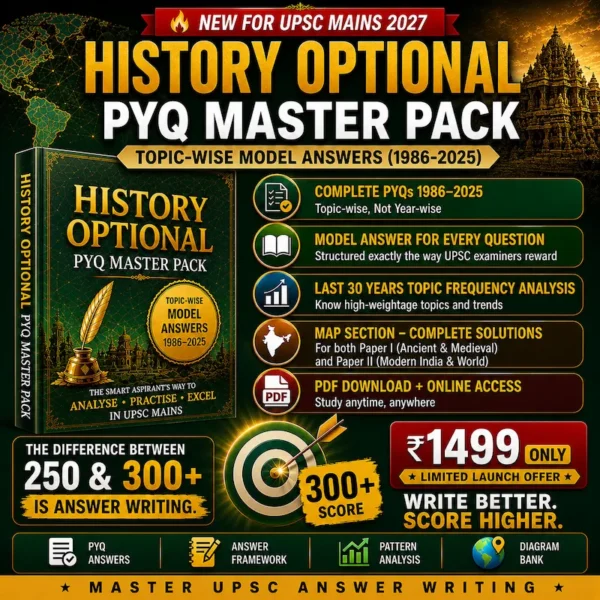
The History Optional PYQ Master Pack carries the same for every question the Commission has set since 1985, across the whole syllabus.
- PYQs 1985–2025, arranged topic-wise — revise a theme and see every way it has been asked
- Model answers with historiography — the debate cited where it belongs, not bolted on
- Map sections solved — the full 50-mark section, every year
- PDF plus online access — any device, permanently, no subscription
₹1,499 (regular ₹2,500). One-time payment, instant access.
How to use this topic list
Reading a question list feels like preparation and is not. Three sittings turn it into marks.
Sitting 1 — sort before you read (30 minutes)
- Copy the questions above into the threads identified in the previous section.
- Note which thread has gone longest without being asked — that is your priority, not the one you find most interesting.
Sitting 2 — write three answers cold (45 minutes)
- Pick the most recent question from three different threads.
- Seven minutes for a 10-marker, fifteen for a 20-marker. Stop when the time is up, even mid-sentence.
- Mark every place you wanted a historian’s name and could not produce one.
Sitting 3 — compare, then rewrite (45 minutes)
- Put your script beside the model answer for the same question.
- Compare structure first: opening claim, evidence, counter-view, judgement.
- Rewrite your weakest answer using that structure and no new content. Most candidates gain four to six marks from structure alone.
Two ways to prepare this optional
Two routes, depending on what is actually missing.
| PYQ Master Pack | Mains Master Kit 2027 | |
| Best when | Your notes are done; answer-writing is the gap | You are still building the subject |
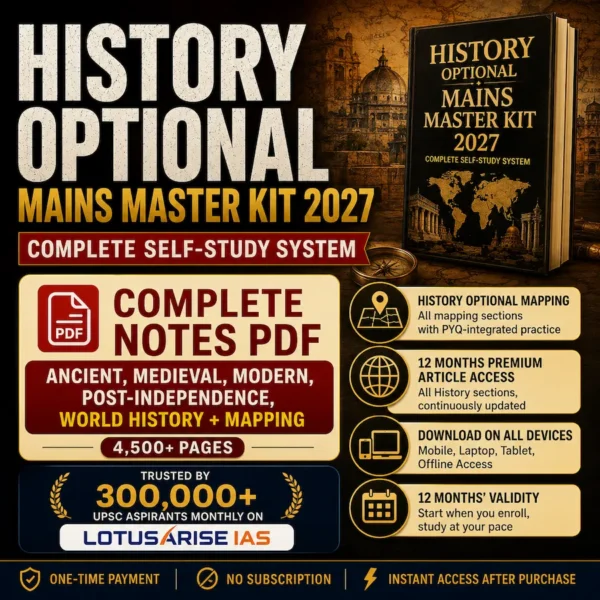
| What you get | Model answers to every question since 1985, topic-wise, map sections included | 4,500+ pages of notes, full mapping coverage, 12 months of article access |
| Price | ₹1,499 (reg. ₹2,500) | ₹1,770 (reg. ₹5,000) |
Frequently asked questions
Related topics
Sources questions almost always reach into a substantive unit. These are the usual neighbours:
- Pre-history and Proto-history
- Indus Valley Civilization
- Aryans and Vedic Period
- Mauryan Empire
- Themes in Early Indian Cultural History
- All topics — History Optional PYQs, topic-wise
Prefer to work year by year?
The complete papers, with both papers in full, unit-wise analysis and the official PDFs:
- History Optional Question Paper 2026
- History Optional Question Paper 2025
- History Optional Question Paper 2024
- History Optional Question Paper 2023
- History Optional Question Paper 2022
- History Optional Question Paper 2021
- History Optional Question Paper 2020
- UPSC History Optional Map Solutions (2013–2025)



thnq so much sir
Thank you Sirr
‘
Thank you