Geographical factors; hunting and gathering (paleolithic and mesolithic); Beginning of agriculture (neolithic and chalcollthlc).
Pre-history and Proto-history carries only seven questions between 2010 and 2026 — but it appeared in four of the last ten papers, and three of those four are from 2023 onwards. On the evidence, this unit is becoming more active, not less.
Every question the Commission has asked on this topic is listed below, newest first, with a written model answer linked against each one.
| Questions asked (2010–2026) | 7 |
| Appeared in | 4 of the last 10 papers |
| Paper | Paper I, Section A (Ancient India) |
| Usual mark value | 10, 15 or 20 marks |
| Model answers available | 6 of 7 |
PYQs: Pre‐history and Proto‐history (1985-2026)

| Year | Question | Answer |
|---|---|---|
| 2026 | Analyze the role of terrain, climate and vegetation in shaping the settlement and movement of prehistoric communities in India. | |
| 2025 | "The Chalcolithic people were experts in microliths and were also skilful workers in stone." Elucidate. | View answer |
| 2023 | “The Neolithic Age represents a revolution due to significant changes that took place during this period. Examine. | View answer |
| 2017 | The emergence of Non-Harappan Chalcolithic cultures in Central India and the Deccan mark a change not only in the subsistence pattern of people but an overall transition from pre to proto historic period. Critically analyze. | View answer |
| 2016 | Delineate and account for the regional characteristics the Neolithic Period in India. | View answer |
| 2013 | In the absence of a written script Chalcolithic pottery gives us a fascinating insight into the culture and life styles of the people of those times. Comment critically. | View answer |
| 2010 | To what extent archaeological materials are useful in understanding the progress of neolithic man in India? | View answer |
What UPSC keeps asking about Pre-history and Proto-history
Seven questions is a small sample, so treat what follows as a pattern rather than a law. Even so, three threads are visible, and none of them reward a chronological narrative of tool types.
1. Regional variation, not a single sequence (2016, 2017, 2026)
- Every recent question resists the idea of one national Stone Age.
- 2016 asked for the regional characteristics of the Neolithic; 2017 for what the non-Harappan Chalcolithic cultures of Central India and the Deccan changed; 2026 for how terrain, climate and vegetation shaped settlement.
- Prepare two or three regions properly — Kashmir, the Vindhyas, the Deccan — rather than a general account.
2. What archaeology can and cannot establish (2010, 2013)
- With no script, everything is inference from material remains.
- 2013 used Chalcolithic pottery as the entry point into culture and lifestyle; 2010 asked how far archaeological material helps at all.
- The strong answer is explicit about the limits of the inference, not just the findings.
3. Was it a revolution? (2023, 2025)
- 2023 asked whether the Neolithic represents a revolution; 2025 asked about Chalcolithic skill in microliths and stone.
- The framing is about the pace and depth of change — Childe’s revolution model against gradualist readings.
The model answers to this unit, in one place
Knowing the questions is half the work. The other half is seeing what a full-mark answer to each one looks like — not a hint or a bullet outline, but a complete answer at the mark and the word limit, with the historians named inside the argument.
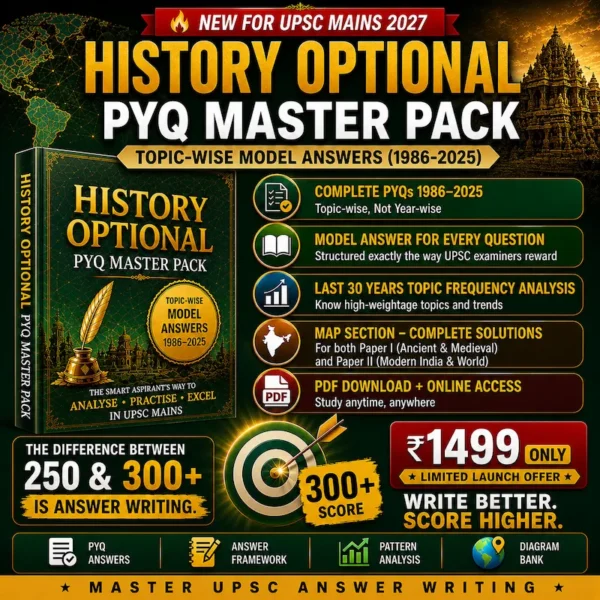
The History Optional PYQ Master Pack carries the same for every question the Commission has set since 1985, across the whole syllabus.
- PYQs 1985–2025, arranged topic-wise — revise a theme and see every way it has been asked
- Model answers with historiography — the debate cited where it belongs, not bolted on
- Map sections solved — the full 50-mark section, every year
- PDF plus online access — any device, permanently, no subscription
₹1,499 (regular ₹2,500). One-time payment, instant access.
How to use this topic list
Reading a question list feels like preparation and is not. Three sittings turn it into marks.
Sitting 1 — sort before you read (30 minutes)
- Copy the questions above into the threads identified in the previous section.
- Note which thread has gone longest without being asked — that is your priority, not the one you find most interesting.
Sitting 2 — write three answers cold (45 minutes)
- Pick the most recent question from three different threads.
- Seven minutes for a 10-marker, fifteen for a 20-marker. Stop when the time is up, even mid-sentence.
- Mark every place you wanted a historian’s name and could not produce one.
Sitting 3 — compare, then rewrite (45 minutes)
- Put your script beside the model answer for the same question.
- Compare structure first: opening claim, evidence, counter-view, judgement.
- Rewrite your weakest answer using that structure and no new content. Most candidates gain four to six marks from structure alone.
Two ways to prepare this optional
Two routes, depending on what is actually missing.
| PYQ Master Pack | Mains Master Kit 2027 | |
| Best when | Your notes are done; answer-writing is the gap | You are still building the subject |
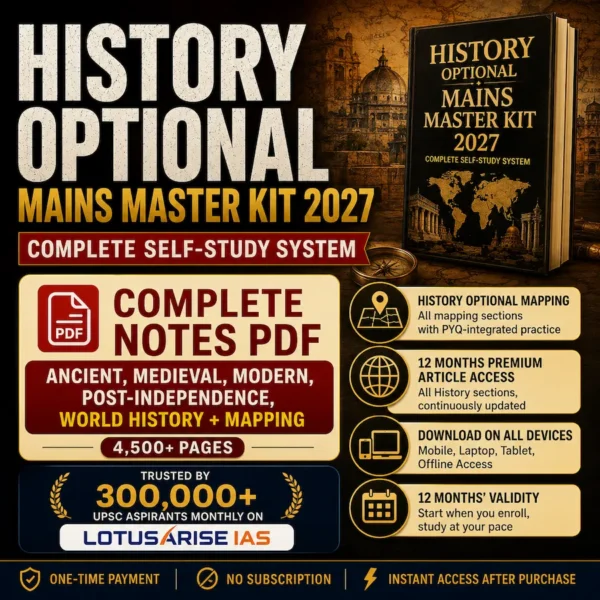
| What you get | Model answers to every question since 1985, topic-wise, map sections included | 4,500+ pages of notes, full mapping coverage, 12 months of article access |
| Price | ₹1,499 (reg. ₹2,500) | ₹1,770 (reg. ₹5,000) |
Frequently asked questions
Related topics
This unit is almost always examined alongside one of these:
- Indus Valley Civilization
- Megalithic Cultures
- Sources
- Aryans and Vedic Period
- All topics — History Optional PYQs, topic-wise
Prefer to work year by year?
The complete papers, with both papers in full, unit-wise analysis and the official PDFs:
- History Optional Question Paper 2026
- History Optional Question Paper 2025
- History Optional Question Paper 2024
- History Optional Question Paper 2023
- History Optional Question Paper 2022
- History Optional Question Paper 2021
- History Optional Question Paper 2020
- UPSC History Optional Map Solutions (2013–2025)